Inbound vs Outbound Marketing: Which Wins for B2B in 2026?
Inbound compounds but starts slow. Outbound starts Monday but decays without clean data. Here is the honest cost, speed, and pipeline-quality breakdown — plus the split most B2B teams actually run.
TL;DR
- Inbound compounds, outbound controls. Inbound builds an asset that keeps producing after you stop paying; outbound gives you the ability to decide which 500 accounts hear from you this week.
- Timeline is the real differentiator. Expect 6-12 months before content and SEO produce reliable pipeline. Outbound can produce a booked meeting inside 10 days — if your contact data is clean.
- Cost per lead favors inbound at scale; cost per target account favors outbound. If you sell to 2,000 companies on earth, inbound alone is a bad bet.
- Neither works with bad data. Outbound dies on bounces; inbound dies when the MQLs you capture never get enriched or routed.
- Most B2B teams that hit plan run both, usually somewhere near a 70/30 or 60/40 split by budget, with outbound leaning heavier in the first two years.
What is the difference between inbound and outbound marketing?#
The difference is who starts the conversation.
Inbound marketing publishes something valuable — a blog post, a comparison page, a benchmark report, a free tool, a YouTube teardown — and waits for buyers who are already searching to find it. The buyer initiates. Inbound marketing as a discipline was formalized by HubSpot in the mid-2000s, and the core promise has not changed: earn attention instead of renting it.
Outbound marketing picks the accounts you want, finds the people inside them, and contacts them directly — cold email, cold calls, LinkedIn, paid ads targeted at a matched list, direct mail. You initiate.
That single distinction cascades into everything else: how fast you see results, how much control you have over who you reach, what breaks when you scale, and which team owns the number.
Here is the honest side-by-side.
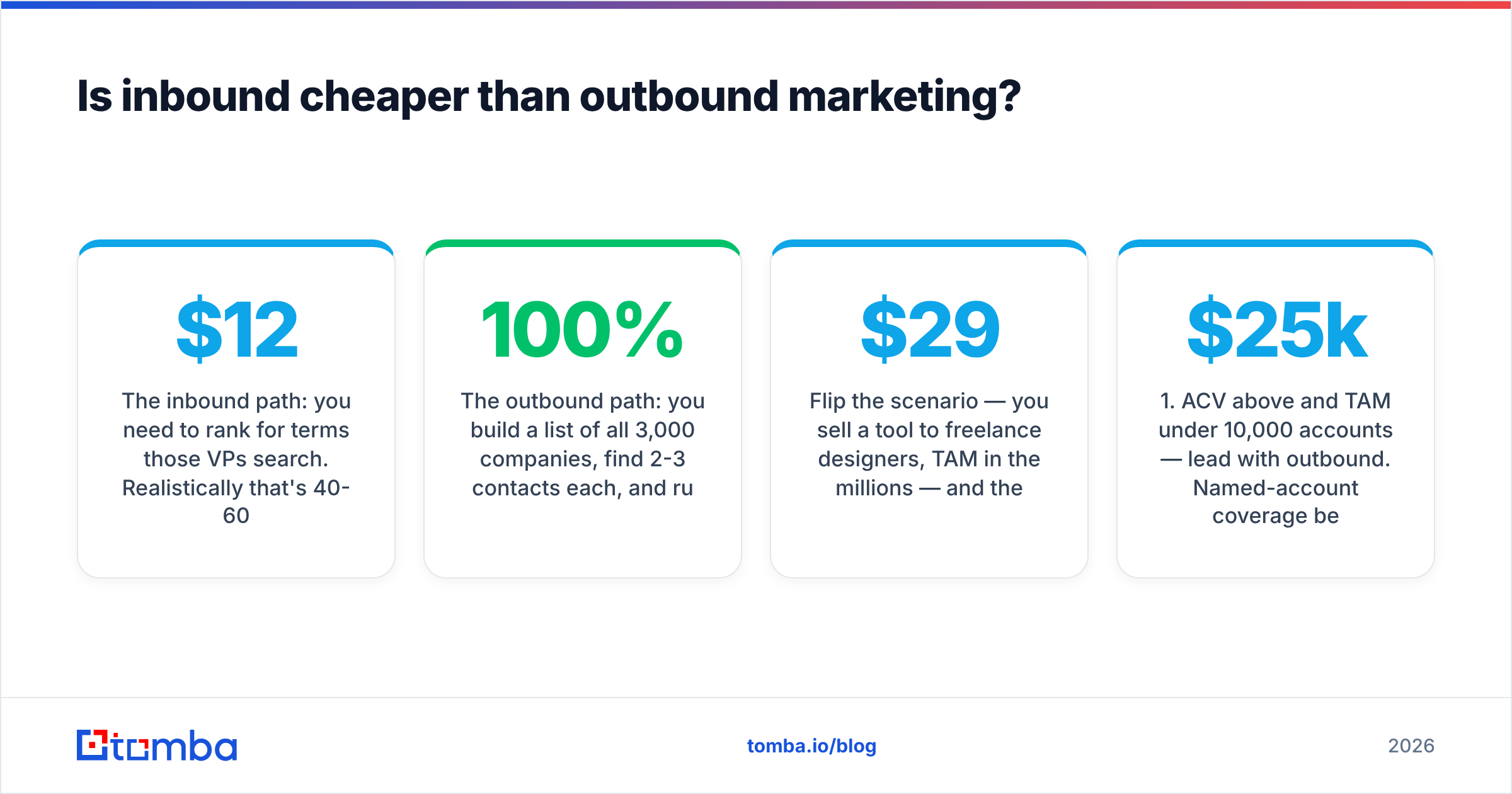
| Dimension | Inbound marketing | Outbound marketing | Practical read |
|---|---|---|---|
| Who initiates | Buyer finds you | You find the buyer | Outbound wins when your TAM is small and known |
| Time to first pipeline | 4-12 months | 1-3 weeks | Outbound is the only realistic option for a new product with no domain authority |
| Cost curve | High upfront, falls over time | Flat to rising (seats, data, sending infra) | Inbound cost per lead drops as traffic compounds |
| Control over targeting | Low — you get who searches | High — you pick the account list | ABM programs are structurally outbound |
| Ceiling | Capped by search demand for your category | Capped by your list size and reply rates | Category creators struggle with inbound early |
| Decay if you stop | Slow (months) | Immediate (days) | Inbound is an asset; outbound is a spend |
| Primary failure mode | No one is searching yet | Bad data, spam complaints, burned domains | Both are fixable; the fixes are different |
| Team that owns it | Content, SEO, demand gen | SDRs, RevOps, growth | Budget fights usually start here |
The mistake most teams make is treating this as an identity question — "we're an inbound company" — instead of a sequencing question. The right answer changes with your stage, your total addressable market, and how much search demand exists for the problem you solve.
Is inbound cheaper than outbound marketing?#
Eventually, per lead. Rarely, per target account.
Run the math on a real scenario. Say you sell compliance software to mid-market fintechs. There are roughly 3,000 companies worldwide that fit. Your buyer is a VP of Compliance.
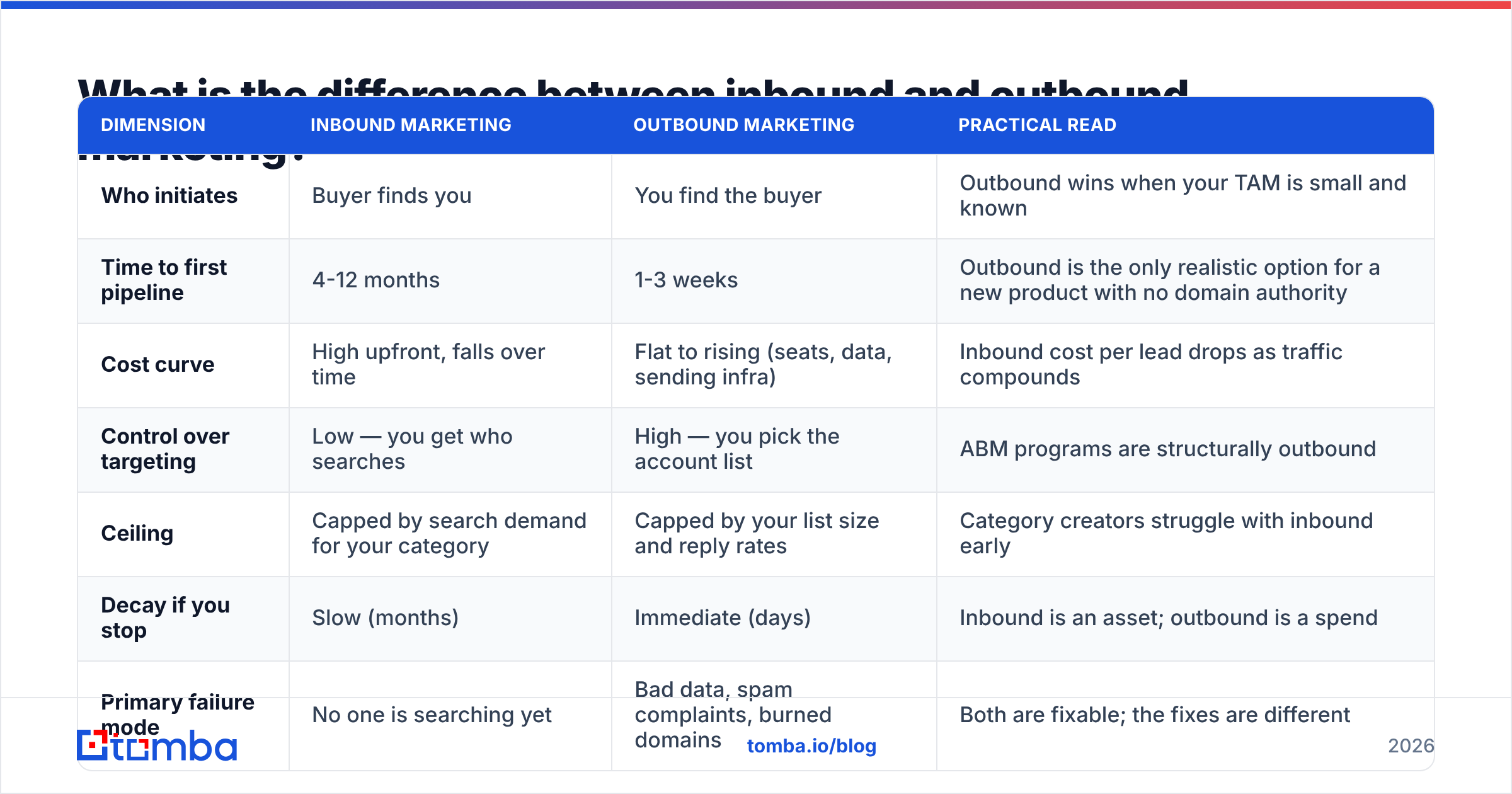
The inbound path: you need to rank for terms those VPs search. Realistically that's 40-60 pieces of content, a technical SEO cleanup, and 9-15 months. Budget $12,000-$25,000/month all-in for a small content team plus tooling. If it works, you might capture 3-5% of your TAM as organic visitors per quarter — because most of those 3,000 companies are not searching for anything in a given quarter. That is the hard ceiling nobody mentions: inbound only reaches the small slice of your market that is actively in-market right now.
The outbound path: you build a list of all 3,000 companies, find 2-3 contacts each, and run sequenced email plus calls. You reach 100% of your TAM in a quarter. At a 2% positive reply rate on 7,000 contacts, that's 140 conversations. Cost: SDR salaries, sending infrastructure, and a data budget that might be $99-$500/month.
Inbound produced cheaper leads per unit. Outbound produced coverage. If your market is small and high-ACV, coverage is worth more than efficiency.
Flip the scenario — you sell a $29/month tool to freelance designers, TAM in the millions — and the math inverts hard. You cannot cold-email your way to volume at that price point. Inbound and product-led growth are the only paths that clear CAC.
The rule of thumb worth internalizing:
- ACV above $25k and TAM under 10,000 accounts — lead with outbound. Named-account coverage beats search volume.
- ACV under $5k and TAM above 100,000 — lead with inbound and product-led loops. Outbound unit economics won't clear.
- Category has real search volume already — inbound gets to work faster because you are capturing demand, not creating it.
- Category is new or renamed — outbound first, because nobody searches for a term they haven't heard.
- Sales cycle over 6 months with a buying committee — you need both: outbound to open the account, inbound content to arm your champion internally.
- You have under 6 months of runway — outbound, full stop. Inbound will not save a company on a two-quarter clock.
Which channel produces better-quality pipeline?#
Inbound leads convert better on average. Outbound leads are better fits on average. Both statements are true and they are not in conflict.
An inbound lead raised their hand. They have intent, and intent is the single strongest predictor of close rate — HubSpot's marketing research has shown organic and referral sources outperforming cold channels on conversion for years. But you do not get to pick who raises their hand. A meaningful share of inbound "leads" are students, consultants, competitors, and companies 10x too small for your pricing.
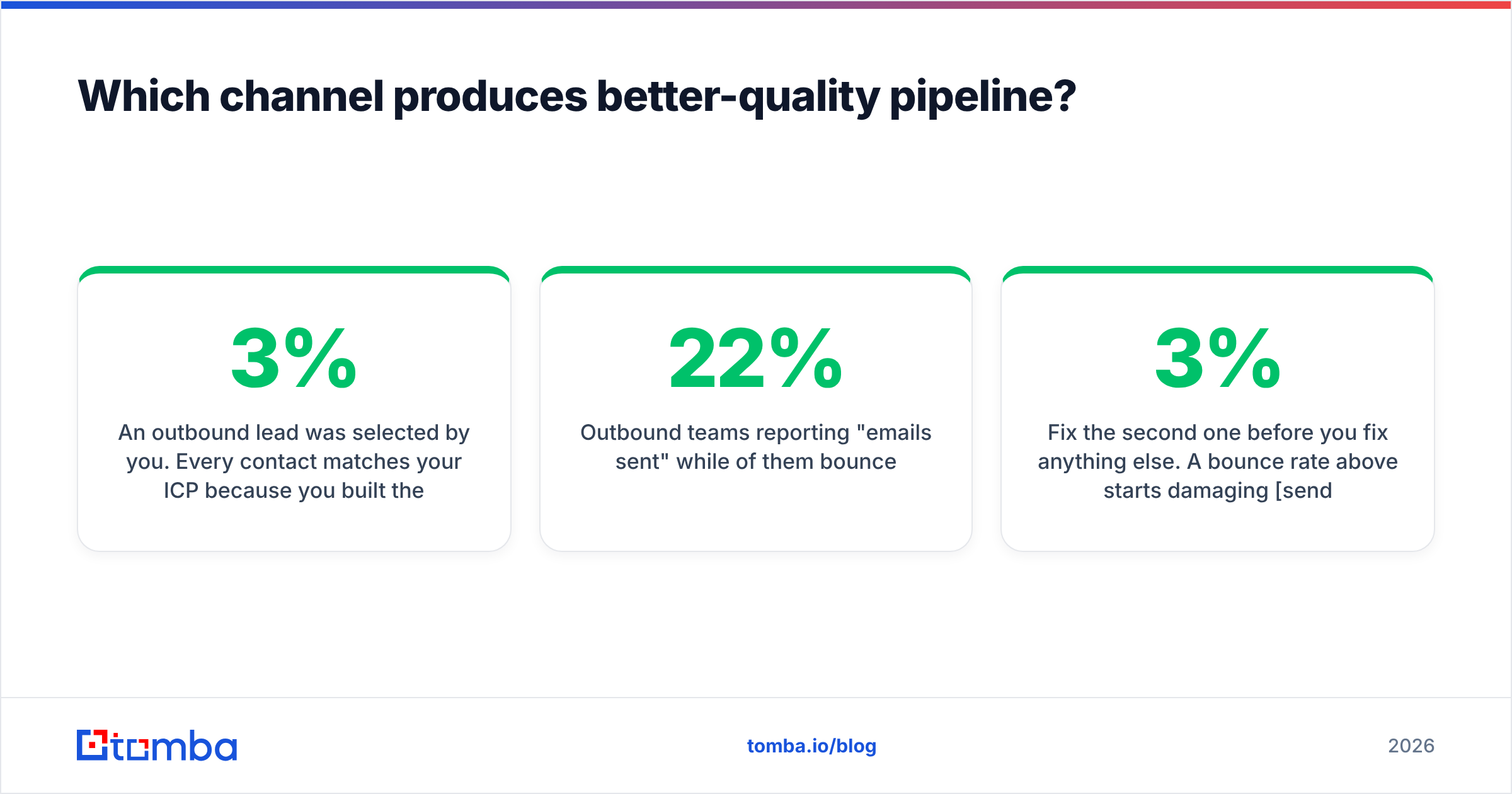
An outbound lead was selected by you. Every contact matches your ICP because you built the list that way. Conversion rates are lower — a 1-3% positive reply rate is normal — but every deal that comes out of it is a deal you wanted.
This is why the smartest teams stop comparing raw conversion rates and compare pipeline created per dollar within ICP. That metric kills a lot of bad arguments. It also exposes the two silent killers:
- Inbound teams reporting MQL volume that includes traffic they'd never sell to.
- Outbound teams reporting "emails sent" while 22% of them bounce.
Fix the second one before you fix anything else. A bounce rate above 3% starts damaging sender reputation, and once your domain is throttled, even your good sends stop landing. Running every list through an email verifier before the first send is the cheapest insurance in outbound.
When should you lead with inbound marketing?#
Lead with inbound when three conditions hold at once:
Search demand already exists. Type your category into a keyword tool. If your head terms have real monthly volume and the top results are competitors rather than Wikipedia definitions, buyers are looking. Capture that.
You have 12+ months of runway. Inbound is a compounding asset with a long fuse. Starting it with two quarters of cash is how teams end up shutting down a program right before it would have worked.
Your product is self-serve or low-friction to evaluate. If a buyer can sign up, try it, and see value without a demo, inbound traffic converts directly into revenue instead of into a queue of meetings someone has to run.
Inbound's real superpower is asymmetric returns on a small number of pages. Comparison content ("X vs Y"), alternatives pages, pricing-transparency posts, and free tools attract buyers at the bottom of the funnel who are days from a decision. One page ranking for "[competitor] alternative" can outperform 30 top-of-funnel blog posts combined.
The corollary: most content programs fail not because inbound doesn't work, but because they published 40 thought-leadership posts nobody searches for.
When should you lead with outbound marketing?#
Lead with outbound when you know exactly who should buy and they don't know you exist yet.
That covers more B2B situations than marketers like to admit: new categories, enterprise sales, regulated industries where buyers don't Google vendors, geographic expansion, and any product whose buyer is too senior to be reading blog posts at 11pm.
Modern outbound looks nothing like the spray-and-pray era. The 2026 version is:
- Narrow lists. 200-500 accounts per campaign, not 50,000. Segmented by a real trigger — funding, hiring signals, tech stack changes, leadership moves.
- Verified contact data. Every address checked before send. Catch-all domains handled separately with a catch-all verifier rather than blindly mailed or blindly discarded.
- Multi-channel sequencing. Email plus phone plus LinkedIn, because email-only reply rates have compressed as inbox volume rose.
- Infrastructure hygiene. Separate sending domains, warmed inboxes, SPF/DKIM/DMARC configured, volume capped per mailbox.
- Relevance over personalization theater. "I saw you went to Michigan" is noise. "You just posted three SOC 2 auditor roles" is a reason to reply.
Google and Yahoo's bulk-sender requirements made the sloppy version of outbound genuinely unworkable — which, if you run the disciplined version, is good news. The floor rose and the noise dropped.

What does a hybrid inbound and outbound motion look like?#
The teams that hit plan don't debate inbound vs outbound marketing. They wire the two together so each one makes the other cheaper.
Four connection points do most of the work:
- Outbound seeds inbound. Every account you cold-email that doesn't reply now is an account that recognizes your brand when they search in eight months. Track branded search lift by target-account segment and you'll see it.
- Inbound content arms outbound sequences. Your best comparison post is the highest-performing link in a cold email. You're not pitching — you're sending something genuinely useful, which converts better than any subject-line trick.
- Website visitors become outbound targets. Anonymous companies browsing your pricing page are the warmest outbound list in existence. Visitor identification turns that traffic into named accounts your SDRs can work the same week.
- Inbound form fills get enriched, not interrogated. Ask for a work email, then use data enrichment to fill in company size, industry, and role. Shorter forms convert better and you still get the routing data you need.
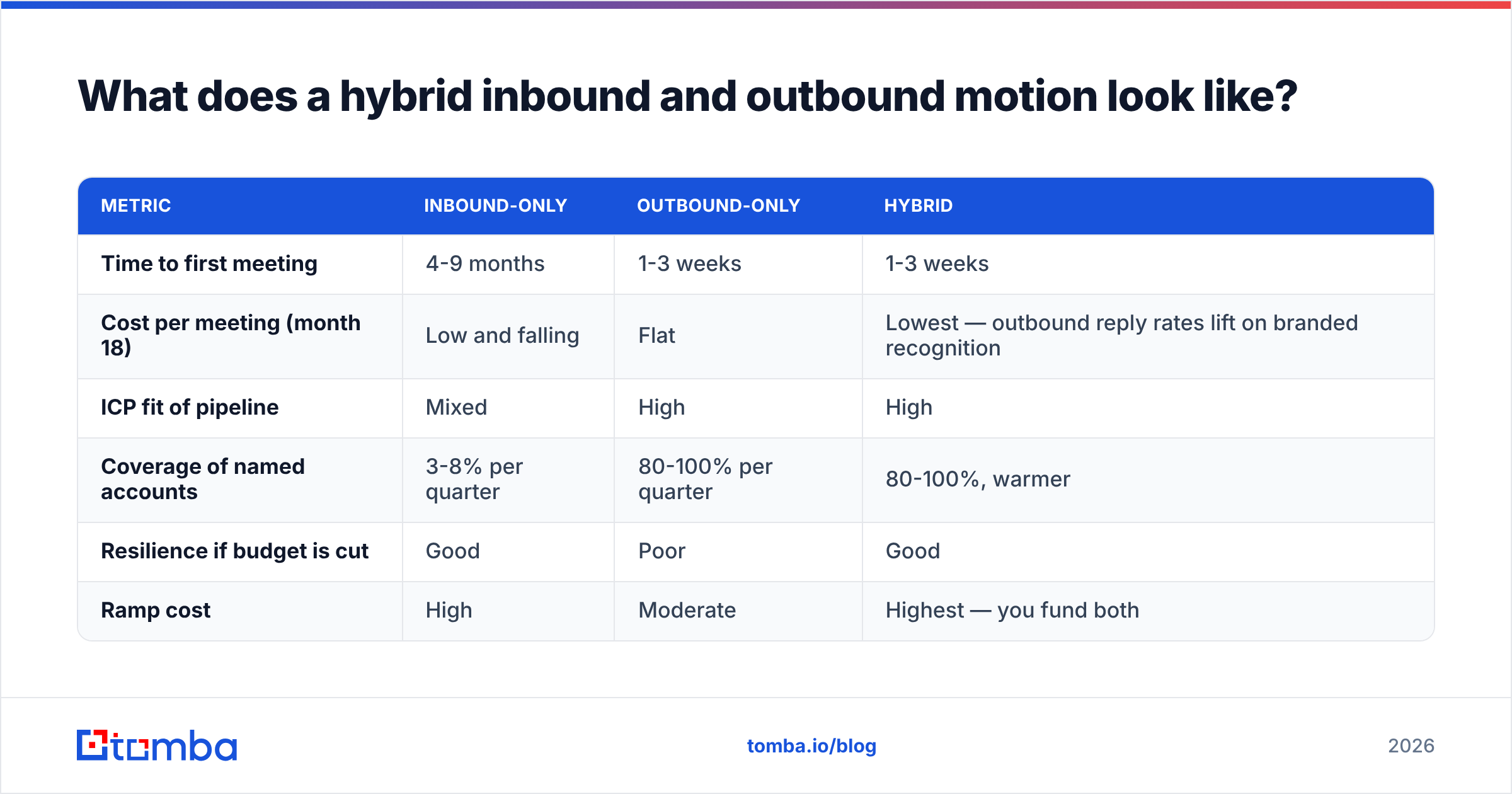
Here's how the two motions compare once they're running together rather than competing for budget:
| Metric | Inbound-only | Outbound-only | Hybrid |
|---|---|---|---|
| Time to first meeting | 4-9 months | 1-3 weeks | 1-3 weeks |
| Cost per meeting (month 18) | Low and falling | Flat | Lowest — outbound reply rates lift on branded recognition |
| ICP fit of pipeline | Mixed | High | High |
| Coverage of named accounts | 3-8% per quarter | 80-100% per quarter | 80-100%, warmer |
| Resilience if budget is cut | Good | Poor | Good |
| Ramp cost | High | Moderate | Highest — you fund both |
The hybrid column has one honest downside: it costs more to start. That's the real trade, and it's why early-stage teams sequence rather than parallelize — outbound first for cash and market feedback, inbound layered in once you know which messages actually land. The messaging your SDRs discover in 400 cold conversations is the outline for your first 20 blog posts. That's a shortcut most content teams never get.
How do you measure inbound vs outbound without fooling yourself?#
Pick one shared metric and make both teams report against it: qualified pipeline created, in-ICP, per dollar spent.
Then add three guardrails:
Attribution windows must be honest. Last-touch attribution systematically overcredits inbound, because a buyer who was cold-emailed in March will Google your brand in June and arrive "organic." If your outbound number looks bad and your branded search is climbing, you're measuring wrong.
Count coverage, not just conversion. Outbound's job includes reaching accounts that aren't ready. A campaign with a 1.2% reply rate that touched 90% of your TAM did something inbound structurally cannot.
Track deliverability as a marketing metric. Bounce rate, spam complaint rate, and inbox placement belong on the same dashboard as MQLs. Gartner's research on B2B buying behavior consistently finds buyers spending only a small fraction of the cycle with any single vendor — if your email lands in spam, you don't get that fraction at all.
For anyone evaluating tooling across both motions, category listings on G2's lead intelligence software are a reasonable starting point for shortlists, though you should always run a live accuracy test on your own ICP before committing. Providers differ enormously by region and seniority — a tool with excellent US SMB coverage may be thin on EMEA enterprise. Vendors like BookYourData, which sells pre-built verified B2B lists, and search-based finders that resolve contacts on demand solve slightly different problems: prebuilt lists are fast to deploy, while on-demand lookup keeps data fresh at the moment you need it. Many teams use both.
What data quality does outbound actually require in 2026?#
More than most teams budget for, and it's the single highest-leverage fix available.
A 5,000-contact list with a 20% bad-data rate wastes 1,000 sends, generates enough bounces to throttle your domain, and quietly caps every campaign that follows. The fix is unglamorous: verify before send, re-verify quarterly, and treat contact data as a perishable asset that decays roughly 25-30% per year as people change jobs.
The workflow that holds up at volume:
- Build the account list from your ICP definition, not from whatever export was handy.
- Resolve contacts with a domain search to see the real people and email patterns at each company.
- Verify every address, and handle catch-all domains as their own bucket.
- Enrich with role, seniority, and company attributes so your segmentation is real.
- Suppress existing customers, open opportunities, and anyone who opted out — every time, automatically.
Inbound has an equivalent hygiene list: dedupe form fills, validate emails at the point of capture so typos don't become bounced nurture sends, and enrich before routing so leads reach the right rep. Same discipline, different entry point.
Which should you choose?#
Choose based on your constraint, not your philosophy.
Short runway, small known market, high ACV — outbound first, layer inbound at month 9. Long runway, large market, low ACV, existing search demand — inbound first, add outbound only for enterprise accounts. Everything in between — run both, weight toward outbound in years one and two, and shift budget toward inbound as your content starts compounding.
The teams that stall are the ones that picked a side and defended it through two bad quarters. The inbound vs outbound marketing question has a stage-dependent answer, and the correct move is to re-answer it every year.
Ready to make the outbound half actually work? The fastest place to start is contact data you can trust. The Tomba Email Finder resolves verified professional emails by domain, name, or company, with a free tier of 25 searches per month to test accuracy against your own ICP before you spend anything. Paid plans start at $49/month for Starter, $99/month for Growth, and $249/month for Pro — see full Tomba pricing for credit limits and API access. Build the list, verify it, and let your inbound content do the warming while your sequences do the reaching.
Related guides#
// get started
Find, verify and enrich your first contacts today
Start on the free plan with 25 searches a month, then scale when your team is ready.
Free plan · No credit card required · GDPR & CCPA
// about the author