Inbound vs Outbound Marketing Strategies: A 2026 Playbook
Inbound compounds but takes months. Outbound works this week but costs more per touch. Here is an honest breakdown of cost, speed, CAC, and the data stack behind each — plus how to run both without burning budget.
TL;DR
- Inbound marketing buys you compounding, lower-cost pipeline — but it usually takes 6 to 12 months before it pays rent.
- Outbound marketing buys you speed and targeting control — you can pick the exact 400 accounts you want and start conversations this week.
- The real cost gap is narrower than the marketing blogs claim: inbound's content and SEO labor is expensive and slow to amortize; outbound's cost is front-loaded into data, tooling, and rep time.
- Almost every company above $1M ARR runs both. The question is never "inbound or outbound," it is "which one do we lead with for this segment, this quarter?"
- Outbound lives or dies on data quality. Bad emails destroy sender reputation faster than bad copy does, which is why verification belongs before sequencing, not after.
What is inbound marketing, really?#
Inbound marketing is the practice of earning attention instead of interrupting it. You publish something useful — a comparison post, a calculator, a benchmark report, a YouTube teardown — and buyers who are already researching the problem find you. HubSpot popularized the term in the mid-2000s and still maintains the canonical definition of inbound, and the Wikipedia entry is a decent neutral summary if you want the history without the vendor framing.
Think of inbound like planting an orchard. Nothing happens for two seasons. Then, if you picked the right land and pruned consistently, you get fruit every year without replanting. The economics are brutal early and beautiful late.
The modern inbound stack is broader than "write a blog":
- Search content — comparison pages, "best X for Y" roundups, and problem-aware guides that rank in Google and, increasingly, get cited inside AI answer engines.
- Product-led surfaces — free tools, calculators, and templates that rank on their own and capture emails as a side effect.
- Community and creator distribution — LinkedIn posts, newsletters, podcasts, and Slack/Discord presence where your buyers already spend time.
- Owned audience — a newsletter list you can email without paying for reach a second time.
The thing nobody tells you: inbound is not free. A single well-researched comparison post that actually ranks in a competitive B2B category costs somewhere between $600 and $3,000 in writer, SME, and editor time. Multiply by the 40 to 120 pages you need for topical authority and inbound looks a lot like a capital expenditure with a delayed return.
What is outbound marketing in 2026?#
Outbound marketing is you initiating the conversation: cold email, cold calls, LinkedIn outreach, paid ads pushed at a defined audience, direct mail, and event-based prospecting. You choose the account list. You control the timing. You do not wait for demand — you go find the accounts that fit your ICP and start the dialogue.
Outbound in 2026 looks nothing like outbound in 2019. Three things changed:
- Inbox filtering got strict. Google and Yahoo's bulk sender requirements made authentication (SPF, DKIM, DMARC) and low complaint rates non-negotiable. Sloppy senders get filtered before copy ever matters.
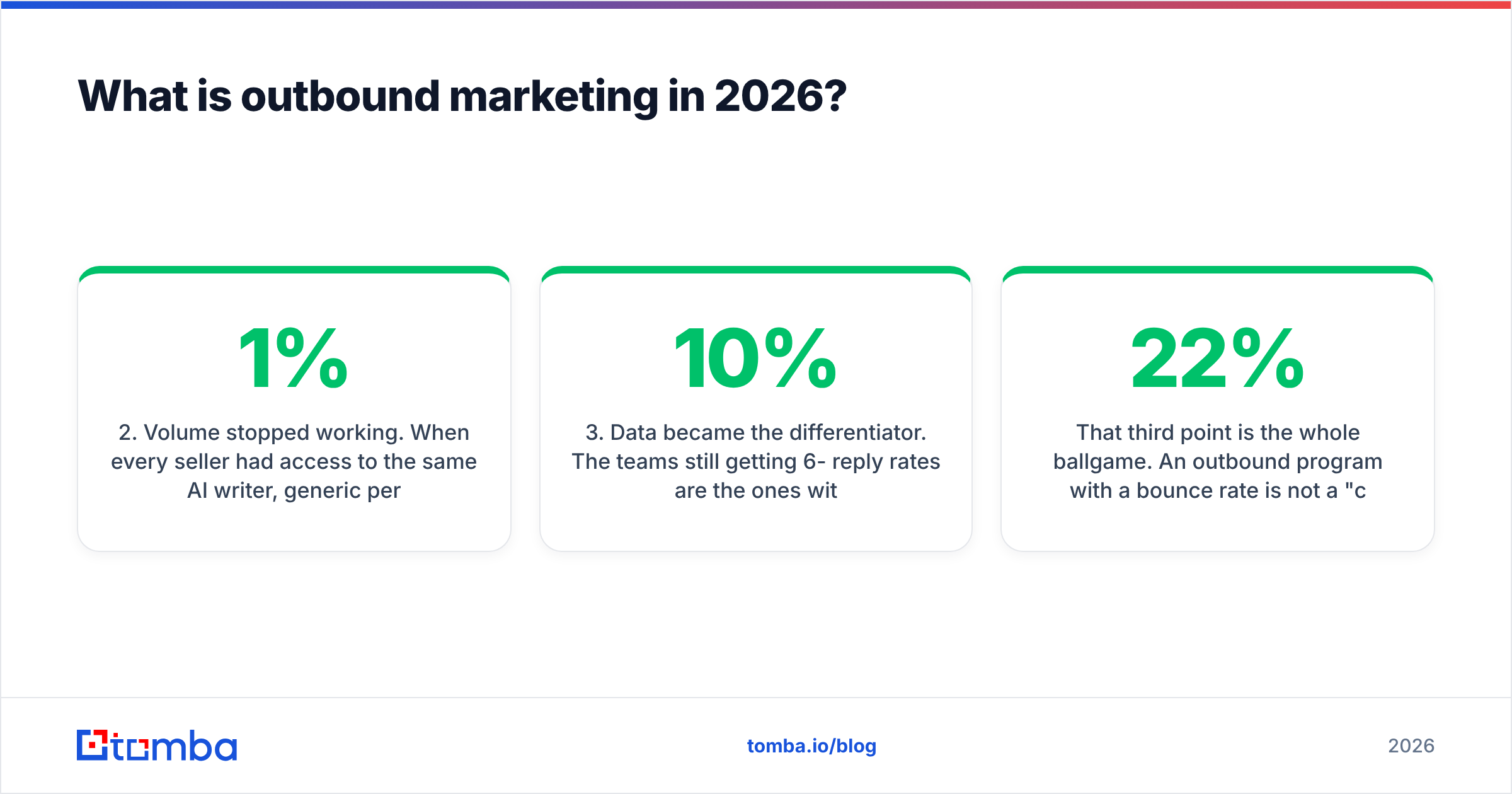
- Volume stopped working. When every seller had access to the same AI writer, generic personalization became noise. Reply rates on untargeted blasts collapsed into the sub-1% range.
- Data became the differentiator. The teams still getting 6-10% reply rates are the ones with tight lists, verified addresses, and a genuinely specific reason to reach out.
That third point is the whole ballgame. An outbound program with a 22% bounce rate is not a "copy problem" — it is a data problem that is actively burning your domain. Running an email verifier across every list before it enters a sequence is the cheapest insurance in the entire outbound stack.
How do inbound vs outbound marketing strategies actually compare?#
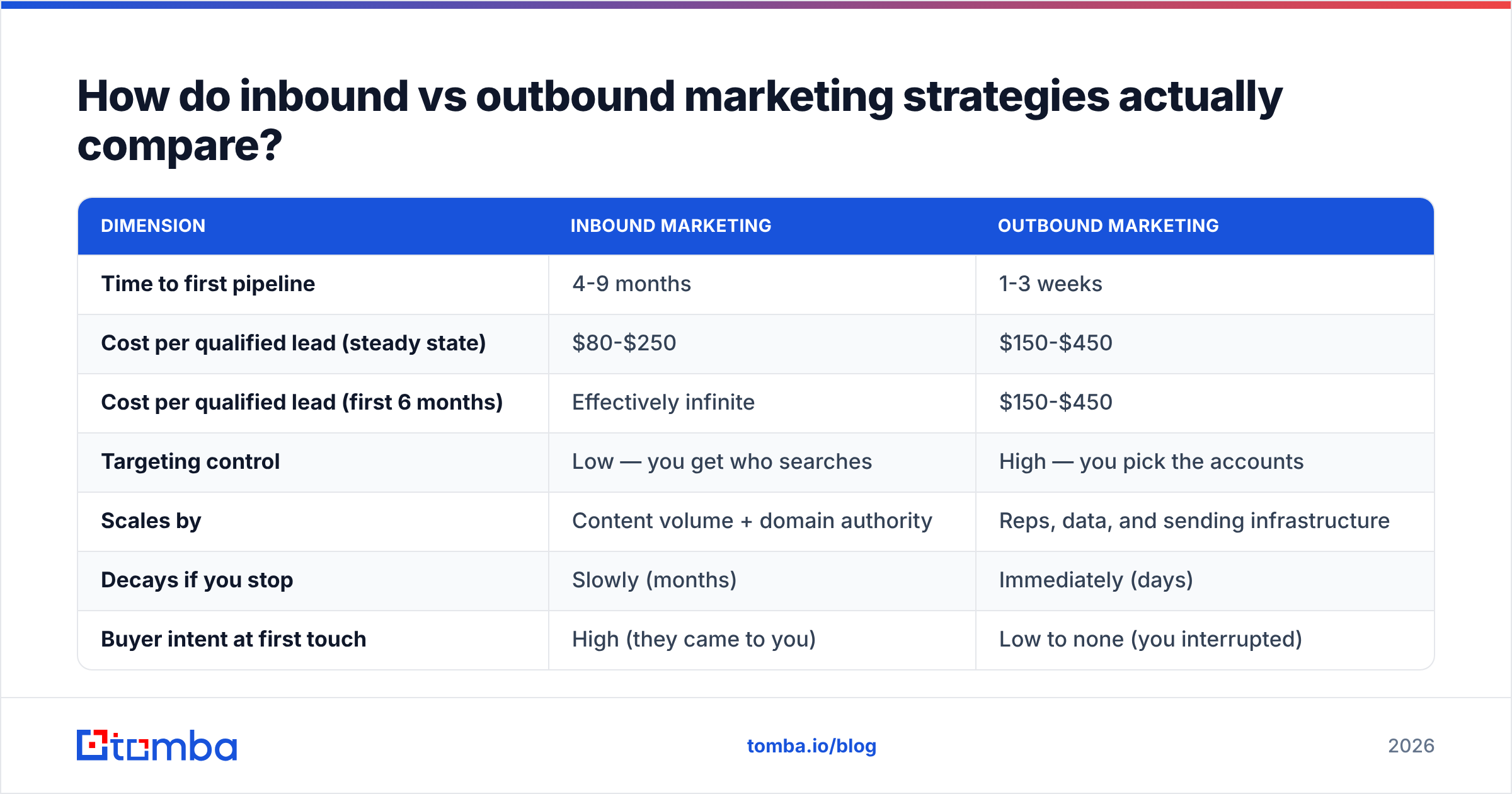
Here is the honest side-by-side. Numbers reflect typical mid-market B2B SaaS ranges — your category will shift them, but the shape holds.
| Dimension | Inbound marketing | Outbound marketing |
|---|---|---|
| Time to first pipeline | 4-9 months | 1-3 weeks |
| Cost per qualified lead (steady state) | $80-$250 | $150-$450 |
| Cost per qualified lead (first 6 months) | Effectively infinite | $150-$450 |
| Targeting control | Low — you get who searches | High — you pick the accounts |
| Scales by | Content volume + domain authority | Reps, data, and sending infrastructure |
| Decays if you stop | Slowly (months) | Immediately (days) |
| Buyer intent at first touch | High (they came to you) | Low to none (you interrupted) |
| Primary failure mode | Publishing content nobody searches for | Bad data, bad targeting, burned domains |
| Best for | Categories with existing search demand | New categories, ABM, enterprise, niche ICPs |
| Attribution difficulty | High (multi-touch, dark social) | Low (sequence → reply → meeting) |
Two numbers in that table deserve a caveat. The "$80-$250 per inbound lead" figure only holds once your content is ranking — it is the amortized cost, not the cash cost in month three. And outbound's per-lead cost assumes clean data. Add a 20% bounce rate and a domain reset and your real cost per meeting doubles.
The other honest point: inbound leads and outbound leads are not the same asset. An inbound lead who read three comparison pages and requested a demo converts at 2-4x the rate of a cold-outbound meeting. Comparing raw CPL between the two channels without adjusting for conversion rate is how marketing teams talk themselves into bad decisions.
Is inbound cheaper than outbound?#
Yes, eventually — and no, not when you need pipeline this quarter.
The framing that actually helps: inbound is an asset, outbound is a service. Assets are expensive to build and cheap to hold. Services are cheap to start and expensive to sustain. A ranked comparison page keeps producing leads at near-zero marginal cost for years. A rep sending 60 emails a day stops producing the day they stop.
Run the math on your own runway before choosing:
- If you have 18+ months of runway and a category with real search volume, lead with inbound. You will be structurally cheaper than competitors in year two.
- If you have 9 months of runway, or you are selling something buyers don't know to search for, lead with outbound. Nobody googles a category that doesn't exist yet.
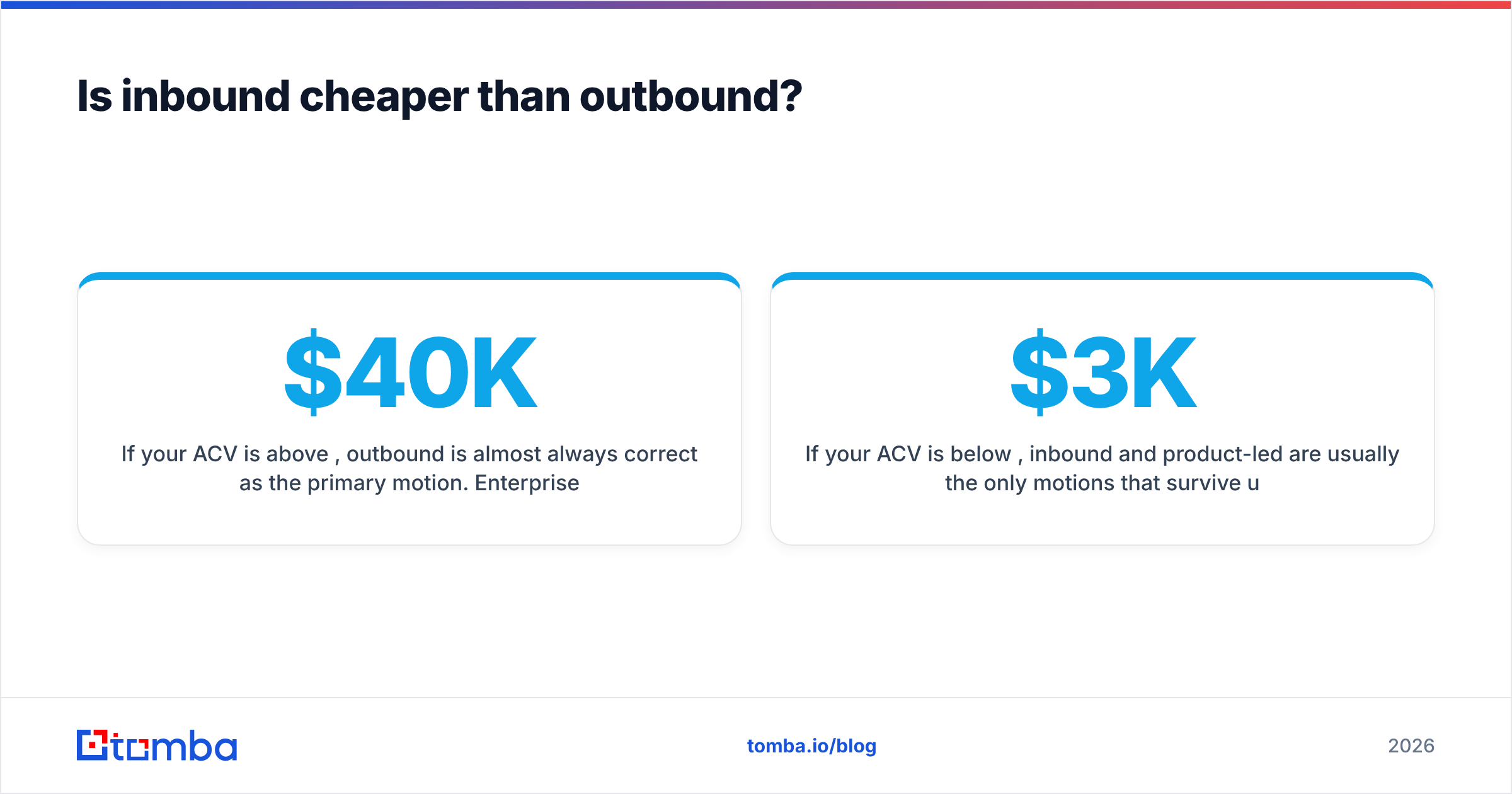
- If your ACV is above $40K, outbound is almost always correct as the primary motion. Enterprise buying committees are too small and too specific for search demand to reach them reliably.
- If your ACV is below $3K, inbound and product-led are usually the only motions that survive unit economics. Paying a rep to chase a $2K deal rarely pencils out.
Gartner's marketing research is worth reading here if you want vendor-neutral data on where B2B budgets are actually shifting — the short version is that budgets have compressed and demand-gen leaders are being asked to prove channel efficiency, not channel philosophy.
What does the data stack look like for each motion?#
This is where the two strategies diverge most concretely, and where most teams under-invest.
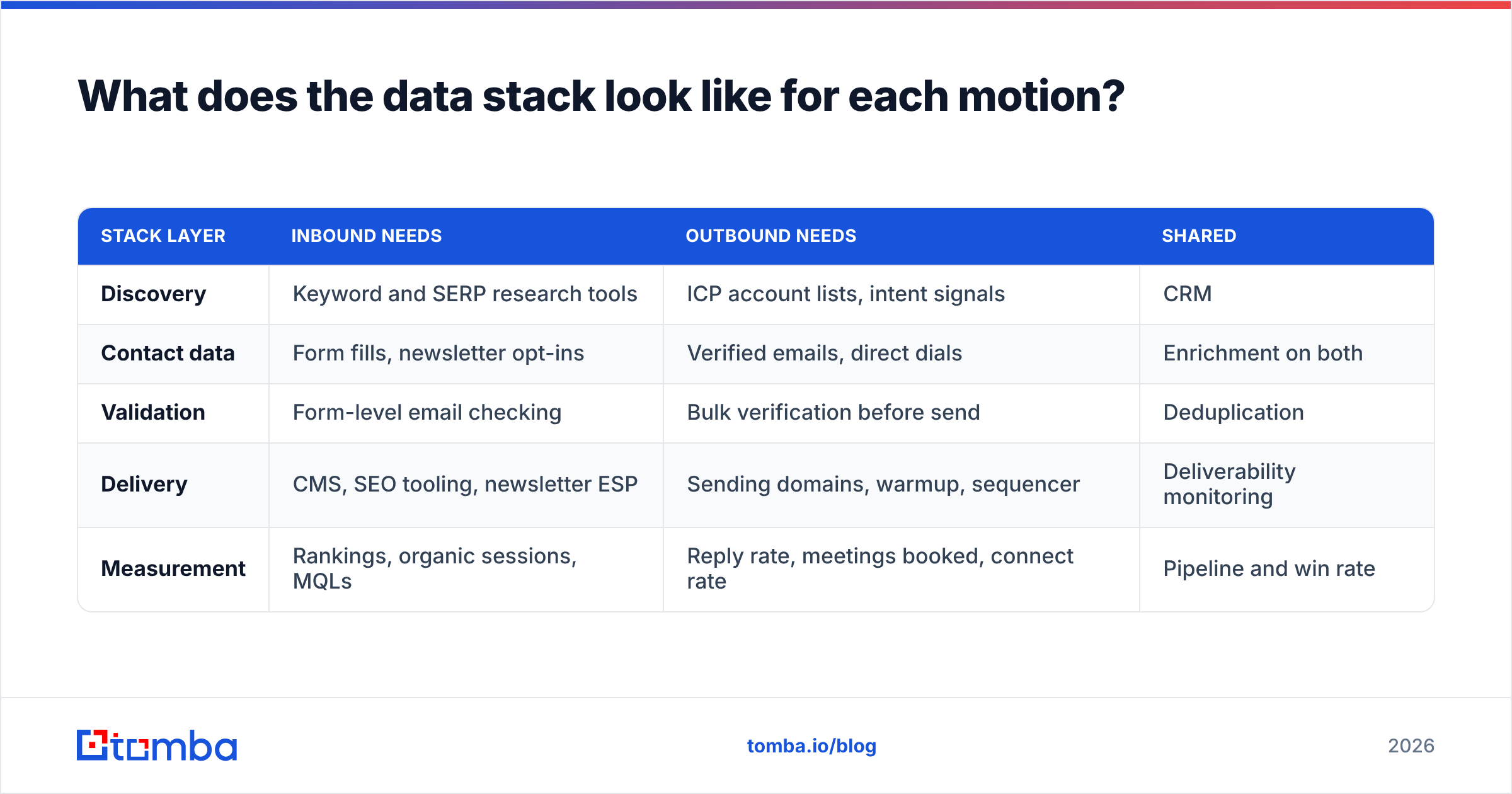
| Stack layer | Inbound needs | Outbound needs | Shared |
|---|---|---|---|
| Discovery | Keyword and SERP research tools | ICP account lists, intent signals | CRM |
| Contact data | Form fills, newsletter opt-ins | Verified emails, direct dials | Enrichment on both |
| Validation | Form-level email checking | Bulk verification before send | Deduplication |
| Delivery | CMS, SEO tooling, newsletter ESP | Sending domains, warmup, sequencer | Deliverability monitoring |
| Measurement | Rankings, organic sessions, MQLs | Reply rate, meetings booked, connect rate | Pipeline and win rate |
Inbound teams tend to treat data as a form-fill problem: someone types an email, it goes to the CRM, done. That is a mistake. Roughly 8-15% of B2B form fills contain a typo, a personal Gmail, or a deliberately fake address. Running submitted addresses through a free email checker at the point of capture keeps your nurture list clean and your ESP happy.
Outbound teams have the harder data job. You are constructing lists from scratch, which means finding contacts by role and company, verifying them, and enriching them with enough context to write something that isn't generic. Tools like a domain search let you pull every discoverable address at a target company in one pass, and providers like BookYourData are a solid option when you would rather license a pre-built list than assemble one. Both approaches work — the failure is skipping verification either way.
How do you blend inbound and outbound into one motion?#
The teams getting the best results in 2026 stopped treating these as separate departments. Here is the sequence that works:
- Let inbound define the ICP, let outbound execute against it. Look at which companies actually convert from organic. Those firmographics become your outbound target list. You are no longer guessing who to prospect — your content told you.
- Use outbound to distribute inbound assets. Instead of a pitch, send the benchmark report. "We analyzed 400 companies in your category — here's the section on yours" outperforms "do you have 15 minutes" by a wide margin, because you are giving before asking.
- Retarget outbound recipients with paid inbound. Anyone who opened a sequence but didn't reply should be seeing your content on LinkedIn for the next 60 days. Cold becomes warm without another email.
- Route inbound signals to outbound reps in real time. Someone from a target account read your pricing page three times? That is an outbound trigger, not a marketing nurture email. Website visitor identification turns anonymous traffic into a named account a rep can actually work.
- Share one revenue number, not two dashboards. When inbound reports MQLs and outbound reports meetings, nobody can tell which motion is working. Force both into pipeline created and closed-won.
- Recycle outbound objections into inbound content. Every "we already use X" reply is a comparison post you haven't written yet. Your reps are doing keyword research for free.
That fifth point kills more programs than any tactic. Channel attribution in B2B is genuinely hard — buyers touch 8 to 12 sources before a demo, and half of them are invisible. Pick a directional model (first-touch for inbound investment decisions, last-touch for outbound rep performance), write it down, and stop relitigating it every board meeting.
How do you measure each without fooling yourself?#
Different channels, different honest metrics.
Inbound, in order of importance: organic sessions to money pages (not total traffic), demo requests from organic, assisted pipeline, and rankings for commercial-intent keywords. Total blog traffic is a vanity metric — 50,000 monthly readers who will never buy is worse than 800 who will, because it distorts your content roadmap toward whatever gets clicks.
Outbound, in order of importance: bounce rate first, then reply rate, then positive reply rate, then meetings held. Bounce rate leads because it is a leading indicator of everything else. Above 3% and you are damaging deliverability; above 8% and you are actively getting filtered. Fix the list before you touch the copy.
A useful diagnostic: if your outbound reply rate is under 1% but your bounce rate is clean, that is a targeting or copy problem. If your bounce rate is over 5%, no copy in the world will save you — you have a data accuracy problem. If you want peer benchmarks on tools in either stack, G2's category pages are the least-biased public source available.
What are the biggest mistakes in each strategy?#
Inbound mistakes: writing for search volume instead of buying intent; publishing 200 thin pages instead of 40 deep ones; gating content that should be free and free-ing content that should convert; and abandoning the program at month five, right before the compounding starts. Inbound punishes impatience more than any other channel.
Outbound mistakes: scraping lists without verifying them; sending from your primary domain instead of dedicated sending domains; personalizing the first line and nothing else; and mistaking volume for effort. Sending 5,000 mediocre emails is not ten times better than sending 500 good ones — it is worse, because the 5,000 cost you your domain.
The shared mistake is treating either channel as a one-quarter experiment. Inbound needs three quarters to produce a signal. Outbound needs one quarter of iteration before the numbers mean anything. Judging either at week six guarantees you kill something that was about to work.
Which should you start with?#
Start with outbound if you need pipeline in under 90 days, sell above $10K ACV, or operate in a category buyers don't search for yet. Start with inbound if you have runway, existing search demand, and a product that benefits from buyer education. Then add the other one within two quarters — the compounding case for running both is too strong to ignore past a certain scale.
Whichever you lead with, the constraint is the same: you need accurate contact data. Inbound needs it clean at capture, outbound needs it verified before send, and both need enrichment to make the follow-up specific.
That is exactly what the Tomba Email Finder is built for — find verified professional addresses by name, domain, or company, check them before they enter a sequence, and keep your sender reputation intact while you scale. The free tier includes 25 searches a month so you can test list quality against your own ICP before committing, and paid plans start at $49/mo. See Tomba pricing for the full breakdown, or start with a single domain search and see how many verified contacts your top target account actually has.
Related guides#
Ready to find emails that actually work?
Join 150,000+ professionals who stopped guessing and started sending. Free credits on signup — no credit card required.
Get the Tomba newsletter
Practical outbound tactics and product updates — once every two weeks.
About the author