Inbound vs Outbound Prospecting: A 2026 Pipeline Playbook
Inbound waits for intent; outbound manufactures it. Here is how the two channels really compare on cost per meeting, cycle length, and win rate — and how to split your budget between them in 2026.
TL;DR
- Inbound prospecting harvests demand that already exists. Outbound prospecting creates conversations with buyers who were not looking. Both fill pipeline; they fail for completely different reasons.
- Inbound usually wins on conversion rate and cost per meeting once the engine is running. Outbound wins on speed, targeting precision, and control over which logos enter your pipeline.
- The honest breakeven: inbound needs 6–12 months and content budget before it produces predictable volume. Outbound produces meetings in week two, but the cost per meeting stays roughly flat forever.
- Most teams under $20M ARR should run roughly 60/40 outbound-to-inbound, then invert the ratio as brand search volume grows.
- The failure mode nobody admits: outbound does not die from bad copy. It dies from bad data. Verify contacts before sequencing or your domain reputation absorbs the damage.
What is inbound vs outbound prospecting?#
Inbound prospecting is the work your reps do after someone raises a hand: a demo request, a pricing-page visit, a webinar signup, a content download. The buyer moved first. The rep's job is to qualify, route, and respond fast enough to matter.
Outbound prospecting is the reverse. You define an ideal customer profile, build a list of accounts and people who match it, find their contact details, and start a conversation they did not ask for. No hand raised. You picked them.
The distinction sounds academic until you look at where the effort goes. Inbound spends its budget upstream — content, SEO, paid ads, events, product-led loops — and its reps downstream on speed-to-lead. Outbound spends almost nothing upstream and everything on list quality, sequencing, and rep hours.
A useful analogy: inbound is farming and outbound is fishing. Farming takes a season before anything is edible, but once the field is planted, the yield compounds and the marginal cost per crop drops. Fishing pays today, every day, but you never stop rowing. Teams that only farm starve in month three. Teams that only fish never build an asset.
Here is the split most sales orgs actually run on:
- Demand capture (inbound). SEO pages, comparison content, review-site listings, branded search. You are catching buyers already in-market.
- Demand creation (outbound). Cold email, cold calling, LinkedIn, direct mail. You are provoking a problem the buyer had not prioritised.
- Warm outbound (the hybrid). Website visitors who never converted, closed-lost accounts, job-change alerts, competitor users. Outbound mechanics pointed at inbound signal.
- Partner and referral flow. Technically neither, but it borrows inbound's trust and outbound's targeting.
- Product-led signal. Free-tier users, trial expiries, usage spikes. Inbound intent that still needs an outbound-style motion to convert.
Most "inbound vs outbound prospecting" arguments are really arguments about item 3 — because warm outbound outperforms both pure plays and nobody wants to give the other side credit for it.
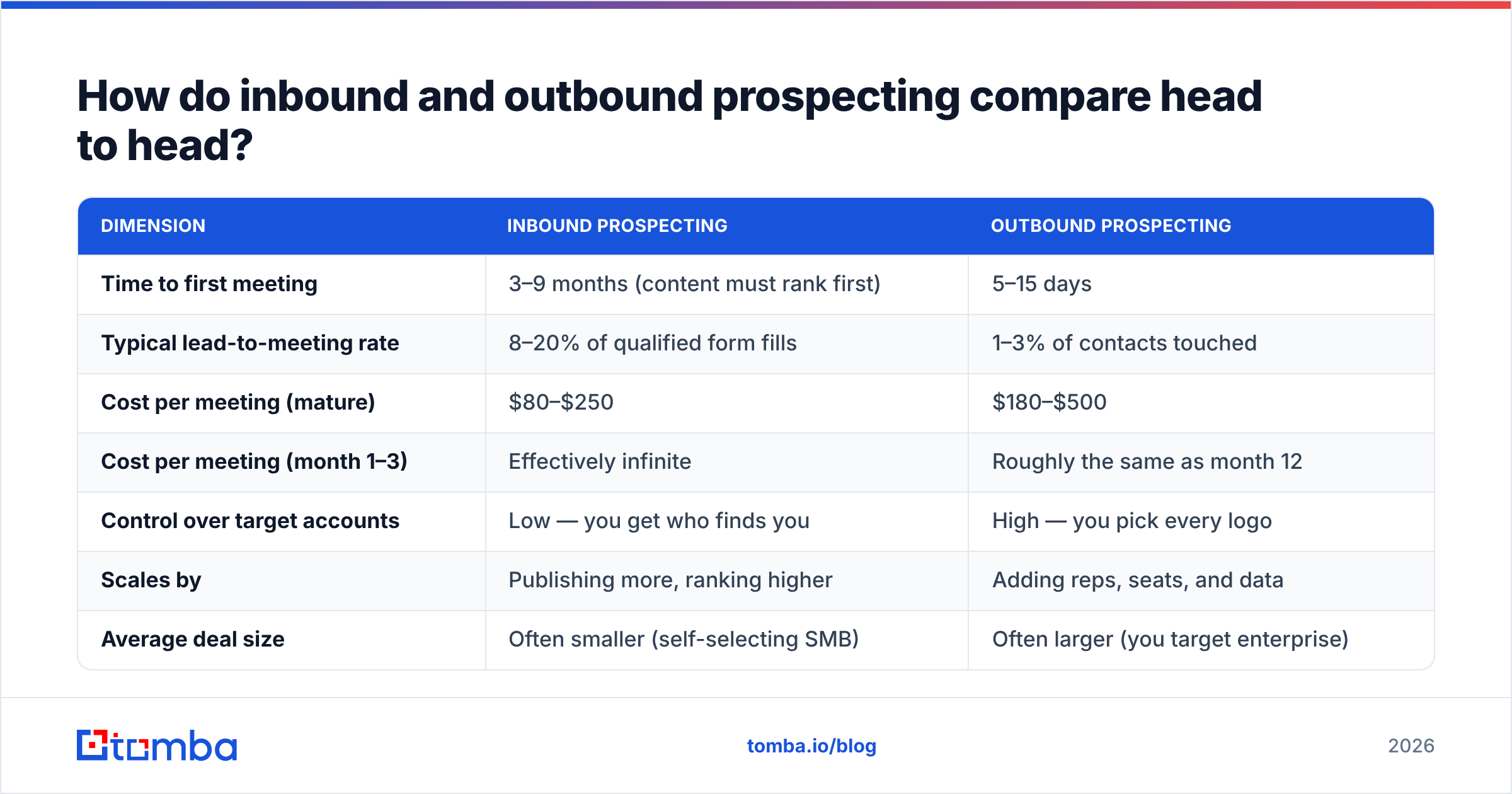
How do inbound and outbound prospecting compare head to head?#
| Dimension | Inbound prospecting | Outbound prospecting |
|---|---|---|
| Time to first meeting | 3–9 months (content must rank first) | 5–15 days |
| Typical lead-to-meeting rate | 8–20% of qualified form fills | 1–3% of contacts touched |
| Cost per meeting (mature) | $80–$250 | $180–$500 |
| Cost per meeting (month 1–3) | Effectively infinite | Roughly the same as month 12 |
| Control over target accounts | Low — you get who finds you | High — you pick every logo |
| Scales by | Publishing more, ranking higher | Adding reps, seats, and data |
| Average deal size | Often smaller (self-selecting SMB) | Often larger (you target enterprise) |
| Primary failure mode | Slow ramp, traffic that never converts | Bad data, spam complaints, burned domains |
| Sales cycle length | Shorter — buyer is already educated | Longer — you must create urgency |
| Marginal cost curve | Falls over time | Stays flat |
Read that table twice, because the rows that matter most are the last four.
Inbound's average deal size problem is chronic and underdiscussed. When you let the market select itself into your funnel, you get whoever your content attracts — which skews toward smaller companies with more time to read blogs and fewer procurement gates. Outbound lets you decide that you only sell to 500-employee manufacturers in the Midwest, and then talk to exactly those people.
Outbound's failure mode is equally chronic. Teams blame their subject lines when reply rates drop. The actual cause is usually a list where 22% of the addresses bounce, which tanks email deliverability and quietly moves the other 78% into spam folders. Copy cannot fix a reputation problem.
Gartner's research on the B2B buying journey makes the strategic point plainly: buyers spend the majority of their evaluation time away from any vendor, doing independent research. That fact cuts both ways. It is the argument for inbound (be findable during that research) and the argument for outbound (if you are not top-three in their consideration set before the research starts, being findable is not enough).
Which channel is actually cheaper per meeting?#
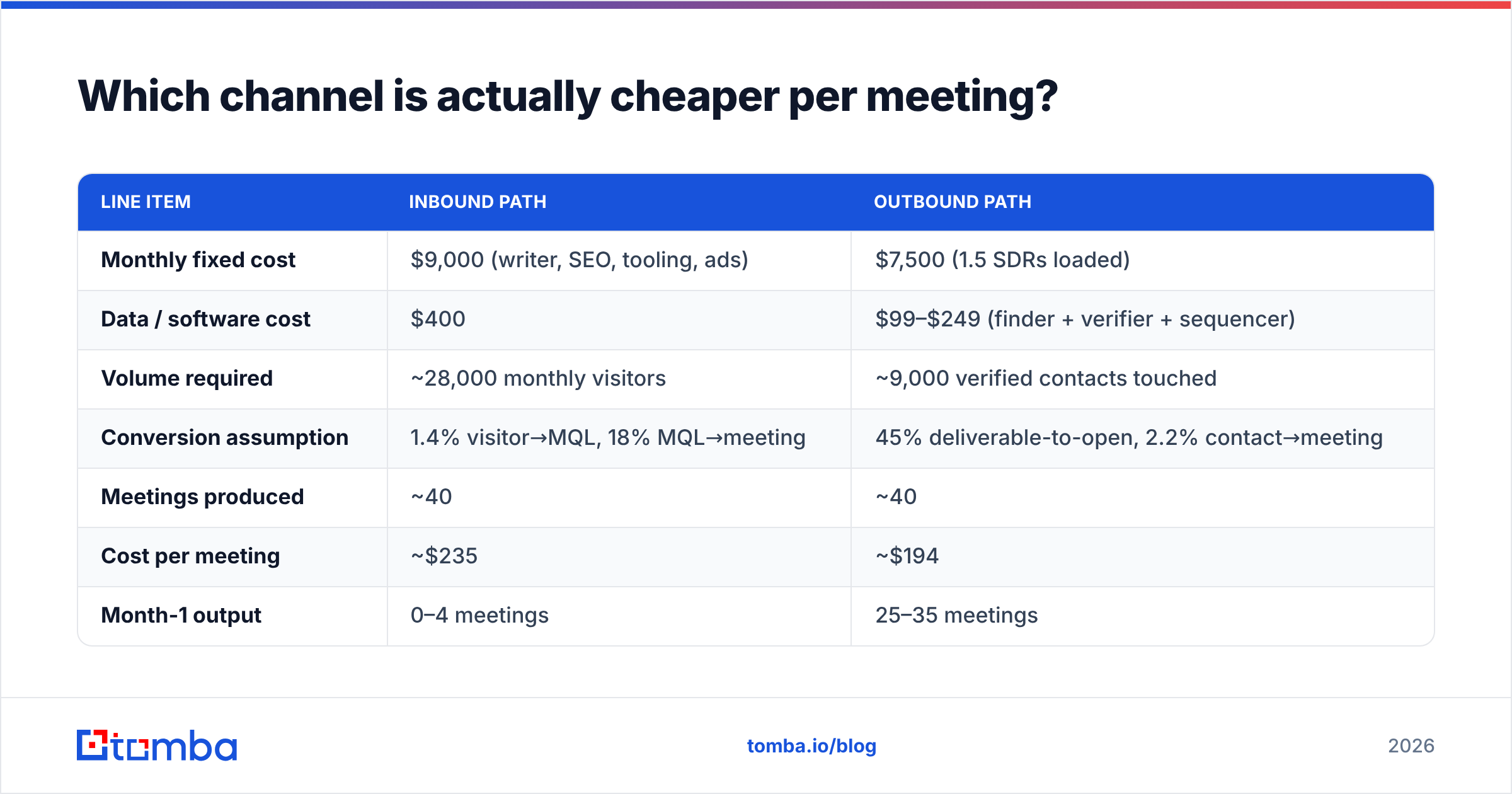
Run the arithmetic rather than trusting the vibes. Here is a realistic model for a team targeting 40 sales-qualified meetings a month.
| Line item | Inbound path | Outbound path |
|---|---|---|
| Monthly fixed cost | $9,000 (writer, SEO, tooling, ads) | $7,500 (1.5 SDRs loaded) |
| Data / software cost | $400 | $99–$249 (finder + verifier + sequencer) |
| Volume required | ~28,000 monthly visitors | ~9,000 verified contacts touched |
| Conversion assumption | 1.4% visitor→MQL, 18% MQL→meeting | 45% deliverable-to-open, 2.2% contact→meeting |
| Meetings produced | ~40 | ~40 |
| Cost per meeting | ~$235 | ~$194 |
| Month-1 output | 0–4 meetings | 25–35 meetings |
| Month-24 output at same spend | 90–140 meetings | 40–45 meetings |
Two conclusions fall out of this.
First, at a single point in time the two channels cost roughly the same. Anyone telling you inbound is "free" is comparing outbound's fully loaded cost to inbound's marginal cost and hoping you do not notice the content salaries.
Second, the slope is the whole argument. Outbound is a line; inbound is a curve. If you have 24 months of runway and patience, inbound wins decisively. If you have two quarters to prove the motion, outbound is the only channel that can answer in time.
The credit-side variable most teams get wrong is data cost. When outbound spend balloons, it is usually because the team is paying per-contact rates on a platform that charges for unverified records. Fixed-price Tomba pricing — free tier at 25 searches a month, Starter at $49/mo, Growth at $99/mo, Pro at $249/mo — makes the per-meeting math predictable instead of a monthly surprise.
When should you lead with inbound prospecting?#
Lead with inbound when four conditions hold:
- Your category has search volume. If nobody types your problem into Google, there is no demand to capture. "Project management software" has demand. "AI-native compliance orchestration layer" does not, yet.
- Your ACV is under roughly $25,000. Low-touch deals cannot absorb the cost of a human touching every account. You need volume that arrives on its own.
- You can self-serve or trial. Product-led loops turn content traffic into pipeline without a rep. Without that, traffic converts poorly.
- You have 9+ months of runway. SEO compounds. It does not sprint.
Inbound also earns its keep through second-order effects that never show up in an attribution report: cheaper paid acquisition, higher outbound reply rates from prospects who recognise your name, and better response rate on every channel because trust is pre-loaded.
The mistake is treating inbound as a prospecting channel rather than a prospecting multiplier. Your best inbound-driven outbound play: pull the companies visiting your pricing page, find the actual decision maker at those accounts, and reach out before they finish comparing you to two competitors. That is not inbound and it is not cold — it is the highest-converting motion in B2B, and it requires both engines running.
When should you lead with outbound prospecting?#
Lead with outbound when the reverse is true:
- You know exactly who buys. A tight ICP is an outbound superpower and an inbound irrelevance.
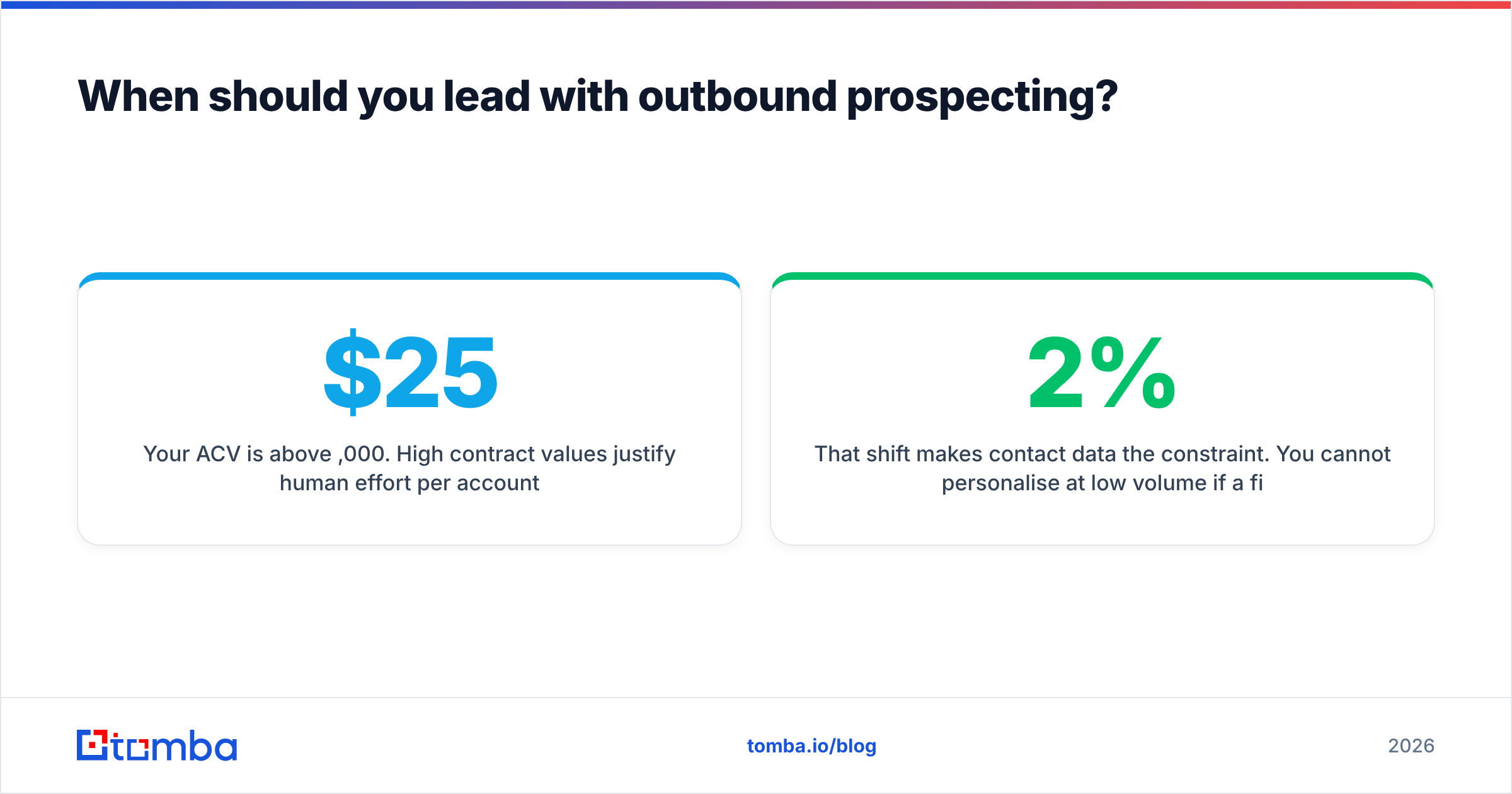
- Your ACV is above $25,000. High contract values justify human effort per account.
- The market is small. If there are 2,000 qualified companies on earth, you do not need SEO. You need a list of 2,000 companies and a reason to call.
- You are launching, pivoting, or entering a new segment. Outbound is the only channel that produces evidence in weeks.
- Timing matters. Funding rounds, exec hires, tech-stack changes, and layoffs are outbound triggers. Content cannot react to a Tuesday announcement.
Outbound in 2026 looks nothing like outbound in 2019. Volume-first spray is dead — inbox providers enforce authentication, complaint thresholds, and engagement-based filtering that punish it automatically. What replaced it is a smaller, sharper motion: 300 highly relevant contacts a week with researched openers, rather than 3,000 templated blasts.
That shift makes contact data the constraint. You cannot personalise at low volume if a fifth of your addresses are guesses. Start from a domain search to map the real people at a target account, then run every address through an email verifier before it touches a sequence. A 2% bounce rate is survivable. An 8% bounce rate ends your sending domain.
What does a blended pipeline actually look like in 2026?#
The teams hitting number consistently do not pick a side. They run a stacked motion where each layer feeds the next:
- Define the account universe first. Before any channel activity, write down the 1,500–5,000 companies that can realistically buy. Everything downstream references this list. Inbound leads outside it get deprioritised, not celebrated.
- Publish for the bottom of the funnel only, at first. Comparison pages, alternatives pages, pricing explainers, integration pages. These rank faster than thought leadership and convert 5–10x better. Save the big brand content for when you have volume to justify it.
- Run outbound against the same account universe. Same ICP, same messaging themes, different trigger. When a prospect gets your cold email and then sees your comparison page in search results a week later, the two channels compound instead of competing.
- Convert anonymous inbound traffic into outbound targets. Visitor identification plus contact enrichment turns "someone from Acme read your pricing page" into a named VP with a verified email. This is the highest-yield play available to most teams and almost nobody runs it systematically.
- Route by fit, not by channel. A form fill from a 12-person startup should not outrank a cold-outbound reply from a 4,000-person enterprise just because one is labelled an MQL. Score on ICP fit first, intent second, channel never.
- Recycle relentlessly. Closed-lost, went-dark, and champion-job-change accounts are outbound gold with inbound-level familiarity. Re-sequence them quarterly.
How do you measure inbound vs outbound honestly?#
Both channels lie to you in predictable ways. Inbound over-claims credit because last-touch attribution rewards whoever was standing nearest the finish line. Outbound under-claims because a cold email in March that produced a demo in July gets attributed to "direct."
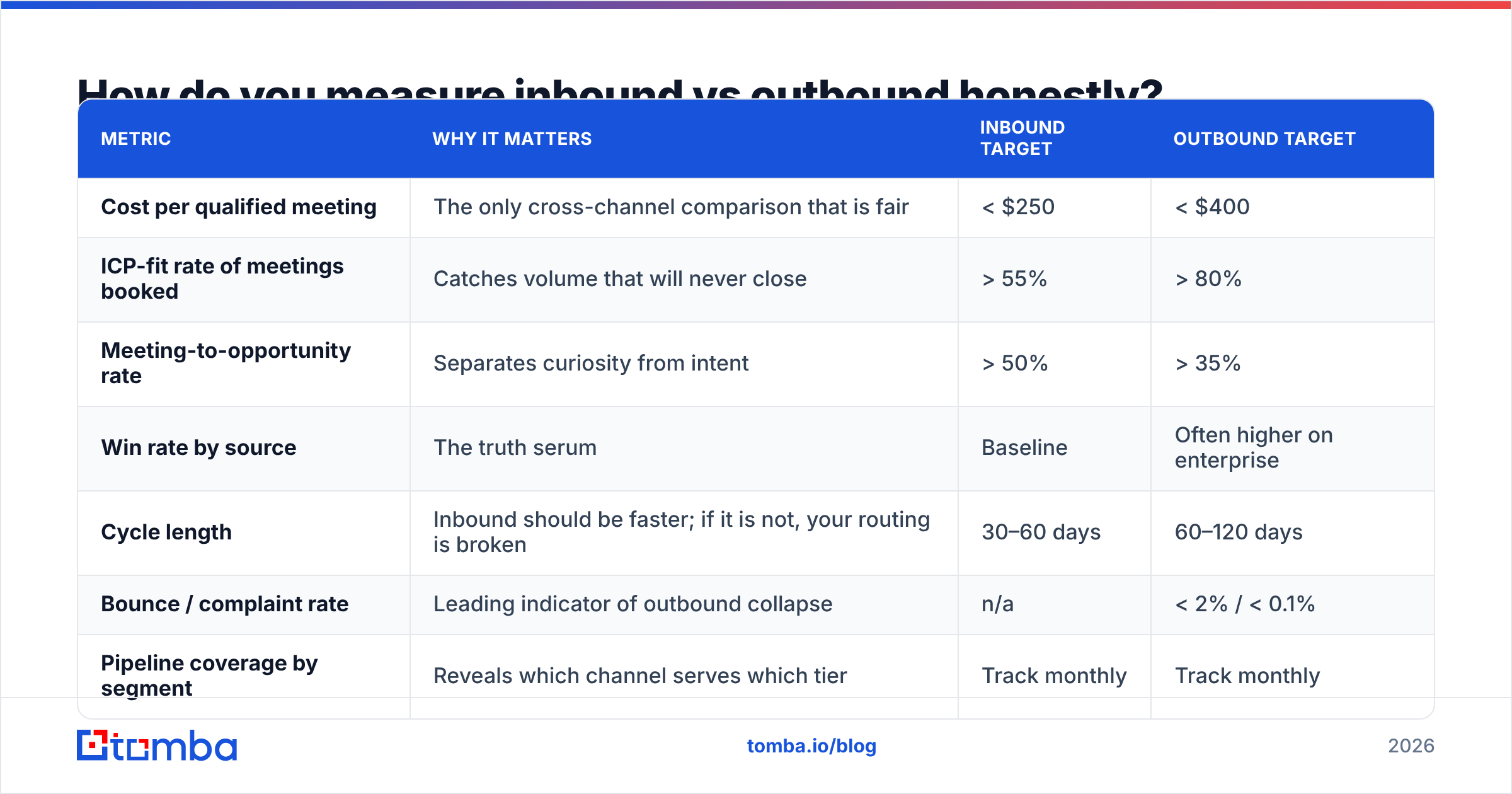
Measure these instead:
| Metric | Why it matters | Inbound target | Outbound target |
|---|---|---|---|
| Cost per qualified meeting | The only cross-channel comparison that is fair | < $250 | < $400 |
| ICP-fit rate of meetings booked | Catches volume that will never close | > 55% | > 80% |
| Meeting-to-opportunity rate | Separates curiosity from intent | > 50% | > 35% |
| Win rate by source | The truth serum | Baseline | Often higher on enterprise |
| Cycle length | Inbound should be faster; if it is not, your routing is broken | 30–60 days | 60–120 days |
| Bounce / complaint rate | Leading indicator of outbound collapse | n/a | < 2% / < 0.1% |
| Pipeline coverage by segment | Reveals which channel serves which tier | Track monthly | Track monthly |
Two rows deserve emphasis. ICP-fit rate is where inbound quietly bleeds — a channel can look efficient on cost per meeting while filling your calendar with prospects who will never buy. And win rate by source frequently favours outbound in enterprise segments, because you chose those accounts on purpose. Peer reviews on G2's sales intelligence category show the same pattern anecdotally: teams that abandoned outbound for pure inbound tend to report smaller average deals within a year.
For a broader benchmark of how buying behaviour is shifting across both motions, HubSpot's ongoing State of Marketing research is a reasonable annual reference point — though treat any single vendor's benchmark as directional, not gospel.
What is the practical verdict?#
Inbound and outbound prospecting are not competing strategies. They are different positions on a single trade-off between speed and compounding.
If you need pipeline this quarter, outbound is the answer and there is no second answer. If you want your cost per meeting to fall every year instead of staying flat, you have to start building inbound now, accepting that it will contribute nothing for two or three quarters.
The teams that struggle are the ones that commit to inbound with an outbound-length runway, or run outbound for three years without ever building an asset that lowers their acquisition cost. Pick your ratio based on runway, ACV, and market size — then revisit it every two quarters, because the correct answer changes as your brand grows.
And whichever way you lean, the contact data underneath decides whether the plan survives contact with reality. Outbound sequences fail on bad addresses. Inbound follow-up fails when the form fill uses a personal Gmail and you cannot reach the actual buyer.
Start with the layer both motions depend on. The Tomba Email Finder locates verified professional addresses by domain, name, or company, so your outbound sequences land in inboxes instead of spam traps — and your inbound follow-up reaches the decision maker, not the intern who downloaded the PDF. The free tier gives you 25 searches a month to test list quality before committing budget; paid plans start at $49/mo. Build the list first, then argue about the channel.
Related guides#
// get started
Find, verify and enrich your first contacts today
Start on the free plan with 25 searches a month, then scale when your team is ready.
Free plan · No credit card required · GDPR & CCPA
Get the Tomba newsletter
Product and data updates
// about the author