Inbound vs Outbound Sales: Which Actually Wins in 2026?
Inbound compounds but takes 9-18 months. Outbound is instant but expensive. Here's the honest breakdown of cost per meeting, CAC payback, and which mix fits your deal size in 2026.
TL;DR
- Inbound sales is cheaper per deal at scale but takes 9-18 months to produce reliable pipeline. Outbound produces meetings in week two and costs 3-6x more per meeting.
- The real deciding variable is not preference, it is average contract value. Below roughly $2K ACV, outbound rarely pays back. Above $25K ACV, pure inbound almost never fills quota.
- Most teams that claim to "do both" are actually doing inbound with a thin outbound layer bolted on, and they measure both with the same broken dashboard.
- 2026 changed the math on both sides: AI answer engines are flattening top-of-funnel traffic, and stricter mailbox-provider enforcement means outbound now lives or dies on list quality, not volume.
- The winning structure is sequenced, not split: pick one motion as the primary engine, run the other as a targeted supplement, and give each its own metrics.
What is the actual difference between inbound and outbound sales?#
The textbook answer is direction: inbound means the buyer starts the conversation, outbound means you do. That definition is true and almost useless operationally, because it tells you nothing about how to staff, budget, or forecast either one.
The useful difference is who controls timing.
With inbound, the prospect controls when the conversation happens. You invest in content, SEO, product-led signups, review sites, and community presence, then wait for intent to surface. Your leverage is on conversion quality: how fast you respond, how well you qualify, how tightly your demo maps to the problem that drove the search.
With outbound, you control when the conversation happens. You pick the accounts, build the contact list, and initiate. Your leverage is on targeting and data quality: whether the person exists, whether the email lands, whether the timing is remotely plausible.
That single distinction cascades into everything else — hiring profile, comp plan, tooling budget, and how long you should wait before declaring the channel dead.
Here is the anatomy of each motion, broken into the parts that actually cost money:
- Demand creation vs. demand capture. Inbound mostly captures demand that already exists (someone searched "best CRM for agencies"). Outbound creates it, or more accurately, finds latent demand before the buyer has articulated it. Creating is harder and slower per unit.
- Fixed cost vs. variable cost. Inbound is front-loaded and fixed: a content team, a site, a year of patience. Outbound is variable and linear: more meetings require more reps, more data credits, more inbox infrastructure. Inbound has better unit economics at scale; outbound has better economics at small scale.
- Compounding vs. resetting. A ranking article earns leads for three years. A cold sequence earns nothing the month after you stop it. Inbound assets appreciate; outbound activity depreciates to zero instantly.
- Qualification burden. Inbound leads are self-selected but frequently unqualified — students, competitors, tire-kickers, and job seekers all fill forms. Outbound leads are pre-qualified by you but resistant. You pay either way, just at different points in the funnel.
- Data dependency. Inbound needs almost no external data. Outbound is entirely a data problem wearing a persuasion costume. If your contact data is 60% accurate, no amount of copywriting rescues the campaign.

Which is cheaper: inbound or outbound sales?#
Neither, until you specify deal size and time horizon. But the shape of the cost curve is predictable, and it is where most budget arguments get resolved.
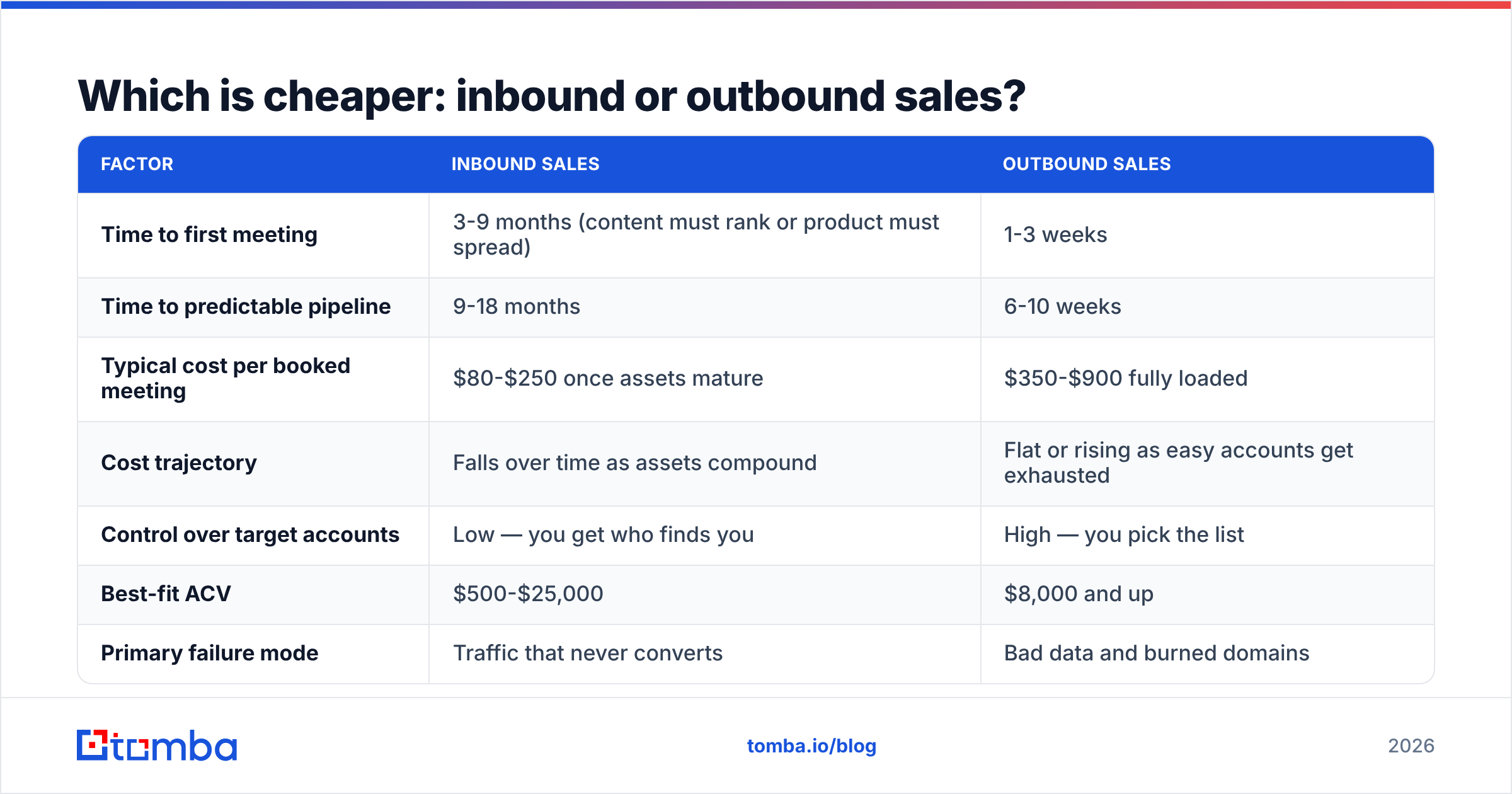
| Factor | Inbound sales | Outbound sales |
|---|---|---|
| Time to first meeting | 3-9 months (content must rank or product must spread) | 1-3 weeks |
| Time to predictable pipeline | 9-18 months | 6-10 weeks |
| Typical cost per booked meeting | $80-$250 once assets mature | $350-$900 fully loaded |
| Cost trajectory | Falls over time as assets compound | Flat or rising as easy accounts get exhausted |
| Control over target accounts | Low — you get who finds you | High — you pick the list |
| Best-fit ACV | $500-$25,000 | $8,000 and up |
| Primary failure mode | Traffic that never converts | Bad data and burned domains |
| Team profile | Content, SEO, lifecycle marketing, AE closers | SDRs, RevOps, data ops, sequence engineers |
| Scales by | Publishing volume and rankings | Headcount and list supply |
| Stops working when | Search demand shifts or competitors outrank you | You exhaust your ICP or your sender reputation dies |
The table hides one important asymmetry: inbound failure is silent, outbound failure is loud. If your content strategy is wrong, you find out in month eleven when the pipeline review is empty. If your outbound list is wrong, you find out in week two when reply rates sit at 0.4%. Fast failure is a feature, and it is the strongest practical argument for running outbound early even at a company that believes in inbound long term.
There is also a cash-flow argument that gets ignored. Gartner's sales research has consistently found that B2B buyers spend only a small fraction of their buying journey with any vendor's sellers — most of it happens in independent research. That favors inbound investment strategically. But strategy does not pay salaries in Q2. Outbound is the motion you use to survive long enough for inbound to work.
Is inbound better than outbound for your business?#
Run these four tests before you pick.
Test 1: Is there search demand for the problem you solve? Open a keyword tool and check whether people search for your category. If your product is genuinely new — a category that does not have a name yet — there is nothing to rank for, and inbound will be an expensive education project. Outbound is the only channel that works on unaware markets.
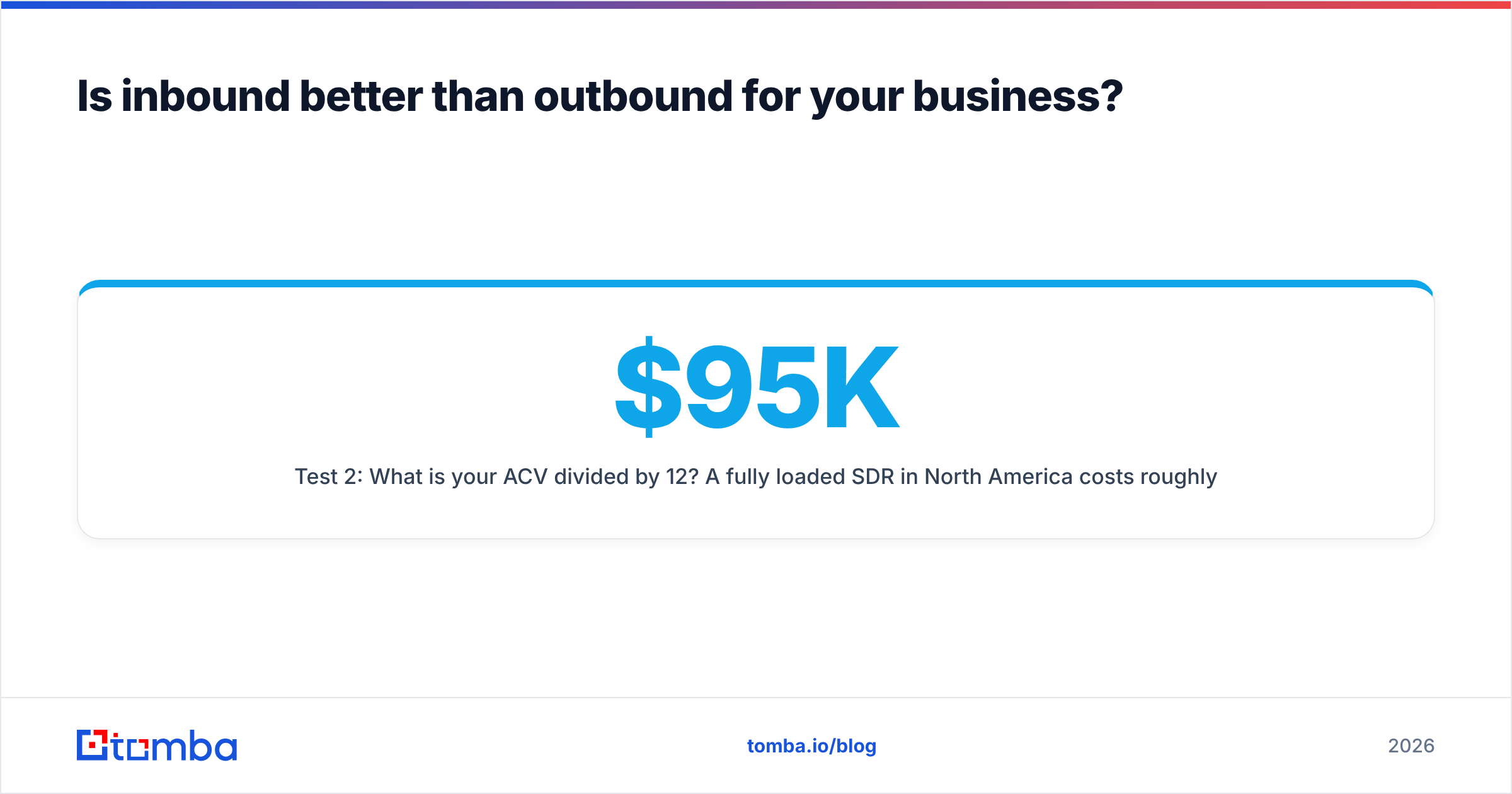
Test 2: What is your ACV divided by 12? A fully loaded SDR in North America costs roughly $95K-$130K per year all-in, and a good one books 12-18 qualified meetings per month. At a 20% meeting-to-close rate, that's about 30-40 closed deals a year. If your ACV is $900, that rep generates $30K against a $110K cost. The arithmetic ends the debate.
Test 3: How concentrated is your ICP? If 400 companies on earth can buy your product, inbound is nearly irrelevant — you cannot wait for eight of them to Google something. You need a named-account list, verified contacts, and patience. If two million SMBs could buy it, you cannot afford to reach them one at a time.
Test 4: How fast do you need proof? Fundraising in six months? Outbound. Building a durable moat over three years? Inbound, with outbound funding the runway.
Most teams get Test 2 wrong because they compare outbound cost per meeting against inbound cost per meeting after the inbound engine matured, ignoring the two years of salaries that produced it. Compare like for like: total channel spend divided by closed-won revenue, measured over the same window.
What changed about inbound vs outbound sales in 2026?#
Three things, and they cut in opposite directions.
AI answer engines compressed the top of the funnel. A meaningful share of informational queries now resolve inside an AI summary without a click. Top-of-funnel "what is X" content — the traditional entry point of an inbound program — produces a fraction of the traffic it did in 2022. Bottom-of-funnel content (comparisons, pricing, alternatives, integration pages) held up far better because those searches carry purchase intent and buyers still want to see the vendor. If you are starting inbound today, start at the bottom of the funnel and work upward. That inverts the standard playbook.
Mailbox providers got serious about enforcement. Bulk-sender requirements around authentication, one-click unsubscribe, and complaint-rate thresholds are now enforced, not suggested. The practical effect: outbound at volume is no longer a numbers game you can win with brute force. A campaign to 10,000 unverified addresses does not underperform — it destroys the sending domain. Keeping your bounce rate under 2% is now table stakes, which makes email verification a compliance function rather than a nice-to-have.
AI made outbound copy free and therefore worthless as a differentiator. Everyone can generate a personalized-sounding first line. The differentiator moved back to list construction — who you contact and why now — and to signal quality. That is a data problem, not a writing problem.
Net effect: inbound got harder at the top and stayed strong at the bottom. Outbound got harder at volume and stayed strong at precision. Both channels rewarded quality and punished scale-for-its-own-sake. That is a healthier market than 2021, and it is bad news for anyone whose plan was "send more."
How do you run a hybrid motion without doing both badly?#
Sequence it. Do not split a small budget in half.
Phase 1 (months 0-6): outbound as the primary engine. Build a tight ICP of 300-800 accounts. Verify every contact before it enters a sequence. Run 40-60 accounts per rep per week with real research, not 500 with a merge field. Your goal here is not just revenue — it is learning which message, which title, and which trigger produce replies. That learning becomes your inbound content brief.
Phase 2 (months 3-12): bottom-of-funnel inbound built from outbound learnings. Every objection your SDRs hear becomes a page. Comparison pages, alternatives pages, integration pages, pricing explainers. These rank faster than broad topics and convert at 5-15x the rate of blog traffic.
Phase 3 (months 9-24): top-of-funnel inbound plus outbound on inbound signals. Now the two motions feed each other. Someone visits your pricing page twice and does not convert — that is an outbound trigger, not a lost cause. Website visitor identification turns anonymous traffic into named accounts your SDRs can work, which is the single highest-converting outbound list most companies never build.
Phase 4 (ongoing): allocate by payback period, not by ideology. Measure CAC payback per channel quarterly. Move budget to whichever is under 12 months. Revisit every quarter.

What metrics should you track for each motion?#
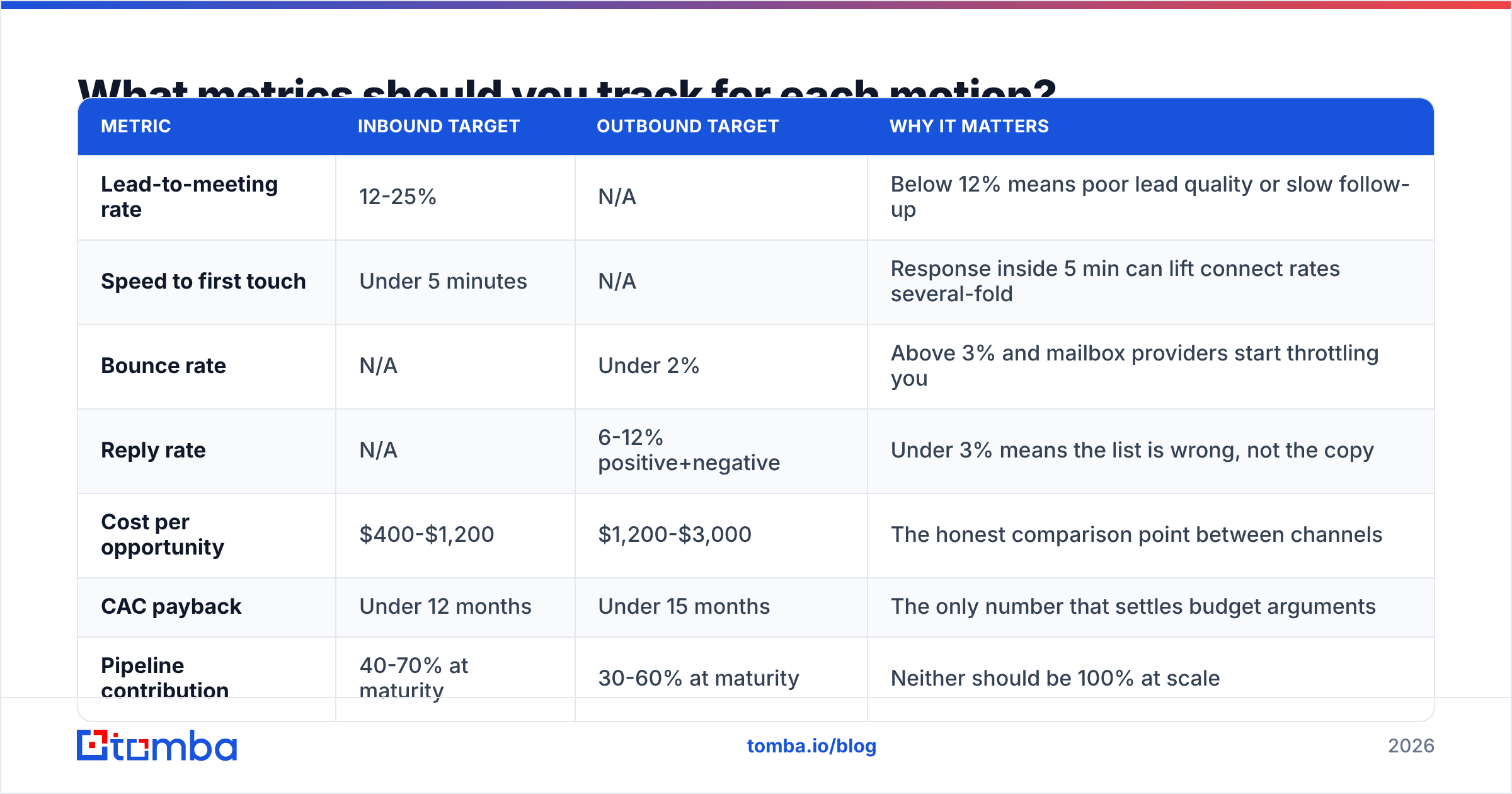
Using the same dashboard for both is the most common measurement mistake in B2B. They fail differently, so they need different leading indicators.
| Metric | Inbound target | Outbound target | Why it matters |
|---|---|---|---|
| Lead-to-meeting rate | 12-25% | N/A | Below 12% means poor lead quality or slow follow-up |
| Speed to first touch | Under 5 minutes | N/A | Response inside 5 min can lift connect rates several-fold |
| Bounce rate | N/A | Under 2% | Above 3% and mailbox providers start throttling you |
| Reply rate | N/A | 6-12% positive+negative | Under 3% means the list is wrong, not the copy |
| Cost per opportunity | $400-$1,200 | $1,200-$3,000 | The honest comparison point between channels |
| CAC payback | Under 12 months | Under 15 months | The only number that settles budget arguments |
| Pipeline contribution | 40-70% at maturity | 30-60% at maturity | Neither should be 100% at scale |
Two practical notes. First, measure cost per opportunity, not per lead — inbound produces enormous lead volume that never qualifies, which flatters the per-lead number and hides the truth. Second, track outbound bounce rate weekly, not monthly. Data decays at roughly 22-30% per year as people change jobs, and a list built in January is materially worse by June. Running periodic bulk verification against your CRM is cheaper than rebuilding a burned domain.
For benchmarking, HubSpot's sales research publishes annual reply and conversion baselines, and category pages on G2 are useful for seeing what buyers actually complain about in each tooling category before you commit budget.
What are the most common mistakes in each channel?#
Inbound mistakes: publishing top-of-funnel content with no commercial intent; treating every form fill as a lead worth a rep's time; waiting six months before measuring anything; ignoring review sites and comparison queries where buyers make actual decisions.
Outbound mistakes: buying a list and sequencing it unverified; optimizing copy when the problem is targeting; sending from your primary domain; scaling volume before a single sequence has proven positive reply rates; treating "no response" as rejection rather than a timing miss.
Shared mistake: letting the two teams compete for attribution credit. When an SDR touches an account that later converts through a demo request, both channels claim it, both dashboards inflate, and leadership makes budget decisions on double-counted pipeline. Pick a single attribution model, write it down, and accept that it will be imperfect.
Which should you choose?#
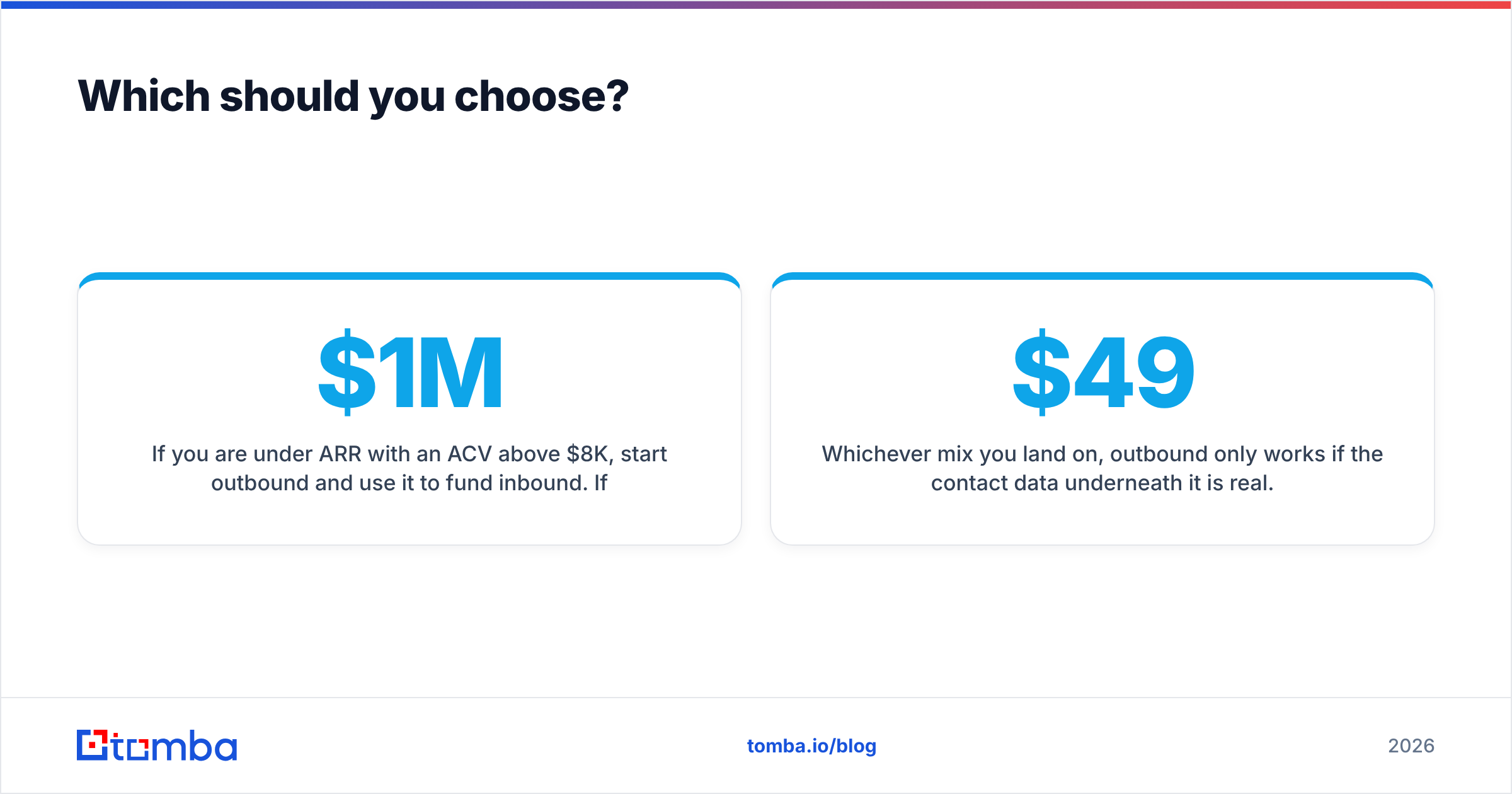
If you are under $1M ARR with an ACV above $8K, start outbound and use it to fund inbound. If your ACV is under $2K, inbound and product-led growth are the only motions with viable unit economics — outbound will be a subsidy you cannot afford. If you are above $10M ARR, you are running both whether you planned to or not, and your real job is allocation discipline rather than channel selection.
The framing that helps most: inbound is an asset you build, outbound is a machine you operate. Assets take capital and time and then pay forever. Machines take fuel and pay immediately. Companies fail when they try to build the asset with no fuel to survive the build.
Whichever mix you land on, outbound only works if the contact data underneath it is real. If you are ready to build a list your reps can actually send to, start with the Tomba Email Finder — find verified professional emails by domain, name, or company, then verify in bulk before anything enters a sequence. The free tier gives you 25 searches a month to test accuracy against accounts you already know, and paid plans start at $49/mo on Tomba pricing. Test it on 50 accounts from your ICP before you commit a rep's quarter to a list you have not validated.
Related guides#
// get started
Find, verify and enrich your first contacts today
Start on the free plan with 25 searches a month, then scale when your team is ready.
Free plan · No credit card required · GDPR & CCPA
// about the author