Inbound vs Outbound SDR: Roles, Metrics, and Which to Hire
Inbound and outbound SDRs share a job title and almost nothing else. Here is how the two roles differ on quota, ramp time, cost per meeting, and tooling — plus a hiring order that matches your funnel.
TL;DR
- An inbound SDR works demand that already raised its hand; an outbound SDR manufactures demand that never asked. Same title, different job.
- Inbound SDRs convert at roughly 5–10x the rate per touch, but their ceiling is capped by marketing spend. Outbound SDRs convert far lower per touch but scale with headcount and data quality.
- Inbound ramps in 4–8 weeks. Outbound ramps in 3–6 months. Budget for the difference or you will fire good reps for the wrong reason.
- Cost per meeting usually favors inbound on paper — until you load in the marketing spend that produced the lead. Load it in.
- Hire inbound first if your site already produces 100+ qualified form fills a month. Hire outbound first if you know exactly which 500 accounts you want and can build clean contact data for them.
What is an SDR, and why does the split matter?#
A sales development representative is the person between "someone might be interested" and "an account executive is running a real sales cycle." The SDR qualifies, books, and hands off. They do not close.
That definition hides an enormous fork in the road. One SDR spends the day responding to people who filled out a demo form fifteen minutes ago. The other spends the day cold-emailing directors of finance at companies that have never heard the product name. Both are "SDRs." Their day, their skills, their metrics, and their tooling barely overlap.
Teams that ignore the split end up with a predictable failure: they hire a friendly, fast-responding inbound rep, hand them a cold list, and then wonder why pipeline flatlined by month three. Or they hire a grinding outbound specialist, sit them on a queue of warm marketing qualified leads, and watch them burn hot demand with a pitch that would have worked fine on a cold prospect.
Think of it like a restaurant. The inbound SDR is the host at the door — people already walked in, the job is to seat them fast and at the right table. The outbound SDR is the person on the sidewalk convincing strangers that dinner here is worth their evening. Both matter. You would not swap them mid-shift.
What does an inbound SDR actually do all day?#
An inbound SDR — sometimes titled MDR (market development rep) or LDR — owns the lead queue. Their work is triage and speed.
A typical day: work the overnight form fills, chase demo requests, qualify content downloaders, route the ones that fit, disqualify the students and the competitors, and re-engage last quarter's "not right now" pile. Response time is the single biggest lever. The classic HubSpot sales research on lead response consistently shows that contact rates collapse when first response slips past the first hour, and most teams still measure their median response in hours, not minutes.
The inbound rep's skill set is qualification under time pressure. They need to figure out in a four-minute call whether this person has budget, a real problem, and any authority — without interrogating someone who came in curious. Good inbound SDRs are conversational, fast on their feet, and disciplined about CRM hygiene, because the routing rules only work if the data behind them is clean.
What they are not doing: building lists, researching accounts, writing sequences from scratch, or absorbing 95% no-reply rates. Their emotional load is lower. Their volume of conversations is often higher.

What does an outbound SDR actually do all day?#
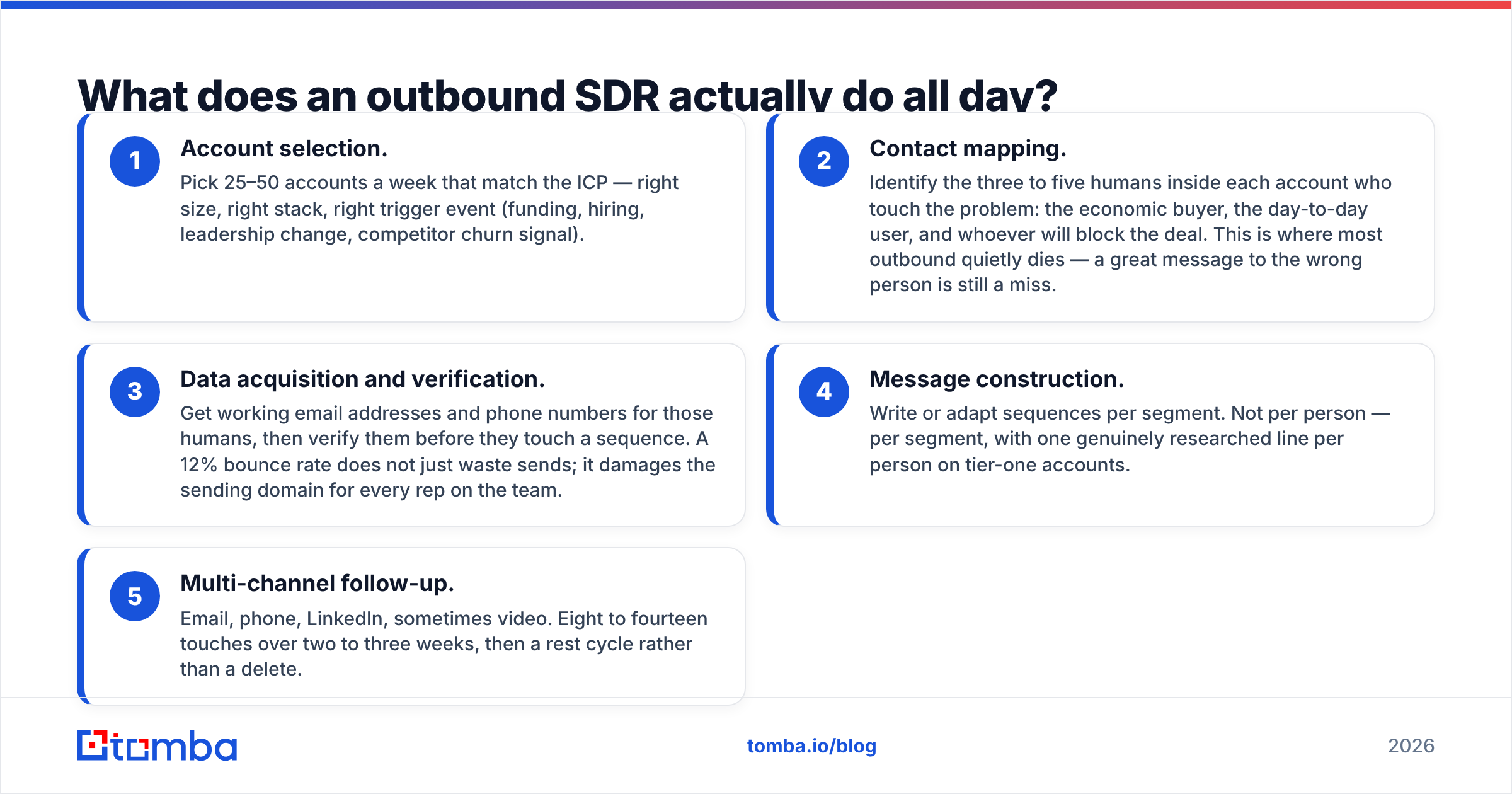
An outbound SDR owns a territory, not a queue. Nobody hands them anything. Their day breaks into five recurring jobs:
- Account selection. Pick 25–50 accounts a week that match the ICP — right size, right stack, right trigger event (funding, hiring, leadership change, competitor churn signal).
- Contact mapping. Identify the three to five humans inside each account who touch the problem: the economic buyer, the day-to-day user, and whoever will block the deal. This is where most outbound quietly dies — a great message to the wrong person is still a miss.
- Data acquisition and verification. Get working email addresses and phone numbers for those humans, then verify them before they touch a sequence. A 12% bounce rate does not just waste sends; it damages the sending domain for every rep on the team.
- Message construction. Write or adapt sequences per segment. Not per person — per segment, with one genuinely researched line per person on tier-one accounts.
- Multi-channel follow-up. Email, phone, LinkedIn, sometimes video. Eight to fourteen touches over two to three weeks, then a rest cycle rather than a delete.
Notice that only step five looks like "selling." The first four are research and data operations, and they are the reason outbound SDRs need dramatically more tooling than inbound SDRs. An outbound rep with a bad contact database is a very expensive person doing manual data entry.
This is also where the email verifier step stops being optional. Deliverability in 2026 is unforgiving: Google and Microsoft both enforce authentication and complaint-rate thresholds on bulk senders, and a list with 10% dead addresses will get a domain throttled long before quota is at risk.
Inbound vs outbound SDR: how do the two roles compare?#
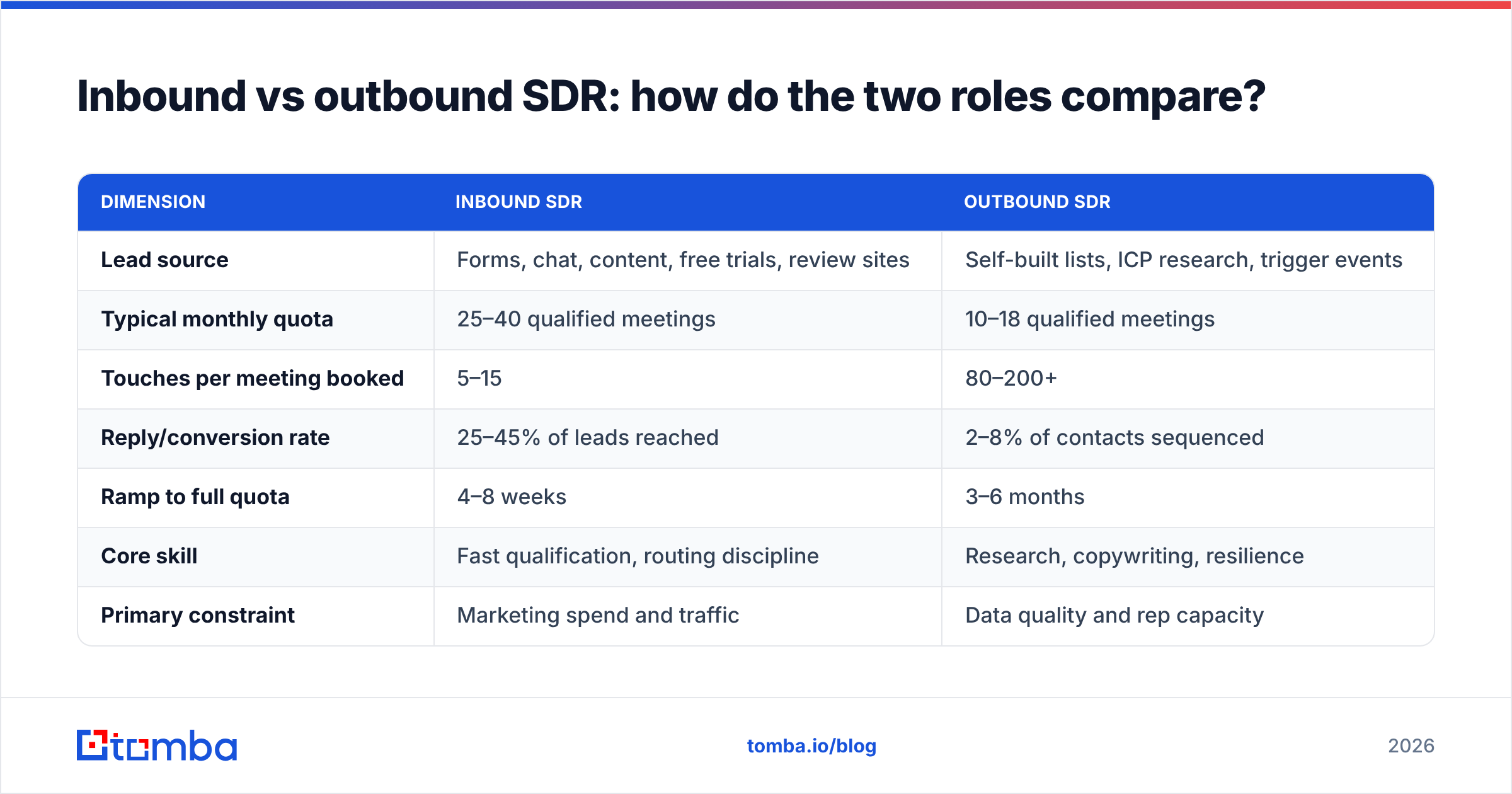
Here is the side-by-side. Numbers are directional benchmarks from mid-market B2B SaaS teams — your mileage varies by ACV, category maturity, and how well-known your brand is.
| Dimension | Inbound SDR | Outbound SDR |
|---|---|---|
| Lead source | Forms, chat, content, free trials, review sites | Self-built lists, ICP research, trigger events |
| Typical monthly quota | 25–40 qualified meetings | 10–18 qualified meetings |
| Touches per meeting booked | 5–15 | 80–200+ |
| Reply/conversion rate | 25–45% of leads reached | 2–8% of contacts sequenced |
| Ramp to full quota | 4–8 weeks | 3–6 months |
| Core skill | Fast qualification, routing discipline | Research, copywriting, resilience |
| Primary constraint | Marketing spend and traffic | Data quality and rep capacity |
| Tooling load | CRM, routing, chat, dialer | CRM, data provider, verification, sequencer, intent |
| OTE split (base/variable) | 70/30 | 60/40 to 65/35 |
| Meeting-to-opportunity rate | 50–70% | 30–50% |
| Best fit | Established brand, strong content engine | Defined ICP, few buyers, high ACV |
Two rows deserve a second look.
Meeting-to-opportunity rate. Inbound meetings convert better because the prospect self-identified a problem. Outbound meetings include a meaningful share of "sure, I'll take the call" politeness. Any comparison of raw meeting counts between the two roles without this adjustment is misleading — and it is exactly how outbound teams get unfairly cut in a budget review.
Touches per meeting. The 10x+ gap in touch volume is the entire argument for why outbound needs better tooling and better data. Cutting an outbound rep's bounce rate from 12% to 2% does not improve results by 10% — it compounds through deliverability, inbox placement, and rep confidence.
Which role produces cheaper pipeline?#
Inbound looks cheaper until you allocate the demand-gen budget honestly.
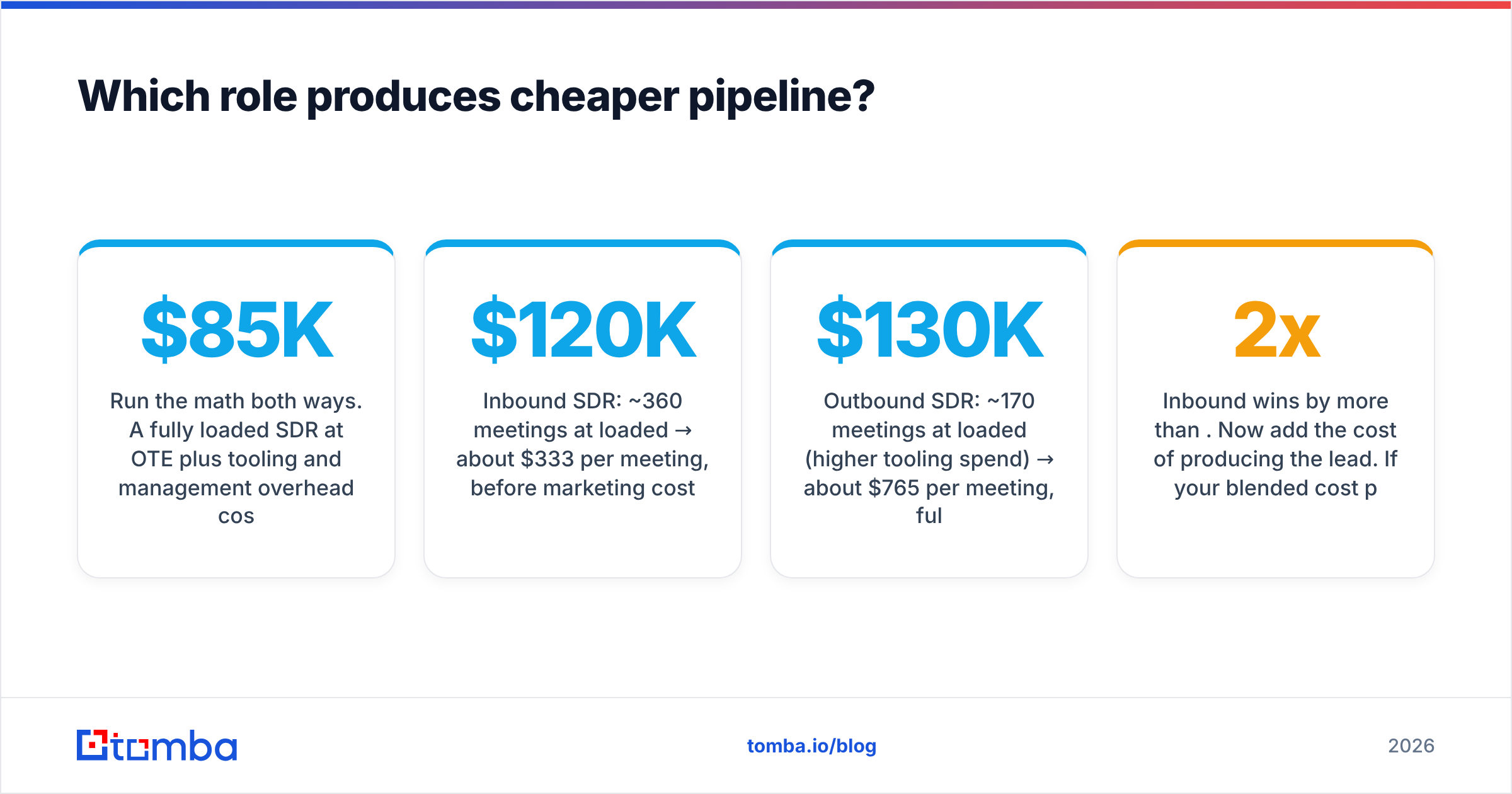
Run the math both ways. A fully loaded SDR at $85K OTE plus tooling and management overhead costs roughly $110–130K a year. Divide by meetings:
- Inbound SDR: ~360 meetings/year at $120K loaded → about $333 per meeting, before marketing cost.
- Outbound SDR: ~170 meetings/year at $130K loaded (higher tooling spend) → about $765 per meeting, fully loaded.
Inbound wins by more than 2x. Now add the cost of producing the lead. If your blended cost per MQL is $180 and it takes 3.5 MQLs to produce one inbound-qualified meeting, that is another $630 per meeting — and inbound is suddenly the more expensive channel at roughly $963.
The honest conclusion is not "outbound is cheaper." It is that the two costs live in different budgets, and CFOs rarely see them side by side. Gartner's sales research has been making a version of this point for years: channel-level cost comparisons that ignore the demand cost upstream produce bad allocation decisions.
The other asymmetry: inbound cost per meeting rises as you push volume (you buy worse traffic), while outbound cost per meeting falls as data and messaging improve. Inbound has a ceiling. Outbound has a learning curve.
How should you quota and compensate each role?#
Do not run one comp plan across both. Three rules:
- Different quota units, same quality bar. Outbound quota should be 40–60% of inbound quota in meeting count. But the definition of "qualified" must be identical, or your team will optimize toward whichever role has the loose door.
- Pay outbound a steeper variable. More variable and a higher per-meeting rate compensates for the higher failure rate and longer ramp. A 60/40 split with accelerators past 100% is standard.
- Add a held-meeting or opportunity-accepted gate. Pay on meetings that happen, not meetings that get booked. This single change eliminates most SDR gaming behavior in both roles.
- Give outbound a 90-day ramp guarantee. If you do not, you will lose reps in month two who would have been top performers in month five.
For a deeper look at how this fits into overall pipeline math, most teams find the bottleneck is not quota design — it is that the top of the funnel is fed by stale contact data. A rep hitting 8 meetings instead of 15 usually has a data problem, not a motivation problem.
Can one person do both jobs?#
Yes, badly — and sometimes that is the right call.
Under about 8–10 SDRs, a blended role is defensible. Below that headcount, splitting creates coverage gaps: your one inbound rep goes on vacation and demo requests sit for three days. A blended rep with a protected time block (inbound queue until 11am, outbound blocks after) works fine at small scale.
Above 10 SDRs, keep them split. The reason is context switching, not capability. Inbound work is interrupt-driven; outbound work needs uninterrupted research and writing blocks. A rep who checks the lead queue every ten minutes will never build a decent sequence, and the inbound queue always wins the attention battle because it feels urgent and converts better today. Blended teams drift toward pure inbound within two quarters, every time. If you have ever watched an outbound motion quietly die without a single decision being made, this was the mechanism.

What tooling does each SDR type actually need?#
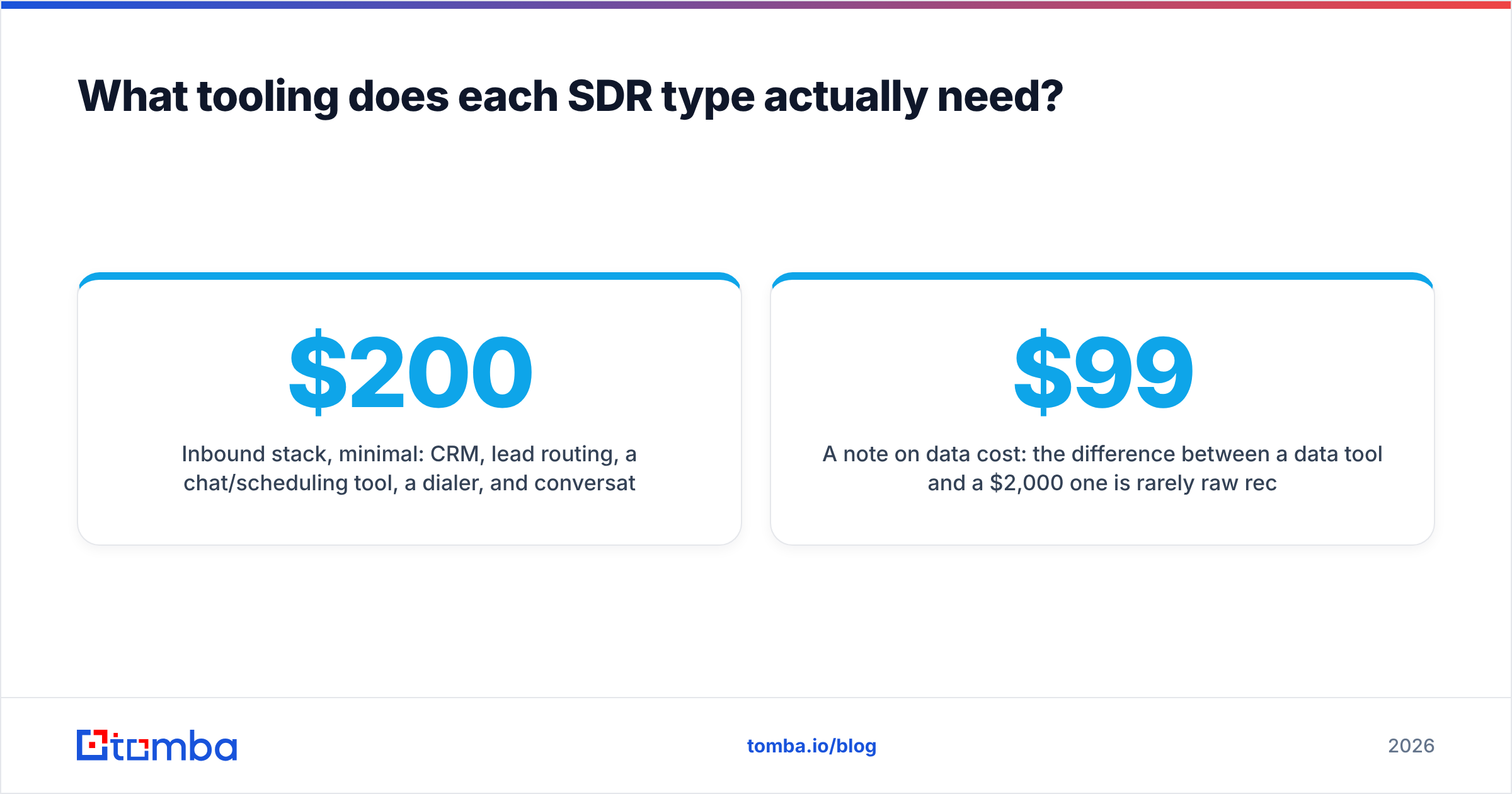
Inbound stack, minimal: CRM, lead routing, a chat/scheduling tool, a dialer, and conversation intelligence. Total tooling cost per rep is modest — usually under $200/month.
Outbound stack is where budgets balloon. The core layers:
- Account and contact data — a B2B database plus an email finder to fill the gaps the database misses, which on niche ICPs is most of them.
- Verification — bounce checking and catch-all handling before anything enters a sequence.
- Enrichment — job titles, company size, tech stack, and headcount signals so sequences can segment properly. Contact enrichment turns a name and a domain into something worth personalizing against.
- Sequencing — the sending engine and multi-channel cadence tool. Compare options on a neutral marketplace like G2's sales engagement category rather than trusting any single vendor's grid.
- Deliverability monitoring — inbox placement, domain warmup, and blacklist checks.
For teams building lists in volume, running finding and verification as a single batch step rather than two disconnected ones saves hours a week. Tomba's bulk email finder exists for exactly that workflow — upload the account and contact list, get verified addresses back, then sequence.
A note on data cost: the difference between a $99/month data tool and a $2,000/month one is rarely raw record count. It is match rate on your ICP and how fresh the records are. Test both against 200 accounts you already know before signing anything annual.
Which SDR should you hire first in 2026?#
Answer the following honestly, in order.
- Do you get 100+ genuinely qualified inbound leads a month, and is anyone responding within an hour? If yes and no, hire an inbound SDR today. You are already paying for that demand and letting it rot.
- Is your ICP under ~5,000 accounts globally, with an ACV above $15K? If yes, hire outbound. Named-account outbound is the only reliable way to reach a small, high-value universe.
- Is your category one buyers search for? If nobody Googles the problem you solve, inbound will never reach scale no matter what you spend on content. Go outbound.
- Can you produce clean contact data for your target accounts today? If not, fix that before hiring the outbound rep. An outbound SDR with bad data costs you a salary and a domain reputation.
- Is your brand recognizable in your segment? Strong brand tilts the ROI toward inbound. Unknown brand means cold outreach carries the whole burden of credibility, which raises the bar on message quality.
Most teams land on the same sequencing: one inbound SDR first to stop leaking existing demand, then two outbound SDRs once ICP and messaging are proven by the AE team. Two, not one — a single outbound rep produces a sample size too small to distinguish a bad rep from a bad ICP.
Where the data layer decides the outcome#
Both roles ultimately depend on knowing who to contact and how to reach them. Inbound gets that for free from a form. Outbound has to build it — and the build quality determines whether the role works at all.
If you are standing up an outbound motion in 2026, start with the contact layer before the sequencer. Use Tomba Email Finder to turn your target account list into verified, deliverable contacts, with the verifier and catch-all checks running in the same pass so nothing dead reaches your sending domain. The free tier covers 25 searches a month if you want to test match rates against accounts you already know; paid plans start at $49/month for Starter, with Growth at $99/month for teams running real outbound volume — full Tomba pricing is public, no demo required. Get the data right, and the inbound-versus-outbound debate becomes a resourcing question instead of a rescue mission.
Related guides#
Ready to find emails that actually work?
Join 150,000+ professionals who stopped guessing and started sending. Free credits on signup — no credit card required.
Get the Tomba newsletter
Practical outbound tactics and product updates — once every two weeks.
About the author