Inbox Radar Alternatives: 7 Inbox Placement Tools for 2026
Inbox Radar tells you where your cold emails land. It won't tell you why. Here are seven alternatives, free and paid, plus the list-hygiene fix most teams skip entirely.

TL;DR
- Inbox Radar is Saleshandy's inbox placement tester: it seeds a test email to Gmail, Outlook, Yahoo and Zoho accounts, then reports whether you landed in Inbox, Promotions, Spam or nowhere at all.
- The strongest alternatives split into three groups: full seed-list platforms (GlockApps, Validity Everest), lightweight spam scorers (Mail-tester, MailReach Spam Test, Mailtrap), and free first-party reputation feeds (Google Postmaster Tools).
- Price is not the deciding factor. Test frequency and provider coverage are — a $9 tool you run weekly beats a $159 tool you run once a quarter.
- Every placement tool is a thermometer, not a cure. Roughly the biggest single driver of a spam-folder result on cold outbound is bounce rate from unverified addresses.
- Fix the list first with an email verifier, then use a placement tool to confirm the fix landed.
What is Inbox Radar, and what does it actually test?#
Inbox Radar is the inbox placement product built by Saleshandy, sold as a standalone subscription rather than only as a bundled sequencer feature. You send a generated test message from the mailbox you care about to a set of seed addresses that Saleshandy controls across the major providers. A few minutes later you get a report: which providers put you in the primary inbox, which shunted you to Promotions or Updates, which dropped you in Spam, and which never delivered at all.
Alongside placement it runs a technical audit — SPF, DKIM and DMARC alignment, blacklist status for your sending IP and domain, and a SpamAssassin-style content score on the message body.
That combination is genuinely useful, and it exists because open rates stopped being trustworthy. Apple Mail Privacy Protection pre-fetches images, Gmail flags tracking pixels, and a 60% "open rate" on a cold campaign now tells you almost nothing. Seed testing is the only direct read on placement you can get without asking a prospect where your email landed.
So why do people search for Inbox Radar alternatives at all?
Why do teams look for Inbox Radar alternatives?#
Four reasons come up repeatedly in reviews and community threads:
- Ecosystem gravity. Inbox Radar is built by a sequencing company. If you already run Instantly, Smartlead, Lemlist or Outreach, adding a Saleshandy login for one job is friction. Teams evaluating a Saleshandy alternative usually re-evaluate its placement tool at the same time.
- Seed-list depth. Placement tools live or die on the quality of their seed accounts. Providers age out, get flagged, or stop being representative. Buyers want to know how many seeds sit behind a result and how often they rotate — and that detail is rarely published by anyone.
- Test volume economics. If you manage 40 sending mailboxes across five clients, you need hundreds of tests a month. Per-test pricing and per-mailbox pricing produce wildly different bills at that scale.
- They want diagnosis, not a score. "You scored 7.2 and landed in Promotions on Gmail" is a symptom. Teams want to know which of the twelve possible causes is theirs.

How do inbox placement tools actually work?#
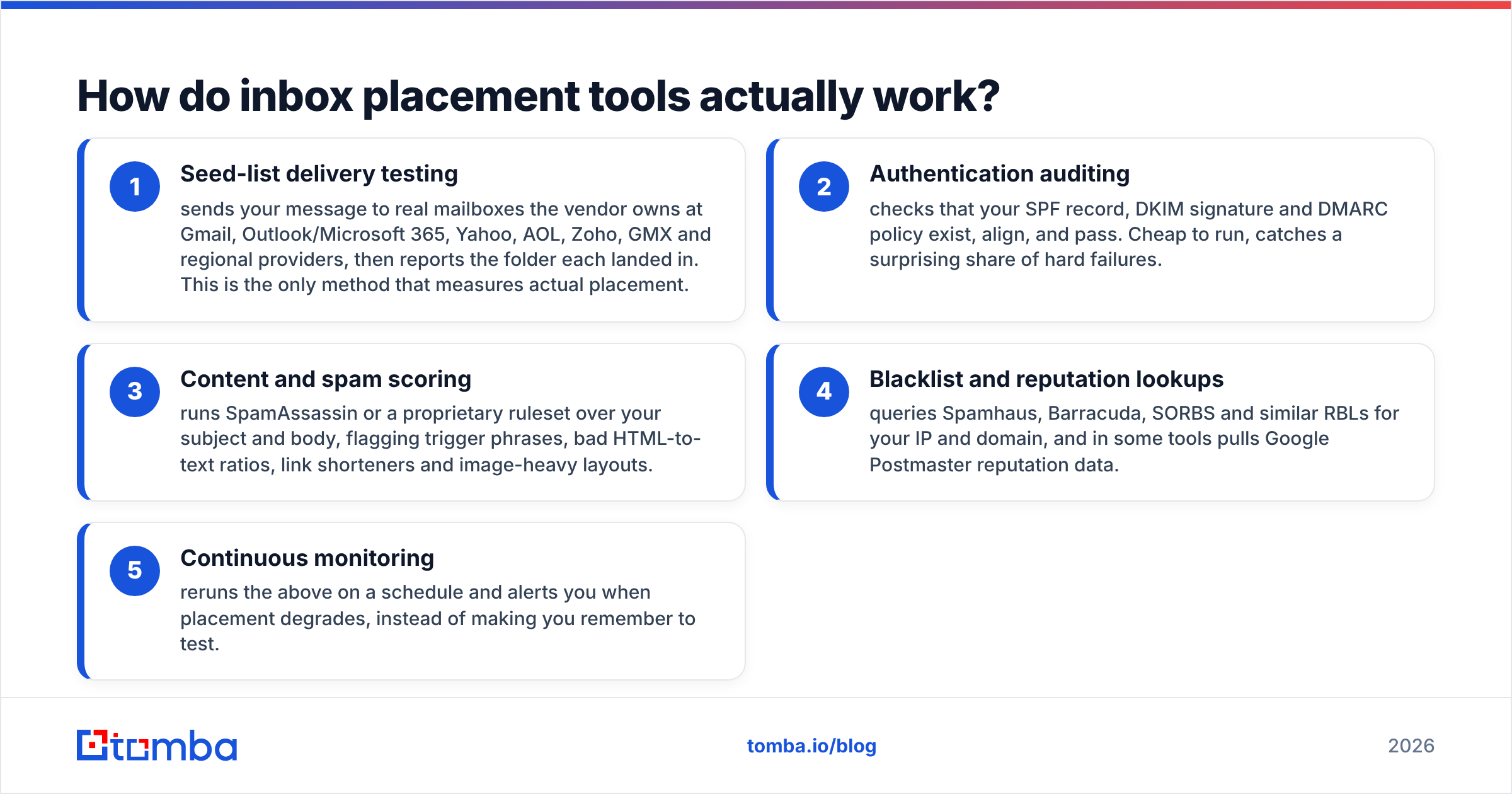
Understanding the mechanism tells you which alternative fits. Every tool in this category does some subset of five things:
- Seed-list delivery testing — sends your message to real mailboxes the vendor owns at Gmail, Outlook/Microsoft 365, Yahoo, AOL, Zoho, GMX and regional providers, then reports the folder each landed in. This is the only method that measures actual placement.
- Authentication auditing — checks that your SPF record, DKIM signature and DMARC policy exist, align, and pass. Cheap to run, catches a surprising share of hard failures.
- Content and spam scoring — runs SpamAssassin or a proprietary ruleset over your subject and body, flagging trigger phrases, bad HTML-to-text ratios, link shorteners and image-heavy layouts.
- Blacklist and reputation lookups — queries Spamhaus, Barracuda, SORBS and similar RBLs for your IP and domain, and in some tools pulls Google Postmaster reputation data.
- Continuous monitoring — reruns the above on a schedule and alerts you when placement degrades, instead of making you remember to test.
A tool that does 2, 3 and 4 but not 1 is a spam checker, not a placement tool. Both are useful; they cost very different amounts and answer different questions. Our free spam checker and blacklist checker cover the second category if that is all you need.
What are the best Inbox Radar alternatives in 2026?#
Pricing below was checked in September 2026 and rounded to the nearest useful figure. Vendors in this category change plans often — confirm on the vendor site before you buy.
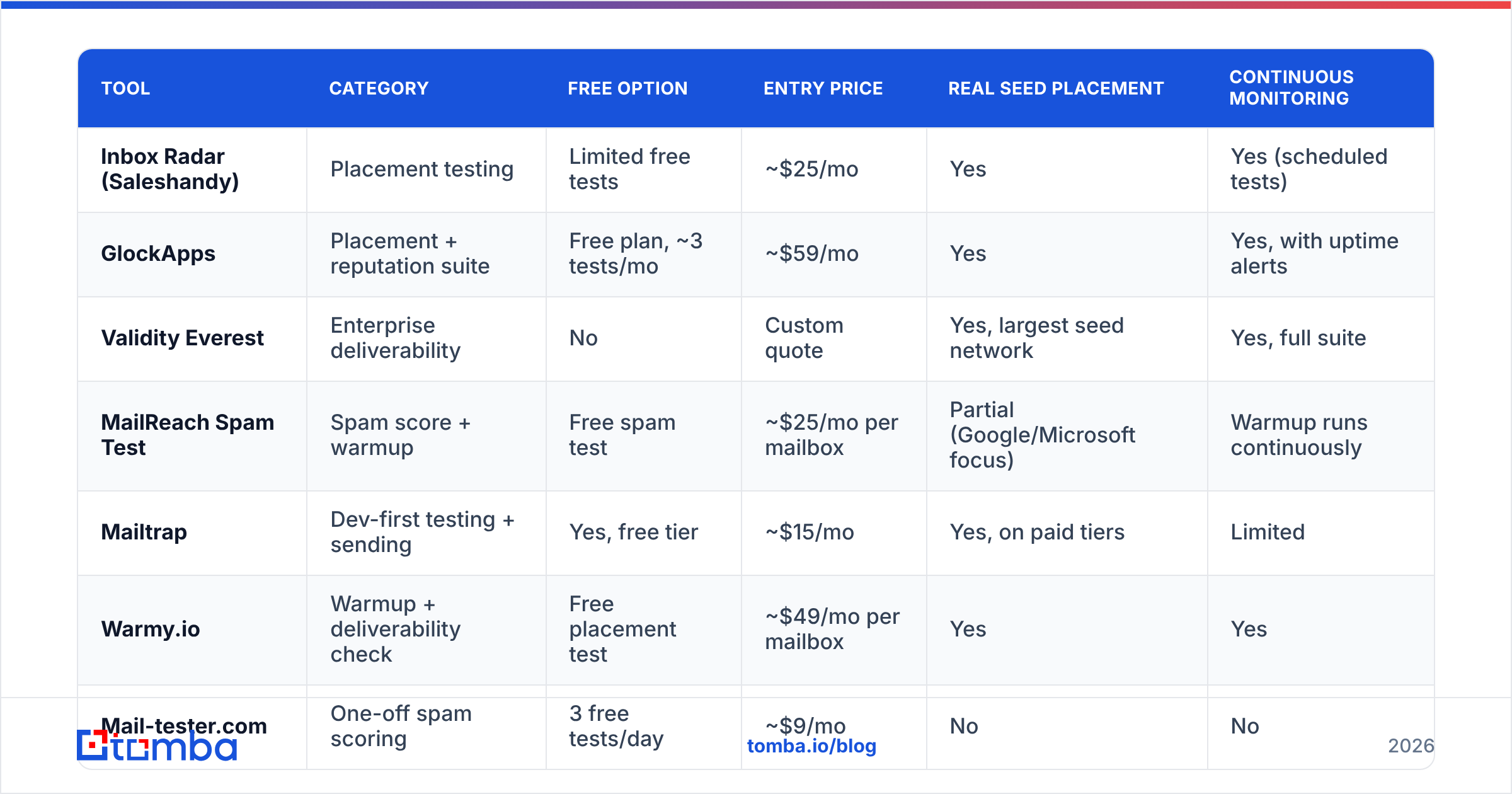
| Tool | Category | Free option | Entry price | Real seed placement | Continuous monitoring |
|---|---|---|---|---|---|
| Inbox Radar (Saleshandy) | Placement testing | Limited free tests | ~$25/mo | Yes | Yes (scheduled tests) |
| GlockApps | Placement + reputation suite | Free plan, ~3 tests/mo | ~$59/mo | Yes | Yes, with uptime alerts |
| Validity Everest | Enterprise deliverability | No | Custom quote | Yes, largest seed network | Yes, full suite |
| MailReach Spam Test | Spam score + warmup | Free spam test | ~$25/mo per mailbox | Partial (Google/Microsoft focus) | Warmup runs continuously |
| Mailtrap | Dev-first testing + sending | Yes, free tier | ~$15/mo | Yes, on paid tiers | Limited |
| Warmy.io | Warmup + deliverability check | Free placement test | ~$49/mo per mailbox | Yes | Yes |
| Mail-tester.com | One-off spam scoring | 3 free tests/day | ~$9/mo | No | No |
| Google Postmaster Tools | First-party reputation data | Free, always | $0 | No (aggregate data only) | Yes, daily |
Is GlockApps the best all-round Inbox Radar alternative?#
For most teams, yes. GlockApps is the closest like-for-like replacement with more surface area: seed testing across a broad provider list, DMARC monitoring, bounce and complaint analytics, and IP reputation tracking in one dashboard. Its free plan lets you validate the workflow before paying.
The trade-off is cost curve. GlockApps prices by tests and seed-list size, and heavy agency use climbs fast. It is also a denser product — expect a real onboarding session rather than a five-minute setup.
Pick it if: you run outbound at scale, need DMARC reporting anyway, and want one vendor instead of three.
When is Validity Everest worth the enterprise price?#
When you are sending marketing volume, not cold outbound. Everest bundles the largest commercial seed network with Return Path certification data, complaint feedback loops from major ISPs, and inbox-placement forecasting. Nobody buys it for a 20-mailbox cold email operation — the quote alone will end the conversation.
Pick it if: you send millions of messages a month and deliverability failures cost six figures.
Is Mailtrap a real placement tool or a developer sandbox?#
Both, and that dual identity is the point. Mailtrap started as an email-testing sandbox for engineers — catch transactional mail in a fake inbox, inspect the HTML, never spam a real user. It has since added spam scoring, blacklist checks and inbox placement testing on paid plans, plus its own sending infrastructure.
If your deliverability problem is transactional (password resets going to spam, receipts landing in Promotions) Mailtrap is a better fit than any cold-outbound tool, because it plugs into your app's SMTP layer directly.
Pick it if: engineering owns the email, not sales.
What about MailReach, Warmy and the warmup-first tools?#
MailReach and Warmy approach the problem from the other end: instead of only measuring placement, they actively build sender reputation by circulating mail through a network of real mailboxes that open, reply and mark as important. Both ship a placement or spam test alongside the warmup engine.
Two honest cautions. First, mailbox providers have gotten better at recognising synthetic engagement networks, and the long-term value of aggressive warmup is debated among deliverability practitioners. Second, warmup and placement testing are separate jobs — bundling them means you may end up paying warmup prices for a testing feature you would rather buy standalone. Use the warmup calculator to sanity-check ramp schedules before you commit to a per-mailbox subscription.
Pick them if: you are spinning up new domains and want ramp plus measurement in one place.
Are the free options good enough?#
For a solo founder or a two-person sales team, often yes.
Mail-tester.com gives you three free checks a day. It is not placement testing — it is a content, authentication and blacklist score against one seed address. But it catches missing DKIM, a broken DMARC policy and a spam-trigger subject line in about ninety seconds.
Google Postmaster Tools is the most undervalued item on this list. It reports domain and IP reputation, spam complaint rates, authentication pass rates and delivery errors straight from Gmail, for free. No seed list can beat first-party data from the provider that holds most of your prospects. The catch: you need enough daily volume to Gmail for the graphs to populate, which rules out very small senders.
Run both. Then buy a paid tool only when the free ones stop explaining your numbers.

Does a placement tool actually fix deliverability?#
No — and this is the part most comparison posts skip.
A placement tool is a thermometer. It tells you that you have a fever. It does not tell you that the fever is caused by sending 3,000 emails a week to addresses you generated with a permutation script and never validated.
Here is the causal chain that puts most cold-outbound senders in the spam folder:
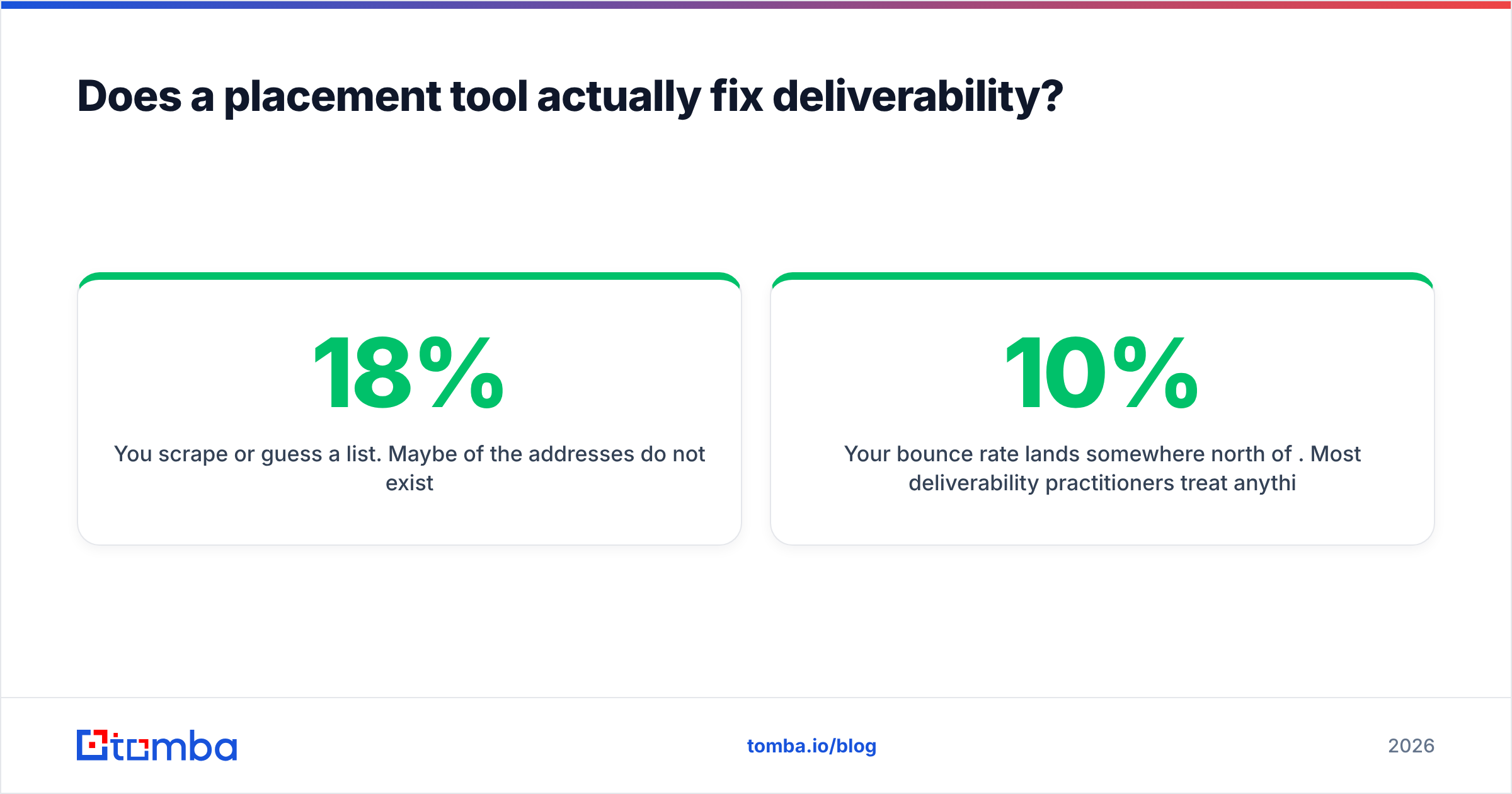
- You scrape or guess a list. Maybe 18% of the addresses do not exist.
- Your bounce rate lands somewhere north of 10%. Most deliverability practitioners treat anything above roughly 2–3% as a warning sign.
- Mailbox providers read a high bounce rate as a signal that you do not have a real relationship with your recipients. Sender reputation drops.
- Placement degrades across the domain, including for the prospects whose addresses were valid.
- You buy a placement tool, watch the Gmail bar go red, and start rewriting subject lines.
Subject lines were never the problem. G2's reviews across this category are full of the same pattern: teams rate the tool highly for visibility, then note that the actual fix was list hygiene. You can browse the email deliverability category on G2 and see it repeated across vendors.
The sequence that works:
- Verify before you send. Run every address through SMTP-level validation, and route catch-all domains through a dedicated catch-all verifier rather than guessing.
- Fix authentication once. SPF, DKIM, DMARC. It takes an afternoon and never needs redoing.
- Ramp volume slowly on new domains, then hold steady. Spiky volume looks like a compromised account.
- Then buy a placement tool, and use it to confirm your fixes worked rather than to hunt for a cause.
Steps 1 through 3 cost less than most placement subscriptions and move the needle further. If you are cleaning a large list, bulk verify it in one pass instead of one address at a time.
Which Inbox Radar alternative should you choose?#
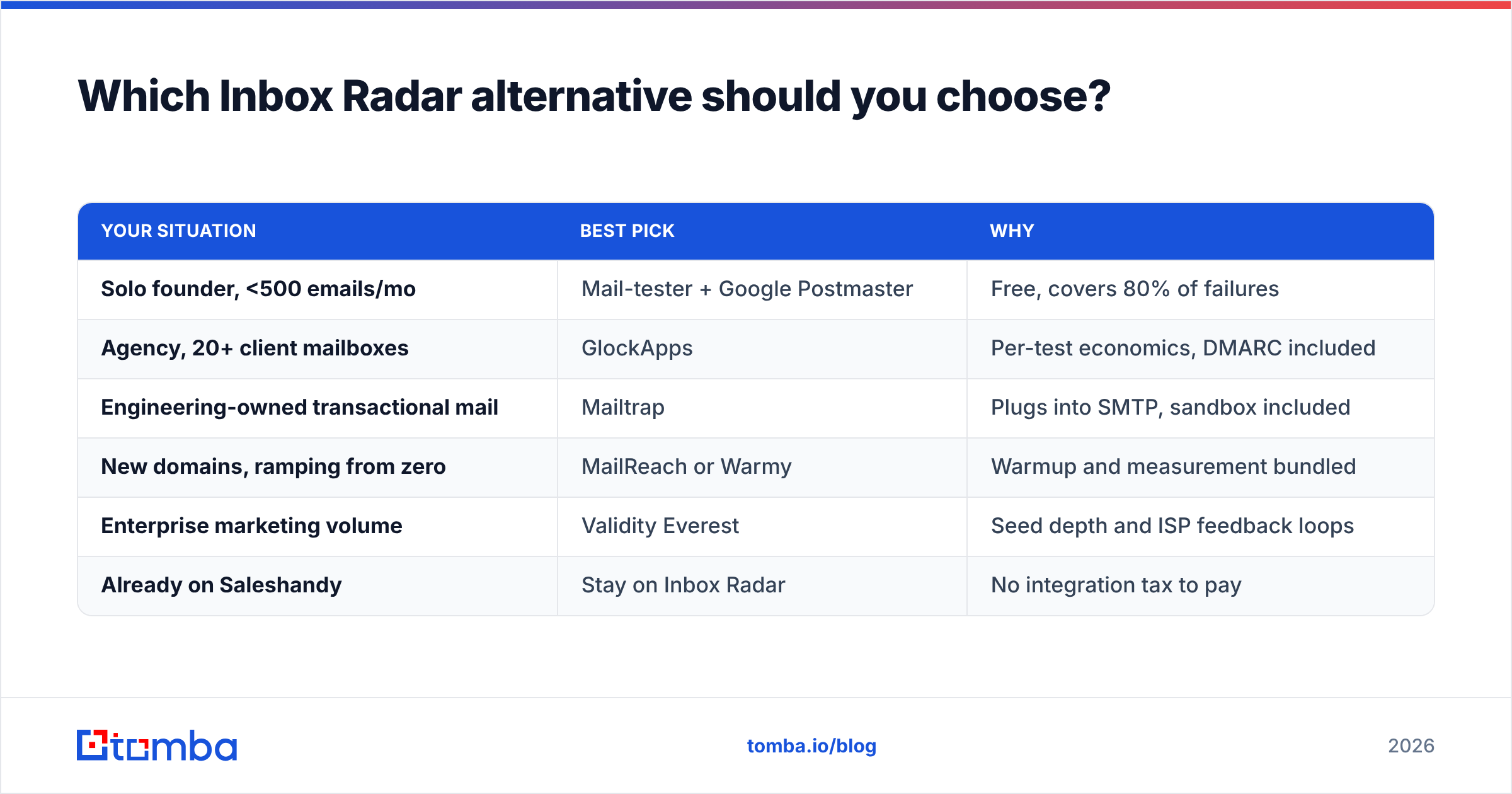
| Your situation | Best pick | Why |
|---|---|---|
| Solo founder, <500 emails/mo | Mail-tester + Google Postmaster | Free, covers 80% of failures |
| Agency, 20+ client mailboxes | GlockApps | Per-test economics, DMARC included |
| Engineering-owned transactional mail | Mailtrap | Plugs into SMTP, sandbox included |
| New domains, ramping from zero | MailReach or Warmy | Warmup and measurement bundled |
| Enterprise marketing volume | Validity Everest | Seed depth and ISP feedback loops |
| Already on Saleshandy | Stay on Inbox Radar | No integration tax to pay |
Two practical rules. First, whatever you pick, schedule recurring tests instead of running them ad hoc — placement drifts, and the value is in the trend line, not the snapshot. Second, test from the actual sending mailbox with the actual campaign copy. A test from a clean mailbox with sanitised copy tells you nothing about the sequence that is currently underperforming.
The fix that comes before the tool#
Every tool on this page measures the same outcome from a different angle. None of them changes it. The input that changes it is the quality of the addresses you send to.
If your bounce rate is above 3%, no placement dashboard will save you — and no amount of warmup will outrun a list built from guessed addresses. Start with data you can trust: Tomba Email Finder returns verified professional addresses with a confidence score and the public sources behind each one, so you know what you are sending to before you send it. The free tier covers 25 searches a month, and paid plans start at $49/mo — less than most of the placement tools listed above, and aimed at the cause instead of the symptom. Compare Tomba pricing against whatever you were about to spend on your third deliverability subscription.
Fix the list. Then buy the thermometer.
Related guides#
// get started
Find, verify and enrich your first contacts today
Start on the free plan with 25 searches a month, then scale when your team is ready.
Free plan · No credit card required · GDPR & CCPA
Get the Tomba newsletter
Product and data updates
// about the author