8 Best InboxAlly Alternatives in 2026 (Free and Paid Tools)
InboxAlly's seed-inbox network works, but it starts around $149/mo and only treats the symptom. Here are 8 alternatives - warmup platforms, seed testers, and the list-hygiene layer most teams skip - compared on price, scope, and who they actually fit.

TL;DR
- InboxAlly is a seed-inbox engagement network: real mailboxes open, reply to, and drag your emails out of spam so mailbox providers learn to trust you. It works, but entry pricing sits around $149/mo and it does nothing about your list.
- The cheapest swap is a sending platform with warmup bundled in. Instantly and Smartlead both include warmup at roughly $37-$39/mo, which replaces both your sequencer and your warmup tool.
- If you only need diagnostics, GlockApps and Google Postmaster Tools cover seed placement and reputation for free or near-free.
- Warmup fixes reputation. It does not fix a dirty list. If you are bouncing above 3%, no seed network will save you - verify first, warm second.
- Best pairing for most cold-email teams: a sequencer with built-in warmup plus a verification layer like Tomba at $49/mo, instead of one $149/mo point tool.
What does InboxAlly actually do?#
InboxAlly runs a network of real, aged mailboxes across Gmail, Outlook, Yahoo and corporate domains. You send to that network on a schedule. The seed accounts open your mail, scroll it, reply, mark it "not spam", and move it from Promotions to Primary. Mailbox providers watch those signals and gradually decide your domain sends mail people want.
Think of it like a new restaurant paying nothing for ads but filling the dining room with real diners who eat, tip and come back. Passers-by see a busy room and assume the food is good. The algorithm at Gmail is doing roughly the same crowd-reading.
That is a legitimate model and InboxAlly's own site is clear about it. Two things it deliberately does not do:
- It does not send your campaigns. You still need a sequencer.
- It does not touch your recipient data. Bounces, spam traps and catch-all guesses all pass straight through.
That second gap is why so many teams search for InboxAlly alternatives after three months: their placement improved, their reply rate did not, and the actual problem was a 9% bounce rate from unverified contacts.

Why do teams look for InboxAlly alternatives?#
Four reasons come up repeatedly in G2 reviews and cold-email communities:
- Price per mailbox. InboxAlly's published entry plan is around $149/mo, and warmup pricing generally scales with the number of sending addresses. If you run 10 inboxes across 3 domains - normal for outbound at scale - the math gets ugly fast against a $39/mo platform with unlimited warmup.
- Tool sprawl. Sequencer + warmup + verifier + seed tester is four invoices and four dashboards. Most teams consolidate to two.
- Diagnostics vs treatment. InboxAlly improves placement but reports lightly. If you want per-provider seed reports, DMARC aggregate parsing and blacklist alerts, you want a testing tool, not a warmup tool.
- The root cause is upstream. Warmup is treatment. Bad data is the disease. Teams eventually notice that email deliverability is mostly a data-quality problem wearing an infrastructure costume.
How do the top InboxAlly alternatives compare?#
Prices below are list prices at time of writing. Vendors change them - verify before you buy.
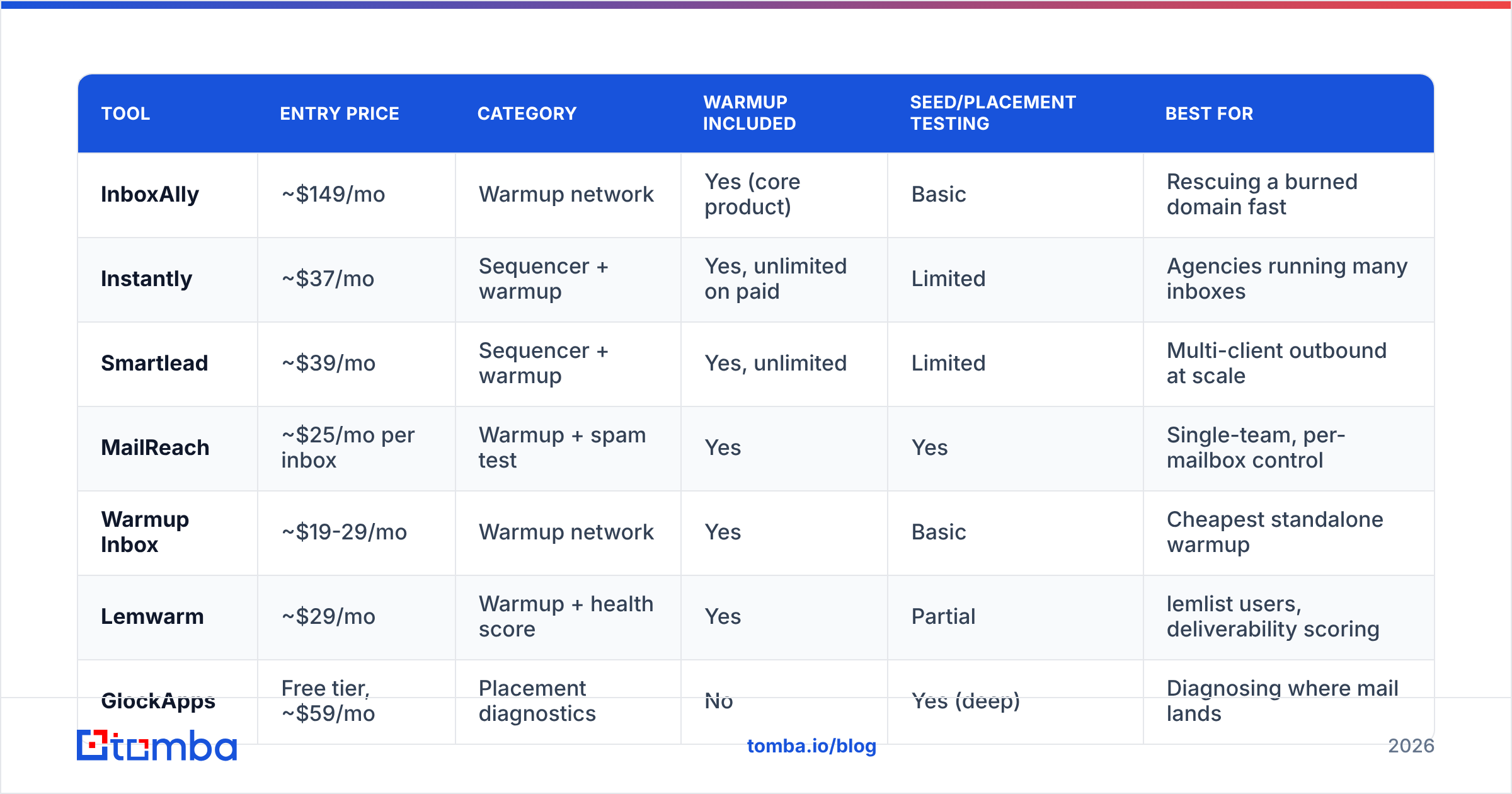
| Tool | Entry price | Category | Warmup included | Seed/placement testing | Best for |
|---|---|---|---|---|---|
| InboxAlly | ~$149/mo | Warmup network | Yes (core product) | Basic | Rescuing a burned domain fast |
| Instantly | ~$37/mo | Sequencer + warmup | Yes, unlimited on paid | Limited | Agencies running many inboxes |
| Smartlead | ~$39/mo | Sequencer + warmup | Yes, unlimited | Limited | Multi-client outbound at scale |
| MailReach | ~$25/mo per inbox | Warmup + spam test | Yes | Yes | Single-team, per-mailbox control |
| Warmup Inbox | ~$19-29/mo | Warmup network | Yes | Basic | Cheapest standalone warmup |
| Lemwarm | ~$29/mo | Warmup + health score | Yes | Partial | lemlist users, deliverability scoring |
| GlockApps | Free tier, ~$59/mo | Placement diagnostics | No | Yes (deep) | Diagnosing where mail lands |
| Folderly | Custom (enterprise) | Full-service deliverability | Yes | Yes | Enterprise with a burned domain |
| Tomba | Free, then $49/mo | Data hygiene + verification | No | No | Preventing the problem upstream |
The table makes the real split obvious: these tools are not competitors so much as three different layers. Warmup networks build reputation, testing tools measure it, and verification tools protect it. InboxAlly sits in the first column only.
What are the 8 best InboxAlly alternatives in 2026?#
1. Instantly - best if you want warmup bundled with sending#
Instantly folds unlimited warmup into its sending platform. Connect 50 mailboxes, toggle warmup on, and every one of them joins the peer network at no extra per-inbox cost. That single pricing decision is why agencies migrate off standalone warmup tools.
The trade-off: warmup is a feature, not the product. Reporting is thinner than a dedicated tool, and you are committing your sequencing workflow to the same vendor. If you already like your sequencer, this is not a clean swap. If you are shopping for both, it is the obvious economic answer. Teams evaluating the switch usually also look at an Instantly alternative shortlist before committing.
2. Smartlead - best for agencies running many client domains#
Smartlead's pitch is nearly identical to Instantly's - unlimited mailboxes on paid tiers, warmup included - with a stronger multi-client structure. Sub-accounts, client-level reporting and a whitelabel option make it the default for agencies billing deliverability as a service.
Warmup quality between Smartlead and Instantly is close enough that the decision usually comes down to UI preference and API needs, not placement outcomes.
3. MailReach - best per-mailbox control and spam testing#
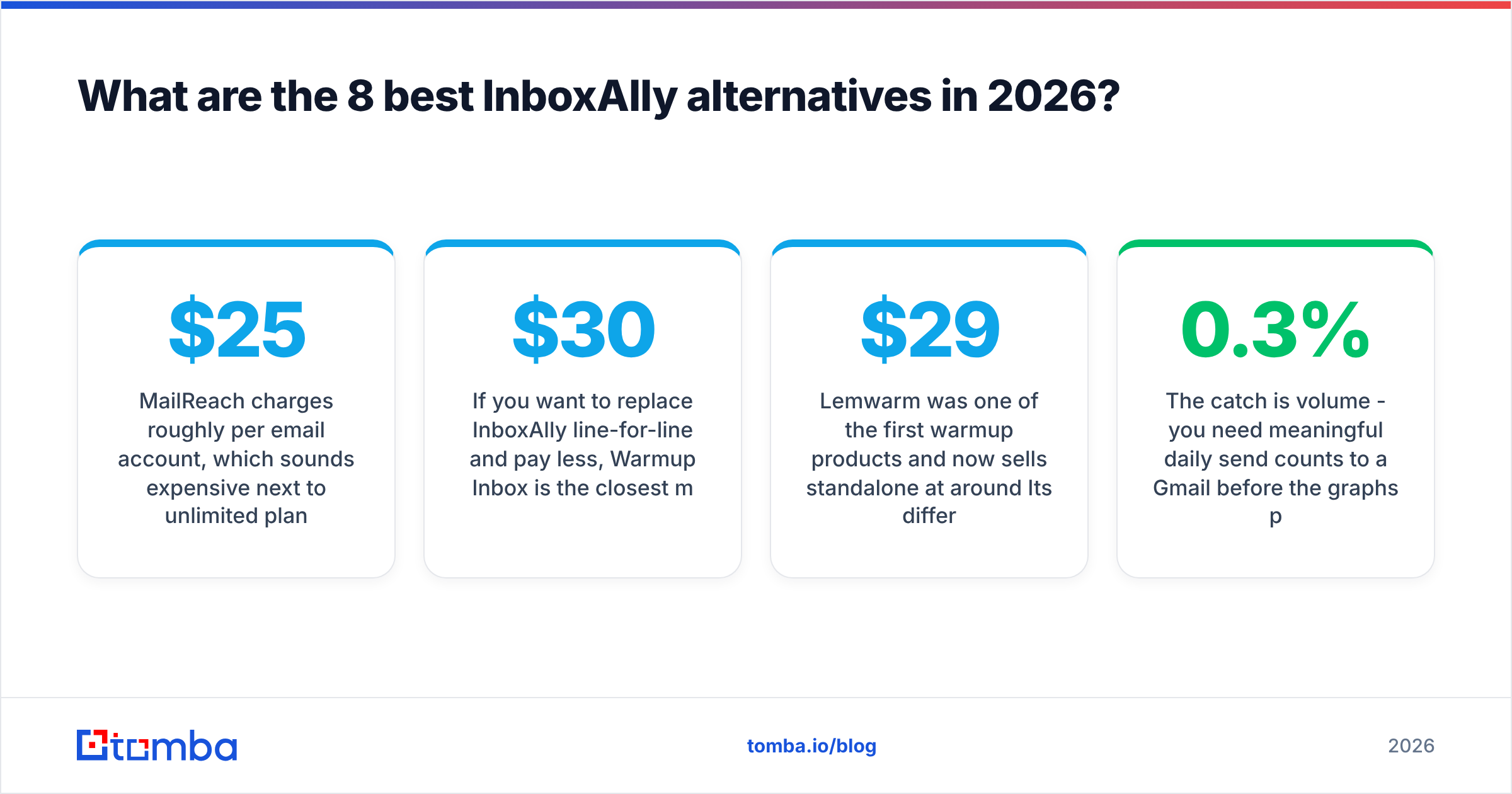
MailReach charges roughly $25/mo per email account, which sounds expensive next to unlimited plans until you realise most teams actually warm 3-5 mailboxes, not 50. For that shape of team it lands cheaper than InboxAlly while adding a spam-test tool that shows per-provider placement.
It is sequencer-agnostic, so you keep whatever sending stack you already have. That neutrality is the main reason it survives against bundled competitors.
4. Warmup Inbox - cheapest standalone warmup#
If you want to replace InboxAlly line-for-line and pay less, Warmup Inbox is the closest match. Entry pricing sits under $30/mo, the network is large, and setup takes about ten minutes per mailbox.
Reporting is basic - you get a health score and a deliverability trend, not forensic per-provider breakdowns. For a solo founder or a two-person sales team, that is usually enough.
5. Lemwarm - best deliverability score for lemlist users#
Lemwarm was one of the first warmup products and now sells standalone at around $29/mo. Its differentiator is a deliverability score that combines warmup engagement with technical checks, so you get one number to watch rather than a spreadsheet of signals.
It works outside lemlist, but the integration is where it earns its keep.
6. GlockApps - best for diagnosing where your mail actually lands#
GlockApps is not a warmup tool. It is a measuring instrument. You send a campaign to their seed list and get back a placement report: Inbox, Promotions, Spam or missing, broken out by Gmail, Outlook, Yahoo and more, plus SPF/DKIM/DMARC validation and blacklist monitoring.
Use it with a warmup tool, not instead of one. Warming without measuring is guessing. There is a free tier that covers a few tests per month, which is enough to answer "is this a reputation problem or a copy problem?"
7. Google Postmaster Tools - the free baseline everyone skips#
Google Postmaster Tools costs nothing and shows Gmail's own view of your domain: spam rate, domain reputation, IP reputation, authentication pass rates and delivery errors. Since Gmail is where most of your B2B recipients live, this is the only reputation dashboard that reports ground truth rather than inference.
The catch is volume - you need meaningful daily send counts to a Gmail before the graphs populate. Set it up on day one anyway. If Postmaster shows your spam rate above 0.3%, no warmup network will out-run it. Pair it with a free SPF checker to confirm your authentication records are actually valid.
8. Tomba - best for fixing the cause instead of the symptom#
Tomba is not a warmup tool and does not pretend to be. It sits one layer upstream: find the right contact, confirm the mailbox exists, then send. That is the layer InboxAlly explicitly does not cover.
The reason it belongs on this list is arithmetic. Mailbox providers weight hard bounces heavily. A 2,000-contact campaign at an 8% bounce rate throws 160 rejections at Gmail in a single afternoon - a stronger negative signal than weeks of warmup engagement can offset. Running that same list through an email verifier first, and pushing ambiguous domains through a catch-all verifier, typically pulls bounce rate under 2% before a single warmup email is sent.
Pricing: free tier at 25 searches/mo, Starter $49/mo, Growth $99/mo, Pro $249/mo. Full Tomba pricing is public, and the Growth tier costs less than InboxAlly's entry plan while solving a problem warmup cannot touch.

Is warmup even the right fix for your problem?#
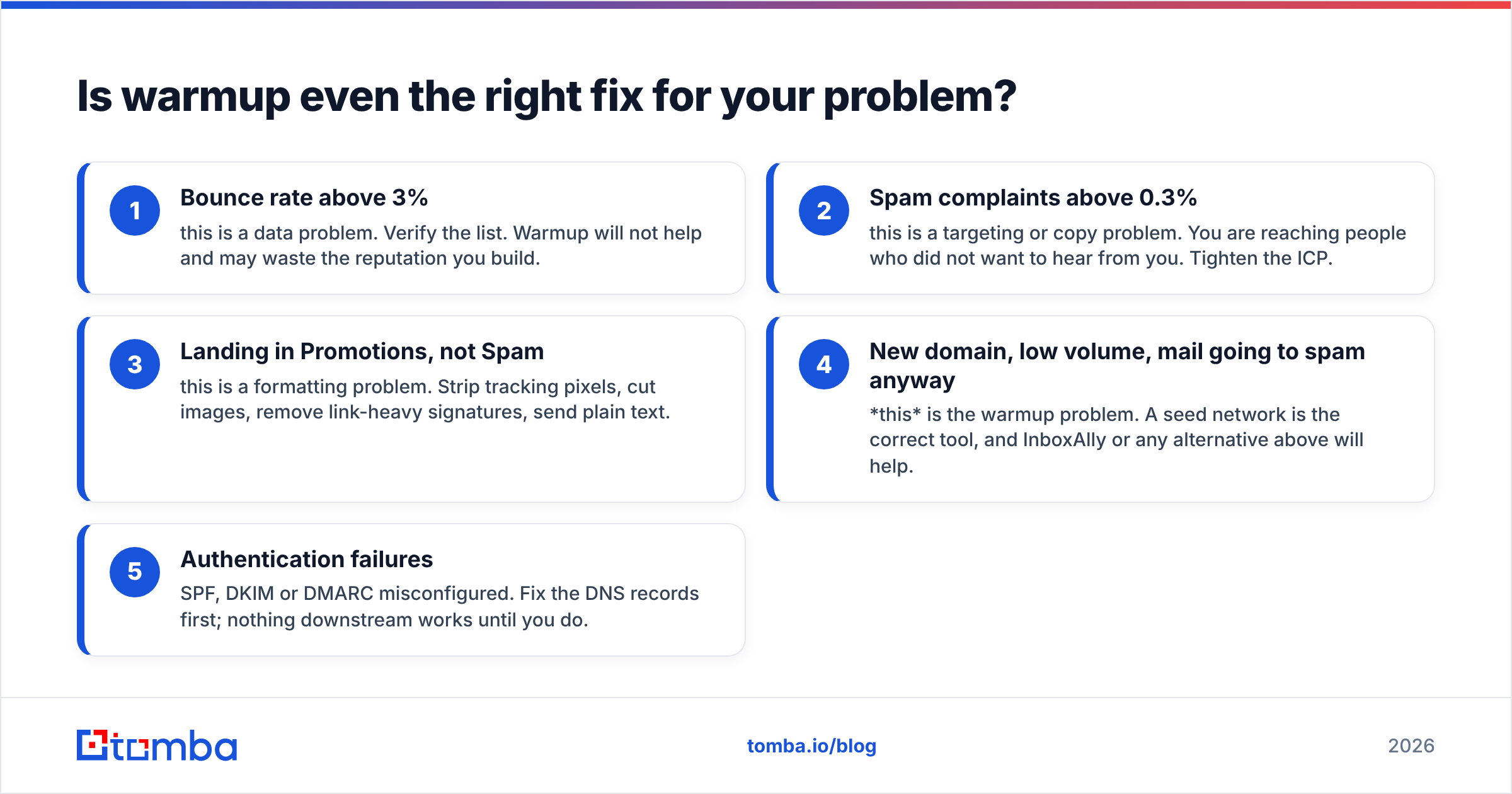
Run this diagnostic before you buy anything. Warmup only helps with one of these four failure modes:
- Bounce rate above 3% - this is a data problem. Verify the list. Warmup will not help and may waste the reputation you build.
- Spam complaints above 0.3% - this is a targeting or copy problem. You are reaching people who did not want to hear from you. Tighten the ICP.
- Landing in Promotions, not Spam - this is a formatting problem. Strip tracking pixels, cut images, remove link-heavy signatures, send plain text.
- New domain, low volume, mail going to spam anyway - this is the warmup problem. A seed network is the correct tool, and InboxAlly or any alternative above will help.
- Authentication failures - SPF, DKIM or DMARC misconfigured. Fix the DNS records first; nothing downstream works until you do.
Most teams that churn off warmup tools were in bucket 1 or 2 and bought a bucket-4 solution. That is the expensive mistake this list is meant to prevent.
What does a working deliverability stack look like in 2026?#
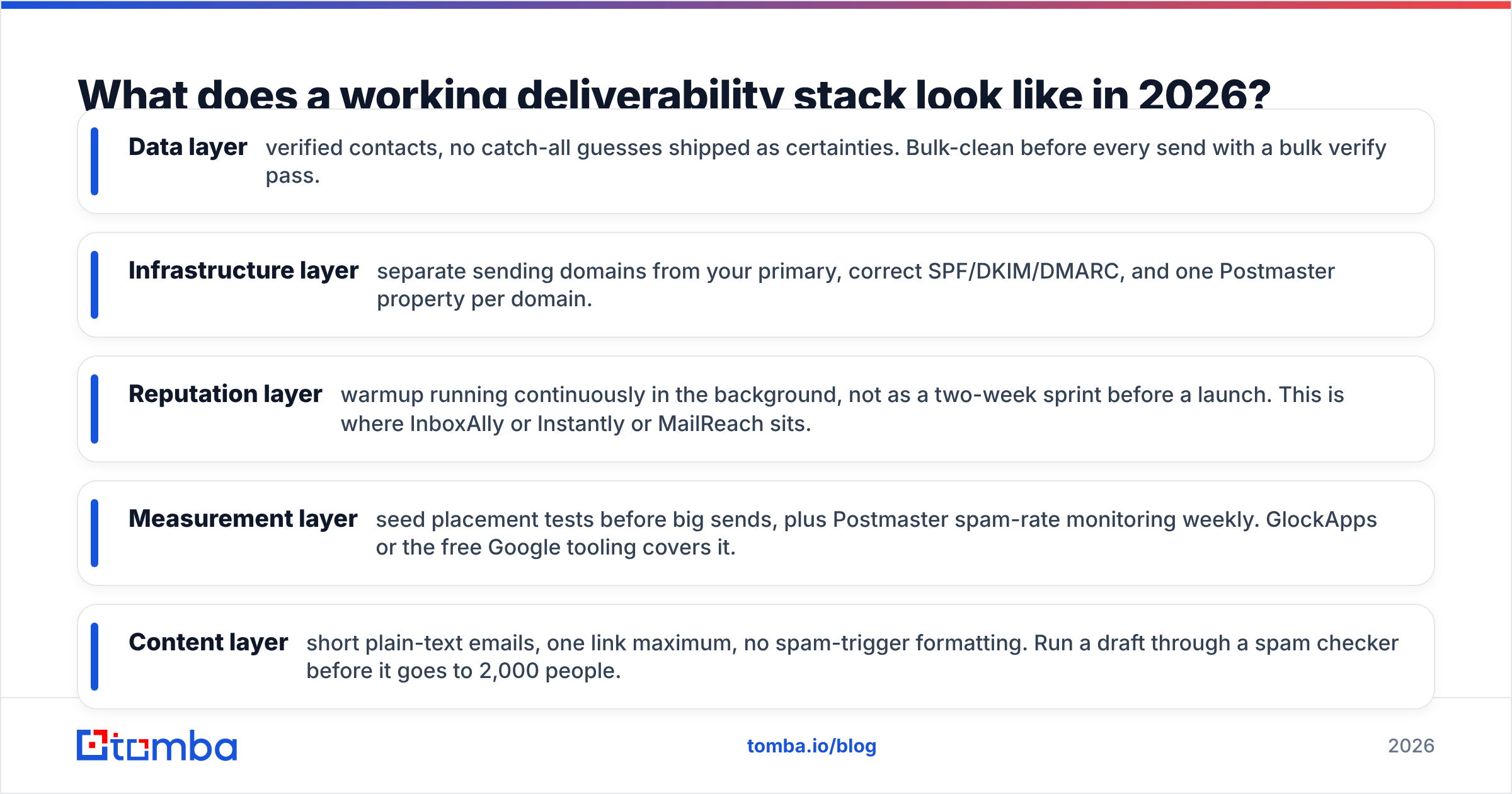
Four layers, and you need all of them. Skipping one is what breaks the other three.
- Data layer - verified contacts, no catch-all guesses shipped as certainties. Bulk-clean before every send with a bulk verify pass.
- Infrastructure layer - separate sending domains from your primary, correct SPF/DKIM/DMARC, and one Postmaster property per domain.
- Reputation layer - warmup running continuously in the background, not as a two-week sprint before a launch. This is where InboxAlly or Instantly or MailReach sits.
- Measurement layer - seed placement tests before big sends, plus Postmaster spam-rate monitoring weekly. GlockApps or the free Google tooling covers it.
- Content layer - short plain-text emails, one link maximum, no spam-trigger formatting. Run a draft through a spam checker before it goes to 2,000 people.
Get layers one and two right and you often need much less of layer three. That is the cheapest possible outcome, and it is the one most vendors have no incentive to tell you about.
Which InboxAlly alternative should you pick?#
- You already pay for a sequencer you dislike - move to Instantly or Smartlead and get warmup free with the switch.
- You like your sequencer and warm 3-5 inboxes - MailReach or Warmup Inbox, sequencer-agnostic, cheaper than $149/mo.
- You need to know exactly where mail lands - GlockApps plus Google Postmaster Tools, mostly free.
- You have an enterprise domain that is genuinely burned - Folderly's managed service, and expect enterprise pricing.
- Your bounce rate is the actual problem - stop shopping for warmup and clean the list first.
Start where the damage begins#
Warmup tools rebuild reputation you have already spent. Verification stops you spending it. If your last campaign bounced above 3%, the cheapest deliverability fix available to you this quarter is not a seed network - it is a clean list.
Run your next prospect list through the Tomba Email Finder to build it from verified, source-backed addresses instead of permutation guesses. The free tier gives you 25 searches to test the difference against your current data, and Starter at $49/mo costs a third of a standalone warmup subscription. Fix the input, and the inbox placement problem gets a lot smaller.
Related guides#
// get started
Find, verify and enrich your first contacts today
Start on the free plan with 25 searches a month, then scale when your team is ready.
Free plan · No credit card required · GDPR & CCPA
Get the Tomba newsletter
Product and data updates
// about the author