7 Best InboxAware Alternatives for 2026 (Tested & Ranked)
InboxAware bundles list verification with deliverability diagnostics, but it is not the only way to protect your sender reputation. Here are seven alternatives compared on price, data depth, and what they actually fix.

TL;DR
- InboxAware sits in an awkward middle: part list verifier, part deliverability auditor. Most teams end up needing one of those jobs done much better than the other.
- If your real problem is bad addresses, a dedicated verifier plus a finder (Tomba, ZeroBounce, NeverBounce) is cheaper and more accurate per credit.
- If your real problem is inbox placement, seed-test and reputation tools (GlockApps, MailReach, Google Postmaster Tools) diagnose things no verifier can see.
- Pricing is the quiet differentiator. Credit-based verification runs from fractions of a cent per email; placement testing is billed per seed test or per inbox.
- Best all-rounder for outbound teams that need to find and verify contacts in one place: Tomba, starting free and $49/mo on Starter.
What does InboxAware actually do?#
InboxAware is an email deliverability platform that combines list hygiene with sender diagnostics. The pitch is a single dashboard: upload a list, get invalid and risky addresses flagged, then run domain-level checks — SPF, DKIM, DMARC, blacklist status, DNS configuration — so you can see whether the problem is your data or your infrastructure. You can review the current feature set on the official InboxAware site.
That bundling is genuinely useful for a marketing team that inherited a decaying list and has no idea where to start. It is less useful once you know where the bleeding is. A team sending 40,000 cold emails a month from ten warmed domains has a very different problem from a newsletter team with a five-year-old list of 300,000 subscribers — and the tool that serves one well tends to be mediocre for the other.
That is the honest reason most people search for InboxAware alternatives: not because the product is broken, but because a bundled tool charges you for half a product you are not using.
Why do teams look for InboxAware alternatives?#
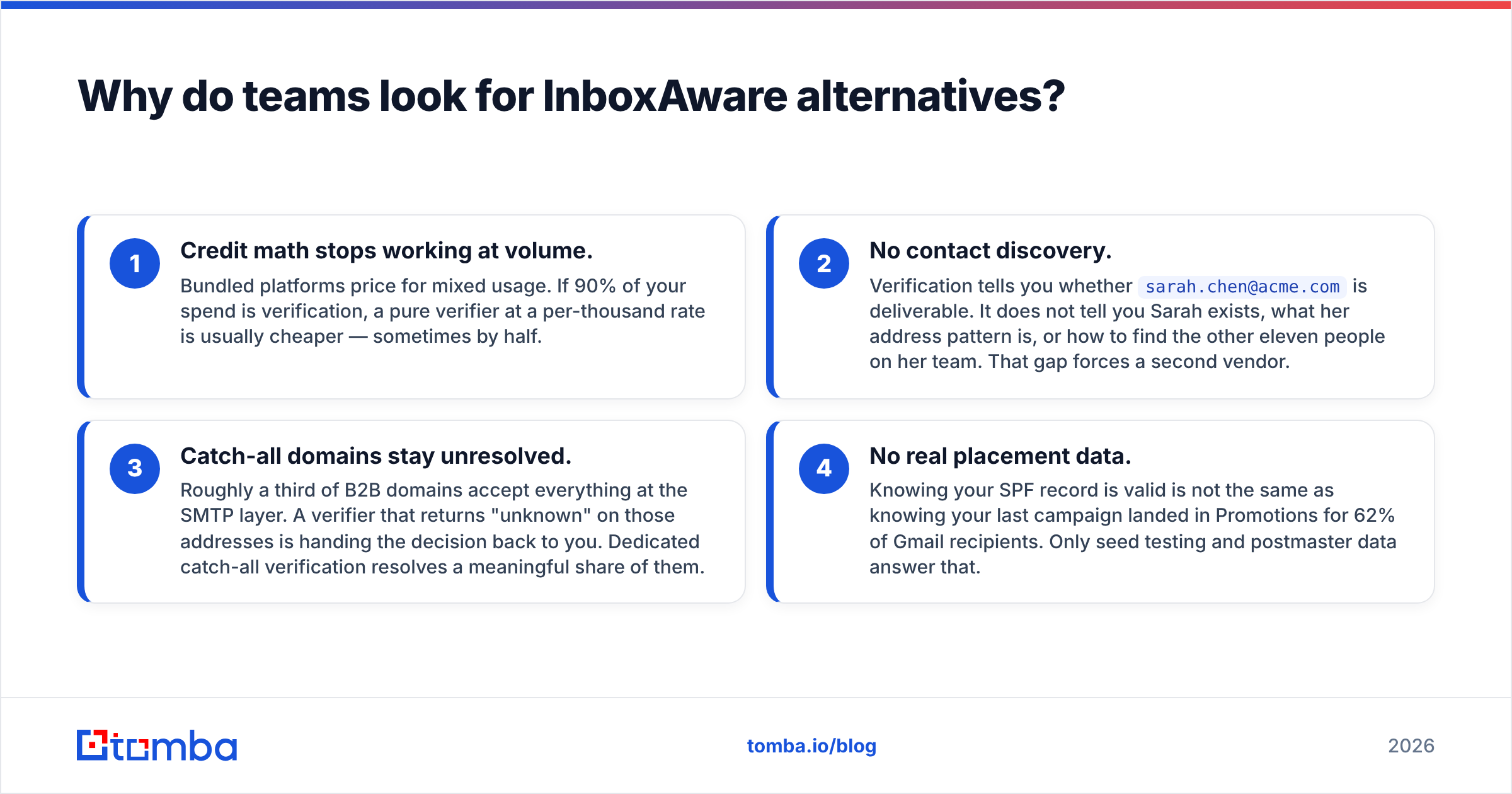
Four patterns come up repeatedly when teams switch:
- Credit math stops working at volume. Bundled platforms price for mixed usage. If 90% of your spend is verification, a pure verifier at a per-thousand rate is usually cheaper — sometimes by half.
- No contact discovery. Verification tells you whether
sarah.chen@acme.comis deliverable. It does not tell you Sarah exists, what her address pattern is, or how to find the other eleven people on her team. That gap forces a second vendor. - Catch-all domains stay unresolved. Roughly a third of B2B domains accept everything at the SMTP layer. A verifier that returns "unknown" on those addresses is handing the decision back to you. Dedicated catch-all verification resolves a meaningful share of them.
- No real placement data. Knowing your SPF record is valid is not the same as knowing your last campaign landed in Promotions for 62% of Gmail recipients. Only seed testing and postmaster data answer that.
What should you compare before switching?#
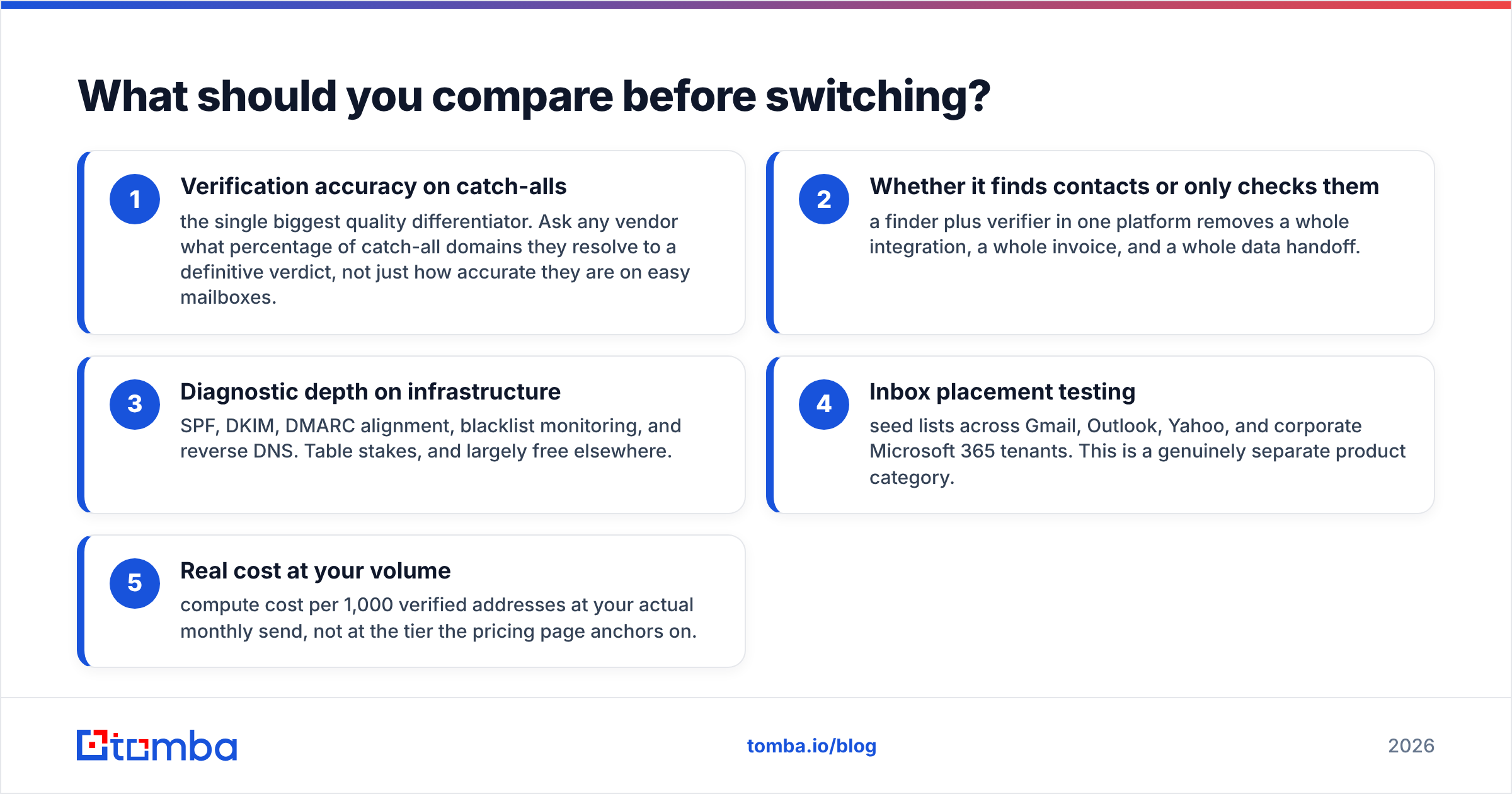
Score any replacement against these five criteria rather than the feature grid on its homepage:
- Verification accuracy on catch-alls — the single biggest quality differentiator. Ask any vendor what percentage of catch-all domains they resolve to a definitive verdict, not just how accurate they are on easy mailboxes.
- Whether it finds contacts or only checks them — a finder plus verifier in one platform removes a whole integration, a whole invoice, and a whole data handoff.
- Diagnostic depth on infrastructure — SPF, DKIM, DMARC alignment, blacklist monitoring, and reverse DNS. Table stakes, and largely free elsewhere.
- Inbox placement testing — seed lists across Gmail, Outlook, Yahoo, and corporate Microsoft 365 tenants. This is a genuinely separate product category.
- Real cost at your volume — compute cost per 1,000 verified addresses at your actual monthly send, not at the tier the pricing page anchors on.
Most teams discover they need two of those five things badly and can ignore the rest.
Which InboxAware alternatives are worth paying for in 2026?#
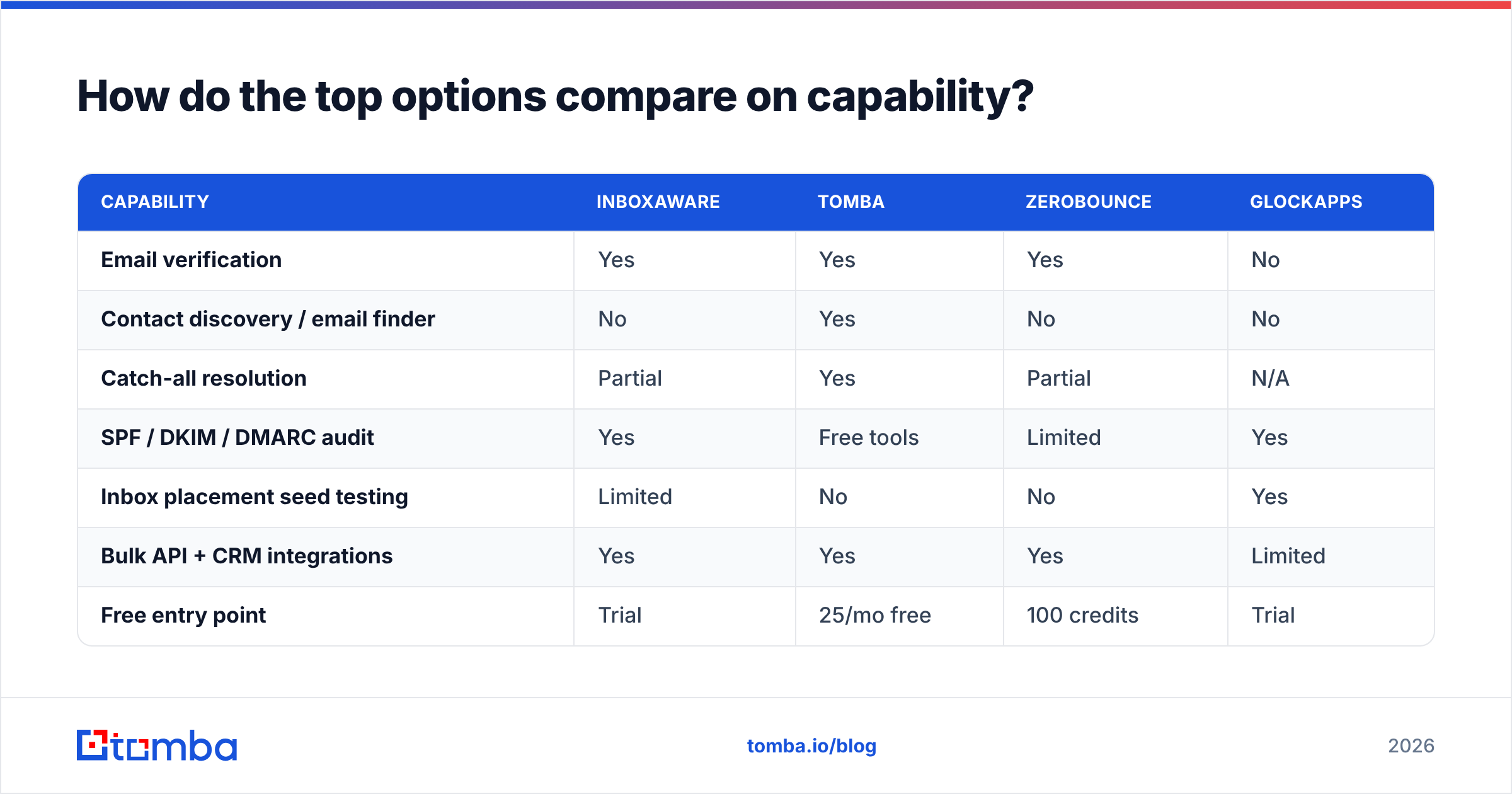
| Tool | Best for | Core strength | Entry price | Free tier |
|---|---|---|---|---|
| Tomba | Outbound teams needing find + verify | Email finder, verifier, catch-all resolution, enrichment in one API | $49/mo Starter | 25 searches/mo |
| ZeroBounce | High-volume list cleaning | Mature verification engine, activity data | ~$18 / 2,000 credits | 100 credits/mo |
| NeverBounce | One-off bulk cleans | Pay-as-you-go, no subscription pressure | ~$0.008/email | 1,000 free trial |
| GlockApps | Diagnosing placement | Seed testing across major providers, spam-filter reports | ~$59/mo | Limited trial |
| MailReach | Warmup + reputation repair | Automated warmup, per-inbox reputation scoring | ~$25/inbox/mo | Trial only |
| Google Postmaster Tools | Gmail-specific reputation | First-party domain and IP reputation data | Free | Free |
| Bouncer | EU/GDPR-sensitive teams | Strong compliance posture, clean API | ~$8 / 1,000 | 100 credits |
| BookYourData | Buying verified contacts outright | Pay-as-you-go verified B2B records, no subscription | Pay per record | Sample available |
Prices reflect published rates as of September 2026 and shift often — confirm on each vendor's site before committing.
Two things stand out in that table. First, the "deliverability tool" label covers three distinct jobs — cleaning, diagnosing, and warming — and no single product is best at all three. Second, the cheapest fix for a lot of teams is free: Google Postmaster Tools gives you reputation data straight from the largest mailbox provider on earth, and nobody resells that better than Google does.
1. Tomba — best if you need to find contacts, not just check them#
Tomba's centre of gravity is the email finder: give it a domain and a name, or just a domain, and it returns verified professional addresses with confidence scores and sources. The verification layer sits underneath rather than beside it, so an address is validated at the moment it is discovered instead of in a separate batch job three days later.
For teams migrating off a bundled deliverability tool, the practical win is consolidation. Domain search, email verification, catch-all handling, phone lookup, and enrichment run through one API and one credit pool. Pricing is transparent — free tier at 25 searches/month, Starter at $49/mo, Growth at $99/mo, Pro at $249/mo, with enterprise custom. Full details are on the Tomba pricing page.
Where it is not the answer: Tomba does not run seed-list placement tests or warm your inboxes. If your addresses are fine and your reputation is the problem, pair it with a placement tool.
2. ZeroBounce — best for cleaning a large legacy list#
ZeroBounce is the default recommendation when someone has 200,000 subscribers of unknown vintage. The engine is mature, the reporting is detailed, and the extras — abuse-address detection, activity scoring, toxic-domain flags — earn their keep on consumer lists in particular. Credit pricing scales down at volume, so a single large clean is often cheaper than a year of a bundled subscription.
Weakness: it is a checking tool. It will never tell you who to email.
3. NeverBounce — best for occasional, no-commitment cleans#
If you clean a list twice a year, a subscription is a bad instrument. NeverBounce's pay-as-you-go model fits that rhythm, and the bulk upload flow is about as simple as this category gets. Accuracy on standard mailboxes is competitive; catch-all handling is where you should test it against a second vendor before trusting a big send.
4. GlockApps — best for finding out where your mail actually lands#

This is the tool that answers the question a verifier cannot. GlockApps sends your campaign to a seed list across Gmail, Outlook, Yahoo, and corporate tenants, then shows you the inbox-versus-spam-versus-missing split per provider, along with the spam-filter rules you tripped. If your open rates fell off a cliff while your bounce rate stayed flat, this is the diagnostic you need — not more verification.
5. MailReach — best for repairing a burned domain#
Warmup tools generate legitimate-looking conversation between managed inboxes so providers rebuild trust in your domain. MailReach does this well and reports a per-inbox reputation score you can actually track week to week. It is remedial, not preventative — and it is billed per inbox, which gets expensive fast across a large sending fleet.
6. Google Postmaster Tools — the free baseline nobody sets up#
Google Postmaster Tools gives you domain reputation, IP reputation, spam-rate complaints, and authentication pass rates for mail you send to Gmail addresses. It costs nothing, requires a DNS TXT record to verify, and is more authoritative about Gmail than any third party can be. If your spam complaint rate is above 0.3% here, no verification vendor will save you. Set this up before you buy anything.
7. BookYourData — best when the gap is contacts, not hygiene#
Sometimes the honest diagnosis is that your list is small, not dirty. BookYourData sells verified B2B contact records on a pay-as-you-go basis with no subscription, which suits teams that need a targeted list for a single campaign or a new territory. It is a well-regarded option in that specific lane, and it solves a different problem than a deliverability auditor does — worth naming explicitly, because plenty of teams buy a hygiene tool when what they needed was more contacts.

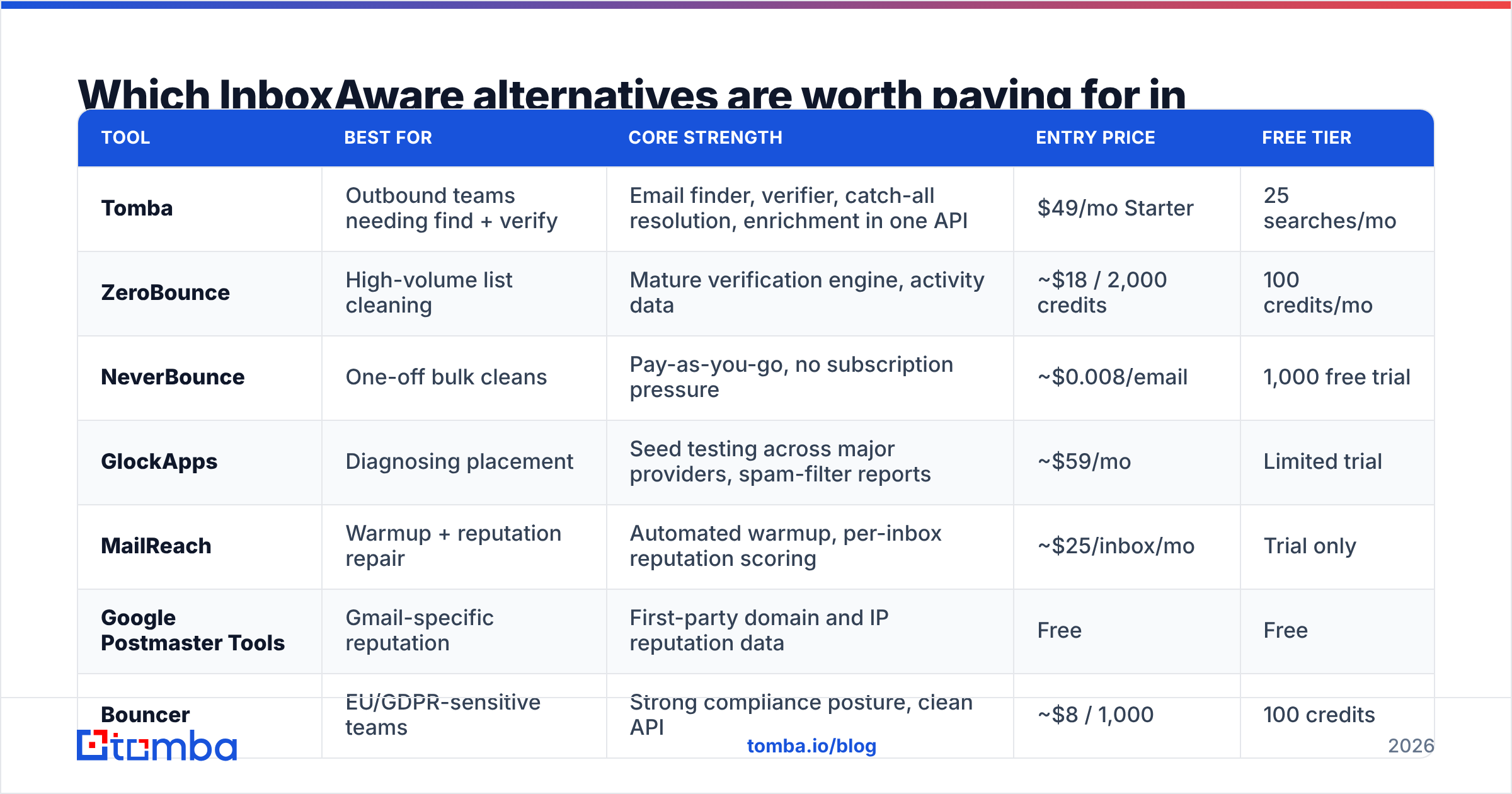
How do the top options compare on capability?#
| Capability | InboxAware | Tomba | ZeroBounce | GlockApps |
|---|---|---|---|---|
| Email verification | Yes | Yes | Yes | No |
| Contact discovery / email finder | No | Yes | No | No |
| Catch-all resolution | Partial | Yes | Partial | N/A |
| SPF / DKIM / DMARC audit | Yes | Free tools | Limited | Yes |
| Inbox placement seed testing | Limited | No | No | Yes |
| Bulk API + CRM integrations | Yes | Yes | Yes | Limited |
| Free entry point | Trial | 25/mo free | 100 credits | Trial |
The pattern is clear once it is laid out: verification and placement testing are separate purchases, and any product claiming to do both well is making a trade somewhere. The cheapest credible stack for most B2B outbound teams is a finder-plus-verifier for the data side, free postmaster and DNS tooling for the infrastructure side, and a seed-testing tool bought only when placement genuinely degrades.
Is a verification tool enough to fix deliverability?#
No — and this is the most expensive misconception in the category.
Think of it like a restaurant failing a health inspection. Throwing out spoiled ingredients (verification) is necessary, but it does nothing about the broken refrigerator (authentication), the complaints already filed (reputation), or the reviewer who told everyone (blocklists). Clean data prevents future damage; it does not undo damage already recorded against your domain.
A workable order of operations:
- Authenticate first. Publish SPF, DKIM, and a DMARC policy. DMARC alignment is now effectively mandatory for bulk senders at Google and Yahoo. Run a free SPF checker to confirm your record resolves and stays under the ten-lookup limit.
- Check your blocklist status. One listing on a major RBL can suppress an entire domain's delivery.
- Verify the list. Bounce rate above 2% is a reputation event, not a data-quality inconvenience.
- Measure placement. Seed tests plus Gmail postmaster data tell you whether the fixes worked.
- Warm slowly. Volume ramps, not step functions.
Skipping straight to step three — buying a verifier because bounce rate is the number you can see — is why teams churn through deliverability tools without their numbers improving.
Which InboxAware alternative should you pick?#
- You run outbound and need new contacts every week → Tomba. Find, verify, and enrich in one place; the bulk email finder handles list-scale jobs and the Tomba API drops into your existing pipeline.
- You have a large, old marketing list → ZeroBounce or NeverBounce for a one-time clean, then re-verify quarterly.
- Your open rates dropped but bounces did not → GlockApps plus Google Postmaster Tools. This is a placement problem, not a data problem.
- Your domain is already burned → MailReach for warmup, and pause cold sending from that domain entirely for 3–4 weeks.
- You need more contacts, not cleaner ones → a verified data provider such as BookYourData, or domain-level discovery.
- You are cost-sensitive and technical → free DNS/blocklist tooling, postmaster data, and a pay-as-you-go verifier. Total cost under $50/month for most senders.
What is the real cost difference?#
Run the numbers at your own volume before switching. For a team verifying 20,000 addresses per month and finding 2,000 new contacts:
- Bundled deliverability platform: one subscription, but you are paying for placement features you may use twice a year.
- Verifier-only stack: roughly $80–160/month in credits, plus a separate finder subscription, plus the engineering time to join two datasets.
- Consolidated finder-plus-verifier: Tomba Growth at $99/mo covers both jobs in one credit pool and one integration.
The consolidation argument is not about the sticker price. It is about the second invoice, the second API key, and the CSV that sits between them going stale.
Ready to replace the guesswork?#
If your reason for looking at InboxAware alternatives is that you need more good contacts rather than a prettier audit of the bad ones, start with the Tomba Email Finder. Search by domain, name, or company, get confidence-scored addresses verified at the point of discovery, and stop paying two vendors to do one job. The free tier gives you 25 searches a month with no card — enough to benchmark accuracy against whatever you are running today before you renew anything.
Related guides#
// get started
Find, verify and enrich your first contacts today
Start on the free plan with 25 searches a month, then scale when your team is ready.
Free plan · No credit card required · GDPR & CCPA
// about the author