Incentive Plan for Sales Team: Structures That Work in 2026
Most sales incentive plans fail on math, not motivation. Here is how to design pay mix, quotas, accelerators, and governance that reps trust and finance can actually fund.
TL;DR
- An incentive plan for a sales team is a written contract between three parties who all want different things: the rep (predictable upside), the manager (behavior change), and finance (a cost of sale that scales down as revenue scales up).
- Pay mix matters more than commission rate. A 50/50 split for a closer and an 80/20 split for a customer success manager will produce completely different behavior at the same total OTE.
- Quota credibility is the whole game. If fewer than 60% of your reps hit plan, the plan is a lottery ticket, not an incentive — and your best people will read it that way.
- Accelerators above 100% attainment beat higher base rates for driving the top decile. Caps are almost always a mistake you pay for during the next hiring cycle.
- No comp plan survives bad data. If reps burn a third of their week on dead contacts and wrong titles, you are paying commission on a broken input.
What is an incentive plan for a sales team?#
An incentive plan for a sales team is the documented system that converts selling outcomes into variable pay. It covers who gets paid, for what result, at what rate, on what schedule, and under which exceptions.
Think of it like the wiring in a house. Nobody admires it, nobody talks about it at dinner, and it is invisible when it works. But run one circuit wrong and the whole floor goes dark at the worst possible moment — usually the last week of Q4. Technically, the plan is a set of measurement rules, crediting rules, and payout curves attached to a role.
The mistake most companies make is treating the plan as a motivation document. It is not. Motivation comes from the manager, the territory, and the product. The plan's job is narrower and harder: to make the math of doing the right thing obviously better than the math of doing the convenient thing.
A plan that pays the same on a 12-month deal and a 36-month deal will get you 12-month deals. A plan that pays on booked revenue with no clawback will get you bookings that churn in month four. Reps are not gaming you when this happens — they are reading your plan correctly.
What are the core components of every sales incentive plan?#
Before you argue about percentages, get these six pieces on paper. Every disagreement about a comp plan is really a disagreement about one of them.
- On-target earnings (OTE) — Total cash a rep earns at exactly 100% of quota, base plus variable. This is your market-competitiveness lever. Benchmark it by role and region, not by what you paid the last hire.
- Pay mix — The base-to-variable ratio inside OTE, written as 60/40, 50/50, 70/30. Higher variable means more risk transferred to the rep and more aggression in the field. Lower variable suits long, consultative, multi-stakeholder cycles.
- Quota and attainment curve — The target number and the shape of payout above and below it. Includes thresholds (the floor where commission starts), accelerators, and decelerators.
- Crediting rules — Who gets credit when an SDR sources it, an AE closes it, a partner referred it, and a solutions engineer saved it. Split credit generously; ambiguity here poisons teams faster than a low rate.
- Payout timing and clawbacks — Monthly, quarterly, on booking, on invoice, or on cash collected. Clawback windows for early churn or non-payment. Reps discount future money heavily, so timing changes behavior as much as amount.
- Governance and exceptions — Who approves a quota relief, a windfall cap, a mid-year territory change. Decide before you need it, in writing, or every exception becomes a negotiation.
Which incentive plan structure fits your team?#
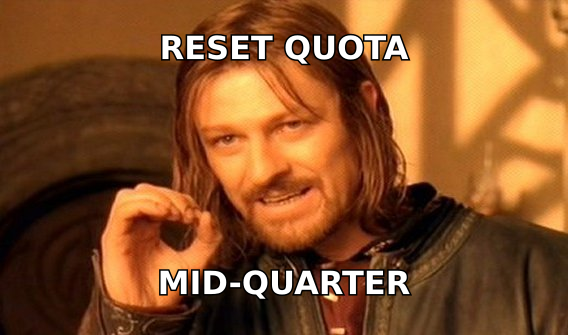
There is no universally correct model. There is a correct model for your sales cycle length, deal size, and how much of the outcome the rep actually controls. Here is how the six common structures compare.
| Structure | How it pays | Typical pay mix | Best for | Main risk |
|---|---|---|---|---|
| Straight commission | % of every dollar closed, no base | 0/100 | Independent contractors, real estate, high-churn transactional | Zero retention leverage; reps chase any deal |
| Base + commission | Flat rate on revenue above threshold | 50/50 to 60/40 | Mid-market and enterprise AEs | Flat rate under-rewards the top decile |
| Tiered / accelerated | Rate steps up past 100% attainment | 50/50 | Teams with a reliable top 20% | Costly if quotas are set too low |
| Gross-margin based | % of profit, not revenue | 60/40 | Reselling, services, discount-heavy markets | Reps need margin visibility or it feels arbitrary |
| MBO + commission | Part revenue, part scored objectives | 70/30 to 80/20 | SDRs, CS, partner managers, new-market plays | Subjective scoring erodes trust fast |
| Team / pooled | Shared pool split by role or seniority | 70/30 | Pod-based selling, complex enterprise motions | Free riders unless individual floors exist |
For most B2B SaaS teams with a 45- to 120-day cycle, base plus accelerated commission at a 50/50 mix is the default that survives contact with reality. Start there, then deviate only when you can name the specific behavior you are trying to buy.
How do you set a quota reps actually believe?#
Work backward from capacity, not forward from the board deck.
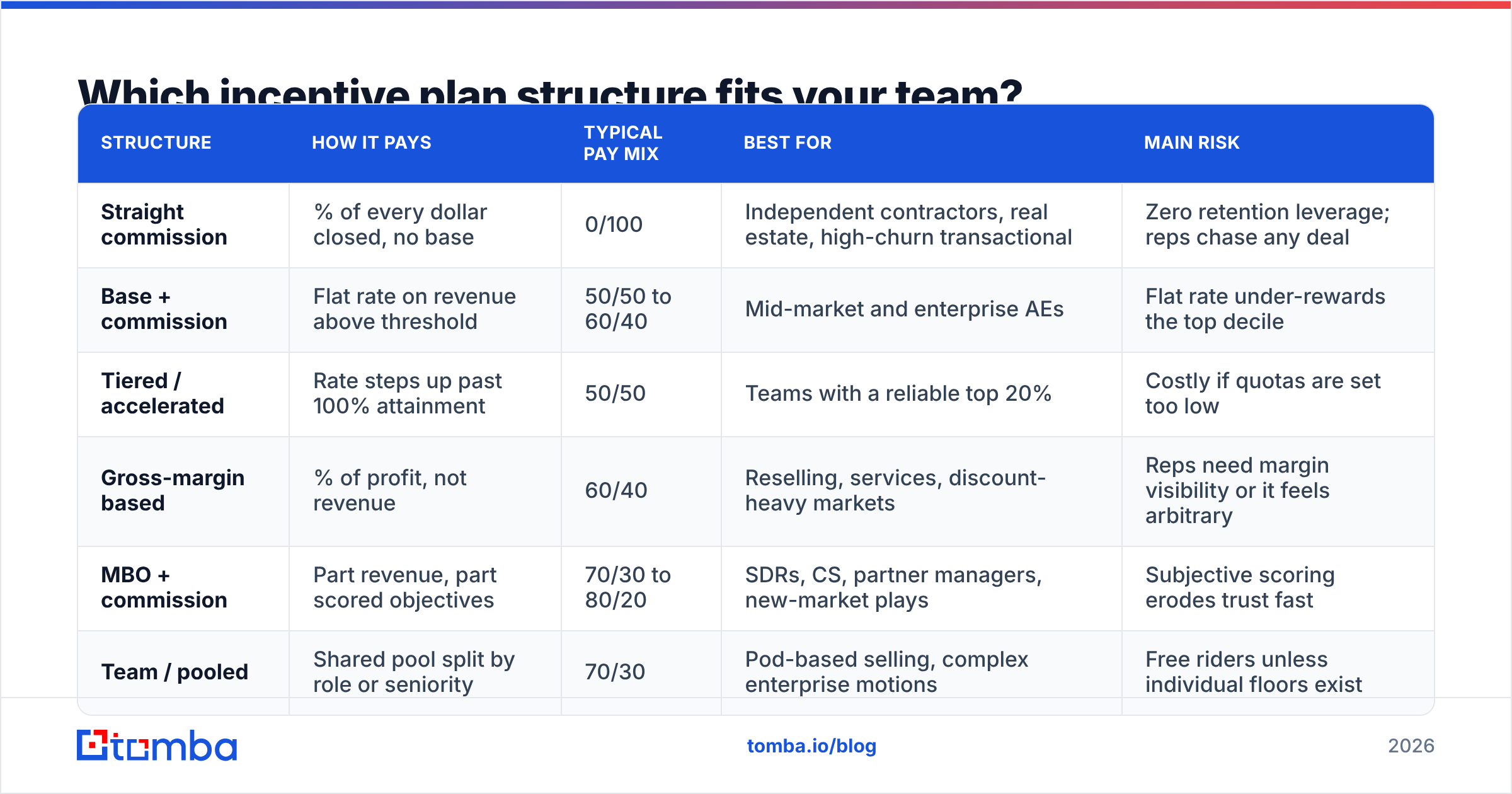
The forward method — take the revenue target, divide by headcount, add 20% "coverage" — is how you end up with a number nobody hits. The backward method starts with what one rep can physically produce: pipeline available in territory, historical win rate, average deal size, and cycle length.
A workable sanity test:
Quota = (qualified pipeline per rep per quarter) × (win rate) × (average contract value), discounted 15% for ramp, PTO, and churn of open opportunities.
Then check the distribution. Healthy plans land 60–70% of reps at or above quota, with the top decile at 150%+ and the bottom decile under 60%. If 95% of the team hits plan, your quotas are a payroll increase with extra steps. If 25% hit plan, you have designed a resignation letter.
Three quota rules that save arguments later:
- Ramp explicitly. New hires get 25% / 50% / 75% / 100% over four quarters, with guaranteed draws during ramp. Do not pretend a month-two rep has a month-twelve territory.
- Freeze mid-period. Changing quota inside a live period, even upward for good reasons, tells the team the number is negotiable. Adjust at period boundaries only.
- Publish the territory math. Reps accept a hard number they can audit. They will not accept a number that appeared from a spreadsheet they have never seen.
Should you cap commissions or use accelerators?#
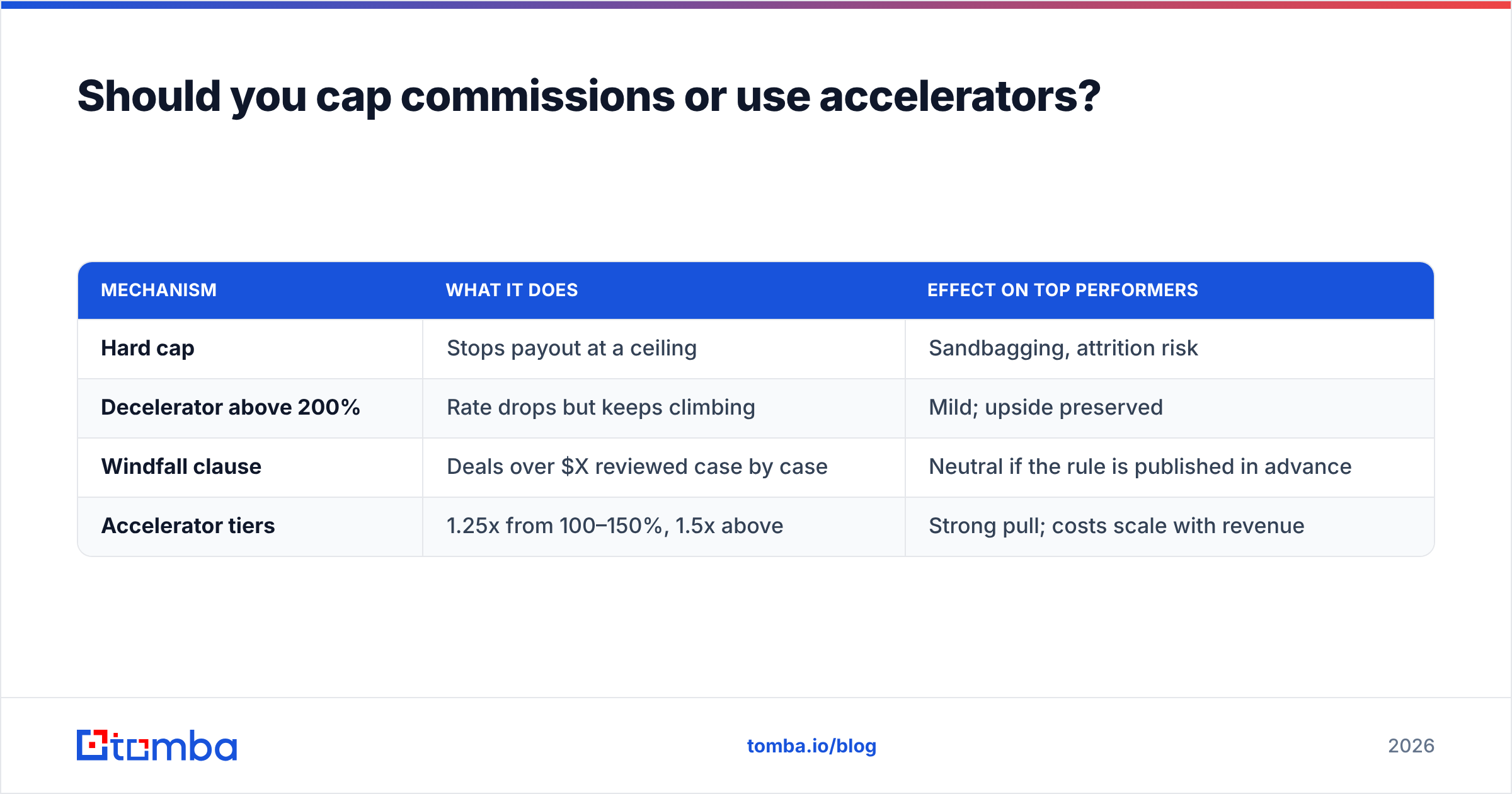
Do not cap. Use accelerators, and control cost through quota-setting instead.
The argument for a cap is always the windfall scenario: a rep lands a $2M deal from an inbound lead and earns more than the VP. That feels wrong to a compensation committee. But the cost of a cap is structural — your best rep learns that effort past a line is free labor, and either sandbags the deal into next quarter or takes a call from your competitor.
Better tools for the windfall problem:
| Mechanism | What it does | Effect on top performers |
|---|---|---|
| Hard cap | Stops payout at a ceiling | Sandbagging, attrition risk |
| Decelerator above 200% | Rate drops but keeps climbing | Mild; upside preserved |
| Windfall clause | Deals over $X reviewed case by case | Neutral if the rule is published in advance |
| Accelerator tiers | 1.25x from 100–150%, 1.5x above | Strong pull; costs scale with revenue |
Accelerators are the single highest-leverage line in most plans. Moving from a flat 10% to 8% base / 14% accelerated above quota often costs the same total dollars but shifts attainment distribution upward, because the marginal deal in week eleven of the quarter is suddenly worth chasing.
Salesforce's own guidance on sales compensation design makes the same point in different language: variable pay should be steepest exactly where you want discretionary effort.
What does a good plan look like by role?#
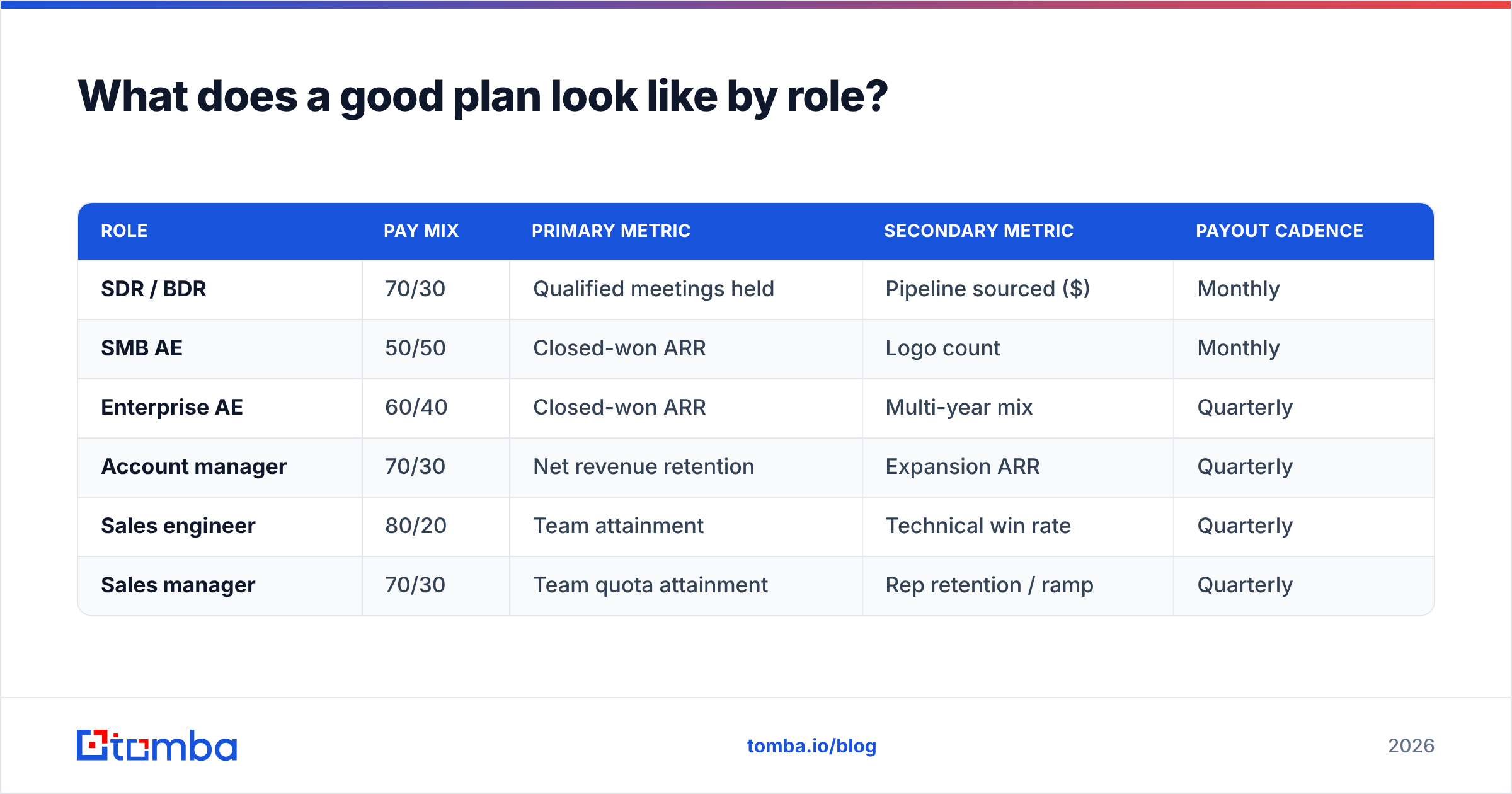
Not every seller should be on the same curve. The rule of thumb: the more control a role has over the closed outcome, the more variable pay it carries.
| Role | Pay mix | Primary metric | Secondary metric | Payout cadence |
|---|---|---|---|---|
| SDR / BDR | 70/30 | Qualified meetings held | Pipeline sourced ($) | Monthly |
| SMB AE | 50/50 | Closed-won ARR | Logo count | Monthly |
| Enterprise AE | 60/40 | Closed-won ARR | Multi-year mix | Quarterly |
| Account manager | 70/30 | Net revenue retention | Expansion ARR | Quarterly |
| Sales engineer | 80/20 | Team attainment | Technical win rate | Quarterly |
| Sales manager | 70/30 | Team quota attainment | Rep retention / ramp | Quarterly |
Two notes on the SDR line. Pay on meetings held and accepted by the AE, never on meetings booked — booking-only metrics reward volume spam and punish the AE who has to sit through it. And keep a secondary pipeline-dollar component so SDRs care whether the account was ever a fit.
That fit question is where data quality quietly decides the plan's outcome. An SDR working a list with 30% bounced addresses and stale titles cannot hit a meetings quota no matter how the curve is drawn. Cleaning the input with a proper email verifier and contact enrichment before the quarter starts changes attainment more than a two-point rate bump ever will.

What non-cash incentives actually change behavior?#
Cash sets the floor. Non-cash incentives are for the specific, temporary behaviors cash is too blunt to target.
- SPIFFs with a narrow window. A $500 bonus on every deal that includes the new module, running for six weeks. Short, specific, retired on schedule. SPIFFs that never end become entitlements.
- President's Club. Still the strongest retention tool in enterprise sales, because it is public, social, and hard to explain away. Publish the qualification bar on day one of the year.
- Choice-based rewards. Letting a rep pick between travel, equipment, or a charitable donation outperforms a fixed prize of the same value, which is consistent with the broader research on incentive program design.
- Career-path visibility. The clearest promotion criteria you can write. For mid-career reps, "what does it take to get the enterprise patch" is worth more than a SPIFF.
- Time. A guaranteed Friday off after a quota-crushing quarter costs almost nothing and is remembered longer than a gift card.
Avoid leaderboard-only incentives on teams smaller than eight. When three people can see the whole board, the bottom two disengage in week two.
How do you roll out and govern the plan?#
The rollout matters as much as the design. HubSpot's breakdown of sales compensation plans puts communication ahead of structure for a reason — a mediocre plan explained clearly beats an elegant plan reps do not trust.
A sequence that works:
- Model it against last year's actuals. Run every rep's prior-year results through the new plan. If a rep who hit 110% would have earned less, you have a problem to solve now, not in March.
- Pressure-test with two managers, not the whole team. Get the loopholes found by people who want the plan to work.
- Deliver in a live session, then in writing. One-page summary, full terms attached, worked examples for 80%, 100%, and 140% attainment.
- Give every rep a personal calculation. Their territory, their quota, their payout at three attainment levels. Generic plan docs get skimmed; a number with your own name on it gets read.
- Lock a review cadence. Monthly attainment review, quarterly design review, annual redesign. Publish the calendar so nobody wonders whether the rules are shifting.
- Track cost of sale, not just payout. Total comp divided by revenue booked, trended by quarter. That single ratio tells you whether the plan is scaling or leaking.
What are the most common incentive plan mistakes?#
- Too many metrics. Three components maximum. Four or more and reps optimize for whichever is easiest, which is rarely the one you care about.
- Retroactive changes. Adjusting rates after deals are in flight destroys trust permanently. Grandfather in-flight opportunities every time.
- Paying on bookings with no clawback. You will fund commission on revenue that never arrives. A 90- or 180-day clawback on non-payment is standard and defensible.
- Ignoring the ramp. New reps on full quota in month one churn at roughly double the rate of ramped reps.
- Uncontrolled exceptions. Every one-off approval becomes precedent. Write the exception policy first.
- Blaming the plan for a data problem. If response rate is collapsing because contact data is stale, no payout curve fixes it.
Where should you start?#
Pick the structure that matches your cycle, set quotas backward from capacity, add accelerators instead of caps, and publish the governance rules before anyone needs them. Then check your inputs — because a comp plan is only as good as the pipeline it sits on top of.
If your reps are missing quota because they cannot reach the right people, start upstream. Tomba Email Finder gives your team verified professional email addresses by name, domain, or company, so quota attainment reflects selling skill rather than list quality. The free tier covers 25 searches a month, and paid plans start at $49/mo — see Tomba pricing for the full breakdown, or run a list through the bulk email finder before your next quarter opens.
Related guides#
// get started
Find, verify and enrich your first contacts today
Start on the free plan with 25 searches a month, then scale when your team is ready.
Free plan · No credit card required · GDPR & CCPA
Get the Tomba newsletter
Product and data updates
// about the author