Incentive Program for Sales: How to Build One That Works
Most sales incentive programs pay out fine and change nothing. Here's how to design quotas, accelerators, SPIFFs, and non-cash rewards that actually move pipeline behavior in 2026.
TL;DR
- An incentive program for sales works when it pays for behavior you can repeat, not for deals that would have closed anyway.
- The 60/40 base-to-variable split is still the default for closing roles, but SDRs and CSMs need flatter mixes (70/30 or 80/20) or you get sandbagging and churn.
- Accelerators above quota drive more incremental revenue per dollar than raising base commission rates — they cost you nothing until reps overperform.
- SPIFFs are a scalpel, not a diet. Run them for 2-6 weeks on one specific behavior, then kill them.
- Non-cash rewards (recognition, choice of accounts, president's club) outperform equivalent cash on retention, and cost less.
- The most expensive part of any incentive plan is usually bad data — reps paid on activity they can't verify, or on contacts that bounce.
What is an incentive program for sales?#
An incentive program for sales is the set of rules that converts rep behavior into pay. That's it. It includes quota, commission rate, the base-to-variable split, accelerators, decelerators, SPIFFs, kickers, clawbacks, and any non-cash reward layered on top.
Think of it like a thermostat, not a bonus pool. You set a target temperature (the behavior you want), and the plan applies pressure until the room matches. If the room never changes temperature, the thermostat is broken — even if it's spending money the whole time.
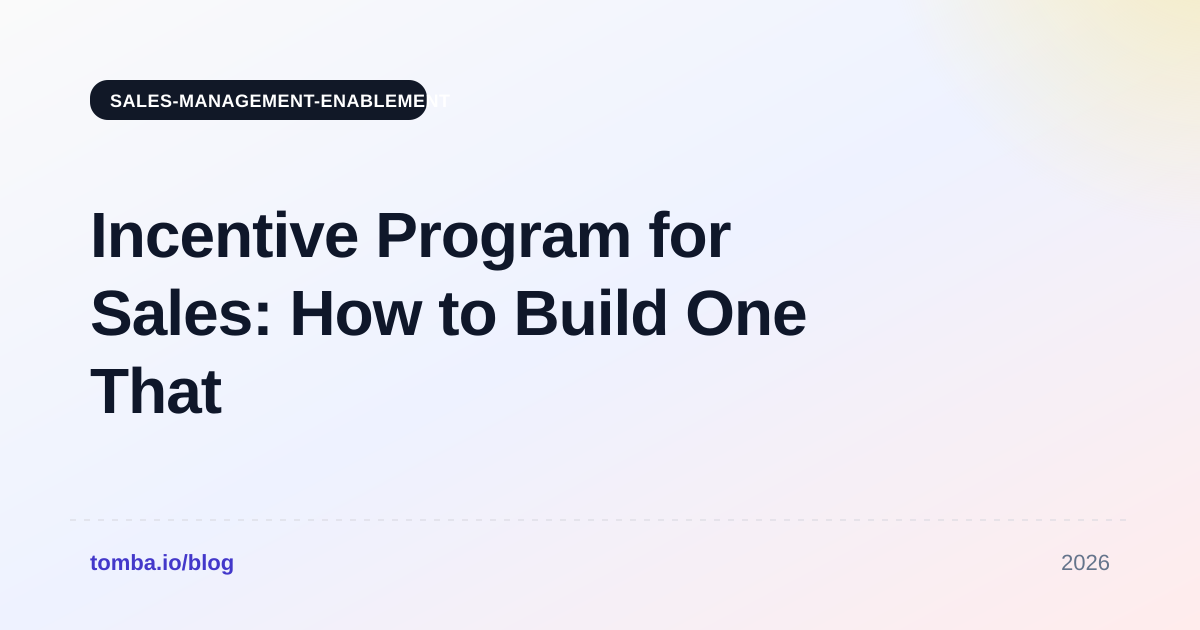
That reframe matters because most plans are audited on cost ("we paid out 4.2% of revenue in commission") when they should be audited on change ("multi-threaded deals went from 31% to 58% of closed-won"). A plan that pays out perfectly and changes nothing is a payroll line item, not an incentive.
The components you're actually designing:
- Quota — the number that defines "on target." Should be attainable by 60-70% of the team. Below 50% attainment and the plan reads as a lottery; above 85% and you're underpricing your reps' time.
- On-Target Earnings (OTE) — base plus variable at 100% quota. This is the number reps compare across job offers, so it's your recruiting instrument as much as your motivation instrument.
- Pay mix — how OTE splits between guaranteed base and at-risk variable. The more control a rep has over the outcome, the more variable you can justify.
- Accelerators and decelerators — rate changes above and below quota. Accelerators are the highest-ROI lever in the whole plan.
- SPIFFs and kickers — short-term, targeted payments for a specific action (new logos in a vertical, multi-year terms, a product line that's lagging).
- Non-cash rewards — recognition, territory choice, conference budget, president's club. Cheap, sticky, and consistently underused.

How should you structure pay mix by role?#
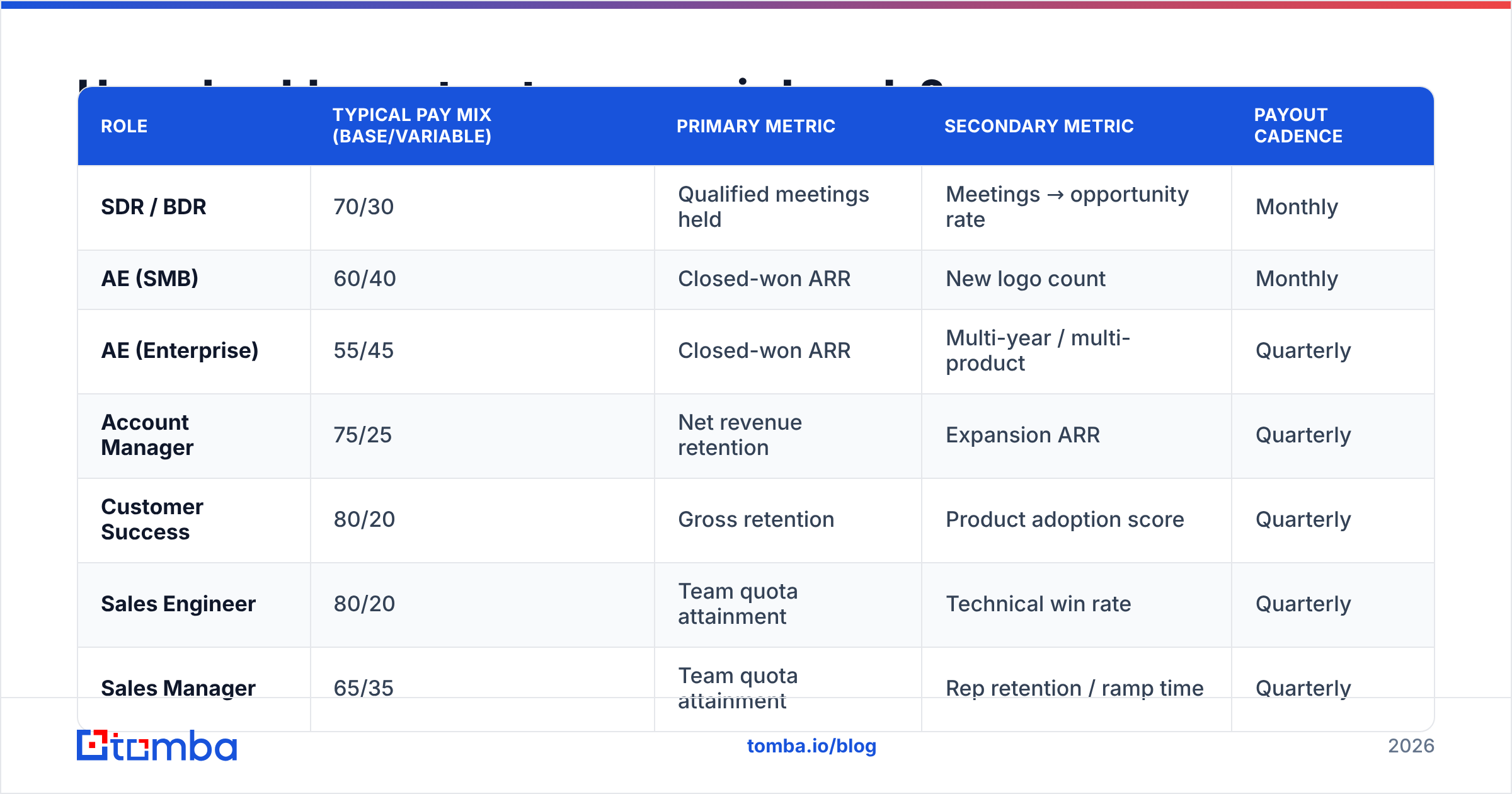
Match variable pay to control. A rep who personally negotiates and signs the contract can carry 40-50% variable. An SDR who books meetings but has no influence on whether the AE closes them cannot — pay them heavily variable and they'll optimize for meeting volume, book unqualified prospects, and quit in nine months.
Here's the structure that holds up across most B2B orgs:
| Role | Typical pay mix (base/variable) | Primary metric | Secondary metric | Payout cadence |
|---|---|---|---|---|
| SDR / BDR | 70/30 | Qualified meetings held | Meetings → opportunity rate | Monthly |
| AE (SMB) | 60/40 | Closed-won ARR | New logo count | Monthly |
| AE (Enterprise) | 55/45 | Closed-won ARR | Multi-year / multi-product | Quarterly |
| Account Manager | 75/25 | Net revenue retention | Expansion ARR | Quarterly |
| Customer Success | 80/20 | Gross retention | Product adoption score | Quarterly |
| Sales Engineer | 80/20 | Team quota attainment | Technical win rate | Quarterly |
| Sales Manager | 65/35 | Team quota attainment | Rep retention / ramp time | Quarterly |
Two things to notice.
First, the secondary metric exists to stop gaming the primary. An SDR paid only on meetings held will book anyone with a pulse. Add "meetings → opportunity rate" at 20-30% of their variable and the quality problem largely self-corrects, because the rep now eats their own bad qualification.
Second, cadence tracks deal cycle. Monthly payouts for SMB reps working 30-day cycles keep the feedback loop tight. Quarterly for enterprise, because a monthly cycle on a six-month deal is just noise. Salesforce's own guidance on commission structures lands in the same range, and G2's compensation category reviews show the same clustering across hundreds of vendor implementations.
Which incentive models actually change behavior?#
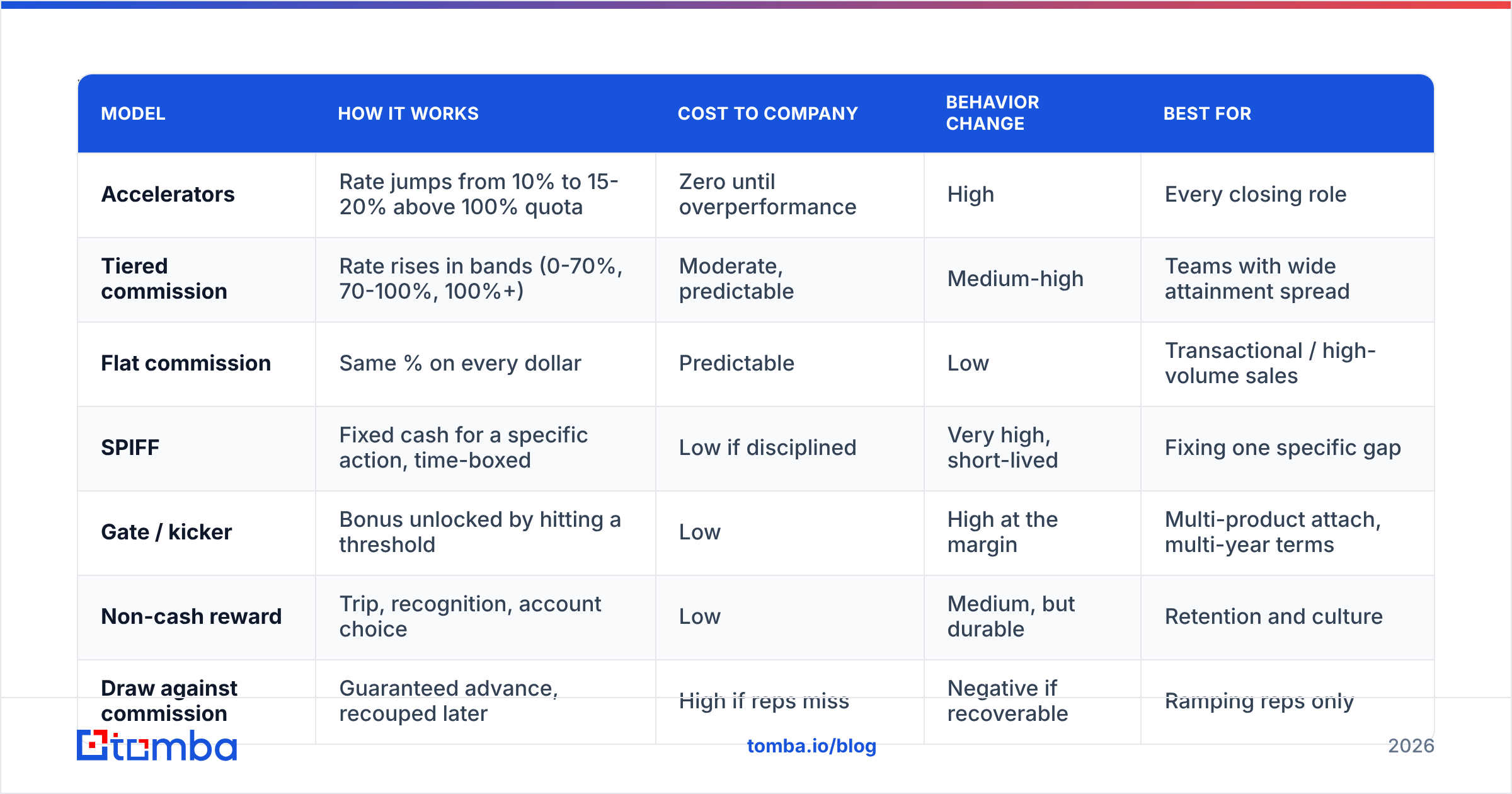
Not all payout structures are equal. Some are cheap and effective, some are expensive and inert. This is the honest ranking based on cost-per-behavior-changed:
| Model | How it works | Cost to company | Behavior change | Best for |
|---|---|---|---|---|
| Accelerators | Rate jumps from 10% to 15-20% above 100% quota | Zero until overperformance | High | Every closing role |
| Tiered commission | Rate rises in bands (0-70%, 70-100%, 100%+) | Moderate, predictable | Medium-high | Teams with wide attainment spread |
| Flat commission | Same % on every dollar | Predictable | Low | Transactional / high-volume sales |
| SPIFF | Fixed cash for a specific action, time-boxed | Low if disciplined | Very high, short-lived | Fixing one specific gap |
| Gate / kicker | Bonus unlocked by hitting a threshold | Low | High at the margin | Multi-product attach, multi-year terms |
| Non-cash reward | Trip, recognition, account choice | Low | Medium, but durable | Retention and culture |
| Draw against commission | Guaranteed advance, recouped later | High if reps miss | Negative if recoverable | Ramping reps only |
Accelerators are the single best line item in most plans. If your commission rate is 10% up to quota and 18% above it, you have created a situation where the 101st percent of quota is worth 80% more than the 99th. Reps feel that. The cost is entirely conditional — you only pay the premium on revenue you didn't budget for.
Recoverable draws are the worst. A rep who misses quota for two quarters now owes the company money, which is a spectacular way to guarantee they leave and take the pipeline with them. Use non-recoverable draws during ramp (first 3-6 months), then stop.
SPIFFs decay fast. The first "$500 for every closed deal in healthcare this month" produces a genuine surge. The fourth consecutive monthly SPIFF just becomes expected income, and reps start holding deals back to time them into SPIFF windows. Run them sparingly, on one behavior, with a hard end date.
How do you set a quota reps believe?#
Build quota from capacity, not from the board deck. The bottom-up math:
- Start with pipeline coverage. If your historical win rate is 22%, a rep needs roughly 4.5x quota in pipeline. Can they source or receive that much? If not, the quota is fiction regardless of how confident the spreadsheet looks.
- Subtract ramp. A new AE hitting full productivity in month five carries roughly 8 months of quota in year one, not 12. Plans that ignore this manufacture failure on day one.
- Check attainment distribution. After the first quarter, plot attainment. You want a rough bell curve centered near 100%, with 60-70% of reps at or above target. If 90% of the team is over, your quota is too low and you're overpaying. If 25% are over, you've built a lottery and your top performers are being taxed to fund a broken model.
- Segment by territory, not by seniority. A rep in a mature territory with 400 named accounts and one in a greenfield vertical should not carry identical numbers. Territory quality is the biggest uncontrolled variable in most comp plans.
- Cap nothing above quota. Capped commission is the fastest way to lose your top 10%. If a rep hits 300% of quota, pay them. That's a data problem in your quota model, not a rep problem — and you fix it next cycle, not by clawing back this one.
The failure mode nobody talks about: quota set on a data foundation that can't support it. If your reps are working from a contact list where 30% of emails bounce, you haven't set a quota — you've set a quota and a 30% tax on it. Before you touch the comp plan, audit list quality. Running prospect lists through an email verifier before they hit the sequence removes the single most common invisible drag on attainment, and it changes what a realistic quota even looks like.
What does a real incentive plan cost?#
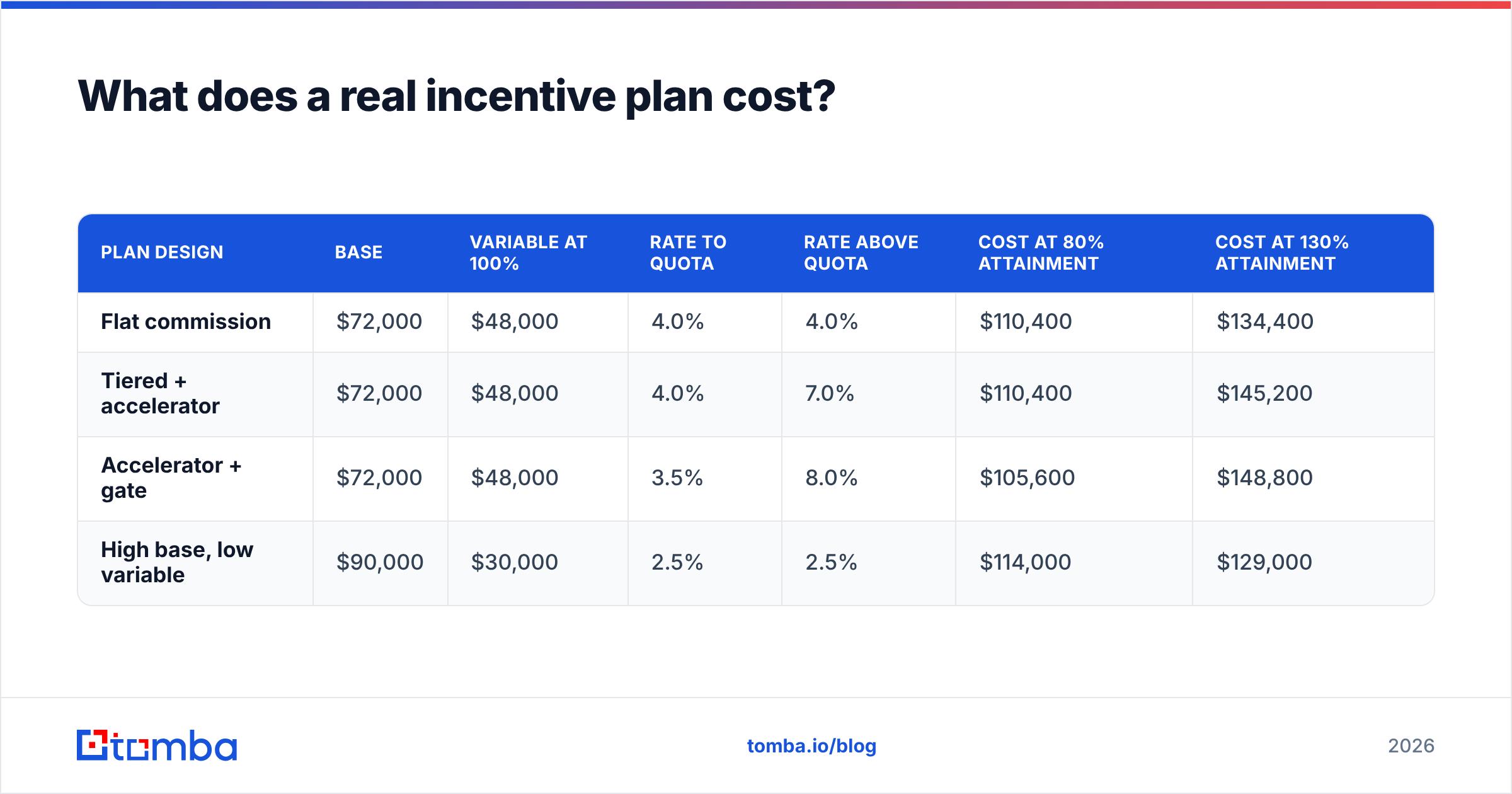
Sales compensation typically runs 10-25% of revenue for the full go-to-market org, with commission alone landing around 5-10% for closing roles. Here's how three plan shapes compare on a $120,000 OTE AE carrying $1.2M annual quota:
| Plan design | Base | Variable at 100% | Rate to quota | Rate above quota | Cost at 80% attainment | Cost at 130% attainment |
|---|---|---|---|---|---|---|
| Flat commission | $72,000 | $48,000 | 4.0% | 4.0% | $110,400 | $134,400 |
| Tiered + accelerator | $72,000 | $48,000 | 4.0% | 7.0% | $110,400 | $145,200 |
| Accelerator + gate | $72,000 | $48,000 | 3.5% | 8.0% | $105,600 | $148,800 |
| High base, low variable | $90,000 | $30,000 | 2.5% | 2.5% | $114,000 | $129,000 |
The accelerator plans cost less when reps underperform and more when they overperform — which is exactly the correlation you want. The high-base plan is the inverse: you pay a premium for underperformance and underpay your best people. It feels safer to finance and it is quietly the most expensive option over three years, because it drives your top quartile to competitors.
One more number worth holding onto: Gartner's sales research consistently finds that plan complexity is negatively correlated with plan effectiveness. If a rep can't calculate their own commission on a napkin, the plan is not motivating anyone — it's just producing surprise. Three components maximum. Quota, accelerator, one strategic kicker.

How do non-cash incentives compare to cash?#
Cash gets spent and forgotten; a trip gets talked about for two years. That's not sentiment, it's how memory and social status work — a $2,000 bonus disappears into rent, while a $2,000 experience becomes an identity marker the rep tells other people about.
Non-cash options ranked by durability per dollar:
- President's Club — the top-tier reward. Expensive per head, but it creates a visible in-group that reps orient a whole year around. The announcement matters as much as the trip.
- Territory and account choice — near-zero cost, high perceived value. Letting the top rep pick first from next year's account list is a real prize.
- Public recognition with specifics — "Maria closed the Acme deal by getting three stakeholders on one call" beats "great job team." Specificity is what makes recognition land.
- Development budget — conference tickets, coaching, certifications. Signals investment, not just payment.
- Time — an extra Friday off for the quarter's top performer costs one day of capacity and buys enormous goodwill.
Layer these on top of cash, never instead of it. Non-cash rewards are a multiplier on a fair cash plan; they cannot rescue an unfair one. A rep who feels underpaid does not want a branded jacket.
What are the mistakes that quietly kill incentive plans?#
Changing the plan mid-year. Nothing destroys trust faster. If a rep builds a year around a plan and you rewrite it in Q3 because someone is earning "too much," you've taught the entire team that overperformance is punished. Hold the plan for the full period, fix the model at the boundary.
Paying on bookings you can't collect. Commission on signed contracts that churn in 90 days is commission on nothing. Add a clawback window (60-90 days) or pay on collected revenue for new logos. Make it explicit at hire, not a surprise in month four.
Too many metrics. Five weighted components means no component actually drives behavior — reps just do what they were going to do and the plan pays out whatever it pays out. Cut to three.
Ignoring the ramp. New reps on full quota from day one will miss, feel like failures, and leave before they produce. Non-recoverable draw plus a stepped quota (25%, 50%, 75%, 100% across four quarters) fixes it.
Paying for activity you can't verify. If an SDR is paid per meeting booked and nobody checks whether the meeting happened with a real decision-maker at a real company, you're paying for calendar entries. This is where data quality and comp design intersect: verified contact data makes activity-based incentives auditable. Pulling verified contacts through a domain search or enriching inbound leads with data enrichment means the meeting you're paying for is attached to a real person at a real account.
Rewarding the close and nothing before it. If only closed-won pays, reps abandon anything that won't land this quarter, and your pipeline in two quarters is empty. Add a small kicker for qualified opportunities created, or for multi-threading — behaviors that predict future revenue. Track response rate alongside closed revenue so early-funnel effort stays visible.
How do you roll out a new incentive program?#
A six-step sequence that avoids the usual chaos:
- Model it against last year's actuals. Run every rep's prior-year performance through the new plan. If your top rep would have earned less, you have a problem. Fix it before the plan ships.
- Socialize with a small group first. Two or three trusted reps and one manager. They will find the loophole your finance team missed, because they think like people who get paid by it.
- Write it in plain language. One page. Quota, rate, accelerator, kicker, clawback terms, payout date. If it needs a glossary, simplify the plan rather than adding the glossary.
- Launch with a live calculator. A spreadsheet where a rep types in a deal size and sees the commission. Adoption of the plan is proportional to how easily reps can simulate it.
- Pay on time, every time. A late commission check does more damage than a slightly-below-market rate. This is non-negotiable and it is entirely within your control.
- Review quarterly, change annually. Track attainment distribution, cost of sale, and rep retention every quarter. Adjust the model at the annual boundary only.
Instrument it properly in your CRM so attainment is visible to the rep in real time. Reps who can see their number daily behave differently from reps who find out at month-end.
Ready to fix the data your incentive plan sits on?#
The best-designed comp plan in the world still fails if your reps are working bad lists. Quota assumes reach, and reach assumes the contact data is real. Before your next planning cycle, benchmark your list quality — then build quota on what your team can actually reach.
Tomba's Email Finder gives your team verified professional emails by name, domain, or company, so the activity you're paying commission on connects to real buyers. Start free with 25 searches a month, or scale up on the Starter plan at $49/mo — see full Tomba pricing for team volumes. Fix the input, and the incentive plan finally measures what you meant it to measure.
Related guides#
// get started
Find, verify and enrich your first contacts today
Start on the free plan with 25 searches a month, then scale when your team is ready.
Free plan · No credit card required · GDPR & CCPA
// about the author