Incentive Program for Sales Team: How to Build One That Works
Most sales incentive programs pay out plenty and change nothing. Here's how to design an incentive program for sales team performance that actually moves pipeline, with plan types, math, and a real comparison table.
TL;DR
- An incentive program for sales team members is the variable layer on top of base salary and commission — SPIFFs, accelerators, contests, non-cash rewards. It shifts behavior in a set window, and it does not replace core comp.
- Most programs fail for one of three reasons: they reward outcomes reps don't control, the math takes too long to explain, or the payout lands too late to connect to the behavior.
- Pay for leading indicators (meetings booked, multi-threaded accounts) when you need behavior change. Pay for lagging indicators (closed-won, net retention) when you need revenue protection.
- Budget 10-15% of on-target earnings above core commission. Under 5% is noise. Over 25% and you've quietly rebuilt your comp plan.
- Bad data kills good design. Pay per meeting booked while half your list bounces, and you're paying for luck. Clean contact data is a prerequisite.
Incentive Program for Sales Team: What It Actually Is#
An incentive program for sales team members is a structured, time-bound reward system that sits on top of base pay and standard commission. Commission is the contract: sell X, earn Y. The incentive is the nudge: do this specific thing, in this window, and get something extra.
The distinction matters more than most managers admit. Commission plans are annual, negotiated, and slow to change. Incentive programs are tactical. You run one when a specific number is off — new logo acquisition is flat, a product line isn't attaching, Q3 pipeline coverage is under 2.5x. You shut it off when the number recovers.
Common formats:
- SPIFFs — Short-term cash or prize, tied to one narrow behavior (sell three units of the new module this month, get $500). Best for product launches and quarter-end pushes.
- Accelerators — A higher commission rate above a threshold (110% of quota pays 1.5x). Best for stretching top performers who would otherwise sandbag.
- Contests and leaderboards — Ranked competition with tiered prizes. Best for activity metrics where the ceiling is effort, not territory quality.
The other three formats work on longer horizons:
- Non-cash rewards — Travel, equipment, extra PTO, President's Club. Best for long-cycle motivation and retention. Research shows non-cash rewards are remembered longer than cash of the same value.
- Team-based pools — A shared payout that unlocks when the whole segment hits a number. Best when handoffs between SDR, AE, and CS are the real bottleneck.
- Enablement-linked incentives — Reward certification, call-review scores, or CRM hygiene. Best when the problem is skill or process, not motivation.
Pick one primary format per program. Run three at once and reps will spend the week optimizing a spreadsheet instead of selling.

Why do most sales incentive programs fail?#
They fail on design, not on generosity. Four failure patterns show up over and over:
The metric isn't controllable. Say you pay on closed-won revenue in a market where deals take nine months and procurement sits on every contract for six weeks. You're paying reps for calendar luck. Incentives work when a rep can look at the metric and know which action moves it today.
The math needs a calculator. A rep should be able to explain the program to a friend at lunch in two sentences. "Book five qualified meetings with VP-level or above in accounts over 500 employees, get $750." That works. "Tiered multiplier on weighted pipeline value adjusted for stage-decay against a rolling trailing quota" does not, however elegant the model is.
The feedback loop is too slow. A payout that lands 75 days after the behavior is a bonus, not an incentive. Behavioral reinforcement decays fast. Weekly or biweekly standings close most of that gap, even when the money comes quarterly.
Everyone gets paid, so nobody cares. If 90% of the team clears the bar, you've given a raise with extra steps. If 5% clear it, you've demoralized the other 95%. Aim for roughly 50-70% attainment, with real differentiation at the top.
There's a fifth, quieter failure: the incentive is sound but the inputs are garbage. Pay an SDR per meeting booked. Hand them a list where 30% of the emails bounce. The reward now tracks list quality, not skill. Fix the data layer before you tune the payout curve. Running your prospect list through an email verifier before a contest launches costs almost nothing, and it removes the single biggest source of "the program is unfair" complaints.
Which incentive metrics should you actually pay for?#
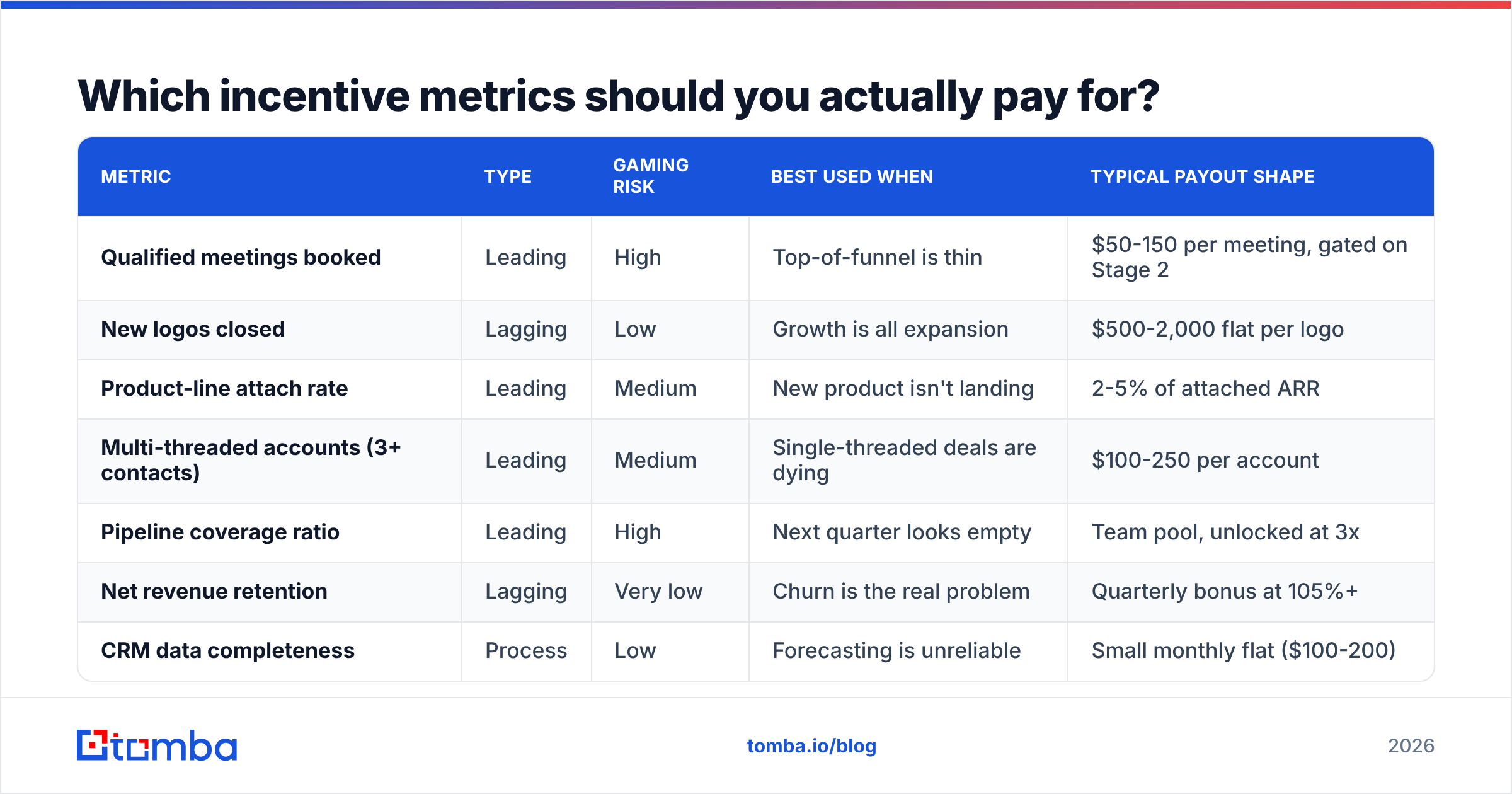
It depends on what's broken. Leading indicators change behavior fast but can be gamed. Lagging indicators resist gaming but move slowly. Most healthy programs pair a leading metric with a lagging gate — you earn on meetings booked, but only meetings that reach Stage 2 count.
| Metric | Type | Gaming risk | Best used when | Typical payout shape |
|---|---|---|---|---|
| Qualified meetings booked | Leading | High | Top-of-funnel is thin | $50-150 per meeting, gated on Stage 2 |
| New logos closed | Lagging | Low | Growth is all expansion | $500-2,000 flat per logo |
| Product-line attach rate | Leading | Medium | New product isn't landing | 2-5% of attached ARR |
| Multi-threaded accounts (3+ contacts) | Leading | Medium | Single-threaded deals are dying | $100-250 per account |
| Pipeline coverage ratio | Leading | High | Next quarter looks empty | Team pool, unlocked at 3x |
| Net revenue retention | Lagging | Very low | Churn is the real problem | Quarterly bonus at 105%+ |
| CRM data completeness | Process | Low | Forecasting is unreliable | Small monthly flat ($100-200) |
Two notes on this table. First, the "gaming risk" column isn't a reason to avoid a metric. It's a reason to add a gate. High-risk metrics need a downstream qualifier attached.
Second, the CRM hygiene line looks unglamorous, and it is. But teams that pay a small, reliable amount for complete records forecast measurably better than teams that nag.
How much should a sales incentive program cost?#
Benchmark: budget 10-15% of on-target earnings for incentive spend above core commission. For a team of ten AEs at $150K OTE, that's roughly $150K-225K a year across all programs.
Below 5%, the reward doesn't clear the effort threshold and reps ignore it. Above 25%, you haven't built an incentive program. You've built a second comp plan that competes with the first one, and reps will chase whichever pays better that week.
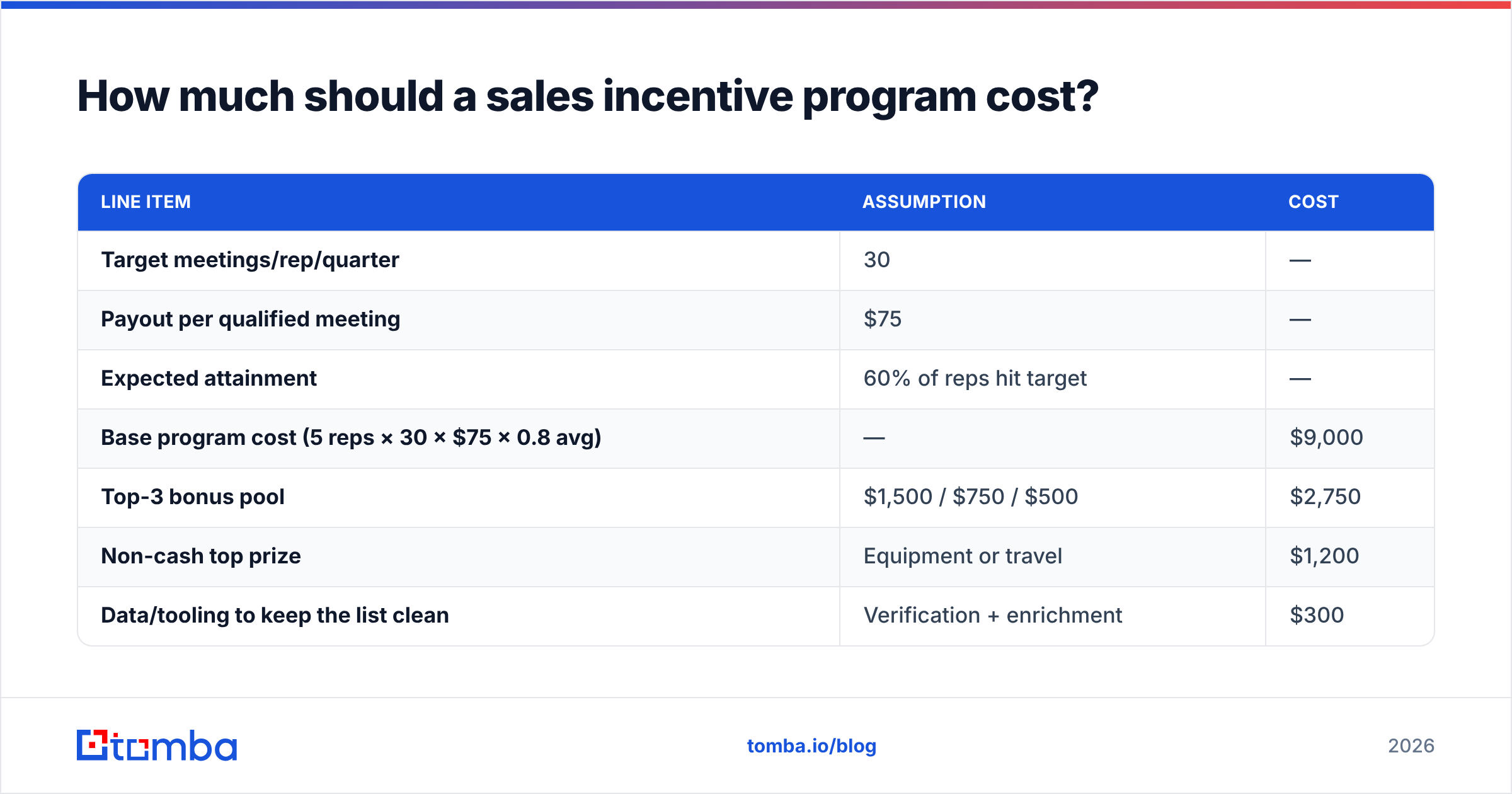
A worked example for a five-person SDR team running a quarterly meeting contest:
| Line item | Assumption | Cost |
|---|---|---|
| Target meetings/rep/quarter | 30 | — |
| Payout per qualified meeting | $75 | — |
| Expected attainment | 60% of reps hit target | — |
| Base program cost (5 reps × 30 × $75 × 0.8 avg) | — | $9,000 |
| Top-3 bonus pool | $1,500 / $750 / $500 | $2,750 |
| Non-cash top prize | Equipment or travel | $1,200 |
| Data/tooling to keep the list clean | Verification + enrichment | $300 |
| Total quarterly cost | — | $13,250 |
| Meetings generated (est.) | 120 | $110 per meeting |
That last row is the number that matters. Cost per incremental meeting is how you defend the program to finance. If paid channels deliver a qualified meeting at $400 and the incentive delivers one at $110, the conversation is over.
Should you use cash or non-cash rewards?#
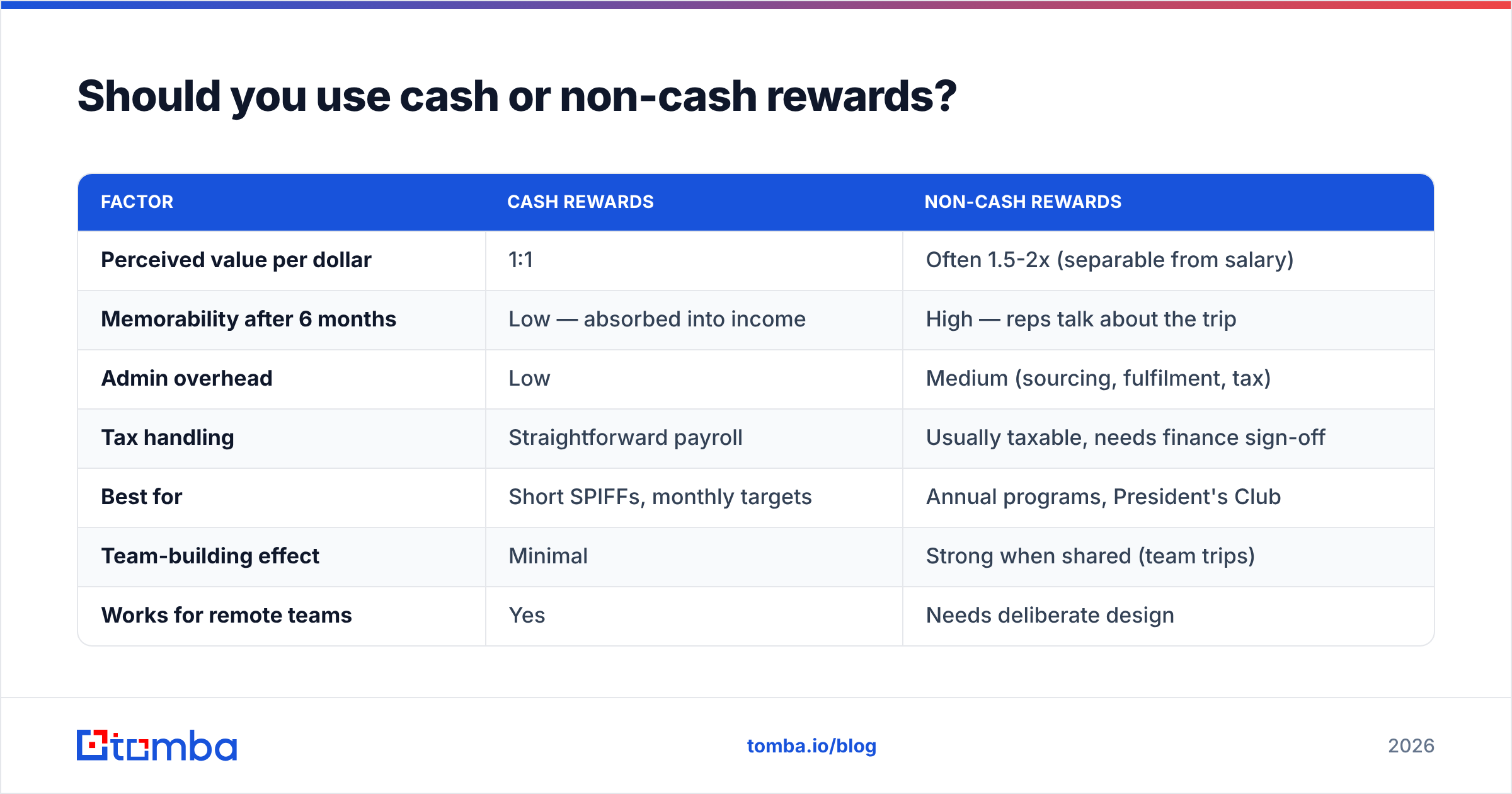
Use both, for different jobs. Cash is efficient and reps prefer it in surveys. Non-cash is more memorable, and it creates the internal storytelling that makes the next program work.
| Factor | Cash rewards | Non-cash rewards |
|---|---|---|
| Perceived value per dollar | 1:1 | Often 1.5-2x (separable from salary) |
| Memorability after 6 months | Low — absorbed into income | High — reps talk about the trip |
| Admin overhead | Low | Medium (sourcing, fulfilment, tax) |
| Tax handling | Straightforward payroll | Usually taxable, needs finance sign-off |
| Best for | Short SPIFFs, monthly targets | Annual programs, President's Club |
| Team-building effect | Minimal | Strong when shared (team trips) |
| Works for remote teams | Yes | Needs deliberate design |
Most teams land on a simple split: cash for anything under a month, non-cash for anything over a quarter. A $500 SPIFF for a two-week product push should be cash, because reps want it fast and simple. An annual top-performer program should be an experience, because the point is the story, not the dollar value.

How do you launch an incentive program without breaking your comp plan?#
Six steps, in order. Skipping step two is the most common mistake.
- Name the single number you're fixing. Not "improve performance." Something like "new-logo bookings are 34% behind plan." One number, one program.
- Check whether the number is an incentive problem at all. If reps aren't booking meetings because the contact data is stale or the ICP is wrong, no payout fixes that. Audit the inputs first. A domain search pass across your target account list tells you within an hour whether reps have reachable contacts to work.
- Pick one metric and one gate. Leading metric to drive behavior, lagging gate to prevent gaming.
- Model the payout curve at three attainment levels. What does the program cost if 30%, 60%, and 90% of reps hit? If the 90% case blows the budget, add a cap or a tier. If the 30% case is trivial, the incentive is too small to matter.
- Write it on one page and read it aloud. If it takes more than 90 seconds to explain, simplify.
- Publish standings weekly and pay fast. Visibility is half the mechanism. A Slack leaderboard every Monday does more work than an extra $200 in the pot.
Then set an end date before you launch. Programs without expiry dates become entitlements, and clawing back an entitlement costs more goodwill than the program ever generated.
What role does data quality play in incentive design?#
Bigger than most managers price in. Every activity-based incentive is really a bet that your reps' input list is workable.
Consider a $100-per-meeting SPIFF. Rep A works a clean list where 92% of emails deliver. Rep B works a list scraped six months ago where 61% deliver. Rep A wins the contest. Rep A is not the better seller — Rep A got the better list. Run that three quarters in a row and you've taught the team that outcomes are arbitrary, which is the opposite of what an incentive is for.
Three practical guardrails:
- Verify before the program starts, not during. Bulk-verify the target list so every rep starts from the same delivery baseline. Tomba's bulk email finder handles list-wide passes, and the catch-all verifier covers domains that standard verification returns as ambiguous.
- Normalize territory quality, not just territory size. Two territories with 500 accounts each aren't equal if one has 80% contact coverage and the other has 40%.
- Track bounce rate as a program health metric. If bounce rate climbs mid-contest, reps have run out of good contacts and started scraping. That's a data problem dressed as an effort problem, and it's a fast route to deliverability damage that outlasts the contest by months.
For teams building a contact layer from scratch, tools in this category vary widely. BookYourData is a solid option when you want prepaid, pay-as-you-go B2B lists with verification built into the purchase. Tools like Tomba's email finder work better when you're enriching accounts you've already selected rather than buying a list. Different jobs — worth knowing which one you're doing before you buy.
How do you measure whether the program worked?#
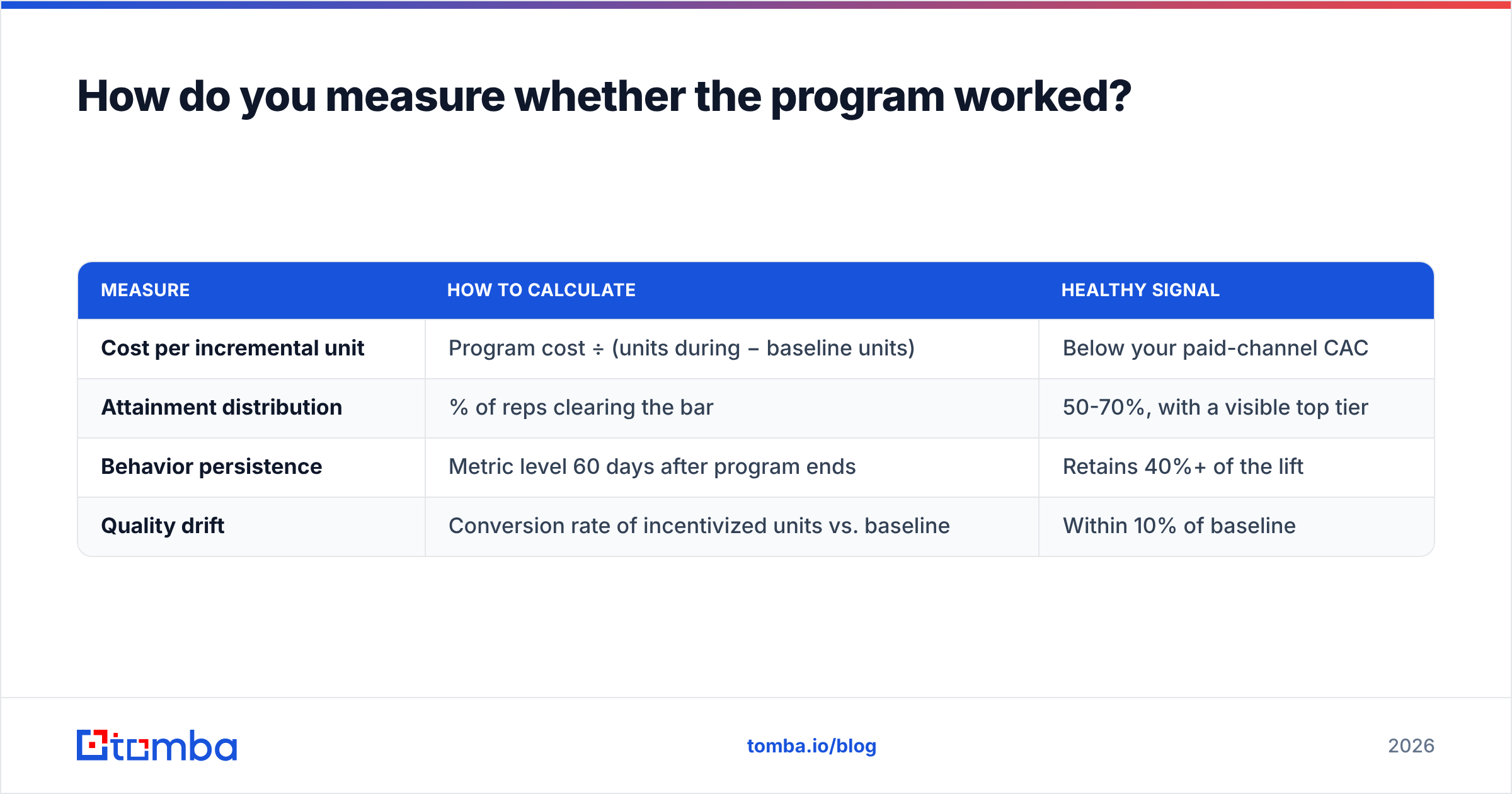
Four numbers, measured against a pre-program baseline:
| Measure | How to calculate | Healthy signal |
|---|---|---|
| Cost per incremental unit | Program cost ÷ (units during − baseline units) | Below your paid-channel CAC |
| Attainment distribution | % of reps clearing the bar | 50-70%, with a visible top tier |
| Behavior persistence | Metric level 60 days after program ends | Retains 40%+ of the lift |
| Quality drift | Conversion rate of incentivized units vs. baseline | Within 10% of baseline |
Quality drift is the one people skip, and the one that catches disasters. If meetings booked doubled but Stage 2 conversion halved, the program produced nothing except a payout. Measure it before you decide to run the program again.
Track the baseline for at least 60 days before launch. Without it, every post-program conversation turns into an argument about seasonality that nobody can win. G2's sales compensation category is a reasonable starting point if you want tooling that automates the tracking, and HubSpot's sales compensation resources cover plan structure in more depth than most vendor content.
What should you do next?#
Start with the input audit, not the payout design. Pull your target account list. Check what share of accounts have a verified, reachable decision-maker. Then you'll know whether your reps are underperforming or under-supplied. In most teams that number is lower than management expects, and no incentive program for sales team members survives contact with a list where a third of the emails bounce.
If the audit turns up gaps, the Tomba Email Finder closes them: search by domain, name, or company, verify in the same pass, and export straight into your CRM before the program starts. The free tier covers 25 searches a month if you just want to sample list quality. Tomba pricing starts at $49/mo on Starter and $99/mo on Growth once you're ready to verify every territory. Get the data right, then design the incentive. That order is the whole difference between a program that changes behavior and one that just changes payroll.
Related guides#
Ready to find emails that actually work?
Join 150,000+ professionals who stopped guessing and started sending. Free credits on signup — no credit card required.
Get the Tomba newsletter
Practical outbound tactics and product updates — once every two weeks.
About the author