Incentives for Sales Teams: What Actually Works in 2026
Most sales incentive plans reward the wrong behavior and quietly cap revenue. Here's how commission, SPIFFs, and non-cash rewards actually compare — and how to design a plan reps don't game.
TL;DR
- Incentives for sales teams fail more often from bad design than from bad budgets — a plan with more than three components stops steering behavior and starts confusing it.
- Cash commission drives volume; SPIFFs drive short-term focus; non-cash rewards drive recognition and retention. You need a deliberate mix, not one lever cranked to maximum.
- The 60/40 base-to-variable split still works for closing roles, but SDRs and CS-attached AEs perform better closer to 70/30 or 80/20.
- Uncapped commission beats capped commission on almost every measurable outcome, and the "runaway payout" fear is usually solved with tiered accelerators instead of caps.
- No incentive plan survives bad data. If reps burn a third of their week chasing bounced contacts, you are paying commission on activity your CRM can't even prove happened.
What are incentives for sales teams, really?#
An incentive is a promise about behavior. You are telling a rep: do this specific thing, and money or recognition follows. Everything else — the spreadsheets, the accelerator tables, the quarterly kicker — is just the accounting layer on top of that promise.
The mistake most revenue leaders make is treating compensation as a retention tool rather than a steering tool. Retention is a side effect. The primary job of a sales incentive plan is to make the highest-leverage behavior also the most personally profitable behavior for the rep. When those two things diverge, reps do not become disloyal — they become rational. They chase the number that pays them, which may have nothing to do with the number your board cares about.
Consider a plan that pays flat commission on closed revenue with no multi-year modifier. A rep facing a choice between a $40,000 one-year deal and a $30,000 three-year deal will take the one-year deal every time, even though the second contract is worth roughly twice as much to the company. The rep isn't wrong. The plan is.
Incentives break into four families:
- Base-plus-commission — the structural backbone. Predictable base salary, variable component tied to quota attainment. Covers 80%+ of B2B closing roles.
- SPIFFs and contests — short-duration, narrow-target bonuses. Good for pushing a new product line, clearing aging pipeline, or breaking a Q3 slump. Bad as a permanent fixture.
- Non-cash rewards — trips, equipment, extra PTO, public recognition. Consistently outperform equivalent cash in memorability, and cost less than reps assume.
- Equity and long-term incentives — for senior AEs and sales leadership, where the goal is multi-year retention rather than quarterly behavior.
The plans that work blend one from column A, occasional doses from column B, and a steady baseline from column C.
Which sales incentive structures actually perform?#
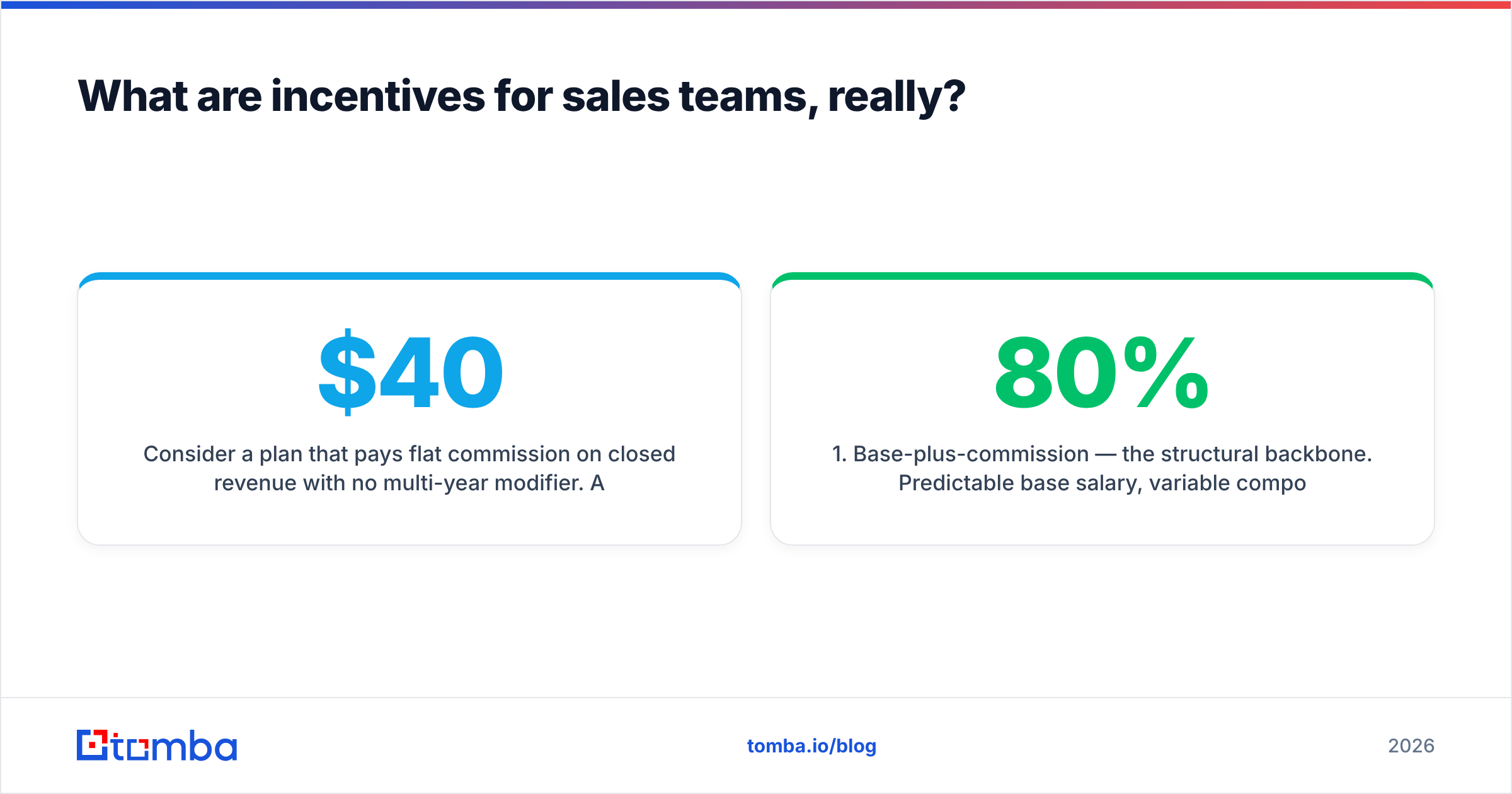
Here is how the main structures compare on the dimensions that matter when you are picking one.
| Structure | Best for | Typical split | Motivates | Main risk |
|---|---|---|---|---|
| Base + uncapped commission | Full-cycle AEs, enterprise | 50/50 to 60/40 | Volume + deal size | Discounting to close faster |
| Base + capped commission | Regulated / low-margin sales | 70/30 | Predictable spend | Top reps stop selling after cap |
| Tiered accelerators | Teams with reliable quota data | 60/40 | Overachievement | Sandbagging into next quarter |
| Straight commission | Contractors, channel partners | 0/100 | Raw activity | High churn, brand risk |
| Team-based pool | Pods, ABM squads, CS-attached | 75/25 | Collaboration | Free-riding by weaker reps |
| SPIFF overlay | New product pushes | +$250–2k per unit | Short-term focus | Cannibalizes core selling |
The pattern in that table: the more predictable your quota-setting is, the more aggressively you can shift pay into the variable component. If your quotas are guesses — new market, new product, no historical baseline — a 50/50 split just transfers your forecasting risk onto individual reps, and the good ones leave.

Why capped commission keeps losing#
Caps exist because a CFO once got surprised by a payout. That's the entire origin story. The problem is what a cap communicates: past this point, stop. Harvard Business Review's research on sales compensation found that removing caps and replacing them with tiered accelerators produced higher total revenue at a comparable or better cost of sale, because the marginal deal remains worth chasing.
If runaway payouts genuinely scare you, use decelerating tiers instead. Pay 10% up to quota, 14% from 100–150%, and 8% beyond 150%. The rep still earns on every additional dollar. Your cost of sale stays bounded. Nobody sits on a signed contract until January 2nd.
How do you set quota so the incentive means something?#
Quota is the denominator of your whole plan. Get it wrong and every downstream incentive is noise.
Three rules that hold across most B2B orgs:
- Target 60–70% of reps hitting quota. If 90% hit, quota is too low and you are overpaying for baseline performance. If 30% hit, the plan reads as a lottery and reps disengage by week six of the quarter.
- Set quota from capacity, not from the board deck. Work backward from average deal size, cycle length, win rate, and the number of qualified accounts a rep can realistically touch. If the math needs 400 conversations a quarter and your data can only supply 250 reachable contacts, the quota is fiction.
- Publish the methodology. Reps who understand how quota was derived argue about the inputs. Reps who don't understand it assume you made it up, and act accordingly.
That second rule is where most plans quietly break. Quota capacity is a function of how many contactable, correctly-targeted humans a rep can reach — which means it's a data problem before it's a compensation problem. A rep with a list that's 40% stale isn't underperforming; they're running a plan built on inputs that don't exist. Fixing that starts upstream with clean contact data: an accurate email finder plus email verification before the list ever reaches the sequencer changes the capacity math more than any accelerator table will.
Are non-cash incentives better than cash?#
Sometimes — and specifically when the goal is recognition, morale, or reinforcing a behavior that doesn't show up in bookings.
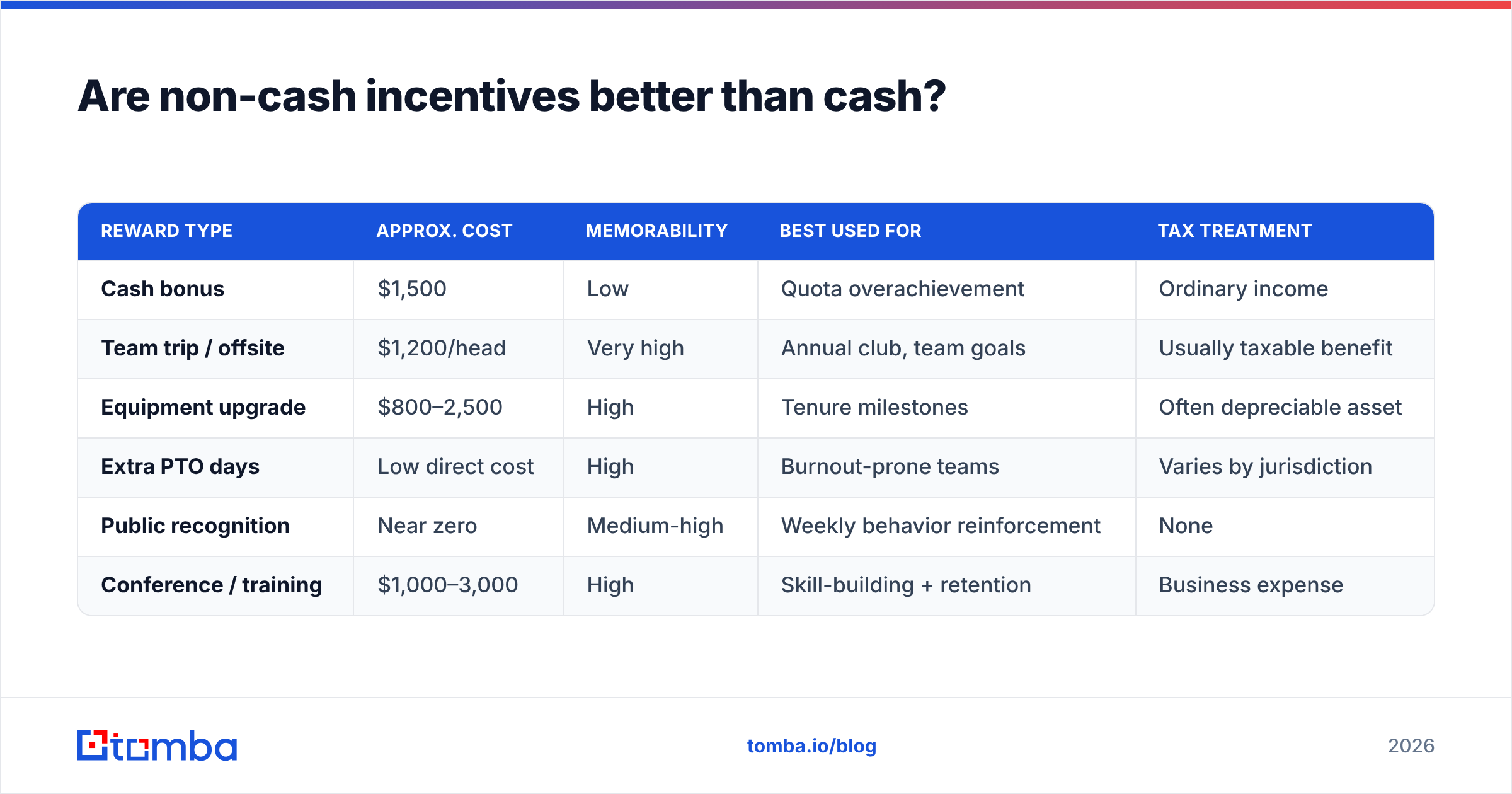
Cash gets absorbed. A $1,500 bonus lands in a bank account, pays down a credit card, and disappears from memory within a pay cycle. A $1,200 trip, a top-spec laptop, or a conference ticket with the team gets talked about for a year. Behavioral economists call this the mental accounting effect: non-cash rewards live in a separate psychological bucket and get remembered as rewards rather than as income.
| Reward type | Approx. cost | Memorability | Best used for | Tax treatment |
|---|---|---|---|---|
| Cash bonus | $1,500 | Low | Quota overachievement | Ordinary income |
| Team trip / offsite | $1,200/head | Very high | Annual club, team goals | Usually taxable benefit |
| Equipment upgrade | $800–2,500 | High | Tenure milestones | Often depreciable asset |
| Extra PTO days | Low direct cost | High | Burnout-prone teams | Varies by jurisdiction |
| Public recognition | Near zero | Medium-high | Weekly behavior reinforcement | None |
| Conference / training | $1,000–3,000 | High | Skill-building + retention | Business expense |
Note the last two rows. Public recognition costs almost nothing and is chronically underused — most teams do it once a quarter at a kickoff instead of once a week in a Slack channel. And training budgets double as retention tools: a rep who believes they're getting better at their craft under your roof is measurably harder to poach.
The rule: cash for outcomes, non-cash for behaviors. Pay commission on closed revenue. Reward the rep who wrote the best discovery-call notes with something they'll remember. Mixing those up — paying a $200 SPIFF for good CRM hygiene — teaches reps that process work only matters when you're bribing them for it.
What behaviors should you actually incentivize?#
Beyond closed revenue, these are the levers worth paying for:
- Multi-year contract terms — a 1.2x multiplier on 24-month-plus deals reorients the entire team toward LTV without a single meeting about it.
- Net revenue retention on owned accounts — if AEs keep accounts post-sale, tie 10–15% of variable pay to renewal and expansion. It kills the "sell it and forget it" pattern instantly.
- New-logo acquisition — a distinct rate for net-new accounts prevents the entire team from farming the same five existing customers.
- Discount discipline — pay a higher commission rate on deals closed at or above list. This is the cheapest margin protection available to you.
- Pipeline quality, not pipeline volume — reward opportunities that pass a stage-2 qualification gate, never raw meetings booked. Otherwise you get meetings with unqualified prospects, forever.
- Referral and expansion sourcing — a flat bonus for a closed deal that started as a customer referral costs less than any paid channel you're running.
What not to incentivize: dials made, emails sent, or LinkedIn connections. Activity metrics are management diagnostics, not payable outcomes. The moment you pay for dials, you get dials — 200 of them, into disconnected numbers, generating nothing.
How do incentives differ by sales role?#
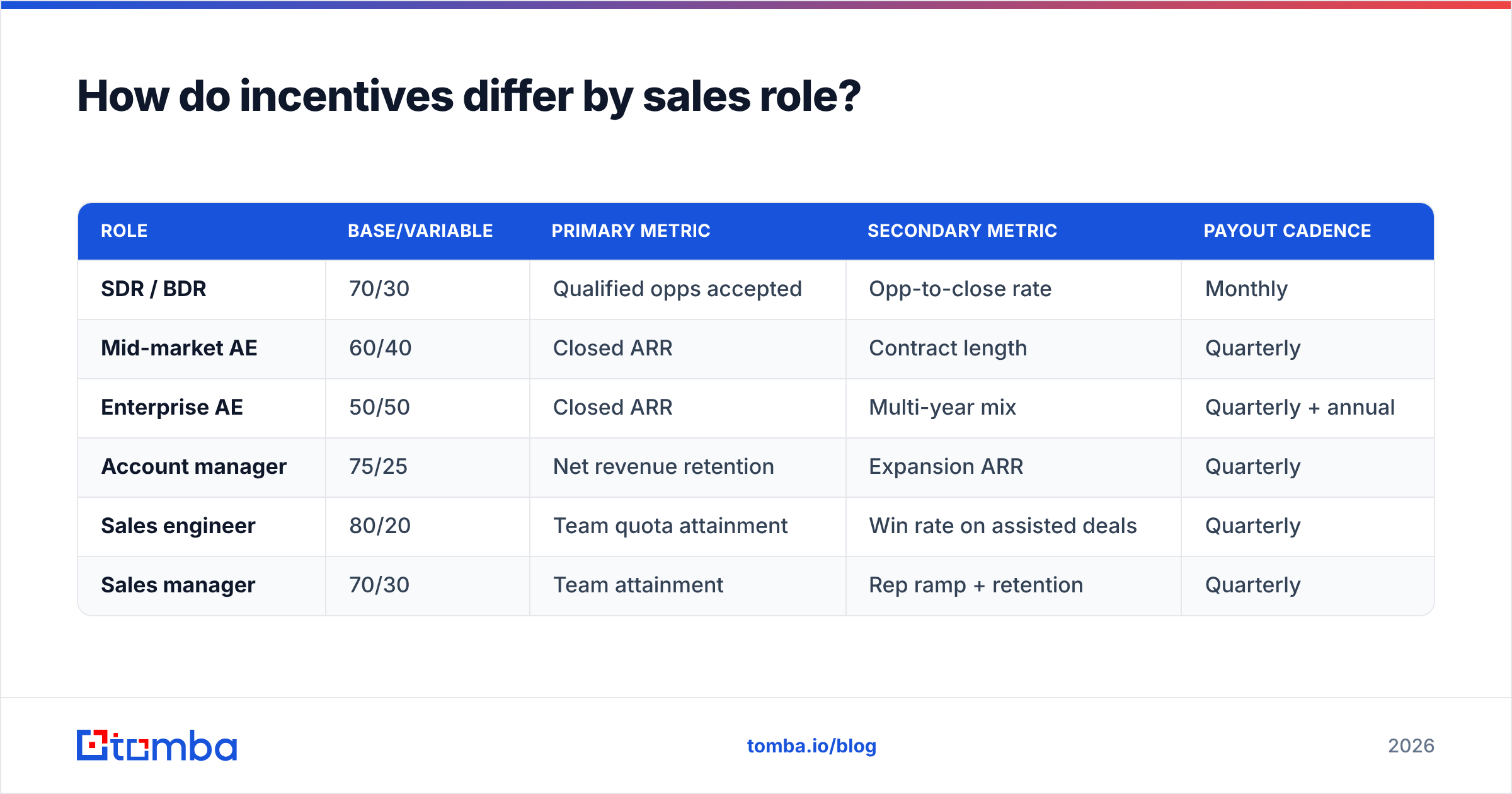
Not every seat should be on the same plan. A useful default set:
| Role | Base/variable | Primary metric | Secondary metric | Payout cadence |
|---|---|---|---|---|
| SDR / BDR | 70/30 | Qualified opps accepted | Opp-to-close rate | Monthly |
| Mid-market AE | 60/40 | Closed ARR | Contract length | Quarterly |
| Enterprise AE | 50/50 | Closed ARR | Multi-year mix | Quarterly + annual |
| Account manager | 75/25 | Net revenue retention | Expansion ARR | Quarterly |
| Sales engineer | 80/20 | Team quota attainment | Win rate on assisted deals | Quarterly |
| Sales manager | 70/30 | Team attainment | Rep ramp + retention | Quarterly |
Two things to notice. First, SDRs are paid on accepted opportunities, not booked meetings — the AE has to accept the opp for it to count, which builds a natural quality gate between the two roles. Second, sales managers carry a retention component. A manager who hits team quota by burning through four reps a year is more expensive than one who hits 92% with a stable team.
Payout cadence matters more than most leaders think. Monthly payouts suit high-velocity, short-cycle roles where feedback needs to be immediate. Quarterly suits complex sales where a monthly window would just create end-of-month discounting. Annual-only plans are a retention mechanism, not a motivation mechanism, and should never be the primary variable component.
What breaks sales incentive plans?#
Five failure modes account for most of it:
Too many components. Three is the ceiling. A plan with a base rate, an accelerator, two SPIFFs, a team kicker, and a strategic-product modifier is a plan no rep can hold in their head. If a rep can't calculate their own commission on a deal in under 30 seconds, the plan no longer steers behavior.
Mid-year changes. Changing the plan mid-period, especially downward, is the single fastest way to lose your top quartile. If you must change it, grandfather in-flight deals and announce well ahead of the new period.
Payout disputes. Late or disputed commission checks corrode trust faster than a low rate. A rep who trusts a 7% rate will outproduce one who suspects a 10% rate is being calculated creatively. Automate the calculation, publish the ledger, pay on schedule.
Quota inflation without capacity change. Raising quota 25% without adding accounts, data, headcount, or improving conversion is a pay cut dressed as ambition. Reps recognize it immediately.
Incentivizing on top of broken inputs. This is the quiet one. If your CRM is full of duplicates, unverified contacts, and accounts with no reachable decision-maker, then no incentive structure can fix the output. You're optimizing the reward for a process whose raw material is defective. Cleaning the top of the funnel with data enrichment and a bulk email finder run against your existing account list typically recovers more selling hours than any comp change — and it's a one-time fix, not a permanent budget line.
How do you roll out a new incentive plan?#
A workable sequence:
- Model it against last year's actuals first. Run every rep's prior-year performance through the proposed plan. If your top performer earns less than they did before, you have a resignation on your hands. If your bottom quartile earns the same, the plan isn't differentiating.
- Pressure-test for gaming. Hand the draft plan to your two most cynical reps and ask them how they'd maximize earnings with minimum effort. They will find the exploit in about four minutes, and that's cheaper than finding it in Q2.
- Write the plan in plain language. One page. Example calculations with real numbers. No appendix.
- Announce with 30 days of lead time. Reps need to reforecast their year and, honestly, decide whether to stay. Both are better handled before the period starts.
- Publish a live attainment dashboard. A rep who can't see their attainment in real time is guessing. Guessing reps disengage. Pipe attainment into wherever they already live — most teams do this through their CRM or a HubSpot integration so the number sits next to the pipeline it came from.
- Review quarterly, change annually. Track for gaming, distribution skew, and quota accuracy every quarter. Only change the structure at period boundaries.
For benchmarking your plan against what's actually being paid in your segment, Gartner's sales research and peer comp surveys on G2 are more useful than anecdotes from your last three hires — those anecdotes are a self-selecting sample of people who left somewhere else.
What does a good plan look like end to end?#
A mid-market SaaS AE, $120k OTE, 60/40 split:
- $72,000 base, $48,000 variable at 100% attainment
- Annual quota: $600,000 new ARR (8% commission rate at target)
- Accelerator: 12% on 100–150% attainment, 8% above 150%, uncapped
- Multi-year modifier: 1.2x on contracts 24 months or longer
- Discount guardrail: full rate at list, 0.75x rate below 15% discount
- Quarterly payout, paid within 30 days of quarter close
- One annual non-cash reward: President's Club for top 20%
That's six lines. A rep can calculate any deal's commission mentally. Every component points the same direction — bigger deals, longer terms, less discounting — and nothing in it rewards activity theater.
Where does the data layer fit?#
Every incentive plan makes an implicit promise: there is enough winnable pipeline out there for you to hit this number. Whether that promise is true has almost nothing to do with the comp structure and almost everything to do with whether reps can reach the right people.
If a rep sends 500 emails a month and 22% bounce, you've paid for 110 messages that never arrived — plus the sender reputation damage that makes the next month worse. No accelerator table compensates for that. Verified contact data is the cheapest performance intervention available, and it's upstream of everything your comp plan is trying to steer.
Before you redesign the plan, run the capacity math with real numbers: how many reachable decision-makers exist in each rep's territory, verified, right now. If the answer supports the quota, redesign the incentives. If it doesn't, fix the list first — you'll find the incentive problem was a data problem wearing a costume.
Start there with Tomba Email Finder: find verified professional emails by domain, name, or company so your reps spend the quarter selling rather than guessing at addresses. The free tier gives you 25 searches a month to test territory coverage before committing, and paid plans start at $49/mo — check Tomba pricing to size it against your team. Fix the inputs, then let the incentives do their job.
Related guides#
// get started
Find, verify and enrich your first contacts today
Start on the free plan with 25 searches a month, then scale when your team is ready.
Free plan · No credit card required · GDPR & CCPA
Get the Tomba newsletter
Product and data updates
// about the author