How to Increase B2B Lead Generation in 2026: 9 Proven Plays
More volume is not a lead generation strategy. Here is the data-first playbook that lifts qualified pipeline — channel benchmarks, a 90-day plan, and the metrics that tell you it is working.
TL;DR
- Volume is the last lever you should pull. Fix targeting, data accuracy, and offer quality first — a 3% reply rate on 500 verified contacts beats 0.4% on 5,000 scraped ones.
- Bad contact data is the single largest hidden tax on B2B lead generation. Bounce rates above 3% throttle deliverability and quietly cap every downstream number.
- Multi-channel beats single-channel, but only when the channels share one contact record. Email plus phone plus LinkedIn on the same lead lifts connect rates materially; three disconnected campaigns do not.
- Measure four things weekly: verified-contact rate, reply rate, meeting-held rate, and cost per qualified opportunity. Everything else is vanity.
- A realistic 90-day rebuild: 30 days on data and ICP, 30 days on channel testing, 30 days on scaling what converted.
What Does It Actually Mean to Increase B2B Lead Generation?#
It means more qualified conversations per dollar and per rep-hour — not more form fills.
That distinction matters because most teams optimise the wrong number. You can double raw lead count in a quarter by loosening form fields and buying a bigger list, and end up with a sales team that trusts marketing less than it did before. Gartner's sales research has been consistent on this for years: buying groups have grown, cycles have lengthened, and the constraint is rarely lead quantity. It is lead relevance.
So set the target properly. If your current state is 40 meetings a month at $310 cost per meeting, "increase B2B lead generation" should be phrased as "70 meetings a month at under $350 cost per meeting by Q2." Now every play below can be judged against a number instead of a feeling.
Why Do Most B2B Lead Generation Programs Stall?#
Five failure modes account for almost everything I see when auditing a stalled program:
- The ICP is a paragraph, not a filter. "Mid-market SaaS companies that care about security" cannot be turned into a list. "US-based B2B SaaS, 50–500 employees, has a named CISO or Head of IT, uses Okta or Auth0" can. If your ICP does not compile into search filters, your list will always be mush.
- Contact data decays faster than anyone budgets for. B2B contact records go stale at roughly 25–30% per year through job changes alone. A list you built in January is measurably worse by June, and nobody re-verifies it.
- Deliverability is treated as an IT problem. Sending to unverified addresses drives hard bounces; hard bounces above 2–3% damage sender reputation; damaged reputation moves your inbox placement down for every future campaign, including the good ones.
- Channels run in silos. The SDR calls a list that email never touched, ads retarget a segment sales never sees, and nobody can attribute anything.
- The offer is a demo request. A demo is the highest-friction ask in B2B. Teams that add a lower-friction step — a teardown, a benchmark, a data audit — routinely see 2–3× more first replies.

Which Lead Generation Channels Actually Produce Pipeline?#
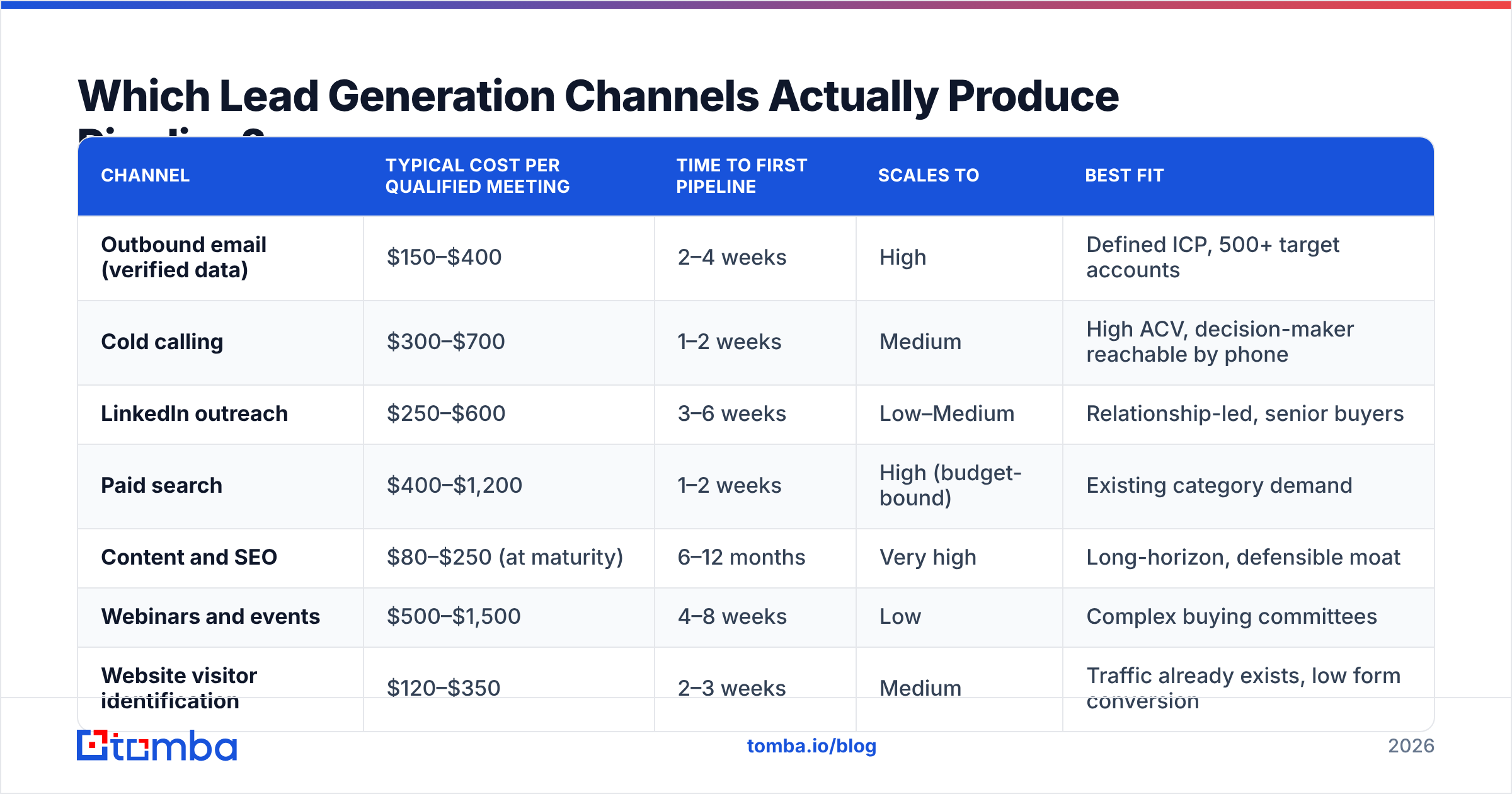
There is no universally best channel — there is a best channel for your ACV and sales cycle. Here is how the main options compare for a typical $15k–$60k ACV B2B software or services business.
| Channel | Typical cost per qualified meeting | Time to first pipeline | Scales to | Best fit |
|---|---|---|---|---|
| Outbound email (verified data) | $150–$400 | 2–4 weeks | High | Defined ICP, 500+ target accounts |
| Cold calling | $300–$700 | 1–2 weeks | Medium | High ACV, decision-maker reachable by phone |
| LinkedIn outreach | $250–$600 | 3–6 weeks | Low–Medium | Relationship-led, senior buyers |
| Paid search | $400–$1,200 | 1–2 weeks | High (budget-bound) | Existing category demand |
| Content and SEO | $80–$250 (at maturity) | 6–12 months | Very high | Long-horizon, defensible moat |
| Webinars and events | $500–$1,500 | 4–8 weeks | Low | Complex buying committees |
| Website visitor identification | $120–$350 | 2–3 weeks | Medium | Traffic already exists, low form conversion |
Two notes on reading this table. First, outbound email looks cheap because the marginal cost of a send is near zero — but that only holds if the data is accurate. Feed it a 20% bounce list and the real cost per meeting triples while your domain reputation degrades. Second, content is the cheapest channel at maturity and the most expensive in month three. Do not fund it from the same budget line you use to hit this quarter's number.
The practical answer for most teams is two primary channels plus one compounding channel. For example: outbound email as primary, phone as secondary on the same contact records, and SEO running quietly underneath.
How Do You Fix Data Quality Before Adding Volume?#
Run this sequence before you touch send volume. It is unglamorous and it is where most of the gain is.
Step 1 — Define the account list, not the contact list. Build the target accounts first using firmographic and technographic filters. Contacts come second. This prevents the classic mistake of a list full of the right job titles at the wrong companies.
Step 2 — Find contacts by pattern, not by guess. Most companies use one or two email formats. A domain search across the target domain returns the known addresses and the dominant pattern, which lets you resolve the rest of the org chart reliably instead of permutating and hoping.
Step 3 — Verify everything, then verify again before send. An email verifier pass at build time and a second pass immediately before launch catches the records that decayed in between. Aim for a list that is 95%+ deliverable at send time. Anything below 92% and you should not press go.
Step 4 — Handle catch-all domains explicitly. Roughly a fifth of B2B domains accept everything at the SMTP layer, so a naive verifier marks them "unknown" and teams either delete them (losing good leads) or send blindly (taking bounces). A dedicated catch-all check separates the recoverable ones from the genuine dead ends.
Step 5 — Enrich for personalisation inputs, not for vanity fields. You need three things per contact that a human can act on: role context, a company trigger, and a reason-to-reach-now. Everything else is column bloat. Use data enrichment to fill those fields at build time so reps are not researching in the middle of a sequence.
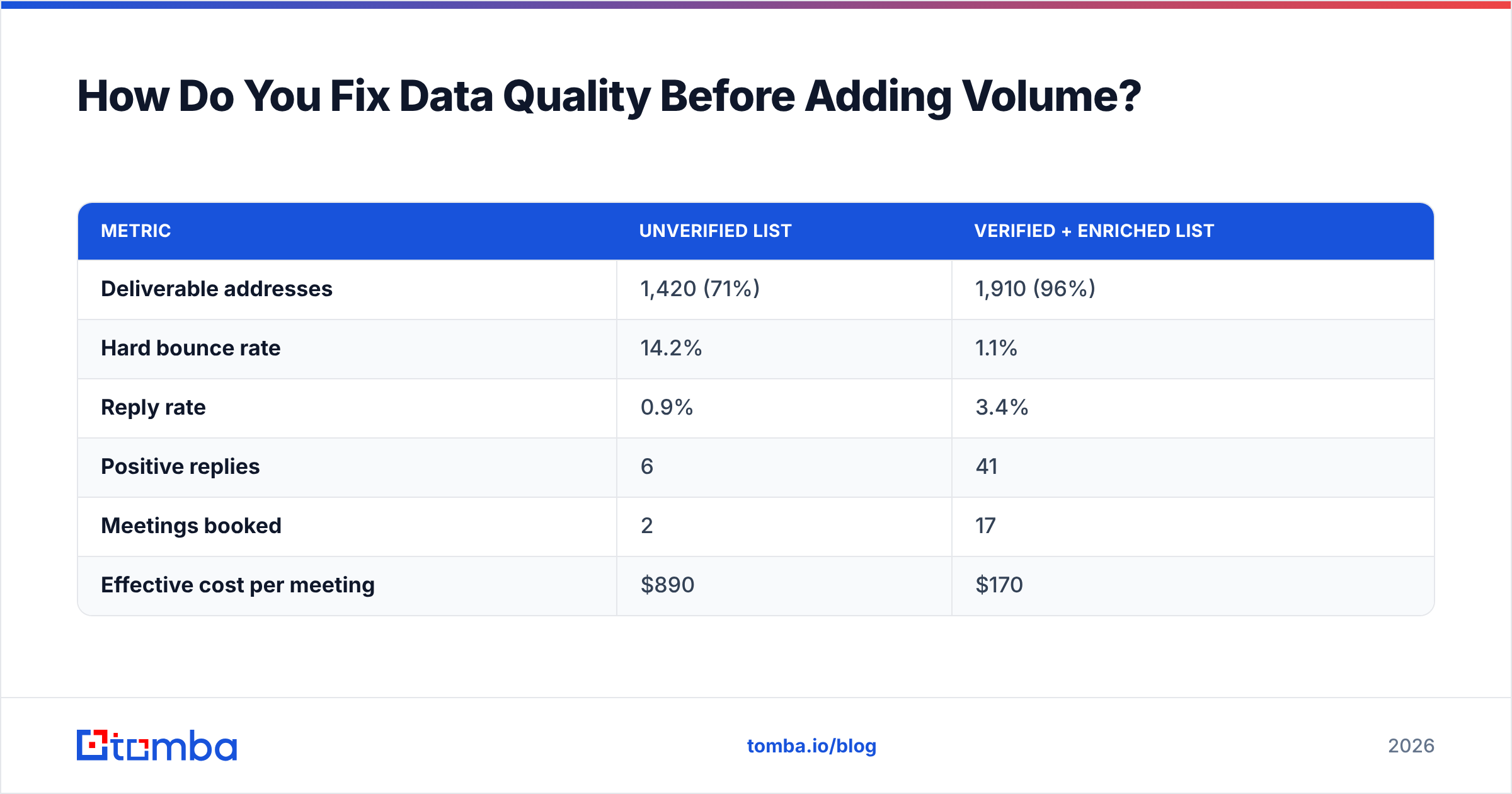
Here is what the difference looks like in practice on the same 2,000-contact target list:
| Metric | Unverified list | Verified + enriched list |
|---|---|---|
| Deliverable addresses | 1,420 (71%) | 1,910 (96%) |
| Hard bounce rate | 14.2% | 1.1% |
| Reply rate | 0.9% | 3.4% |
| Positive replies | 6 | 41 |
| Meetings booked | 2 | 17 |
| Effective cost per meeting | $890 | $170 |
The send volume is identical. The only change is the input quality. This is why "increase B2B lead generation" almost never means "send more" in month one.
What Are the Nine Plays That Increase B2B Lead Generation?#
- Narrow the ICP until it hurts, then expand deliberately. Pick the segment where your last ten closed-won deals came from. Run the first 60 days entirely inside it. Expansion after proof is cheap; expansion before proof is how you burn a quarter.
- Rebuild the list on verified data. Covered above. This is the highest-ROI single action available to most teams and it takes about a week.
- Add phone to your best 20% of accounts. Email books meetings at scale; phone books meetings with the accounts you actually want. Pulling B2B phone numbers for tier-one accounts and pairing them with the email sequence typically lifts meeting rate on that cohort by 40–60% versus email alone.
- Replace the demo ask with a lower-friction first step. Offer a 12-minute teardown, a benchmark against their peer set, or a specific insight about their stack. The ask should cost the prospect less than five minutes to accept.
- Sequence across channels on one record. Day 1 email, day 3 LinkedIn view plus connect, day 5 call, day 8 email reply-to-thread, day 12 breakup. Same contact, same context, one CRM record. Disconnected channel campaigns produce disconnected data.
- Turn existing traffic into leads. If you get 5,000+ monthly visitors and convert under 2%, visitor identification and reverse lookup will surface more qualified accounts than any new campaign. Start with reverse email lookup on the partial identities you already collect.
- Build one compounding content asset per quarter. Not ten blog posts — one asset that ranks: an original benchmark, a calculator, a comparison page. HubSpot's State of Marketing data consistently shows original research outperforming commodity content on lead conversion, and it earns links that lift everything else on the domain.
- Systematise referrals and customer intros. Ask at the moment of demonstrated value — after onboarding milestones, after a positive support resolution, after a renewal — not at renewal-negotiation time. Referred leads close at roughly 2× the rate of cold ones in most B2B datasets.
- Instrument the funnel weekly and kill losers fast. Two-week review cycles on sequences, four-week cycles on channels. Anything below half of your target conversion rate at the two-week mark gets rewritten, not "given more time."

How Should You Choose Between Building and Buying Your Data?#
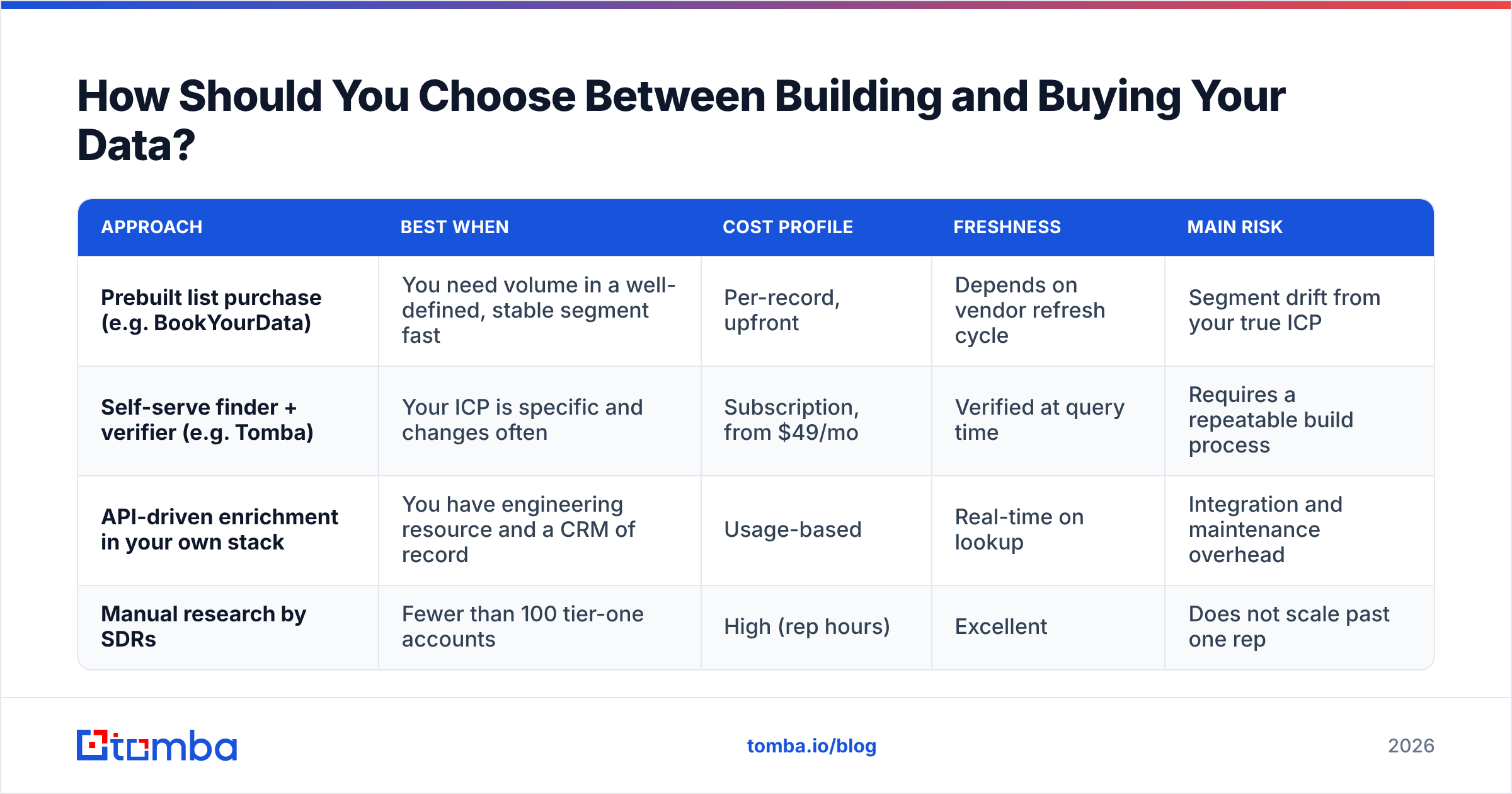
Both work. The failure mode is picking one without knowing which problem you have.
| Approach | Best when | Cost profile | Freshness | Main risk |
|---|---|---|---|---|
| Prebuilt list purchase (e.g. BookYourData) | You need volume in a well-defined, stable segment fast | Per-record, upfront | Depends on vendor refresh cycle | Segment drift from your true ICP |
| Self-serve finder + verifier (e.g. Tomba) | Your ICP is specific and changes often | Subscription, from $49/mo | Verified at query time | Requires a repeatable build process |
| API-driven enrichment in your own stack | You have engineering resource and a CRM of record | Usage-based | Real-time on lookup | Integration and maintenance overhead |
| Manual research by SDRs | Fewer than 100 tier-one accounts | High (rep hours) | Excellent | Does not scale past one rep |
For most teams under 50 employees the answer is a hybrid: a reputable prebuilt list for breadth in your core segment, plus a finder and verifier for the accounts you identify yourself. Tomba pricing starts with a free tier at 25 searches a month, then $49/mo Starter and $99/mo Growth, which makes the build-side of that hybrid cheap enough to test before committing budget.
If you are evaluating vendors, read the category reviews on G2 with one filter in mind: ignore feature counts, look only at review comments mentioning bounce rate and data accuracy. That is the only variable that reliably predicts whether a tool increases your pipeline.
How Do You Measure Whether It Is Working?#
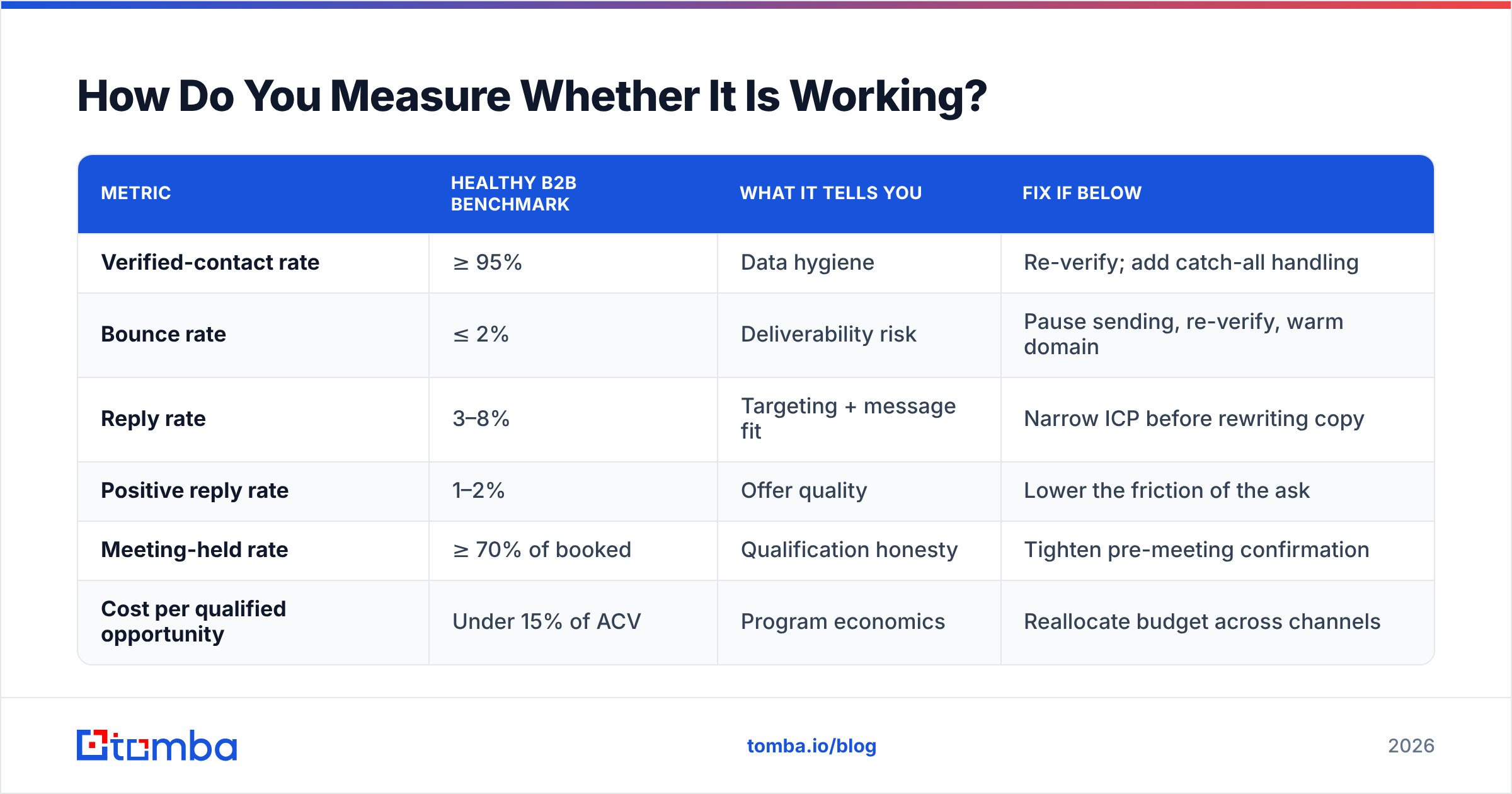
Track five numbers weekly. If you cannot produce them in under ten minutes, your instrumentation is the problem before your campaigns are.
| Metric | Healthy B2B benchmark | What it tells you | Fix if below |
|---|---|---|---|
| Verified-contact rate | ≥ 95% | Data hygiene | Re-verify; add catch-all handling |
| Bounce rate | ≤ 2% | Deliverability risk | Pause sending, re-verify, warm domain |
| Reply rate | 3–8% | Targeting + message fit | Narrow ICP before rewriting copy |
| Positive reply rate | 1–2% | Offer quality | Lower the friction of the ask |
| Meeting-held rate | ≥ 70% of booked | Qualification honesty | Tighten pre-meeting confirmation |
| Cost per qualified opportunity | Under 15% of ACV | Program economics | Reallocate budget across channels |
One caveat on reply rate: it is the metric most easily gamed by provocative subject lines that generate replies with no buying intent. Always read it alongside positive reply rate and meeting-held rate. A campaign at 9% replies and 0.3% positive replies is worse than one at 4% and 1.6%, and it is actively burning your domain.
Also define what counts as qualified before you start, and write it down. If marketing and sales disagree on what a marketing qualified lead is, you will spend the quarter arguing about attribution instead of building pipeline.
What Does a Realistic 90-Day Plan Look Like?#
Days 1–30 — Foundation. Rewrite the ICP into hard filters. Rebuild the target account list. Find and verify contacts. Set up domain authentication and warm any new sending domains. Define qualification criteria with sales in the room. Expected output: a clean list of 1,000–3,000 verified contacts and zero campaigns launched. This feels slow. It is the reason months two and three work.
Days 31–60 — Test. Launch three sequences against three sub-segments with genuinely different angles, not three subject-line variants. Add phone to your top-tier accounts. Publish the first compounding content asset. Review at day 45 and kill the weakest sequence. Expected output: a validated angle and a known baseline reply rate.
Days 61–90 — Scale. Push volume into the winning angle, expand the account list adjacent to the proven segment, and add the second channel properly. Now — and only now — does increasing send volume increase pipeline instead of increasing bounces. Expected output: 1.8–2.5× the meeting volume of your day-30 baseline at a flat or lower cost per meeting.
The trap in month three is expanding the ICP and the volume at the same time. Do one. If results drop, you will know which caused it.
Where Should You Start This Week?#
Pull a random sample of 200 contacts from your current list and verify them. If more than 8% come back invalid, unknown, or catch-all-unresolved, stop every other initiative on this list and fix the data. That single check is the fastest diagnostic available, and it decides whether your next quarter is a growth story or a deliverability post-mortem.
When you are ready to rebuild, start with the Tomba Email Finder — find verified professional addresses by name, domain, or company, check them against the verifier before you send, and push clean records straight into your CRM. The free tier gives you 25 searches a month to test the accuracy on your own target accounts before you spend anything. Verify first, then scale. That order is the whole strategy.
Related guides#
// get started
Find, verify and enrich your first contacts today
Start on the free plan with 25 searches a month, then scale when your team is ready.
Free plan · No credit card required · GDPR & CCPA
// about the author