Industrial Lead Generation: The 2026 Playbook for Manufacturers
Industrial buying cycles run 6-18 months across 6+ stakeholders, yet most manufacturers still run tactics built for SaaS. Here's what actually fills a pipeline in 2026.
TL;DR
- Industrial lead generation is not SaaS lead generation with different logos. Deal cycles run 6-18 months, buying committees average 6-10 people, and a single specification win can lock revenue for a decade.
- The highest-ROI channels for manufacturers in 2026 are technical SEO on part-number and spec queries, distributor/rep co-marketing, and precise outbound to engineering and procurement titles — not paid social.
- Trade shows still work, but only when you treat them as a data-capture event feeding a 9-month nurture, not as a closing venue.
- Your CRM data decays 25-30% a year in industrials because of plant closures, retirements, and acquisitions. Verification is not optional.
- The cheapest fix most manufacturers ignore: getting accurate contact data for the plant manager, quality director, and buyer before the RFQ goes out — not after.
What is industrial lead generation, and why is it different?#
Industrial lead generation is the process of identifying, attracting, and qualifying buyers of manufactured goods, industrial equipment, components, and technical services. Think CNC machining, valves and actuators, automation integrators, injection molders, process chemicals, and contract manufacturing.
It behaves differently from software lead generation in four measurable ways:
- Cycle length. A $250K capital equipment purchase typically takes 6-18 months from first inquiry to PO. A tooling or contract-manufacturing qualification can take longer, because it involves plant audits and first-article inspection.
- Committee size. You are rarely selling to one person. Engineering writes the spec, quality signs off on capability, procurement negotiates, operations approves downtime, and finance approves capex. Miss one and the deal stalls indefinitely.
- Specification lock-in. If your part number lands in the drawing, you win the revenue for the life of the program. That makes early-stage engineering visibility worth far more than late-stage price competition.
- Low search volume, high search value. "Stainless steel sanitary butterfly valve 3 inch tri-clamp" gets maybe 90 searches a month. Ten of those searchers are qualified buyers with active projects. That ratio does not exist in consumer or SaaS categories.
The practical consequence: tactics optimized for volume — broad paid social, generic gated ebooks, spray-and-pray sequences — underperform badly here. Tactics optimized for precision win.

Which industrial lead generation channels actually produce pipeline?#
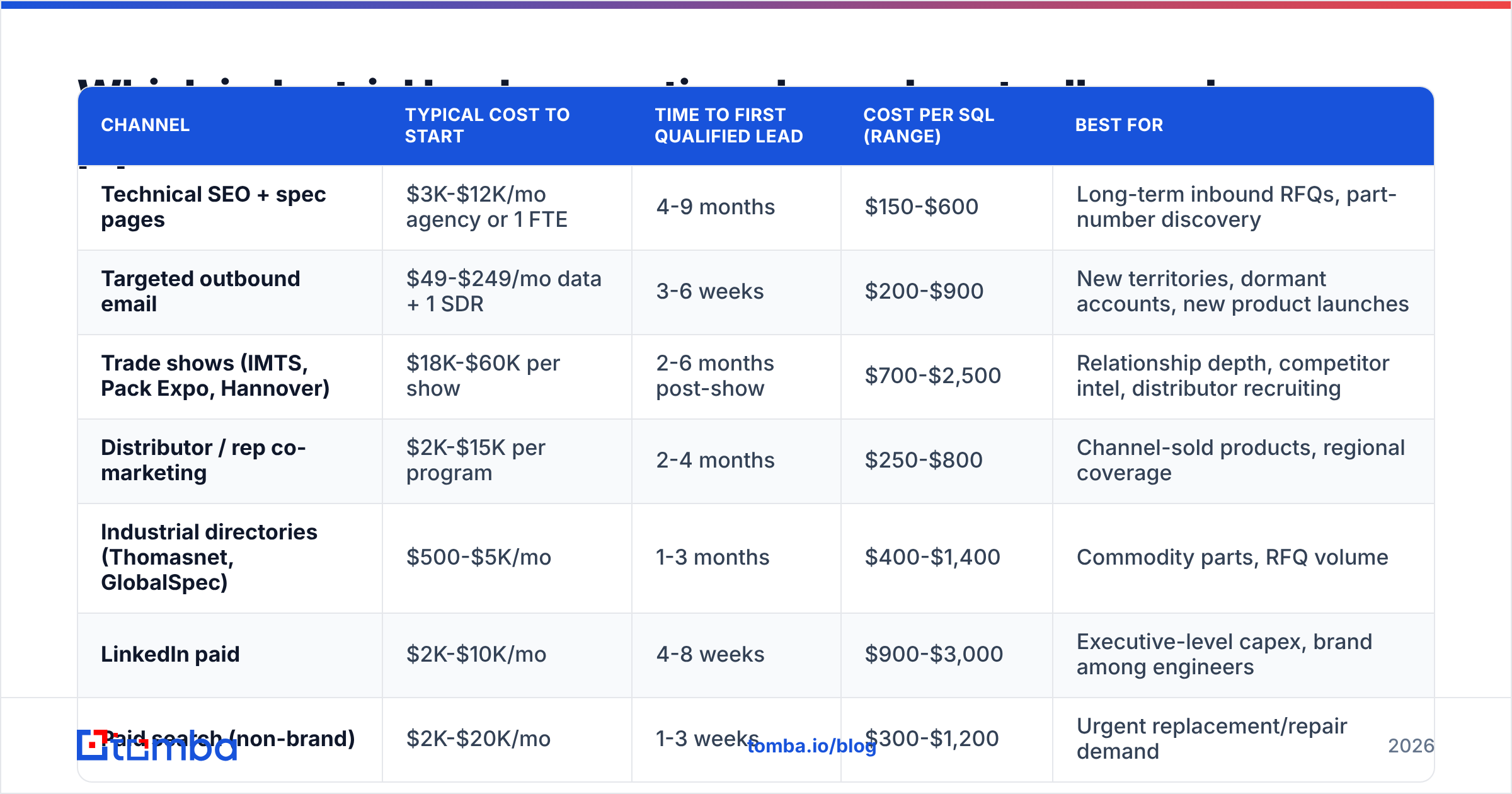
Here's how the main channels compare for a mid-size manufacturer (roughly $10M-$150M revenue) based on typical performance patterns reported across industrial marketing benchmarks and vendor case data. Treat these as planning ranges, not guarantees — your category and ASP move them substantially.
| Channel | Typical cost to start | Time to first qualified lead | Cost per SQL (range) | Best for |
|---|---|---|---|---|
| Technical SEO + spec pages | $3K-$12K/mo agency or 1 FTE | 4-9 months | $150-$600 | Long-term inbound RFQs, part-number discovery |
| Targeted outbound email | $49-$249/mo data + 1 SDR | 3-6 weeks | $200-$900 | New territories, dormant accounts, new product launches |
| Trade shows (IMTS, Pack Expo, Hannover) | $18K-$60K per show | 2-6 months post-show | $700-$2,500 | Relationship depth, competitor intel, distributor recruiting |
| Distributor / rep co-marketing | $2K-$15K per program | 2-4 months | $250-$800 | Channel-sold products, regional coverage |
| Industrial directories (Thomasnet, GlobalSpec) | $500-$5K/mo | 1-3 months | $400-$1,400 | Commodity parts, RFQ volume |
| LinkedIn paid | $2K-$10K/mo | 4-8 weeks | $900-$3,000 | Executive-level capex, brand among engineers |
| Paid search (non-brand) | $2K-$20K/mo | 1-3 weeks | $300-$1,200 | Urgent replacement/repair demand |
Three observations from that table that matter more than the numbers themselves.
Speed and cost trade off predictably. Outbound and paid search buy you speed at a per-lead premium. SEO and channel programs buy you cost efficiency at the price of patience. Most manufacturers need both running simultaneously — inbound to compound, outbound to cover the 9-month gap while inbound compounds.
Trade show math only works with follow-through. A $40K booth that generates 300 badge scans is $133 per lead, which looks excellent. But if 80% of those scans never get a personalized follow-up within 10 days, your real cost per engaged lead is closer to $650. The booth is not the expense that determines ROI; the follow-up system is.
Directories are a floor, not a ceiling. Thomasnet and GlobalSpec listings produce genuine RFQs, but they place you in a price-comparison context by design. Use them, and simultaneously build the branded demand that lets you avoid competing on quote alone.
How do you build an industrial ICP that isn't useless?#
Most industrial ICPs read like this: "manufacturers in North America, 50-500 employees." That is not an ICP. That is a phone book with a filter.
A usable industrial ICP has five layers:
- Firmographic base — NAICS/SIC code, revenue band, employee count, number of plant locations. This is table stakes and it is where most teams stop.
- Operational signal — Do they run the process your product serves? A vacuum pump seller cares whether the plant runs freeze-drying, not whether it has 200 employees. Sources: plant permits, environmental filings, equipment tech-stack scrapes, job postings mentioning specific machinery.
- Trigger events — Capital expansion announcements, new plant permits, ISO or IATF certification renewals, quality recalls, tariff exposure changes, a new VP of Operations. Triggers compress an 18-month cycle to 4 months.
- Buying committee map — Named roles, not just titles: who specs, who audits, who buys, who blocks. For a typical industrial deal that's a design or process engineer, a quality manager, a plant or ops manager, a strategic buyer, and sometimes a corporate category manager two states away.
- Disqualifiers — Single-source contracts with 3 years remaining, corporate mandates locking a competitor, plants slated for closure. Writing these down saves more SDR hours than any prospecting tactic.
Layer 2 and layer 3 are where competitive advantage lives, because almost nobody does them. Layer 1 is available to anyone with a B2B database subscription.
Why does industrial contact data decay faster than anywhere else?#
Because the industrial workforce is structurally unstable in ways that software companies are not.
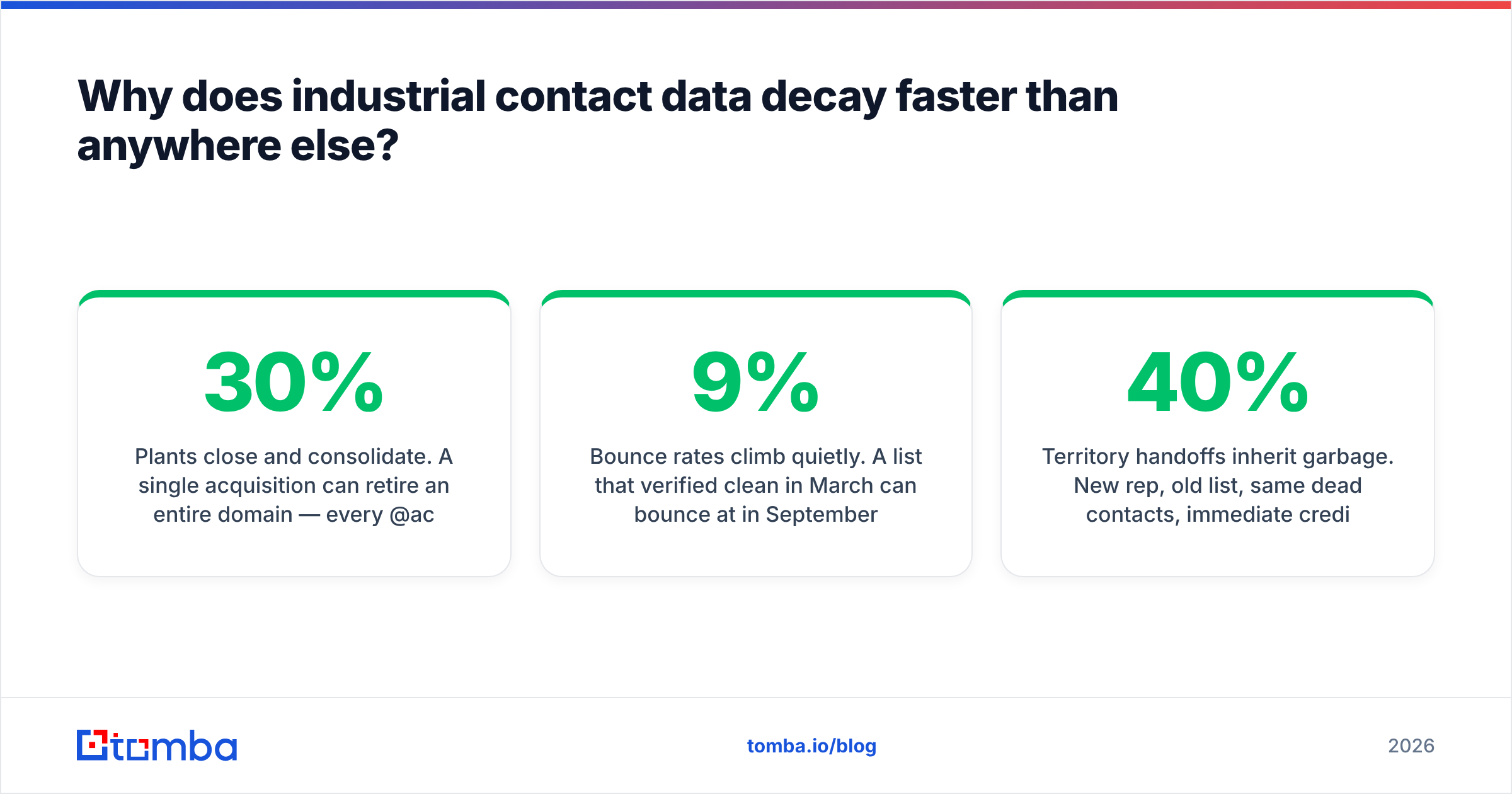
Plants close and consolidate. A single acquisition can retire an entire domain — every @acmevalve.com address becomes @parentco.com in a quarter. The manufacturing workforce also skews older than the B2B average, which means retirement-driven churn hits engineering and plant leadership harder than it hits a SaaS org chart. Add contract manufacturers where the "buyer" is a rotating program manager, and you get list decay that routinely runs 25-30% annually — meaningfully worse than the ~22.5% figure usually cited for B2B contact data overall.
The operational consequences are concrete:
- Bounce rates climb quietly. A list that verified clean in March can bounce at 9% in September. Anything over 3% starts damaging sender reputation, and once your domain is throttled, every campaign underperforms — including the ones with perfect targeting.
- CRM enrichment goes stale between quarters. If you enrich once at import and never again, half your "active" accounts are fiction within 18 months.
- Territory handoffs inherit garbage. New rep, old list, same 40% dead contacts, immediate credibility problem.
The fix is unglamorous and cheap relative to the cost of the alternative: verify before every campaign, not once at list build. Running a list through an email verifier before send costs a fraction of a cent per record and prevents the deliverability damage that takes weeks to unwind. For industrial domains that are often configured as catch-all — extremely common with older manufacturing IT setups — a dedicated catch-all verifier tells you whether a mailbox actually exists rather than returning a useless "accept all" verdict.
How do you find and reach the right industrial buyer?#
The workflow that consistently works looks like this. Five steps, in order:
- Build the account list from operational signals, not just NAICS filters. Job boards, permit databases, and equipment-tech scrapes beat generic firmographics.
- Map the committee per account. Identify at minimum: process/design engineer, quality manager, plant manager, and the buyer. Four contacts per account, not one.
- Find verified contact details. Use domain search to pull the email pattern and known contacts for each target plant domain, then fill named gaps with the email finder. For accounts where you have a LinkedIn profile but no address, a LinkedIn finder closes the loop.
- Verify everything, then segment by role. The message to a quality manager (audit readiness, PPAP, traceability) is not the message to a strategic buyer (landed cost, dual-sourcing, lead-time risk). Same account, different problem.
- Sequence across channels with realistic patience. Email, phone, LinkedIn, and — for high-value accounts — physical mail. Industrial buyers respond to specificity about their process, not to "just circling back."
On step 5, a note about phones: industrial buyers answer the phone at rates that would astonish a SaaS SDR. Plant and quality roles are frequently not sitting in inbox-triage mode all day. Pairing verified email with a phone finder lift is one of the few places where multi-channel genuinely outperforms email-only in this segment.

What should an industrial outbound message actually say?#
Three rules, in priority order.
Rule 1: Lead with their process, not your capability. "We do precision CNC machining to ±0.0005"" is a capability statement. "Your Tier 1 automotive program means PPAP submissions on a 6-week clock — we run first-article in 8 days" is a process statement. The second one gets replies.
Rule 2: Reference something only a real researcher would know. A specific line, a specific certification, a specific published expansion. Industrial buyers get the same generic templates everyone else gets, and they delete them faster because they are less patient with sales theater.
Rule 3: Make the ask proportional to the cycle. Asking for a 30-minute demo on a first touch in a category with an 18-month cycle is a mismatch. Ask for a spec sheet review, a sample, a capability comparison, or a 10-minute technical call. Small asks convert; big asks in long cycles do not.
If you want structure to start from, adapt cold email templates rather than writing from scratch — then rewrite every sentence that could apply to more than one company. Anything that survives a find-and-replace of the company name is not personalization.
Is inbound or outbound better for manufacturers?#
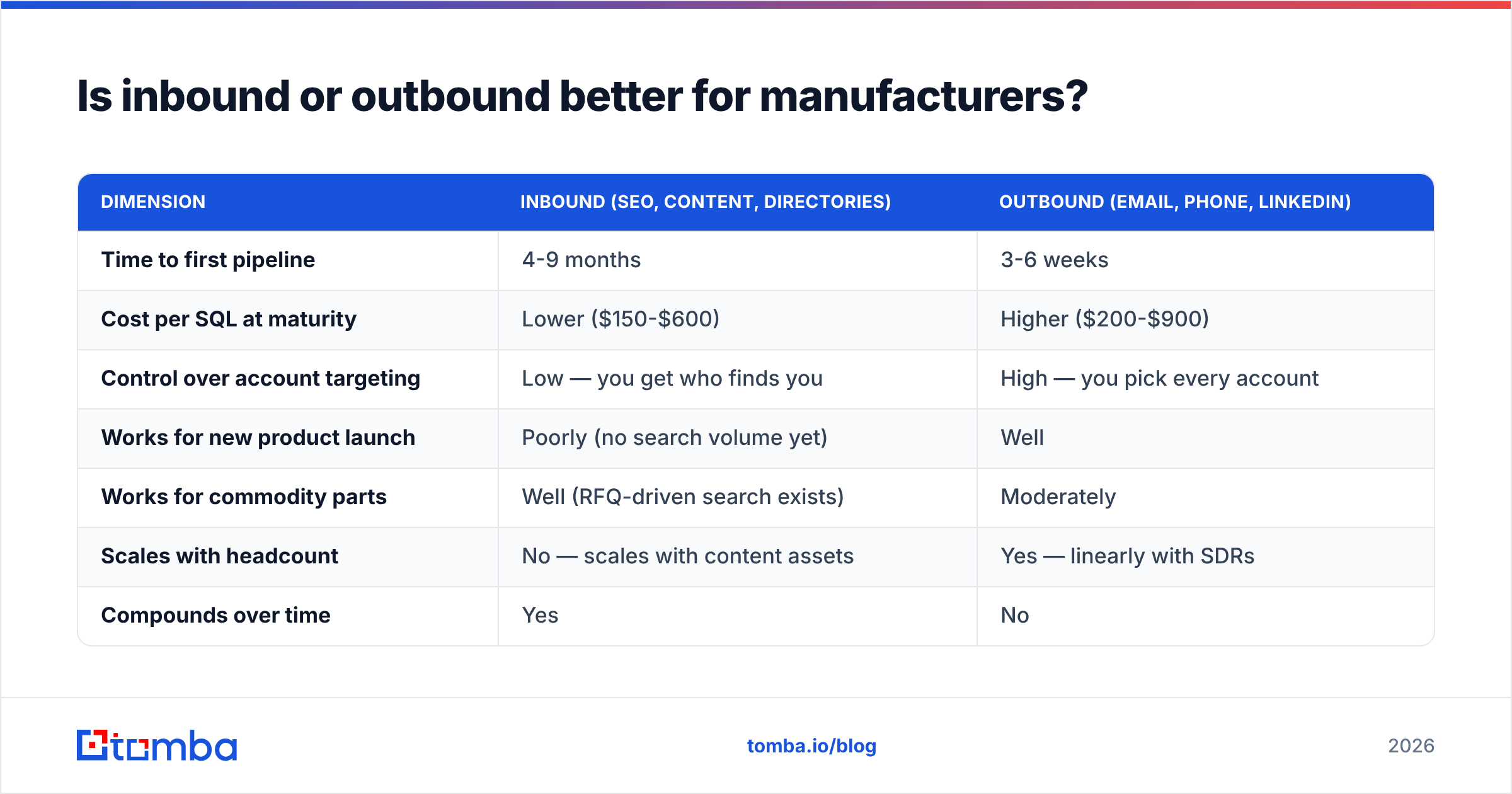
Neither alone. Here's the honest comparison:
| Dimension | Inbound (SEO, content, directories) | Outbound (email, phone, LinkedIn) |
|---|---|---|
| Time to first pipeline | 4-9 months | 3-6 weeks |
| Cost per SQL at maturity | Lower ($150-$600) | Higher ($200-$900) |
| Control over account targeting | Low — you get who finds you | High — you pick every account |
| Works for new product launch | Poorly (no search volume yet) | Well |
| Works for commodity parts | Well (RFQ-driven search exists) | Moderately |
| Scales with headcount | No — scales with content assets | Yes — linearly with SDRs |
| Compounds over time | Yes | No |
| Dependency risk | Google algorithm, directory pricing | Deliverability, data quality |
The practical allocation for most mid-market manufacturers: roughly 60% of marketing budget into inbound assets that compound (technical spec pages, CAD downloads, application engineering content, comparison guides), 40% into outbound that covers the revenue gap while those assets mature. Shift toward outbound when launching a new line or entering a new geography; shift toward inbound once you have enough share that buyers search for you by name.
One place inbound wins decisively: CAD file downloads. If you sell components, publishing downloadable STEP and IGES files is among the highest-intent lead magnets in existence. An engineer who downloads your model is designing you into a product. That is worth more than fifty ebook downloads, and it is trackable.
How do you measure industrial lead generation without lying to yourself?#
Most industrial marketing dashboards measure activity because outcomes take too long to show up. That's understandable and it's also how budgets get cut.
Track these instead:
- Spec-in rate — percentage of engaged engineering contacts where your part number appears in a drawing or BOM. This is the real leading indicator in component sales.
- Quote-to-order ratio by lead source. If directory leads close at 4% and outbound leads close at 19%, cost per lead is the wrong metric entirely.
- Committee coverage — how many of the 4-6 required roles you have verified contact with per open opportunity. Deals with one contact stall; deals with four don't.
- Time-to-first-response on inbound RFQs. Industrial buyers frequently award to whoever quotes first with a competent answer. Hours matter here more than most manufacturers believe.
- Data health — percentage of CRM contacts verified in the last 90 days. Below 60% and your reported pipeline is partly fictional.
For benchmarking your own funnel against broader B2B norms, G2's buyer behavior research and HubSpot's annual sales data are reasonable neutral reference points, though both skew toward software-industry respondents — adjust cycle-length expectations upward for industrials.
What tools do you actually need?#
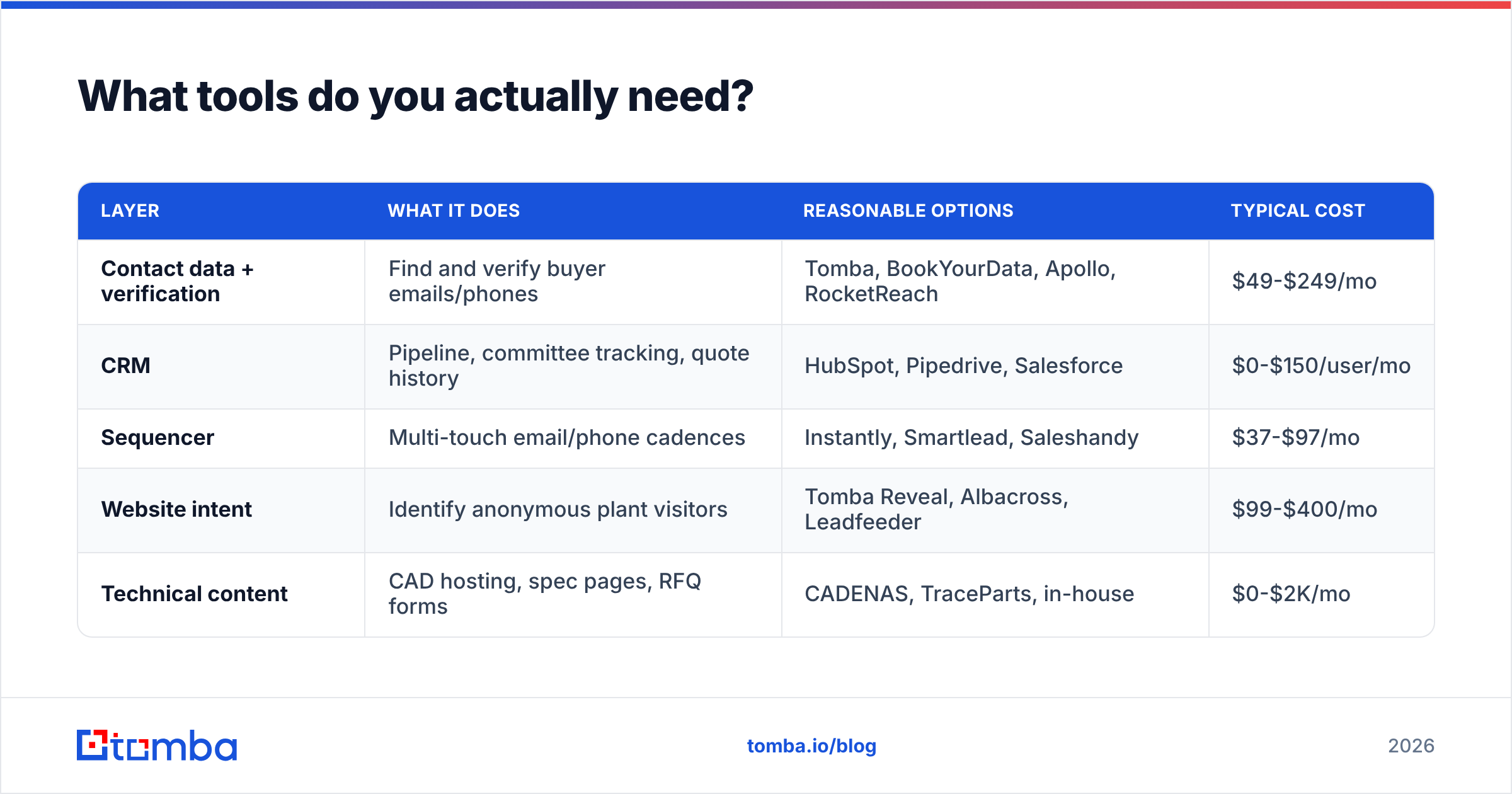
You need less than the vendor landscape suggests. A functional industrial lead gen stack in 2026:
| Layer | What it does | Reasonable options | Typical cost |
|---|---|---|---|
| Contact data + verification | Find and verify buyer emails/phones | Tomba, BookYourData, Apollo, RocketReach | $49-$249/mo |
| CRM | Pipeline, committee tracking, quote history | HubSpot, Pipedrive, Salesforce | $0-$150/user/mo |
| Sequencer | Multi-touch email/phone cadences | Instantly, Smartlead, Saleshandy | $37-$97/mo |
| Website intent | Identify anonymous plant visitors | Tomba Reveal, Albacross, Leadfeeder | $99-$400/mo |
| Technical content | CAD hosting, spec pages, RFQ forms | CADENAS, TraceParts, in-house | $0-$2K/mo |
A few notes on selection. If you sell into a niche vertical, a curated data provider like BookYourData can be a strong fit for pre-built, verified industry lists where you want volume without building the query yourself. If your motion is account-by-account — you know the 800 plants that matter and need the right four people at each — a search-and-verify tool serves you better than a bulk list. Many manufacturers use both: curated lists for breadth, targeted lookup for the named accounts that actually move the number.
For teams running lists at scale, the deciding factor is usually credit economics and API access rather than raw database size. Compare Tomba pricing against per-record list costs before committing to either model — a Growth plan at $99/mo behaves very differently from a per-contact purchase once your monthly volume crosses a few thousand lookups.
Also worth checking: whether the tool plugs into where your team already works. If your rep list lives in a spreadsheet, a Google Sheets add-on removes an entire copy-paste step. If it lives in your CRM, a HubSpot integration does the same. Tools that require a separate tab are tools your reps will quietly stop using by week three.
What does a realistic 90-day industrial lead gen plan look like?#
Days 1-30 — Fix the foundation. Audit CRM data health and verify every contact on active opportunities. Define the ICP with all five layers above. Map the buying committee for your top 50 target accounts. Set up basic intent tracking on your site.
Days 31-60 — Launch precision outbound. Build a 300-500 account list from operational signals. Find and verify 4 contacts per account. Write four role-specific message tracks. Launch sequences at low volume (30-50/day per mailbox) with warmed domains. Measure reply rate by role, not overall.
Days 61-90 — Build the compounding layer. Publish spec pages for your top 20 part families. Add CAD downloads where applicable. Set up RFQ forms with under-2-hour response SLAs. Start one distributor co-marketing program. Review outbound data: which operational signals predicted replies, and double down on those.
Nothing in that plan requires a large budget. It requires accepting that industrial buyers move slowly and reward specificity, and building a system that matches that reality instead of fighting it.
Where to start#
If you're going to fix one thing this quarter, fix the contact data underneath everything else. Targeting, messaging, sequencing, and follow-up all inherit the quality of the addresses and phone numbers you started with — and in industrials, that's the layer that rots fastest.
Start with the Tomba Email Finder on your top 50 target plants: pull the email pattern for each domain, find your four committee contacts per account, and verify before a single message goes out. The free tier gives you 25 searches a month to test whether the coverage holds up on your specific NAICS codes and geographies — run it against accounts where you already know the right contact, and see how it scores before you commit budget.
Related guides#
// get started
Find, verify and enrich your first contacts today
Start on the free plan with 25 searches a month, then scale when your team is ready.
Free plan · No credit card required · GDPR & CCPA
// about the author