9 Best Influ2 Alternatives in 2026 for Person-Based Ads
Influ2 pioneered person-based advertising, but it is not the only way to put ads in front of named buyers. Here are 9 alternatives compared on targeting depth, data quality, and what they actually cost.
TL;DR
- Influ2 sells one thing very well: showing ads to named individuals and telling you exactly who clicked. Everything else in its stack is thinner than an enterprise ABM platform.
- The best Influ2 alternatives split into three camps — account-based ad platforms (RollWorks, Demandbase, 6sense), paid-social automation (Metadata, Terminus), and DIY person-level targeting (LinkedIn contact-list ads plus your own data).
- Person-level targeting lives or dies on contact data. If your buyer list is stale, no platform can match it — match rates of 30–50% are common with bad lists.
- The cheapest credible route for a team under 20 people: build clean, verified contact lists yourself and upload them to LinkedIn and Meta. That is a $49–$99/month data cost against a $2,000+/month platform fee.
- Pick by the question you need answered: which accounts are in-market (6sense), which people saw the ad (Influ2, Primer), or which creative works (Metadata).
What is Influ2 and who actually uses it?#
Influ2 is a person-based advertising platform. Instead of targeting a company, a job-title segment, or an IP range, you upload a list of specific human beings — first name, last name, company — and Influ2 matches them across LinkedIn, Meta, Google Display, and programmatic inventory, then reports engagement at the individual level. Your SDR sees "Maria Chen, VP Engineering at Acme, clicked your ad twice this week" rather than "Acme showed 14 impressions."
That single capability is why it has fans. Sales teams get an intent signal tied to a name they can actually email. Marketing gets attribution that survives a CFO's questioning. Influ2 has been pushing this "person-based advertising" category since 2018, and most of its reviews on G2 praise the same thing: buyer-level visibility.
The complaints are also consistent. Pricing is quote-only and lands in enterprise territory for what is essentially an ad-buying layer. Match rates depend entirely on the contact list you feed it. Reporting is strong on engagement but weak on pipeline modeling. And if you already run a full ABM platform, you are paying twice for overlapping audience management.

Why do teams look for Influ2 alternatives?#
Four reasons come up over and over in procurement conversations:
- Cost against addressable market. If your total addressable market is 800 accounts and 3,000 named buyers, a five-figure annual platform fee before a dollar of ad spend is hard to defend. The math works at 5,000 accounts, not 500.
- Overlap with existing ABM spend. Teams already paying for Demandbase or 6sense have audience management, intent data, and ad delivery in the contract. Adding person-level ads on top is a second bill for a feature the incumbent partly covers.
- Match-rate disappointment. Person-based ads only fire when the platform can resolve your contact to an ad-network profile. Feed it a list scraped 18 months ago and half your audience simply never sees anything — but you still pay the platform fee.
- Channel limits. Person-level matching is strongest on LinkedIn and Meta. Display and programmatic person-matching is fuzzier than the pitch implies, and buyers notice when the reporting stops being crisp.
- Attribution disputes. Ad clicks from a named person are a signal, not a conversion. Some revenue teams found themselves arguing internally about whether an ad click deserved credit for a deal an SDR had already worked for six weeks.
How does person-based advertising actually work?#
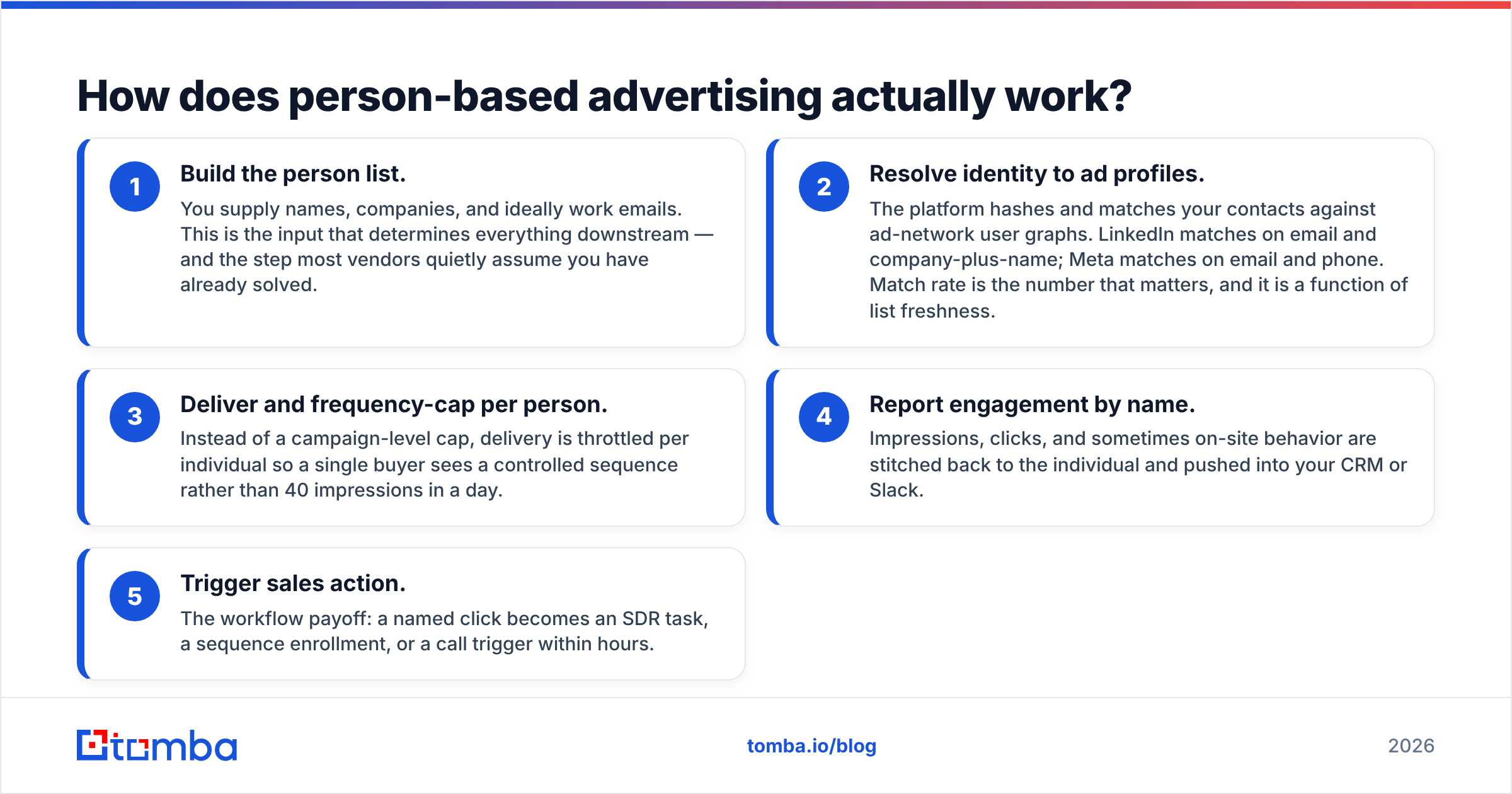
Understanding the mechanics tells you which alternative you actually need, because every vendor in this category does the same four steps with different levels of automation.
- Build the person list. You supply names, companies, and ideally work emails. This is the input that determines everything downstream — and the step most vendors quietly assume you have already solved.
- Resolve identity to ad profiles. The platform hashes and matches your contacts against ad-network user graphs. LinkedIn matches on email and company-plus-name; Meta matches on email and phone. Match rate is the number that matters, and it is a function of list freshness.
- Deliver and frequency-cap per person. Instead of a campaign-level cap, delivery is throttled per individual so a single buyer sees a controlled sequence rather than 40 impressions in a day.
- Report engagement by name. Impressions, clicks, and sometimes on-site behavior are stitched back to the individual and pushed into your CRM or Slack.
- Trigger sales action. The workflow payoff: a named click becomes an SDR task, a sequence enrollment, or a call trigger within hours.
Steps 2 through 5 are what you are buying. Step 1 is what you are responsible for — and it is where most programs underperform. A verified, recent list can push LinkedIn match rates well above 60%; a stale export from an old CRM often lands under 35%. That gap is worth more than any feature difference between the vendors below, which is why contact enrichment and verification belong in your budget before the ad platform does.
What are the best Influ2 alternatives in 2026?#
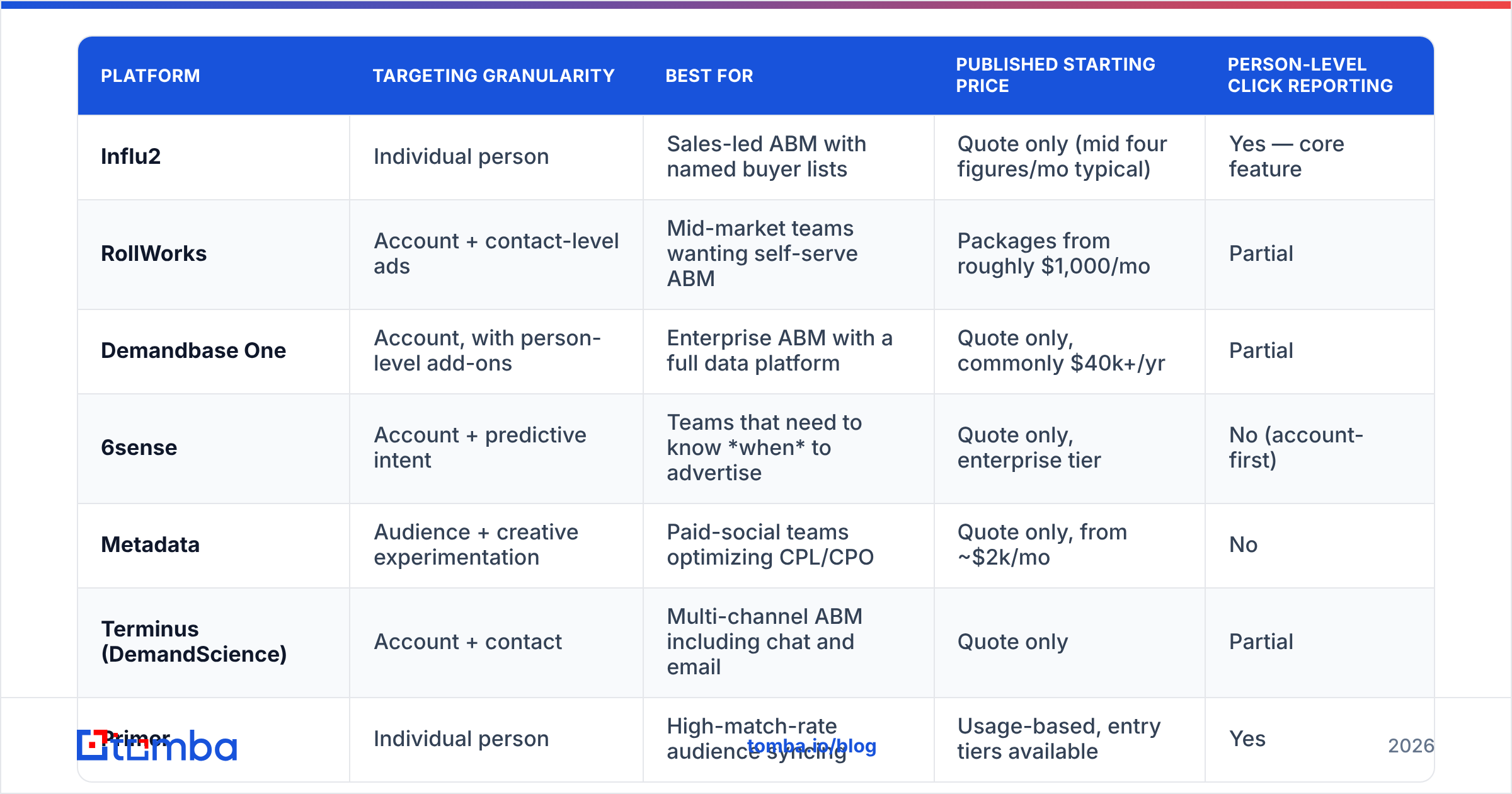
| Platform | Targeting granularity | Best for | Published starting price | Person-level click reporting |
|---|---|---|---|---|
| Influ2 | Individual person | Sales-led ABM with named buyer lists | Quote only (mid four figures/mo typical) | Yes — core feature |
| RollWorks | Account + contact-level ads | Mid-market teams wanting self-serve ABM | Packages from roughly $1,000/mo | Partial |
| Demandbase One | Account, with person-level add-ons | Enterprise ABM with a full data platform | Quote only, commonly $40k+/yr | Partial |
| 6sense | Account + predictive intent | Teams that need to know when to advertise | Quote only, enterprise tier | No (account-first) |
| Metadata | Audience + creative experimentation | Paid-social teams optimizing CPL/CPO | Quote only, from ~$2k/mo | No |
| Terminus (DemandScience) | Account + contact | Multi-channel ABM including chat and email | Quote only | Partial |
| Primer | Individual person | High-match-rate audience syncing | Usage-based, entry tiers available | Yes |
| LinkedIn Contact Targeting | Individual person | DIY person-based ads at any budget | Ad spend only, no platform fee | Yes, via list segmentation |
| Tomba + native ad platforms | Individual person | Lean teams building their own lists | Free tier; $49/mo Starter | Yes, via list segmentation |
RollWorks#
The most common step-down from enterprise ABM. RollWorks handles account identification, ad delivery, and contact-level targeting inside NextRoll's ad infrastructure. It is not truly person-based in the Influ2 sense — reporting is strongest at the account level — but the packaging is friendlier and mid-market teams can actually self-serve. Choose it when you want an ABM ad program without an implementation project.
Demandbase One#
The full platform: intent data, account identification, advertising, sales intelligence, and orchestration. If your program is 3,000+ accounts and multiple product lines, Demandbase does things Influ2 never attempts. It also costs several times more and takes a quarter to implement. Teams comparing the two usually end up reading a Demandbase alternative breakdown before signing, because the contract minimums are the deciding factor more often than features.
6sense#
6sense answers a different question. It is not primarily "which person clicked" but "which accounts are researching this category right now." Advertising is one activation channel among several. If your problem is timing rather than precision, 6sense is the better spend — and you can layer person-level list uploads on top of its account output.
Metadata#
Metadata automates paid-social experimentation: audience permutations, creative variants, budget reallocation to whatever converts. It is the strongest alternative if your bottleneck is campaign operations rather than targeting. It will not tell you that Maria Chen clicked. It will tell you which of your 46 audience-creative combinations produced pipeline.
Terminus#
Now part of DemandScience, Terminus remains a multi-channel ABM option — display, email signature ads, chat, and web personalization in one place. Useful when you want more than one touchpoint per account and dislike stitching four vendors together. Evaluate the roadmap carefully post-acquisition.
Primer#
The closest philosophical match to Influ2. Primer focuses on getting your person lists to actually match inside ad platforms, with match rates as the headline metric, and it syncs audiences continuously rather than as one-off uploads. Lighter, more usage-priced, and a genuine option for teams who like the person-based model but not the enterprise contract.
LinkedIn contact targeting (the DIY route)#
You can upload a list of work emails directly into LinkedIn Campaign Manager as a matched audience, segment those lists by persona or account tier, and read engagement per list. Split your 400 buyers into 20 lists of 20 and you have approximate person-level reporting for the cost of ad spend alone. It is manual, it needs a minimum audience size per list, and it lacks cross-channel stitching — but the incremental platform cost is zero.

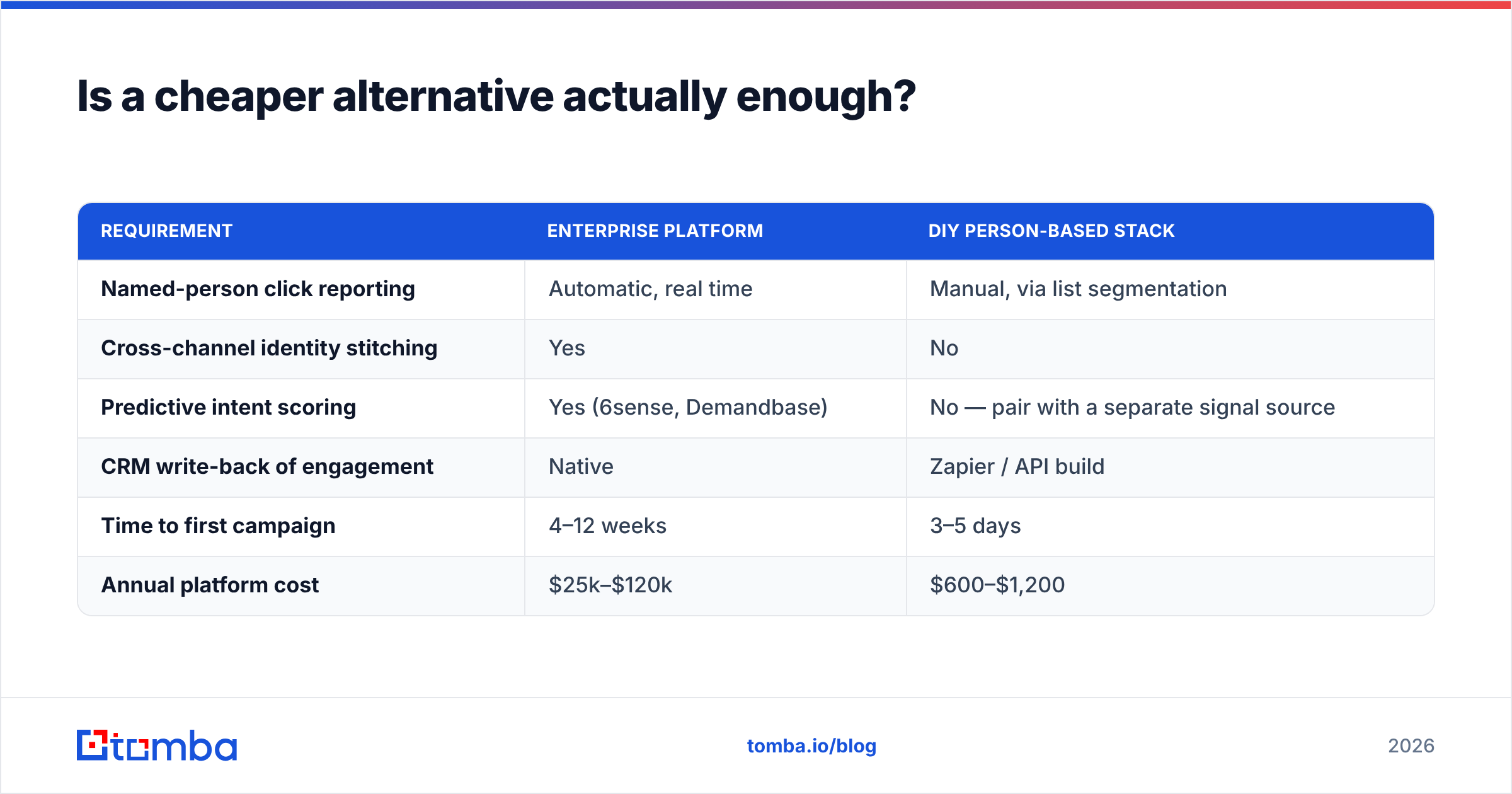
Is a cheaper alternative actually enough?#
For most teams under $20M ARR, yes — provided you fix the data layer first. Here is the honest trade:
| Requirement | Enterprise platform | DIY person-based stack |
|---|---|---|
| Named-person click reporting | Automatic, real time | Manual, via list segmentation |
| Cross-channel identity stitching | Yes | No |
| Predictive intent scoring | Yes (6sense, Demandbase) | No — pair with a separate signal source |
| CRM write-back of engagement | Native | Zapier / API build |
| Time to first campaign | 4–12 weeks | 3–5 days |
| Annual platform cost | $25k–$120k | $600–$1,200 |
The DIY column loses on automation and wins on everything financial. If you run fewer than 1,000 target buyers, the manual work is a few hours a month — genuinely less than the time you would spend in onboarding calls for the enterprise option.
What does contact data have to do with ad performance?#
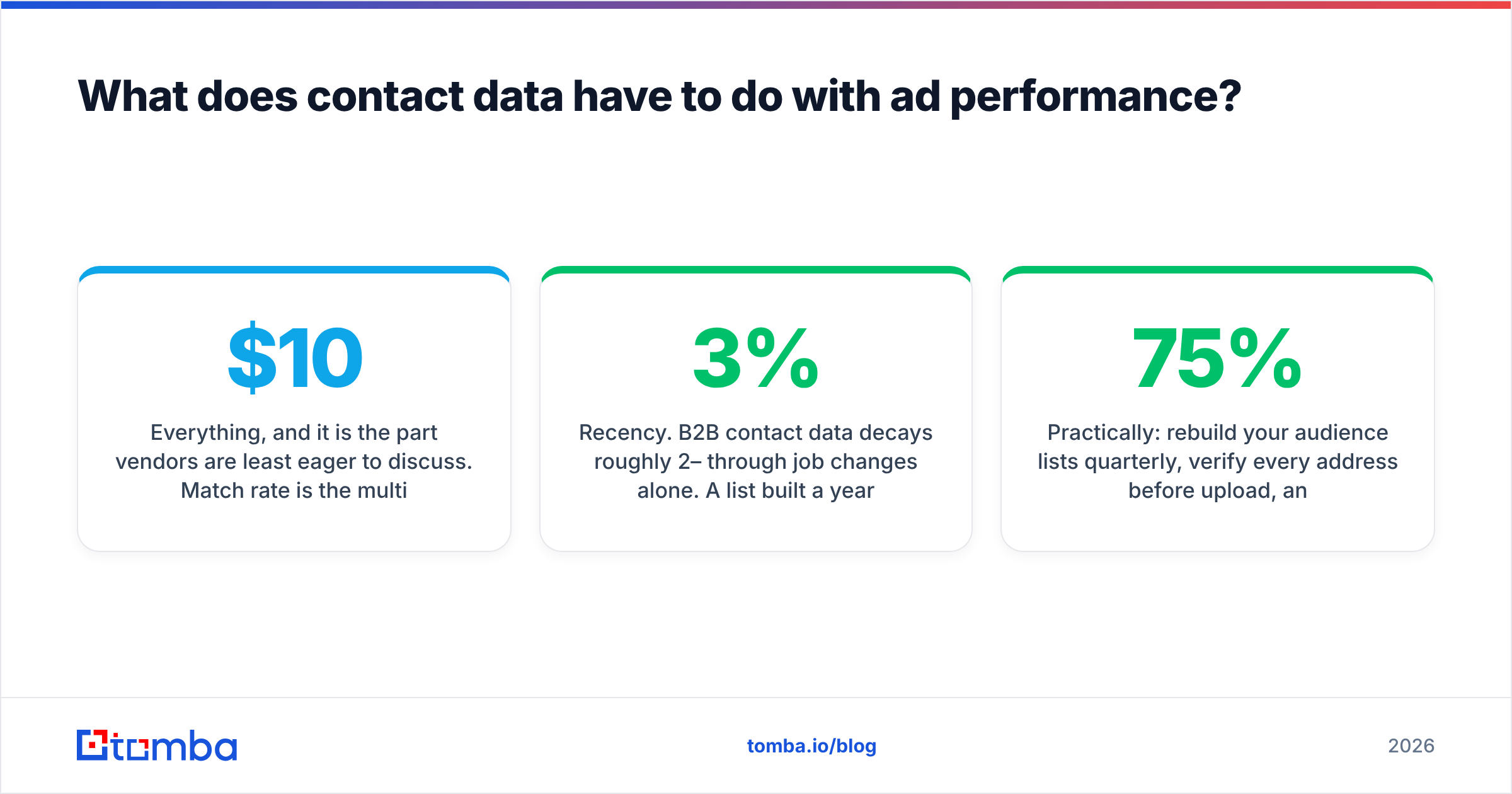
Everything, and it is the part vendors are least eager to discuss. Match rate is the multiplier on your entire program. Spend $10,000 against a list that matches at 35% and you effectively bought 3,500 reachable people; the same spend against a 65%-match list buys 6,500. No creative optimization recovers that gap.
Three things drive match rate:
- Email accuracy. Ad networks match on hashed email first. A wrong or long-dead address is an automatic miss, which is why running lists through an email verifier before upload is not optional.
- Recency. B2B contact data decays roughly 2–3% per month through job changes alone. A list built a year ago is meaningfully different from the one you think you have.
- Coverage of the right people. Buying committees have grown; targeting only the VP misses the four people who will actually kill or champion the deal. Use domain search to map every relevant role at a target account, not just the one name in your CRM.
Practically: rebuild your audience lists quarterly, verify every address before upload, and track match rate per list as a first-class metric alongside CTR and CPL. Teams that do this routinely see match rates in the 60–75% range on LinkedIn — which changes the ROI case for every platform in this article.
Which Influ2 alternative should you choose?#
- You need named-person reporting and have budget: stay with Influ2 or evaluate Primer for a lighter, usage-priced version of the same idea.
- You need to know when to advertise: 6sense, with person-level lists layered on the accounts it surfaces.
- You already own an ABM platform: use its contact-level ad features before adding a second vendor; check the 6sense alternative and Demandbase comparisons for what you are already entitled to.
- Your bottleneck is campaign ops, not targeting: Metadata.
- You want mid-market ABM without an implementation project: RollWorks.
- You have fewer than 1,000 target buyers: build the lists yourself, upload to LinkedIn and Meta, and put the saved budget into ad spend and data quality.
Whichever way you go, the sequencing is the same. Fix the list, then buy the platform. A person-based ad program built on unverified contacts is an expensive way to advertise to people who no longer work there.
Start with the input layer. Use the Tomba Email Finder to build verified, role-complete buyer lists for every account in your ICP, then push those lists straight into LinkedIn, Meta, or whichever platform you land on. The free tier covers 25 searches a month so you can benchmark match rates before committing, and Tomba pricing starts at $49/month for Starter — roughly one afternoon of your ABM platform's daily cost.
Related guides#
// get started
Find, verify and enrich your first contacts today
Start on the free plan with 25 searches a month, then scale when your team is ready.
Free plan · No credit card required · GDPR & CCPA
// about the author