Influ2 Pricing Reviews: Pros, Cons and Costs in 2026
Influ2 sells person-based advertising with quote-only pricing and annual contracts. Here is what buyers actually pay, what reviewers praise, where it breaks down, and when a cheaper contact-data stack does the same job.
Influ2 pricing reviews are hard to pin down, because Influ2 never publishes a price. This guide pulls together what buyers report paying in 2026, what they praise, and where the model breaks.
TL;DR
- Influ2 does not publish a price. Every deal is a quote. Buyers report annual contracts in the low five figures to $60k+ per year, with media spend billed on top of the platform fee.
- The product is genuinely different: it serves ads to named individuals, then reports which people clicked. Nobody else does this as cleanly.
- The top gripe in Influ2 pricing reviews is not the interface. It is cost against the size of the list you can actually reach. Small target lists burn budget fast.
On scope and budget:
- Influ2 is an awareness and warming layer, not a contact-data source. You still need verified emails, phone numbers, and enrichment to work the accounts it lights up.
- Is your ICP under ~2,000 accounts, on a budget under ~$2k/month? Then a direct outbound stack built on accurate contact data will usually win on cost per meeting.
What is Influ2 and who actually buys it?#
Influ2 is a person-based advertising platform. Instead of targeting "SaaS companies with 200-1,000 employees in North America," you upload a list of specific humans — Jane Chen, VP Ops at Acme. Influ2 then serves display and social ads to those individuals across Google, LinkedIn, Facebook, and programmatic inventory. When Jane clicks, the platform tells you it was Jane, not "someone at Acme."
That last part is the whole pitch. Traditional account-based advertising gives you account-level signals: somebody at Acme saw your ad seven times. Influ2 gives you person-level signals. That maps onto how sales teams actually work, because you call a person, not a company.
The typical buyer is a demand-gen or ABM lead at a mid-market or enterprise B2B company with:
- A defined buying committee. Deals involving 5-12 stakeholders where you need multi-threaded air cover, not a single champion.
- A long sales cycle. 90+ days, where warming a name for six weeks before the SDR calls is a rational investment.
- High ACV. Reviewers on G2 who report positive ROI are almost always selling deals worth $50k+.
- Existing SDR capacity. Influ2 produces intent signals. Someone has to act on them within hours, or the signal decays.
- A CRM that's already clean. Person-level attribution is worthless if your contact records are stale.
If two or more of those are missing, the economics get shaky fast — which is exactly what the more critical Influ2 pricing reviews describe.
How does Influ2 pricing actually work?#
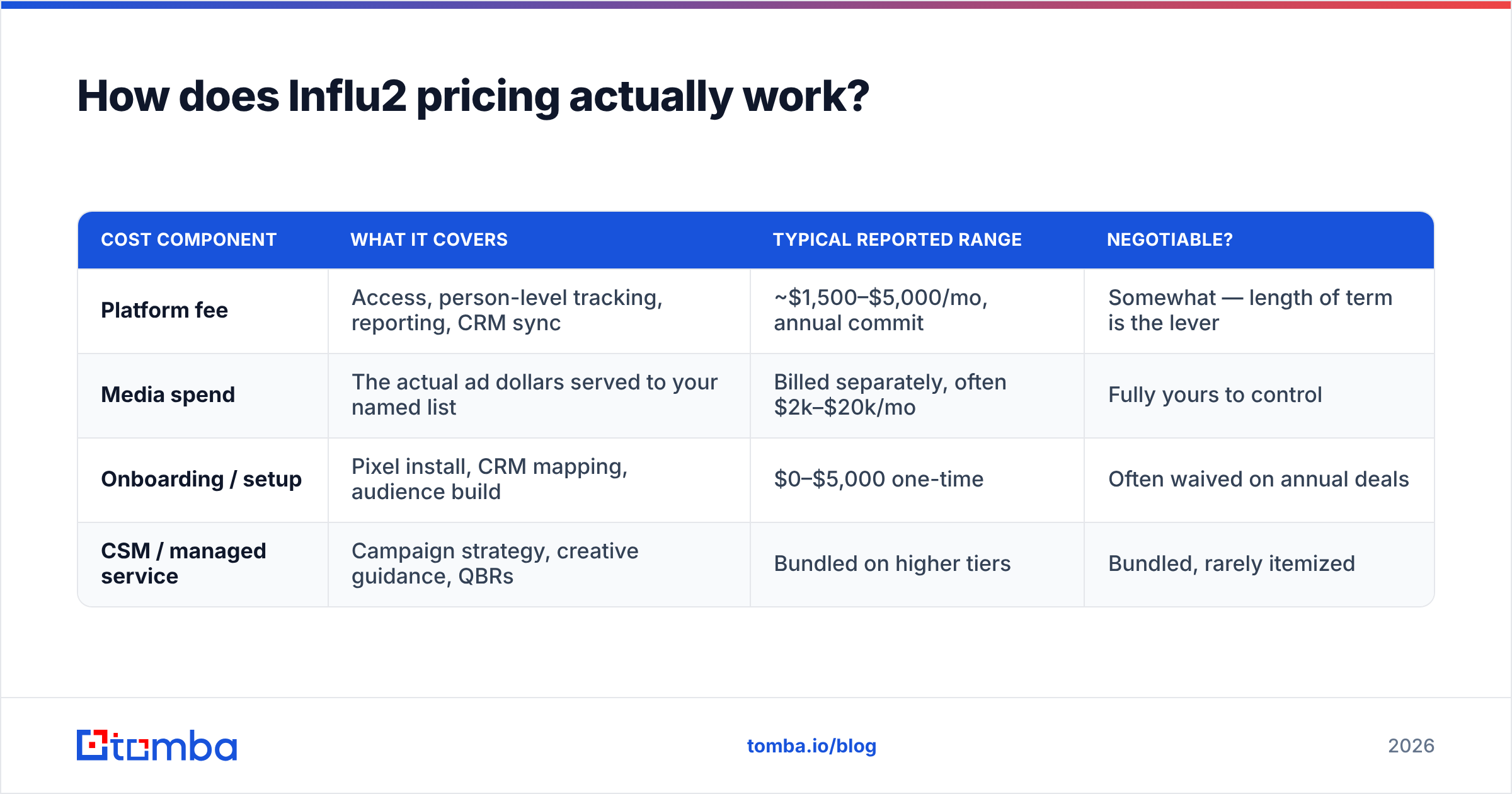
There is no public pricing page. Influ2's own site sends you to a demo request, and each deal is priced on its own. Buyer reports across review platforms and published case studies point to four separate line items.
| Cost component | What it covers | Typical reported range | Negotiable? |
|---|---|---|---|
| Platform fee | Access, person-level tracking, reporting, CRM sync | ~$1,500–$5,000/mo, annual commit | Somewhat — length of term is the lever |
| Media spend | The actual ad dollars served to your named list | Billed separately, often $2k–$20k/mo | Fully yours to control |
| Onboarding / setup | Pixel install, CRM mapping, audience build | $0–$5,000 one-time | Often waived on annual deals |
| CSM / managed service | Campaign strategy, creative guidance, QBRs | Bundled on higher tiers | Bundled, rarely itemized |
Three things matter more than the headline number:
- Annual commitment is the default. Month-to-month is rare, and priced harshly when it is offered. Buyers with regrets almost always signed a 12-month deal after a demo, not a pilot.
- Pricing scales with audience size, not seats. Bigger target-person lists cost more. That flips the usual SaaS instinct that "more data = better value."
- Media spend is not included. Many first-time buyers budget the platform fee, then find that the ads are a separate, uncapped line.
Sorry — that renders as a plain image below:
What do Influ2 pricing reviews say about the product?#
Sentiment across G2 and Gartner Peer Insights is positive on capability and mixed on value. Here is the honest split.
What reviewers consistently praise:
- Person-level click reporting. This is the feature people renew for. Knowing the CFO clicked your ad twice this week — not "an unknown visitor" — is a real signal for SDRs.
- Fast setup. Most teams go live in one to three weeks. That is quick for an ABM platform.
- Responsive customer success. Named CSMs, real campaign feedback, and quick turnaround come up again and again in positive reviews.
- CRM integration quality. Salesforce and HubSpot syncs are called reliable, with engagement data landing on the contact record where reps live.
- Sales-marketing alignment. The output is a list of named humans showing interest, so sales teams stop arguing about MQL quality.
What reviewers consistently criticize:
- Opaque pricing. The most common friction point by far. Buyers dislike sitting through two demos before they see a number, and dislike learning that media spend is separate.
- Audience match rates. Not every person on your list can be reached across ad networks. Rates swing by geography and seniority. The unmatched part is money you cannot spend.
- Cost per reachable person on small lists. If your ICP is 400 people, the platform fee spread across 400 names is brutal math.
- Creative burden falls on you. Influ2 handles targeting and reporting. Banner design, messaging, and landing pages are your job. Weak creative produces weak results, however precise the targeting.
- Attribution debates never end. Person-level clicks beat account-level impressions. Still, tying a click to closed revenue takes assumptions your CFO may not accept.
None of that makes it a bad product. It makes it a specific product with a narrow window of ideal fit.
How does Influ2 compare to the alternatives?#
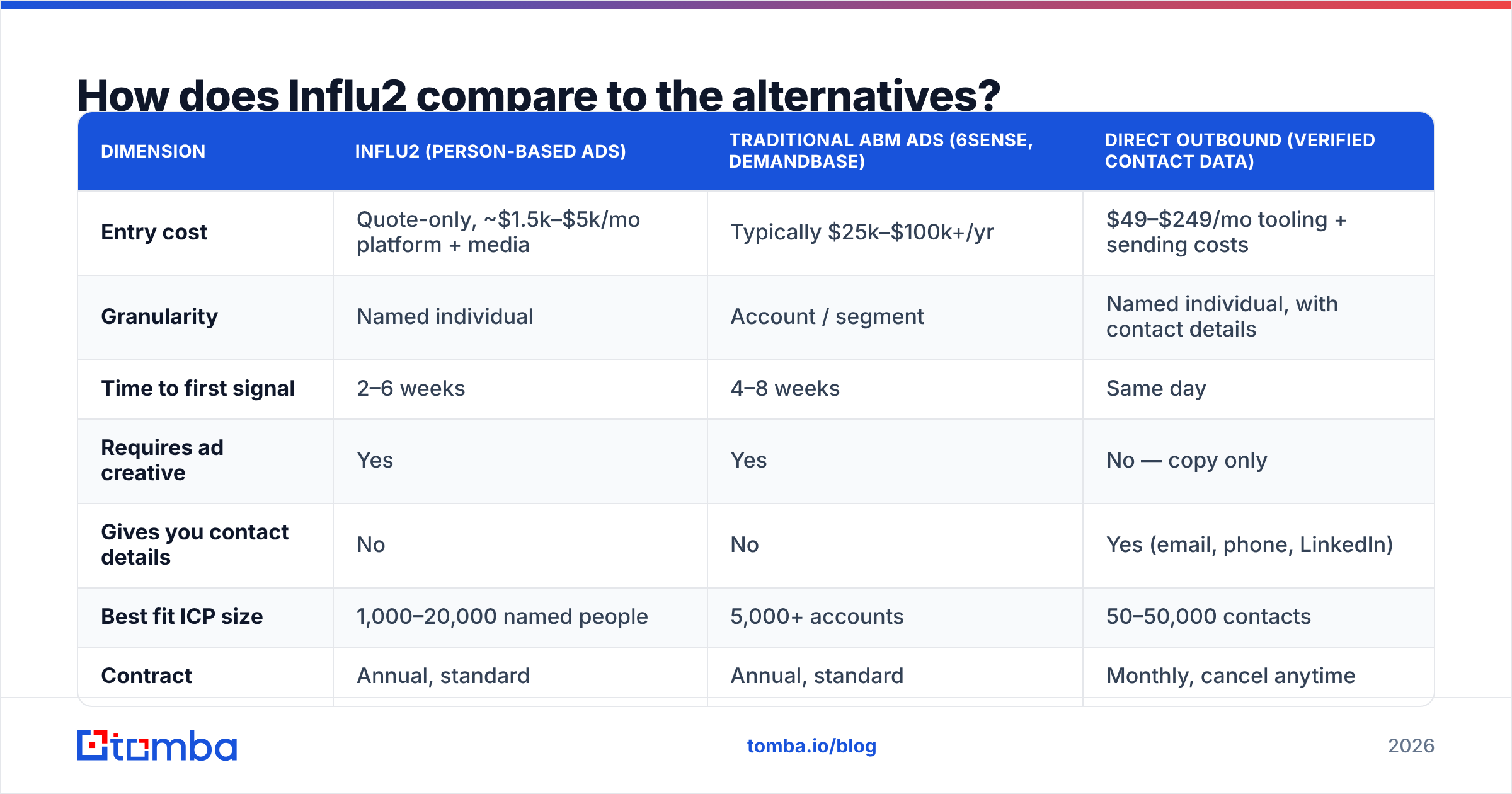
The comparison people actually need isn't Influ2 vs. another ABM ad platform. It is person-based advertising vs. the cheaper things you could do with the same budget. Here's how the categories stack up.
| Dimension | Influ2 (person-based ads) | Traditional ABM ads (6sense, Demandbase) | Direct outbound (verified contact data) |
|---|---|---|---|
| Entry cost | Quote-only, ~$1.5k–$5k/mo platform + media | Typically $25k–$100k+/yr | $49–$249/mo tooling + sending costs |
| Granularity | Named individual | Account / segment | Named individual, with contact details |
| Time to first signal | 2–6 weeks | 4–8 weeks | Same day |
| Requires ad creative | Yes | Yes | No — copy only |
| Gives you contact details | No | No | Yes (email, phone, LinkedIn) |
| Best fit ICP size | 1,000–20,000 named people | 5,000+ accounts | 50–50,000 contacts |
| Contract | Annual, standard | Annual, standard | Monthly, cancel anytime |
| Main failure mode | Low match rate, weak creative | Cost, long ramp | Poor data quality, deliverability |
The row that decides most evaluations is "gives you contact details." Influ2 tells you who is interested. It does not tell you how to reach them. That is a separate purchase. You need a verified email finder, a phone finder, or a data enrichment layer. Each one turns a name and a company into a working contact record.
Teams that budget for Influ2 and forget that second line item end up with a beautiful dashboard of warm names they cannot email.
What are the hidden costs buyers miss?#
Four line items show up after signature, not before.
Costs on the ad side:
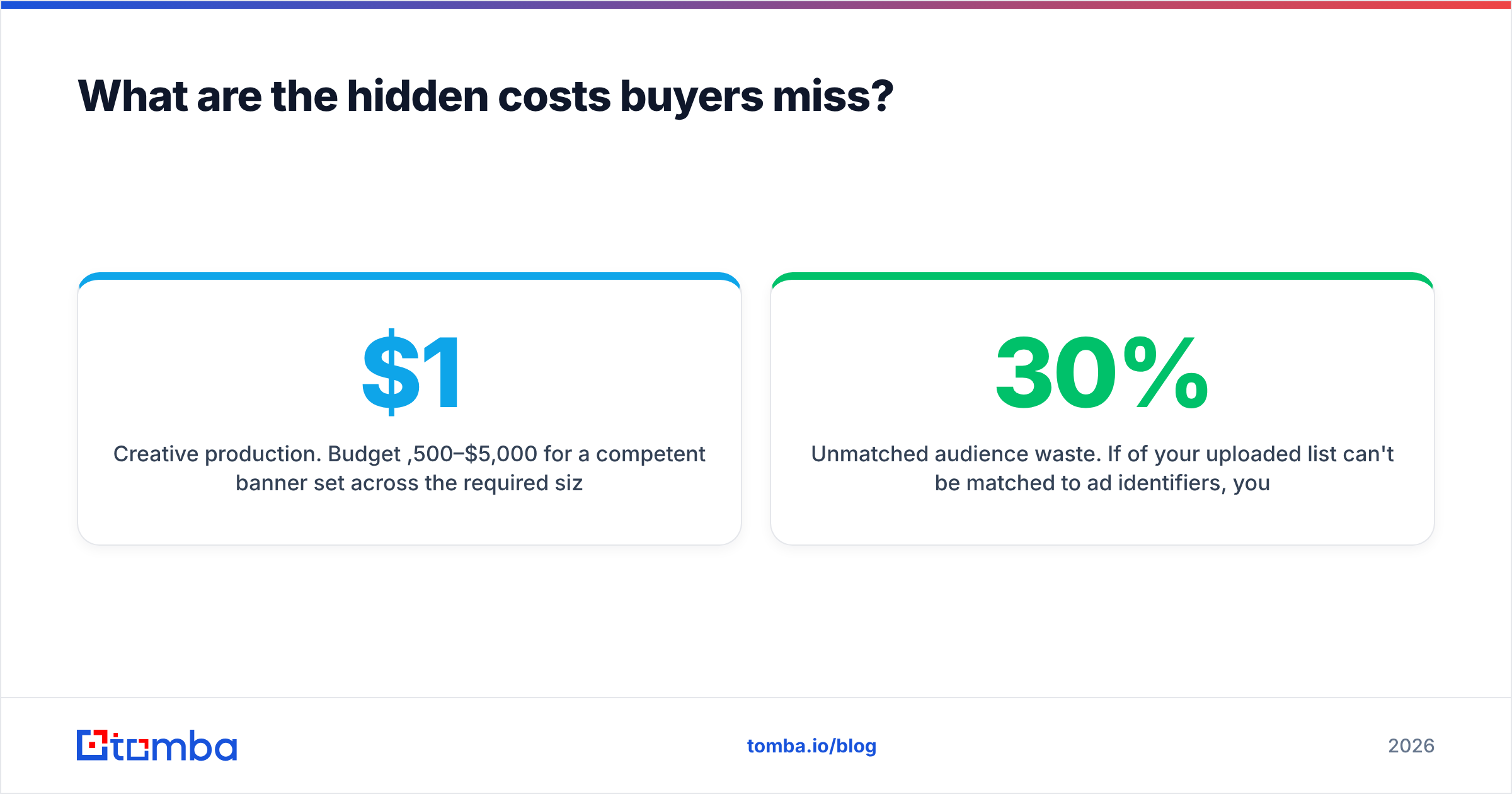
- Creative production. Budget $1,500–$5,000 for a solid banner set in the required sizes, or an in-house designer's time. Refreshing creative each quarter is not optional. The same 3,000 people see every ad, so fatigue hits faster than on broad audiences.
- Unmatched audience waste. If 30% of your list cannot be matched to ad identifiers, you pay platform fees on names you cannot reach. Ask for match-rate benchmarks for your own geography and seniority mix before you sign.
Costs on the sales side:
- The follow-up stack. Person-level intent only pays off if a rep acts on it. That means sequencing tools plus accurate contact data. A verified email verifier step matters more here than usual, because you are emailing high-value named executives and a bounce costs you twice.
- Annual commitment risk. If the program stalls in months two and three, you still owe months four through twelve. Negotiate an out clause tied to performance, or a shorter first term, even at a higher monthly rate.
Is Influ2 worth it in 2026?#
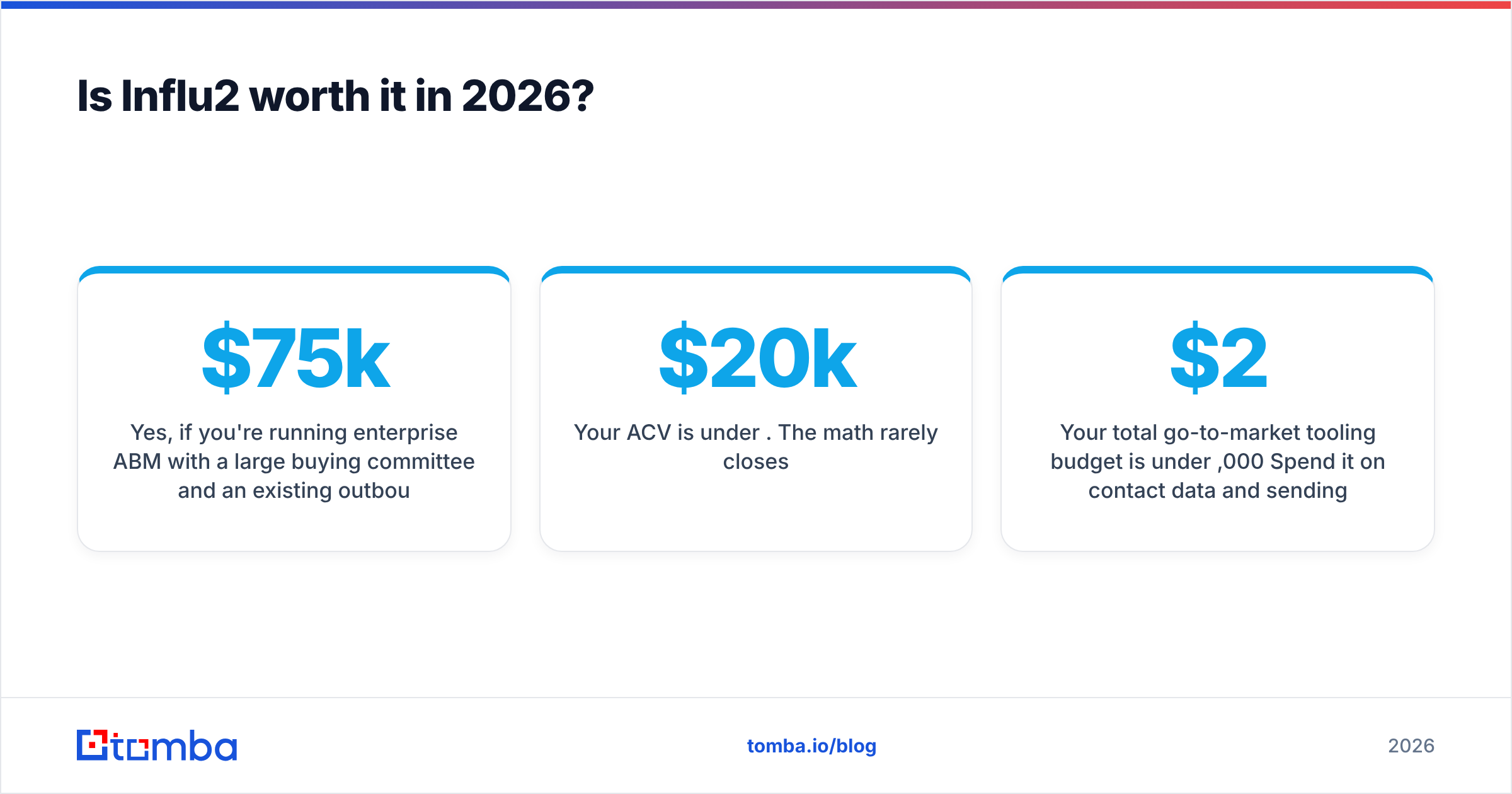
Yes, if you're running enterprise ABM with a large buying committee and an existing outbound motion. The person-level signal is real, the reporting changes how SDRs pick their next call, and no cheaper tool copies it. At $75k+ ACV with a 6-month cycle, one extra deal pays for the year.
No, if any of these are true:
- Your total addressable list is under about 1,000 named people. The fixed platform fee never spreads thin enough.
- Your ACV is under $20k. The math rarely closes.
- You don't have SDRs or a rep team ready to act on signals within 24 hours.
- Your total go-to-market tooling budget is under $2,000/month. Spend it on contact data and sending infrastructure first. Those are prerequisites, not alternatives.
- You need contact-level reachability, not awareness. Ads warm people; they don't hand you an inbox.
The honest framing: Influ2 is a multiplier on an outbound engine that already works. It is a poor substitute for one. Teams that buy it as a shortcut past the hard work of building clean lists and accurate contact data tend to churn at renewal.
What should you do before you take the demo?#
Run this sequence and you'll negotiate from a much better position.
Before the call:
- Size your reachable audience first. Count the named people in your ICP, not the accounts. Use domain search to list real contacts at your target companies and see whether that list is 800 people or 8,000. The number tells you whether Influ2's model fits, before you hear a price.
- Verify the list. A list full of people who left two years ago will drag down match rates and skew every metric after it.
On the call and after:
- Ask three specific questions. What is the platform fee, separate from media? What match rate do you see for my geography and seniority? What is the shortest term you will write?
- Model cost per reachable person. Total annual cost divided by matched, verified names. Under $10 is defensible. Over $40 needs a very good ACV story.
- Pilot the cheap version first. Run a targeted outbound sequence to the same list for one quarter. If direct outreach to verified contacts books meetings, Influ2 will amplify it. If it books nothing, ads will not fix the message.
Where does the contact data come from?#
Every person-based program starts with a list of real humans at real companies. That list is the input, and its quality caps everything downstream. Bad emails mean bad match rates, bounced follow-ups, and numbers you cannot trust.
Tomba's Email Finder builds that input layer. Find professional email addresses by domain, name, or company. Verify them before they hit a sequence. Then enrich the records your ad platform and CRM both depend on. Plans start free at 25 searches a month, with Starter at $49/mo and Growth at $99/mo — see full Tomba pricing for the tiers. Build the accurate list first. Decide whether to spend five figures advertising to it second.
Related guides#
// get started
Find, verify and enrich your first contacts today
Start on the free plan with 25 searches a month, then scale when your team is ready.
Free plan · No credit card required · GDPR & CCPA
// about the author