Influencers Club vs Apollo.io: Which Data Tool Wins in 2026?
Influencers Club vs Apollo.io: one tool indexes creators and their contact details. The other indexes 200M+ business contacts and sequences them. Here is how the two actually differ — and which one fits your outbound motion.
Influencers Club vs Apollo.io is not really one contest. One tool finds creators. The other finds staff inside companies. Pick the wrong one and you pay for a list you cannot use.
TL;DR
- They are not true rivals. Influencers Club indexes creators. It maps TikTok, Instagram and YouTube profiles, then adds contact details. Apollo.io indexes business people — job titles, firms, buying signals — and adds a sequencer on top.
- Pick Influencers Club if your buyer is the creator. Think influencer agencies, UGC platforms, affiliate programs and creator-economy SaaS.
- Pick Apollo.io if your buyer sits on an org chart. Think B2B SaaS, agencies that sell to marketing teams, and anyone who needs titles, headcount and intent data.
- Neither is a good email checker. Both tie contact data to their own workflow. Both charge you again for exports you already paid to find.
- A standalone finder and verifier (Tomba starts free, then $49/mo) fills the gaps in either one. It costs less than a seat you barely use.
Influencers Club vs Apollo.io: what does each tool do?#
Start with the honest framing. These two tools share a label — "contact data" — and little else.
Influencers Club is a creator database. It crawls social platforms. It builds a profile around the person as a channel: follower count, engagement rate, audience make-up, niche and posting rhythm. Then it attaches a business email where it can find one. You search it the way a brand partnerships manager thinks. "Fitness creators in the US, 50K–250K followers, 3%+ engagement, public email." Read their pitch at influencers.club.
Apollo.io is a B2B sales tool with a large database behind it. It sells access to 200M+ contacts, by its own count. You filter by title, seniority, team, tech stack, funding and hiring signals. Then you email or call those people in the same tab. Details on apollo.io.
The overlap is one field: an email address. Everything around that field serves a different job.
Here is the practical split:
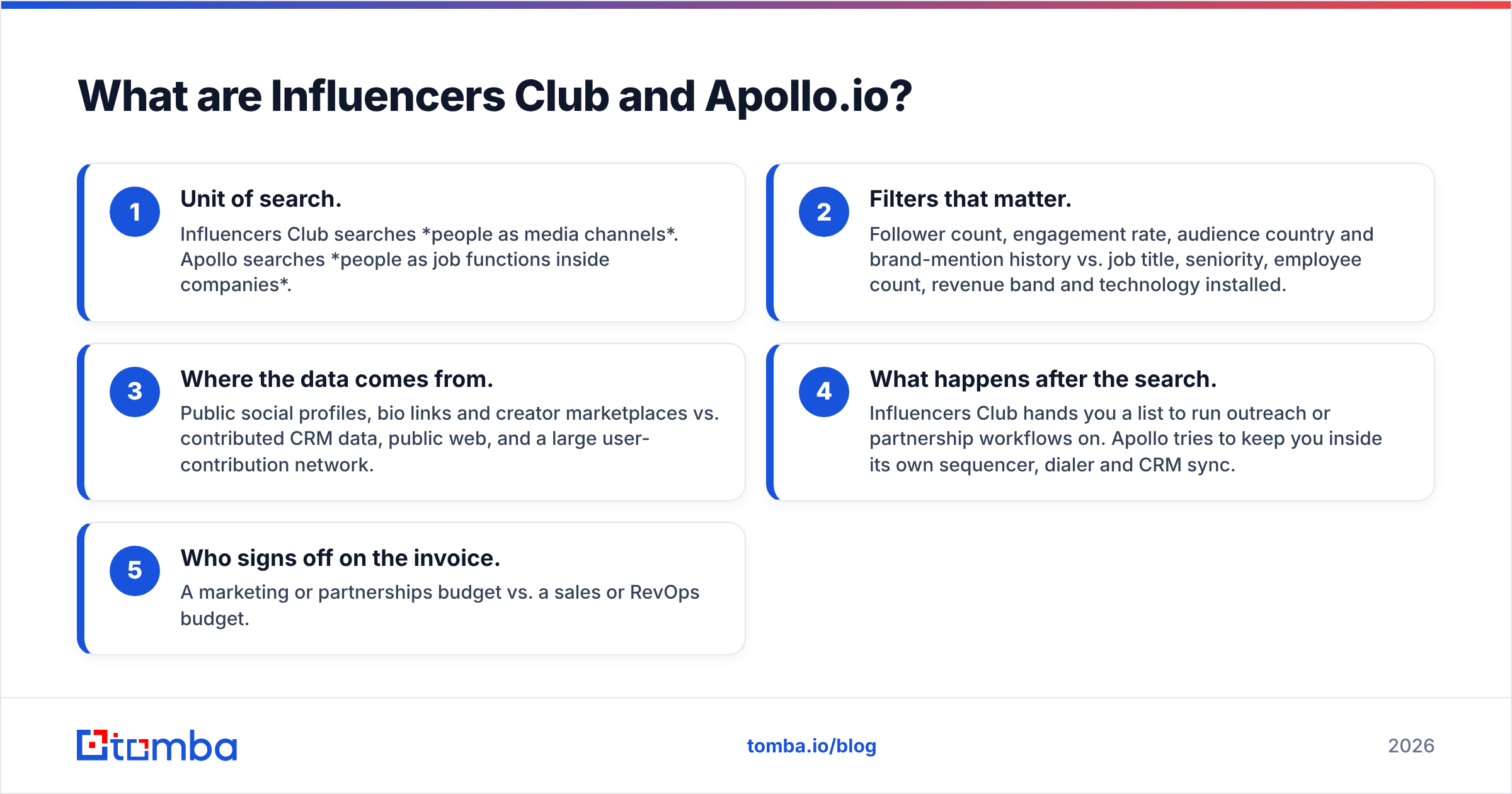
- Unit of search. Influencers Club searches people as media channels. Apollo searches people as job roles inside firms.
- Filters that matter. Followers, engagement, audience country and past brand deals — against job title, seniority, staff count, revenue band and installed tech.
- Where the data comes from. Public social profiles, bio links and creator markets — against shared CRM data, the open web and a large user network.
- What happens after the search. Influencers Club hands you a list to work. Apollo tries to keep you inside its own sequencer, dialer and CRM sync.
- Who signs the invoice. A marketing budget, or a sales budget.
Are you pulling B2B decision-maker emails out of a creator index? Are you asking Apollo for "creators with 100K followers"? Then you already picked wrong.
How do the two databases compare head to head?#
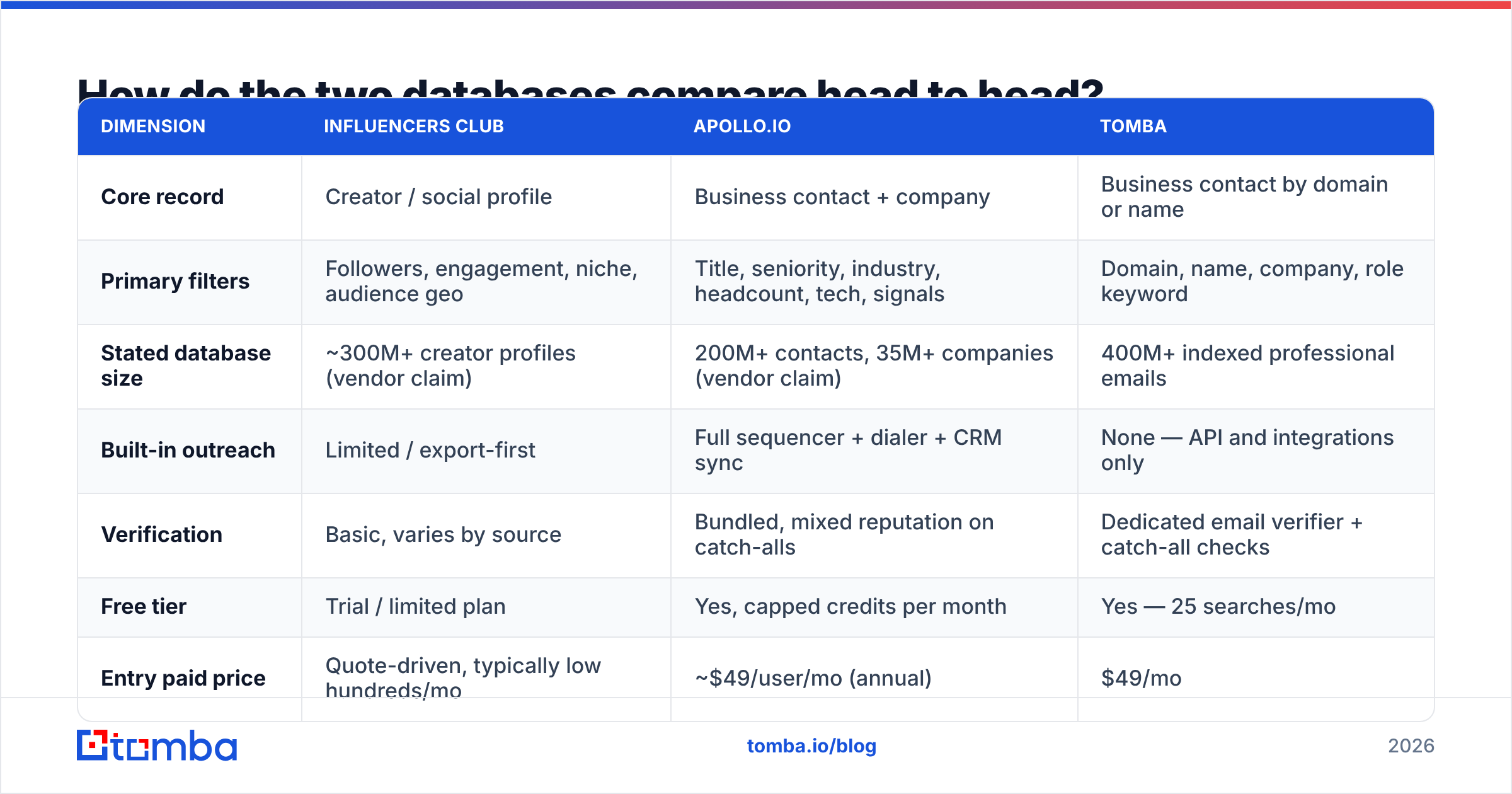
The Influencers Club vs Apollo.io table below puts the core traits side by side.
| Dimension | Influencers Club | Apollo.io | Tomba |
|---|---|---|---|
| Core record | Creator / social profile | Business contact + company | Business contact by domain or name |
| Primary filters | Followers, engagement, niche, audience geo | Title, seniority, industry, headcount, tech, signals | Domain, name, company, role keyword |
| Stated database size | ~300M+ creator profiles (vendor claim) | 200M+ contacts, 35M+ companies (vendor claim) | 400M+ indexed professional emails |
| Built-in outreach | Limited / export-first | Full sequencer + dialer + CRM sync | None — API and integrations only |
| Verification | Basic, varies by source | Bundled, mixed reputation on catch-alls | Dedicated email verifier + catch-all checks |
| Free tier | Trial / limited plan | Yes, capped credits per month | Yes — 25 searches/mo |
| Entry paid price | Quote-driven, typically low hundreds/mo | ~$49/user/mo (annual) | $49/mo |
| Best for | Influencer, UGC, affiliate, creator SaaS | B2B outbound to company org charts | Filling gaps + verifying either list |
Two warnings before you screenshot that table. First, both vendors change their packaging often. Check the live pricing page before you set a budget. Second, database size is the least useful number in this market.
Think about it. A 300M-profile creator index means little if only 12% of the profiles in your niche carry a working email. A 200M-contact B2B index means little if nobody ever added your 400 target accounts to it.
Size is a marketing metric. Coverage on your own list is the number that counts. You can only measure it by running a sample.
Which one has better data accuracy?#
Neither wins outright. They fail in different spots, and that is where the Influencers Club vs Apollo.io choice gets murky.
Influencers Club has one weak spot: the nature of creator contact data. Many creator emails are a personal Gmail listed in a bio. Others belong to a manager's shared inbox or a link-in-bio form. Those addresses are real. They are just not always the right reader. They bounce rarely, but they get ignored often. Delivery holds up; relevance does not.
Apollo has a different weak spot: decay and catch-alls. B2B contact data rots at about 25–30% a year as people change jobs. A crowd-fed database inherits every stale row someone once kept in a CRM. Apollo marks many records as "unverified". It leaves catch-all domains unclear. Plenty of teams on G2 say they scrub exports before they trust them in a sequence.
Here is the rule. Whatever database you buy, verify before you send. A high bounce rate is the fastest way to burn a sending domain. No vendor's own "verified" badge beats a fresh check on the day you send.

Catch-all domains are a real problem here. Many creator businesses run them. So do many mid-market B2B firms. You need a tool that says more than "unknown". A dedicated catch-all verifier still gives you a confidence score on domains that accept every address at the handshake. That is the exact group both tools tend to skip.
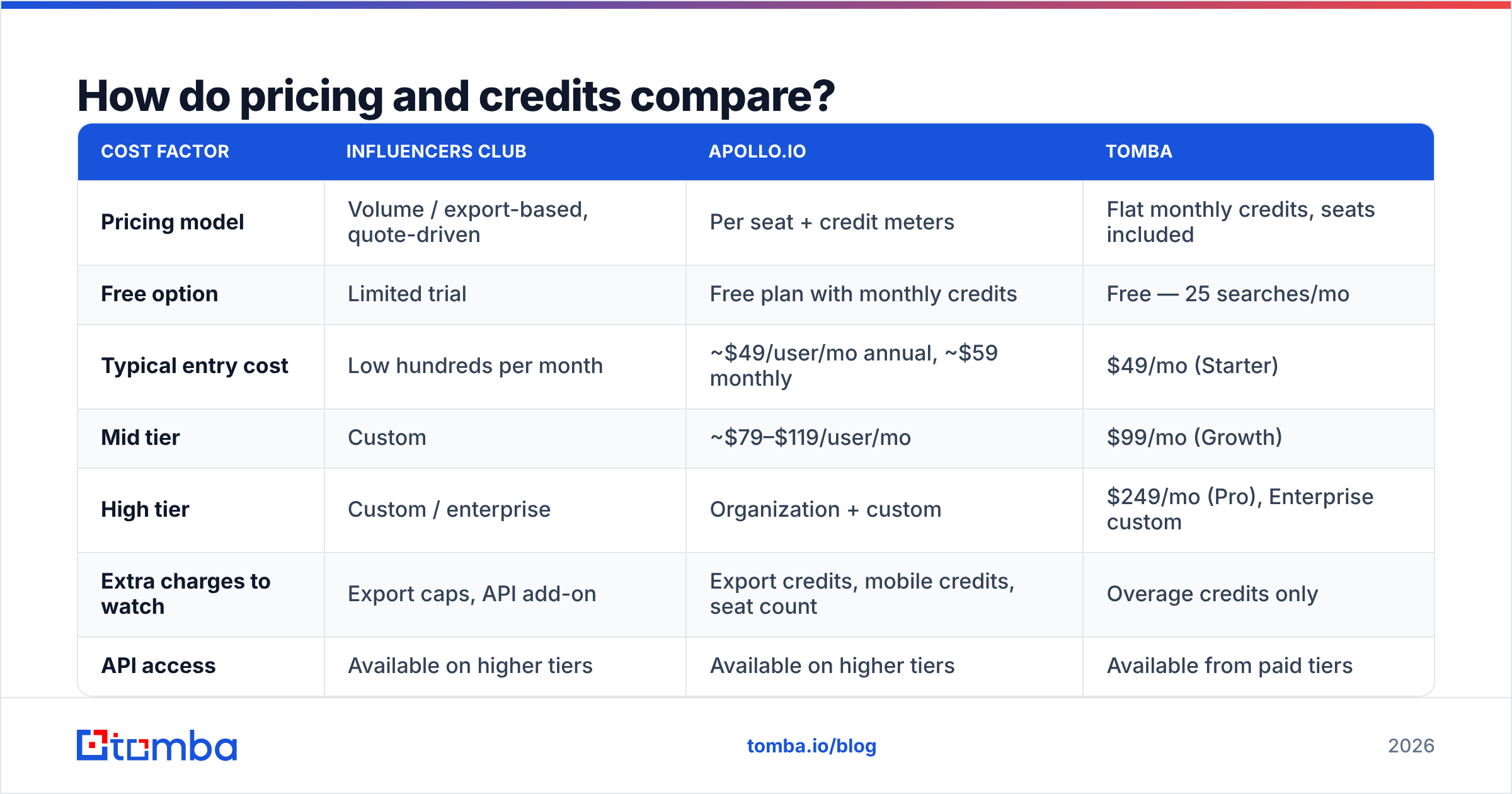
Influencers Club vs Apollo.io pricing: how do credits compare?#
This is where most reviews go wrong. The two tools price different things.
Apollo charges per seat, per month. Credits ride along with the seat. The free tier is good enough to test. The first paid tier sits near $49 per user per month on an annual plan. The trap is not the sticker price. Export credits, mobile-number credits and sending limits all sit on separate meters. A five-person SDR team on the entry plan will hit a wall in month two.
Influencers Club charges by database access and export volume. At higher tiers you get a quote, not a checkout page. That is normal for creator-data vendors. Your price tracks how much of the index you pull, not how many people log in.
| Cost factor | Influencers Club | Apollo.io | Tomba |
|---|---|---|---|
| Pricing model | Volume / export-based, quote-driven | Per seat + credit meters | Flat monthly credits, seats included |
| Free option | Limited trial | Free plan with monthly credits | Free — 25 searches/mo |
| Typical entry cost | Low hundreds per month | ~$49/user/mo annual, ~$59 monthly | $49/mo (Starter) |
| Mid tier | Custom | ~$79–$119/user/mo | $99/mo (Growth) |
| High tier | Custom / enterprise | Organization + custom | $249/mo (Pro), Enterprise custom |
| Extra charges to watch | Export caps, API add-on | Export credits, mobile credits, seat count | Overage credits only |
| API access | Available on higher tiers | Available on higher tiers | Available from paid tiers |

Here is the honest way to budget. Model your cost per usable, verified, on-target contact. Do not model it per credit. A $99/mo tool that returns 800 good addresses in your ICP beats a $49/user/mo tool across four seats that returns 3,000 addresses when 1,100 bounce or fit the wrong persona. Full Tomba pricing is public for that reason. Quote-driven pricing makes the math impossible to run before a sales call.
Which should you pick for your use case?#
Choose Influencers Club if:
- Your buyer is a creator, a creator's manager, or a creator-owned brand.
- You need audience filters — country, age skew, engagement quality — that no B2B database will ever hold.
- You run affiliate recruiting, UGC sourcing, gifting or brand deals at volume.
- Your outreach is personal. You send hundreds of emails a month, not tens of thousands.
Choose Apollo.io if:
- Your buyer is defined by job title and company traits.
- You want search, sequencing and calling in one tool. You accept "good enough" data to get that.
- You have SDRs who live in one tab all day, plus someone to keep the CRM sync honest.
- You value signals — hiring, funding, tech installs — more than raw accuracy.
Choose neither as your only source if:
- You have a fixed account list and need coverage on those domains. Broad databases are weakest here. A domain search across your 300 named accounts often finds people a filtered database misses.
- You already hold partial records: names without emails, profiles without domains. You need to complete them, not discover new ones. That is a data enrichment job, not a database subscription.
A pattern worth stealing: keep the platform that matches your main motion. Run it at the lowest tier that clears your volume. Then bolt a standalone finder and verifier onto the gaps. That is almost always cheaper than the upgrade that promises better coverage. You also get a second opinion on every address before it hits your sending domain. That is the whole game for email deliverability.
What about the outreach layer?#
Apollo bundles a sequencer. Influencers Club mostly does not. That sounds like a clear win for Apollo — until you price it out.
Bundled sequencers are handy and average. They trail standalone sending tools on inbox rotation, warmup, per-mailbox limits and reply detection. Those things matter far more than the template editor. Send real volume and you will buy a sending tool anyway. At that point you pay for Apollo's sequencer and never open it.
The other side of the argument holds for small teams. One tool, one bill, one login, and no tape holding it together. With two SDRs and no ops person, one tool beats best-of-breed. Just know what you are buying: comfort, not speed. And comfort carries a per-seat price that grows with headcount. A standalone data layer does not.
For creator outreach the sequencer question barely matters. Sending 200 warm partnership emails a month needs no automation. It needs the right 200 addresses and a subject line that does not read like a mail merge.
Influencers Club vs Apollo.io: what is the verdict?#
There is no single winner. The Influencers Club vs Apollo.io question only makes sense once you know your buyer.
Does your buyer post content for a living? Then Influencers Club is the right shape of database, and Apollo will waste your money. Does your buyer have a title, a team and a boss? Then Apollo is the right shape, and Influencers Club will return nothing you can use. Each tool is strong at its own job and weak at the other's.
Both share the same flaw. Contact data is a by-product of their real product. Influencers Club really sells creator discovery. Apollo really sells a sales workflow. Email accuracy is a side feature in both cases. That is why teams running serious volume add their own verify-and-fill layer within a quarter.
Shop for that layer on purpose. Do not inherit it by accident. Whatever you buy this year, budget for a second pass on the addresses before they reach your sending domain. A bounce rate above 3% costs more than any plan on this page.
Fill the gaps in whichever database you pick. Tomba Email Finder finds work emails by domain, name or company. It scores confidence and checks each address at the server level. You get 25 free searches a month to test it on your own list, then $49/mo. Run your target accounts through it beside Apollo or Influencers Club. Let the bounce rate settle the argument.
Related guides#
// get started
Find, verify and enrich your first contacts today
Start on the free plan with 25 searches a month, then scale when your team is ready.
Free plan · No credit card required · GDPR & CCPA
Get the Tomba newsletter
Product and data updates
// about the author