Influencersclub vs Kipplo (2026): Creator Data Compared
Influencersclub and Kipplo both sell creator contact data, but they solve different problems. Here's a side-by-side on coverage, contact accuracy, pricing models, and the gap neither one fills.
TL;DR
- Influencersclub is the heavier platform: a large multi-network creator database with deep audience filters, contact data, and an API built for teams that pull creator lists in volume.
- Kipplo sits at the lighter end: creator discovery and outreach for small teams that want to search, shortlist, and message without learning a data platform.
- Contact data is the real differentiator. Both surface creator emails; neither guarantees them. Assume a meaningful share of any export needs verification before you send.
- Neither tool covers the other half of influencer work — reaching the brand-side marketing manager, agency partner, or affiliate lead. That is a B2B email problem, not a creator-data problem.
- Pick by volume: repeat, list-heavy sourcing leans Influencersclub; occasional campaigns and a two-person team lean Kipplo. Budget check both directly, since pricing on this category moves fast.
What are Influencersclub and Kipplo?#
They are both creator-data tools, but they were built for different buyers.
Influencersclub positions itself as a creator database and enrichment layer — millions of profiles across Instagram, TikTok, YouTube, and adjacent networks, filterable by audience demographics, engagement, location, keyword, and follower bands, with contact details attached where they exist. Its pitch is scale and structure: build a filtered list of a few thousand creators, export it, push it into your stack, and repeat next month. The API and bulk export exist because the assumed use case is recurring, not one-off.
Kipplo takes the opposite posture. It is a search-and-outreach tool aimed at brands and small agencies that want to find relevant creators, look at the profile, and start a conversation. Fewer knobs, faster to a shortlist, less setup. That is a legitimate design choice — most influencer programs die from operational friction, not from insufficient filters.
The confusion in the "Influencersclub vs Kipplo" search is that both categories get called "influencer marketing platforms." They are not the same product. One is a database you query; the other is a workflow you run.
How do the two platforms differ on core capability?#
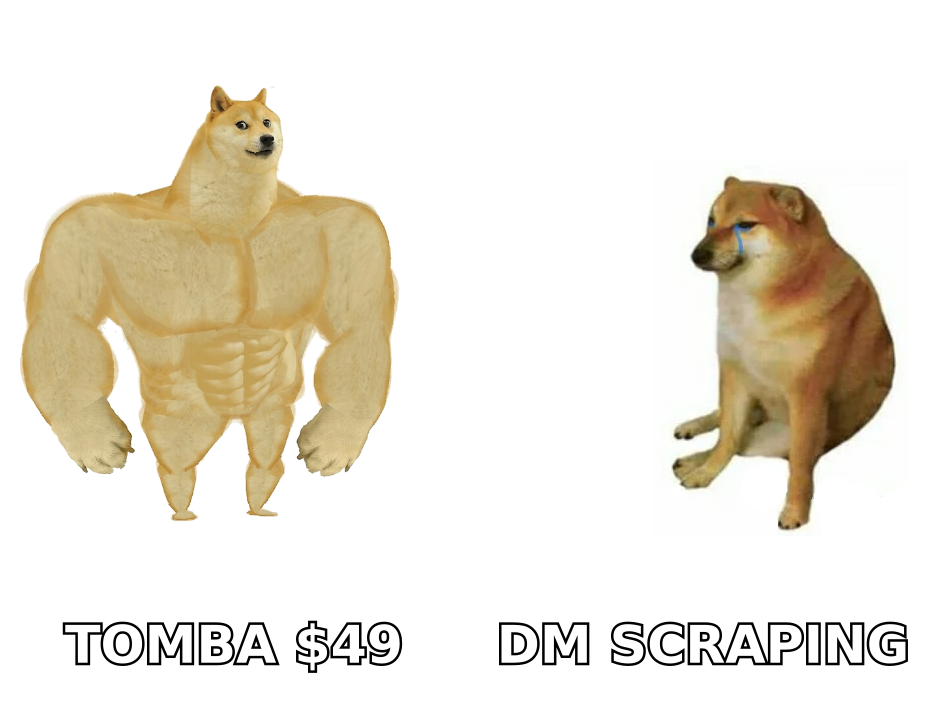
Here is the honest split, dimension by dimension. Where a vendor does not publish a hard number, this says so rather than guessing.
| Dimension | Influencersclub | Kipplo |
|---|---|---|
| Primary job | Query a large creator database and export lists | Discover creators and run outreach in one place |
| Best fit | Agencies, marketplaces, data teams, recurring sourcing | Brands and small teams running a few campaigns |
| Filter depth | Deep — audience demographics, engagement, geo, keyword, lookalikes | Moderate — niche, platform, size, basic audience filters |
| Contact data | Emails plus additional identifiers where available | Emails where discoverable on-profile or via enrichment |
| Bulk export | Core to the product (CSV plus API access) | Present but lighter; built around shortlists |
| Learning curve | Higher — it behaves like a data tool | Low — search, click, send |
| Pricing model | Tiered plans scaled by records/credits; higher entry point | Lower entry point, self-serve oriented |
Two caveats before you screenshot that table. First, both vendors iterate quickly, so verify limits and prices on their own sites before you commit — anything published in a comparison post ages within a quarter. Second, "filter depth" is not automatically better. A team that runs four campaigns a year does not need lookalike audience modeling; it needs to stop opening spreadsheets.
Which one finds creator contact details more reliably?#
Neither has a clean advantage, and any vendor claiming 95%+ creator email coverage is measuring something narrower than you think.
Creator contact data is structurally messier than B2B contact data. A corporate email address follows a pattern — first.last@company.com — tied to a domain with public MX records you can probe. A creator's email is whatever they chose to paste into a bio, a link-in-bio page, a business inquiry field, or a management company's contact form. There is no domain to pattern-match against and no directory to fall back on.
That produces three failure modes you will hit on both platforms:
- Stale bio emails. A creator switched from a personal Gmail to a management address 14 months ago and never updated three of the five places it is listed. Both tools may still hold the old one.
- Gatekeeper addresses.
partnerships@or a talent agency inbox. Technically valid, deliverable, and answered at maybe a tenth of the rate of a direct address. - Missing entirely. Mid-tier creators frequently publish no email at all and take business through DMs. No database invents what was never public.
The practical response is the same regardless of which tool you buy: run the export through an email verifier before it touches your sending domain. A creator list with 18% dead addresses will trash your bounce rate in a single send, and once your sender reputation is damaged, your legitimate outreach suffers for weeks. Verification is cheap. Reputation repair is not.
Rough working assumption for planning, not a benchmark: on nano and micro creators (under 50k followers), expect a meaningful minority of records with no usable email on either platform. On mid and macro tiers, coverage improves because business inquiries are already formalized — but you increasingly reach a manager rather than the creator.
What does each platform actually cost?#
Both publish plans, and both gate the interesting numbers behind volume tiers, so treat this as a framework rather than a quote sheet.
Influencersclub prices like a data vendor: entry plans exist, but the pricing conversation is really about how many records you unlock per month and whether you need API access. If you export a few thousand profiles monthly, you are into mid or upper tiers. That is normal for the category and defensible if sourcing is a recurring function on your team.
Kipplo prices like a SaaS tool: a lower monthly entry point, self-serve signup, and limits designed around one team running campaigns rather than a data pipeline. If you are comparing an annual number, Kipplo will usually be the smaller one — and for a brand doing six campaigns a year, the smaller number may buy everything you need.
The cost mistake in this category is not overpaying for a plan. It is buying a large record allowance and then using 12% of it because nobody owns the sourcing workflow. Before you sign anything, answer one question: how many new creators does someone on this team need to contact per month? If the answer is under 100, the cheaper tool wins by default. If it is over 1,000 on a repeating basis, the database wins and the price difference stops mattering.
Is Influencersclub better than Kipplo?#
Better at different things — here is the decision rule.
Choose Influencersclub if:
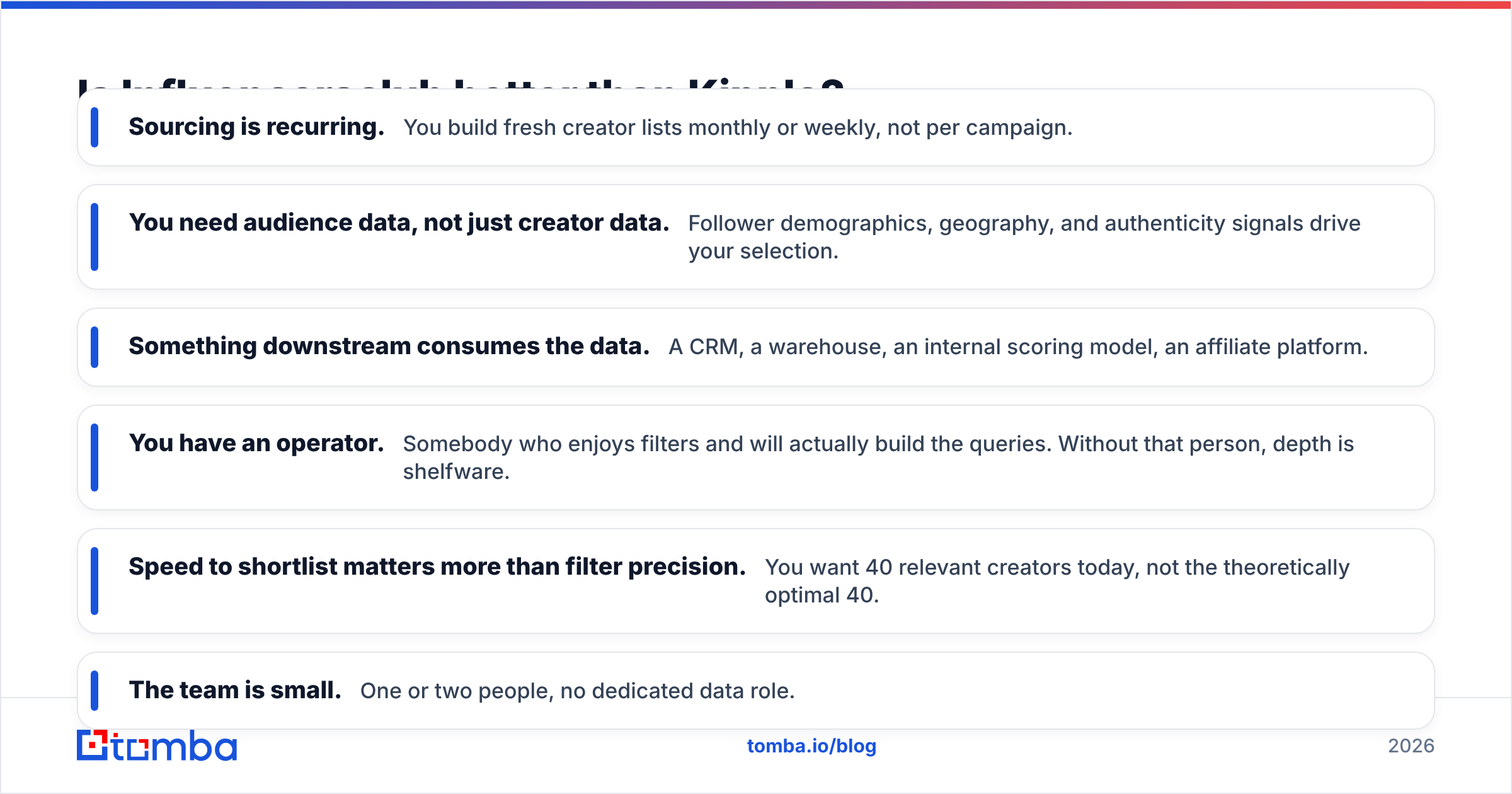
- Sourcing is recurring. You build fresh creator lists monthly or weekly, not per campaign.
- You need audience data, not just creator data. Follower demographics, geography, and authenticity signals drive your selection.
- Something downstream consumes the data. A CRM, a warehouse, an internal scoring model, an affiliate platform.
- You have an operator. Somebody who enjoys filters and will actually build the queries. Without that person, depth is shelfware.
Choose Kipplo if:
- Speed to shortlist matters more than filter precision. You want 40 relevant creators today, not the theoretically optimal 40.
- The team is small. One or two people, no dedicated data role.
- Outreach happens in the same tool. Fewer exports, fewer spreadsheets, fewer handoffs where campaigns quietly die.
- Budget is a hard constraint and you would rather spend the difference on creator fees.
Choose neither if: your bottleneck is reaching brands, agencies, or affiliate managers rather than creators. That is a different data problem, and it is the one the next section covers.
What do both tools miss?#
Both are creator-side tools. Real influencer programs have a brand side, and that side runs on B2B contact data.
Concrete cases where an influencer database returns nothing useful:
- You are an agency selling influencer services. Your buyers are Heads of Growth and Brand Marketing Managers at DTC companies. No creator database indexes them.
- You are a creator or creator-collective doing outbound. You need the partnerships lead at 200 target brands, with a real inbox and a real name.
- You run affiliate recruitment. Publisher and media contacts sit in company domains, not in social bios.
- You are doing competitive partnership research. You found a brand's campaign; now you need the person who signed it off.
That is standard B2B prospecting. You start from a company domain and work down to the person. A domain search returns the published addresses on a company's domain along with the pattern in use; from there, a name-plus-domain lookup gets you the specific contact. For a 200-brand target list, bulk email finder processing turns that into a one-afternoon job instead of a week of manual profile-hunting.
The workflow that actually works looks like this:
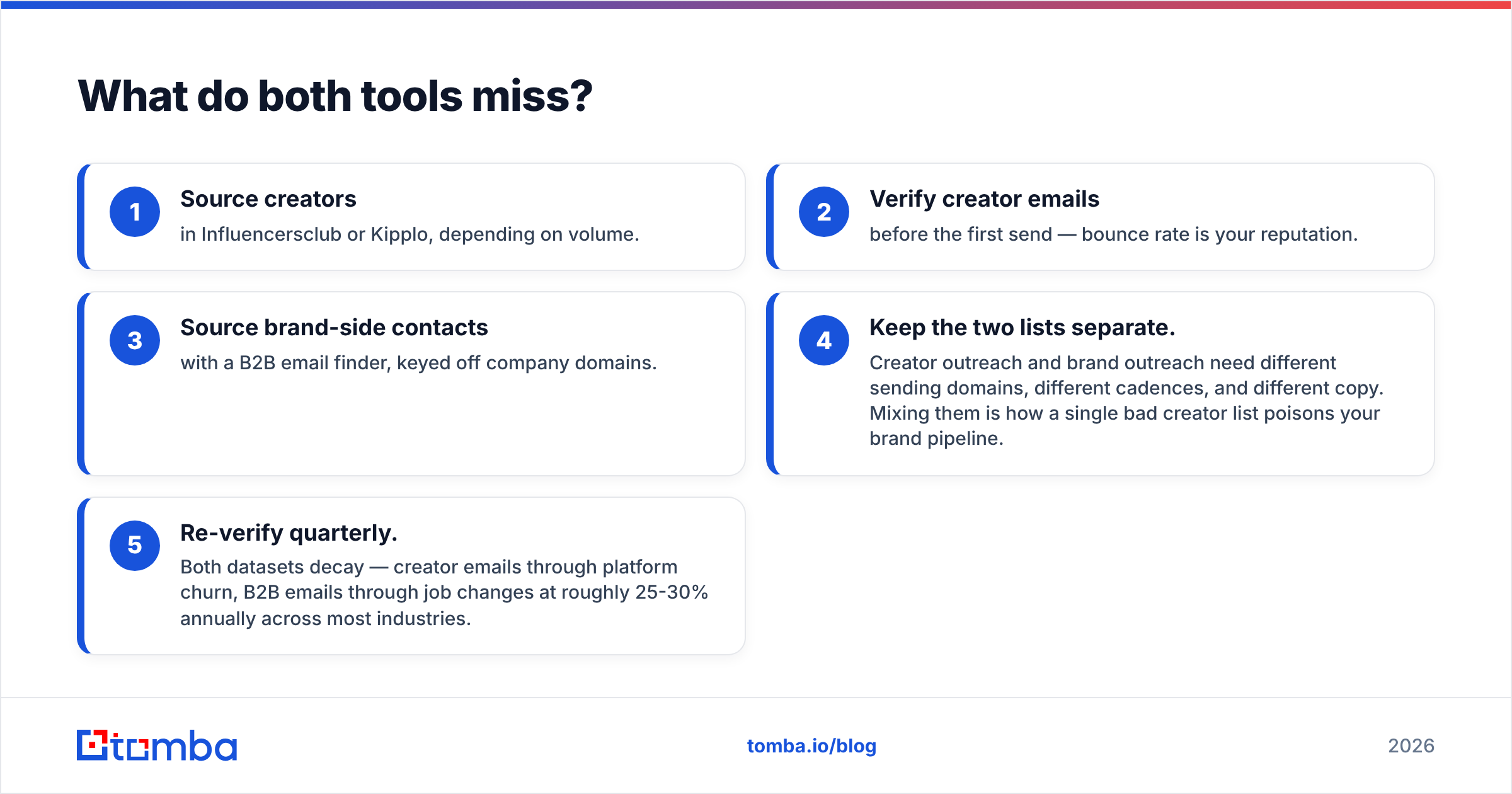
- Source creators in Influencersclub or Kipplo, depending on volume.
- Verify creator emails before the first send — bounce rate is your reputation.
- Source brand-side contacts with a B2B email finder, keyed off company domains.
- Keep the two lists separate. Creator outreach and brand outreach need different sending domains, different cadences, and different copy. Mixing them is how a single bad creator list poisons your brand pipeline.
- Re-verify quarterly. Both datasets decay — creator emails through platform churn, B2B emails through job changes at roughly 25-30% annually across most industries.
How should you evaluate either tool in a trial?#
Do not evaluate on the demo list the vendor builds for you. Run this instead, on both platforms, with the same inputs:
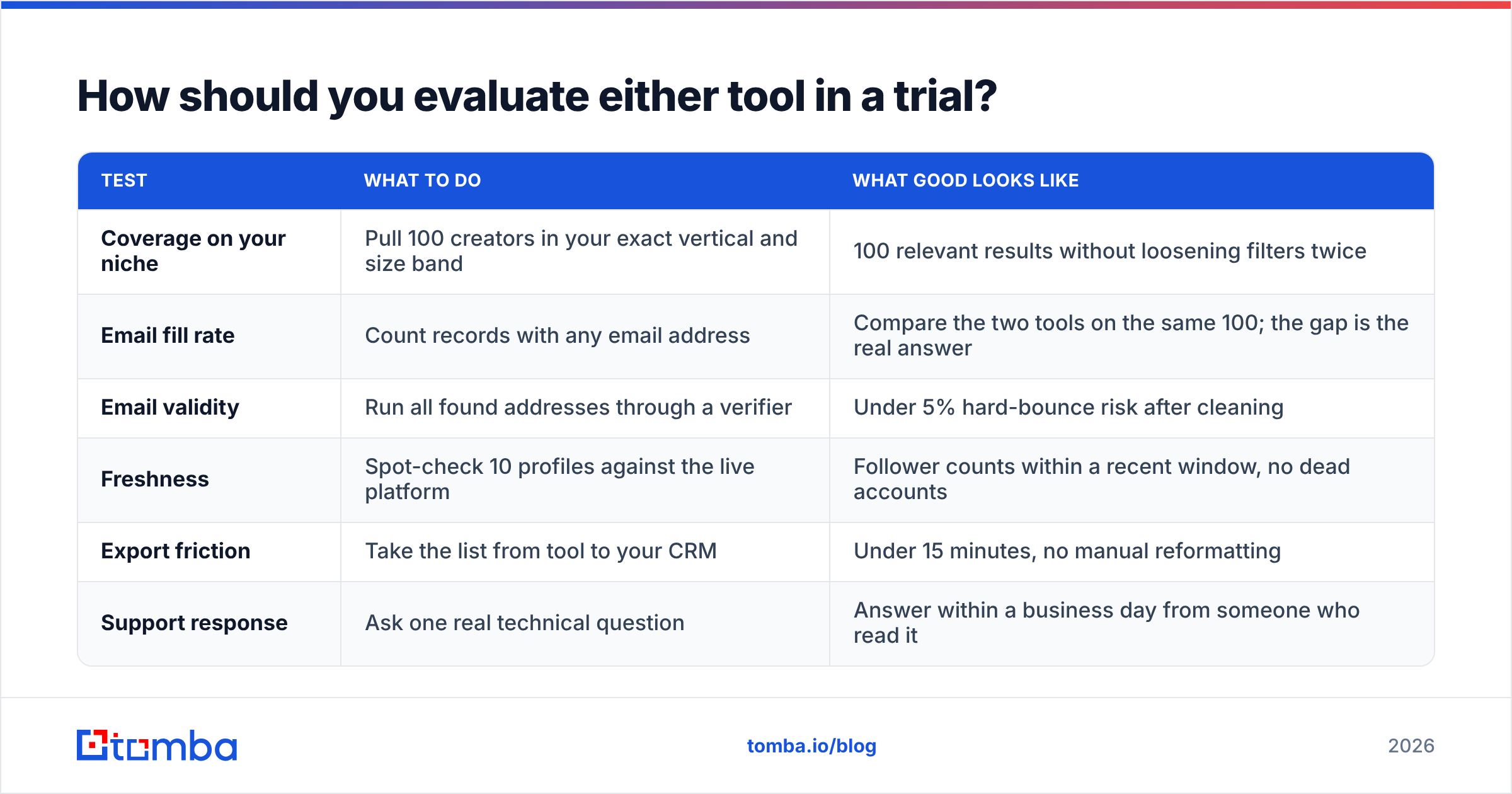
| Test | What to do | What good looks like |
|---|---|---|
| Coverage on your niche | Pull 100 creators in your exact vertical and size band | 100 relevant results without loosening filters twice |
| Email fill rate | Count records with any email address | Compare the two tools on the same 100; the gap is the real answer |
| Email validity | Run all found addresses through a verifier | Under 5% hard-bounce risk after cleaning |
| Freshness | Spot-check 10 profiles against the live platform | Follower counts within a recent window, no dead accounts |
| Export friction | Take the list from tool to your CRM | Under 15 minutes, no manual reformatting |
| Support response | Ask one real technical question | Answer within a business day from someone who read it |
Five hours of that beats five demo calls. And do it during the trial, because the fill-rate gap between two creator databases in a specific vertical is frequently larger than the gap in their marketing claims — sometimes in the direction the pricing does not predict.
If you want outside signal to go with your own testing, G2 carries reviews for most tools in this category, and it is worth filtering to reviewers whose company size matches yours. A 400-person agency's complaints tell you very little about how the tool behaves for a team of three. For background on how the category itself is structured, the influencer marketing overview is a reasonable primer on where the money and the incentives sit.
What's the verdict on Influencersclub vs Kipplo?#
Influencersclub wins on data depth and repeatability. Kipplo wins on time-to-first-campaign and cost. If sourcing creators is a monthly job with a named owner, pay for the database. If it is something you do four times a year around product launches, the lighter tool is the correct answer and the depth you would be buying is depth you will not use.
What neither answers is the brand-side half of the equation — and for most agencies, creator collectives, and affiliate teams, that half is where revenue actually comes from.
Get the brand-side contacts your creator database will never have. Tomba's Email Finder works the way B2B contact data should: give it a name and a company domain, get back a verified professional address with a confidence score, or run a whole target list at once. The free tier gives you 25 searches a month to test it against your own brand list before you spend anything, and paid plans start at $49/mo — see Tomba pricing for the full breakdown. Source your creators wherever you like. Source the people who sign the contracts with Tomba.
Related guides#
// get started
Find, verify and enrich your first contacts today
Start on the free plan with 25 searches a month, then scale when your team is ready.
Free plan · No credit card required · GDPR & CCPA
Get the Tomba newsletter
Product and data updates
// about the author