Influencers Club vs LeadEngine AI: Which One Wins in 2026?
One tool indexes creators and their contact details. The other scores and routes B2B leads with AI. Here is how Influencers Club and LeadEngine AI actually differ, and which one belongs in your stack.
TL;DR
- These two tools are not really competitors. Influencers Club is a creator/influencer contact database. LeadEngine AI is an AI-assisted B2B lead engine that scores, enriches, and routes prospects. Comparing them only makes sense if you are deciding what kind of pipeline you are building.
- Pick Influencers Club if your buyers are content creators, UGC talent, affiliates, or social-first brands, and you need audience metrics attached to each contact.
- Pick LeadEngine AI if you sell to companies and want intent-style scoring plus workflow automation on top of a company/contact list.
- Neither is a substitute for a dedicated email layer. Both are only as good as the deliverable addresses they hand you, and both leave gaps on catch-all domains and smaller companies.
- Cheapest honest setup for most B2B teams: a focused finder/verifier (Tomba starts free, then $49/mo) plus whichever platform matches your buyer type.
What are Influencers Club and LeadEngine AI?#
They solve different halves of the same problem: who do I contact, and how do I reach them?
Influencers Club (influencers.club) is a creator-economy data platform. Its index is built around social profiles, mostly Instagram, TikTok, and YouTube, and it attaches contact details, audience demographics, engagement rates, and brand-affinity signals to each creator. The filters are the product: you narrow by follower band, niche, location, audience gender split, or which brands a creator has already worked with, then export the shortlist. Teams use it for influencer marketing, affiliate recruiting, and UGC sourcing.
LeadEngine AI is positioned in the AI-lead-generation category: ingest or build a list of companies and contacts, let models score fit and buying signals, enrich the records, and push the survivors into a CRM or sequencer. The pitch is less "we have a bigger database" and more "we decide which records are worth your rep's time." That places it next to tools like Apollo, Clay, and the newer AI SDR platforms rather than next to a creator index.
So the honest framing of Influencers Club vs LeadEngine AI is not "which tool has better data." It is "which buyer are you actually chasing." A B2B SaaS team selling infrastructure to CTOs will get almost nothing from a creator database. A DTC brand recruiting 300 micro-influencers per quarter will get almost nothing from AI lead scoring built for company firmographics.

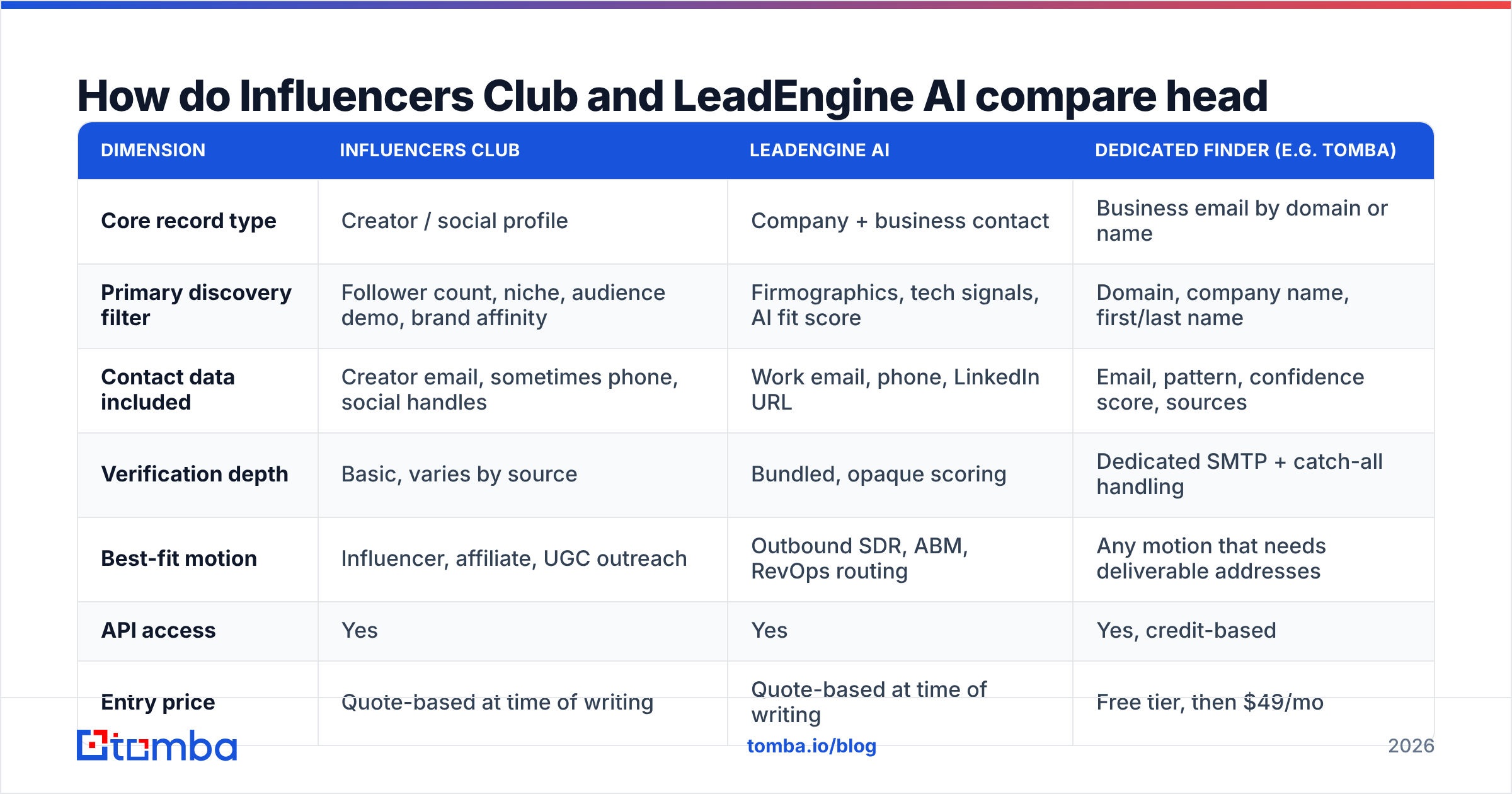
How do Influencers Club and LeadEngine AI compare head to head?#
| Dimension | Influencers Club | LeadEngine AI | Dedicated finder (e.g. Tomba) |
|---|---|---|---|
| Core record type | Creator / social profile | Company + business contact | Business email by domain or name |
| Primary discovery filter | Follower count, niche, audience demo, brand affinity | Firmographics, tech signals, AI fit score | Domain, company name, first/last name |
| Contact data included | Creator email, sometimes phone, social handles | Work email, phone, LinkedIn URL | Email, pattern, confidence score, sources |
| Verification depth | Basic, varies by source | Bundled, opaque scoring | Dedicated SMTP + catch-all handling |
| Best-fit motion | Influencer, affiliate, UGC outreach | Outbound SDR, ABM, RevOps routing | Any motion that needs deliverable addresses |
| API access | Yes | Yes | Yes, credit-based |
| Entry price | Quote-based at time of writing | Quote-based at time of writing | Free tier, then $49/mo |
| Weak spot | Almost no B2B firmographics | Coverage thins on SMB and non-US domains | Not a database of creators or intent |
Two caveats on that table. First, both vendors publish pricing that moves; check their own sites before you budget, because seat minimums and credit rollover policies change more often than feature lists do. Second, "verification depth" is where most buyers get burned. Bundled verification inside a discovery platform is usually a pass/fail flag with no explanation, which is fine until 12% of your list bounces and your domain reputation takes the hit.
What does Influencers Club actually do well?#
- Audience-level filtering. You can screen on the creator's audience, not just the creator: age skew, country split, real-vs-inflated follower estimates. That is the part a generic B2B database cannot replicate.
- Contact details attached to social profiles. Most creator tools show you a handle and leave you to DM. Having an email on the record is the difference between a 2% response rate and a workable campaign.
- Brand-affinity history. Seeing that a creator has already posted about three competitors is a qualification signal, and it is faster than manual profile archaeology.
- Volume for lower-tier creators. Micro and nano creators (5k–50k followers) are underrepresented in legacy influencer platforms. This is where creator-native indexes usually win.
- Export and API. You can get records out into a sheet or a workflow tool rather than living inside the vendor's UI.
Where it falls down for B2B: there is no meaningful firmographic layer. You cannot say "SaaS companies, 50–200 employees, using HubSpot, in DACH." If that is your ICP, this is the wrong index, no matter how good the data is.
Where does LeadEngine AI fit in a B2B stack?#
LeadEngine AI is best understood as a filter and a router, not as a source of truth. The value shows up when you already have volume and need prioritization: 40,000 accounts in the addressable market, 12 reps, and no honest way to rank them.
What it does reasonably:
- Fit scoring against a definition of your ICP, usually trained on your closed-won accounts.
- Enrichment passes that fill in missing job titles, headcount, tech stack, and contact fields.
- Routing and workflow, pushing qualified records into a CRM with an owner and a next action attached.
- Deduplication before records reach your CRM, which is unglamorous and saves real money.
What to interrogate during a trial:
- Ask what happens on a catch-all domain. Most AI lead platforms return "valid" for anything on a catch-all because the SMTP handshake accepts everything. That is not verification, it is optimism. A dedicated catch-all verifier exists precisely because this is a hard problem.
- Ask for the source of each email. "Our AI found it" is not a source. Pattern inference, public web, partner data, and user contribution have very different decay rates.
- Ask about non-US coverage. AI scoring on top of thin European or APAC data produces confident nonsense.
The broader category is competitive and getting more so; the lead intelligence category on G2 alone lists dozens of tools making near-identical claims. Score models are easy to build. Data is not.
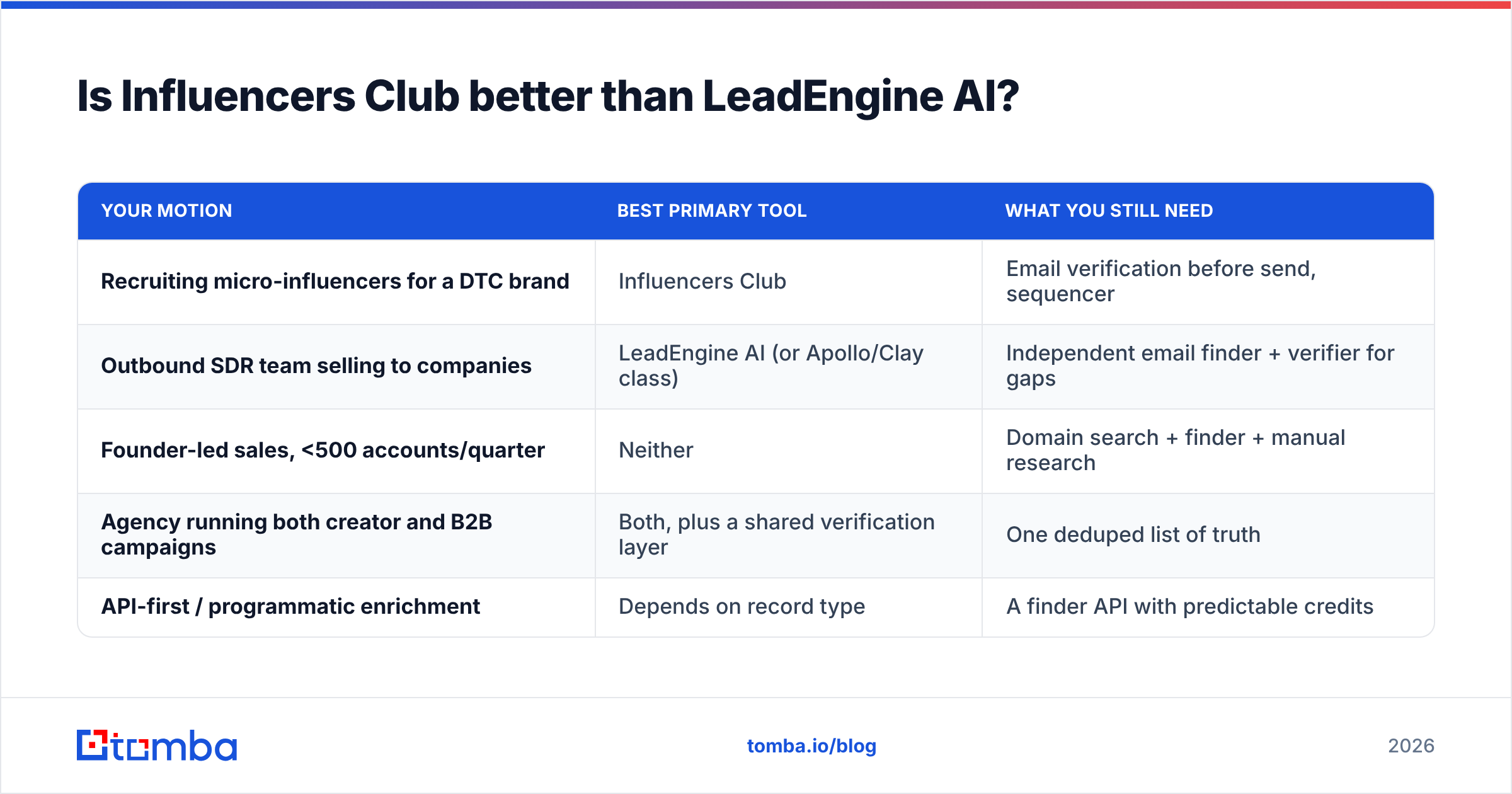
Is Influencers Club better than LeadEngine AI?#
For creator outreach, yes, and it is not close. For B2B outbound, no, and it is also not close. The useful question is which of three scenarios you are in.
| Your motion | Best primary tool | What you still need |
|---|---|---|
| Recruiting micro-influencers for a DTC brand | Influencers Club | Email verification before send, sequencer |
| Outbound SDR team selling to companies | LeadEngine AI (or Apollo/Clay class) | Independent email finder + verifier for gaps |
| Founder-led sales, <500 accounts/quarter | Neither | Domain search + finder + manual research |
| Agency running both creator and B2B campaigns | Both, plus a shared verification layer | One deduped list of truth |
| API-first / programmatic enrichment | Depends on record type | A finder API with predictable credits |
That fourth row is the one people underestimate. Agencies routinely end up paying for two discovery platforms and still bouncing 10% of sends, because neither platform is accountable for deliverability. The fix is boring: run every list, regardless of origin, through one email verifier before it touches a sending domain.
What about data accuracy and deliverability?#
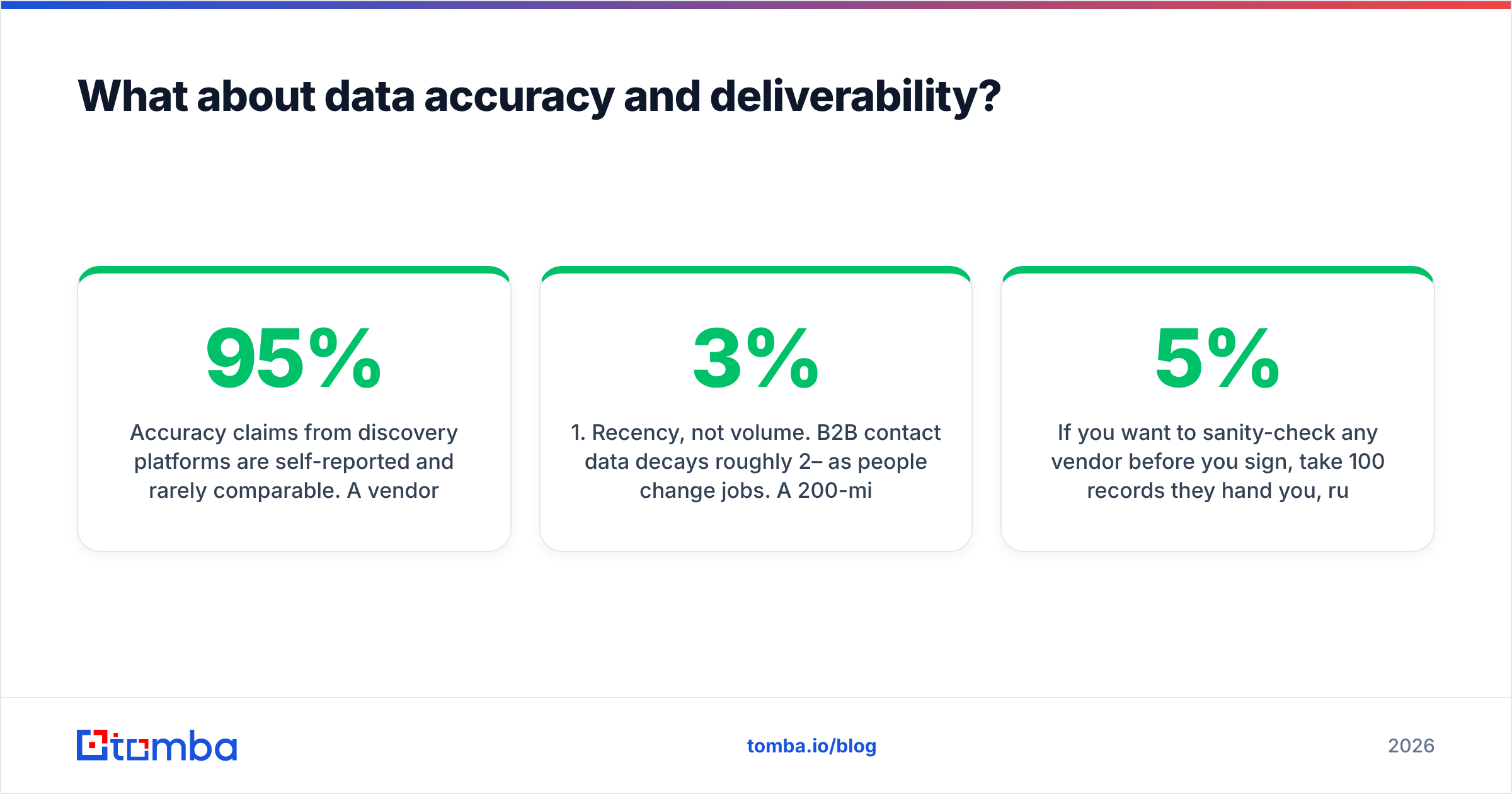
Accuracy claims from discovery platforms are self-reported and rarely comparable. A vendor claiming "95% accurate" usually means "95% of records we chose to report on passed our own check." Nobody audits it.
Three things actually move your bounce rate:
1. Recency, not volume. B2B contact data decays roughly 2–3% per month as people change jobs. A 200-million-record database refreshed annually is worse than a 40-million-record one refreshed weekly. Ask for refresh cadence in writing.
2. Verification method. There is a real hierarchy: syntax check < MX record check < SMTP handshake < SMTP plus catch-all logic plus historical engagement signals. Most bundled verification stops at level two or three.
3. What the tool does when it does not know. The good behavior is returning "unknown" with a confidence score. The bad behavior is returning a guessed pattern like first.last@domain.com with no flag. Guessed patterns are the single largest source of hard bounces in cold outbound, and they are why sender reputation collapses in week three of a campaign rather than week one.
If you want to sanity-check any vendor before you sign, take 100 records they hand you, run them through an independent verifier, and compare. A 5% discrepancy is normal. A 20% discrepancy means the "verified" label is decorative.
Which is cheaper, and what are the hidden costs?#
Both vendors run quote-based or tiered pricing that shifts, so treat any number you read in a blog post, including this one, as a starting point for your own check. What is more stable is the shape of the cost:
- Seat minimums. Platforms aimed at teams often require 3–5 seats. A two-person team pays for five.
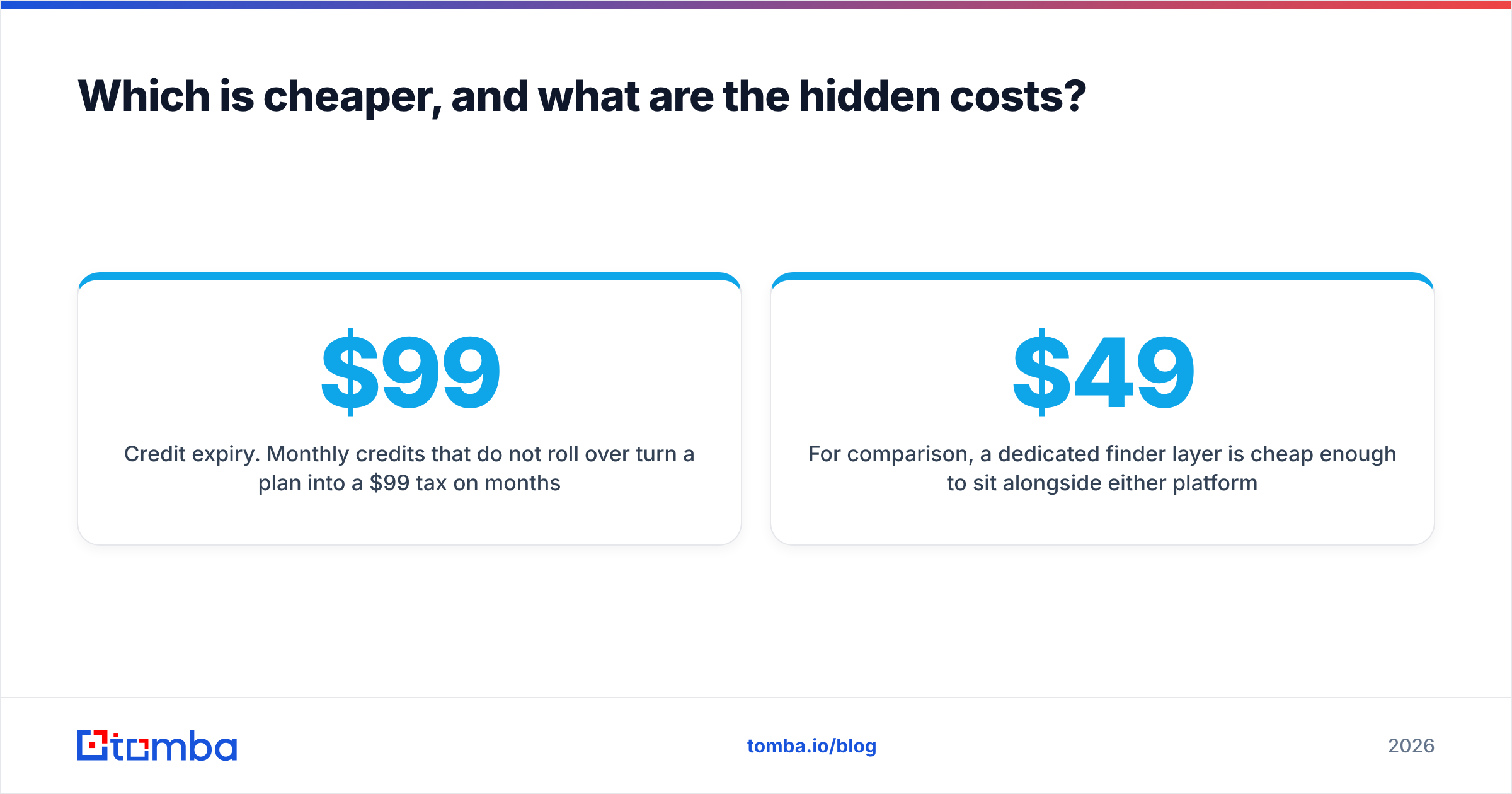
- Credit expiry. Monthly credits that do not roll over turn a $99 plan into a $99 tax on months you are not prospecting.
- Enrichment double-charging. Some platforms charge a credit to reveal an email and another to verify it. Read the credit table, not the pricing page.
- Export limits. Unlimited search with a 1,000-row monthly export cap is not unlimited.
- The bounce cost. Nobody prices this, but a burned sending domain costs weeks of warmup and real pipeline.
For comparison, a dedicated finder layer is cheap enough to sit alongside either platform rather than replace it. Tomba pricing runs a free tier at 25 searches per month, Starter at $49/mo, Growth at $99/mo, and Pro at $249/mo, with the same credits usable across finding, verification, and data enrichment. If you are buying a discovery platform anyway, adding a verification layer is usually the cheapest line item in the stack and the one that protects everything else.
Worth noting: if what you actually need is a pre-built, pre-verified B2B list rather than a discovery engine, list vendors like BookYourData solve that directly and are often faster than building the same list through a scoring platform. Different tool for a different job, and a legitimate option.
How should you decide?#
Run this sequence before you book a demo:
- Define the record type. Creator or company. If you cannot answer in one word, you are not ready to buy.
- Write down your ICP filters. Then check whether the tool can express them. Most demos fail here quietly, because the rep steers to filters the product is good at.
- Pull 100 real records in trial. Not the vendor's curated sample.
- Verify those records independently. Measure the real deliverable rate, not the claimed one.
- Price the whole year. Seats, credit expiry, overage rate, export caps.
- Decide what you own vs. rent. Scoring models are rentable. A clean, verified contact list is an asset you should own and be able to export.
If you want background reading on how the two categories evolved separately, the lead generation overview on Wikipedia is a neutral primer on the B2B side, and it makes the structural difference from creator sourcing fairly obvious.
The verdict#
Influencers Club wins for creator and affiliate outreach. Its audience-level filters and coverage of smaller creators are things a B2B platform cannot fake, and the contact data attached to social profiles is the reason to pay.
LeadEngine AI wins for B2B teams with volume and a prioritization problem. If you have more accounts than reps, scoring and routing earn their keep. If you have 200 target accounts, they do not.
Neither wins on email deliverability, and that is the part that decides whether any of it works. Both hand you addresses; neither is accountable when those addresses bounce.
Add a verification layer regardless of which side you pick. The Tomba Email Finder finds and verifies business emails by domain or by name, flags catch-all domains instead of guessing at them, and returns a confidence score with sources so you can decide what to send. Start on the free tier at 25 searches a month, test it against whatever list your discovery platform just exported, and keep whichever numbers hold up.
Related guides#
Ready to find emails that actually work?
Join 150,000+ professionals who stopped guessing and started sending. Free credits on signup — no credit card required.
Get the Tomba newsletter
Practical outbound tactics and product updates — once every two weeks.
About the author