Influencersclub vs Leadzenai: Which B2B Data Tool Wins?
One indexes 350M+ creators, the other indexes Indian and global B2B decision-makers. Here is how Influencers Club and Leadzen.ai actually compare on coverage, accuracy, pricing, and which one belongs in your stack.
TL;DR
- They are not really competitors. Influencers Club is a creator-economy database (influencers, YouTubers, TikTokers, podcasters) with contact data attached. Leadzen.ai is a B2B lead-intelligence platform aimed at company and decision-maker search, with strong India coverage.
- Pick Influencers Club if your outreach list is made of individual creators and you filter by audience size, engagement rate, niche, and location.
- Pick Leadzen.ai if you are selling to companies, need firmographics plus phone numbers, and a large share of your ICP sits in India or APAC.
- Neither is a general-purpose email finder. Both hand you contact records from a fixed index; if the person is not in that index, you get nothing.
- Verify before you send, always. Whichever you pick, run the exported list through an independent email verifier — database freshness is the single biggest driver of bounce rate.
What are Influencers Club and Leadzen.ai?#
Short version: one sells access to people who make content, the other sells access to people who sign purchase orders.
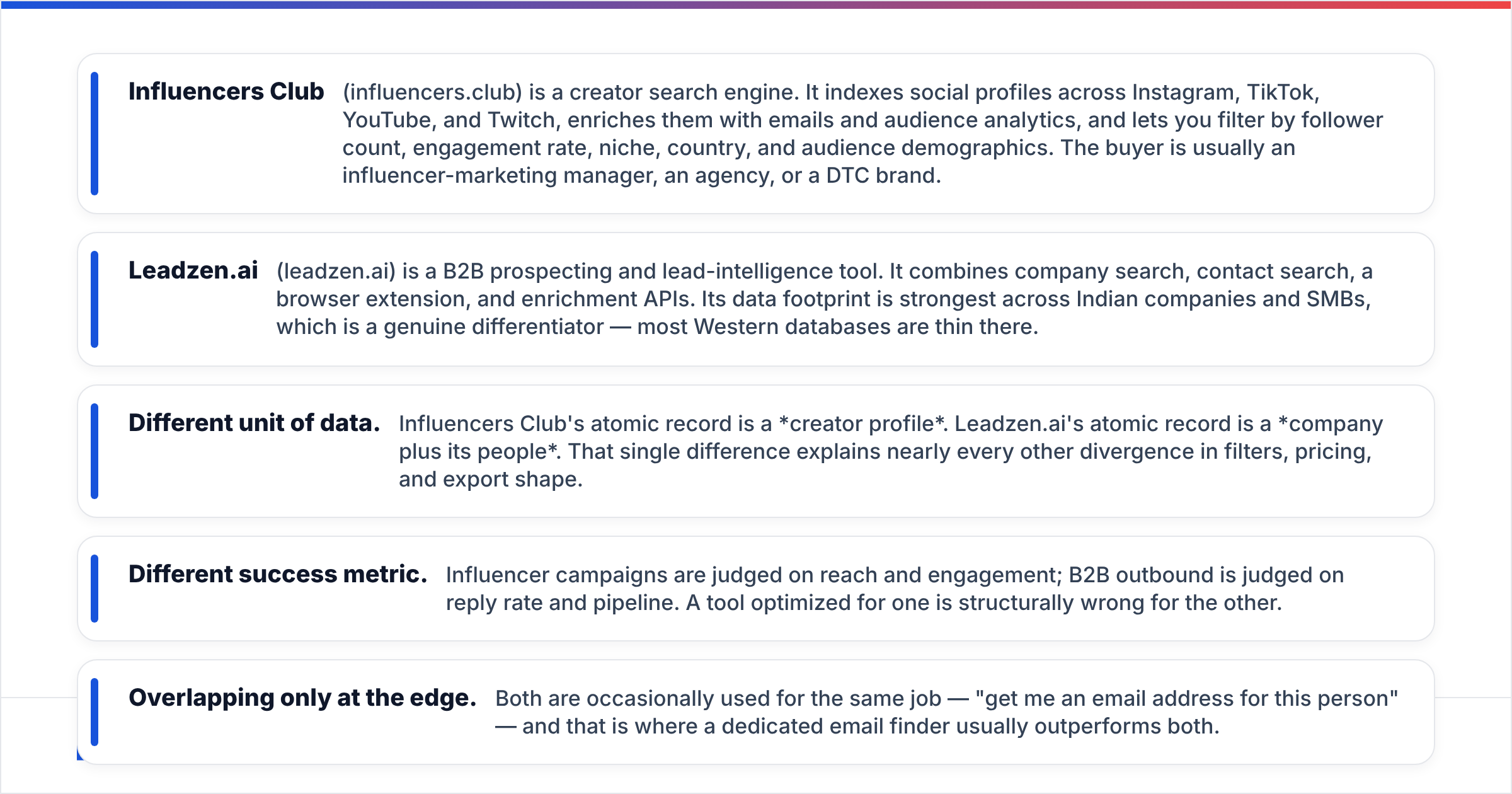
- Influencers Club (influencers.club) is a creator search engine. It indexes social profiles across Instagram, TikTok, YouTube, and Twitch, enriches them with emails and audience analytics, and lets you filter by follower count, engagement rate, niche, country, and audience demographics. The buyer is usually an influencer-marketing manager, an agency, or a DTC brand.
- Leadzen.ai (leadzen.ai) is a B2B prospecting and lead-intelligence tool. It combines company search, contact search, a browser extension, and enrichment APIs. Its data footprint is strongest across Indian companies and SMBs, which is a genuine differentiator — most Western databases are thin there.
- Different unit of data. Influencers Club's atomic record is a creator profile. Leadzen.ai's atomic record is a company plus its people. That single difference explains nearly every other divergence in filters, pricing, and export shape.
- Different success metric. Influencer campaigns are judged on reach and engagement; B2B outbound is judged on reply rate and pipeline. A tool optimized for one is structurally wrong for the other.
- Overlapping only at the edge. Both are occasionally used for the same job — "get me an email address for this person" — and that is where a dedicated email finder usually outperforms both.
If you came here searching "Influencersclub vs Leadzenai" expecting a straight fight, the honest answer is that you are probably choosing between two different jobs, not two versions of the same tool.
How do the two platforms compare head-to-head?#
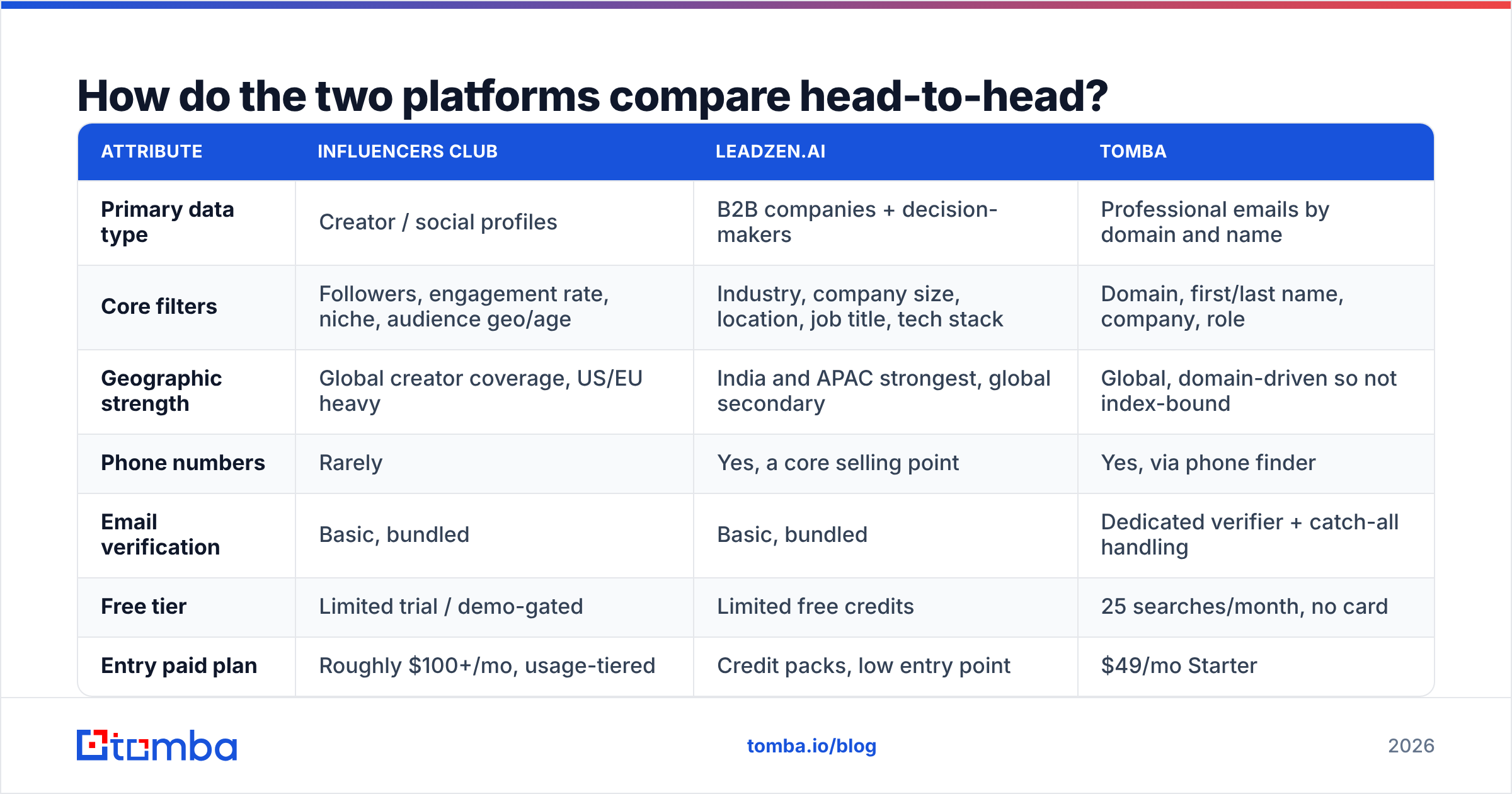
Here is the practical comparison. Treat pricing as directional — both vendors change tiers and credit bundles frequently, so confirm on their own pages before you buy.
| Attribute | Influencers Club | Leadzen.ai | Tomba |
|---|---|---|---|
| Primary data type | Creator / social profiles | B2B companies + decision-makers | Professional emails by domain and name |
| Core filters | Followers, engagement rate, niche, audience geo/age | Industry, company size, location, job title, tech stack | Domain, first/last name, company, role |
| Geographic strength | Global creator coverage, US/EU heavy | India and APAC strongest, global secondary | Global, domain-driven so not index-bound |
| Phone numbers | Rarely | Yes, a core selling point | Yes, via phone finder |
| Email verification | Basic, bundled | Basic, bundled | Dedicated verifier + catch-all handling |
| Free tier | Limited trial / demo-gated | Limited free credits | 25 searches/month, no card |
| Entry paid plan | Roughly $100+/mo, usage-tiered | Credit packs, low entry point | $49/mo Starter |
| API access | Available on higher tiers | Available | Available on all paid tiers |
| Best fit | Influencer marketing at scale | India-focused B2B outbound | Filling in and verifying emails anywhere |
The pattern that matters: both niche tools are index-bound. You are renting a snapshot of their crawl. A domain-driven finder is pattern-bound — it resolves an address from a company's mail conventions plus corroborating sources, so it does not fail simply because a person was never crawled.

Which one has better data accuracy?#
Neither publishes an audited accuracy figure you can hold them to, so judge them the way you would judge any vendor: by category behavior.
Creator databases like Influencers Club face a specific decay problem. Creators use personal Gmail addresses, rotate business inboxes when they sign with a management agency, and hide contact details behind link-in-bio pages. An email scraped from a TikTok bio eighteen months ago is a coin flip today. In our experience auditing creator lists, the failure mode is not a hard bounce — it is a live-but-abandoned inbox that quietly swallows your pitch.
B2B databases like Leadzen.ai face a different decay problem: job changes. Roughly a fifth to a quarter of B2B contacts go stale annually as people move roles, and the effect is worse in fast-growing SMB segments — exactly where Leadzen's Indian coverage is strongest. The address format usually stays valid (the company still exists), but the human behind it left.

Three things you can do about it regardless of vendor:
- Sample before you buy. Export 100 records from a trial, verify them independently, and measure. A vendor that refuses a sample export is telling you something.
- Re-verify at send time, not at export time. A list verified in March and mailed in July is an unverified list.
- Treat catch-all domains as their own bucket. They pass basic SMTP checks and still bounce. A catch-all verifier separates "probably real" from "cannot be determined" instead of lumping them together as valid.
Is Influencers Club worth it for creator outreach?#
Yes, if creator outreach is a repeating motion rather than a one-off campaign.
What it does well:
- Audience-side filtering. Being able to search by the creator's audience — age bands, gender split, country — rather than just the creator's own attributes is the feature you cannot easily replicate with scrapers.
- Engagement-rate sanity checks. Follower counts are gameable; engagement ratios surface the bought-audience accounts before you pay them.
- Volume. For mid-tail and long-tail creators (10k–200k followers), the index is far deeper than manual Instagram searching.
Where it frustrates people:
- Pricing opacity. Plans are frequently demo-gated, which makes budgeting hard for small teams and slows procurement.
- Contact quality varies by platform. YouTube business emails tend to resolve well; TikTok and Instagram bio emails are the weakest link.
- Wrong tool for B2B. If you try to use it to reach a VP of Marketing at a SaaS company, you will find the person only if they happen to be an active content creator.
Check current user sentiment on G2 before committing to an annual contract — creator-data vendors change their index sources often, and reviews from the past two quarters are worth more than a feature list.
Is Leadzen.ai worth it for B2B prospecting?#
Yes, with one strong caveat about geography.
What it does well:
- India and APAC depth. This is the honest headline. If your ICP includes Indian mid-market companies, most US-built databases return sparse, stale, or wrong records. Leadzen is materially better there.
- Phone plus email in one record. For markets where cold calling still converts — and India is one — having a mobile number attached to the record removes a whole enrichment step.
- Low entry cost. Credit-pack pricing lets a two-person team start without a four-figure commitment.
Where it frustrates people:
- Coverage falls off outside its home turf. For US, UK, and DACH prospecting, you will find gaps that a global database fills.
- UI and workflow polish lag the category leaders; expect more manual export-and-clean than you would get from a top-tier platform.
- Compliance homework is on you. Phone data across jurisdictions carries different consent rules. Read the terms, check your local DNC obligations, and do not assume a vendor's export is compliant for your use case.
If you are evaluating Leadzen against the broader field, it sits closest in spirit to the mid-market prospecting tools — the same bracket you would consider when shopping for an Apollo alternative, just with a different regional bias.
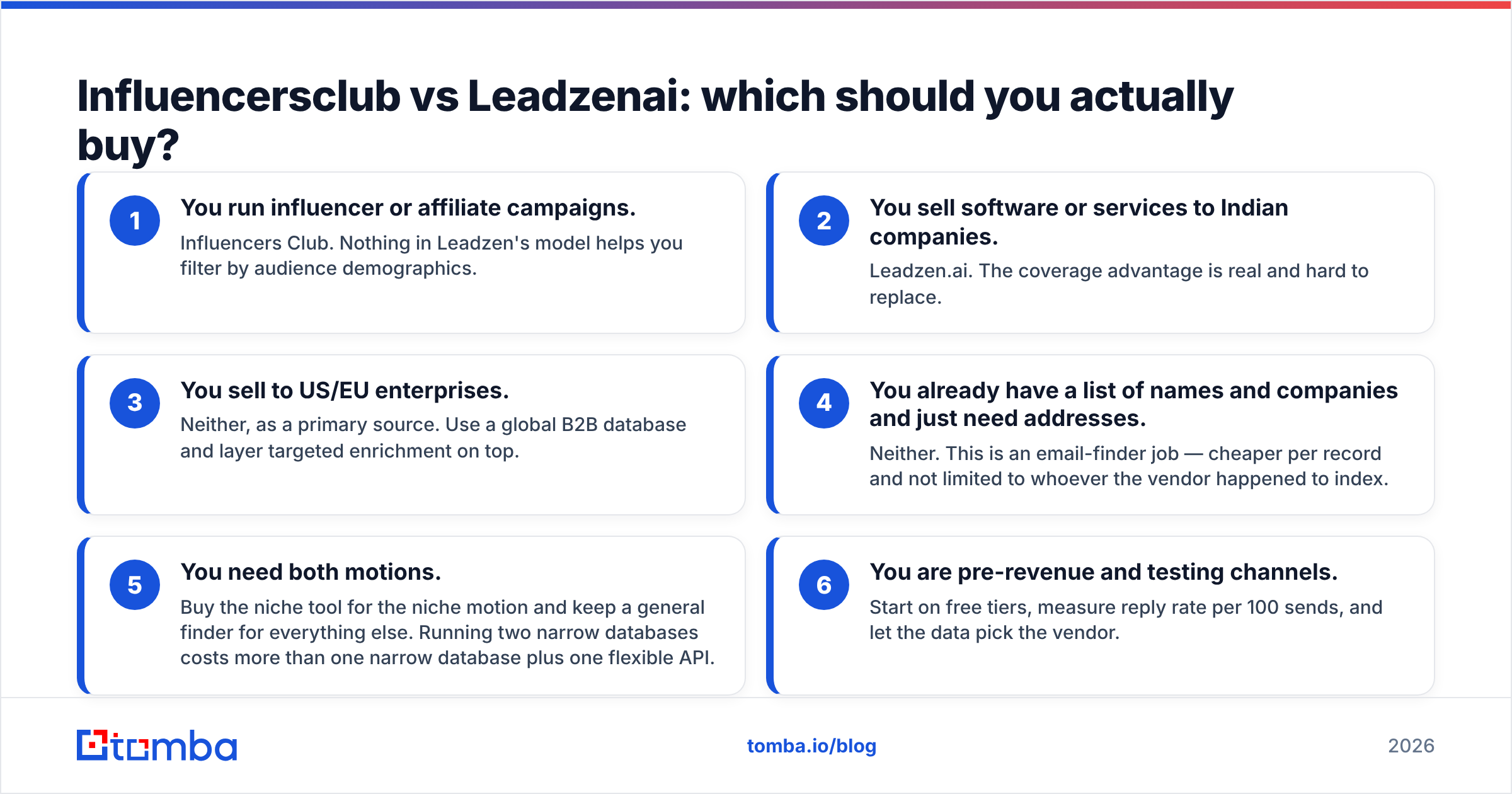
Influencersclub vs Leadzenai: which should you actually buy?#
Use the job, not the feature list, to decide:
- You run influencer or affiliate campaigns. Influencers Club. Nothing in Leadzen's model helps you filter by audience demographics.
- You sell software or services to Indian companies. Leadzen.ai. The coverage advantage is real and hard to replace.
- You sell to US/EU enterprises. Neither, as a primary source. Use a global B2B database and layer targeted enrichment on top.
- You already have a list of names and companies and just need addresses. Neither. This is an email-finder job — cheaper per record and not limited to whoever the vendor happened to index.
- You need both motions. Buy the niche tool for the niche motion and keep a general finder for everything else. Running two narrow databases costs more than one narrow database plus one flexible API.
- You are pre-revenue and testing channels. Start on free tiers, measure reply rate per 100 sends, and let the data pick the vendor.
What do both tools leave you to solve?#
Three gaps show up in almost every stack built on a single niche database.
The coverage gap. Every database has a shape. When your target falls outside it — a new company, a stealth startup, a non-English market — you get an empty result and no path forward. Domain-based lookup solves this differently: give it a company website and a name, and it resolves the likely address from the organization's mail pattern. That is why teams pair a niche database with a general domain search rather than replacing one database with another.
The freshness gap. Bundled verification inside a data platform is usually a light syntax and MX check, because deep verification is expensive and slows the export. Independent verification catches the disposable domains, role accounts, full mailboxes, and catch-alls that basic checks wave through. If your bounce rate is above 3%, this is where the problem lives — not in your copy.
The workflow gap. Both tools want to be the place you work. In practice your CRM is the place you work. Look for a vendor with real integrations — CRM sync, Sheets, Zapier, and a documented API — so enrichment happens where the record already lives instead of in a fourth browser tab.
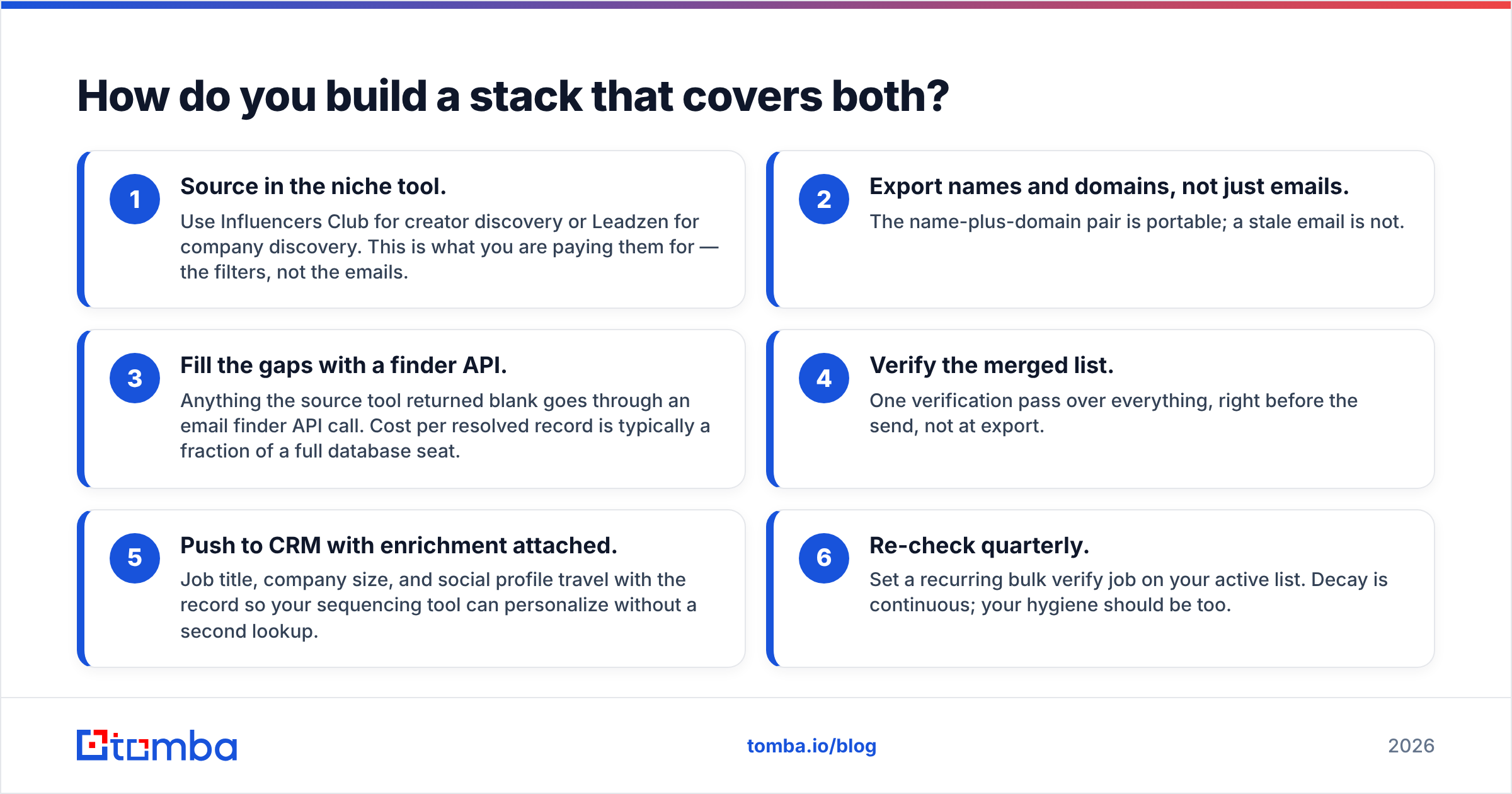
How do you build a stack that covers both?#
A pattern that works for teams running creator marketing and B2B outbound side by side:
- Source in the niche tool. Use Influencers Club for creator discovery or Leadzen for company discovery. This is what you are paying them for — the filters, not the emails.
- Export names and domains, not just emails. The name-plus-domain pair is portable; a stale email is not.
- Fill the gaps with a finder API. Anything the source tool returned blank goes through an email finder API call. Cost per resolved record is typically a fraction of a full database seat.
- Verify the merged list. One verification pass over everything, right before the send, not at export.
- Push to CRM with enrichment attached. Job title, company size, and social profile travel with the record so your sequencing tool can personalize without a second lookup.
- Re-check quarterly. Set a recurring bulk verify job on your active list. Decay is continuous; your hygiene should be too.
That structure lets you swap the source tool without rebuilding the pipeline — which matters, because the niche-database market reshuffles every eighteen months.
The bottom line#
Influencers Club wins creator discovery. Leadzen.ai wins India-focused B2B prospecting. Neither wins "find me a verified email for this specific person at this specific company," because that is not the problem they were built to solve.
If that last problem is the one blocking your outbound, start with the tool built for it. Tomba's Email Finder resolves professional addresses from a domain and a name, flags catch-all domains instead of hiding them, and ships with verification, bulk processing, and an API on every plan. The free tier gives you 25 searches a month with no card, paid plans start at $49/mo, and full Tomba pricing is public — no demo gate. Run 100 of your hardest-to-find contacts through it and compare the hit rate against whatever database you are about to renew.
Related guides#
// get started
Find, verify and enrich your first contacts today
Start on the free plan with 25 searches a month, then scale when your team is ready.
Free plan · No credit card required · GDPR & CCPA
// about the author