Influencers Club vs SalesIntel: Which Contact Data Wins?
One sells creator and consumer-brand contacts, the other sells human-verified B2B contacts with intent. They barely overlap — here is how to tell which one your pipeline actually needs, and what each still leaves you to verify.
Influencers Club vs SalesIntel is an odd matchup. One tool sells creator contacts. The other sells human-verified B2B contacts. Here is how to tell which one your pipeline needs, and what each still leaves you to check.
TL;DR
These two tools barely compete. Influencers Club is a creator and consumer-brand database — TikTok, Instagram, YouTube, Shopify stores. SalesIntel is a human-verified B2B contact database with intent and tech data.
Pick Influencers Club if you sell to creators, DTC founders, or influencer-marketing agencies.
Pick SalesIntel if you sell software or services to mid-market and enterprise firms in North America.
SalesIntel's edge is human checks and re-verification on request. The cost is annual contracts, credit caps, and thin coverage outside the US.
Influencers Club's edge is social filtering: follower count, engagement rate, platform, niche. The cost is patchier work emails and weaker company data.
Either way, run the export through your own verifier first. Both vendors grade their own homework.
What are Influencers Club and SalesIntel?#
Short version: one indexes people who build audiences. The other indexes people who sign purchase orders.
Influencers Club (influencers.club) is a creator-data platform. It crawls profiles on Instagram, TikTok, and YouTube, plus a growing set of ecommerce stores. It then attaches contact details: email, sometimes a phone, sometimes the brand behind the handle. You filter by follower count, engagement rate, niche, language, and location — not by employee count or revenue.
SalesIntel (salesintel.io) is a classic B2B contact and company database. Its pitch is human-verified records. Researchers confirm contacts on a rolling cycle, and you can ask for a specific record to be re-checked. It also bundles firmographics, technographics, and buyer intent (historically through Bombora).
The buyer is different. Influencers Club sells to agencies, DTC brands, and creator-economy SaaS. SalesIntel sells to SDR teams and RevOps at B2B companies with set territories and a CRM to feed.
The record shape is different. An Influencers Club record centers on a person with an audience: handle, platform metrics, category. A SalesIntel record centers on a person in a company: title, department, direct dial, revenue band, tech stack.
The decay is different. Social data goes stale when handles change. B2B data goes stale when people change jobs. Roughly 25–30% of B2B contact data dies each year. That is why SalesIntel leans so hard on human checks.
If you are weighing these two seriously, you probably run a hybrid motion. You do outbound to brands and partnerships with creators. Very few teams need both databases at full price.
Whose data is actually more accurate?#
Take neither headline number at face value. That is not an accusation — it is how the category works. Each vendor measures accuracy on its own sample, at its own moment, in the segments where it is strongest.

Here is how to read the claims:
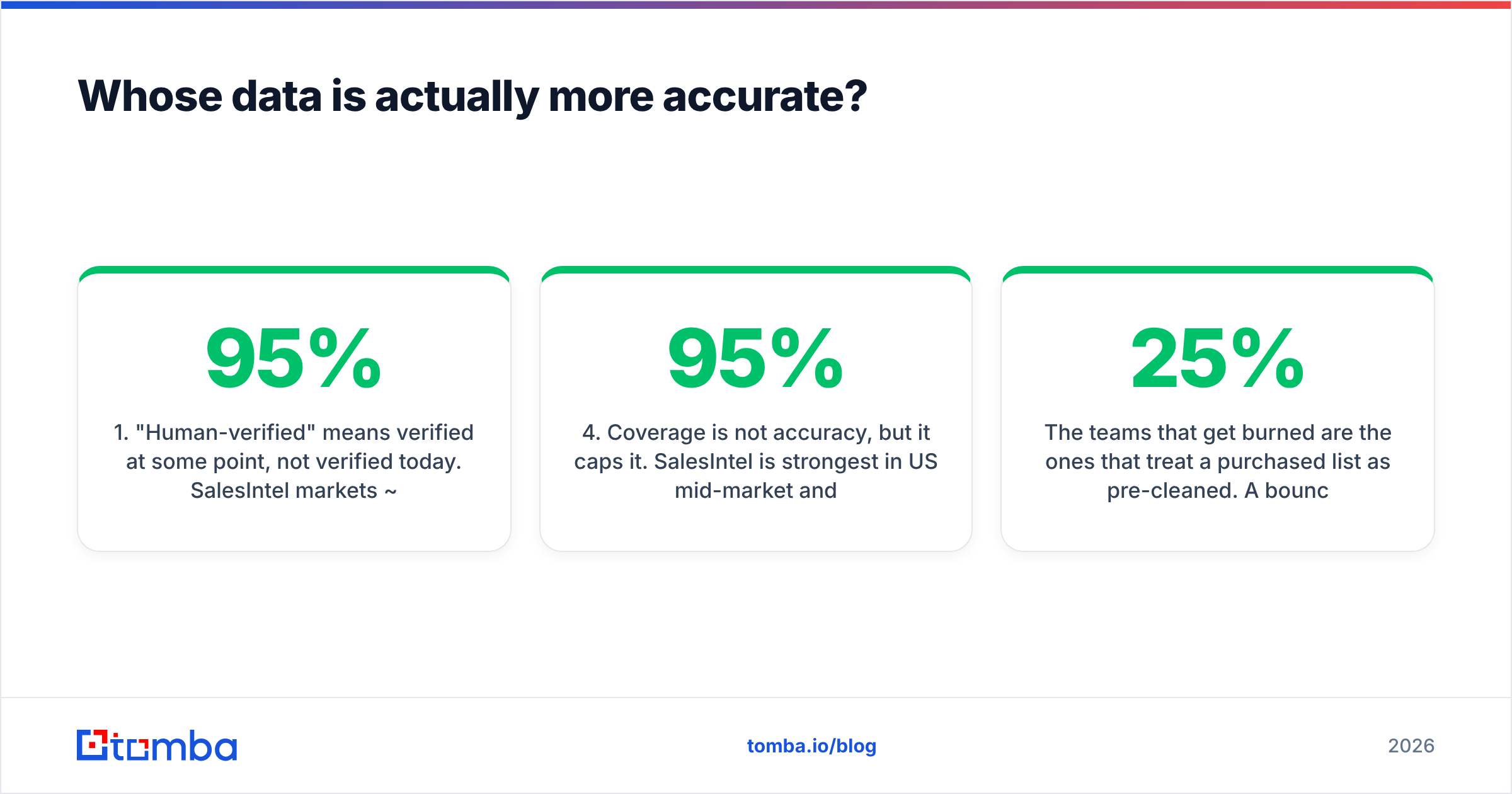
"Human-verified" means verified once, not verified today. SalesIntel markets about 95% accuracy on human-verified records. That holds up for records touched recently. It is weaker for long-tail titles at small firms. Use the re-verification request before you spend budget on a list.
Creator emails skew personal, not professional. Influencers Club often surfaces the inbox listed in a bio or contact card. Those addresses deliver well. They are also public, heavily mailed, and often filtered.
Catch-all domains hide the failures. Many DTC and agency domains are catch-all. A "valid" verdict there really means "the server did not say no." Run a catch-all verifier before you count those rows as usable.
Coverage is not accuracy, but it caps it. SalesIntel is strongest in US mid-market and enterprise. Ask for a coverage test in your exact territory. A 95% accurate set covering 30% of your ICP is worse than an 88% set covering 80%.
Test with your own sample. Pull 250 rows from each vendor for the same segment. Dedupe them. Then run them through an independent email verifier. The gap between the vendor claim and your bounce rate is the only number that counts.
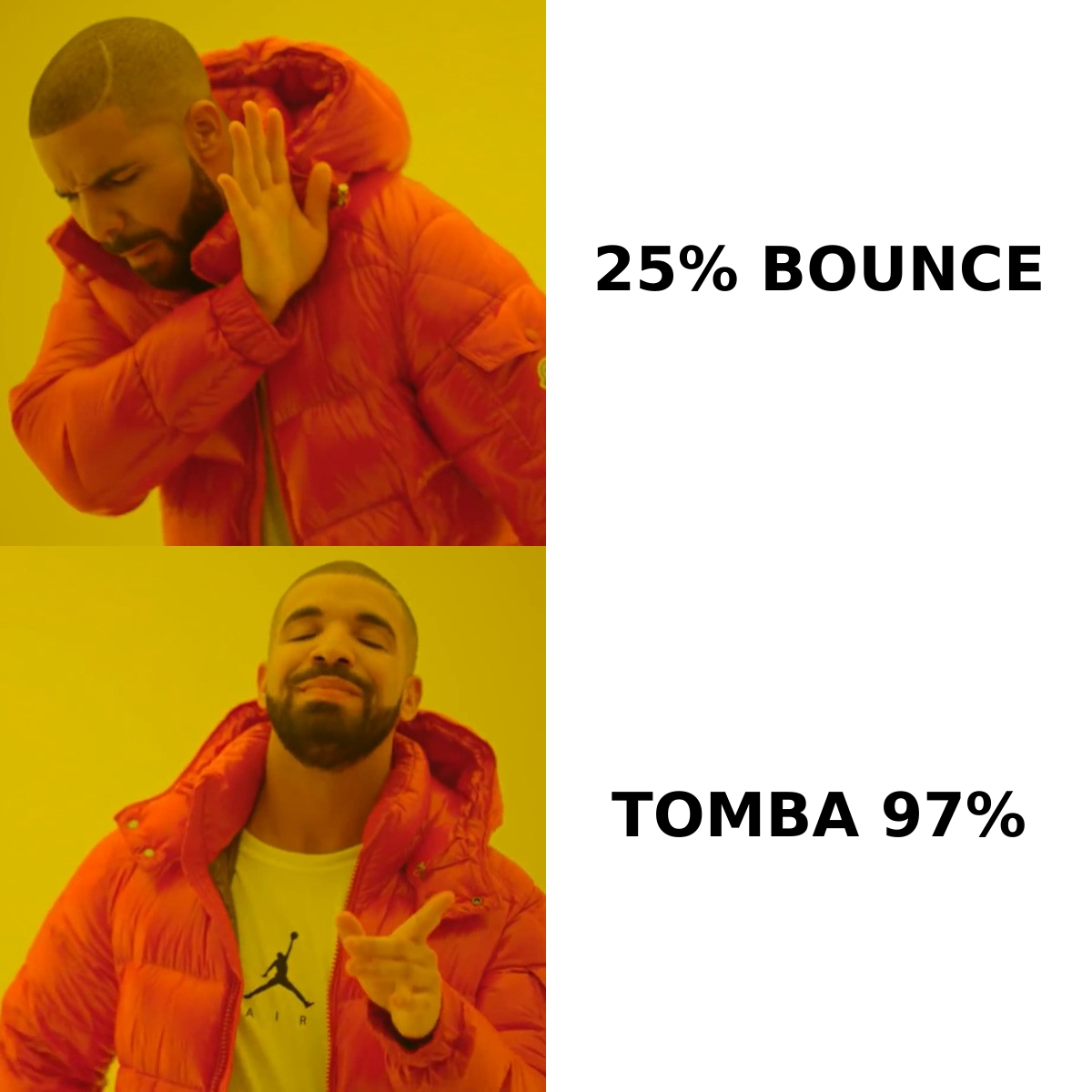
Teams get burned when they treat a bought list as pre-cleaned. A 25% bounce rate on a new sending domain is not a data problem for next quarter. It is a reputation problem in week two.
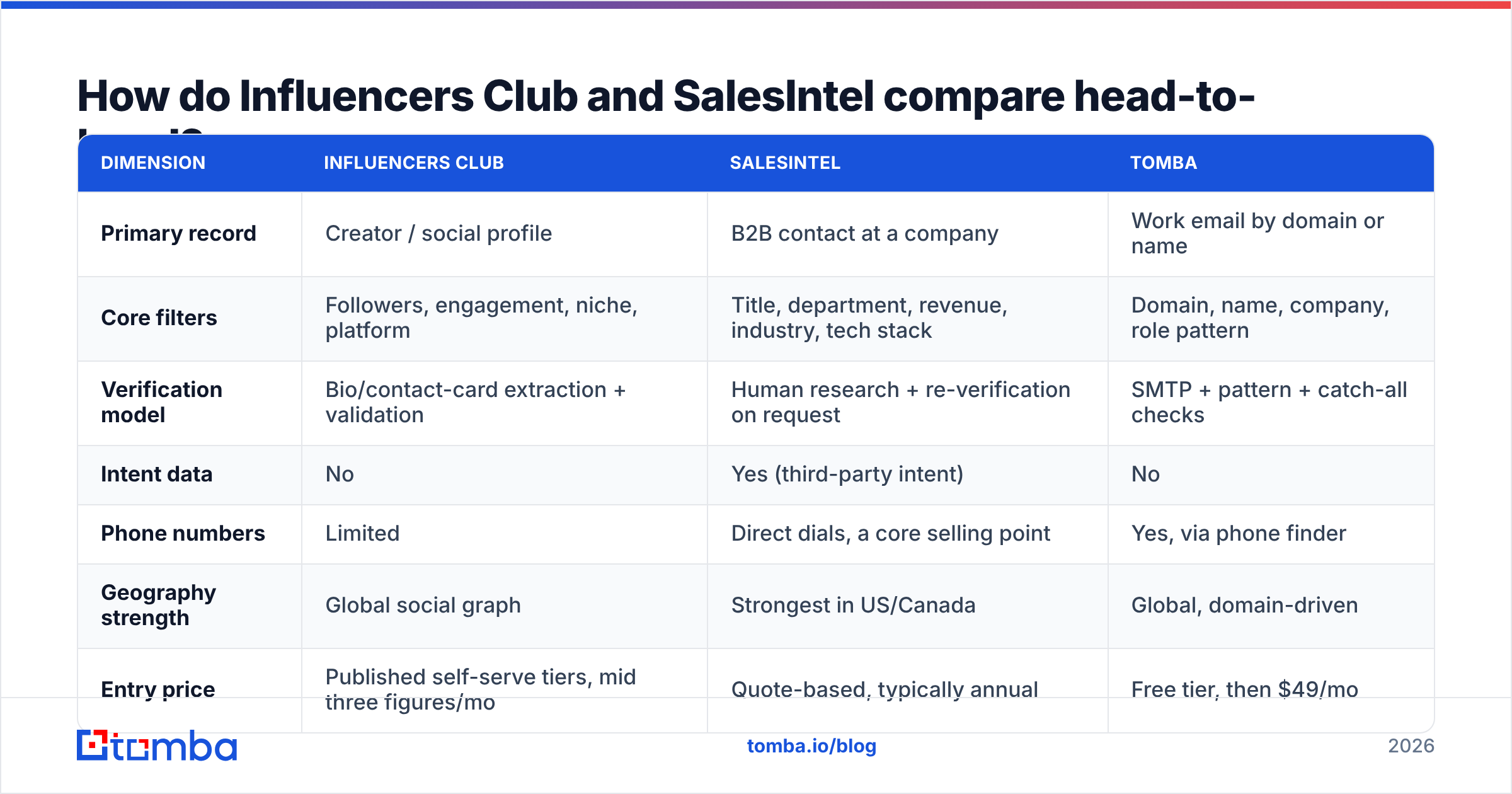
Influencers Club vs SalesIntel: how do they compare head-to-head?#

| Dimension | Influencers Club | SalesIntel | Tomba |
|---|---|---|---|
| Primary record | Creator / social profile | B2B contact at a company | Work email by domain or name |
| Core filters | Followers, engagement, niche, platform | Title, department, revenue, industry, tech stack | Domain, name, company, role pattern |
| Verification model | Bio/contact-card extraction + validation | Human research + re-verification on request | SMTP + pattern + catch-all checks |
| Intent data | No | Yes (third-party intent) | No |
| Phone numbers | Limited | Direct dials, a core selling point | Yes, via phone finder |
| Geography strength | Global social graph | Strongest in US/Canada | Global, domain-driven |
| Entry price | Published self-serve tiers, mid three figures/mo | Quote-based, typically annual | Free tier, then $49/mo |
| Contract | Monthly options available | Usually annual commitment | Monthly, no commitment |
| Free trial | Limited free/trial credits | Demo-gated sample | 25 free searches/mo, no card |
| API | Yes | Yes | Yes, documented and self-serve |
| Best for | Creator and DTC outreach | Enterprise SDR territories | Filling gaps and verifying any list |
| Weak spot | Firmographics, job titles | Non-US coverage, price floor | No intent or social metrics |
Two things fall out of that table. First, the two products barely overlap on filtering. You cannot ask SalesIntel for "beauty creators with 50k–200k followers and 4%+ engagement." You cannot ask Influencers Club for "VP Finance at companies using NetSuite." Second, both are heavier and pricier than what many teams need. The real job is often simpler: find a work email and confirm it works.
How much do Influencers Club and SalesIntel cost?#
Price is the cleanest dividing line. It is also where most evaluations end.
SalesIntel does not publish a price. It sells seats plus credits on a quote, almost always for a year. Buyer reports on G2 put realistic entry spend in the four- to five-figure annual range. The number moves with credit volume and with whether you add intent. Credits burn on export, and unused ones rarely roll over forever. You are buying a data program, not a tool.
Influencers Club publishes self-serve tiers with monthly options. Price scales with the number of creator records you unlock. It costs far less than an enterprise B2B data contract. But the per-record math gets uncomfortable once you pull tens of thousands of profiles, and fill rates drop on smaller creators.
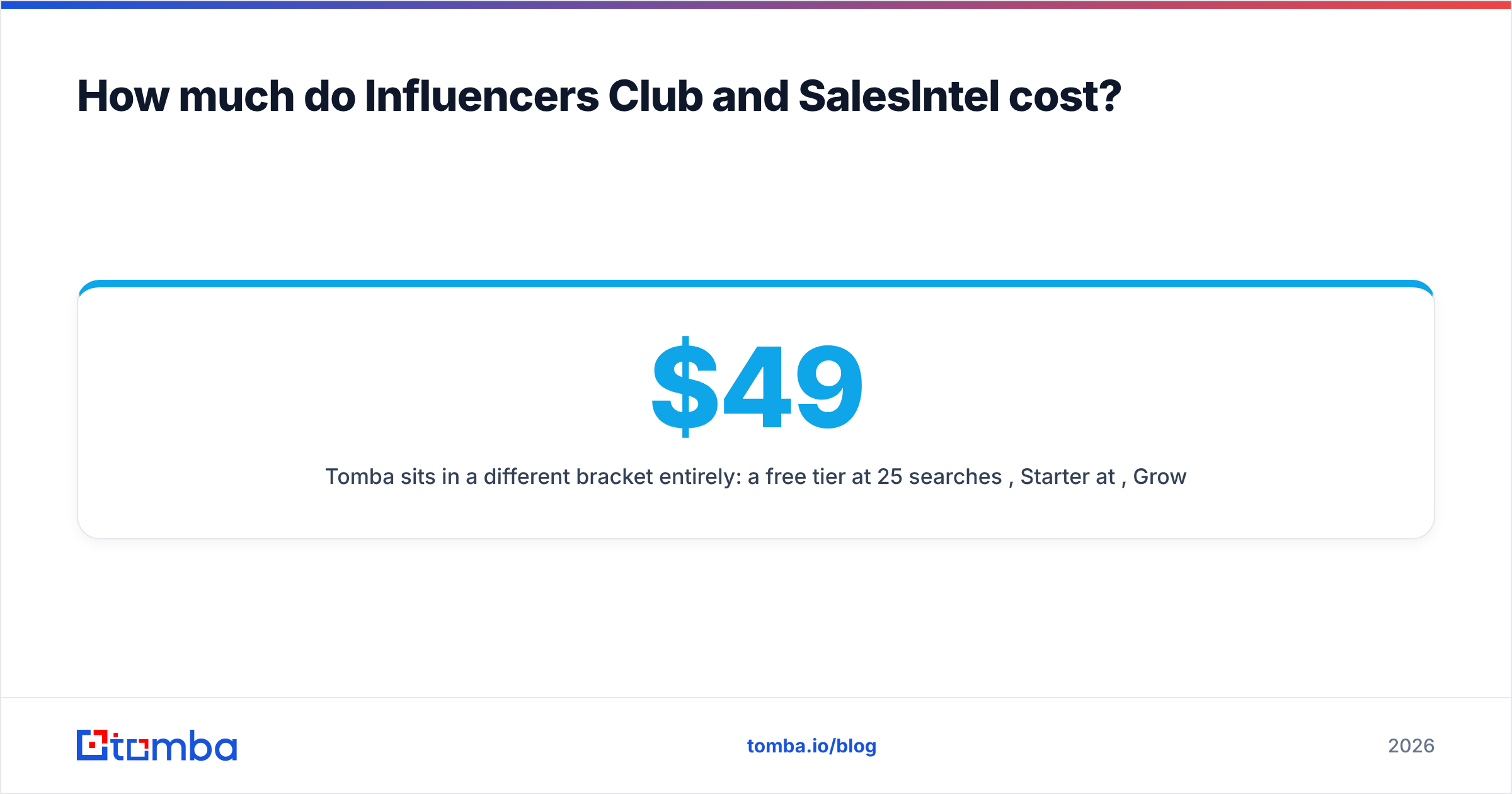
Tomba sits in another bracket: a free tier at 25 searches per month, Starter at $49/mo, Growth at $99/mo, Pro at $249/mo, and custom Enterprise. Full Tomba pricing is public and monthly. There is no sales call. That matters while you are still testing whether a segment is worth working at all.
A simple budgeting rule: do not sign an annual data contract until you can name the exact list and the exact campaign. Prove the segment with a monthly tool first. Buy the big database once you know which fields you really filter on.
Which one should you buy for your motion?#
Match the tool to the motion, not to the feature list.
Creator partnerships, affiliate recruiting, UGC sourcing → Influencers Club. No classic B2B tool filters on followers and engagement. And no firmographic field tells you whether an audience buys.
Enterprise outbound in US territories with a defined ICP → SalesIntel. Direct dials and the re-verification workflow earn their keep for 8+ SDRs under quota and strict compliance.
DTC and ecommerce outbound (selling to brands) → Either, and often neither. Influencers Club surfaces the brand behind the handle. SalesIntel's coverage of sub-50-employee ecommerce firms is thin. Domain-first search wins here.
Agencies pitching both brands and creators → Influencers Club for the creator side, plus a domain-based finder for the brand side. Two cheap tools beat one costly one.
Low volume, high-value ABM → Skip both. Build the target list by hand. Then find and verify each contact one at a time.
Once you know the motion, the next question is what fills the gaps.
What do both tools leave you to solve?#
Every contact database has three holes. You close them with process, not with a bigger contract.
Hole 1: the record is missing. Long-tail companies, non-US domains, and fresh promotions are the usual misses. A domain search against the company website recovers many of them in seconds. The email pattern belongs to the domain, not to any vendor's index.
Hole 2: the record is stale. Job changes cause most bounces. Re-verify anything older than 60 days before it enters a sequence. Enrich the company record at the same time so routing and scoring stay right. That is what data enrichment is for.
Hole 3: creators and authors are not in B2B databases. For PR, guest posts, or newsletter deals, the person you want wrote an article, not a job description. An author finder turns a byline into a working address. No creator subscription needed.
Putting a cheap, precise finder under an expensive database is the standard pattern. It is how teams hold down cost per booked meeting instead of cost per record.
Is there a simpler alternative to both?#
Influencers Club vs SalesIntel is not the only question worth asking. For many teams the real job is narrower than either product.
Say your workflow is simple. You have target companies and named people. You need their work emails, verified, in a CSV or in your CRM. Then you do not need social filtering, and you do not need intent scores. You need three things: accurate name-plus-domain resolution, honest verification statuses that flag catch-alls, and pricing that skips procurement.
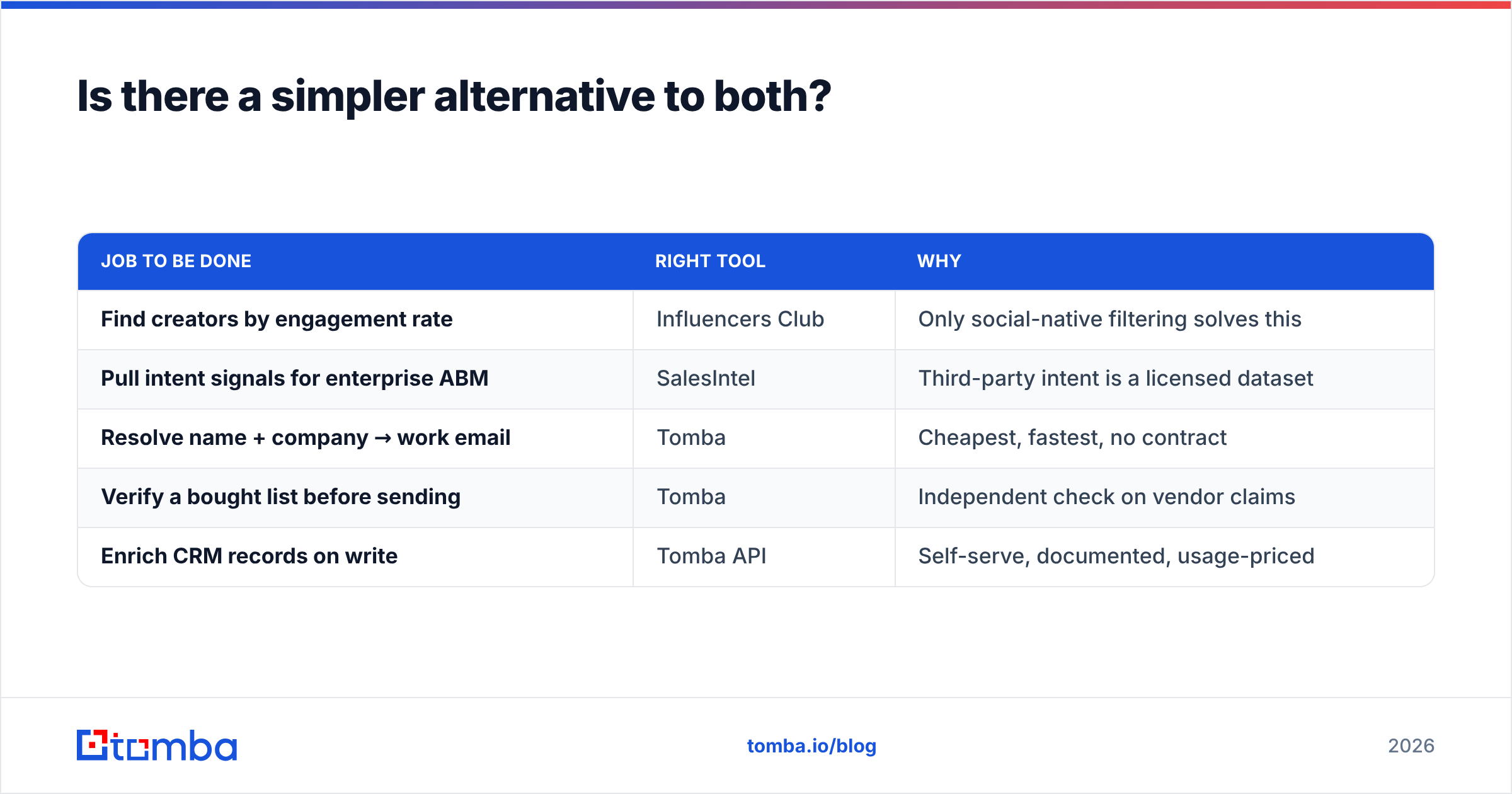
That is the case for running Tomba as the base layer. Add a specialist database only when a campaign needs a filter Tomba lacks. Concretely:
| Job to be done | Right tool | Why |
|---|---|---|
| Find creators by engagement rate | Influencers Club | Only social-native filtering solves this |
| Pull intent signals for enterprise ABM | SalesIntel | Third-party intent is a licensed dataset |
| Resolve name + company → work email | Tomba | Cheapest, fastest, no contract |
| Verify a bought list before sending | Tomba | Independent check on vendor claims |
| Enrich CRM records on write | Tomba API | Self-serve, documented, usage-priced |
Neither Influencers Club nor SalesIntel is a bad product. Both are narrow products sold as broad ones. The mistake is buying either as your only source of contact data.
The verdict#
Influencers Club vs SalesIntel comes down to who you sell to. Buy SalesIntel if you have a US enterprise motion, a compliance rule to meet, and a budget that survives an annual deal. Buy Influencers Club if creators are your ICP and follower-level filtering is non-negotiable. Most B2B teams sit between those two. If that is you, start with a cheaper, verification-first finder. Let the data prove the segment before you sign anything.
Ready to test that? Start with the Tomba Email Finder — 25 free searches a month, no card, no demo call. Pull the same 250-row sample you would send to a SalesIntel rep. Compare the verified count against your current provider. Then decide with your own bounce data instead of someone else's accuracy chart.
Related guides#
// get started
Find, verify and enrich your first contacts today
Start on the free plan with 25 searches a month, then scale when your team is ready.
Free plan · No credit card required · GDPR & CCPA
// about the author