InfluencersClub vs SignalHire: Which Contact Tool Wins?
One tool indexes creators and their audiences. The other indexes working professionals and their phone numbers. Here's an honest look at where each wins, where each fails, and which one your outreach actually needs.
TL;DR: InfluencersClub vs SignalHire comes down to one question. Do you want creators with an audience, or staff with a work email and a phone number?
Influencers Club is a creator-data platform. It indexes social profiles on Instagram, TikTok, and YouTube. Each profile carries audience data, plus whatever contact route the creator lists. It is built for influencer marketing, not B2B sales.
SignalHire is a contact-finding tool. It pulls work emails and direct-dial phone numbers from LinkedIn profiles, company domains, and its own database. A light ATS layer sits on top.
They overlap on one thing: getting you a contact detail. The rest differs. Who is in the database, why you reach out, what you do next — all of it changes.
Pick Influencers Club if your buyer is a creator with an audience. Pick SignalHire if your buyer is a job title at a company.
Need verified work emails at scale? Skip both. A focused tool like Tomba costs less per usable contact, and you never pay for an ATS or an influencer CRM.
What is Influencers Club?#
Influencers Club is a creator search engine. You filter by platform, follower count, engagement rate, niche, and location. Then comes the part that sets it apart: audience attributes. You can filter by the age, gender, country, and interests of the people who follow a creator, not just the creator.
The output is a list of creators with a contact route for each one. That may be a public business email, a link in bio, or a DM. The product is built around three jobs. Find creators worth a partnership. Check that their audience fits. Export enough contact data to start outreach.
Growth teams like one extra trick: the reverse lookup. Match your own customer list against social profiles, and you learn which of your users are creators. A B2B contact database cannot do that.
What it is not: a source of work emails for VPs of Marketing at mid-market SaaS firms. Type a company domain into Influencers Club and you will not get a staff roster. You have the wrong tab open. Their official site shows the full filter set.
What is SignalHire?#
SignalHire sits in the recruiting and sales-contact category. The core loop is simple. You find a person on LinkedIn, usually through the browser extension. You click. SignalHire tries to return a work email, a personal email, and a phone number. There is also a standalone search screen, where you filter by title, company, location, industry, and skills.
Two things set it apart from a plain email finder:
Phone numbers come first, not last. SignalHire leans hard on mobile numbers. That is why recruiters like it. Most email-first tools treat phone as an extra.
There is a small ATS. You can move contacts through stages, leave notes, and work as a team. It suits a small agency. It will not replace Greenhouse.
Credits burn per revealed contact. Here is the part that catches people out: a reveal that returns only a personal email still costs a credit. The SignalHire site explains the credit model. Read it before you sign an annual plan.
InfluencersClub vs SignalHire: how do they differ?#
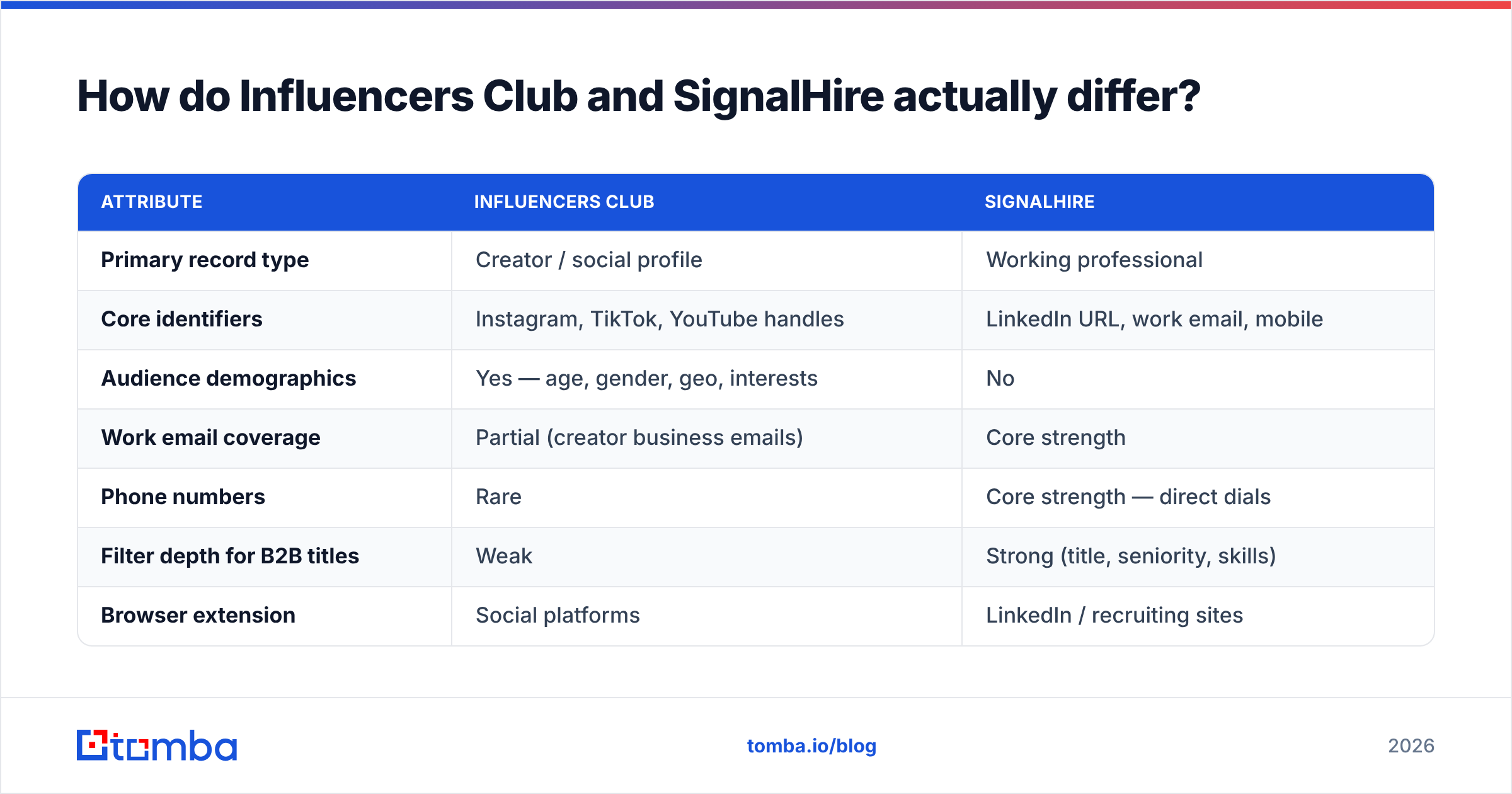
Here is the honest split, attribute by attribute. Treat pricing as a rough guide. Both vendors change tiers, so check their own pages before you buy.
| Attribute | Influencers Club | SignalHire |
|---|---|---|
| Primary record type | Creator / social profile | Working professional |
| Core identifiers | Instagram, TikTok, YouTube handles | LinkedIn URL, work email, mobile |
| Audience demographics | Yes — age, gender, geo, interests | No |
| Work email coverage | Partial (creator business emails) | Core strength |
| Phone numbers | Rare | Core strength — direct dials |
| Filter depth for B2B titles | Weak | Strong (title, seniority, skills) |
| Browser extension | Social platforms | LinkedIn / recruiting sites |
| Built-in workflow | Influencer campaign tracking | Light ATS + pipeline stages |
| Free entry point | Limited trial | Small free credit allotment |
| Typical entry pricing | Higher — creator data carries a premium | Lower — roughly $49/mo published entry tier |
| Best for | Influencer marketing, creator partnerships | Recruiting, B2B sales prospecting |
| Worst for | B2B outbound to job titles | Anything creator- or audience-driven |

The table makes the real point. These tools are not rivals. They are neighbours. People search "InfluencersClub vs SignalHire" for one reason: both promise to find contact details. That phrase hides a lot of variance in whose details you get.
Which has better data accuracy?#
Ask the accuracy question twice, once per tool. They solve different retrieval problems.
SignalHire runs classic waterfall resolution. It guesses the pattern from the company domain, checks its database, then validates the result. For tools in this class, honest deliverability sits between 80% and 95%. US tech is the strong end. SMB, EU, and non-English markets are the weak end. Phone accuracy is harder to measure and decays faster, because people swap numbers on no schedule at all.
Influencers Club does something else. It scrapes public creator data and cleans it up. Follower counts and engagement rates hold up well, because anyone can observe them. Audience data is modelled, not measured. It is inferred from a sample of followers, so treat it as a pointer rather than a fact. Contact emails are usually the public business emails creators publish themselves. Validity is high and coverage is low, because many creators never list one.

One rule covers both tools. Never trust a returned email without a verification pass. A bounce rate above 3% puts your sender reputation at risk, and neither platform is a verification vendor. Run every export through a dedicated email verifier before it reaches your sequencer. This is not optional hygiene. It is the cheapest win in the whole process.
How does pricing compare?#
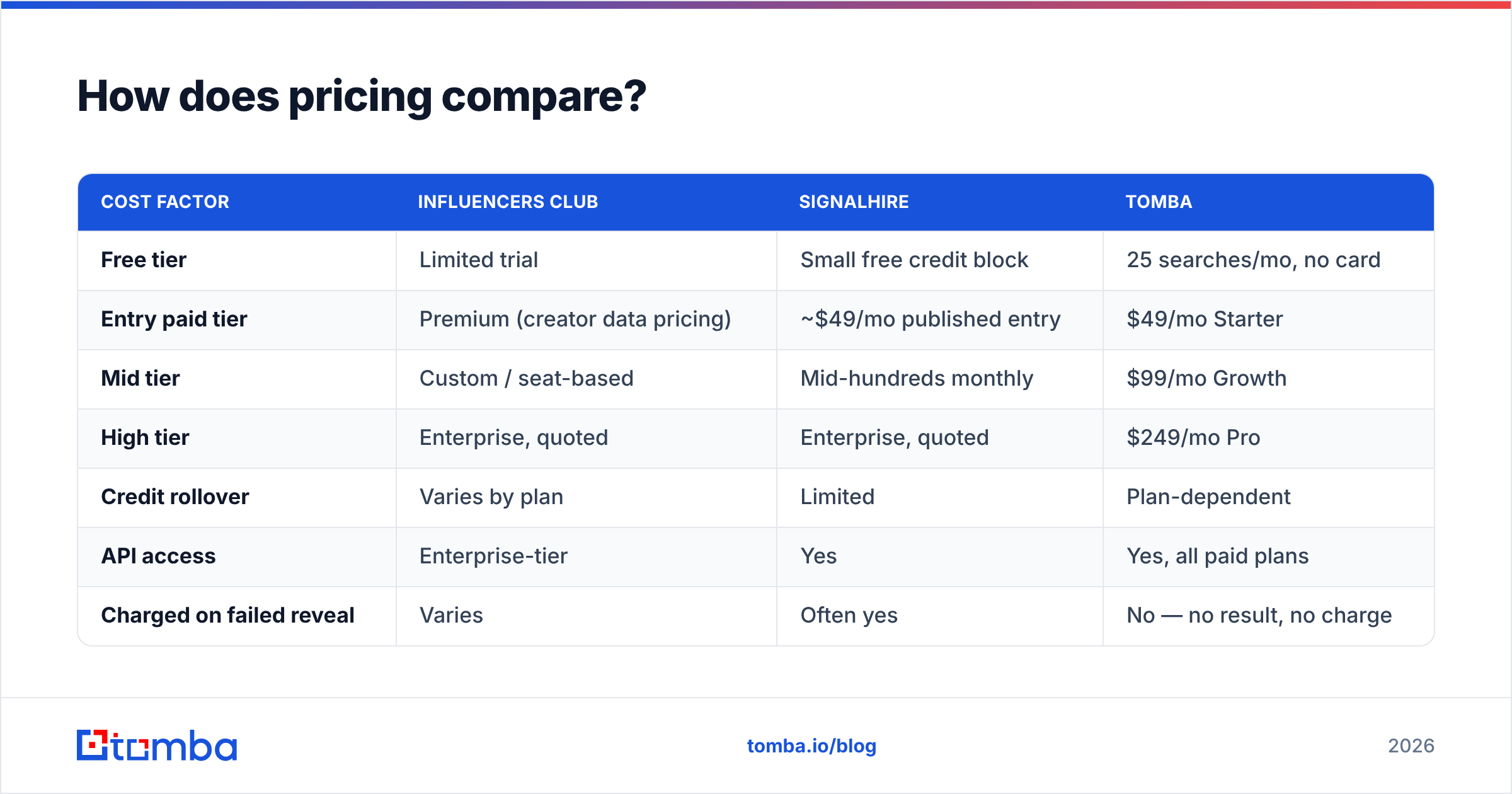
Both platforms sell credits. Both make the same thing hard: working out your real cost per usable contact. Say a reveal returns a personal Gmail that you cannot legally email in some countries. That is not a usable contact. It still cost you a credit.
| Cost factor | Influencers Club | SignalHire | Tomba |
|---|---|---|---|
| Free tier | Limited trial | Small free credit block | 25 searches/mo, no card |
| Entry paid tier | Premium (creator data pricing) | ~$49/mo published entry | $49/mo Starter |
| Mid tier | Custom / seat-based | Mid-hundreds monthly | $99/mo Growth |
| High tier | Enterprise, quoted | Enterprise, quoted | $249/mo Pro |
| Credit rollover | Varies by plan | Limited | Plan-dependent |
| API access | Enterprise-tier | Yes | Yes, all paid plans |
| Charged on failed reveal | Varies | Often yes | No — no result, no charge |

Tomba pricing is public and flat. No seat minimums. No annual-only entry plan. That is a deliberate contrast with the quote-on-request model creator-data platforms tend to use, where your price depends on how big your team looks on the call.
Which one fits your use case?#
Skip the feature grid. Answer one question: what makes a good lead for you?
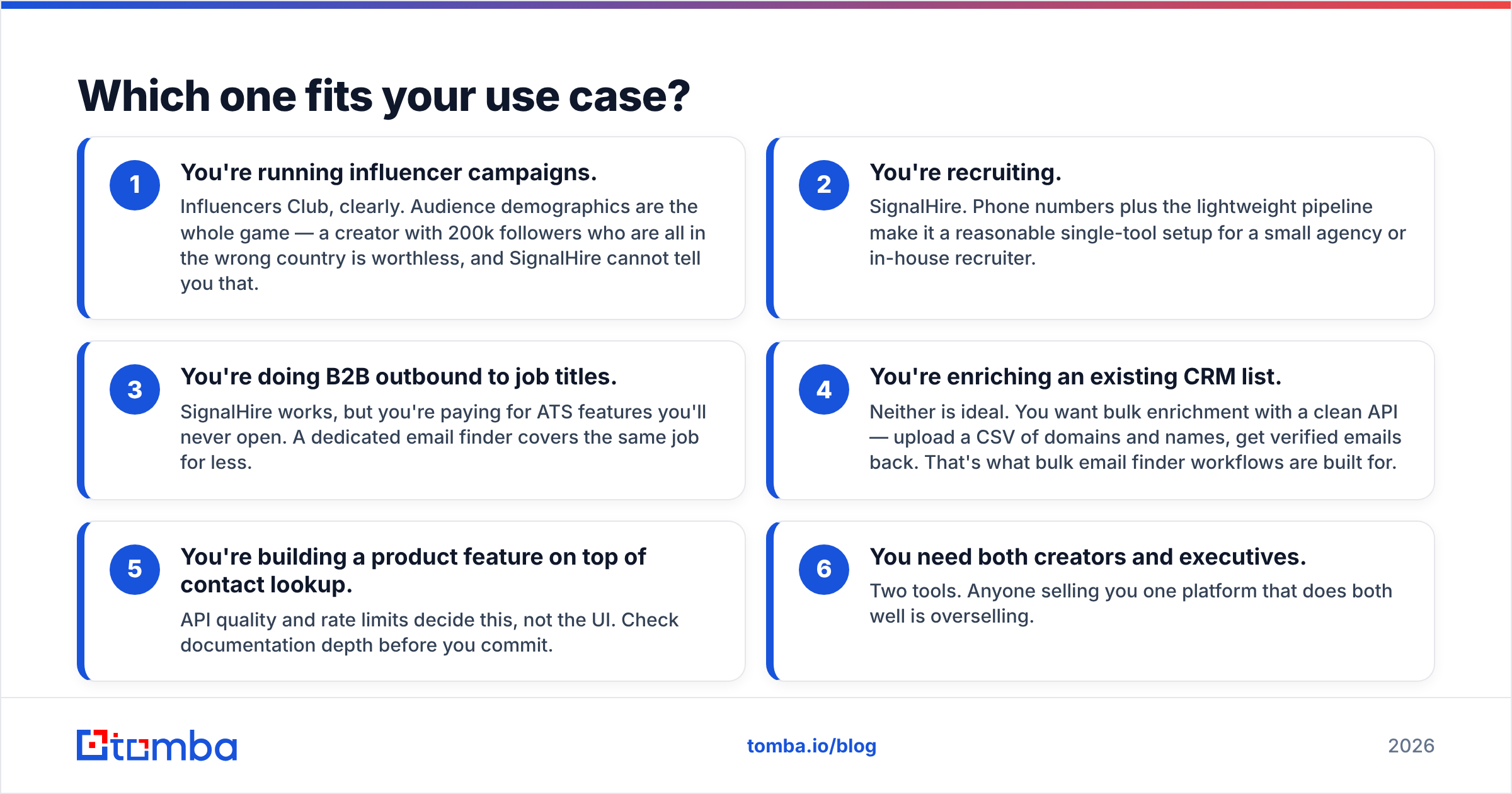
Running influencer campaigns? Influencers Club, clearly. Audience data is the whole game. A creator with 200k followers in the wrong country is worthless, and SignalHire cannot tell you that.
Recruiting? SignalHire. Phone numbers plus the small pipeline make it a fair single-tool setup for an in-house recruiter or a small agency.
Doing B2B outbound to job titles? SignalHire works, but you pay for ATS features you never open. A dedicated email finder does the same job for less.
Enriching a CRM list? Neither is ideal. You want bulk enrichment with a clean API: upload a CSV of domains and names, get verified emails back. That is what bulk email finder workflows do.
Building a product feature on contact lookup? API quality and rate limits decide this, not the UI. Read the docs before you commit.
Need creators and executives? Buy two tools. Anyone who sells you one platform for both is overselling.
What do reviewers actually say?#
Both tools carry real review volume on G2. The complaint patterns teach you something.
The usual SignalHire gripe is credit waste. Users burn credits on reveals that come back partial. Phone hit rates also drop outside North America. The usual praise is speed, and the LinkedIn extension, which people call genuinely fast.
Influencers Club draws fire on price, because you still qualify creators by hand. The filters narrow the list. They do not finish the job. Praise goes to the depth of the audience data, which reviewers say they cannot get anywhere else.
Neither pattern is a deal-breaker. Both are the normal shape of a data product. The data is good enough to be useful, and never good enough to run on its own.
Where do both tools leave gaps?#
Three gaps show up whichever one you pick.
Verification is separate. Finding an address is one job. Proving it accepts mail is another. Catch-all domains are the specific trap: the server accepts everything, then bounces later. They are common at large firms. A dedicated catch-all verifier is the only reliable fix.
Deliverability is not included. Perfect data still lands in spam when your SPF, DKIM, and DMARC are wrong. A cold domain does the same. Neither platform touches email deliverability. Budget for warmup and authentication on their own.
Compliance is on you. GDPR and CCPA duties fall on whoever contacts the person, not whoever sold the record. In the EU, personal emails carry more risk than work emails. Write down your lawful basis before you export.
So which should you choose?#
Choose Influencers Club if creator audiences decide who you contact. Nothing in B2B contact data copies follower demographics. Doing it by hand costs more than the subscription.
Choose SignalHire if you want phone numbers next to emails, plus a small pipeline in the same tab. It is fair value as a recruiting tool.
Choose neither if what you need is verified work emails at volume. That is the real job behind most InfluencersClub vs SignalHire searches. It is also where a broad platform gets expensive. You pay a premium for creator analytics or ATS screens you never open, while your bounce rate stays where it was.
Start with the Tomba Email Finder. You get 25 free searches a month, no card, and no charge when a search returns nothing. Run your current list through it. Compare the verified-email yield with what you get today. Let the numbers pick your stack, not the sales call.
Related guides#
// get started
Find, verify and enrich your first contacts today
Start on the free plan with 25 searches a month, then scale when your team is ready.
Free plan · No credit card required · GDPR & CCPA
// about the author