Influencersclub vs SMARTe: Which B2B Data Tool Wins?
One sells creator contact data, the other sells B2B contact data, and buying the wrong one burns a whole quarter. Here is how Influencersclub and SMARTe actually compare on coverage, accuracy, and price.
TL;DR
- Influencersclub and SMARTe are not really competitors. Influencersclub sells creator and social-profile contact data; SMARTe sells B2B company and job-title contact data. Picking between them starts with who you actually email.
- Influencersclub wins if your ICP is defined by follower count, niche, engagement rate, or platform (Instagram, TikTok, YouTube). SMARTe wins if your ICP is defined by industry, headcount, tech stack, and job title, especially with mobile numbers attached.
- Both are database-first tools: you buy access to a stored index. That is fast, but stored records decay roughly 25-30% per year, so verification at send time matters more than the size of the database.
- Pricing is the sharpest split. Influencersclub publishes self-serve plans; SMARTe is largely quote-based, which means a procurement cycle before you can test a single record.
- If you mostly need verified work emails at a predictable price, a focused email finder with a real-time verification layer usually beats paying for a database you use 5% of.
What is Influencersclub?#
Influencersclub is a creator-economy data platform. It indexes social profiles across Instagram, TikTok, YouTube, and adjacent networks, then attaches contact details (email, sometimes phone) and audience analytics to each profile.
The search experience is built around creator attributes, not firmographics. You filter by follower range, engagement rate, audience geography, audience age and gender split, posting frequency, hashtags used, and niche. Then you export a list with emails attached.
That makes it a natural fit for influencer marketing agencies, DTC brands running gifting or affiliate programs, and creator-partnership teams at consumer apps. It is a poor fit if you are selling a $40k ACV SaaS product to VP-level buyers at mid-market manufacturers.
The honest framing: Influencersclub is a B2C-adjacent database with a B2B-style interface. The records are people who publish content, not people who hold budget in an org chart.
What is SMARTe?#
SMARTe is a B2B contact and company data provider. It sells access to a global database of business contacts with work emails, mobile numbers, job titles, seniority, department, and company firmographics, plus a Chrome extension for pulling records off LinkedIn and company sites.
Its two loudest selling points are mobile number coverage and privacy compliance posture. SMARTe leans hard on GDPR and CCPA alignment, which matters if you are prospecting into the EU and your legal team asks where the data came from. Coverage is strongest in North America, with meaningful depth in EMEA and APAC.
The buying motion is enterprise-shaped. Most pricing is quote-based, seat and credit terms are negotiated, and annual contracts are the norm. You will usually talk to a rep before you see a record.
Which tool matches your motion?#
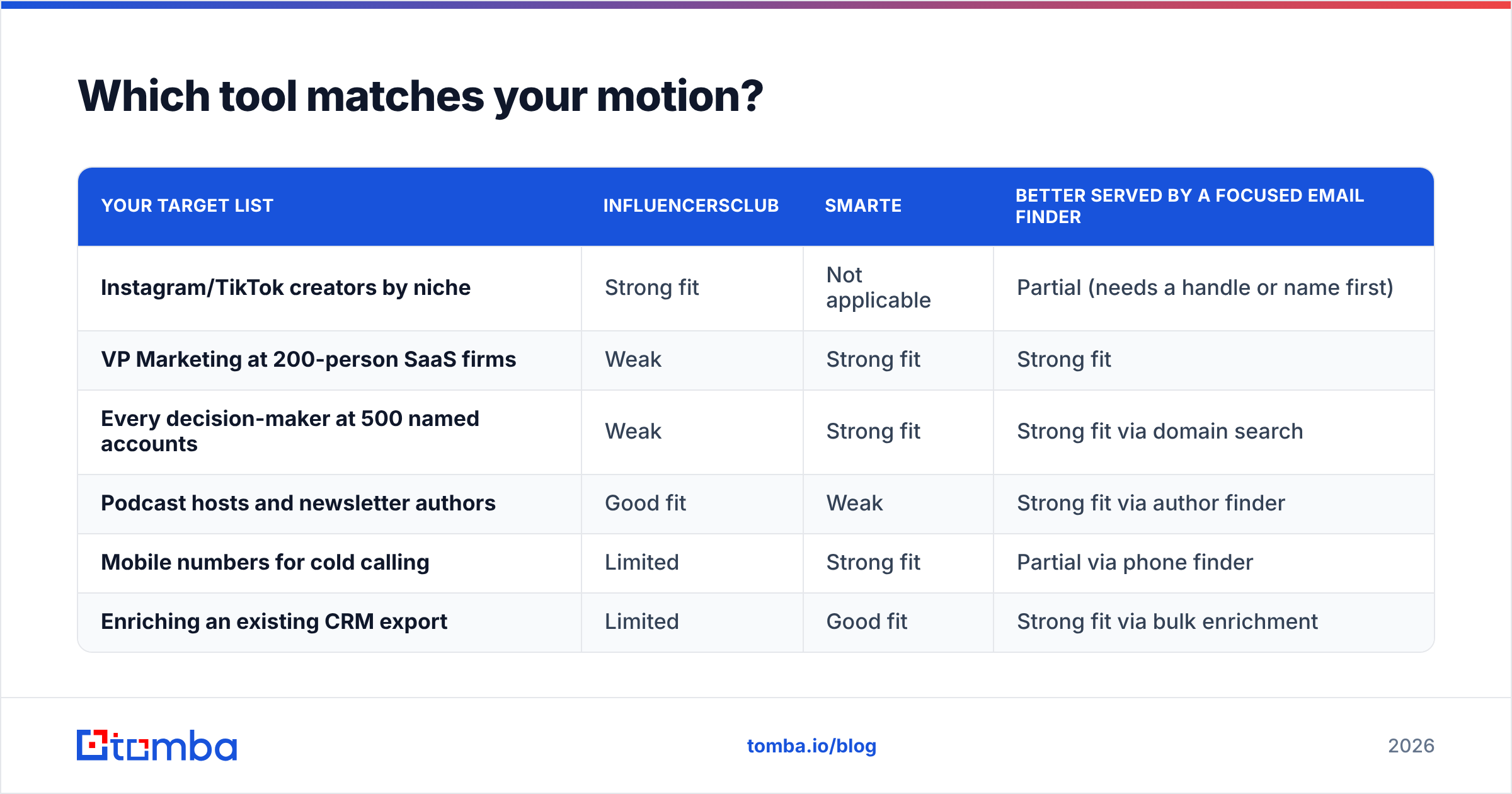
Match the tool to the shape of your target list, not to the feature count. Here is the practical split.
| Your target list | Influencersclub | SMARTe | Better served by a focused email finder |
|---|---|---|---|
| Instagram/TikTok creators by niche | Strong fit | Not applicable | Partial (needs a handle or name first) |
| VP Marketing at 200-person SaaS firms | Weak | Strong fit | Strong fit |
| Every decision-maker at 500 named accounts | Weak | Strong fit | Strong fit via domain search |
| Podcast hosts and newsletter authors | Good fit | Weak | Strong fit via author finder |
| Mobile numbers for cold calling | Limited | Strong fit | Partial via phone finder |
| Enriching an existing CRM export | Limited | Good fit | Strong fit via bulk enrichment |
Four rules that follow from that table:
- Define the list before the tool. If your ICP field is "follower count," a B2B database cannot help you, and no amount of credits will fix it.
- Count how many records you actually need per month. Under ~2,000, an enterprise annual contract is almost always the wrong shape.
- Separate discovery from contact retrieval. Finding who to email and finding their email are two different jobs, and they are often best bought separately.
- Budget for verification regardless. Every stored database, including both of these, decays. Verification is not optional overhead; it is the thing standing between you and a blocked sending domain.
Whose data is actually more accurate?#
Neither vendor's marketing number should be taken at face value, and both are measuring different things.
Influencersclub reports strong match rates on creator emails, which is easier than it sounds: many creators publish a business email directly in their bio or channel "about" section. Scraping a published address is a high-confidence operation. Where it gets shakier is creators who hide contact info behind a management agency or a contact form.
SMARTe reports high accuracy on work emails and mobiles, backed by human verification passes on parts of the database. In practice, the thing to interrogate is recency, not accuracy. A record verified 14 months ago and a record verified last week can both be labelled "verified."

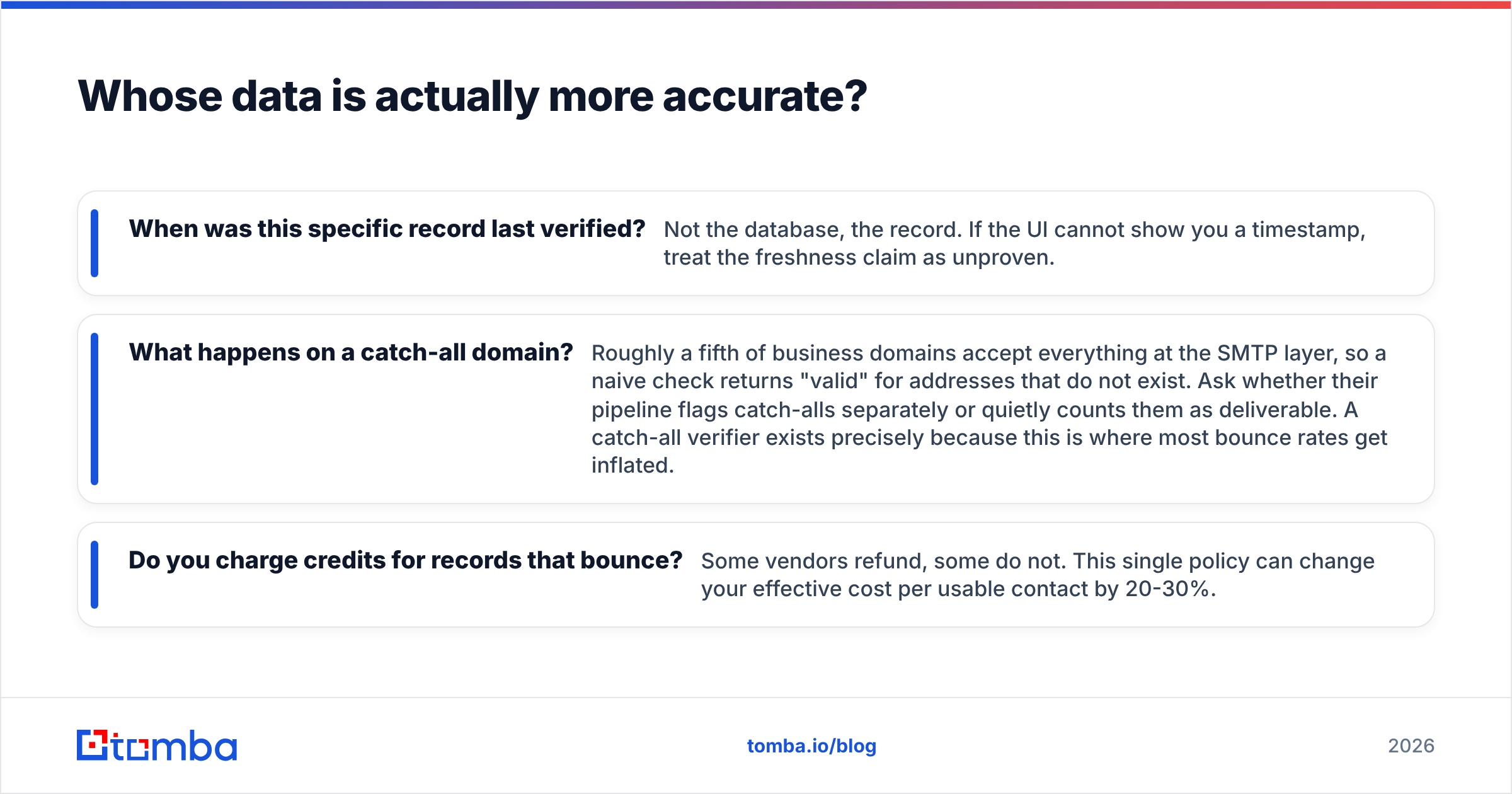
Three questions to ask either vendor on a demo call:
- When was this specific record last verified? Not the database, the record. If the UI cannot show you a timestamp, treat the freshness claim as unproven.
- What happens on a catch-all domain? Roughly a fifth of business domains accept everything at the SMTP layer, so a naive check returns "valid" for addresses that do not exist. Ask whether their pipeline flags catch-alls separately or quietly counts them as deliverable. A catch-all verifier exists precisely because this is where most bounce rates get inflated.
- Do you charge credits for records that bounce? Some vendors refund, some do not. This single policy can change your effective cost per usable contact by 20-30%.
The blunt reality: no database is accurate at rest. Email deliverability depends on what the mailbox provider thinks of your list today, which is why running an email verifier pass immediately before a send beats trusting any vendor's stored status flag.
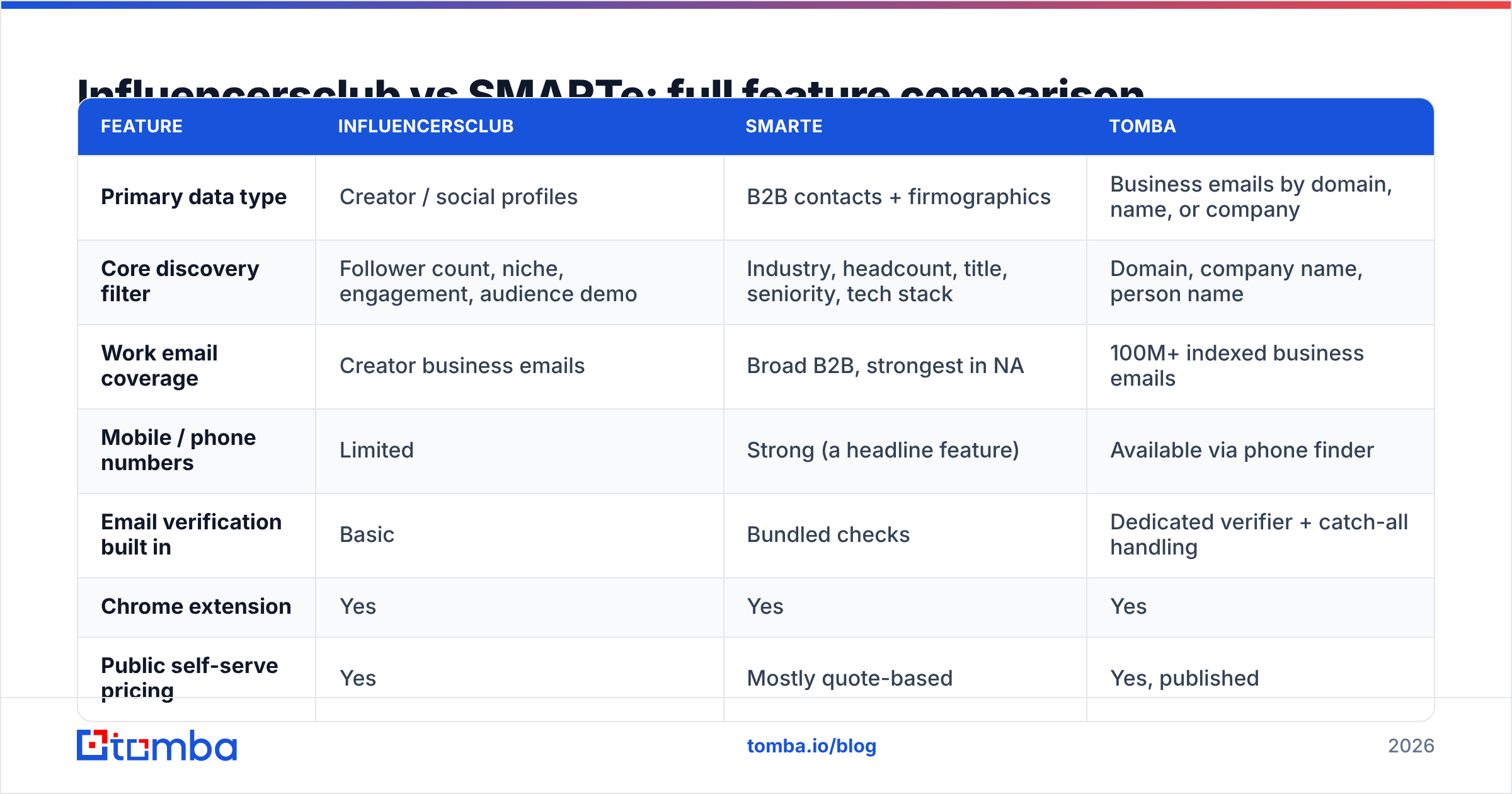
Influencersclub vs SMARTe: full feature comparison#
| Feature | Influencersclub | SMARTe | Tomba |
|---|---|---|---|
| Primary data type | Creator / social profiles | B2B contacts + firmographics | Business emails by domain, name, or company |
| Core discovery filter | Follower count, niche, engagement, audience demo | Industry, headcount, title, seniority, tech stack | Domain, company name, person name |
| Work email coverage | Creator business emails | Broad B2B, strongest in NA | 100M+ indexed business emails |
| Mobile / phone numbers | Limited | Strong (a headline feature) | Available via phone finder |
| Email verification built in | Basic | Bundled checks | Dedicated verifier + catch-all handling |
| Chrome extension | Yes | Yes | Yes |
| Public self-serve pricing | Yes | Mostly quote-based | Yes, published |
| Entry price | Published plans, mid-range | Contact sales | Free tier (25 searches/mo), then $49/mo |
| API access | Yes | Yes, on higher tiers | Yes, on all paid plans |
| Free tier to test | Trial / limited | Sample list on request | 25 free searches/mo, no card |
| Best for | Influencer and creator outreach | Enterprise B2B outbound with dialing | Verified B2B email sourcing at predictable cost |

Two things stand out when you line them up. First, the overlap between these two products is genuinely small; anyone shortlisting both is probably still deciding what their go-to-market motion is. Second, both charge you for database access, whether or not you use the discovery layer. If you already know your target accounts, that is a large chunk of spend on capability you will not touch.
How does pricing actually compare?#
Check both vendors' current pricing pages before committing, since data vendors revise tiers often. What is stable is the shape of each offer.
Influencersclub sells self-serve monthly plans with export limits. You can sign up, run searches, and see records without a call. Costs scale with export volume and the number of seats. For an agency running three or four campaigns a month, it is predictable.
SMARTe sells annual, credit-based contracts, usually negotiated. Expect a discovery call, a scoping conversation about seats and regions, and a proposal. The upside is that enterprise procurement, SOC 2 questions, and DPAs are handled properly. The downside is time: weeks between "I want to test this" and "I have records."
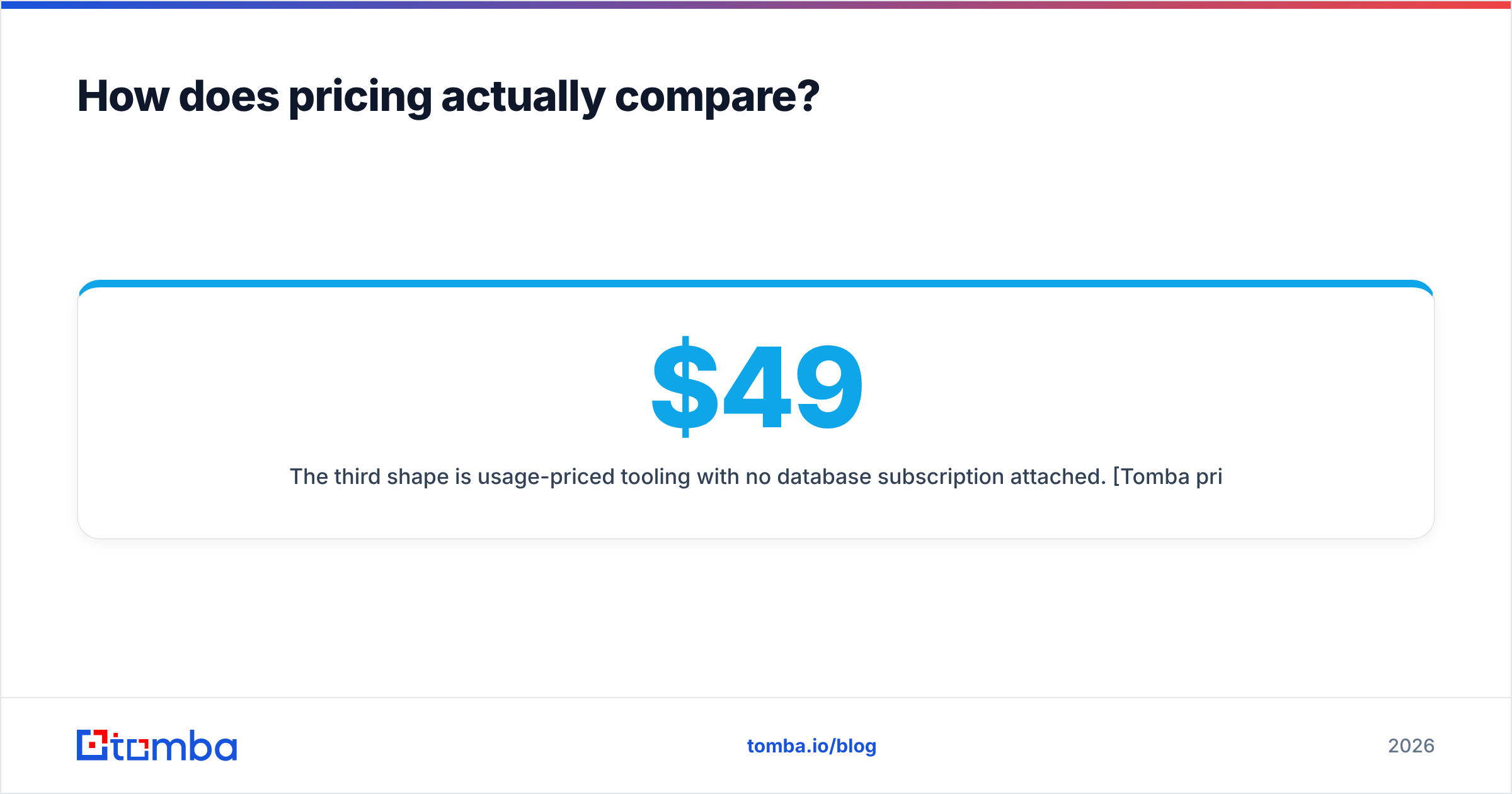
The third shape is usage-priced tooling with no database subscription attached. Tomba pricing starts with a free tier at 25 searches per month, then Starter at $49/mo, Growth at $99/mo, and Pro at $249/mo, with Enterprise custom. You pay for lookups and verifications, not for the privilege of browsing an index.
For prepaid, download-now B2B lists with a per-record price you can see up front, BookYourData is another well-regarded option worth putting on the shortlist, especially if you want to avoid a subscription entirely.

Where do both tools fall short?#
Every data vendor has the same three structural weaknesses. These two are no exception.
- Decay. Job changes, domain migrations, and rebrands invalidate records continuously. A database that was 95% accurate at ingestion is materially worse a year later. Neither vendor can outrun this; the only defence is verification at send time.
- Coverage cliffs. Both are strongest in their home territory. Influencersclub thins out on smaller platforms and non-English creator niches. SMARTe thins out in LATAM and parts of APAC compared to its North American depth. Test your actual target segment, not a generic sample.
- Credit accounting. Read the fine print on what consumes a credit: a search, a reveal, a bounce, a re-enrichment. Vendors that charge on reveal and on failed reveals have a very different effective price than the sticker suggests.
There is also an integration cost nobody quotes you. Getting records from either platform into your CRM and sequencer cleanly usually means a Zapier chain, a CSV ritual, or engineering time. If your workflow already runs through HubSpot or Salesforce, check the native depth before you sign; G2 reviews are a reasonable place to see where integrations break in practice.
Which should you pick?#
Pick Influencersclub if creators are your buyers or partners. Nothing in a B2B database will let you filter by audience gender split or average engagement rate, and rebuilding that from scraped social data is a project, not an afternoon. See what they currently offer at influencers.club.
Pick SMARTe if you run enterprise outbound with a dialing motion, need mobile numbers at volume, and have a legal team that will ask hard sourcing questions. The compliance posture is a genuine differentiator, and the quote-based model stops mattering once you are at scale. Details at smarte.pro.
Pick neither if your real requirement is "verified work emails for accounts I have already identified." That is the most common case and the one where database subscriptions waste the most money. You do not need a 200M-record index to find the head of ops at 400 named companies. You need domain search, a name-to-email lookup, and a verification pass.
That third path is what Tomba is built for. Run domain search against your target account list to pull every published pattern and contact, use the email verifier to strip risky and catch-all addresses before they touch your sequencer, and push everything through the Tomba API or the Chrome extension so nothing depends on a CSV handoff. Start on the free tier at 25 searches a month, and move to Starter at $49/mo when the volume justifies it.
Try the Tomba Email Finder on ten of your hardest target accounts before you book a demo with anyone. If it returns verified addresses for names a database subscription would have charged you a year's contract to reach, you have your answer.
Related guides#
// get started
Find, verify and enrich your first contacts today
Start on the free plan with 25 searches a month, then scale when your team is ready.
Free plan · No credit card required · GDPR & CCPA
// about the author