Influencers Club vs Warpleads (2026): Which Data Wins?
One sells creator and influencer contact data. The other sells unlimited B2B lead exports. They look similar on a pricing page and behave nothing alike in a real outbound campaign — here's how to pick.
TL;DR
- Influencers Club is a creator-data platform. Its edge is contact data for social profiles — TikTok, Instagram, YouTube — with audience demographics attached. It is not a B2B sales database.
- Warpleads is a volume play: an unlimited-export B2B lead database plus a bulk email finder, priced flat rather than per credit.
- They are almost never real alternatives to each other. If you are choosing between them, one of the two is wrong for your motion.
- Both share the same weak spot: verification happens after export, not before, so raw list quality lands on you.
- If your actual job is "get a verified work email for this named person at this company," a dedicated email finder beats both on cost per usable contact.
What are Influencers Club and Warpleads?#
Different tools that happen to sell the same-looking commodity: rows with an email in them.
Influencers Club is built for influencer marketing and creator-led commerce. You search by platform, follower band, engagement rate, niche, audience country, and audience age — then pull the creator's business email, and often a phone number or social handle set. The value is not the email. The value is the filtering layer around it: knowing that a creator has 40k followers, 4.1% engagement, and a US-majority female audience aged 25-34 is the reason you want the email at all.
Warpleads sits in the opposite corner. It targets outbound sales teams that burn thousands of contacts a month and resent credit meters. The pitch is unlimited exports from a B2B database, plus an on-demand bulk email finder for lists you bring yourself. Filters are the familiar B2B set: job title, seniority, company size, industry, geography, technology.
So the honest framing is this: Influencers Club sells audience intelligence with contacts attached. Warpleads sells contact volume with firmographics attached. Anyone comparing them is really comparing two go-to-market motions.
How do Influencers Club and Warpleads compare head-to-head?#
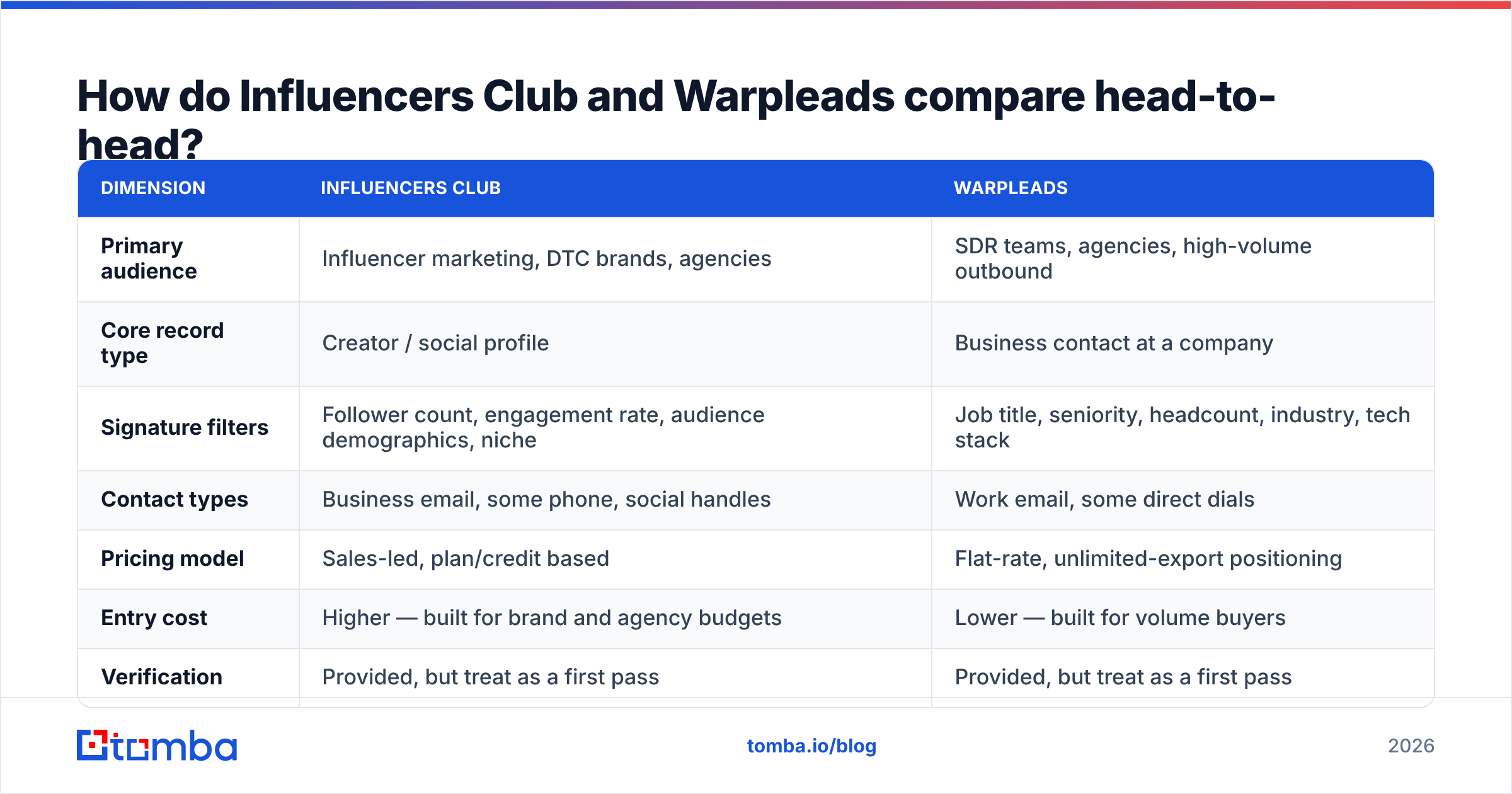
| Dimension | Influencers Club | Warpleads |
|---|---|---|
| Primary audience | Influencer marketing, DTC brands, agencies | SDR teams, agencies, high-volume outbound |
| Core record type | Creator / social profile | Business contact at a company |
| Signature filters | Follower count, engagement rate, audience demographics, niche | Job title, seniority, headcount, industry, tech stack |
| Contact types | Business email, some phone, social handles | Work email, some direct dials |
| Pricing model | Sales-led, plan/credit based | Flat-rate, unlimited-export positioning |
| Entry cost | Higher — built for brand and agency budgets | Lower — built for volume buyers |
| Verification | Provided, but treat as a first pass | Provided, but treat as a first pass |
| Best for | "Find 200 skincare creators with US audiences" | "Find 20,000 ops managers at 50-500 person SaaS firms" |
| Worst for | Any B2B SaaS outbound motion | Any creator or influencer sourcing motion |
Read that table once and the decision is usually made. The interesting question is not which one wins — it is what each one costs you after the export.

What actually differs between creator data and B2B lead data?#
Four structural differences that matter more than any feature list:
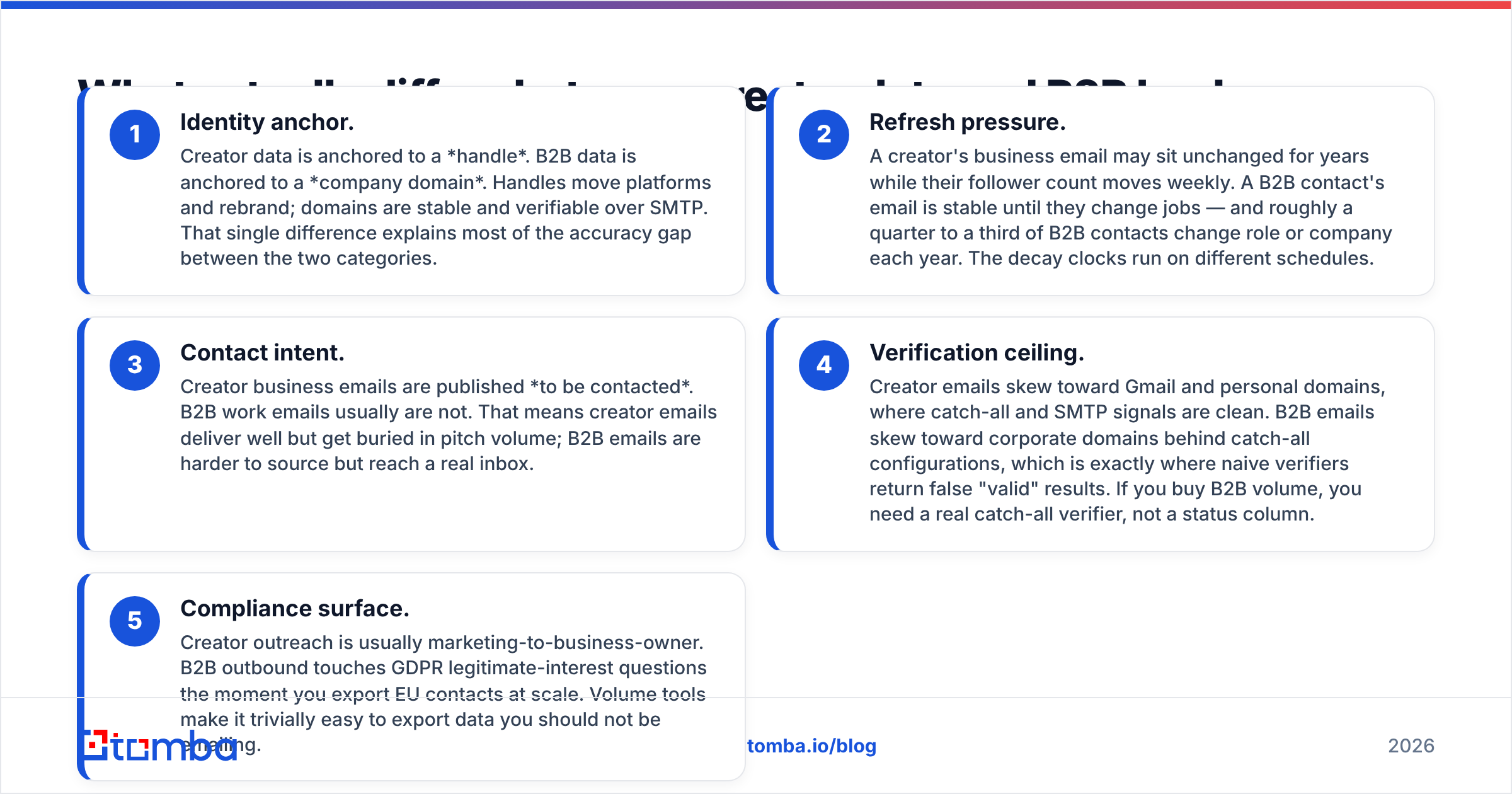
- Identity anchor. Creator data is anchored to a handle. B2B data is anchored to a company domain. Handles move platforms and rebrand; domains are stable and verifiable over SMTP. That single difference explains most of the accuracy gap between the two categories.
- Refresh pressure. A creator's business email may sit unchanged for years while their follower count moves weekly. A B2B contact's email is stable until they change jobs — and roughly a quarter to a third of B2B contacts change role or company each year. The decay clocks run on different schedules.
- Contact intent. Creator business emails are published to be contacted. B2B work emails usually are not. That means creator emails deliver well but get buried in pitch volume; B2B emails are harder to source but reach a real inbox.
- Verification ceiling. Creator emails skew toward Gmail and personal domains, where catch-all and SMTP signals are clean. B2B emails skew toward corporate domains behind catch-all configurations, which is exactly where naive verifiers return false "valid" results. If you buy B2B volume, you need a real catch-all verifier, not a status column.
- Compliance surface. Creator outreach is usually marketing-to-business-owner. B2B outbound touches GDPR legitimate-interest questions the moment you export EU contacts at scale. Volume tools make it trivially easy to export data you should not be emailing.
How accurate is the email data on each platform?#
Neither vendor publishes an independently audited accuracy figure, and you should be skeptical of any tool in this category that claims one without showing method. What you can measure is your own bounce rate on your own ICP — the only number that pays.

Here is the practical pattern most teams report:
- Influencers Club tends to hold up well on creator business emails, because those addresses are scraped from public bios and contact buttons where the creator wants inbound. The failure mode is staleness on inactive accounts and generic agency inboxes (
management@) rather than hard bounces. - Warpleads behaves like most volume databases. Headline coverage is broad, and the marginal record gets weaker as you widen filters. Pull 500 tightly filtered contacts and quality is respectable. Pull 20,000 across loose filters and you will find role accounts, departed employees, and catch-all domains that silently swallow mail.
The fix is the same either way and it is unglamorous: re-verify everything before it touches your sending domain. A 12% bounce rate on a 10,000-contact send is not a data problem you can apologize your way out of — it is a sender reputation event that suppresses the next three campaigns too. Run exports through an independent email verifier, drop unknowns into a separate low-volume warm list, and send only on what survives.
What do Influencers Club and Warpleads cost in 2026?#
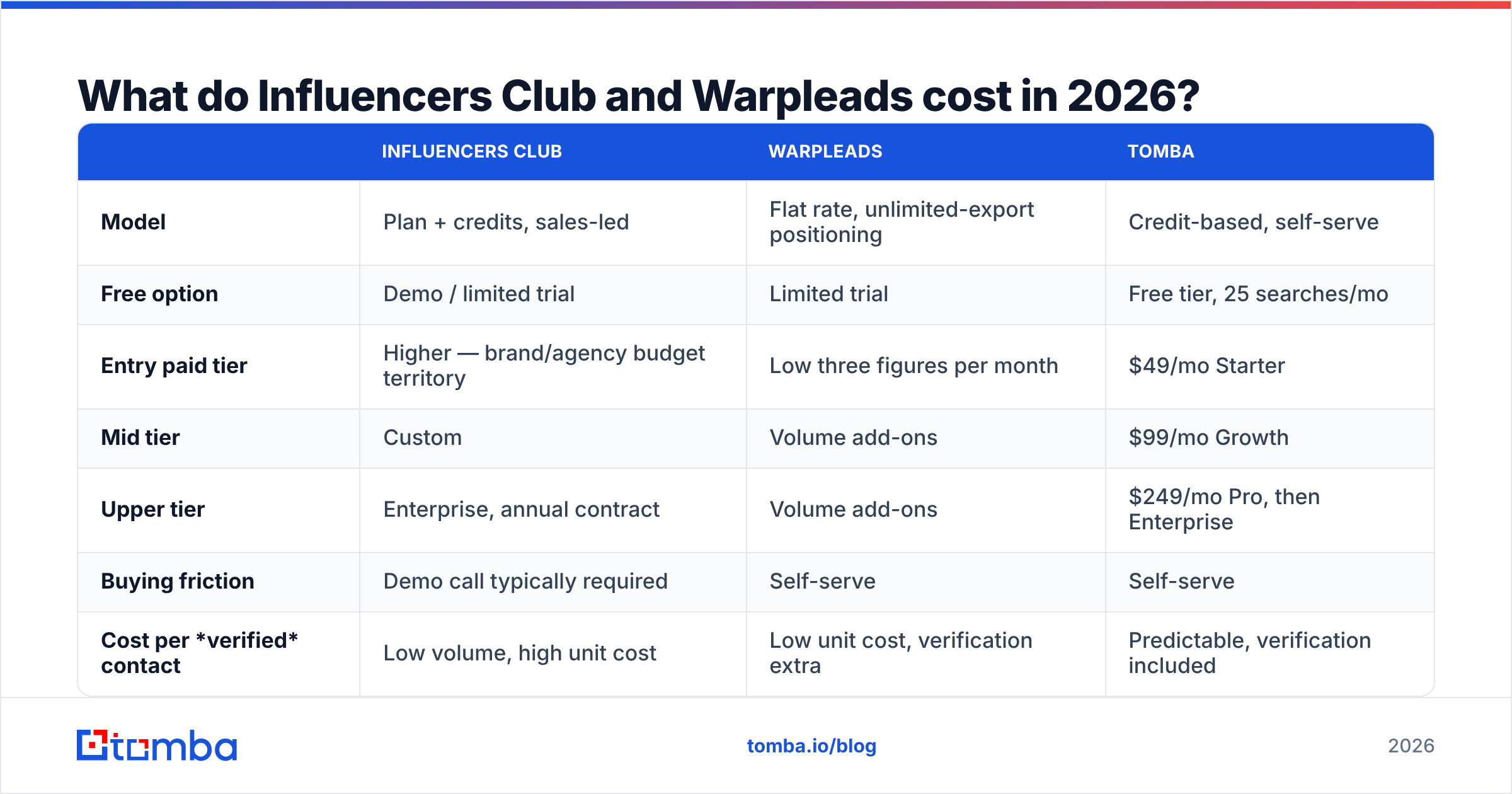
Both vendors move their packaging around, and Influencers Club is largely sales-led, so treat the shape of the pricing as the signal rather than any specific number. Check the live pages before you commit.
| Influencers Club | Warpleads | Tomba | |
|---|---|---|---|
| Model | Plan + credits, sales-led | Flat rate, unlimited-export positioning | Credit-based, self-serve |
| Free option | Demo / limited trial | Limited trial | Free tier, 25 searches/mo |
| Entry paid tier | Higher — brand/agency budget territory | Low three figures per month | $49/mo Starter |
| Mid tier | Custom | Volume add-ons | $99/mo Growth |
| Upper tier | Enterprise, annual contract | Volume add-ons | $249/mo Pro, then Enterprise |
| Buying friction | Demo call typically required | Self-serve | Self-serve |
| Cost per verified contact | Low volume, high unit cost | Low unit cost, verification extra | Predictable, verification included |
The line that matters is the last one. "Unlimited exports" is a real advantage only if the exported rows are sendable. If 30% of an unlimited export is unusable and you pay a separate verifier to find that out, your effective cost per usable contact is not unlimited-priced anymore — it is the flat fee plus verification plus the reputation cost of whatever slipped through. Compare that against transparent Tomba pricing where verification sits inside the same workflow.
Which one should you actually choose?#
Pick by motion, not by feature count.
- Creator sourcing and influencer campaigns → Influencers Club. If your brief contains words like "engagement rate," "audience overlap," or "nano-influencer," Warpleads has nothing for you. No amount of B2B filtering reconstructs audience demographics.
- High-volume cold outbound to businesses → Warpleads. If you send 10,000+ B2B emails a month across broad ICPs and credit meters are your main cost line, the flat-rate model is genuinely attractive. Budget separately for verification.
- Named-account, low-volume, high-value prospecting → neither. When you have a target list of 300 companies and need the right person at each, database breadth is irrelevant. You need precision on a known domain, which is what domain search and a per-person email finder are built for.
- Agencies running both motions → a stack, not a tool. Creator platform for the influencer side, a B2B finder plus verifier for the outbound side. Trying to force one vendor to cover both produces mediocre data on both halves.
- Engineering-led or programmatic enrichment → API first. If enrichment runs inside your product or CRM sync rather than in a CSV, evaluate on API quality, rate limits, and response schema — not on UI screenshots. This is where sales-led creator platforms drop out immediately.
Where do both tools fall short?#
Influencers Club's constraints. Sales-led pricing means you cannot test cheaply, and the platform's value collapses outside creator use cases. Business emails for creators are frequently managed inboxes — you are emailing a gatekeeper, not the person. Coverage is also uneven by platform and region; strong on the big three social networks, thinner elsewhere.
Warpleads' constraints. The unlimited framing encourages the exact behavior that wrecks deliverability: exporting more than you can personalize. Filter depth is decent but not best-in-class for niche firmographics, and verification status should be treated as a hint rather than a guarantee. Support and data-refresh cadence are the usual questions to press on in a trial — check recent reviews on G2 before you sign annually.
What they share. Neither is designed around the moment that actually decides campaign outcomes: confirming that this specific address accepts mail today. Both are discovery layers. Verification is a separate discipline, and if you treat it as a checkbox inside a discovery tool, your bounce rate tells you so about four days into the first send.
Is a dedicated email finder a better fit than either?#
For most B2B teams, yes — and for a boring reason: you already know who you want to reach.

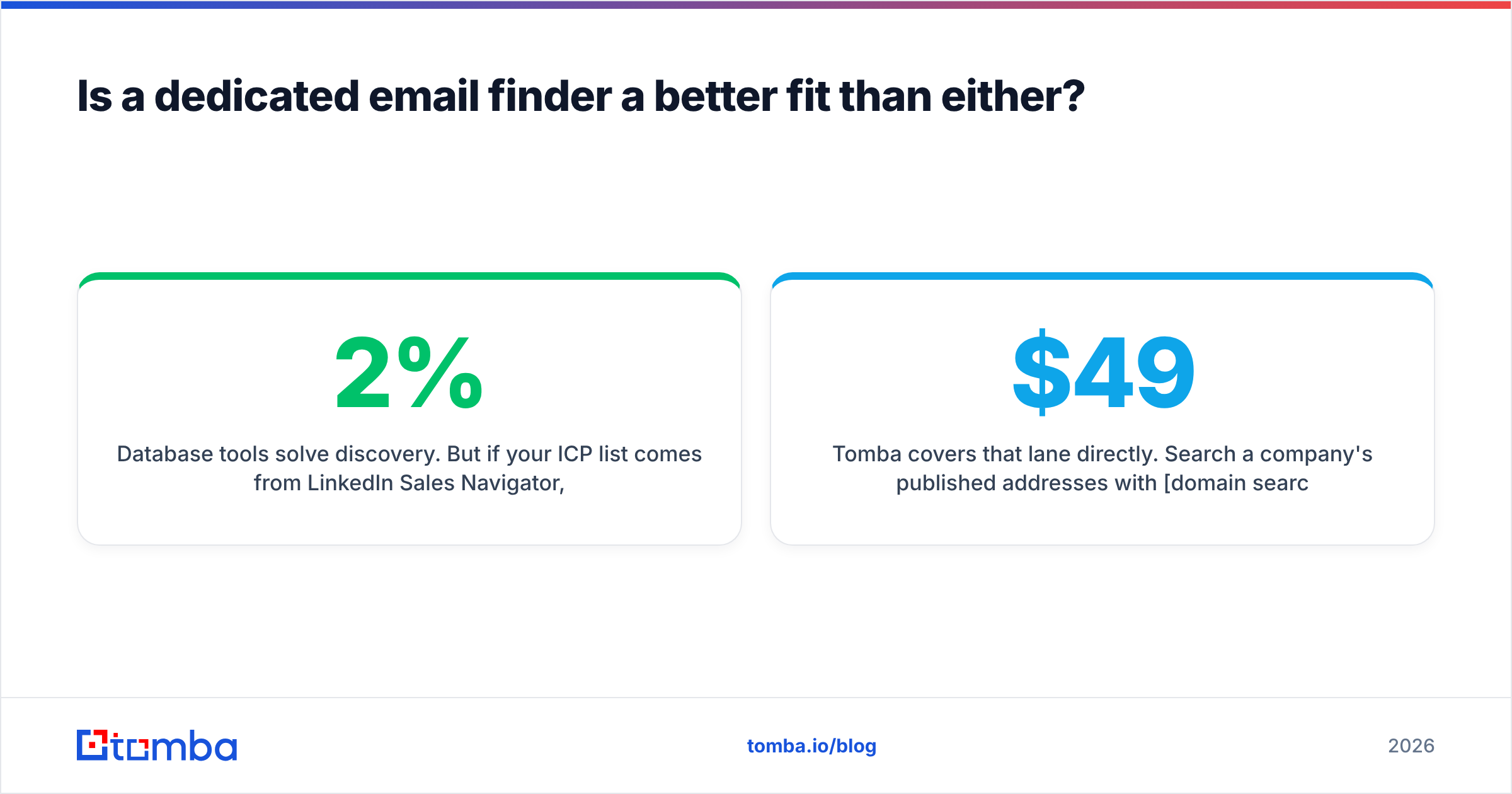
Database tools solve discovery. But if your ICP list comes from LinkedIn Sales Navigator, a conference attendee list, a partner referral, or your own CRM, discovery is already done. What remains is resolution: name plus domain in, verified work email out. That is a cheaper, higher-accuracy problem, and a purpose-built finder solves it without you renting an entire database you will filter down to 2% of anyway.
Tomba covers that lane directly. Search a company's published addresses with domain search, resolve individual people with the email finder, push whole spreadsheets through the bulk email finder, then verify everything — including catch-all domains — before a single message leaves your sending domain. Pricing is self-serve and legible: free tier at 25 searches per month, Starter at $49/mo, Growth at $99/mo, Pro at $249/mo. No demo call to find out the number.
That does not make Tomba a replacement for Influencers Club. If you need creator audience demographics, buy a creator platform. It does make Tomba a strong replacement for the email-finding half of what a volume B2B database sells you — at a cost per verified contact you can forecast.
The verdict#
Influencers Club wins creator sourcing. Warpleads wins raw B2B volume. Neither wins accuracy per contact.
Choose Influencers Club when audience data is the product you are buying and the email is incidental. Choose Warpleads when you genuinely send at volume, your ICP is broad, and flat-rate economics beat per-credit economics — then budget for independent verification on top, because the unlimited number only helps if the rows are deliverable.
And if you read this whole comparison thinking "I don't need 20,000 contacts, I need the right 500," you have already opted out of the matchup. That is a finder-and-verifier job, not a database job.
Start with the Tomba Email Finder — free tier included, 25 searches a month, no sales call. Feed it the accounts you already care about, verify what comes back, and compare your real bounce rate against whatever list you are paying for today. That single test settles the question faster than any pricing page will.
Related guides#
// get started
Find, verify and enrich your first contacts today
Start on the free plan with 25 searches a month, then scale when your team is ready.
Free plan · No credit card required · GDPR & CCPA
// about the author