Influencersclub vs Zintlr: Which Data Tool Wins in 2026?
One platform sells creator and influencer contact data. The other sells B2B contacts wrapped in personality intelligence. Here is how Influencers Club and Zintlr actually differ on coverage, accuracy, pricing, and API access — plus when neither is the right buy.
TL;DR
- They are not really competitors. Influencers Club is a creator-economy database (Instagram, TikTok, YouTube profiles with contact data). Zintlr is a B2B contact database with a personality-profiling layer on top. Comparing them only makes sense if you are shopping for "a place to get emails."
- Pick Influencers Club if your buyer is a creator, an agency roster, or a brand partnerships pipeline, and you need audience metrics alongside the email.
- Pick Zintlr if you sell to companies, want firmographic filters plus a browser extension, and find the personality-intelligence angle useful for call prep.
- Pick neither if what you actually need is verified work emails at volume for a named list of domains — a dedicated email finder does that job cheaper and with a cleaner API.
- Both vendors change pricing frequently and gate real numbers behind a demo. Always price-check the vendor page before you commit to an annual contract.
What is Influencers Club?#
Influencers Club is a creator-discovery and contact database. Think of it as a people-search engine that only indexes the social internet: instead of "VP of Engineering at a 200-person SaaS company," you search "TikTok creator in the fitness niche, 50k–200k followers, US audience, engagement rate above 4%."
The platform's pitch is that every profile comes hydrated with contact data — email, sometimes phone, sometimes a linked website — so brand and agency teams can go from discovery to outreach without a separate enrichment step. It also offers lookalike search (find creators similar to one that converted) and audience demographics, which is the part a pure email tool cannot give you.
Who buys it: influencer marketing agencies, DTC brands running creator programs, affiliate managers, and talent scouts. Who does not: a classic B2B SDR team selling software to IT directors. The index simply is not built for that.
Check the current feature set on the official Influencers Club site, because creator databases churn their filters faster than B2B vendors do.
What is Zintlr?#
Zintlr is a B2B sales-intelligence platform. It sells the familiar stack — a contact and company database, search filters, a Chrome extension for pulling contacts off LinkedIn and company sites, and export to CRM — plus one differentiator: personality intelligence.
That layer, which Zintlr markets as "Zintros" or personality profiles, attempts to infer behavioural traits of a prospect (how they like to be pitched, how fast they decide, whether they want detail or headlines) and surfaces talking points before a call. Whether you find that useful depends entirely on how much you trust inferred psychographics. Some reps love the pre-call cheat sheet. Others treat it the way they treat astrology in a CRM field.
Zintlr's other selling point is price. It has historically positioned itself well below the Apollo/ZoomInfo band, with a free tier and low-cost paid plans, which makes it popular with solo founders and small teams in cost-sensitive markets. Verify the current plan structure on zintlr.com — this is the part of the product that moves most.
How do Influencersclub vs Zintlr compare head-to-head?#
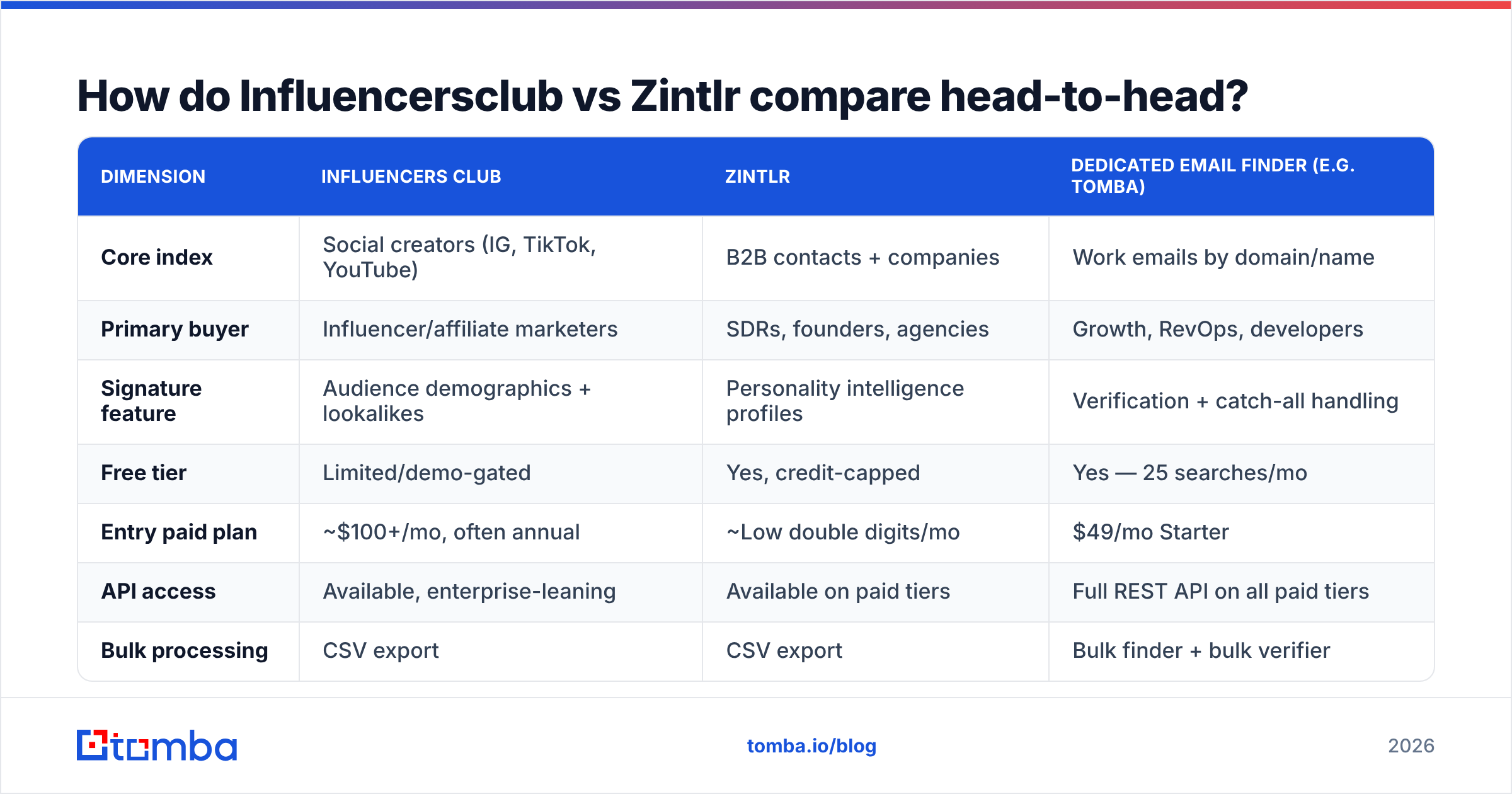
Here is the honest side-by-side. Prices marked with ~ are approximate published entry points at the time of writing and are demo-gated in at least one case — treat them as a starting range, not a quote.
| Dimension | Influencers Club | Zintlr | Dedicated email finder (e.g. Tomba) |
|---|---|---|---|
| Core index | Social creators (IG, TikTok, YouTube) | B2B contacts + companies | Work emails by domain/name |
| Primary buyer | Influencer/affiliate marketers | SDRs, founders, agencies | Growth, RevOps, developers |
| Signature feature | Audience demographics + lookalikes | Personality intelligence profiles | Verification + catch-all handling |
| Free tier | Limited/demo-gated | Yes, credit-capped | Yes — 25 searches/mo |
| Entry paid plan | ~$100+/mo, often annual | ~Low double digits/mo | $49/mo Starter |
| API access | Available, enterprise-leaning | Available on paid tiers | Full REST API on all paid tiers |
| Bulk processing | CSV export | CSV export | Bulk finder + bulk verifier |
| Best-fit use case | Creator campaigns | SMB B2B prospecting | Verified email at volume |
Two things jump out of that table.
First, the overlap between the two products is thin. If you genuinely cannot decide between them, you probably have not defined your ICP tightly enough. A creator database and a B2B database answer different questions, and buying the wrong one is not a pricing mistake — it is a targeting mistake.
Second, neither tool is optimised for the most common job in outbound: "I have 4,000 target companies and named contacts, get me deliverable emails for all of them." That is a finder-and-verifier problem, and both platforms treat it as a side feature.
Which platform has better data accuracy?#
Accuracy is the only metric that survives contact with reality, and it is measured differently in each world.
For Influencers Club, "accurate" mostly means: is this the creator's actual business inbox, and are the audience stats current? Creator emails decay fast — people swap management, change agency representation, or move to a @creatorname.com alias. Bio-scraped addresses are the shakiest input in the entire contact-data ecosystem, because they are self-published and rarely updated.
For Zintlr, "accurate" means the familiar B2B questions: is this person still at this company, is the pattern-derived email real, and does the domain accept mail? B2B data decays at roughly 25–30% per year according to widely cited industry estimates, which is why every serious vendor now bundles verification.

The practical rule, regardless of which you buy: never send to an unverified export. Both platforms will hand you a CSV that contains a meaningful slice of guessed or stale addresses. Running that list through an email verifier before it touches your sequencer costs a fraction of a cent per row and protects the only asset you cannot buy back — your sending domain's reputation.
If a chunk of your list returns "unknown" because the domain accepts everything, that is where a catch-all verifier earns its keep. Most tools that report high "accuracy" quietly exclude catch-all domains from the denominator.

How does pricing compare in practice?#
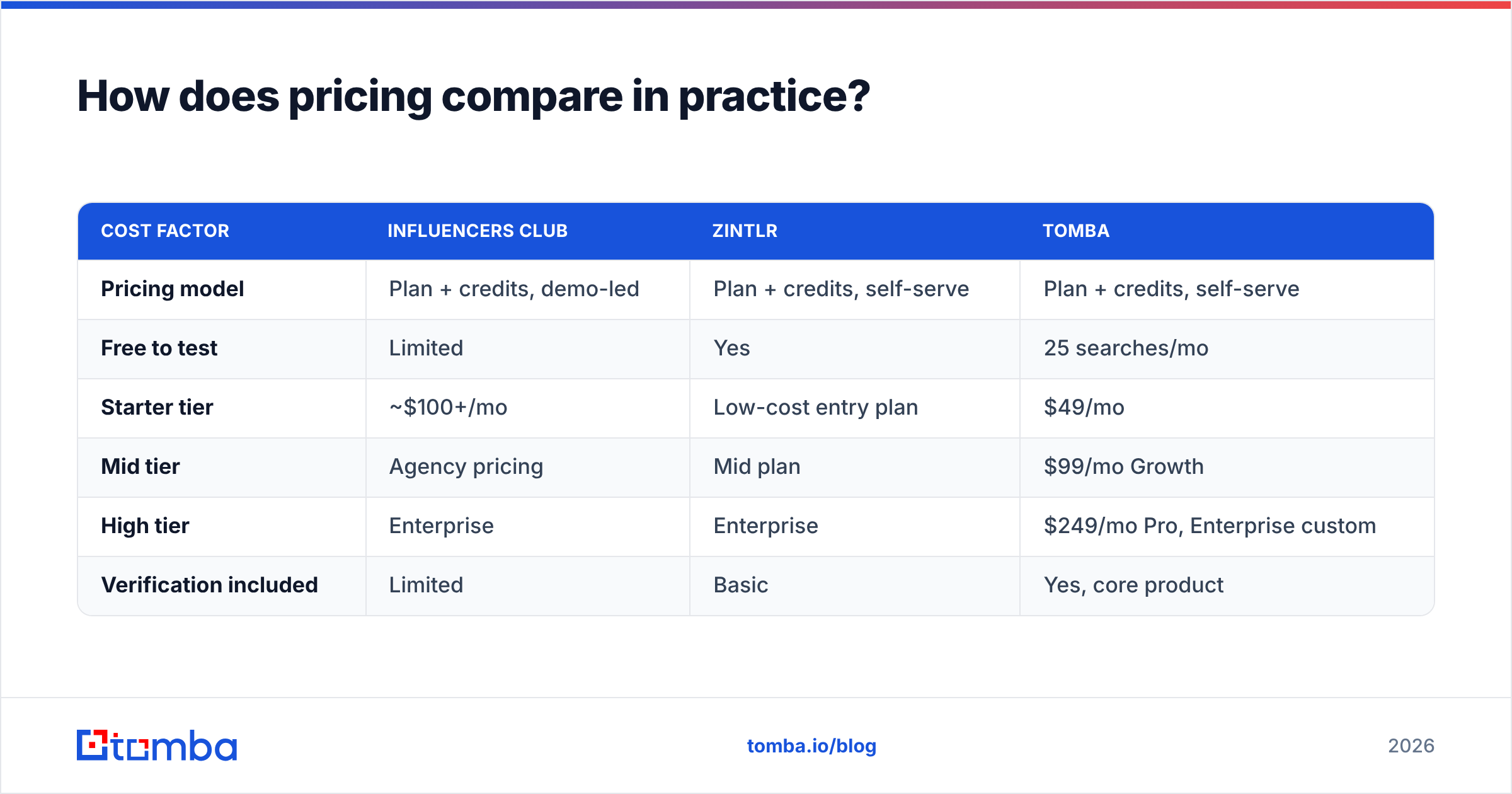
The sticker price is rarely the real price. Four cost drivers matter more than the headline number:
- Credit definition. Does one credit equal one search, one revealed email, or one enriched row with phone included? Vendors that count "reveals" burn credits faster than vendors that count "searches."
- Seat multiplication. Many B2B platforms price per seat and per credit. A $30/user plan for a six-person team is $180/month, not $30.
- Annual lock-in. Demo-gated tools frequently quote monthly but contract annually. Ask for the month-to-month number, then compare.
- Rollover and overage. Unused credits usually expire. Overage rates are often 2–4x the blended in-plan rate.
- Verification bundled or extra. If verification is a separate SKU, add it to the total — you will need it.
| Cost factor | Influencers Club | Zintlr | Tomba |
|---|---|---|---|
| Pricing model | Plan + credits, demo-led | Plan + credits, self-serve | Plan + credits, self-serve |
| Free to test | Limited | Yes | 25 searches/mo |
| Starter tier | ~$100+/mo | Low-cost entry plan | $49/mo |
| Mid tier | Agency pricing | Mid plan | $99/mo Growth |
| High tier | Enterprise | Enterprise | $249/mo Pro, Enterprise custom |
| Verification included | Limited | Basic | Yes, core product |
Full, current numbers for the third column are on the Tomba pricing page. For the other two, assume the published figure is a floor and budget 20–40% above it once seats and overage land.
Which one fits creator outreach vs B2B outbound?#
Split the decision by what you are actually pitching.
Choose Influencers Club when:
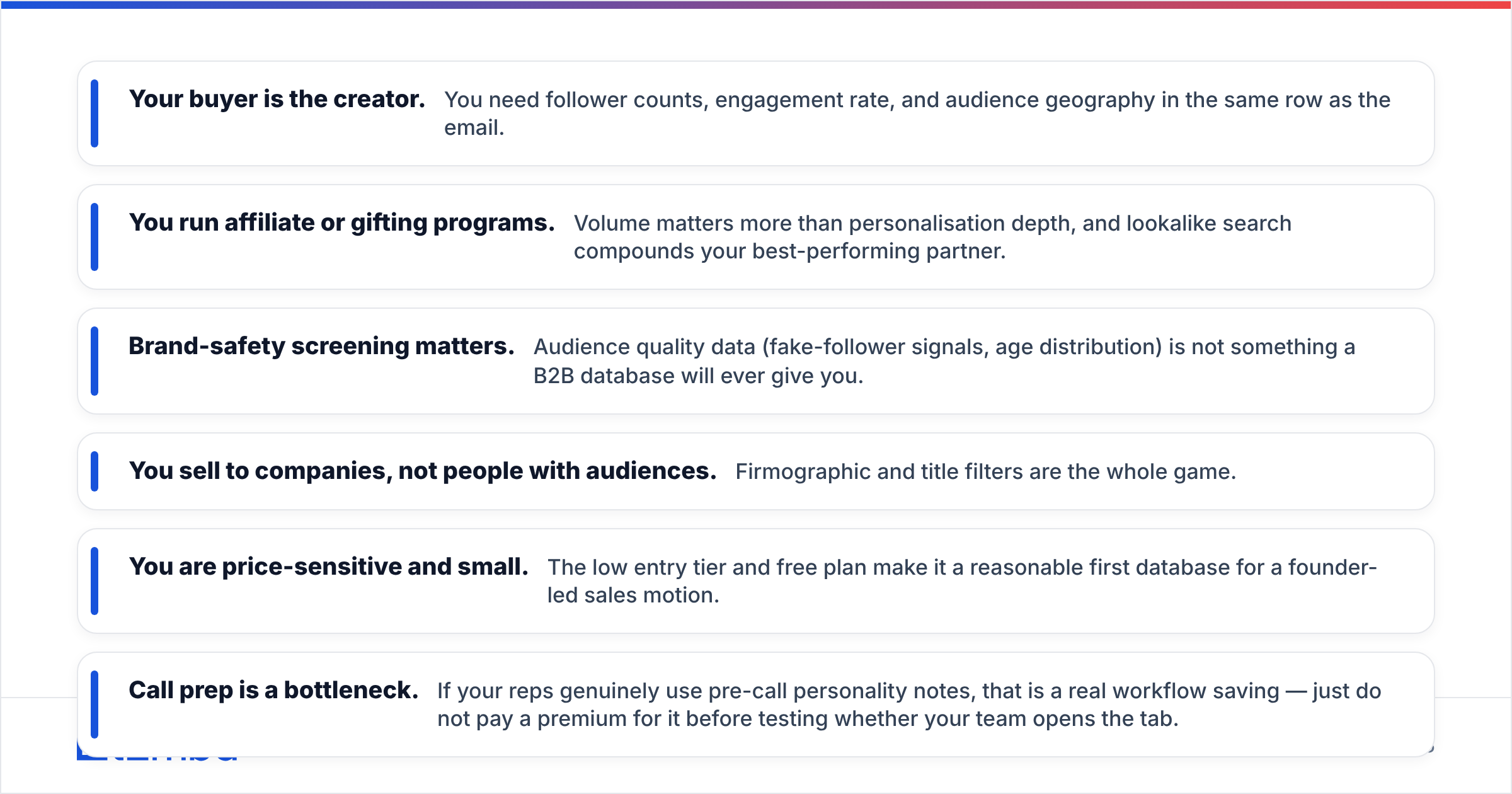
- Your buyer is the creator. You need follower counts, engagement rate, and audience geography in the same row as the email.
- You run affiliate or gifting programs. Volume matters more than personalisation depth, and lookalike search compounds your best-performing partner.
- Brand-safety screening matters. Audience quality data (fake-follower signals, age distribution) is not something a B2B database will ever give you.
Choose Zintlr when:
- You sell to companies, not people with audiences. Firmographic and title filters are the whole game.
- You are price-sensitive and small. The low entry tier and free plan make it a reasonable first database for a founder-led sales motion.
- Call prep is a bottleneck. If your reps genuinely use pre-call personality notes, that is a real workflow saving — just do not pay a premium for it before testing whether your team opens the tab.
Choose a dedicated finder when:
- You already know who to contact. You have the list; you need deliverable addresses, not more discovery.
- You need an API, not a UI. Enrichment inside your own product or workflow means the email finder API matters more than the search screen.
- Deliverability is the constraint. Your bounce rate, not your list size, is what is capping replies.

What do real users say about each?#
Vendor sites are marketing. Third-party review platforms are noisy but directionally useful — filter by recent reviews and by company size closest to yours, then read the two-star reviews first, since they tend to be the most specific. Both platforms have listings you can scan on G2.
Recurring themes worth checking against your own trial:
- Coverage gaps by geography. Creator databases skew US/EU; B2B databases often skew toward whichever market the vendor is headquartered in. Test your actual territory, not a demo territory.
- Credit burn on failed lookups. Ask explicitly whether a search that returns nothing consumes a credit. The answer changes your effective cost per usable contact by a lot.
- Export friction. Some plans cap exports per day regardless of credit balance.
- Support responsiveness. For demo-led tools this is the difference between a two-week rollout and a two-month one.
Should you use one of these instead of a dedicated email finder?#
Use them for what they are good at — discovery — and use a purpose-built tool for the last mile.
The analogy: a creator database and a B2B database are like a phone book. A finder-and-verifier is like calling the number to check someone picks up. You need both, but you should not pay phone-book prices for dial tone.
A practical stack looks like this:
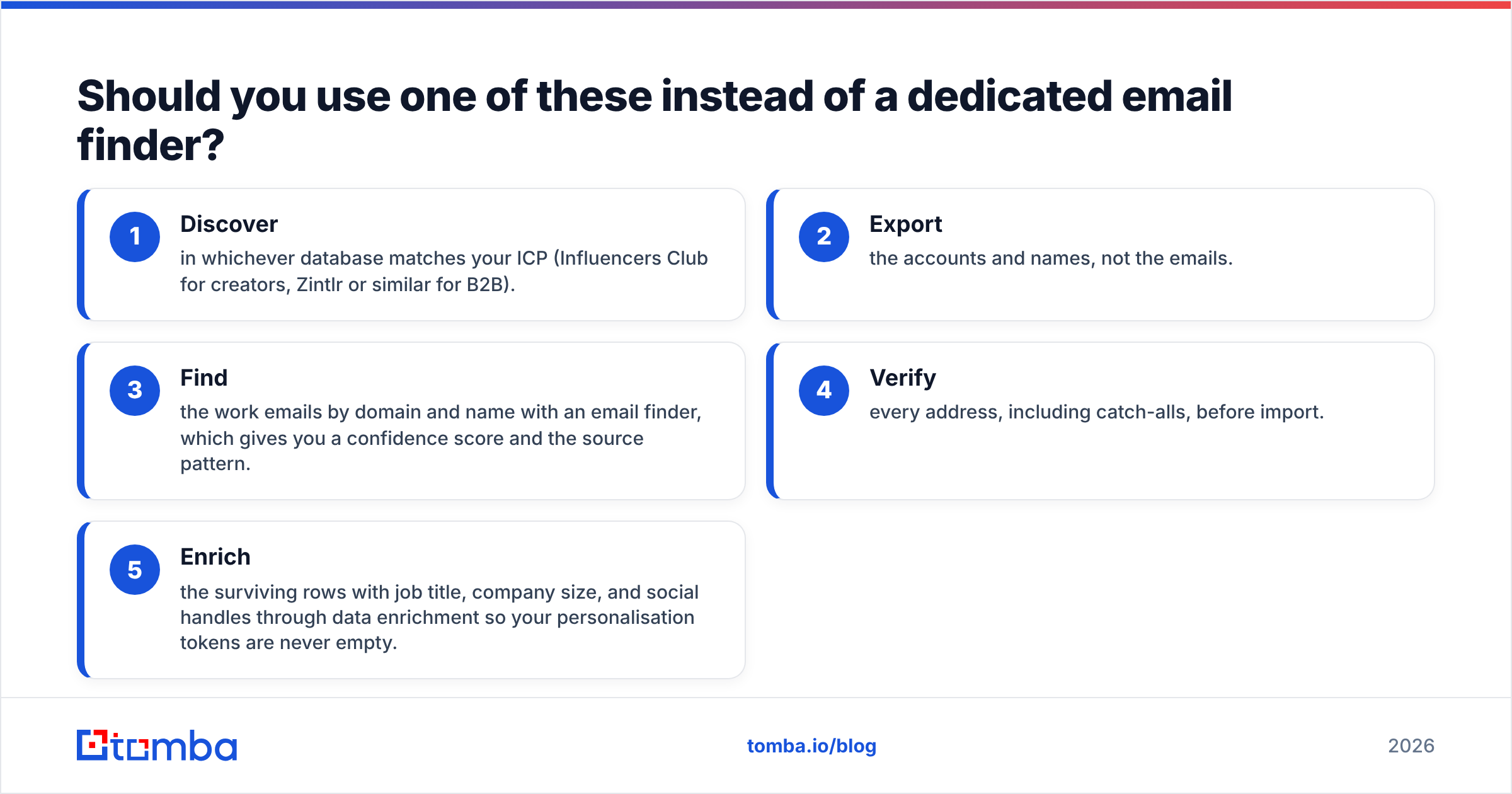
- Discover in whichever database matches your ICP (Influencers Club for creators, Zintlr or similar for B2B).
- Export the accounts and names, not the emails.
- Find the work emails by domain and name with an email finder, which gives you a confidence score and the source pattern.
- Verify every address, including catch-alls, before import.
- Enrich the surviving rows with job title, company size, and social handles through data enrichment so your personalisation tokens are never empty.
That sequence usually costs less than buying reveal credits inside a discovery platform, and it produces a list you can actually send to. It also decouples you from any single vendor's index — if Zintlr's coverage is thin in your territory next quarter, you swap the discovery layer without rebuilding the pipeline.
What is the verdict on Influencersclub vs Zintlr?#
If you run creator campaigns, Influencers Club wins by default — Zintlr has no meaningful creator index, so the comparison collapses. If you run B2B outbound, Zintlr wins by default, and the personality layer is a bonus you should evaluate but not pay a premium for.
The more useful conclusion is the third option. Most teams comparing these two are really asking "where do I get emails that do not bounce?" Neither product is built to answer that at volume. Discovery platforms sell breadth; you need depth on a specific list.
So: buy the database that matches your buyer, keep its plan as small as possible, and put a dedicated finder and verifier downstream of it. That is the configuration that survives a budget review.
Ready to fix the last mile?#
Start with the Tomba Email Finder. Point it at a domain and a name, get a scored, verified work email back — through the web app, the bulk uploader, or the API. The free tier gives you 25 searches a month with no card, Starter is $49/month, and every paid plan includes the full API. Run 100 contacts from your current Influencers Club or Zintlr export through it and compare the bounce rate side by side. That test takes an afternoon and usually settles the argument faster than another demo call.
Related guides#
// get started
Find, verify and enrich your first contacts today
Start on the free plan with 25 searches a month, then scale when your team is ready.
Free plan · No credit card required · GDPR & CCPA
// about the author