Influno vs LeadEngineAI (2026): Which Outbound Tool Wins?
Influno and LeadEngineAI attack outbound from opposite ends: one owns the sending layer, the other owns AI lead sourcing. Here is where each wins, where each leaks money, and what neither fixes.
TL;DR
- They are not the same category. Influno is built around the sending and sequencing layer of cold outreach. LeadEngineAI positions itself around AI-assisted lead sourcing and scoring. Comparing them feature-for-feature is comparing a mail engine to a list engine.
- Pick Influno if your bottleneck is inbox management, sequence logic, and reply handling — you already have a data source you trust.
- Pick LeadEngineAI if your bottleneck is finding and prioritising accounts, and you are willing to verify what the AI hands you before it touches a mailbox.
- Neither one is a data accuracy layer. Both depend on the quality of the email addresses entering the funnel, which is where most outbound programs actually fail.
- Verify pricing directly. Both vendors have changed packaging more than once; treat any number you read in a blog post (including this one) as a starting point, not a quote.
What Are Influno and LeadEngineAI?#
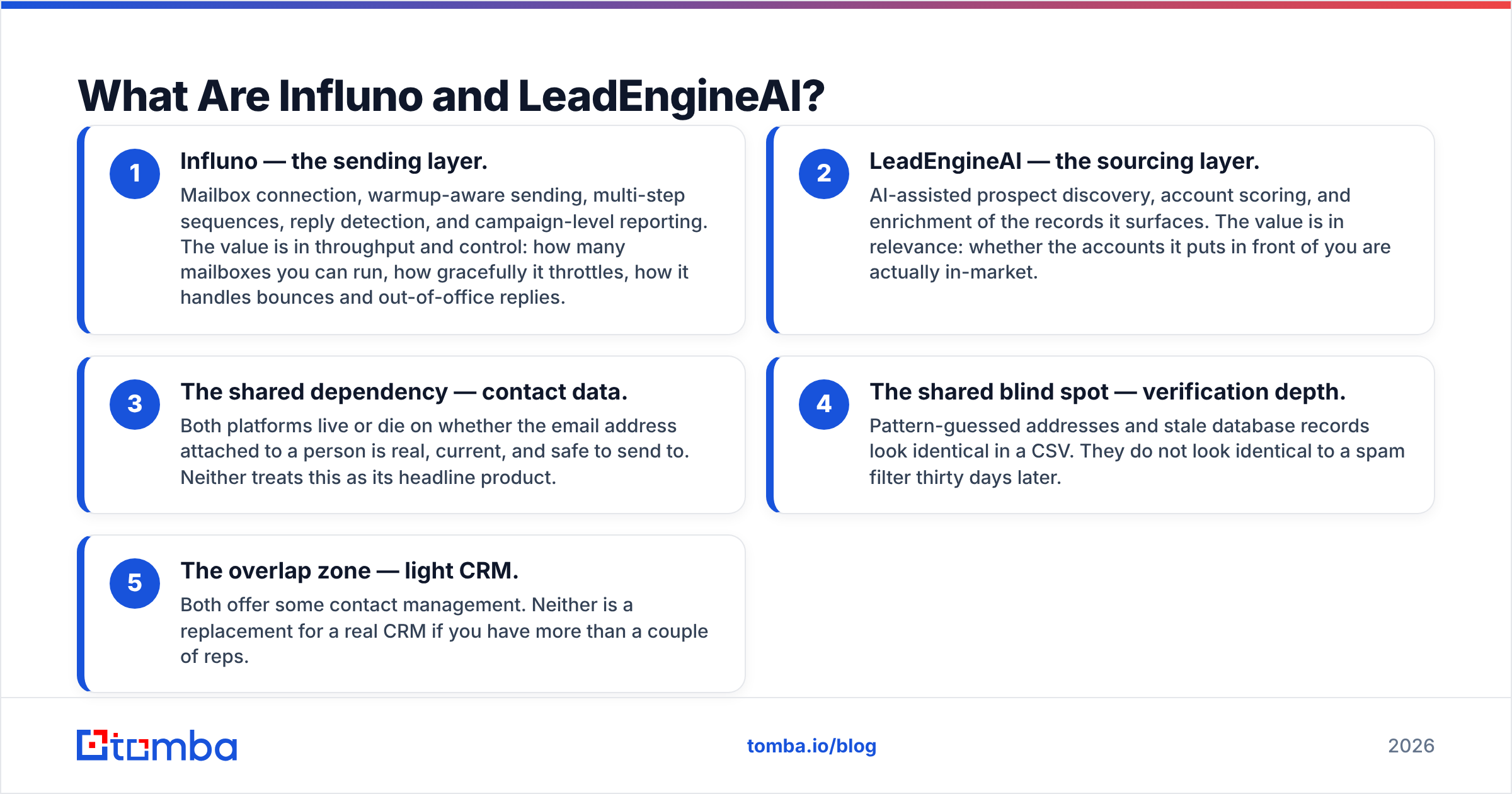
Short version: Influno is an outbound execution platform, LeadEngineAI is an outbound input platform. They sit on opposite ends of the same pipeline.
Think of outbound as a restaurant. LeadEngineAI is the supplier deciding which ingredients arrive at the back door. Influno is the kitchen that turns them into plates and gets them to tables on time. A great kitchen cannot rescue rotten produce, and premium produce does nothing if the kitchen is on fire.
Here is the split in practice:
- Influno — the sending layer. Mailbox connection, warmup-aware sending, multi-step sequences, reply detection, and campaign-level reporting. The value is in throughput and control: how many mailboxes you can run, how gracefully it throttles, how it handles bounces and out-of-office replies.
- LeadEngineAI — the sourcing layer. AI-assisted prospect discovery, account scoring, and enrichment of the records it surfaces. The value is in relevance: whether the accounts it puts in front of you are actually in-market.
- The shared dependency — contact data. Both platforms live or die on whether the email address attached to a person is real, current, and safe to send to. Neither treats this as its headline product.
- The shared blind spot — verification depth. Pattern-guessed addresses and stale database records look identical in a CSV. They do not look identical to a spam filter thirty days later.
- The overlap zone — light CRM. Both offer some contact management. Neither is a replacement for a real CRM if you have more than a couple of reps.
That framing matters because most "Influno vs LeadEngineAI" searches are really asking a different question: which one do I buy first? The answer depends entirely on which end of your pipeline is broken.

How Do Influno and LeadEngineAI Compare Head-to-Head?#
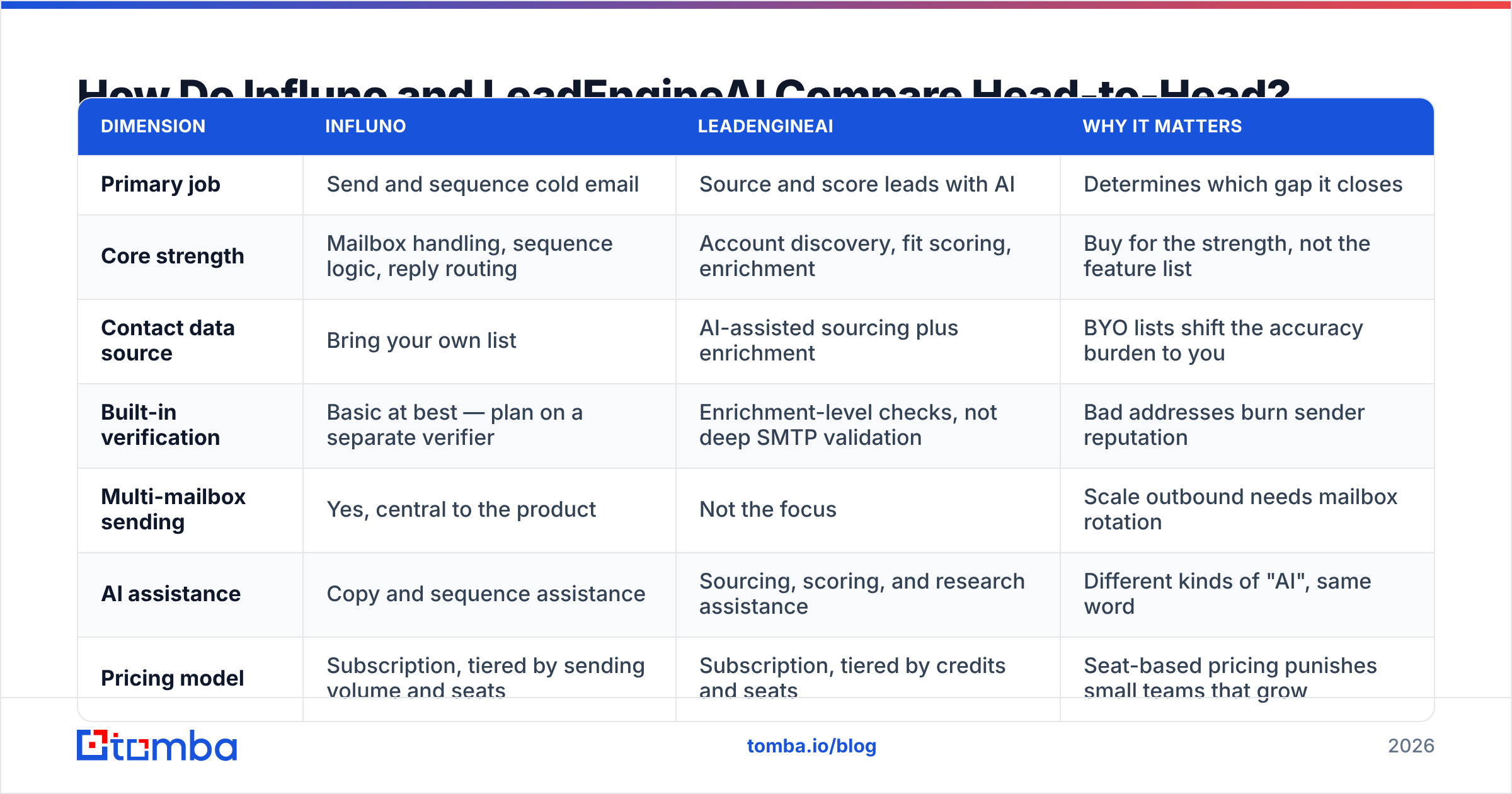
The table below is capability-level, not marketing-copy-level. Where a vendor's packaging shifts frequently, the cell says so rather than inventing a number.
| Dimension | Influno | LeadEngineAI | Why it matters |
|---|---|---|---|
| Primary job | Send and sequence cold email | Source and score leads with AI | Determines which gap it closes |
| Core strength | Mailbox handling, sequence logic, reply routing | Account discovery, fit scoring, enrichment | Buy for the strength, not the feature list |
| Contact data source | Bring your own list | AI-assisted sourcing plus enrichment | BYO lists shift the accuracy burden to you |
| Built-in verification | Basic at best — plan on a separate verifier | Enrichment-level checks, not deep SMTP validation | Bad addresses burn sender reputation |
| Multi-mailbox sending | Yes, central to the product | Not the focus | Scale outbound needs mailbox rotation |
| AI assistance | Copy and sequence assistance | Sourcing, scoring, and research assistance | Different kinds of "AI", same word |
| Pricing model | Subscription, tiered by sending volume and seats | Subscription, tiered by credits and seats | Seat-based pricing punishes small teams that grow |
| Best-fit team | Agencies and SDR teams running high send volume | Founders and GTM teams hunting new segments | Mismatched fit is the most common buying error |
| Weakest link | Only as good as the list you import | Only as good as the emails it returns | Both point back to the data layer |
Two honest caveats. First, both products iterate fast; a feature listed as missing today may ship next quarter, so check the vendor's own changelog before you commit annually. Second, neither has the review volume of a Salesloft or an Apollo, so the public evidence base is thin. If you want third-party signal, the category pages on G2 and Capterra are the least-biased place to start, and even there you should weight recent reviews heavily.
Is LeadEngineAI's AI Sourcing Actually Better Than a Database?#
It depends on what you mean by "better", and the honest answer is: better at discovery, not automatically better at accuracy.
AI sourcing tools are strong when you cannot describe your ICP as a clean filter. If your best customers share a vague trait — "companies that just started hiring RevOps", "SaaS firms with a legacy billing stack" — a model that reads signals across the web will beat a static filter dropdown. That is real value.
What AI sourcing does not do is make an inferred email address true. When a system reasons its way to first.last@company.com because that is the common pattern, it has produced a plausible address, not a verified one. Plausible addresses bounce. Bounces above roughly 2-3% start visibly damaging sender reputation, and the damage lands on every mailbox in the rotation — including the campaigns that were working.
So the practical stance is: let LeadEngineAI decide who to contact, then run its output through an independent email verifier before a single message leaves Influno. That two-step split costs a few cents per record and routinely saves a domain.
A related trap is the catch-all domain. A catch-all server accepts mail for every address at the domain, so a naive check returns "valid" for garbage. If a meaningful slice of your target market runs catch-all — common in enterprise and in EU mid-market — you need a catch-all verifier that goes further than a simple SMTP handshake, or you will send confidently into a void.
How Do Pricing Models Differ?#
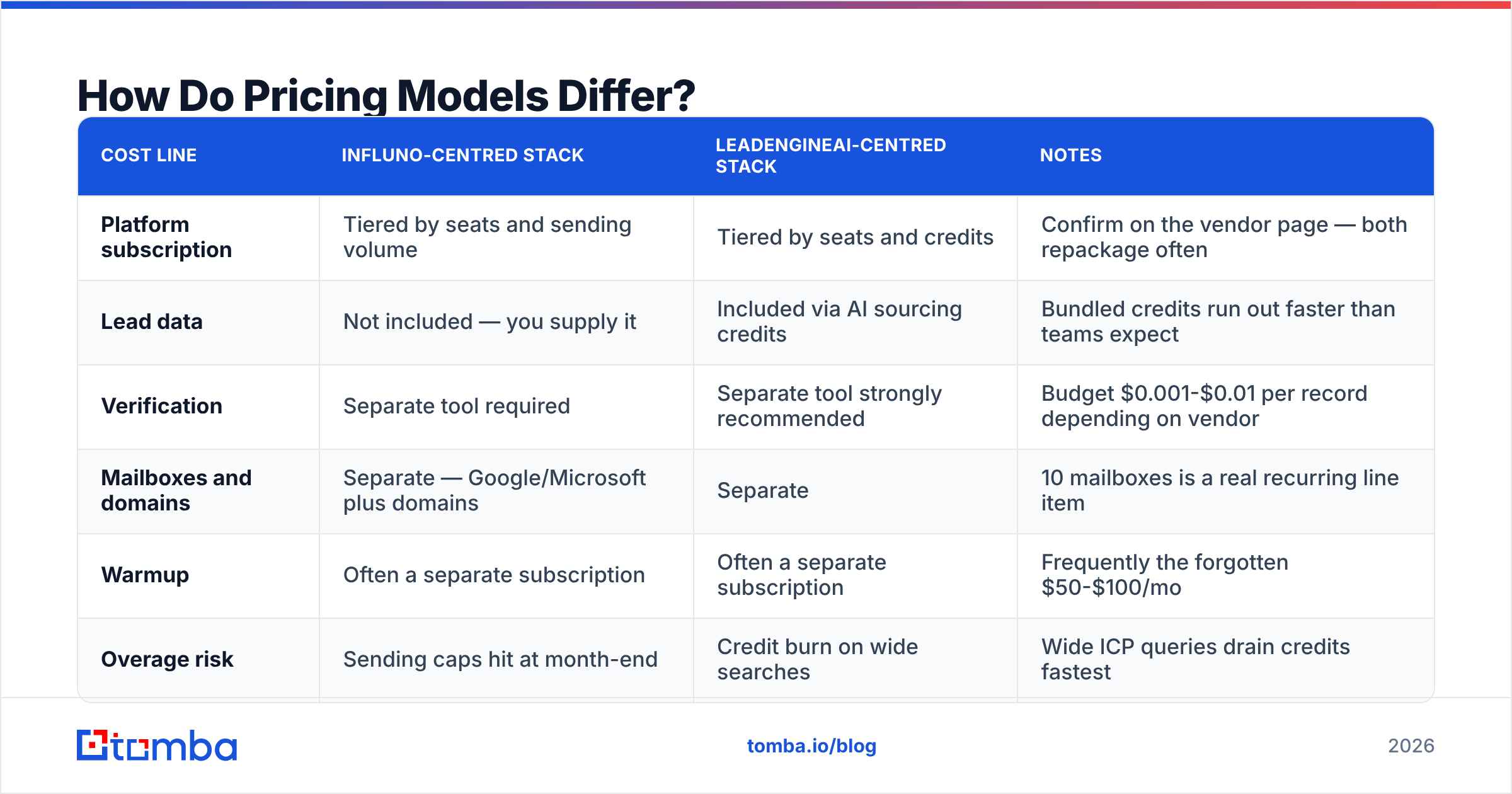
The sticker price is rarely the real cost. Model the total instead.
| Cost line | Influno-centred stack | LeadEngineAI-centred stack | Notes |
|---|---|---|---|
| Platform subscription | Tiered by seats and sending volume | Tiered by seats and credits | Confirm on the vendor page — both repackage often |
| Lead data | Not included — you supply it | Included via AI sourcing credits | Bundled credits run out faster than teams expect |
| Verification | Separate tool required | Separate tool strongly recommended | Budget $0.001-$0.01 per record depending on vendor |
| Mailboxes and domains | Separate — Google/Microsoft plus domains | Separate | 10 mailboxes is a real recurring line item |
| Warmup | Often a separate subscription | Often a separate subscription | Frequently the forgotten $50-$100/mo |
| Overage risk | Sending caps hit at month-end | Credit burn on wide searches | Wide ICP queries drain credits fastest |
The pattern to watch: credit-based sourcing tools get expensive when your ICP is loose. Every speculative search spends credits whether or not the output is usable. Tightening your ICP before you turn on an AI sourcing tool is the single highest-ROI thing you can do to control that bill.
On the sending side, the pattern is different: seat-based pricing punishes growth. A three-rep team that doubles pays double, even if sending volume per rep drops. If you expect headcount swings, price out the annual commitment against a monthly plan honestly rather than optimistically.
For reference on a data-layer line item, Tomba pricing runs a free tier at 25 searches per month, Starter at $49/mo, Growth at $99/mo, and Pro at $249/mo, with Enterprise custom. That is the kind of number to slot into the "lead data" and "verification" rows above when you build your own model.

Which One Should You Buy First?#
Decide by naming your bottleneck out loud. Most teams already know it and are avoiding it.
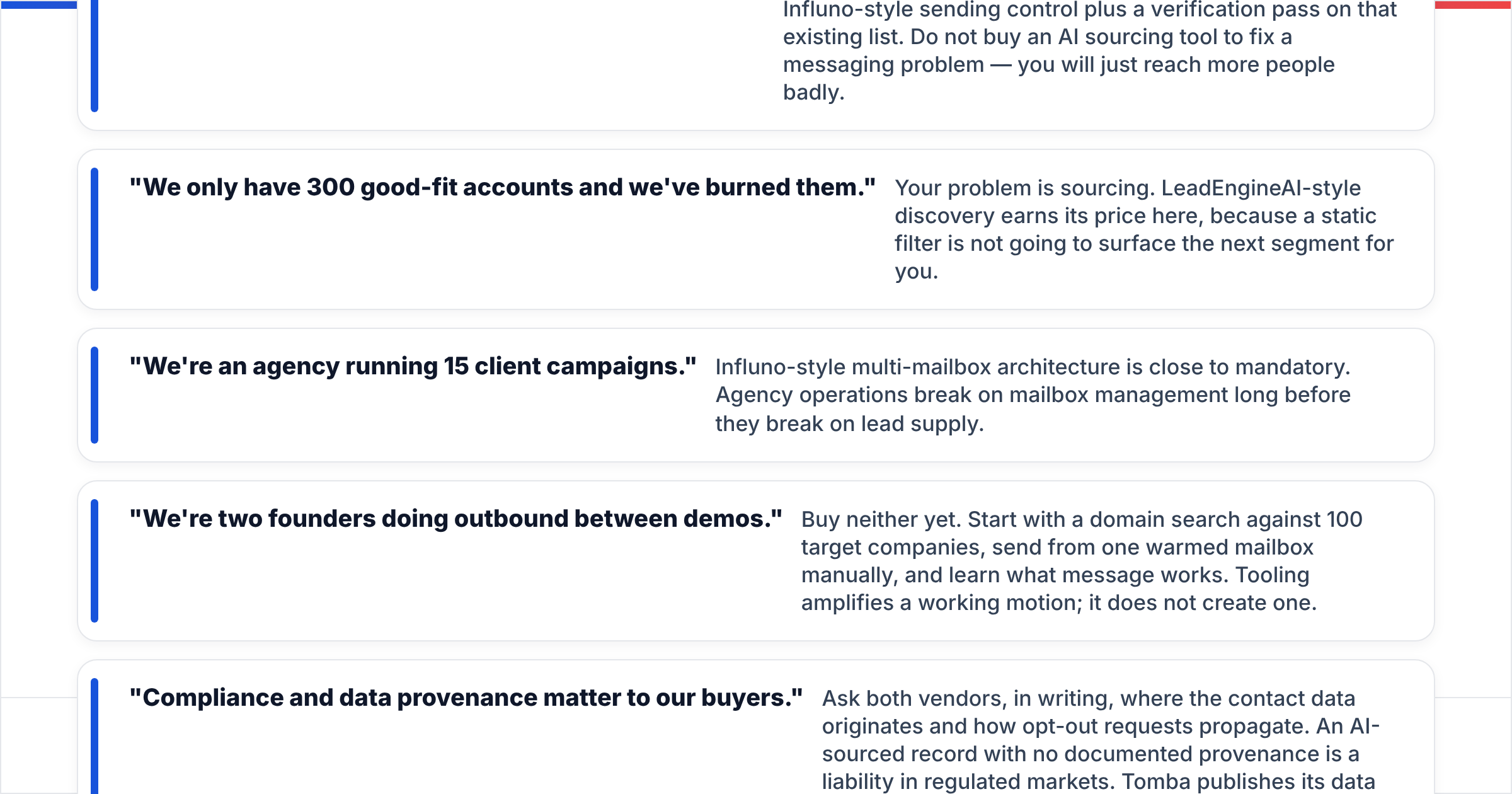
- "We have 40,000 contacts and reply rates are awful." Your problem is messaging and deliverability, not sourcing. Influno-style sending control plus a verification pass on that existing list. Do not buy an AI sourcing tool to fix a messaging problem — you will just reach more people badly.
- "We only have 300 good-fit accounts and we've burned them." Your problem is sourcing. LeadEngineAI-style discovery earns its price here, because a static filter is not going to surface the next segment for you.
- "We're an agency running 15 client campaigns." Influno-style multi-mailbox architecture is close to mandatory. Agency operations break on mailbox management long before they break on lead supply.
- "We're two founders doing outbound between demos." Buy neither yet. Start with a domain search against 100 target companies, send from one warmed mailbox manually, and learn what message works. Tooling amplifies a working motion; it does not create one.
- "Compliance and data provenance matter to our buyers." Ask both vendors, in writing, where the contact data originates and how opt-out requests propagate. An AI-sourced record with no documented provenance is a liability in regulated markets. Tomba publishes its data sources for exactly this reason, and you should demand the same transparency from any vendor.
One more filter people skip: integrations. If your pipeline lives in HubSpot or Salesforce, a tool that cannot write back cleanly will create a second source of truth within a month. HubSpot's own sales documentation is a decent benchmark for what "properly integrated" should look like — anything that only exports CSVs is going to cost you an ops hire eventually.
What Do Both Tools Leave You to Solve?#
The data layer. Neither Influno nor LeadEngineAI is architected to be your accuracy authority, and both are upfront enough about their focus that you should take them at their word.
That gap shows up in four places:
- Pre-send verification. Every address, every campaign, no exceptions. This is not optional hygiene; it is the difference between a domain that lasts two years and one that lasts two months.
- Catch-all handling. Decide your policy explicitly: skip, send at reduced volume, or verify deeper. Guessing is the worst option.
- Enrichment beyond email. Direct dials, LinkedIn profiles, firmographics. A multichannel sequence needs a phone finder and enrichment, not just an inbox.
- Bulk hygiene at list-load time. When you import 20,000 rows, dedupe and validate them before they enter any sending tool. A bulk email finder workflow handles this in one pass instead of discovering the problem through bounce reports.
If you are building this as an automated pipeline rather than a manual step, both tools can be fed programmatically. A Tomba API call at the point of list creation means verification happens before the record ever reaches a sequence, which is the only place it genuinely prevents damage.
It is worth saying plainly: there is no version of this comparison where the answer is "the platform handles data quality for you." Both vendors optimise for their own layer, correctly. The accuracy layer is yours to own.
Frequently Asked Questions#
Can you run Influno and LeadEngineAI together? Yes, and for some teams that is the right architecture — LeadEngineAI sources, Influno sends. Budget for both subscriptions plus verification, and confirm the export/import path is clean before you commit to annual terms on either.
Which has better deliverability? Deliverability is mostly not a platform feature. Authentication records, domain age, warmup discipline, list quality, and copy drive the outcome. A sending platform can help you throttle sensibly; it cannot rescue an unverified list. Check your SPF record before you blame either vendor.
Is AI-sourced data more accurate than a maintained database? Not inherently. AI sourcing is better at finding non-obvious fits. A maintained database with documented sourcing and continuous re-validation is typically better at correctness. Different strengths — use both if the budget allows, verify regardless.
What if I only need email addresses? Then you need neither of these platforms yet. A dedicated email finder plus your existing mailbox covers the first few hundred prospects, and you will learn more from that than from a tool evaluation spreadsheet.
The Bottom Line#
Influno and LeadEngineAI are not really competitors — they are neighbours. Influno wins if your sending layer is the constraint. LeadEngineAI wins if your sourcing layer is. Buy the one that closes your actual bottleneck, run a 30-day trial with a real campaign rather than a demo dataset, and measure replies per 1,000 sends rather than feature checkboxes.
Whichever you pick, the accuracy of the addresses entering the system stays your responsibility. Start there: run your existing target list through the Tomba Email Finder to fill the gaps and confirm what you already have. The free tier covers 25 searches a month so you can test against your own accounts before spending anything, and Starter is $49/mo when you are ready to scale. Fix the data layer first — the platform decision gets a lot easier once you are not sending into the dark.
Related guides#
// get started
Find, verify and enrich your first contacts today
Start on the free plan with 25 searches a month, then scale when your team is ready.
Free plan · No credit card required · GDPR & CCPA
Get the Tomba newsletter
Product and data updates
// about the author