Influno vs Leadmine (2026): Which Outreach Tool Wins?
Influno sells you a sending engine. Leadmine sells you a contact database. They are not the same purchase — and picking the wrong one is how outbound teams end up paying twice. Here is the honest breakdown.
TL;DR
- Influno and Leadmine are not competitors in the strict sense. Influno is an AI-assisted cold outreach platform (sequences, inboxes, sending). Leadmine is a B2B contact database with an email finder and verifier bolted on. Comparing them head-to-head only makes sense if you are deciding where your budget goes first.
- If your list is already good and your reply rate is bad, buy the sending layer. If your reply rate is bad because half your addresses bounce, buy the data layer. Diagnose before you spend.
- Neither tool is a complete outbound stack. Influno without a data source is an empty pipeline. Leadmine without a sequencer is a CSV you have to babysit in Gmail.
- Data quality is the variable that moves revenue most. A 14% bounce rate does not just waste credits — it degrades sender reputation and silently throttles everything you send after it.
- The pragmatic 2026 setup: a dedicated, API-first data provider (Tomba, Leadmine, or similar) feeding a sending platform (Influno, Instantly, Smartlead). Buying one tool that does both badly is the expensive mistake.
What are Influno and Leadmine, actually?#
Start with the category, not the feature list. Most "X vs Y" confusion in outbound tooling comes from comparing products that solve adjacent — not identical — problems.
Influno is an outbound execution platform. Its centre of gravity is the campaign: connect mailboxes, build multi-step sequences, let AI draft and personalise variants, rotate sending across inboxes, track opens, clicks and replies, and route positive responses somewhere useful. It has lead-sourcing features attached, but the product's reason to exist is getting messages sent and replied to. You can see the current positioning on the official Influno site.
Leadmine is a data product. Its centre of gravity is the record: search a database of business contacts by title, company, industry and location, pull the email, verify it, export it. It ships a Chrome extension and an API so the data can flow into whatever you already use. The Leadmine homepage reflects that focus — it sells finding and verifying, not sequencing.
So the real question behind "influno vs leadmine" is rarely which product is better. It is: which layer of my outbound stack is currently broken?

How do Influno and Leadmine compare feature by feature?#
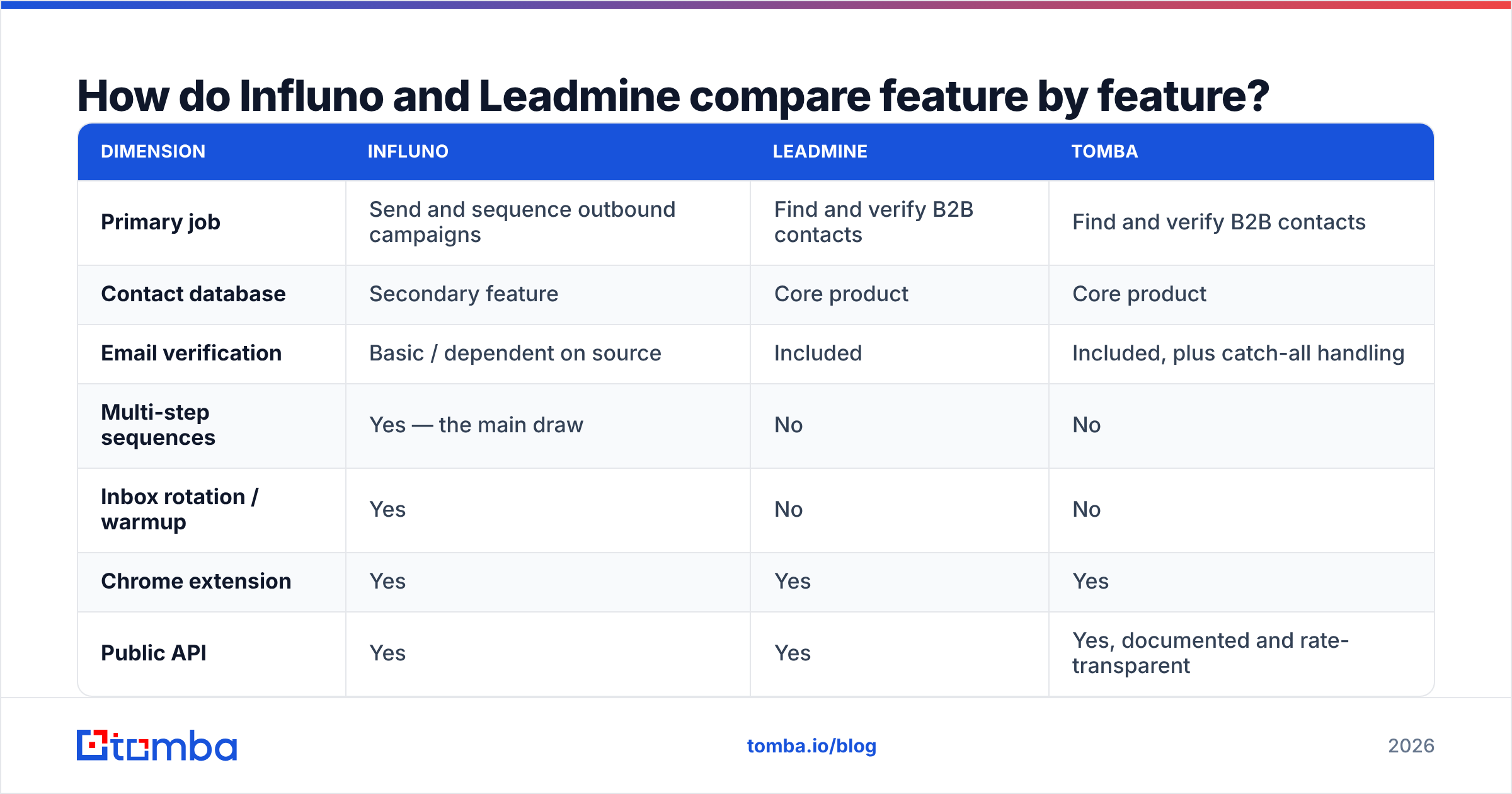
Here is the side-by-side, with a neutral third option included so you can see where a pure data provider sits. Pricing for third-party tools changes often — treat the numbers below as directional and confirm on each vendor's own pricing page before you buy.
| Dimension | Influno | Leadmine | Tomba |
|---|---|---|---|
| Primary job | Send and sequence outbound campaigns | Find and verify B2B contacts | Find and verify B2B contacts |
| Contact database | Secondary feature | Core product | Core product |
| Email verification | Basic / dependent on source | Included | Included, plus catch-all handling |
| Multi-step sequences | Yes — the main draw | No | No |
| Inbox rotation / warmup | Yes | No | No |
| Chrome extension | Yes | Yes | Yes |
| Public API | Yes | Yes | Yes, documented and rate-transparent |
| Bulk CSV enrichment | Limited | Yes | Yes |
| Entry paid plan | Monthly subscription (verify current tier) | Monthly credit plans (verify current tier) | $49/mo Starter |
| Free tier | Trial-based | Trial credits | 25 searches/mo, no card |
| Best for | Teams whose list is solid, reply rate is not | Teams who need clean records at volume | Teams who need clean records plus an API |

Two things jump out of that table.
First, there is almost no feature overlap in the columns that matter. Influno's sequencing, warmup and inbox rotation have no Leadmine equivalent. Leadmine's database depth and bulk verification have no meaningful Influno equivalent. You are not choosing between two versions of the same thing.
Second, the pricing comparison is close to meaningless without normalising the unit. Influno charges for sending capacity and seats. Leadmine and other data tools charge for credits. A $99 sending plan and a $99 data plan are not substitutes — they are two line items in the same budget.
Which one gives you better email data?#
This is where the comparison gets genuinely lopsided, and where most buyers should focus.
A sending platform that also "finds emails" is usually reselling or scraping a thinner dataset than a provider whose entire business is that dataset. That is not a knock on Influno specifically — it is structural. When finding contacts is feature #7 on a roadmap, it gets feature #7's engineering budget.

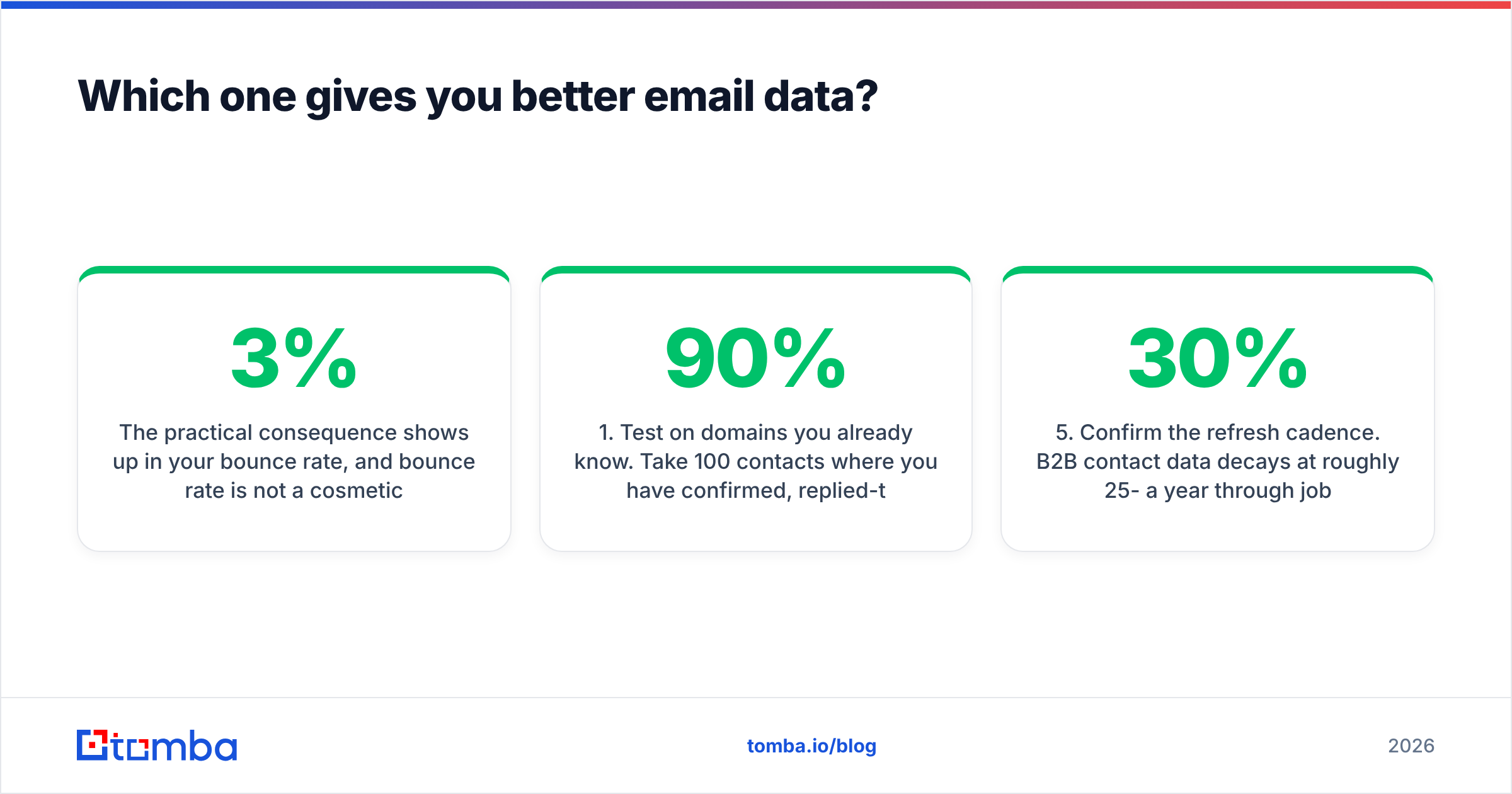
The practical consequence shows up in your bounce rate, and bounce rate is not a cosmetic metric. Google and Microsoft both treat hard bounces as a reputation signal. Cross roughly 2-3% on a domain and you are not just losing those sends — you are reducing inbox placement for every subsequent campaign from that domain. The HubSpot guide to email bounce rates walks through the mechanics if you want the long version.
Here is how to evaluate any provider's data before you commit, in the order that actually surfaces problems:
- Test on domains you already know. Take 100 contacts where you have confirmed, replied-to addresses. Run them through the tool. Anything below ~90% match on known-good records is a red flag, not a rounding error.
- Check the catch-all behaviour. Catch-all domains accept everything at the SMTP layer, so naive verifiers mark them "valid" and let you send into a void. Ask specifically how the vendor handles them — a real catch-all verifier applies pattern confidence and secondary signals rather than shrugging.
- Audit the coverage geography. Most databases skew heavily North American. If you sell into DACH, MENA or APAC, a global accuracy number tells you nothing about your segment.
- Read the credit policy, not the headline price. Do failed lookups burn credits? Do unused credits roll over? Do verifications cost the same as finds? These three answers change effective cost by 2-3x.
- Confirm the refresh cadence. B2B contact data decays at roughly 25-30% a year through job changes alone. A database refreshed quarterly is a fundamentally different product from one refreshed continuously — even if the marketing copy reads identically.
- Test the API, not just the UI. If you plan to enrich at scale, the email finder API matters more than the dashboard. Check rate limits, response latency and whether confidence scores come through in the payload.
Run those six checks on Influno, Leadmine and any third option and the shortlist usually collapses to one obvious answer for your segment — which is the only answer that matters.
Is Influno better than Leadmine for cold outreach?#
For the act of sending, yes — unambiguously. Leadmine does not compete here. It has no sequencer, no warmup, no inbox rotation, no reply detection.
But "better for cold outreach" quietly assumes your list is already clean. Run the numbers. Send 1,000 emails with a 12% bad-address rate through the most sophisticated sequencer on the market and you get 880 delivered, a bounce spike, and a domain that performs worse next month. Send the same 1,000 through a basic sequencer with a 1% bad-address rate and you get 990 delivered and a domain that keeps its reputation.
The sending platform amplifies whatever list quality you feed it. It does not create list quality.
That is why the honest recommendation for most teams is: fix data first, then buy sending sophistication. Spend the first month verifying your existing lists — a free email checker will tell you within an hour whether data is your bottleneck — and only then decide whether you need Influno's AI personalisation or whether a cheaper sequencer would do.

Is Leadmine better than Influno for list building?#
Again, yes — and again, with a caveat.
Leadmine is built for the search-filter-export loop. If your motion is "give me every Head of Engineering at Series B fintechs in Germany," a database product handles that natively. Influno's lead features are not designed for that depth of filtering.
The caveat is that database products are increasingly commoditised. Leadmine competes with a dozen tools that search the same kinds of records — and the differentiators have shifted from raw volume to verification quality, catch-all handling, API ergonomics and price per verified record. Independent review aggregation on G2's lead intelligence category is a reasonable sanity check on whether a given vendor's coverage matches its marketing.
The practical test: build the exact list you need in each tool's free trial, export both, deduplicate them, and verify the combined set with a neutral third-party verifier. You will learn more in two hours than from a month of comparison posts — including this one.
What does a sensible 2026 outbound stack look like?#
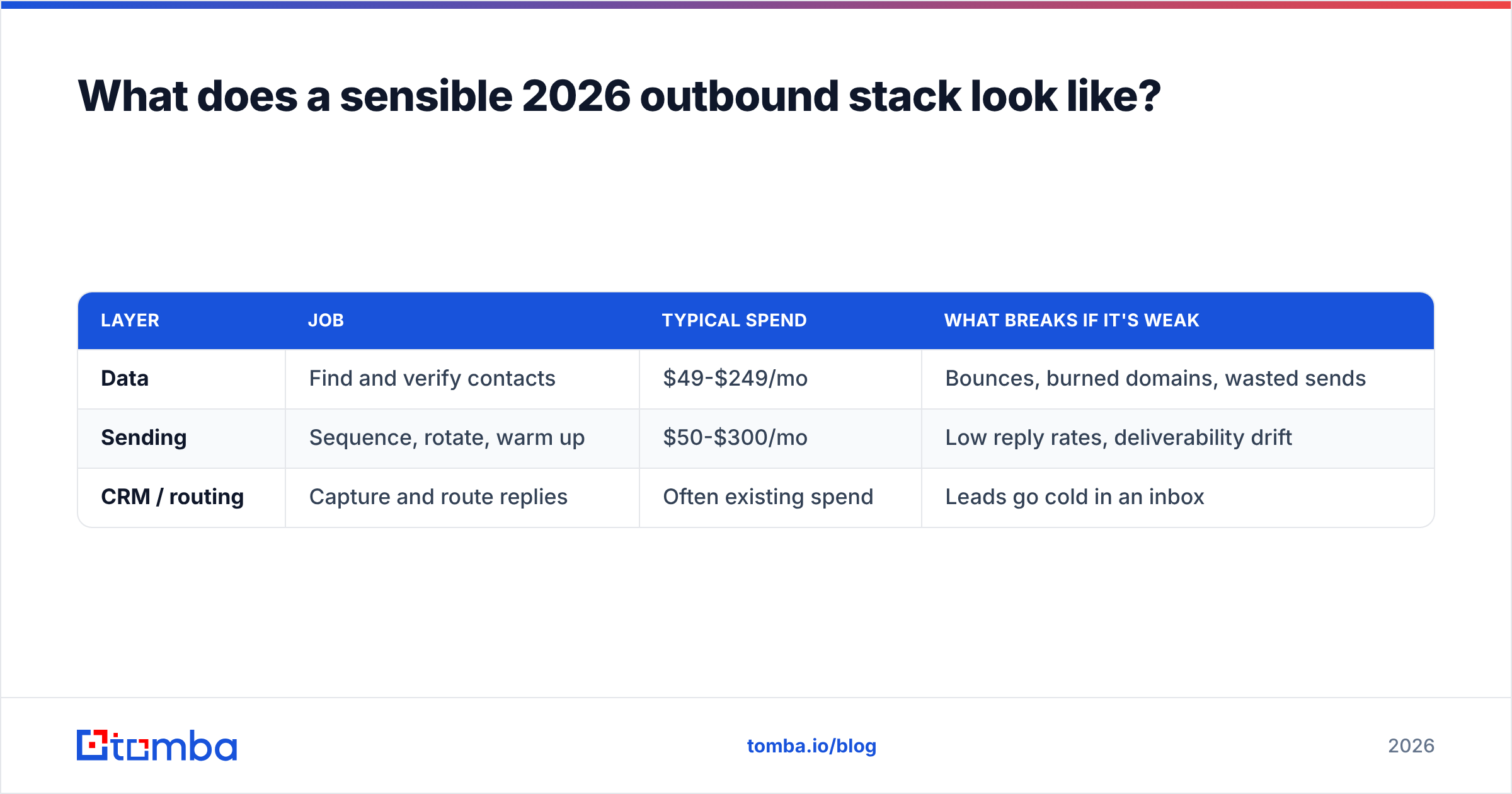
Three layers, bought separately, connected by API:
| Layer | Job | Typical spend | What breaks if it's weak |
|---|---|---|---|
| Data | Find and verify contacts | $49-$249/mo | Bounces, burned domains, wasted sends |
| Sending | Sequence, rotate, warm up | $50-$300/mo | Low reply rates, deliverability drift |
| CRM / routing | Capture and route replies | Often existing spend | Leads go cold in an inbox |
Influno sits in layer two. Leadmine sits in layer one. Buying either and expecting full coverage is the error — not choosing the wrong one of the two.
The teams that get this right tend to over-invest slightly in layer one, because it is the only layer where a mistake compounds. A mediocre sequencer costs you replies this month. A mediocre database costs you sender reputation for the next six.
What are the real trade-offs, plainly stated?#
Choose Influno if: you already have a reliable data source, you are running multi-touch sequences across several mailboxes, and your problem is message quality, personalisation at scale, or deliverability mechanics. Its AI-assisted copy and inbox management earn their keep when volume is the constraint.
Choose Leadmine if: your problem is finding the right people at all. You need filtered search, bulk export, and verification. You can live with sending from a tool you already own.
Choose neither, yet, if: you have not measured your current bounce rate and reply rate separately. Those two numbers tell you which layer to buy. Without them you are guessing with a credit card.
Consider a third data provider if: you need API-first enrichment, catch-all confidence scoring, or transparent per-credit pricing that does not punish failed lookups. That is a narrower brief than "B2B database," and it is worth shopping specifically for.
Where does Tomba fit in this comparison?#
Squarely in layer one, alongside Leadmine rather than Influno — and that is the honest framing. Tomba does not sequence, warm up inboxes, or write your copy. It finds and verifies contacts, and exposes all of it through an API.
Where it tends to win on evaluation is the boring stuff: a genuinely usable free tier (25 searches a month, no card), Tomba pricing that starts at $49/mo and scales to $99 and $249 rather than jumping to "contact sales," explicit catch-all verification instead of an optimistic "valid," and bulk email finder processing for list-level work.
If you run the six-step evaluation above and Leadmine wins on your segment, use Leadmine. The point of this post is not to move you off a working tool — it is to stop you buying a sending platform to solve a data problem, or a database to solve a deliverability problem.
FAQ#
Can I use Influno and Leadmine together? Yes, and for many teams that is the correct answer. Source and verify in the data tool, export or push via API, sequence in Influno. The two layers are complementary, not substitutable.
Which is cheaper? Unanswerable as posed, because the units differ. Normalise to cost per verified, delivered contact — that folds in bounce waste and makes the comparison real.
Do I still need a separate verifier? If your data provider's verification is solid, no. If you are merging lists from multiple sources, scraped exports, or anything older than 90 days, run it through a dedicated email verifier before it touches a sequencer.
How often should I re-verify a list? Before every campaign if the list is older than a quarter. Contact decay is continuous, not event-driven.
Start with the layer that compounds. Before you commit to a sending platform, find out what your current list is actually worth. Run a domain through the Tomba Email Finder on the free tier — 25 searches, no card — and compare the results against whatever you are using today. If the match rate and verification status hold up, you have a data problem you can close this week. If they do not, you just found the reason your sequences underperform.
Related guides#
Ready to find emails that actually work?
Join 150,000+ professionals who stopped guessing and started sending. Free credits on signup — no credit card required.
Get the Tomba newsletter
Practical outbound tactics and product updates — once every two weeks.
About the author