Influno vs Leadzen.ai: Which Outreach Tool Wins in 2026?
Influno is a sending engine. Leadzen.ai is a data engine. Pick the wrong one and you either send great copy to dead inboxes, or collect great contacts with nowhere to send them. Here is the honest breakdown.
TL;DR
- They are not really competitors. Influno is an outbound sending platform (sequences, inbox rotation, warmup, unified inbox). Leadzen.ai is a B2B data platform (contact search, enrichment, intent-style filters). Comparing them head-to-head only makes sense if you are trying to decide which half of your outbound stack to buy first.
- Buy Influno if you already have a list and your problem is volume, deliverability, and reply management.
- Buy Leadzen.ai if you have sending infrastructure and your problem is finding the right people — especially in India and APAC, where its coverage is strongest.
- Neither fully solves verification. Both bolt a validity check onto a bigger product. If bounce rate is what is killing you, a dedicated email verifier will outperform either bundled check.
- Most teams end up with both categories anyway. The real question is what you pay per useful contact, not which logo wins.
What are Influno and Leadzen.ai?#
Influno (influno.com) is a cold email and outbound engagement platform. It sits in the same category as Instantly, Smartlead, and Saleshandy: you connect mailboxes, warm them up, load a list, and run multi-step sequences with rotation across senders. The pitch is consolidation — sending, warmup, AI-assisted copy, and a unified inbox in one subscription instead of three.
Leadzen.ai (leadzen.ai) approaches outbound from the opposite end. It is a B2B data and lead intelligence platform: search a large contact database by role, industry, geography, and company attributes, then pull emails and phone numbers out via the web app or a browser extension. It has notably deeper coverage of Indian companies than most US-built databases, which is the single most common reason teams shortlist it.
So the honest framing is this: Influno is the pipe. Leadzen.ai is the water. A comparison is only useful if you understand what each one is actually replacing in your stack.
Here is how the two split responsibilities:
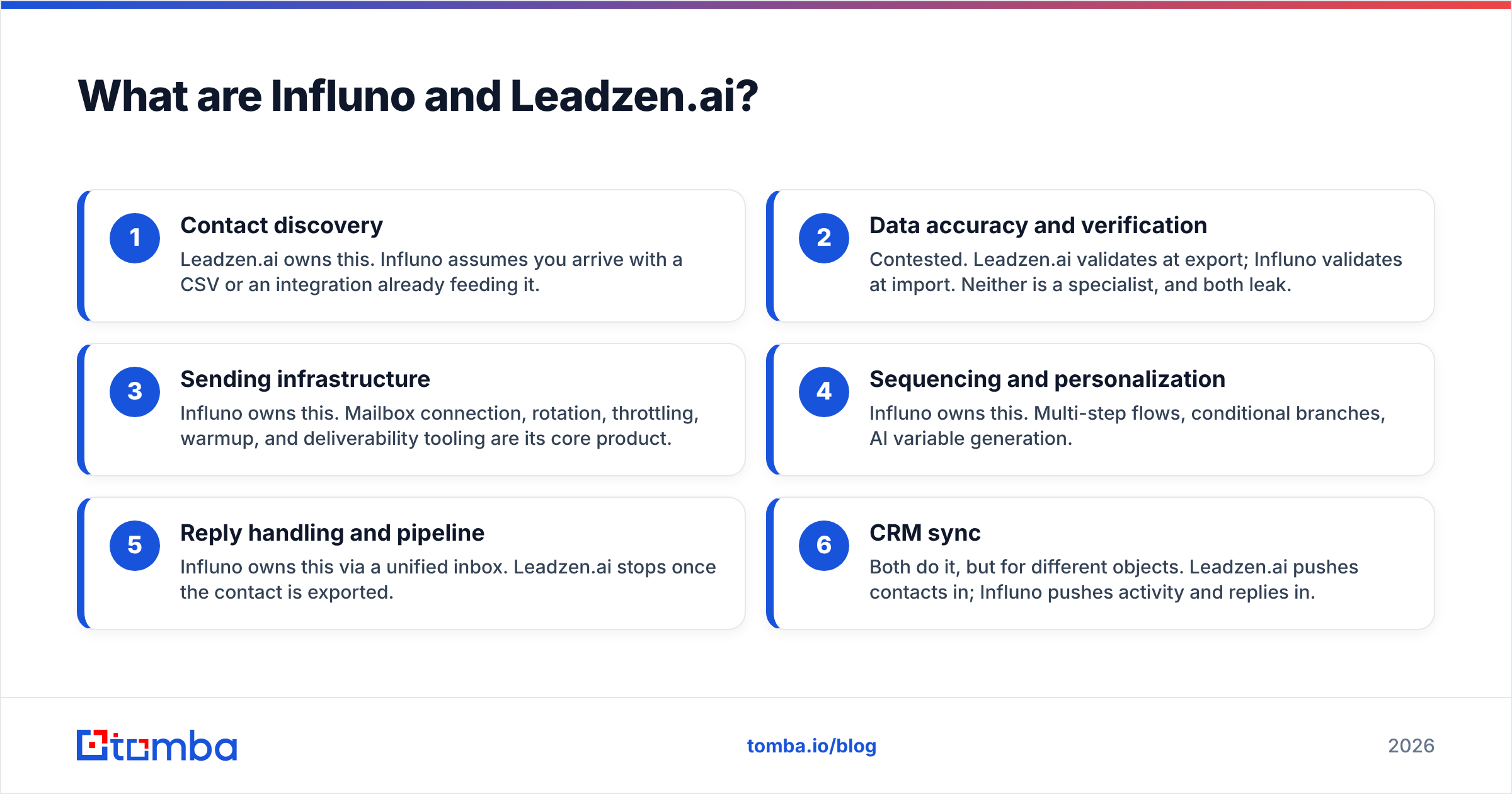
- Contact discovery — Leadzen.ai owns this. Influno assumes you arrive with a CSV or an integration already feeding it.
- Data accuracy and verification — Contested. Leadzen.ai validates at export; Influno validates at import. Neither is a specialist, and both leak.
- Sending infrastructure — Influno owns this. Mailbox connection, rotation, throttling, warmup, and deliverability tooling are its core product.
- Sequencing and personalization — Influno owns this. Multi-step flows, conditional branches, AI variable generation.
- Reply handling and pipeline — Influno owns this via a unified inbox. Leadzen.ai stops once the contact is exported.
- CRM sync — Both do it, but for different objects. Leadzen.ai pushes contacts in; Influno pushes activity and replies in.
If you try to run outbound with only one of them, you will feel the missing half within a week.
How do Influno and Leadzen.ai compare feature by feature?#
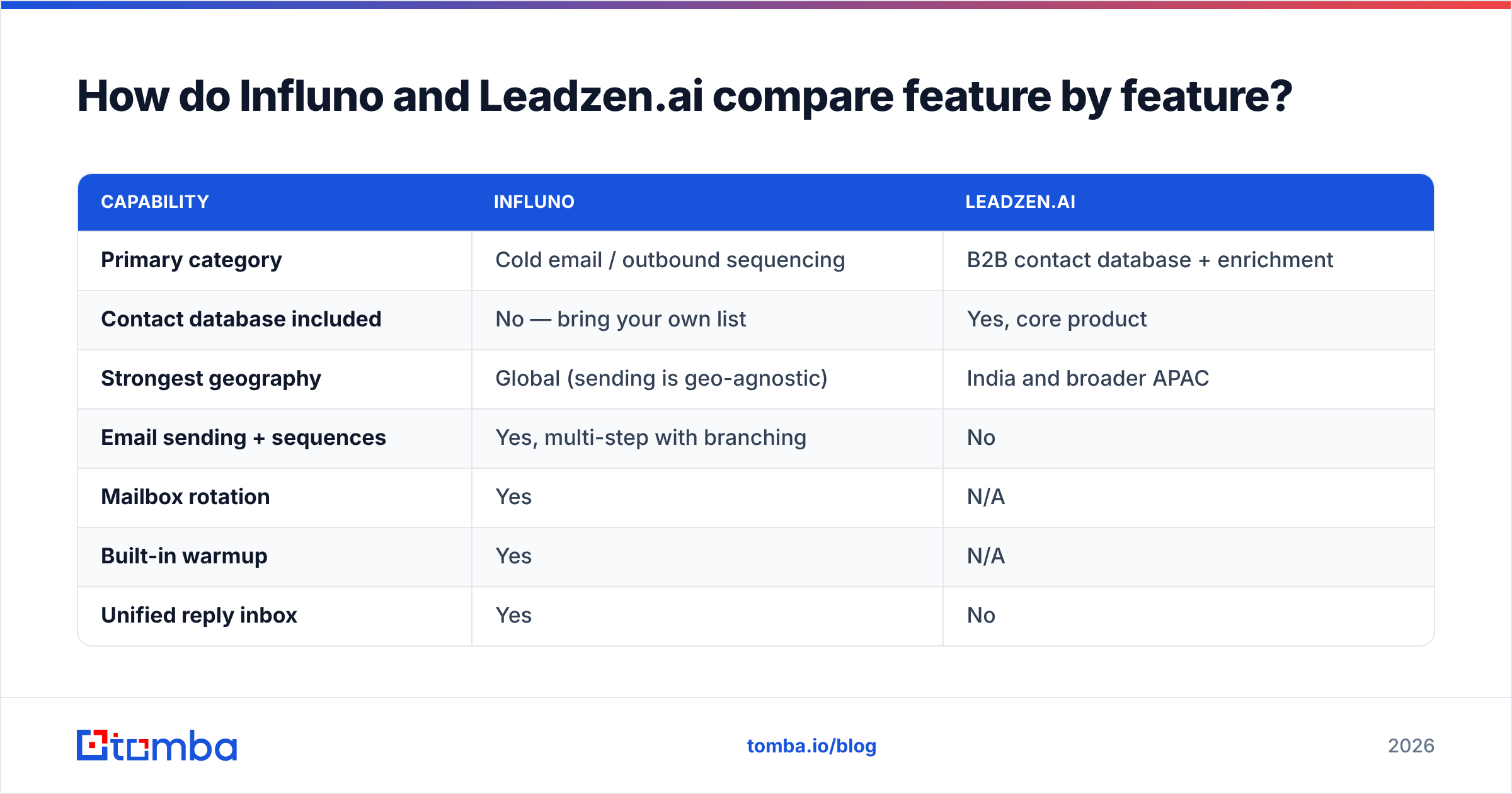
| Capability | Influno | Leadzen.ai |
|---|---|---|
| Primary category | Cold email / outbound sequencing | B2B contact database + enrichment |
| Contact database included | No — bring your own list | Yes, core product |
| Strongest geography | Global (sending is geo-agnostic) | India and broader APAC |
| Email sending + sequences | Yes, multi-step with branching | No |
| Mailbox rotation | Yes | N/A |
| Built-in warmup | Yes | N/A |
| Unified reply inbox | Yes | No |
| Phone numbers | No | Yes |
| Browser extension for prospecting | Limited | Yes |
| Bulk verification | Basic import-time check | Basic export-time check |
| API access | Sending/campaign API | Data lookup API |
| Typical buyer | SDR team, agency, founder-led sales | Demand gen, recruiters, India-focused GTM |
| What you still need to buy | A data source | A sending tool |
That last row is the entire article in one line. Whichever you pick, you are buying half a system.
Which one has better B2B data?#
Leadzen.ai wins by default, because Influno does not sell data. But "wins by default" is not the same as "is enough."
Three things matter when you evaluate any database, and they are worth checking against Leadzen.ai's free trial before you commit:
Coverage where you actually sell. Leadzen.ai's India coverage is genuinely strong — company registry depth, regional firms, and mid-market accounts that Apollo and ZoomInfo thin out on. If your ICP is US mid-market SaaS, that advantage evaporates and you are comparing against much larger Western databases. Check your own top 50 target accounts, not the vendor's sample.
Freshness. B2B contact data decays at roughly 2–3% per month as people change jobs, which compounds to about a quarter of any list going stale inside a year. Industry churn benchmarks published by research firms like Gartner and reflected across review sites such as G2 consistently show this pattern regardless of vendor. A database that was accurate at ingestion is not accurate at send time.
Verification at the moment of use. This is where both tools are weakest. A record marked "valid" three months ago tells you very little today. The fix is not a better database — it is a verification pass immediately before send. Running your export through a real-time email verification step, including catch-all verification for domains that accept everything, typically removes the 8–15% of records that would otherwise bounce.
If you want a second discovery source rather than a replacement, a domain search that returns every discoverable address at a target company is a cheap way to cross-check whether a database is actually complete for your accounts, or just confident.
How does deliverability compare?#
Influno owns this dimension outright, and it is the reason teams buy it.
Sending cold email in 2026 means clearing Google and Microsoft's bulk-sender requirements: authenticated domains (SPF, DKIM, DMARC), one-click unsubscribe, and spam complaint rates held under 0.3%. Google's own sender guidelines are the authoritative reference, and they are enforced now rather than advisory.
Influno's deliverability stack addresses this through:
- Mailbox rotation — spreading volume across many sending accounts so no single mailbox trips a rate threshold.
- Warmup — automated inbox-to-inbox activity to build sender reputation on new domains before real volume starts.
- Throttling and ramping — daily caps per mailbox that increase over time.
- Spam-signal checks on copy before send.
Leadzen.ai has none of this, and should not be expected to. It is a data tool.
But here is the caveat worth stating plainly: no sending platform can rescue a bad list. Warmup, rotation, and throttling manage how you send. They do nothing about who you send to. If 12% of your addresses are dead, every one of those bounces is a reputation hit that no amount of rotation absorbs. The sequence of operations matters — verify first, then send — and buying Influno without fixing list hygiene produces a very expensive way to burn domains.
What do Influno and Leadzen.ai cost?#
Both vendors adjust pricing regularly and both gate some tiers behind a sales conversation, so treat the shape of the pricing as the durable signal rather than any specific number. Confirm current rates on the vendor pages before you buy.
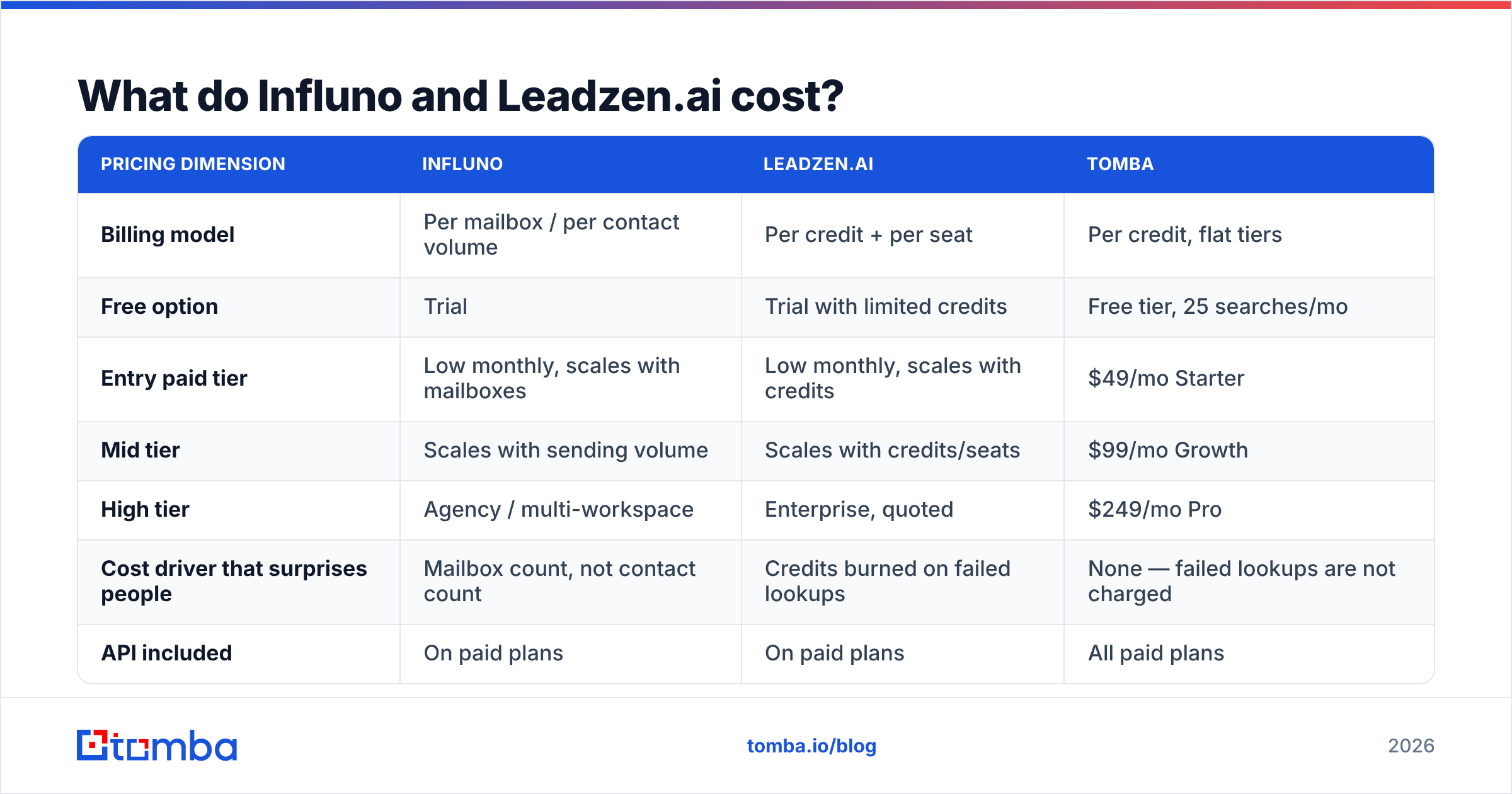
| Pricing dimension | Influno | Leadzen.ai | Tomba |
|---|---|---|---|
| Billing model | Per mailbox / per contact volume | Per credit + per seat | Per credit, flat tiers |
| Free option | Trial | Trial with limited credits | Free tier, 25 searches/mo |
| Entry paid tier | Low monthly, scales with mailboxes | Low monthly, scales with credits | $49/mo Starter |
| Mid tier | Scales with sending volume | Scales with credits/seats | $99/mo Growth |
| High tier | Agency / multi-workspace | Enterprise, quoted | $249/mo Pro |
| Cost driver that surprises people | Mailbox count, not contact count | Credits burned on failed lookups | None — failed lookups are not charged |
| API included | On paid plans | On paid plans | All paid plans |
The cost trap differs by tool. With Influno, teams underestimate mailbox count — running 3,000 emails a month safely means a dozen-plus warmed mailboxes, and the bill tracks mailboxes. With credit-based data tools generally, the trap is paying for lookups that return nothing usable; always check whether a vendor charges for misses. Full Tomba pricing is published without a sales call, which makes the per-contact math easier to model against either.
Who should pick Influno?#
Pick Influno if all three are true:
- You have a list problem solved, or nearly solved. Existing CRM data, a scraped ICP list, inbound leads to re-engage, or a data vendor already in place.
- Your bottleneck is send volume or reply chaos. You are juggling mailboxes manually, or replies are scattered across five Gmail tabs.
- You want one subscription instead of three. The consolidation argument is real if you currently pay separately for warmup, sequencing, and inbox management.
Do not pick Influno as your first outbound purchase if you have no contact data. You will have a beautifully engineered pipe with nothing running through it.
Who should pick Leadzen.ai?#
Pick Leadzen.ai if:
- India or APAC is a meaningful part of your ICP. This is its genuine differentiator, and Western databases will not match it there.
- You need phone numbers alongside emails. Multichannel outbound and recruiting workflows both benefit; Influno offers nothing here.
- You already send through something else — a sequencer, your CRM's native email, or a marketing automation platform.
- You prospect interactively. The browser extension workflow suits researchers who build lists one qualified account at a time rather than in 10,000-row batches.
Do not pick Leadzen.ai expecting it to send for you. It will not.
What is the setup neither tool fully covers?#
The gap sits between them: getting from a raw contact record to a send-safe address.
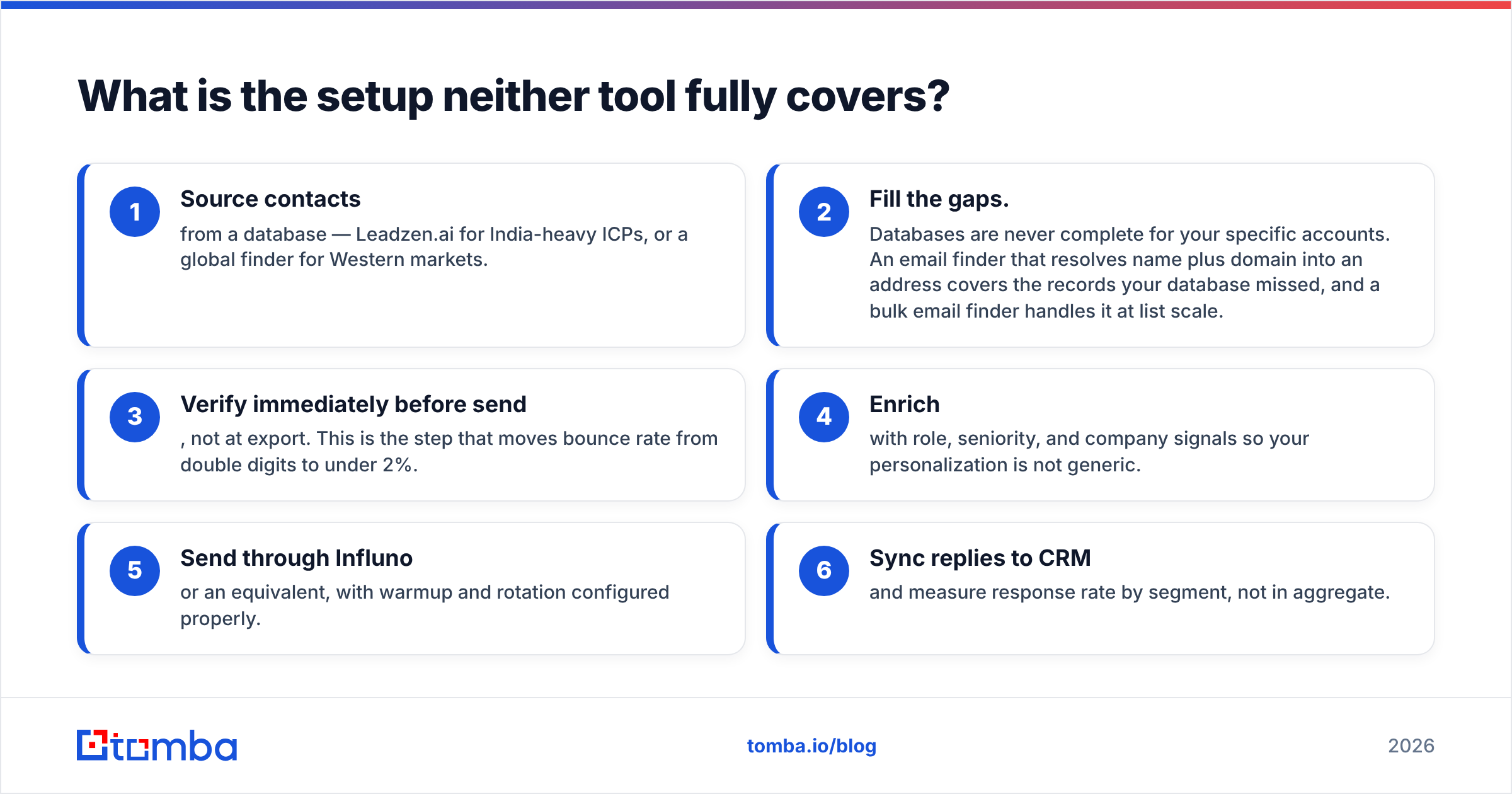
A workable stack looks like this:
- Source contacts from a database — Leadzen.ai for India-heavy ICPs, or a global finder for Western markets.
- Fill the gaps. Databases are never complete for your specific accounts. An email finder that resolves name plus domain into an address covers the records your database missed, and a bulk email finder handles it at list scale.
- Verify immediately before send, not at export. This is the step that moves bounce rate from double digits to under 2%.
- Enrich with role, seniority, and company signals so your personalization is not generic.
- Send through Influno or an equivalent, with warmup and rotation configured properly.
- Sync replies to CRM and measure response rate by segment, not in aggregate.
Skip step 3 and the rest of the chain degrades. It is the cheapest step and the one teams cut first.
Influno vs Leadzen.ai: which actually wins?#
Neither, and that is the useful answer.
If someone forces a single pick: Influno is the better standalone purchase for a team that already has contact data, because sending infrastructure is harder to replicate manually than list-building is. You can build a list by hand in a week. You cannot hand-roll mailbox rotation and warmup.
But Leadzen.ai is the better purchase for an India-focused GTM team, because no amount of sending sophistication compensates for not being able to find the buyer at all.
The comparison that matters more than either is cost per deliverable, verified contact — a number neither vendor puts on its pricing page, and one you should calculate yourself during both trials.
Get the data layer right before you pick a sender#
Whichever platform you land on, the contacts flowing into it determine the outcome. Influno cannot deliver to an address that does not exist, and Leadzen.ai cannot guarantee an address is still live months after it was indexed.
Start with Tomba's Email Finder — it resolves verified professional addresses from a name and domain, flags catch-all domains explicitly rather than silently passing them through, and does not charge you for lookups that return nothing. The free tier gives you 25 searches a month to test it against your own target accounts, and paid plans start at $49/mo with full API access. Run it on 100 contacts from your current list and compare the bounce rate. That test will tell you more than any vendor comparison page, including this one.
Related guides#
// get started
Find, verify and enrich your first contacts today
Start on the free plan with 25 searches a month, then scale when your team is ready.
Free plan · No credit card required · GDPR & CCPA
// about the author