Influno vs Reachfast (2026): Which Outreach Tool Wins?
Influno bundles sending and sequences. Reachfast sells contact data by the credit. We break down accuracy, pricing, limits, and which one actually belongs in your 2026 outbound stack.
TL;DR
- Influno is an all-in-one cold email platform: inbox connection, warmup, sequences, and a bundled contact database. You buy a workflow.
- Reachfast is a contact-data tool built around a LinkedIn-first workflow: pull an email or mobile number for a profile, export, send elsewhere. You buy records.
- They are not really competitors. The honest comparison is sending platform + separate data source versus one bundled subscription — and the bundled option almost always loses on data quality.
- If your bounce rate is the problem, neither tool is the fix on its own. A dedicated finder plus a verifier (Tomba starts at $49/mo with a free 25-search tier) beats both on cost-per-valid-contact.
- Pick Influno if you have zero sending infrastructure. Pick Reachfast if you live in LinkedIn Sales Navigator. Pick neither as your sole data layer.
What are Influno and Reachfast, actually?#
Most "X vs Y" posts pretend two tools do the same job. These two don't, and that mismatch is the whole story.
Influno (influno.com) positions itself as an all-in-one cold outreach platform. You connect mailboxes, run warmup, build multi-step sequences, and pull prospects from an included database. The pitch is consolidation: one bill instead of four.
Reachfast is a contact-finding tool. Its center of gravity is the browser extension — you're on a LinkedIn profile or a Sales Navigator list, you click, you get a work email and often a mobile number. There's no sequencing engine. Exports go to CSV or your CRM, and sending happens somewhere else.
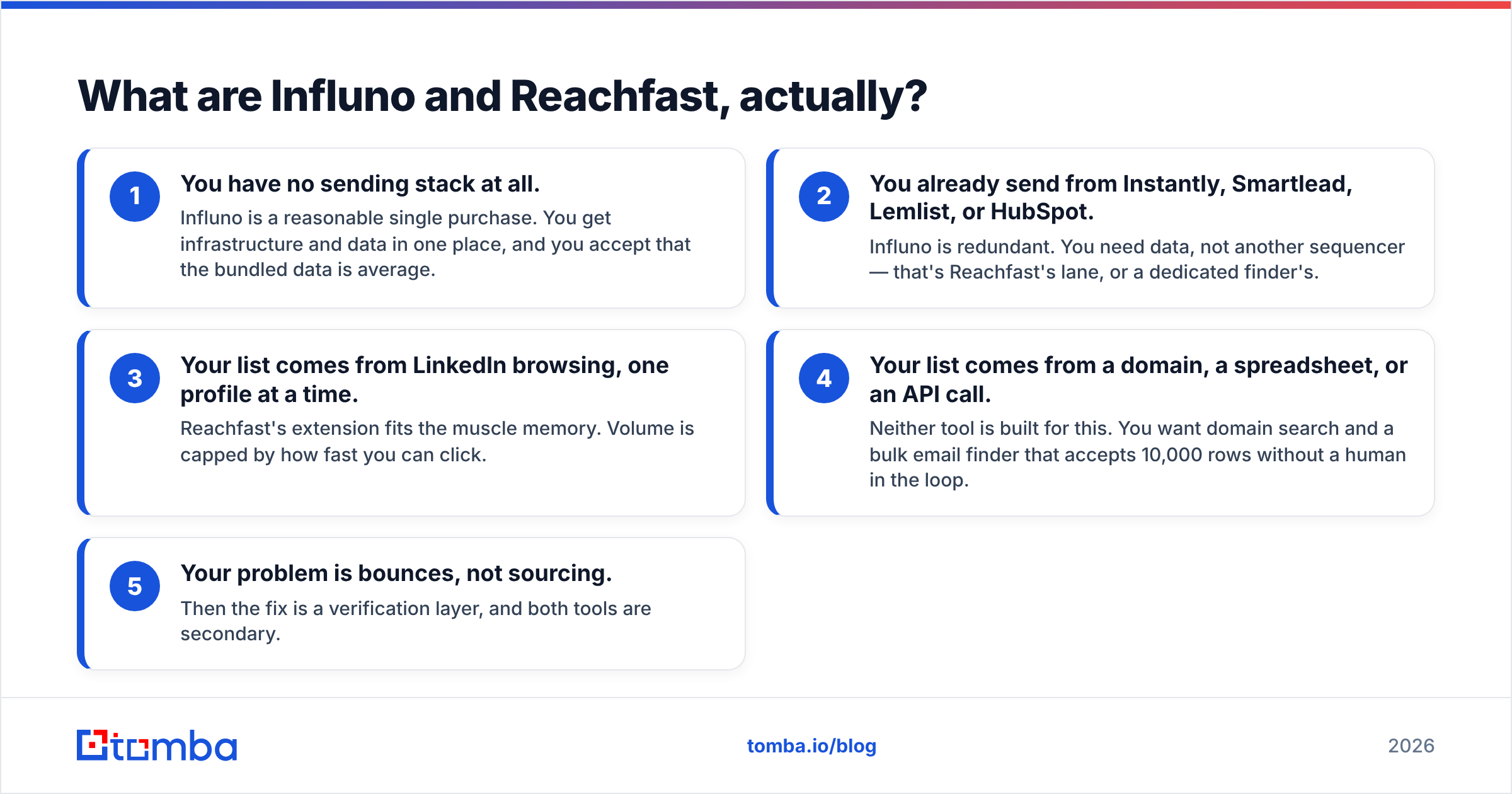
So the real decision tree looks like this:
- You have no sending stack at all. Influno is a reasonable single purchase. You get infrastructure and data in one place, and you accept that the bundled data is average.
- You already send from Instantly, Smartlead, Lemlist, or HubSpot. Influno is redundant. You need data, not another sequencer — that's Reachfast's lane, or a dedicated finder's.
- Your list comes from LinkedIn browsing, one profile at a time. Reachfast's extension fits the muscle memory. Volume is capped by how fast you can click.
- Your list comes from a domain, a spreadsheet, or an API call. Neither tool is built for this. You want domain search and a bulk email finder that accepts 10,000 rows without a human in the loop.
- Your problem is bounces, not sourcing. Then the fix is a verification layer, and both tools are secondary.

How do Influno and Reachfast compare on features?#
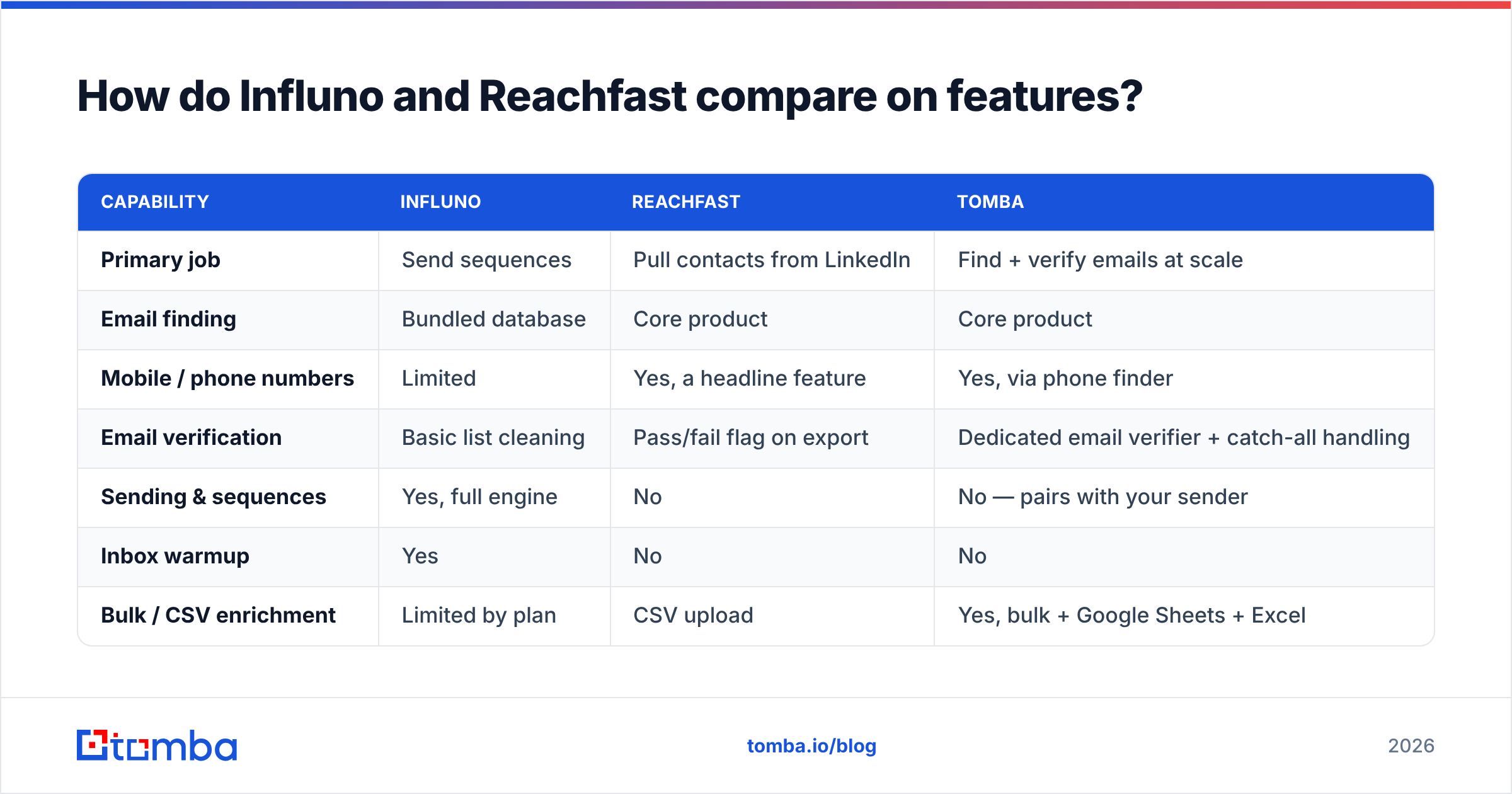
Here's the side-by-side, with a dedicated email finder as the third column so you can see what "data-first" looks like against "bundle-first."
| Capability | Influno | Reachfast | Tomba |
|---|---|---|---|
| Primary job | Send sequences | Pull contacts from LinkedIn | Find + verify emails at scale |
| Email finding | Bundled database | Core product | Core product |
| Mobile / phone numbers | Limited | Yes, a headline feature | Yes, via phone finder |
| Email verification | Basic list cleaning | Pass/fail flag on export | Dedicated email verifier + catch-all handling |
| Sending & sequences | Yes, full engine | No | No — pairs with your sender |
| Inbox warmup | Yes | No | No |
| Bulk / CSV enrichment | Limited by plan | CSV upload | Yes, bulk + Google Sheets + Excel |
| Public API | Limited | Available on higher tiers | Full email finder API, CLI, MCP |
| Free tier | Trial | Limited free credits | 25 searches/mo, no card |
| Entry paid price | Mid two figures/mo | Credit-pack based | $49/mo Starter |
The pattern is consistent across the category: bundled platforms win on convenience and lose on depth. Influno's database exists so you don't leave the app, not because it's the best database anyone could build. Reachfast's finder is the product, so it's sharper — but it's also narrow, because it assumes a LinkedIn profile is your starting point.

Which one has better data accuracy?#
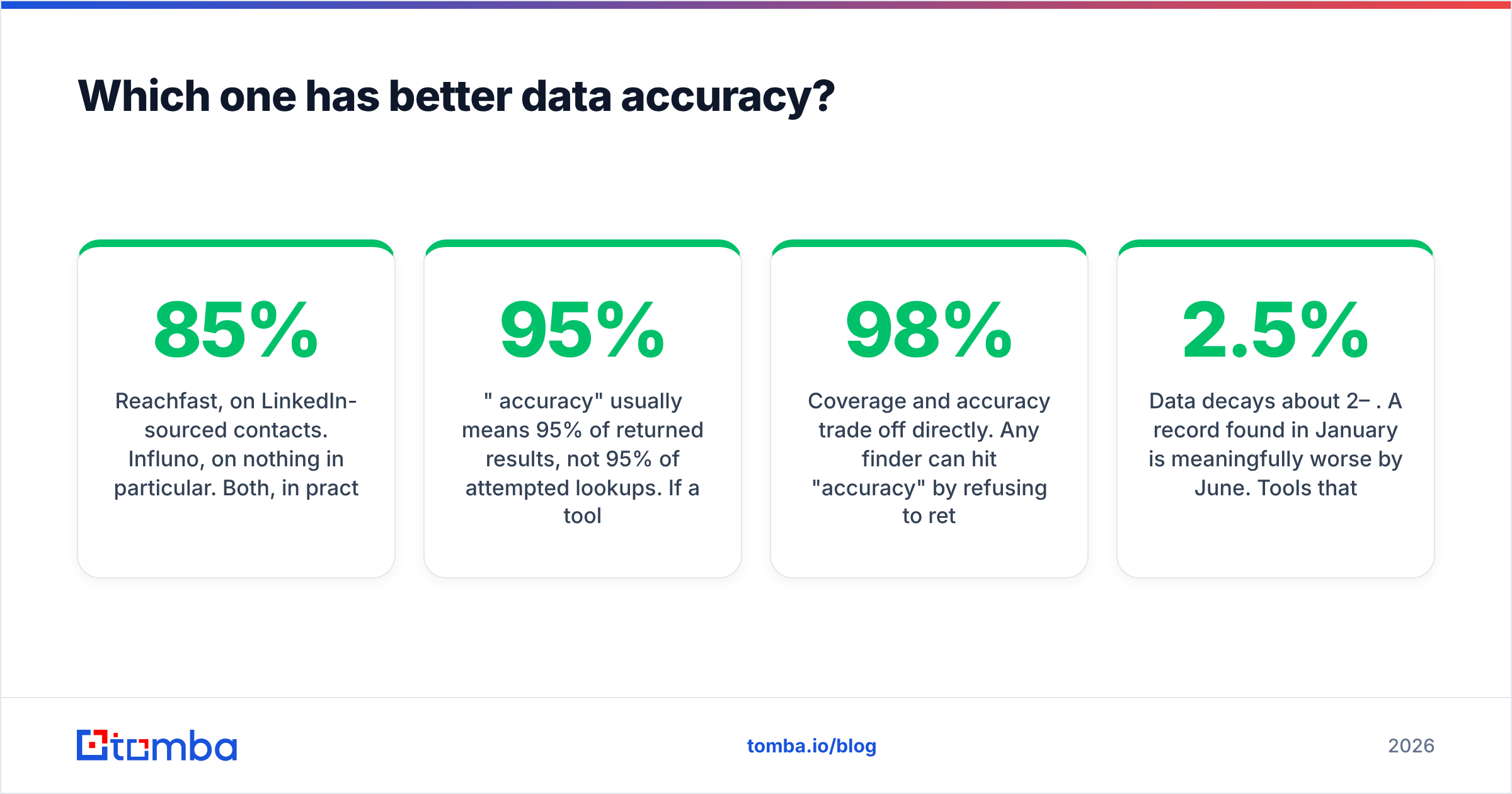
Reachfast, on LinkedIn-sourced contacts. Influno, on nothing in particular. Both, in practice, land in the 70–85% deliverable range depending on the segment — and that is the number that should worry you.
A few things to understand about how vendors report accuracy:
- "95% accuracy" usually means 95% of returned results, not 95% of attempted lookups. If a tool finds an address for only half your list, a 95% claim on that half is a 47% hit rate on the job you actually asked it to do.
- Coverage and accuracy trade off directly. Any finder can hit 98% "accuracy" by refusing to return anything it isn't certain about. Read both numbers or neither.
- Catch-all domains break the math. Roughly one in five B2B domains accepts every address at the SMTP layer, so a naive verifier marks them all "valid." Most bundled tools quietly ship those as good. That's where a hidden bounce rate comes from, and why a catch-all verifier is a separate product and not a checkbox.
- Data decays about 2–2.5% per month. A record found in January is meaningfully worse by June. Tools that resell a static database age faster than tools that re-verify at request time.
Reachfast's LinkedIn-anchored approach has a real advantage here: the profile is a live signal. If someone updated their title last week, the lookup reflects the current employer. Influno's bundled database is more likely to serve a cached record.
Neither, though, gives you an independent verification pass. If you're sending real volume, run every list through a standalone verifier before it touches your sending domain. You can sanity-check individual addresses with a free email checker before committing credits to a bulk job. The economics are brutal and simple: verification costs fractions of a cent per record, and a 5% bounce rate costs you the sending domain.
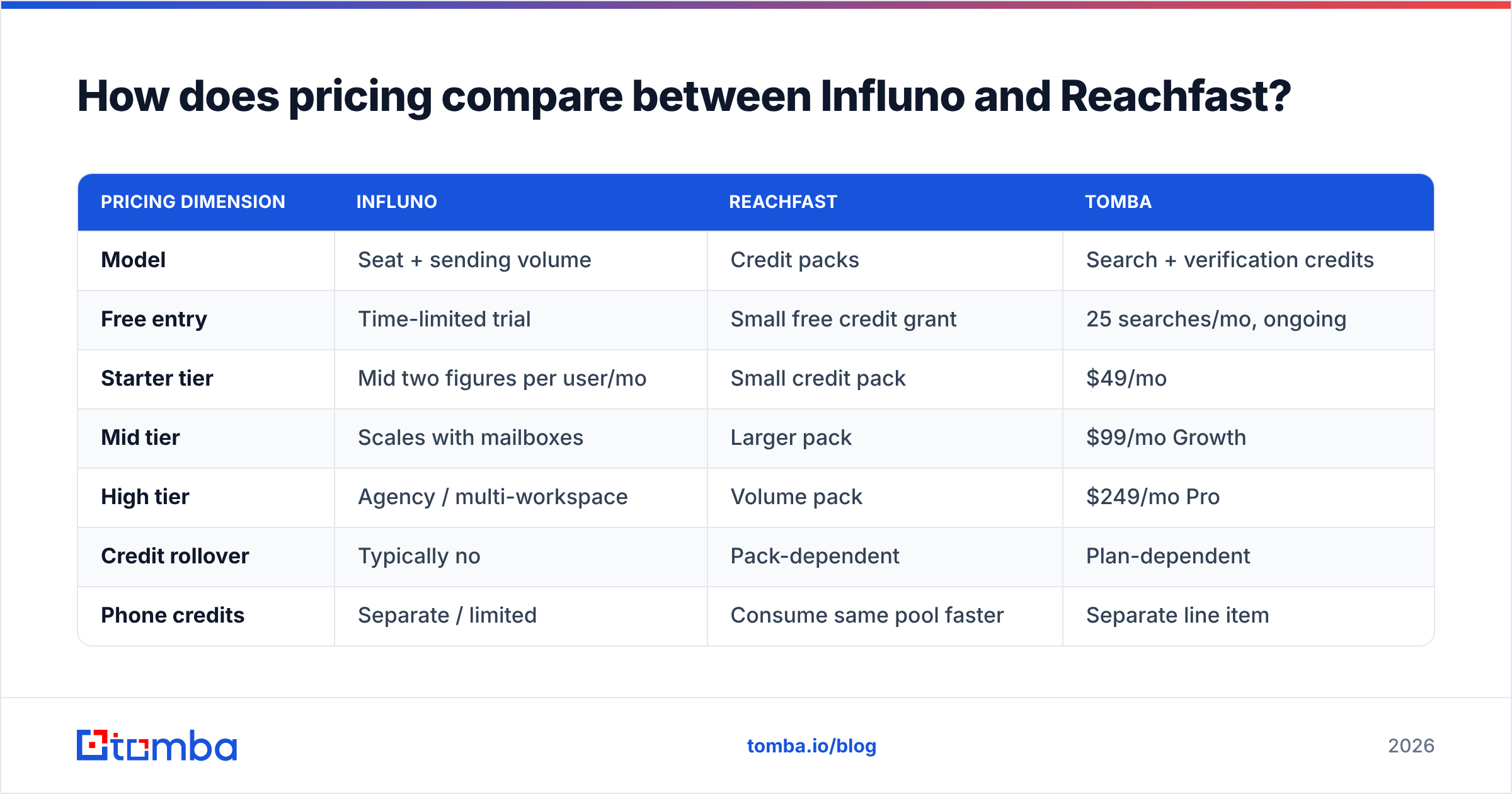
How does pricing compare between Influno and Reachfast?#
Different models, which makes the sticker prices nearly useless on their own.
| Pricing dimension | Influno | Reachfast | Tomba |
|---|---|---|---|
| Model | Seat + sending volume | Credit packs | Search + verification credits |
| Free entry | Time-limited trial | Small free credit grant | 25 searches/mo, ongoing |
| Starter tier | Mid two figures per user/mo | Small credit pack | $49/mo |
| Mid tier | Scales with mailboxes | Larger pack | $99/mo Growth |
| High tier | Agency / multi-workspace | Volume pack | $249/mo Pro |
| Credit rollover | Typically no | Pack-dependent | Plan-dependent |
| Phone credits | Separate / limited | Consume same pool faster | Separate line item |
| API access | Higher tiers | Higher tiers | All paid tiers |
Three cost traps worth naming before you sign anything:
Per-seat pricing punishes teams. Influno's model charges by user and mailbox. Add three SDRs and two sending domains each and the "affordable" tier isn't. Credit-based tools like Reachfast and Tomba scale by usage instead, which means a five-person team on the same pool often pays less than one seat-priced platform.
A credit is not a contact. With most providers, a failed lookup still burns something, and a phone number costs multiple email credits. Ask the specific question: what does a miss cost me? Vendors that don't charge for misses will say so loudly on the pricing page; vendors that do bury it.
Bundling hides the data bill. When sending and data come in one price, you can't see that you're paying platform rates for commodity records. Unbundle for one month, price each layer separately, and the comparison usually shifts.

Is Influno better than Reachfast for cold outreach?#
For running a campaign end to end, yes — because Reachfast doesn't run campaigns. That's not a win on merit, it's a category difference.
The sharper question: is Influno's bundled data good enough to skip a dedicated finder? For most teams sending under ~500 emails a month to a forgiving ICP, probably. Above that, no. Here's the reasoning:
- At 2,000 sends/month, a 12% bad-address rate is 240 bounces. Two months of that and Google Postmaster starts throttling you.
- The cost of fixing it is small — verification is the cheapest line item in outbound.
- The cost of not fixing it is your sending domain, which takes 8–12 weeks to rebuild.
So the strongest 2026 stack isn't "pick one." It's: a sending platform you like, a data layer you trust, and a verification step between them. If you want Influno as the sender, use it as the sender. Feed it from somewhere that treats data as the product rather than as a retention feature.
For teams that found this post while shopping for LinkedIn-specific workflows, a LinkedIn email extractor covers the same trigger as Reachfast's extension while feeding the same verification pipeline as the rest of your list.

What do real users say about each tool?#
Both are small enough that review volume is thin — treat every rating you see as directional, not statistical. Browsing the lead intelligence category on G2 gives better context than either tool's own review count.
The recurring themes, drawn from public reviews across the category:
Influno praise: genuinely easy setup, warmup included, good for solo founders sending their first campaigns, responsive support.
Influno complaints: bundled database thinner than expected outside US tech, per-seat costs escalate, sequence logic less flexible than dedicated senders like Instantly or Smartlead.
Reachfast praise: fast extension, mobile numbers are a differentiator, works well inside Sales Navigator.
Reachfast complaints: credit burn is faster than expected when phones are involved, coverage drops outside North America and larger companies, no sending means it's always a second subscription.
You'll notice neither complaint list is about the marquee feature. Nobody says "Influno can't send email" or "Reachfast can't find contacts." They say the adjacent capability is weak — which is exactly what you'd predict from a bundle and a point tool.
Which should you choose in 2026?#
Choose by what's already in your stack, not by feature count:
- Solo founder, no sending infrastructure, low volume. Influno. One bill, warmup included, good enough data for 200 sends a month. Revisit at 1,000/month.
- SDR living in Sales Navigator, sending from an existing platform. Reachfast, with a verification pass before import. The extension matches how you already work.
- Team of 3+ with a sender you like. Skip both bundles. Buy data by the credit, verify separately, keep the sender. This is the cheapest path per booked meeting at almost every volume above hobby scale.
- Anyone doing domain-level or list-based prospecting. Neither. You need domain search and bulk enrichment, which are structurally different from profile-by-profile lookups.
- Anyone whose bounce rate is above 3%. Fix verification first. No amount of tool-switching helps if the addresses were never good. Understanding why bounces happen at the SMTP layer makes the fix obvious — most bounces are rejections your verifier should have predicted.
The meta-point: outbound tooling has consolidated hard since 2024, and the consolidation is mostly on the sending side. Data has gone the other way — it's fragmenting, because no single provider has coverage everywhere. Assuming one vendor covers both jobs well is the most common and most expensive planning mistake in this category.
Start with data you can actually send to#
Whichever platform you send from, the list is what decides your reply rate. Tomba's Email Finder gives you verified work emails by name, domain, or company, with catch-all detection built in and an API that drops into whatever sequencer you already pay for. Free tier is 25 searches a month with no card, Starter is $49/mo, and misses don't quietly drain your balance. Test it against your current provider on the same 100 accounts — the bounce-rate difference shows up in a week.
Related guides#
// get started
Find, verify and enrich your first contacts today
Start on the free plan with 25 searches a month, then scale when your team is ready.
Free plan · No credit card required · GDPR & CCPA
Get the Tomba newsletter
Product and data updates
// about the author