Influno vs RocketReach: Which Wins for Cold Outreach in 2026?
Influno sends the emails. RocketReach finds the people. Here's an honest breakdown of where each one earns its price, where each one quietly costs you deliverability, and which stack actually books meetings.
TL;DR
- They are not the same category. Influno is a cold email sending platform (sequences, inboxes, warmup, AI copy). RocketReach is a contact database (emails, phone numbers, profile lookups). Comparing them head-to-head only makes sense if you are trying to decide what to buy first.
- RocketReach wins on coverage, especially for personal emails and direct dials across large consumer-facing orgs. It loses on credit economics: lookups are metered per contact and expire.
- Influno wins on cost-per-sent-email if you already have a list. Its built-in finder is a convenience feature, not a data business.
- Neither replaces a dedicated verifier. Both will hand you addresses that bounce if you send without a second validation pass.
- The realistic 2026 stack: a dedicated finder/verifier for data quality, plus a sending tool for delivery. Buying one product to do both is where most teams lose 10-20% of their list to bounces.
What are Influno and RocketReach, exactly?#
Start here, because the two products solve opposite halves of the same problem.
Influno is an outbound sending platform. You connect mailboxes, build sequences, warm the domains, write with AI assistance, and track replies. Its pitch in 2026 leans hard on unlimited email accounts and per-user pricing rather than per-contact pricing. There is a contact-finding layer bolted on, but the core value is throughput: getting a lot of personalized mail out of a lot of inboxes without torching your sender reputation.
RocketReach is a data company. It maintains a very large profile index (hundreds of millions of professional records) and sells you lookups against it. You search a person or a company, spend a credit, get a work email, a personal email, and sometimes a mobile number. There is a light Chrome extension and a bulk lookup feature, but RocketReach does not send anything. It never touches your deliverability, for better and worse.
So the honest framing of "influno vs rocketreach" is not "which is better." It is: do you currently lack a list, or lack a sending engine?
If your CRM is full of contacts you have never emailed, you need Influno (or any sequencer). If you have a working sequencer and keep running out of people to put in it, you need a data source, and RocketReach is one option among several.

How do Influno and RocketReach compare feature by feature?#
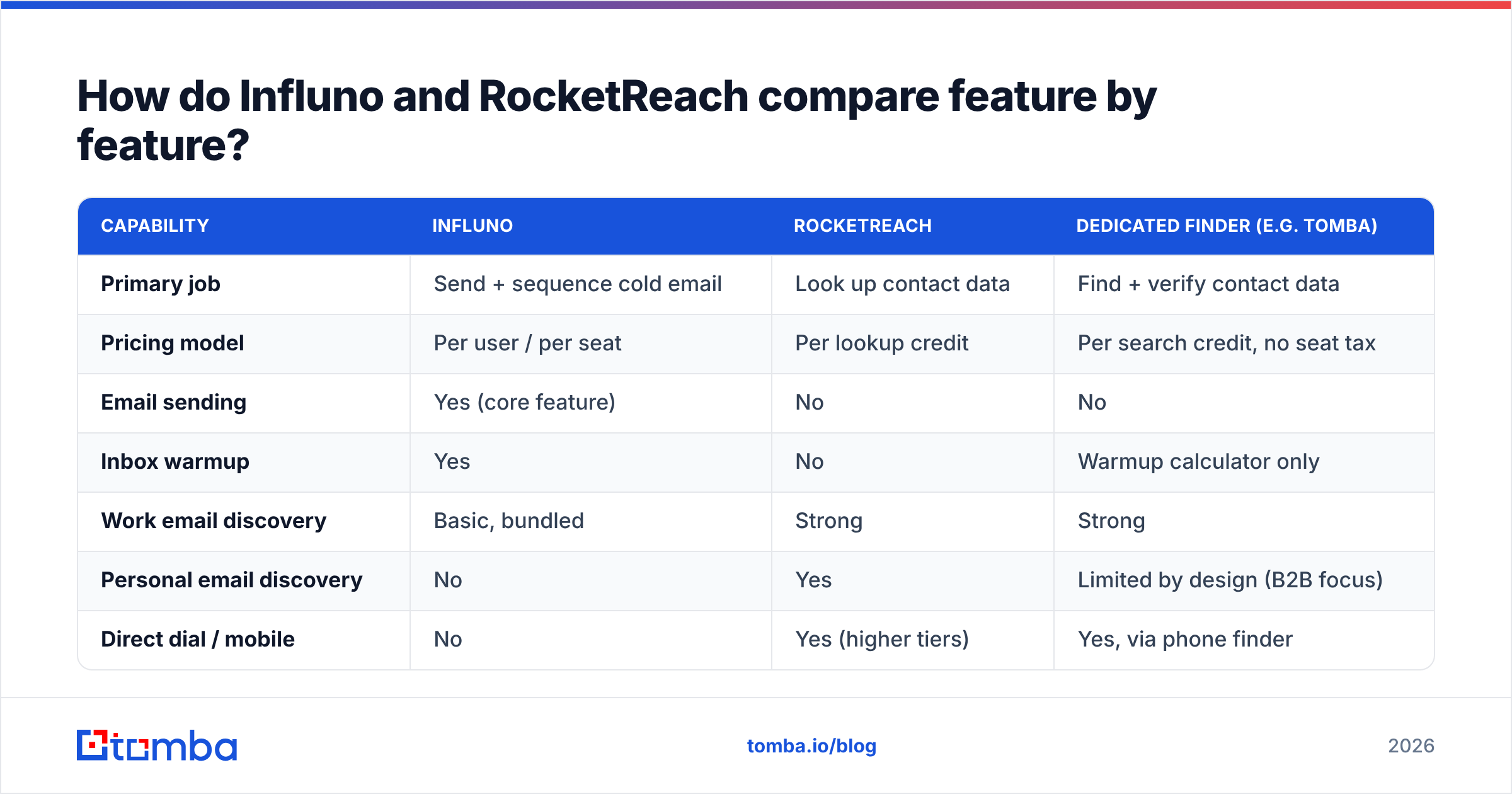
Here is the side-by-side, with a third column for the dedicated-data approach so you can see what each model actually optimizes for.
| Capability | Influno | RocketReach | Dedicated finder (e.g. Tomba) |
|---|---|---|---|
| Primary job | Send + sequence cold email | Look up contact data | Find + verify contact data |
| Pricing model | Per user / per seat | Per lookup credit | Per search credit, no seat tax |
| Email sending | Yes (core feature) | No | No |
| Inbox warmup | Yes | No | Warmup calculator only |
| Work email discovery | Basic, bundled | Strong | Strong |
| Personal email discovery | No | Yes | Limited by design (B2B focus) |
| Direct dial / mobile | No | Yes (higher tiers) | Yes, via phone finder |
| Domain-wide search | Limited | Yes | Yes, with department filters |
| Catch-all handling | Not addressed | Flagged, not resolved | Dedicated catch-all verifier |
| Verification included | Light | Light | Full SMTP-level verification |
| API access | Limited | Yes (paid tiers) | Yes, all paid tiers |
| Free tier | Trial | 5 lookups/mo | 25 searches/mo |
The pattern is obvious once it is laid out. Influno bundles a finder so you do not bounce out of the product to build a list. RocketReach bundles nothing beyond data, so it lives or dies on match rate. Neither one is designed to guarantee that what lands in your sequence is deliverable.

Which one has better data accuracy?#
RocketReach, comfortably, if we are only comparing the two. It is a data business with an index it has been building since 2015, and its coverage of mid-market and enterprise profiles is genuinely deep. Influno's finder is a feature, and features do not get the crawl infrastructure that products do.
But "better than Influno" is a low bar, and accuracy in this category is usually misreported. Three things to understand before you trust any vendor's number:
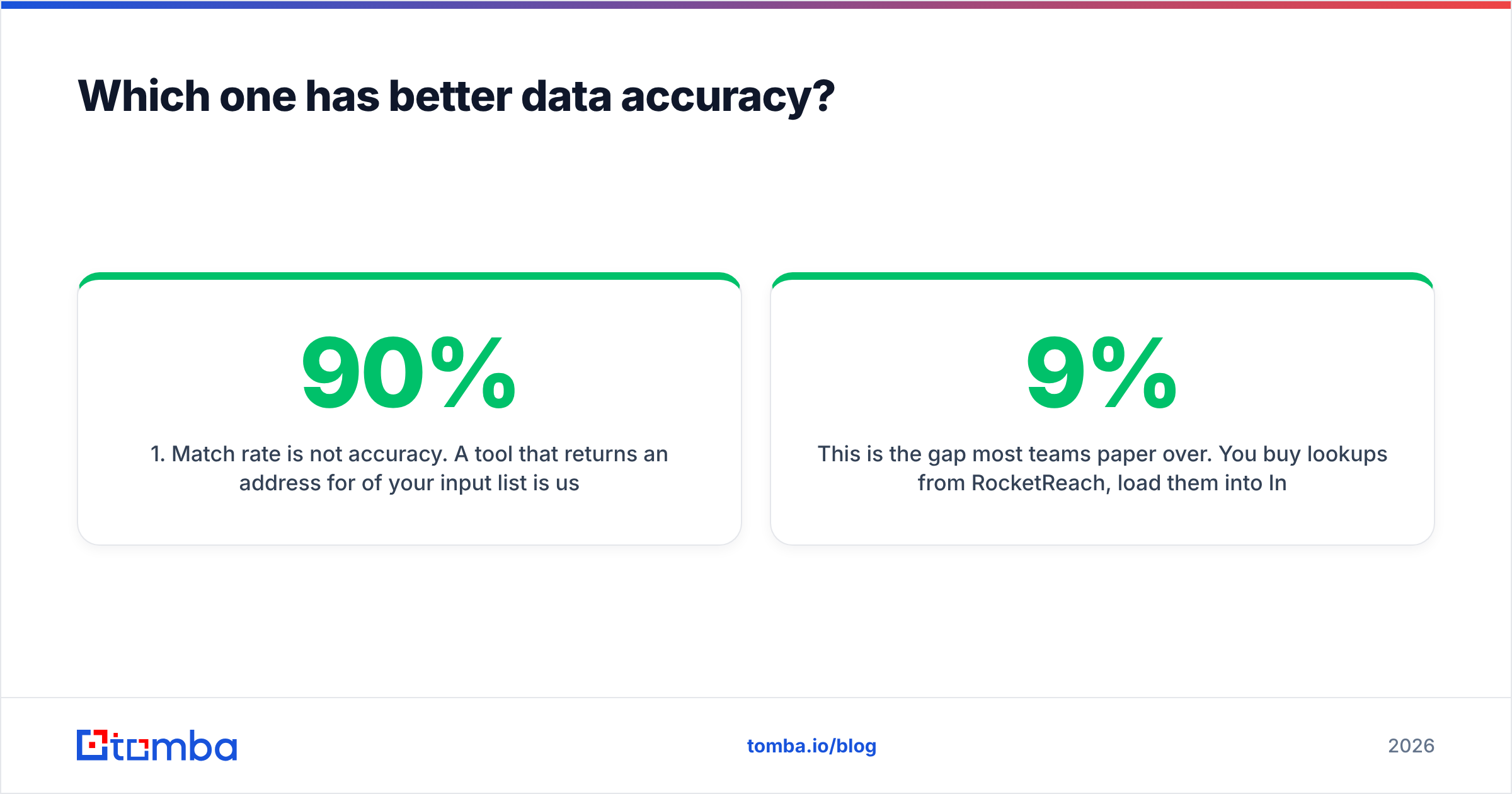
- Match rate is not accuracy. A tool that returns an address for 90% of your input list is useless if 25% of those addresses bounce. Ask for both numbers, or measure them yourself on a 100-row sample.
- "Verified" often means syntax + MX. Plenty of tools mark an address valid after confirming the domain accepts mail. That is a spell-check, not a verification. Real verification means an SMTP-level probe against the specific mailbox.
- Catch-all domains break the scoreboard. Roughly one in five B2B domains accepts all mail at the gateway and rejects internally later. RocketReach flags these; it does not resolve them. If your ICP skews toward companies using Microsoft 365 with catch-all enabled, your "valid" list is partly fiction.

This is the gap most teams paper over. You buy lookups from RocketReach, load them into Influno, and discover your bounce rate at 9% three days into a campaign, after Google has already started throttling you. Running the list through an email verifier before it ever reaches a sequencer costs a fraction of a lookup credit and protects the asset you cannot re-buy: your domain reputation.
If your lists include a lot of catch-all domains, a catch-all verifier is the specific tool for that job. Neither Influno nor RocketReach ships one.
What do Influno and RocketReach cost in 2026?#
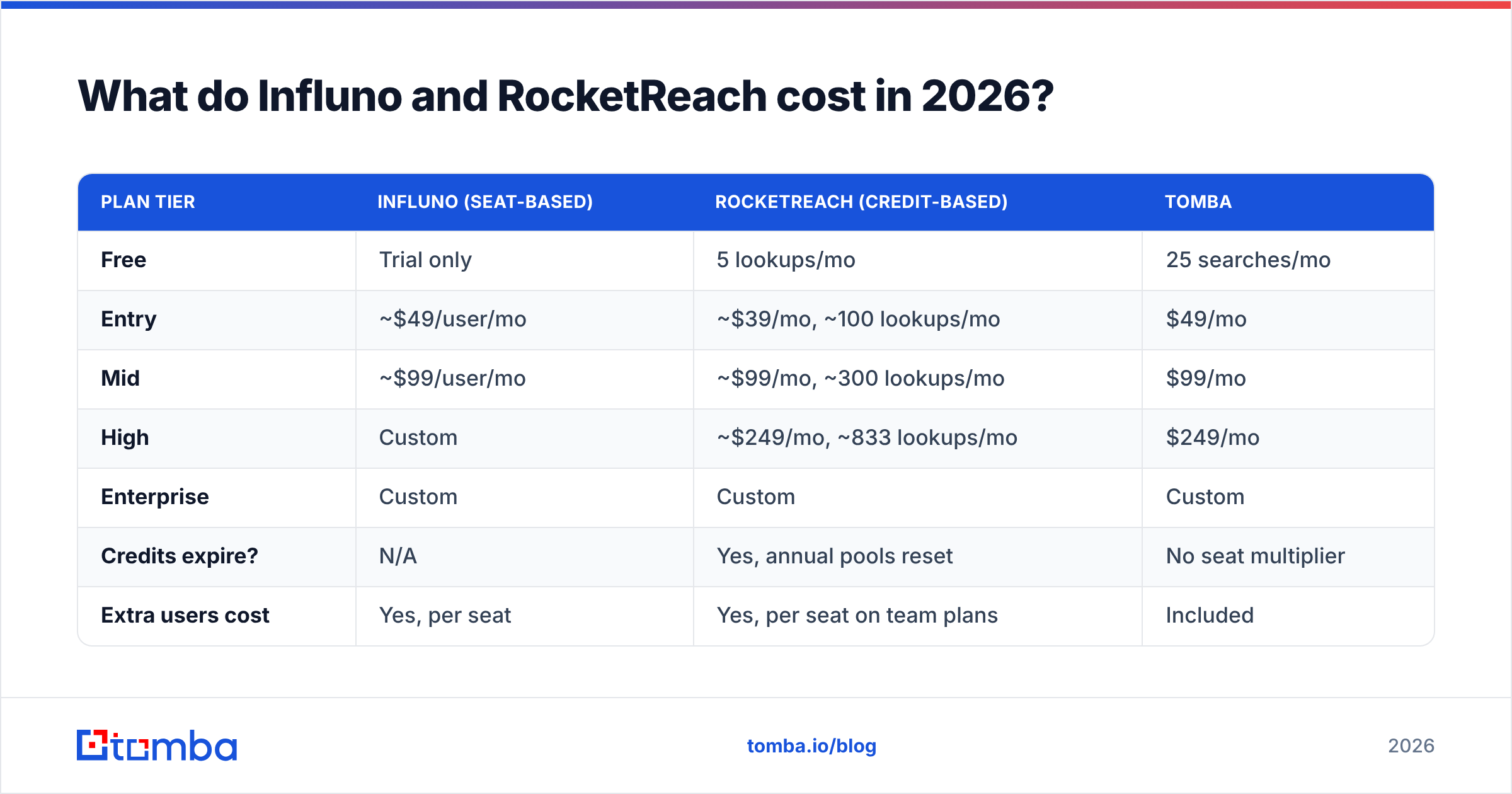
Pricing moves, so treat this as a shape rather than a quote, and check each vendor's page before you commit. The structural differences matter more than the exact dollars.
| Plan tier | Influno (seat-based) | RocketReach (credit-based) | Tomba |
|---|---|---|---|
| Free | Trial only | 5 lookups/mo | 25 searches/mo |
| Entry | ~$49/user/mo | ~$39/mo, ~100 lookups/mo | $49/mo |
| Mid | ~$99/user/mo | ~$99/mo, ~300 lookups/mo | $99/mo |
| High | Custom | ~$249/mo, ~833 lookups/mo | $249/mo |
| Enterprise | Custom | Custom | Custom |
| Credits expire? | N/A | Yes, annual pools reset | No seat multiplier |
| Extra users cost | Yes, per seat | Yes, per seat on team plans | Included |
Two cost traps worth naming out loud.
RocketReach's per-lookup math gets ugly at volume. If you are prospecting 2,000 contacts a month, the entry tier is irrelevant and you are into the top plan or an annual enterprise commitment. Divide the monthly price by the lookups you will actually use, then compare that number to a flat-rate finder. Many teams discover they are paying north of $0.25 per contact for data they then have to verify separately anyway.
Influno's per-seat math gets ugly at headcount. A five-rep team on a $99 plan is $495/month before you have found a single contact. That is fine if all five reps are sending daily. It is expensive if two of them are SDR managers who log in weekly.
If you want a like-for-like reference point on the data side, Tomba pricing runs $49/mo Starter, $99/mo Growth, and $249/mo Pro with a free tier of 25 searches, and credits are not divided by seat count. That structural difference (searches, not seats) is why data-first teams tend to land there and keep their sequencer separate.
Is RocketReach worth it for cold email specifically?#
Partially. Here is the honest split.
Where RocketReach earns its price:
- Recruiting and executive search. Personal emails and mobile numbers are its differentiator, and no B2B-only finder will match it there.
- Hard-to-reach targets. Founders at stealth companies, people who never appear on a company domain, contacts who have changed jobs recently.
- One-off, high-value lookups. When a single correct phone number is worth thousands, credit cost is irrelevant.
Where it struggles for cold email:
- Volume prospecting. Credit economics punish exactly the workflow cold email requires: lots of contacts, many of whom will never reply.
- Domain-level list building. If your motion is "find everyone in marketing at these 400 companies," a domain search with department filters is a faster and cheaper primitive than person-by-person lookups.
- Deliverability hygiene. RocketReach hands you an address and wishes you luck. There is no verification gate between its index and your sequencer.
It is worth saying plainly: RocketReach is a good product being asked to do a job it was not designed for. Most complaints you will read on G2 about credits and bounces are really complaints about using a lookup tool as a list-building tool.

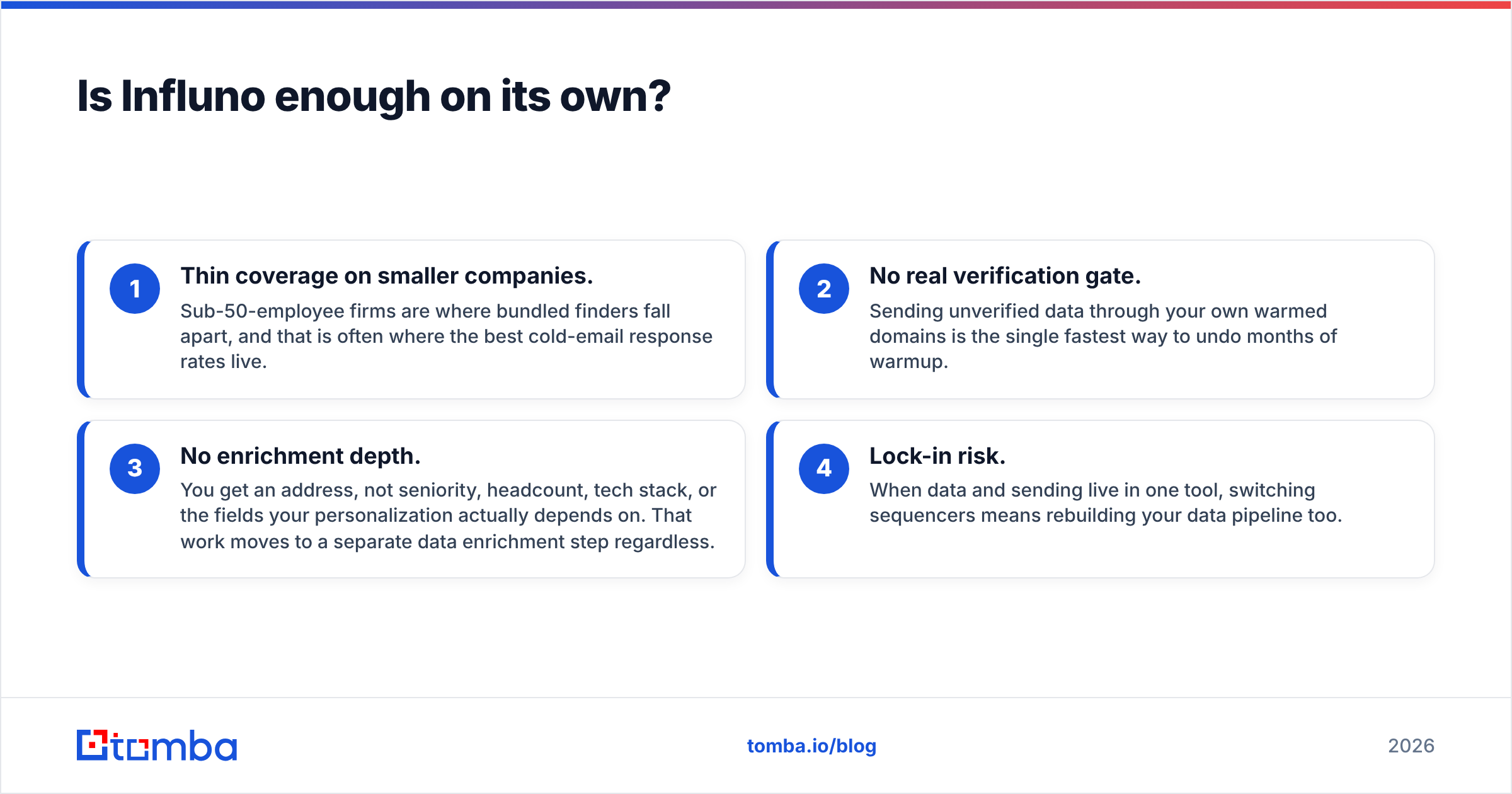
Is Influno enough on its own?#
For sending, yes. For the whole motion, no, and the vendor would probably agree.
Influno does the sequencer job competently: multiple mailboxes, warmup, throttling, reply detection, A/B testing on subject lines and bodies. If your current setup is a Gmail account and a spreadsheet, moving to Influno is a real upgrade in both output and safety. Its unlimited-inbox positioning is genuinely useful for agencies running many client domains.
What it is not is a data platform. The bundled finder is there so you are not blocked, not so you can build your quarter's pipeline. Depending on it has predictable consequences:
- Thin coverage on smaller companies. Sub-50-employee firms are where bundled finders fall apart, and that is often where the best cold-email response rates live.
- No real verification gate. Sending unverified data through your own warmed domains is the single fastest way to undo months of warmup.
- No enrichment depth. You get an address, not seniority, headcount, tech stack, or the fields your personalization actually depends on. That work moves to a separate data enrichment step regardless.
- Lock-in risk. When data and sending live in one tool, switching sequencers means rebuilding your data pipeline too.
Which should you pick for your situation?#
Match the decision to the constraint you actually have:
- You have a list, no sending infrastructure. Buy Influno (or any sequencer you like). Do not buy RocketReach yet. Your bottleneck is delivery, not discovery.
- You have a sequencer, no list. Buy data. RocketReach if you need personal emails and mobiles; a B2B-focused email finder if you need work emails at volume for a fraction of the per-contact cost.
- You are recruiting, not selling. RocketReach, without much debate. Personal-email coverage is the whole game in talent sourcing.
- You are running 1,000+ contacts a month. Split the stack. Flat-rate finder plus verifier for data, sequencer for sending. The credit model will not survive your volume.
- You are an agency with many client domains. Influno's inbox model fits well. Pair it with a bulk email finder so list building does not become the constraint on how many clients you can serve.
- You are already on RocketReach and hate the credit resets. Compare a flat-rate option before renewing; the RocketReach alternative breakdown covers the per-contact math in detail.
What does the right 2026 outbound stack look like?#
Three layers, bought separately, each doing one job well.
Layer 1, data. A finder that returns work emails by domain, name, or company, plus verification in the same pass. This is where accuracy is won or lost. Flat-rate pricing here means your prospecting volume is not a budget decision every month.
Layer 2, hygiene. Verification and catch-all resolution before anything touches a mailbox. Treat this as non-negotiable. A 2% bounce rate is healthy; a 7% bounce rate gets your domain throttled by Google and Microsoft, and recovery takes weeks.
Layer 3, sending. A sequencer with warmup, mailbox rotation, and reply handling. Influno fits here. So do a dozen competitors. This layer is the most commoditized and the easiest to swap, which is exactly why you should not let it own your data.
The failure mode is buying one product that half-does all three. That is the real lesson buried in the Influno vs RocketReach comparison: both are being pushed beyond their design center by buyers who want a single line item.
Ready to fix the data layer?#
If you have read this far, the decision is probably not "Influno or RocketReach." It is "where does my list actually come from, and can I trust it?"
Start with the Tomba Email Finder. Find work emails by domain, name, or company, with verification built into the same call and flat-rate credits that do not get divided across seats or reset annually. The free tier gives you 25 searches a month, which is enough to run the only test that matters: pull 25 contacts from your ICP, verify them, send, and count the bounces. Then compare that number to whatever your current stack is producing.
Keep your sequencer. Fix the data underneath it.
Related guides#
Ready to find emails that actually work?
Join 150,000+ professionals who stopped guessing and started sending. Free credits on signup — no credit card required.
Get the Tomba newsletter
Practical outbound tactics and product updates — once every two weeks.
About the author