Influno vs Skrapp (2026): Which Email Finder Tool Wins?
Influno bundles email finding with sending. Skrapp is a focused B2B email finder with a LinkedIn extension. Here is how they compare on accuracy, credits, pricing, and the outbound workflows each one actually fits.
Influno vs Skrapp is a choice between a bundle and a point tool. Influno finds contacts and sends the campaign. Skrapp only finds the emails and hands you a clean CSV. This guide compares both on find rate, verification, credits, and price, so you can pick the one your outbound stack actually needs.
TL;DR
- Influno is an all-in-one outbound platform. Find contacts, write sequences, and send from your own mailbox in one tool. Best when you want fewer subscriptions.
- Skrapp is a focused B2B email finder. It runs on a LinkedIn extension and domain search. Best when list building is the job.
- Both do well on mid-market SaaS and tech domains. Both drop off on small business, agency, and non-English domains.
- The real decider is not the finder. It is verification depth and credit math.
- A finder-plus-verifier layer like Tomba (free tier, then $49/mo) often costs less than either bundle.
What are Influno and Skrapp?#
They solve overlapping problems from opposite directions.
Influno sells itself as a cold email platform. One subscription covers contact search, campaign building, multi-inbox sending, warmup, and reply tracking. The pitch is simple: pay once instead of paying for a data tool, a sequencer, and a warmup service. Contact finding is there to feed the sequencer. It is not the headline product.
Skrapp went the other way. It started as an email finder and stayed one. A Chrome extension pulls emails while you browse LinkedIn or Sales Navigator. A domain search returns known addresses and the pattern a company uses. There is also a bulk CSV uploader and an API. Sending is not part of the product, so you export to your own sequencer.
That difference explains almost every trade-off below. Influno is built for "I want to launch a campaign today." Skrapp is built for "I want 4,000 clean rows in a CSV."
Influno vs Skrapp: how do they compare at a glance?#
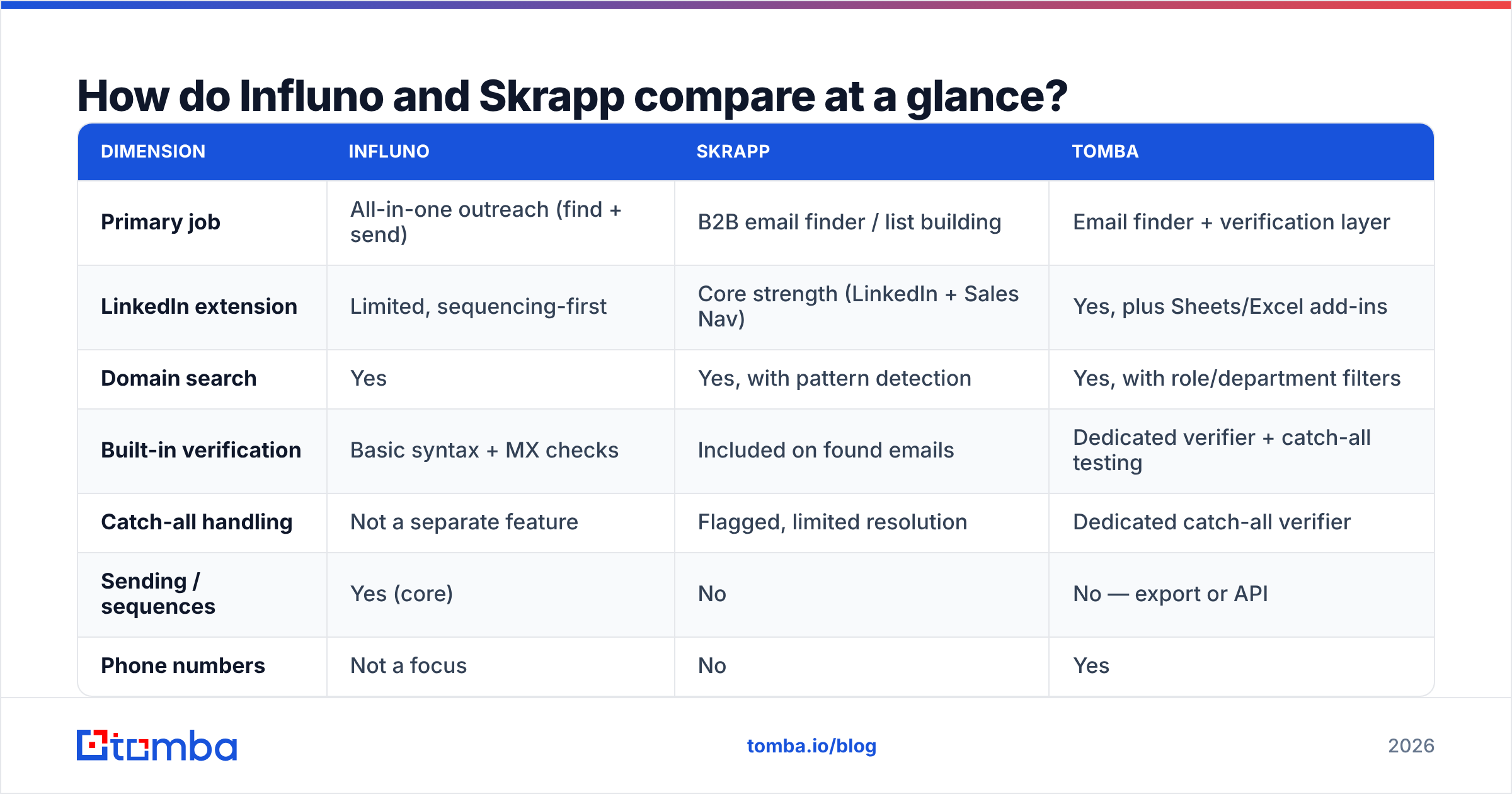
| Dimension | Influno | Skrapp | Tomba |
|---|---|---|---|
| Primary job | All-in-one outreach (find + send) | B2B email finder / list building | Email finder + verification layer |
| LinkedIn extension | Limited, sequencing-first | Core strength (LinkedIn + Sales Nav) | Yes, plus Sheets/Excel add-ins |
| Domain search | Yes | Yes, with pattern detection | Yes, with role/department filters |
| Built-in verification | Basic syntax + MX checks | Included on found emails | Dedicated verifier + catch-all testing |
| Catch-all handling | Not a separate feature | Flagged, limited resolution | Dedicated catch-all verifier |
| Sending / sequences | Yes (core) | No | No — export or API |
| Phone numbers | Not a focus | No | Yes |
| API access | Limited on lower tiers | Yes | Yes, on all paid tiers |
| Free tier | Trial-based | ~100 emails/mo | 25 searches/mo, no card |
| Entry paid price | Bundle pricing, mid-two-figures | About $40/mo | $49/mo Starter |
Prices and limits move. Treat this table as a shape, not a quote. Check each vendor's live pricing page before you buy, and see the Tomba pricing page for current credit allowances.
Which one finds more valid emails?#
Neither company publishes a third-party audit. The honest answer: it depends on your ICP, so test on your own list.
Here is what holds up across most head-to-head tests we have seen and run:
- Mid-market and enterprise SaaS — both tools do well. Coverage is dense and patterns are easy to guess (
first.last@). Expect similar find rates. - Sub-50-employee companies — find rates drop hard for everyone. Skrapp gets a small edge because it will build and test a likely address instead of returning nothing.
- Agencies, consultancies, and local services — the weakest group for both. Many run catch-all mail servers that accept everything, so a "verified" result means little.
- Non-US and non-English domains — coverage thins out. If your ICP is DACH, Nordics, LATAM, or MENA, run a 200-row sample before you buy a year.
- Contacts who just changed jobs — the biggest source of silent bounces. Databases lag job moves by weeks, so a Q1 mover can still return a dead address in Q3.

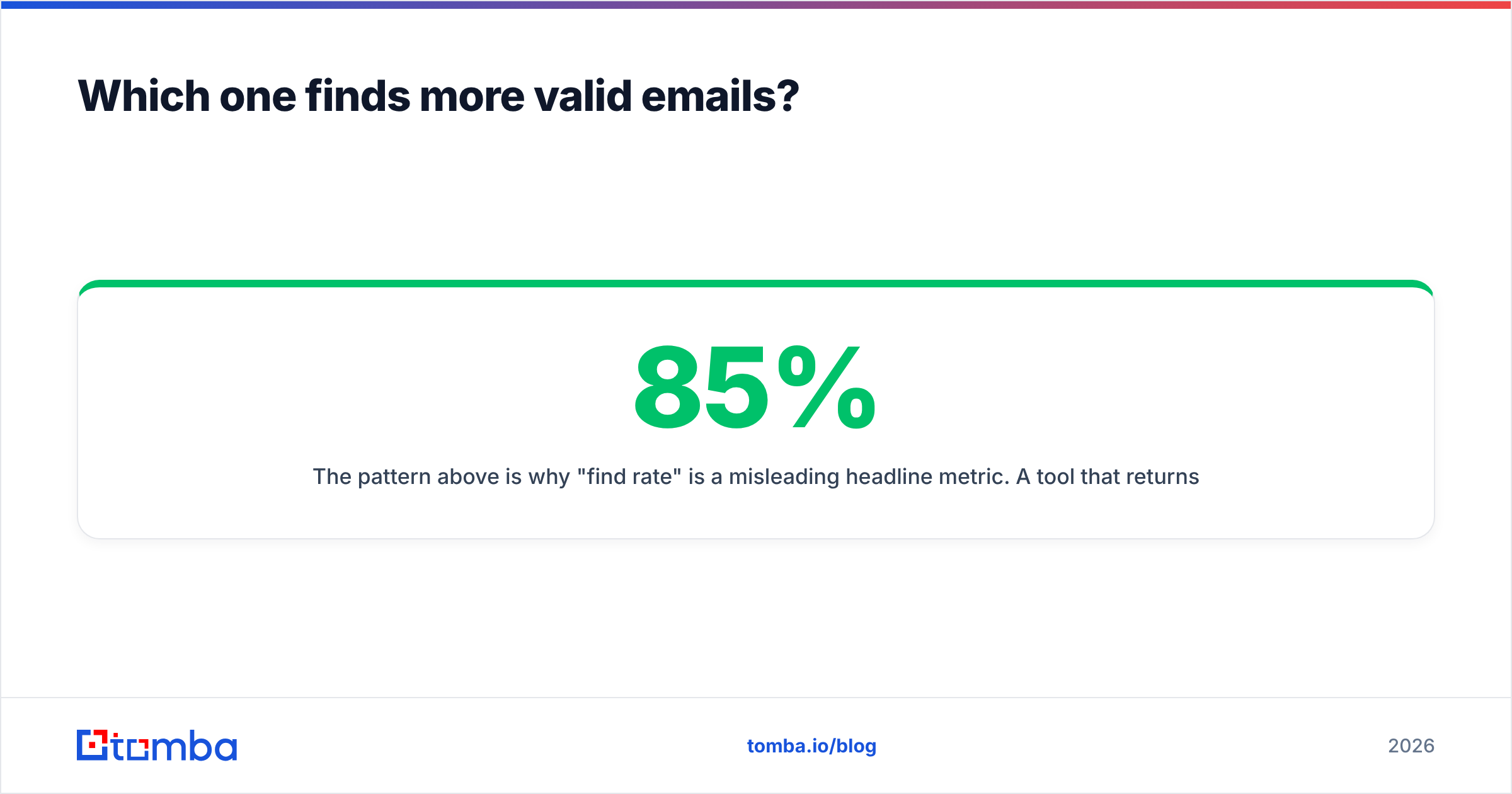
This is why "find rate" is a misleading headline number. Say one tool returns an address for 85% of rows, but 20% of those bounce. It is worse than a tool that returns 70% with a 2% bounce rate. Bounces cost you sender reputation, and you cannot buy that back.

A standalone email verifier earns its keep here, whichever finder you pick. Running any database output through a second check is the cheapest insurance in outbound.
What does each one actually cost?#
Comparing a bundle to a point tool is always apples to oranges. Normalize on cost per usable contact, not cost per credit.
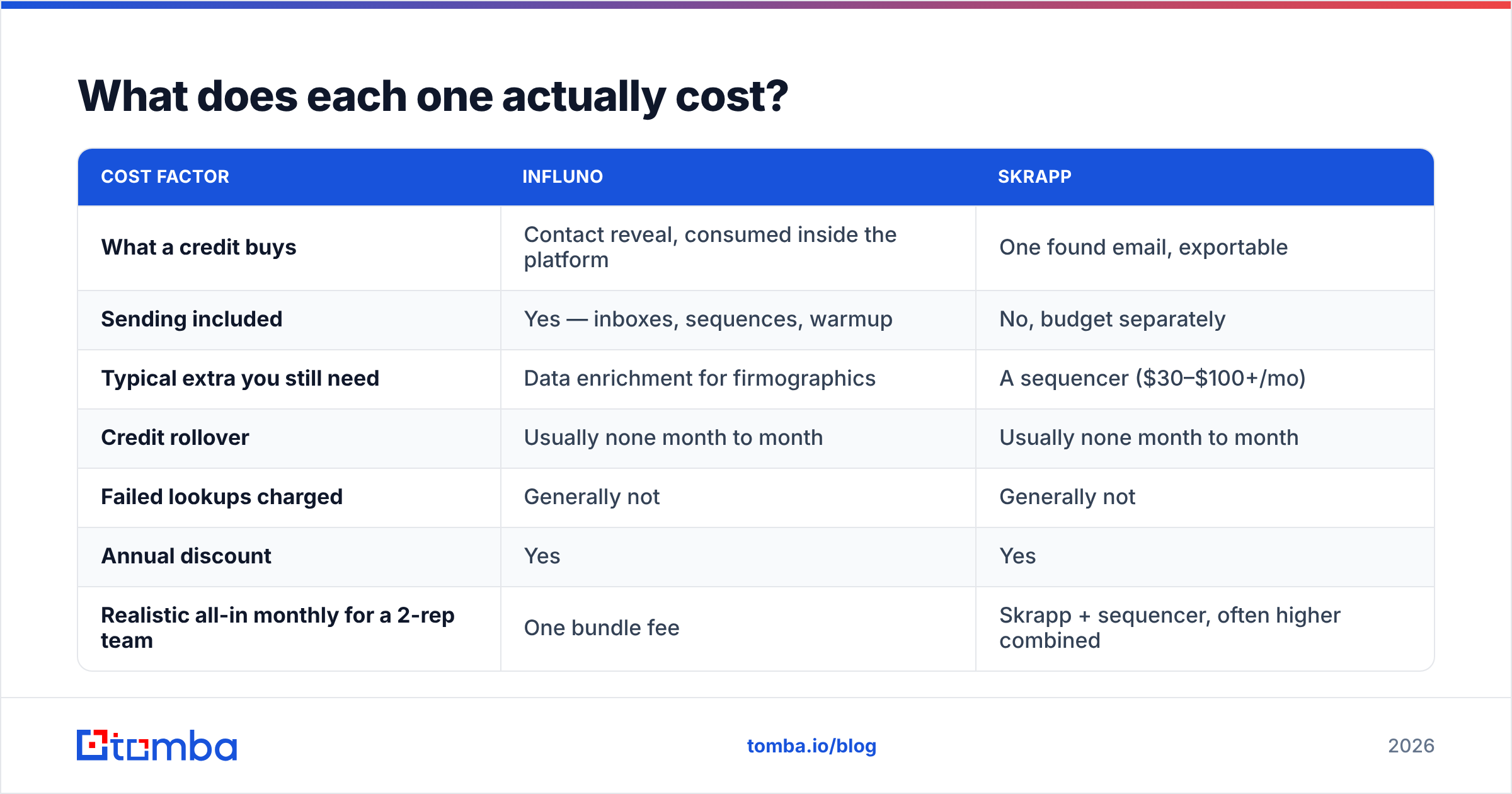
| Cost factor | Influno | Skrapp |
|---|---|---|
| What a credit buys | Contact reveal, consumed inside the platform | One found email, exportable |
| Sending included | Yes — inboxes, sequences, warmup | No, budget separately |
| Typical extra you still need | Data enrichment for firmographics | A sequencer ($30–$100+/mo) |
| Credit rollover | Usually none month to month | Usually none month to month |
| Failed lookups charged | Generally not | Generally not |
| Annual discount | Yes | Yes |
| Realistic all-in monthly for a 2-rep team | One bundle fee | Skrapp + sequencer, often higher combined |
Both models share one trap: credits expire monthly, and outbound demand is lumpy. You build a 5,000-contact list in week one, then use almost nothing for six weeks. Monthly buckets punish that pattern. The "upgrade for more credits" prompt lands at the worst moment to judge it.

Before you compare monthly prices, run this math: plan price ÷ (credits × your find rate × your deliverable rate). At a 60% find rate and a 90% deliverable rate, a $79 plan with 2,000 credits costs about $0.073 per usable contact. The pricing page implies $0.04.
Who should pick Influno?#
Pick Influno when consolidation is worth more to you than data depth. Concretely:
- You are a solo founder or a 1–3 person sales team. One login, one bill, one place where a campaign lives. Stitching five tools together costs more than the data gap at small scale.
- You do not already own a sequencer. If you would otherwise buy Instantly, Smartlead, or Lemlist next to a finder, the bundle math swings toward Influno.
- Your ICP is well covered. Mid-market tech, US/UK heavy, standard titles. If you target "VP of Engineering at Series B SaaS," most databases will serve you fine. Workflow becomes the differentiator.
- You want warmup in the box. SPF, DKIM, DMARC, and a slow volume ramp are where most first cold email programs die. A bundled tool that handles the ramp removes one common failure.
Where it disappoints: enrichment, custom CRM field mapping, and API use at volume. You hit the ceiling fast. Bundles trade depth for breadth by design.
Who should pick Skrapp?#
Pick Skrapp when list building is the actual bottleneck.
- You live in Sales Navigator. Filter a search, sweep the results, export. That flow is fast, and it is Skrapp's strongest surface. If prospecting starts with a LinkedIn search, this matches how you work.
- You already have a sending stack you like. Adding a finder to a working Instantly or Salesloft setup beats moving your whole program into a new platform.
- You need clean CSVs for other systems. Skrapp's output is built to leave the building. Bundled tools tend to make export clunky on purpose.
- You have a data-ops person. Someone who will dedupe, verify, and enrich before anything gets sent. Skrapp assumes that person exists.
Where it disappoints: catch-all domains. Skrapp flags them, but flagging is not resolving. If much of your ICP sits on catch-all servers, you need a separate catch-all verifier. Otherwise you guess on part of every list.
Where do both tools fall short?#
Three gaps show up in both products, and they are the gaps worth budgeting for.
Verification depth. Both check found addresses to some degree. Neither ships a verification engine you would trust on its own for a bought or scraped list. If you import data from a conference list, a partner CSV, or an old CRM export, run an independent check first.
Catch-all resolution. A quarter to a third of B2B domains accept all mail at the SMTP layer. That defeats normal verification. Resolving it takes a send-and-observe dataset or a deliverability-aware score. This is the biggest source of unexplained bounces in B2B outbound, and both tools under-serve it.
Job-change decay. B2B contact data decays about 2–3% per month. That is roughly a quarter of your database going stale each year — a complaint G2 reviewers and CRM vendors have repeated for a decade. Neither tool re-verifies your saved lists. You have to schedule that yourself.

Building a stack instead of buying a bundle? The pattern that works is simple: one finder with a broad database, one verifier with real catch-all handling, and one sequencer. A domain search tool answers "who works here." A bulk email finder covers volume. Verification runs as a gate before anything enters the sequencer.
How do you test them in one week?#
Do not read more reviews. Run this test instead. It takes about four hours spread over five days.
- Build a 200-row list from your real ICP. Not famous logos. Include 40 companies under 50 staff and 30 non-US domains.
- Run that list through both free tiers. Skrapp's free allowance and Influno's trial both cover 200 rows. Record find rate per segment.
- Verify every result with a third-party tool. Most people skip this step. It is the one that matters. Use a free email checker, then label each row valid, invalid, catch-all, or unknown.
- Send a tiny real campaign. 50 addresses from each tool, one warmed inbox, same copy. Measure hard bounces at 48 hours.
- Compute cost per delivered contact. Plan price ÷ (credits × find rate × delivered rate), per segment. Compare that number only.
- Check the export path. Push 20 rows into your CRM as you would in production. Painful at 20 rows means unbearable at 2,000.
Teams that run this test usually change their mind. The winner on marketing pages is rarely the winner on your ICP.
So which one wins?#
In Influno vs Skrapp there is no single winner. Any post that declares one is selling something.
Influno wins if you are consolidating and your ICP is mainstream. One bill, one workflow, warmup in the box. For a small team, that cuts real overhead.
Skrapp wins if list building is the job, LinkedIn is your source, and you already own a sequencer. It is a focused tool that does one job cleanly.
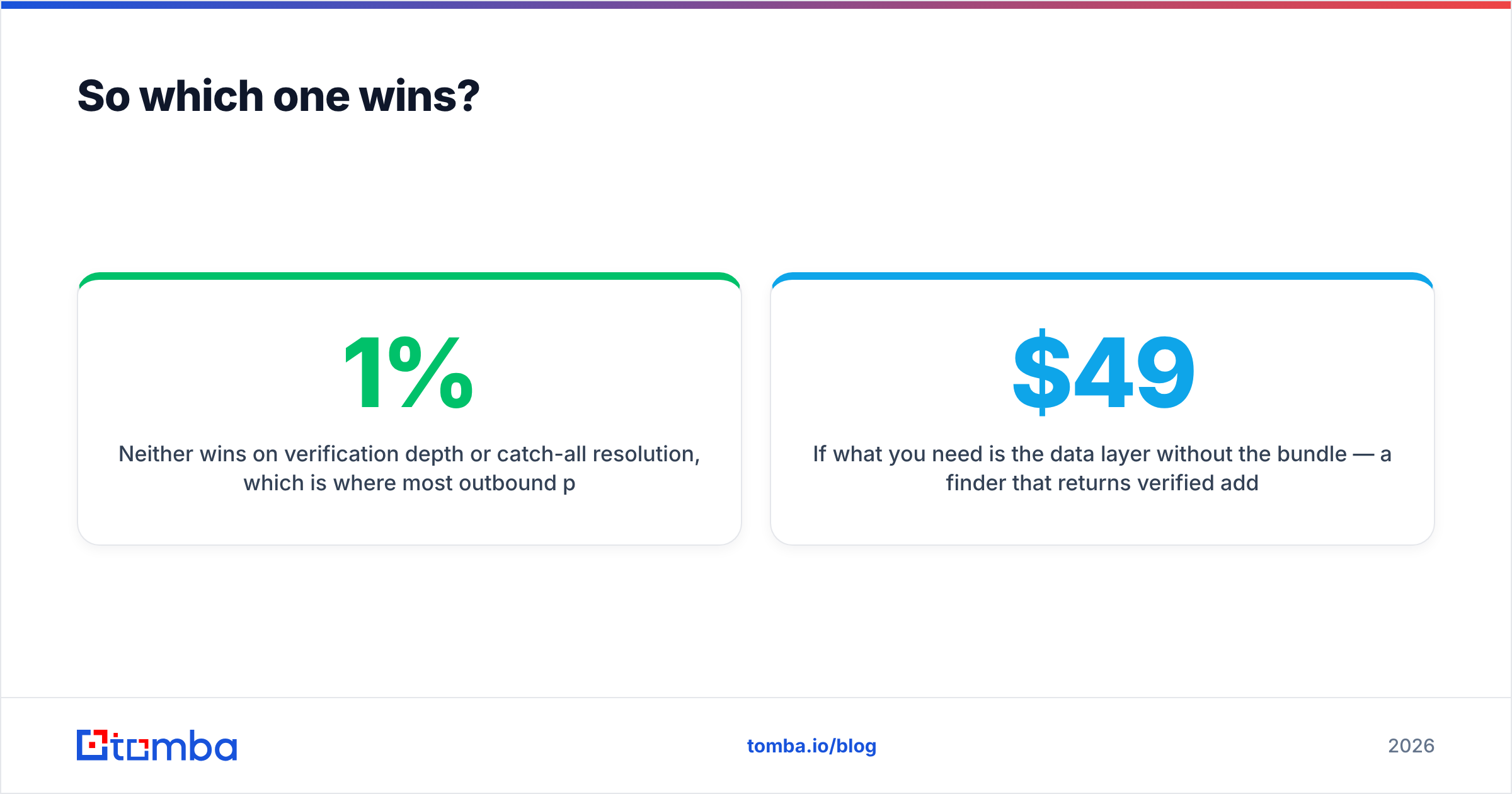
Neither wins on verification depth or catch-all resolution. That is where most outbound programs leak. Whichever you pick, budget for an independent verification layer. It costs less than rebuilding a burned sending domain, and it is the gap between a 1% bounce rate and a 6% one that quietly kills your email deliverability.
Need the data layer without the bundle? A finder that returns verified addresses, resolves catch-all domains, and works from a browser extension, Google Sheets, or an API call — start with the Tomba Email Finder. The free tier gives you 25 searches a month with no card. That is enough to run the 200-row test above on your own ICP. Paid plans start at $49/mo, and verification is built in rather than a second vendor you discover after the first campaign bounces.
Related guides#
// get started
Find, verify and enrich your first contacts today
Start on the free plan with 25 searches a month, then scale when your team is ready.
Free plan · No credit card required · GDPR & CCPA
// about the author