Informal Email Introduction Sample: 12 Templates That Work
Twelve informal email introduction samples you can paste today, scored against formal alternatives, plus the casual lines that quietly destroy your credibility with senior buyers.
TL;DR
- An informal email introduction sample is not a "casual" email — it is a short, structured intro that drops corporate throat-clearing ("I hope this email finds you well") while keeping a clear reason for writing.
- The three-part shape that works: a specific first line about them, one sentence about who you are, one low-friction ask. Everything else is padding.
- Informal wins with founders, marketers, engineers, and anyone under ~200 employees. It loses with procurement, legal, government, healthcare, and most finance buyers.
- Twelve copy-paste samples below, split by context: cold outreach, warm referral, internal team, event follow-up, and inbound reply.
- Tone is free; a valid address is not. An informal intro sent to a bounced mailbox still costs you sender reputation, so verify before you send.
What counts as an informal email introduction?#
An informal email introduction is an opening message where the register is conversational but the structure is still deliberate. The difference is not slang. It is what you delete.
Think of it like showing up to a client meeting in a clean shirt and no tie. You still washed, you still prepared, you still brought the deck. You just stopped performing formality that nobody was grading you on.
A formal intro opens with ritual: full salutation, a compliment about the company's "impressive growth," a paragraph of credentials, then finally the point. An informal intro opens with the point and earns the right to keep going.
Concretely, informal means:
- First-name salutation. "Hi Sarah" or "Sarah —" instead of "Dear Ms. Okafor."
- Contractions and short sentences. "I'm building" beats "I am currently in the process of building."
- No credential dump. One line on who you are, placed after the reason you are writing.
- A single, small ask. "Worth a look?" not "I would welcome the opportunity to schedule a 30-minute discovery call at your earliest convenience."
- Plain sign-off. "Thanks," or "— Ben" instead of "Kind regards, Benjamin R. Mohamed, Senior Director of Strategic Partnerships."
The Wikipedia entry on salutations is a decent reminder that "Dear" was never a warmth signal — it is a 400-year-old convention that survived into email by accident. Nobody in a Slack-native company reads it as respect. They read it as a template.

Is an informal email introduction better than a formal one?#
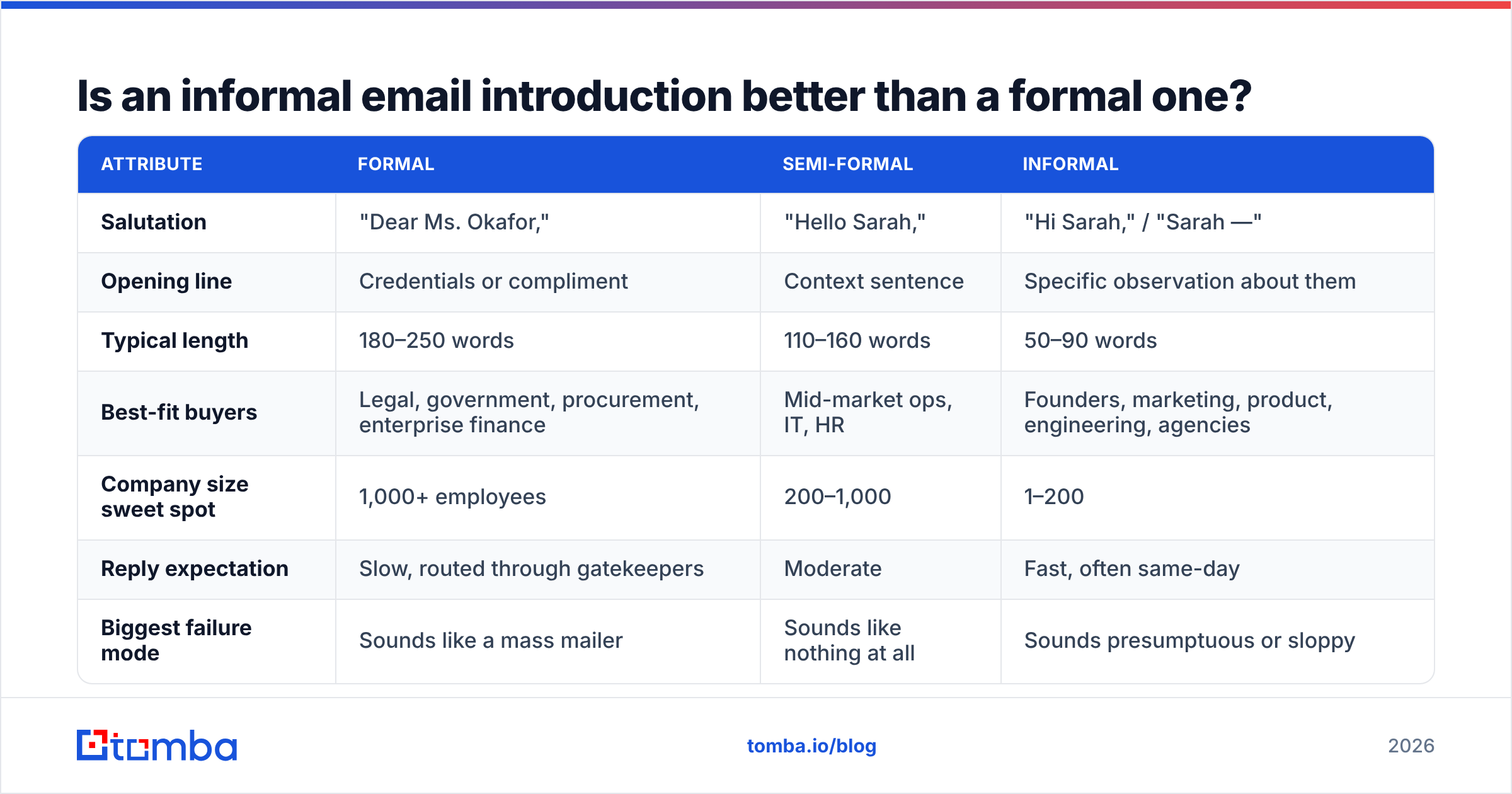
Not universally. It depends on the recipient's environment, not your personal taste. Here is how the three registers actually compare in B2B.
| Attribute | Formal | Semi-formal | Informal |
|---|---|---|---|
| Salutation | "Dear Ms. Okafor," | "Hello Sarah," | "Hi Sarah," / "Sarah —" |
| Opening line | Credentials or compliment | Context sentence | Specific observation about them |
| Typical length | 180–250 words | 110–160 words | 50–90 words |
| Best-fit buyers | Legal, government, procurement, enterprise finance | Mid-market ops, IT, HR | Founders, marketing, product, engineering, agencies |
| Company size sweet spot | 1,000+ employees | 200–1,000 | 1–200 |
| Reply expectation | Slow, routed through gatekeepers | Moderate | Fast, often same-day |
| Biggest failure mode | Sounds like a mass mailer | Sounds like nothing at all | Sounds presumptuous or sloppy |
| Sign-off | "Kind regards," + full title block | "Best," + name and role | "Thanks," + first name |
The middle column is the trap. Semi-formal is where most cold email lands, and it is the register buyers ignore hardest because it commits to nothing. Pick a lane.
One practical test before you choose: read the prospect's last three LinkedIn posts or their company's careers page. If the careers page says "we're looking for someone who ships fast and hates meetings," write informally. If it says "we are seeking a qualified candidate with demonstrated experience," do not.
What does an informal email introduction sample look like?#
Twelve samples, grouped by situation. Swap the bracketed parts and delete anything that does not survive being read aloud.
Cold outreach (no prior relationship)#
1. The observation opener
Subject: your Q3 pricing page change
Hi Sarah,
Noticed you moved the free tier behind an email gate last month. We did the same thing at [Company] and self-serve signups dropped 18% before they recovered.
I run growth at [Company] — we help B2B SaaS teams patch the leak between gate and activation.
Want the two changes that fixed it for us?
— Ben
2. The one-line problem
Hi Marcus,
Quick one: is outbound still owned by the two SDRs, or did that move under marketing after the reorg?
Asking because the answer changes whether what I do is useful to you at all. I build lead data tooling for teams doing 500+ outbound touches a week.
Thanks,
Ben
3. The competitor-adjacent
Hi Priya,
You're on Outreach for sequencing — saw the tech listing on your careers page. Most teams running it hit the same wall around month four: the sequences are fine, the contact data underneath them isn't.
I'm with [Company]. We fix the data half.
Worth fifteen minutes, or is data not the bottleneck for you right now?
— Ben
4. The blunt ask
Hi Tom,
I'm going to skip the pitch. We find and verify B2B email addresses. Your team is hiring three SDRs, which usually means list-building is about to become someone's full-time misery.
Free tier is 25 searches if you want to test it without talking to me.
Ben
Warm referral#
5. The name-drop lead
Hi Dana,
James Okoro suggested I reach out — he mentioned you're rebuilding the RevOps stack this quarter.
I work on the data layer side of that problem. James and I worked together on the same migration at [Company] last year.
Happy to just send notes instead of taking a call, if that's easier.
— Ben
6. The mutual-context intro
Hi Alex,
We both spent 2024 at [Company], though I think you left right as I started. Nadia said you're now running demand gen at [NewCo] and dealing with the same attribution mess we had.
I've since gone deep on that. Want to compare notes?
Thanks,
Ben
Internal and team introductions#
7. New-hire self-intro
Subject: new on the data team
Hi all,
I'm Ben, joined Monday on the data team, reporting to Priya. Previously did four years of analytics at [Company].
For the next two weeks I'm mostly reading and asking annoying questions. If you own a dashboard nobody trusts, I'd like to be your annoying question.
— Ben
8. Cross-team connector
Hi Marcus, meet Dana. Dana, Marcus.
Marcus runs our outbound data pipeline. Dana's team keeps getting duplicate records in Salesforce.
You two should probably talk before either of you builds a workaround. Leaving you to it.
— Ben
9. Requesting time from a senior colleague
Hi Priya,
Ben from the data team — we haven't met properly yet.
I'm mapping how enrichment data reaches the CRM and you're the only person who's touched every part of it. Twenty minutes, this week or next?
Thanks,
Ben
Event and inbound follow-ups#
10. Post-conference
Hi Sarah,
We talked for about four minutes near the coffee at SaaStr — you were the one arguing that intent data is mostly noise. I've thought about it since and I think you're half right.
The other half is what I work on. Continue the argument over a call?
— Ben
11. Webinar or content reply
Hi Alex,
You downloaded our deliverability teardown yesterday. Most people who grab that one are fighting a spam-folder problem they've already tried to fix twice.
Which one are you on — DNS, list quality, or volume?
Ben
12. Inbound lead, first touch
Hi Dana,
You signed up for the free tier this morning and burned through eleven searches, which tells me you're testing us against something.
What's the something? I'll tell you honestly where we lose.
— Ben
That last line is the one people flinch at. It is also the one that gets replies, because admitting a weakness is the cheapest credibility signal available in a cold email. HubSpot's sales blog has made this point for a decade and it still holds.
If you need a broader library beyond introductions, our cold email templates collection covers follow-ups, breakups, and re-engagement. And if the subject line is where you stall, the subject line generator will give you twenty variants in a few seconds.
What makes an informal intro fail?#
Six failure modes, ranked by how often they show up in audits of real sequences.
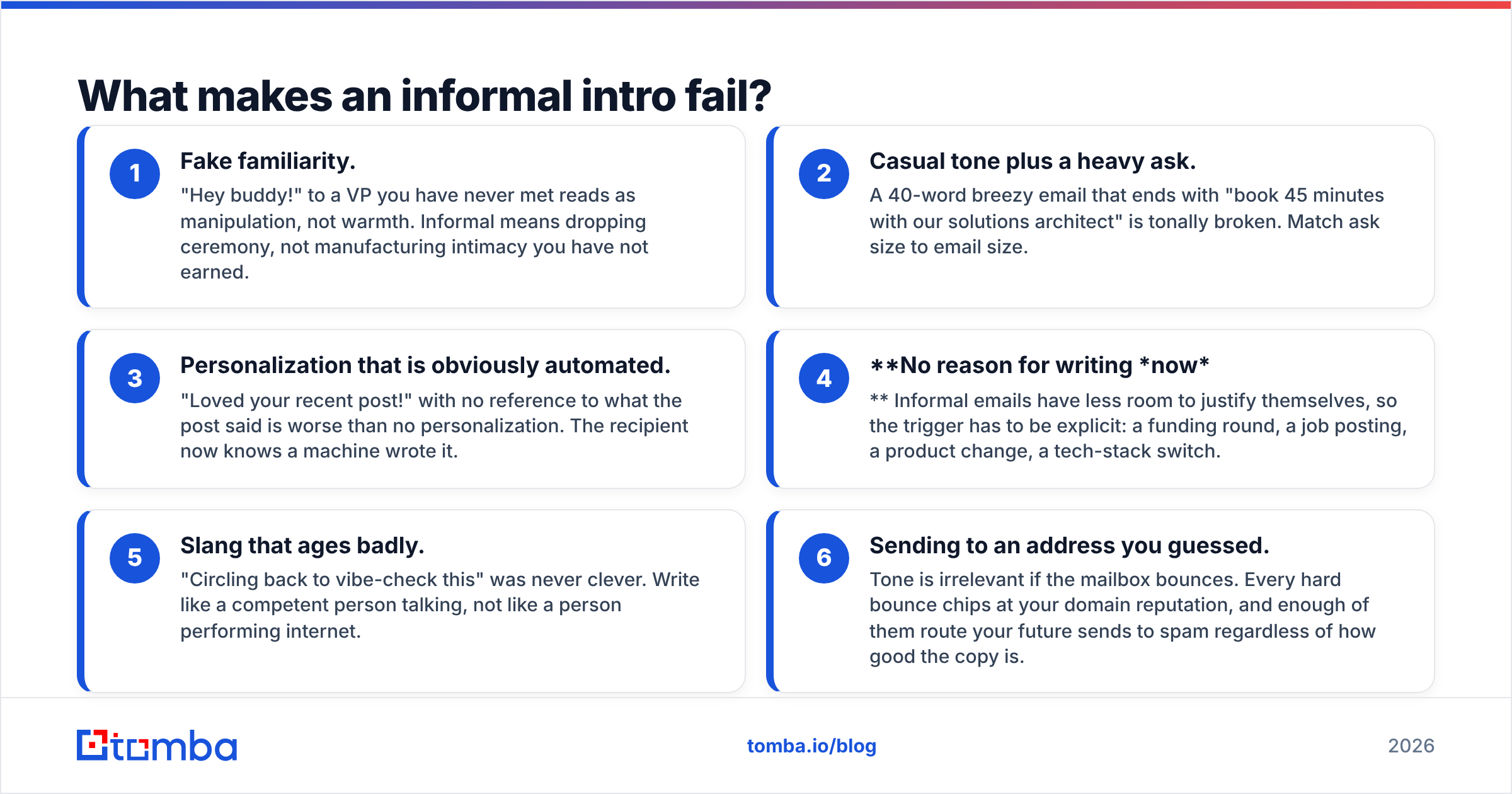
- Fake familiarity. "Hey buddy!" to a VP you have never met reads as manipulation, not warmth. Informal means dropping ceremony, not manufacturing intimacy you have not earned.
- Casual tone plus a heavy ask. A 40-word breezy email that ends with "book 45 minutes with our solutions architect" is tonally broken. Match ask size to email size.
- Personalization that is obviously automated. "Loved your recent post!" with no reference to what the post said is worse than no personalization. The recipient now knows a machine wrote it.
- No reason for writing now. Informal emails have less room to justify themselves, so the trigger has to be explicit: a funding round, a job posting, a product change, a tech-stack switch.
- Slang that ages badly. "Circling back to vibe-check this" was never clever. Write like a competent person talking, not like a person performing internet.
- Sending to an address you guessed. Tone is irrelevant if the mailbox bounces. Every hard bounce chips at your domain reputation, and enough of them route your future sends to spam regardless of how good the copy is.

Does informal tone hurt deliverability?#
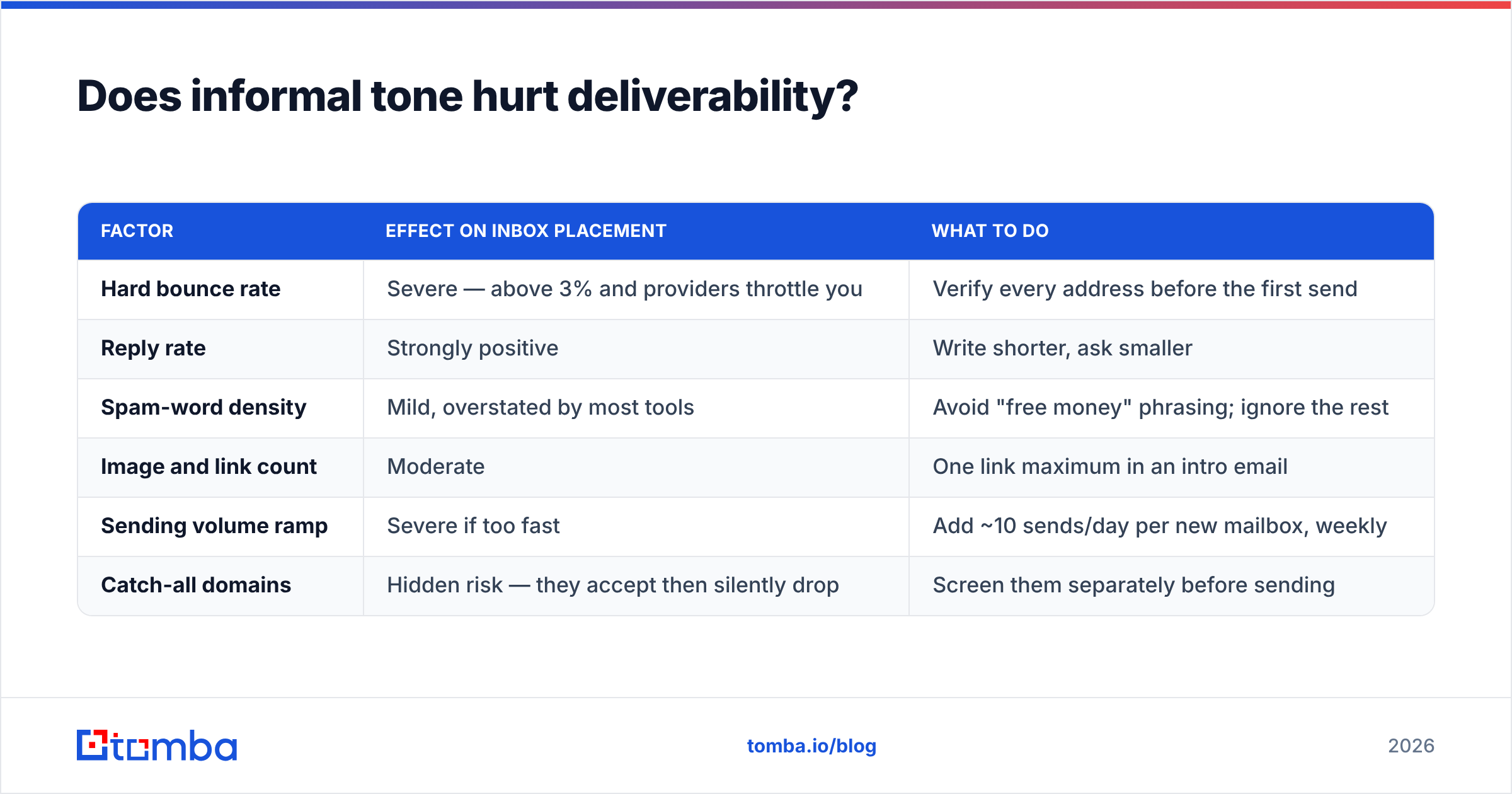
Tone itself is neutral to mailbox providers. What actually moves deliverability is engagement and list hygiene — and here informal copy helps slightly, because shorter emails that earn replies are the strongest positive signal you can send Gmail and Outlook.
The real risk sits upstream of the copy:
| Factor | Effect on inbox placement | What to do |
|---|---|---|
| Hard bounce rate | Severe — above 3% and providers throttle you | Verify every address before the first send |
| Reply rate | Strongly positive | Write shorter, ask smaller |
| Spam-word density | Mild, overstated by most tools | Avoid "free money" phrasing; ignore the rest |
| Image and link count | Moderate | One link maximum in an intro email |
| Sending volume ramp | Severe if too fast | Add ~10 sends/day per new mailbox, weekly |
| Catch-all domains | Hidden risk — they accept then silently drop | Screen them separately before sending |
Run your list through an email verifier before any intro campaign, and screen catch-all domains with a catch-all verifier rather than assuming an accepted SMTP handshake means a real person. Gartner's sales research hub is consistent on this point: data quality, not message volume, is what separates outbound teams that hit quota from teams that burn domains.
How do you adapt one sample across a whole list?#
The mistake is rewriting twelve emails from scratch for every prospect. The efficient version is to keep the skeleton fixed and vary exactly one variable — the first line.
- Fixed: salutation, your one-line identity, the ask, the sign-off.
- Variable: the opening observation, drawn from a single repeatable source.
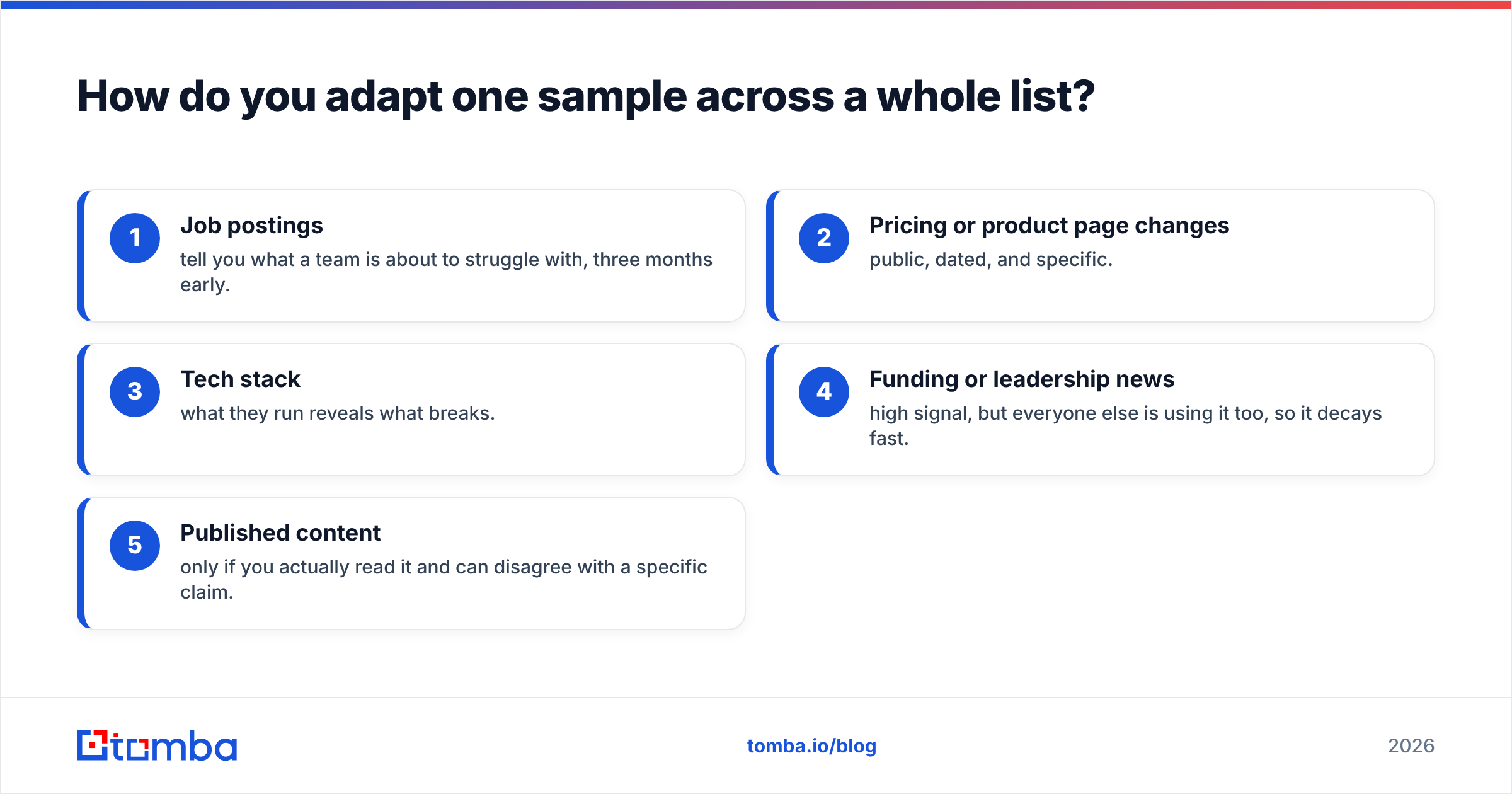
Pick one source and use it for the entire segment. Good sources, ranked by effort-to-signal ratio:
- Job postings — tell you what a team is about to struggle with, three months early.
- Pricing or product page changes — public, dated, and specific.
- Tech stack — what they run reveals what breaks.
- Funding or leadership news — high signal, but everyone else is using it too, so it decays fast.
- Published content — only if you actually read it and can disagree with a specific claim.
Once you have the segment and the source, the bottleneck is contact data, not writing. Pull company-wide contacts with domain search, then confirm the exact person before you paste them into a sequence.
What should you take from this?#
Pick one sample above that matches your actual situation, strip anything that sounds like it was written to impress a compliance officer, and send it to ten people today. Informal intros fail in two ways only: they are too familiar, or they are sent to addresses that do not exist. The first is a writing problem you can fix in one pass. The second is a data problem.
Fix the data problem first. The Tomba Email Finder finds and verifies professional addresses by name, domain, or company, with 25 free searches a month to test it and paid plans starting at $49/mo — see Tomba pricing for the full breakdown. Get the address right, then let the casual first line do its job.
Related guides#
// get started
Find, verify and enrich your first contacts today
Start on the free plan with 25 searches a month, then scale when your team is ready.
Free plan · No credit card required · GDPR & CCPA
// about the author