Informal Meeting Invitation Email Sample: 7 Templates That Work
Seven informal meeting invitation email samples you can copy today, plus the subject lines, timing rules, and tone calibration that decide whether you get a yes or silence.
TL;DR
- An informal meeting invitation email trades ceremony for speed: short subject, one clear ask, a specific time, and an easy out. Under 90 words is the sweet spot.
- Informal beats formal when you already have a relationship, warm context, or internal footing. It backfires with senior external stakeholders, legal or procurement contacts, and anyone in a compliance-heavy role.
- The single highest-leverage edit: replace "let me know when works" with one proposed slot plus a fallback. Decision fatigue kills more invites than tone ever does.
- All seven samples below are copy-paste ready — internal sync, warm prospect, dormant contact, event follow-up, peer networking, and two reschedules.
- A perfect casual invite still fails if the address is wrong. Verify before you send, or your friendly tone bounces into a void.
What is an informal meeting invitation email?#
An informal meeting invitation email is a short, conversational request to talk — no letterhead, no "Dear Sir or Madam," no three-paragraph agenda. It reads like a message you'd send a colleague you actually like.
Think of it as the difference between a printed dinner invitation and leaning over a cubicle wall to say "grabbing coffee at 3, come?" Both get someone into a room. One takes forty minutes to write and creates an obligation. The other takes eleven seconds and creates an option. Technically, the informal version compresses the standard invite structure — greeting, purpose, time, logistics, sign-off — into two or three sentences and drops the hedging language that makes formal invites feel like a summons.
The format has quietly become the default in B2B. Calendars are the real scarce resource, and a 45-minute block described as "a discussion regarding potential synergies" reads as a cost. A 15-minute block described as "want to show you the thing we fixed" reads as a favor.
When should you send an informal invite instead of a formal one?#
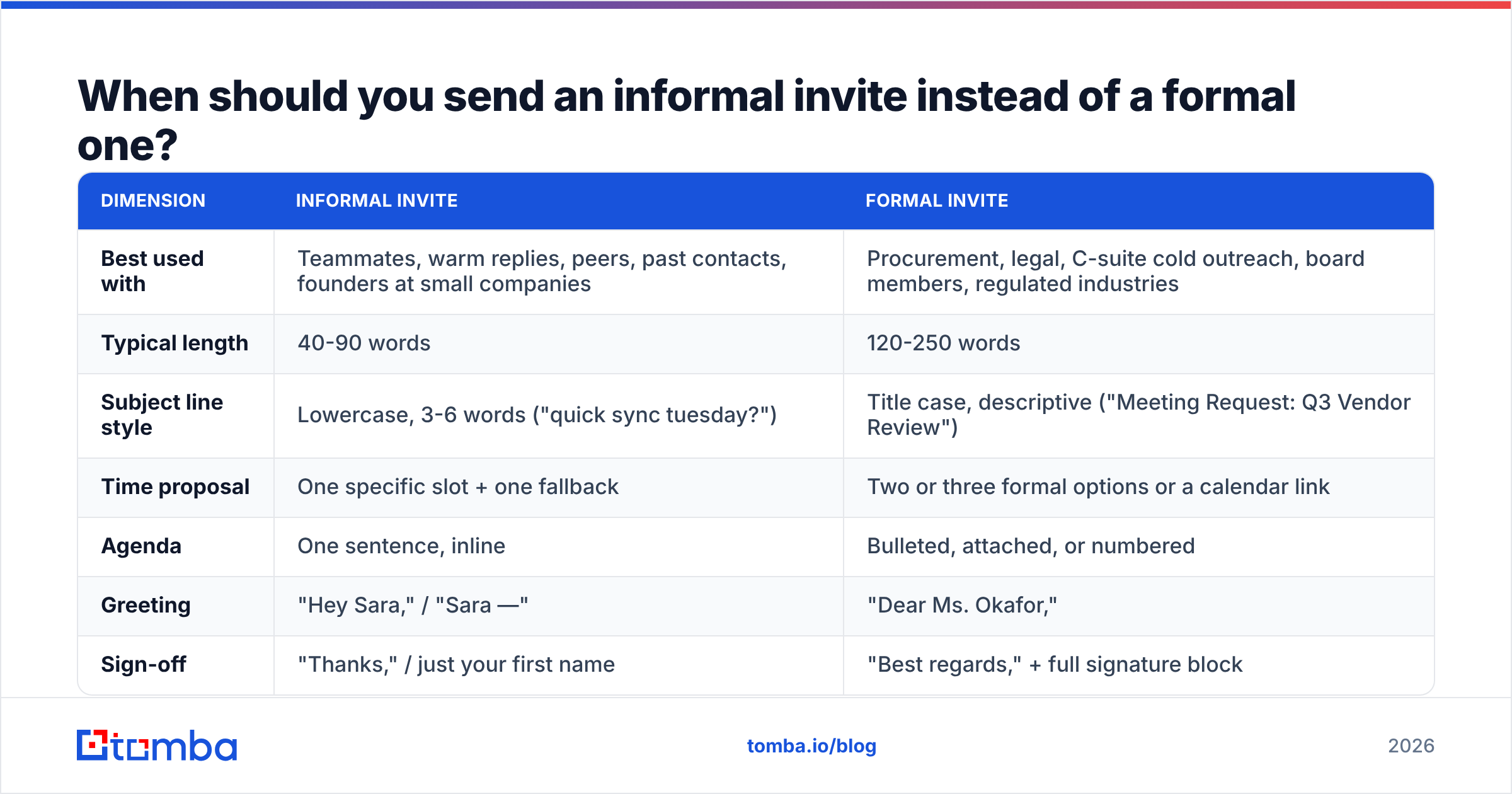
Match the register to the relationship, not to your own comfort. Here's the decision grid most teams need:
| Dimension | Informal invite | Formal invite |
|---|---|---|
| Best used with | Teammates, warm replies, peers, past contacts, founders at small companies | Procurement, legal, C-suite cold outreach, board members, regulated industries |
| Typical length | 40-90 words | 120-250 words |
| Subject line style | Lowercase, 3-6 words ("quick sync tuesday?") | Title case, descriptive ("Meeting Request: Q3 Vendor Review") |
| Time proposal | One specific slot + one fallback | Two or three formal options or a calendar link |
| Agenda | One sentence, inline | Bulleted, attached, or numbered |
| Greeting | "Hey Sara," / "Sara —" | "Dear Ms. Okafor," |
| Sign-off | "Thanks," / just your first name | "Best regards," + full signature block |
| Risk if you get it wrong | Reads as presumptuous or junior | Reads as cold, slow, or bureaucratic |
| Realistic reply window | Same day to 48 hours | 3-7 business days |
The failure mode nobody warns you about: sending informal to someone who has never heard of you. Casual tone is a withdrawal from a relationship account. If the balance is zero, you're overdrawn. Warm up first — reply to their post, answer their support ticket, get introduced — then go casual.
What are the parts of an informal meeting invitation email that actually work?#
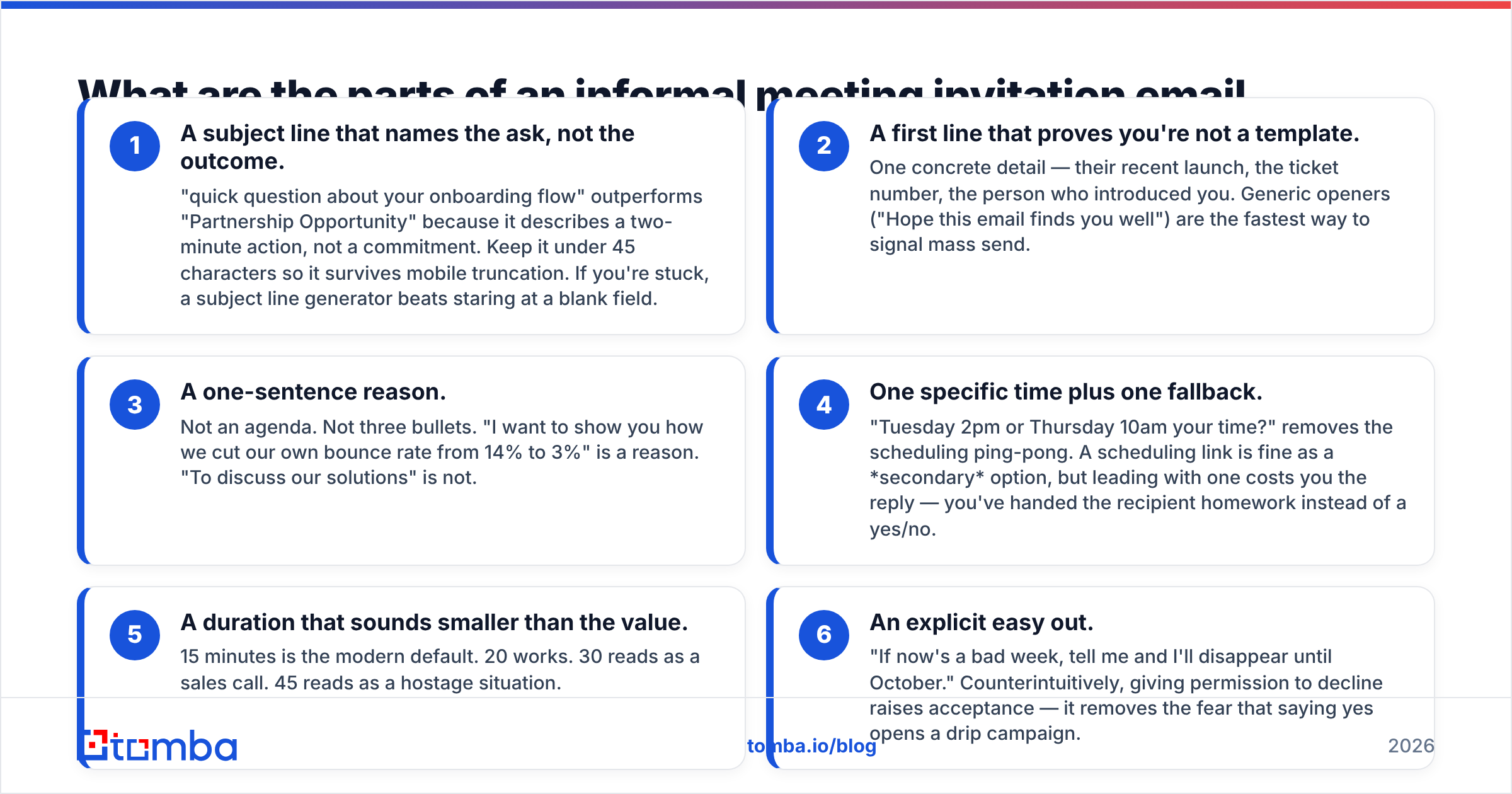
Every sample below is built from the same six components. Cut any of them and the reply rate drops.
- A subject line that names the ask, not the outcome. "quick question about your onboarding flow" outperforms "Partnership Opportunity" because it describes a two-minute action, not a commitment. Keep it under 45 characters so it survives mobile truncation. If you're stuck, a subject line generator beats staring at a blank field.
- A first line that proves you're not a template. One concrete detail — their recent launch, the ticket number, the person who introduced you. Generic openers ("Hope this email finds you well") are the fastest way to signal mass send.
- A one-sentence reason. Not an agenda. Not three bullets. "I want to show you how we cut our own bounce rate from 14% to 3%" is a reason. "To discuss our solutions" is not.
- One specific time plus one fallback. "Tuesday 2pm or Thursday 10am your time?" removes the scheduling ping-pong. A scheduling link is fine as a secondary option, but leading with one costs you the reply — you've handed the recipient homework instead of a yes/no.
- A duration that sounds smaller than the value. 15 minutes is the modern default. 20 works. 30 reads as a sales call. 45 reads as a hostage situation.
- An explicit easy out. "If now's a bad week, tell me and I'll disappear until October." Counterintuitively, giving permission to decline raises acceptance — it removes the fear that saying yes opens a drip campaign.
What does a good informal meeting invitation email sample look like?#
Seven scenarios, seven drop-in templates. Swap the brackets and send.
Sample 1 — Internal team sync#
Subject: 15 min on the onboarding drop-off?
Hey Marcus,
The week-2 drop-off number from Friday's dashboard has been bugging me. I have two theories and no idea which is right.
Got 15 minutes Wednesday at 11? Thursday 3pm also works. I'll bring the cohort chart, you bring the reason I'm wrong.
— Priya
Why it works: a real artifact (the dashboard), a stated uncertainty, and a light joke that signals this is a working session, not a review.
Sample 2 — Cross-team ask where you have no authority#
Subject: borrowing 20 minutes of design brain
Hi Dana,
Support flagged 40+ tickets last month about the export screen, and I don't want to guess at a fix without you.
Any chance we grab 20 minutes next week? Tuesday or Wednesday afternoon are open on my side — happy to work around your calendar either way.
Thanks,
Sam
Why it works: it leads with evidence, frames the ask as respect for their expertise, and defers on timing because you're the one asking for a favor.
Sample 3 — Warm prospect who already replied#
Subject: the deliverability thing you mentioned
Hey Alex,
You said your reply rates tanked after the domain migration — that's a pattern we've cleaned up about a dozen times, usually in one sitting.
Want to do 15 minutes Thursday at 2pm ET? I'll walk through what we'd check first, whether or not you end up working with us.
Nadia
Why it works: it quotes their own words back, offers value that survives a "no," and time-boxes tightly. The "whether or not" clause is the trust unlock.
Sample 4 — Reconnecting with a dormant contact#
Subject: still at Vertex?
Hi Tom,
We talked back in March about the data-warehouse project, then both of us went quiet — I assume yours got as loud as mine did.
If it's still live, I'd love 15 minutes to hear where it landed. Next Tuesday morning? If the project died a quiet death, just reply "dead" and I'll stop bothering you.
Ben
Why it works: it acknowledges the silence instead of pretending it didn't happen, and the one-word exit ("dead") is so easy that people actually use it — which cleans your pipeline for free.
Sample 5 — Post-event or post-webinar follow-up#
Subject: your question about attribution
Hey Lucia,
You asked the attribution question at the end of Thursday's session and I gave you a rushed 30-second answer. It deserved better.
Free for 15 minutes Monday at 10am PT? I'll show you the actual model we use, including the parts that don't work.
— Ravi
Why it works: specificity you couldn't fake, plus an implied apology that creates a small reciprocity debt. "Including the parts that don't work" buys credibility cheaply.
Sample 6 — Peer networking with no commercial angle#
Subject: comparing notes on PLG pricing?
Hi Jess,
I read your teardown of usage-based pricing twice. We're two months into the same migration and hitting the exact problem you described in point four.
Any interest in swapping notes for 20 minutes? Wednesday or Friday, whichever's less painful. Nothing to sell — I just want to know if you solved it.
Omar
Why it works: "nothing to sell" is doing heavy lifting. Peers assume every invite is a disguised pitch; naming and denying it resets the frame.
Sample 7 — Rescheduling without losing the meeting#
Subject: need to move Thursday — my fault
Hey Kim,
A customer escalation ate my Thursday. Entirely on me.
Can we do the same slot Monday, or Tuesday at 1pm if Monday's full? If neither works, send me two times and I'll take whichever.
Sorry for the shuffle,
Dev
Why it works: it owns the cancellation in four words, proposes replacements immediately, and ends with a blank-check offer. Most reschedules die because the sender says "let's find another time" and then nobody does.
Which subject lines get informal meetings accepted?#
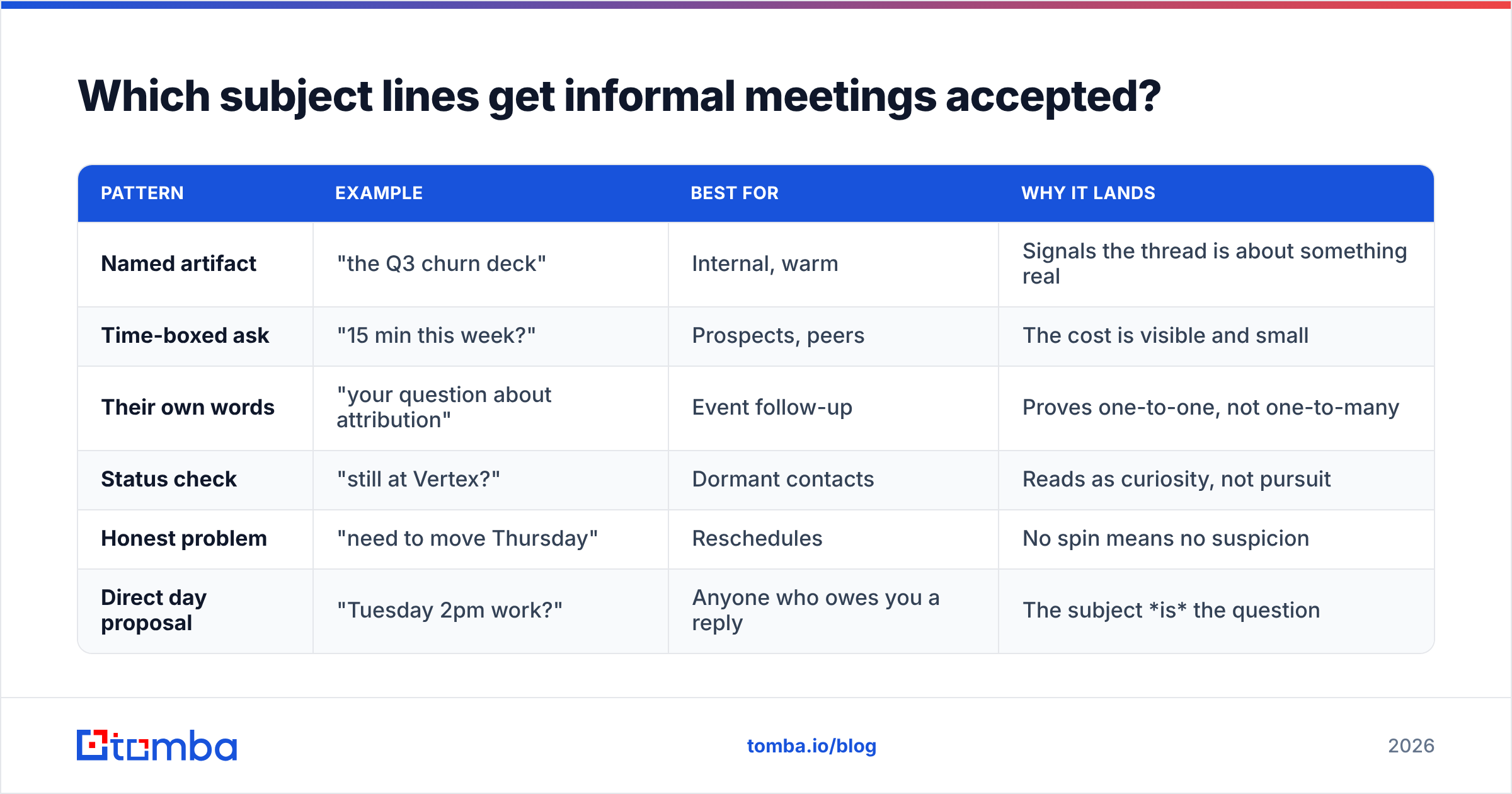
The subject line is 80% of whether the body ever gets read. These six patterns hold up across internal and external sends:
| Pattern | Example | Best for | Why it lands |
|---|---|---|---|
| Named artifact | "the Q3 churn deck" | Internal, warm | Signals the thread is about something real |
| Time-boxed ask | "15 min this week?" | Prospects, peers | The cost is visible and small |
| Their own words | "your question about attribution" | Event follow-up | Proves one-to-one, not one-to-many |
| Status check | "still at Vertex?" | Dormant contacts | Reads as curiosity, not pursuit |
| Honest problem | "need to move Thursday" | Reschedules | No spin means no suspicion |
| Direct day proposal | "Tuesday 2pm work?" | Anyone who owes you a reply | The subject is the question |
What to avoid: title-case corporate phrasing ("Meeting Request Regarding Our Solutions"), anything with "Touching Base," and — critically — false-reply tricks like "RE:" on a thread that never existed. That last one torches trust the moment it's noticed, and modern filters increasingly flag it. HubSpot's own sales team resources have been hammering this point for years, and the data hasn't moved: honesty in the subject line correlates with meeting-held rate, not just open rate.
How informal is too informal?#
There's a line, and it moves by context. Three reliable tripwires:
Slang that assumes shared culture. "Wanna hop on a quick one?" reads fine between two 28-year-old SDRs and reads like a stranger's DM to a 55-year-old VP of Finance. When in doubt, drop the slang and keep the brevity — short and plain is universally safe.
Humor aimed at the recipient. Self-deprecating jokes ("bring the reason I'm wrong") work. Jokes about their company, their tech stack, or their industry do not. You don't have the standing yet.
Punctuation chaos. Multiple exclamation marks, lowercase-everything, or ellipses everywhere signal carelessness rather than casualness. Informal writing is still edited writing — it just hides the effort.
One more: never use informal tone to shrink a big ask. "hey quick 15 min?" for what is actually a two-hour contract negotiation is a bait-and-switch, and people remember it. Match the register to the reality.
Why do good informal invites still go unanswered?#
Because tone was never the bottleneck. Three things kill more invites than word choice:
The address is wrong. Role churn is brutal — a meaningful share of B2B contact records go stale within a year as people change jobs, companies rebrand, and mail servers change patterns. If you're sending to a guessed pattern like first.last@company.com without checking, you're writing beautiful emails to a wall. Run addresses through an email verifier before the send, and use domain search to confirm the company's actual format rather than assuming.
You sent at the wrong hour. Informal invites depend on being read while the recipient is in a decision-making mood. Mid-morning Tuesday through Thursday, in their timezone, still outperforms Monday 8am (buried) and Friday 4pm (ignored). Google's own Calendar documentation makes timezone handling easy — use it, and never propose a slot without naming the zone.
There was no second touch. One invite is a coin flip. A single short bump three business days later — "floating this back up, still happy to work around you" — recovers a large share of non-responses without any added pressure. Two follow-ups is the ceiling for a casual ask; beyond that, the informality starts reading as persistence, and your response rate goes negative in the reputational sense even if the numbers hold.
What should you check before hitting send?#
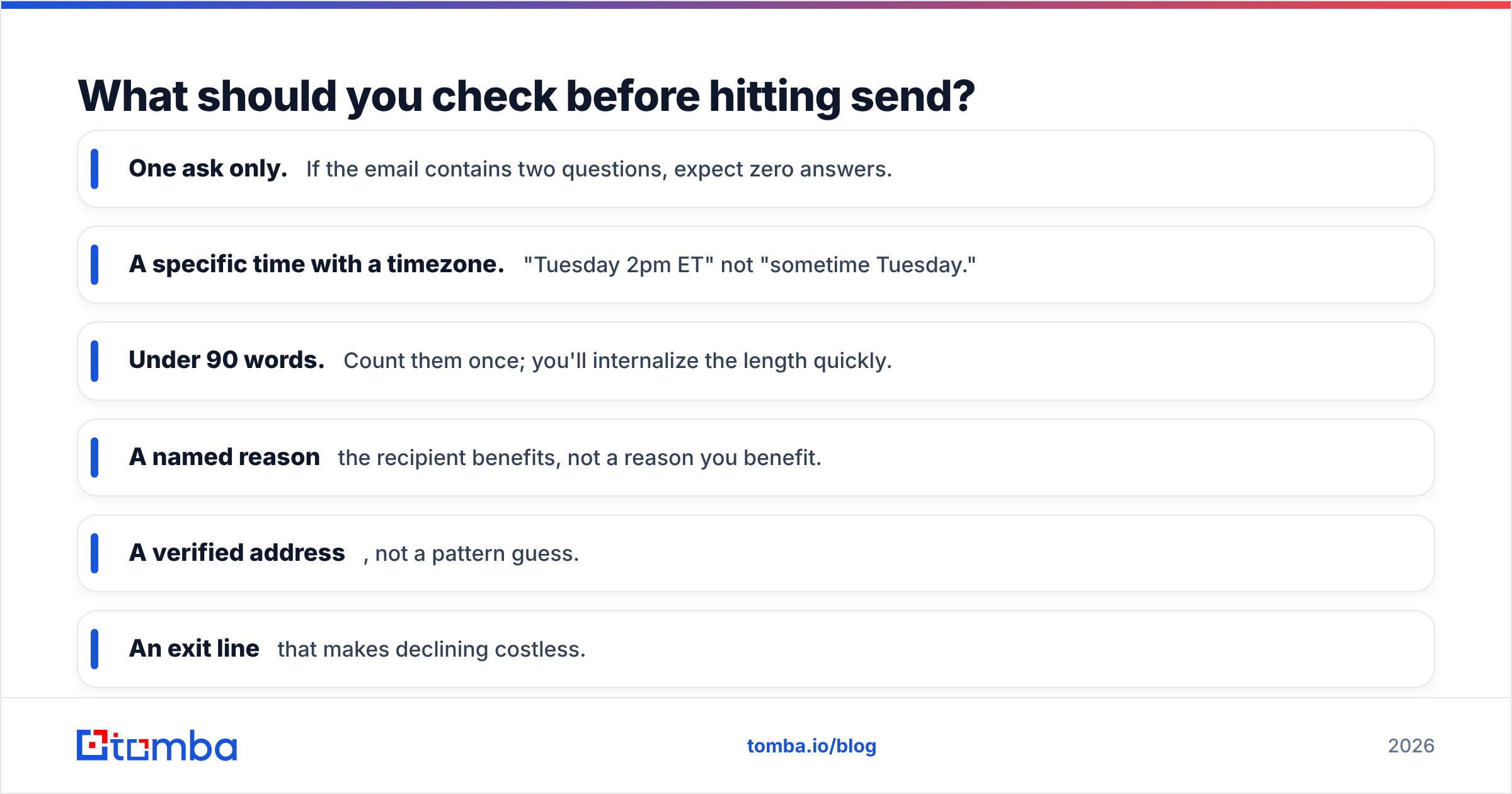
Run this list in under a minute:
- One ask only. If the email contains two questions, expect zero answers.
- A specific time with a timezone. "Tuesday 2pm ET" not "sometime Tuesday."
- Under 90 words. Count them once; you'll internalize the length quickly.
- A named reason the recipient benefits, not a reason you benefit.
- A verified address, not a pattern guess.
- An exit line that makes declining costless.
Frequently asked questions#
How long should an informal meeting invitation email be? Forty to ninety words. If you're over 120, you've written a formal invite in a casual voice — the worst of both.
Should I attach a calendar invite immediately? No. Send the calendar hold after they say yes. An unsolicited calendar block on a stranger's schedule reads as entitled, and many people auto-decline them.
Is it okay to use first names with someone I've never met? Yes, in most Western B2B contexts, provided the rest of the email earns it with specificity. In markets with stronger formality norms — Germany, Japan, much of Korea — start formal and let them set the pace.
What if they don't reply at all? One bump at day three, one final note at day ten, then stop and move the contact to a nurture list. Silence is data.
Can I reuse the same sample across a whole list? Only the skeleton. The first line has to change every time, or the template collapses into the generic outreach these samples exist to replace.
Start with an address that actually works#
The best informal meeting invitation email sample in the world is worthless if it lands in a mailbox nobody reads. Before you send the templates above, confirm you're writing to a real, current, deliverable address — Tomba Email Finder turns a name and a domain into a verified work address in seconds, with a free tier of 25 searches a month and paid plans starting at $49/mo when you're ready to scale. Get the address right, keep the invite under ninety words, propose one specific time, and the calendar takes care of itself.
Related guides#
// get started
Find, verify and enrich your first contacts today
Start on the free plan with 25 searches a month, then scale when your team is ready.
Free plan · No credit card required · GDPR & CCPA
Get the Tomba newsletter
Product and data updates
// about the author