Informal Meeting Request Email: Templates and Examples for 2026
Formal meeting requests read like a contract. Informal ones read like a person. Here is exactly when to go casual, what to write, and the templates that actually get a time on the calendar.
TL;DR
- An informal meeting request email trades protocol for speed: short subject, one-line context, a specific ask, and a low-friction way to say yes.
- Go informal when there is existing warmth (a reply, a referral, a shared event, a past customer). Stay formal for cold executives, procurement, legal, and regulated industries.
- The single biggest lever is not tone. It is the size of the ask. "15 minutes Thursday" beats "a meeting to discuss synergies" every time.
- Templates below cover seven real situations: warm referral, post-webinar, LinkedIn follow-up, dormant customer, internal cross-team, conference pre-book, and the polite nudge.
- Casual wording does not rescue a bad address. If the email bounces, tone is irrelevant, so verify before you send.
What Is an Informal Meeting Request Email?#
An informal meeting request email is a short message that asks for someone's time using conversational language instead of business protocol. No "I hope this email finds you well." No three-paragraph credentials dump. It reads like something a colleague would actually type between meetings.
Think of the difference like showing up at someone's door. A formal request is a printed invitation slipped under the door with an RSVP card. An informal request is knocking and saying "got two minutes?" Both can work. They fail for completely different reasons. The invitation fails because it is slow and easy to ignore. The knock fails when you have no business being at that door.
Technically, the informal version compresses four elements into roughly 60 to 90 words: a reason you are writing, a reason it matters to them, a specific time ask, and an easy exit. Everything else is decoration.
The format has spread because buyer behavior changed. Buyers now do most of their research before they ever talk to a vendor, and Gartner's sales research has tracked that shift for years. By the time someone agrees to a call, they are not evaluating your letterhead. They are deciding whether fifteen minutes with you is worth more than fifteen minutes of anything else.
When Should You Send an Informal Request Instead of a Formal One?#
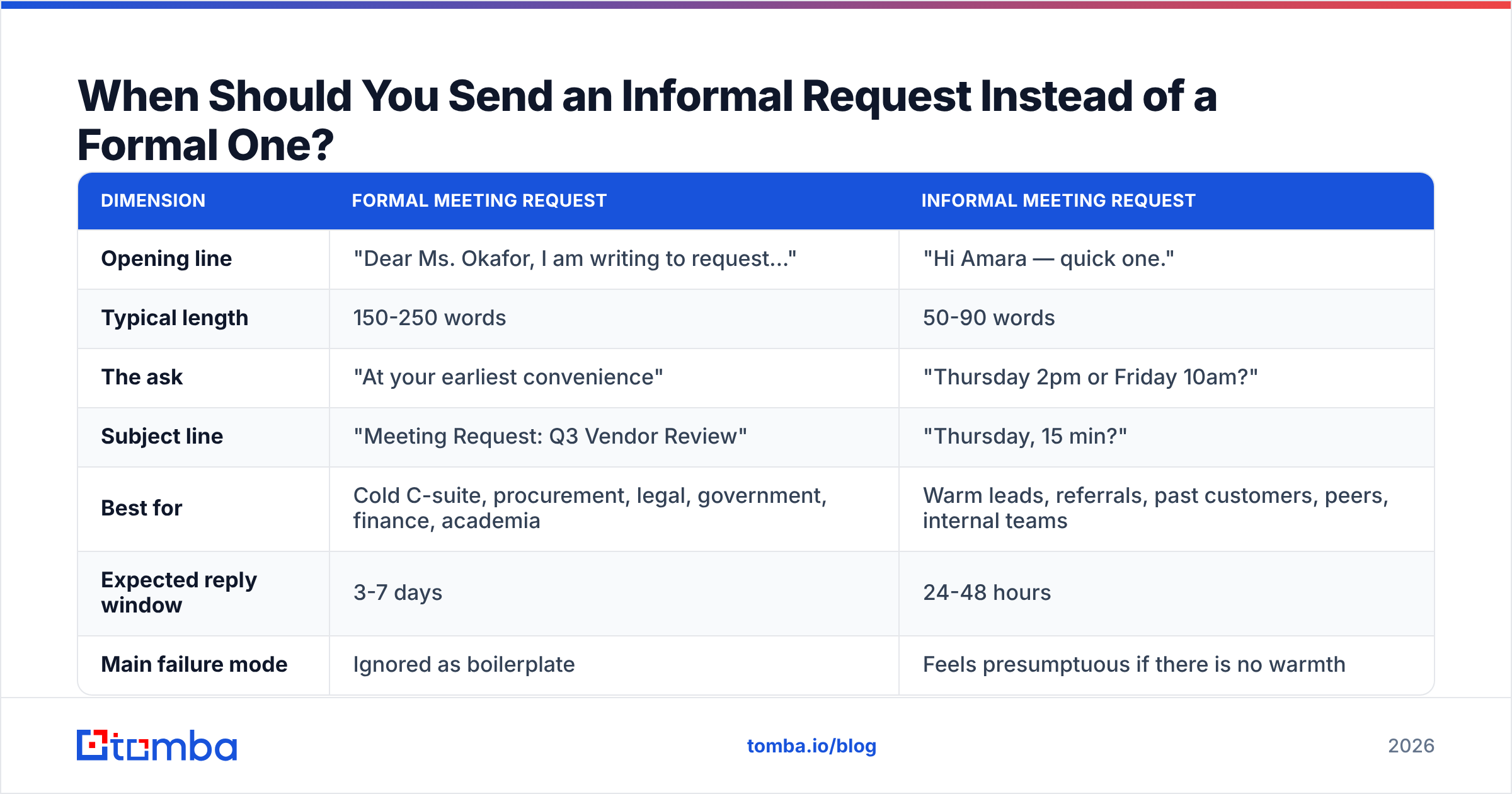
Tone is a function of relationship distance and organizational risk. Here is the practical split.
| Dimension | Formal meeting request | Informal meeting request |
|---|---|---|
| Opening line | "Dear Ms. Okafor, I am writing to request..." | "Hi Amara — quick one." |
| Typical length | 150-250 words | 50-90 words |
| The ask | "At your earliest convenience" | "Thursday 2pm or Friday 10am?" |
| Subject line | "Meeting Request: Q3 Vendor Review" | "Thursday, 15 min?" |
| Best for | Cold C-suite, procurement, legal, government, finance, academia | Warm leads, referrals, past customers, peers, internal teams |
| Expected reply window | 3-7 days | 24-48 hours |
| Main failure mode | Ignored as boilerplate | Feels presumptuous if there is no warmth |
The dividing question is simple: has this person given you any signal at all? A reply, a download, a webinar registration, a LinkedIn comment, a mutual contact who said "mention my name." If yes, informal usually wins. If no, you are a stranger being casual, which reads as entitled rather than friendly.
There is a second filter: industry norms. A VP of Engineering at a Series B startup will find formal language faintly ridiculous. A compliance director at a regional bank will find informal language unprofessional. When you are unsure, mirror the tone of their last message to you, or the tone of their public writing.
What Goes Into an Informal Meeting Request Email?#
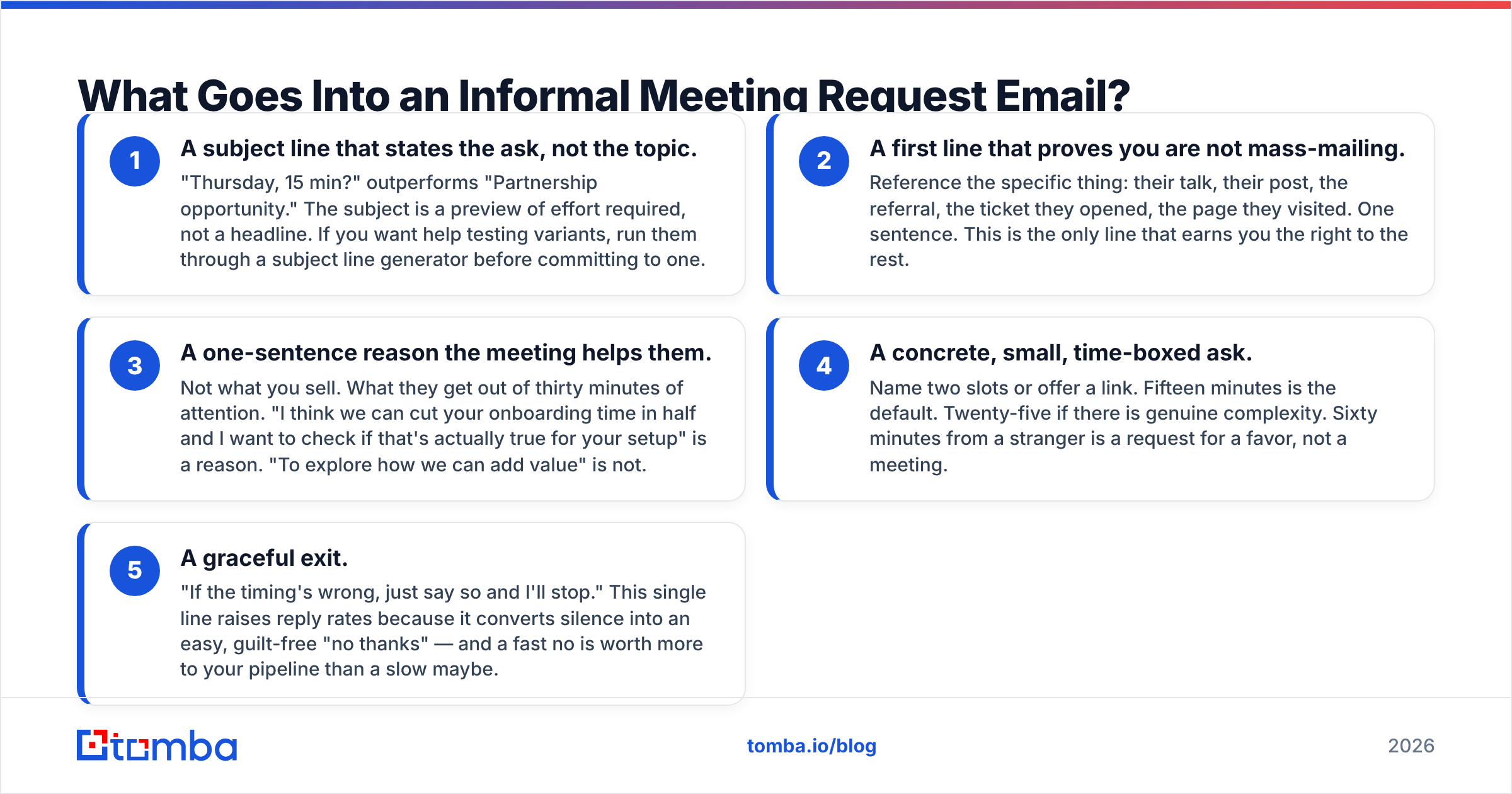
Five components, in this order. Cut anything that does not fit one of them.
A subject line that states the ask, not the topic. "Thursday, 15 min?" outperforms "Partnership opportunity." The subject is a preview of effort required, not a headline. If you want help testing variants, run them through a subject line generator before committing to one.
A first line that proves you are not mass-mailing. Reference the specific thing: their talk, their post, the referral, the ticket they opened, the page they visited. One sentence. This is the only line that earns you the right to the rest.
A one-sentence reason the meeting helps them. Not what you sell. What they get out of thirty minutes of attention. "I think we can cut your onboarding time in half and I want to check if that's actually true for your setup" is a reason. "To explore how we can add value" is not.
A concrete, small, time-boxed ask. Name two slots or offer a link. Fifteen minutes is the default. Twenty-five if there is genuine complexity. Sixty minutes from a stranger is a request for a favor, not a meeting.
A graceful exit. "If the timing's wrong, just say so and I'll stop." This single line raises reply rates because it converts silence into an easy, guilt-free "no thanks" — and a fast no is worth more to your pipeline than a slow maybe.
Notice what is missing: your company boilerplate, your credentials, a case study, a PDF attachment, three calls to action. An informal request has exactly one call to action. Adding a second one is how you turn a 90-second decision into a task the recipient defers.
What Do Good Informal Meeting Request Emails Look Like?#
Seven templates for seven real situations. Swap the brackets, keep the length.
1. Warm referral
Subject: [Referrer] suggested I reach out
Hi [First name],
[Referrer] mentioned you're rebuilding the reporting layer this quarter and thought we should talk — she said you two ran into the same attribution mess at [Previous company].
Worth 15 minutes? I'm free Wednesday after 2 or Thursday morning. Happy to just answer questions and leave you alone after that.
[Your name]
2. Post-webinar follow-up
Subject: your question about data retention
Hi [First name],
You asked about retention limits during Tuesday's session and I gave you a half-answer because we were out of time. The full version takes about ten minutes and depends on how your instance is configured.
Want to grab a slot Thursday or Friday? Either works for me.
[Your name]
3. LinkedIn conversation to calendar
Subject: moving this off LinkedIn
Hi [First name],
Enjoyed the back-and-forth on your post about SDR ramp time. LinkedIn comments are a terrible place to get into detail, so — 15 minutes next week?
Tuesday 11am or Thursday 3pm, your call. No deck, I promise.
[Your name]
4. Dormant customer re-engagement
Subject: checking in before renewal
Hi [First name],
Your renewal's up in six weeks and I noticed usage dropped off around March. Before anyone sends you a quote, I'd rather find out whether the thing still fits.
20 minutes sometime this week? Totally fine if the answer is "we're moving on" — I'd just like to hear why.
[Your name]
5. Internal cross-team request
Subject: 15 min on the Q4 handoff?
Hi [First name],
Support is getting tickets that should be routed to your team and I think the handoff doc is out of date. Rather than trade Slack messages for a week, can we just talk it through?
I've got Thursday 10-11 open. Grab whatever slice you want.
[Your name]
6. Conference pre-booking
Subject: at SaaStr next month?
Hi [First name],
Saw you're speaking Wednesday at SaaStr. I'll be there Tuesday through Thursday and would rather have a real conversation than a booth conversation.
Coffee Wednesday morning before your session, or Thursday whenever you're free?
[Your name]
7. The polite nudge (send 4-5 days later)
Subject: re: Thursday, 15 min?
Hi [First name],
Bumping this once in case it got buried. If now's not the moment, reply "not now" and I'll check back in Q1 — no hard feelings.
[Your name]
The nudge deserves a note. One follow-up is professional. Four is harassment with a calendar link. A single well-timed bump typically recovers a meaningful share of non-responses, and giving people a two-word way to decline protects your response rate data from being polluted by people who were never going to say yes.
How Do You Ask for Time Without Sounding Pushy?#
Pushiness is almost never about word choice. It is about asymmetry — you asking for something large while offering something vague.
Three fixes that work:
Shrink the unit. "Fifteen minutes" and "twenty minutes" get accepted at noticeably different rates than "a call" or "some time." An unnamed duration is assumed to be an hour, and an hour is a real cost.
Offer two options, not an open calendar. Paradoxically, a scheduling link can feel like more work than two named slots, because the link outsources the decision back to the recipient. Name two times first; attach the link as a fallback. Google Calendar's appointment scheduling makes the fallback trivial to set up if you do not use a dedicated tool.
Give away the ending. "If it's not relevant I'll close the loop and stop emailing" removes the fear that agreeing to fifteen minutes means agreeing to a six-week nurture sequence. People do not avoid short meetings. They avoid what the short meeting might commit them to.
One more habit worth stealing from good salespeople: send on Tuesday, Wednesday, or Thursday, mid-morning in the recipient's timezone. Monday inboxes are triage. Friday inboxes are abandoned. HubSpot's sales blog publishes send-time studies regularly and the midweek pattern has been remarkably stable across years of data.
Which Format Fits Which Relationship?#
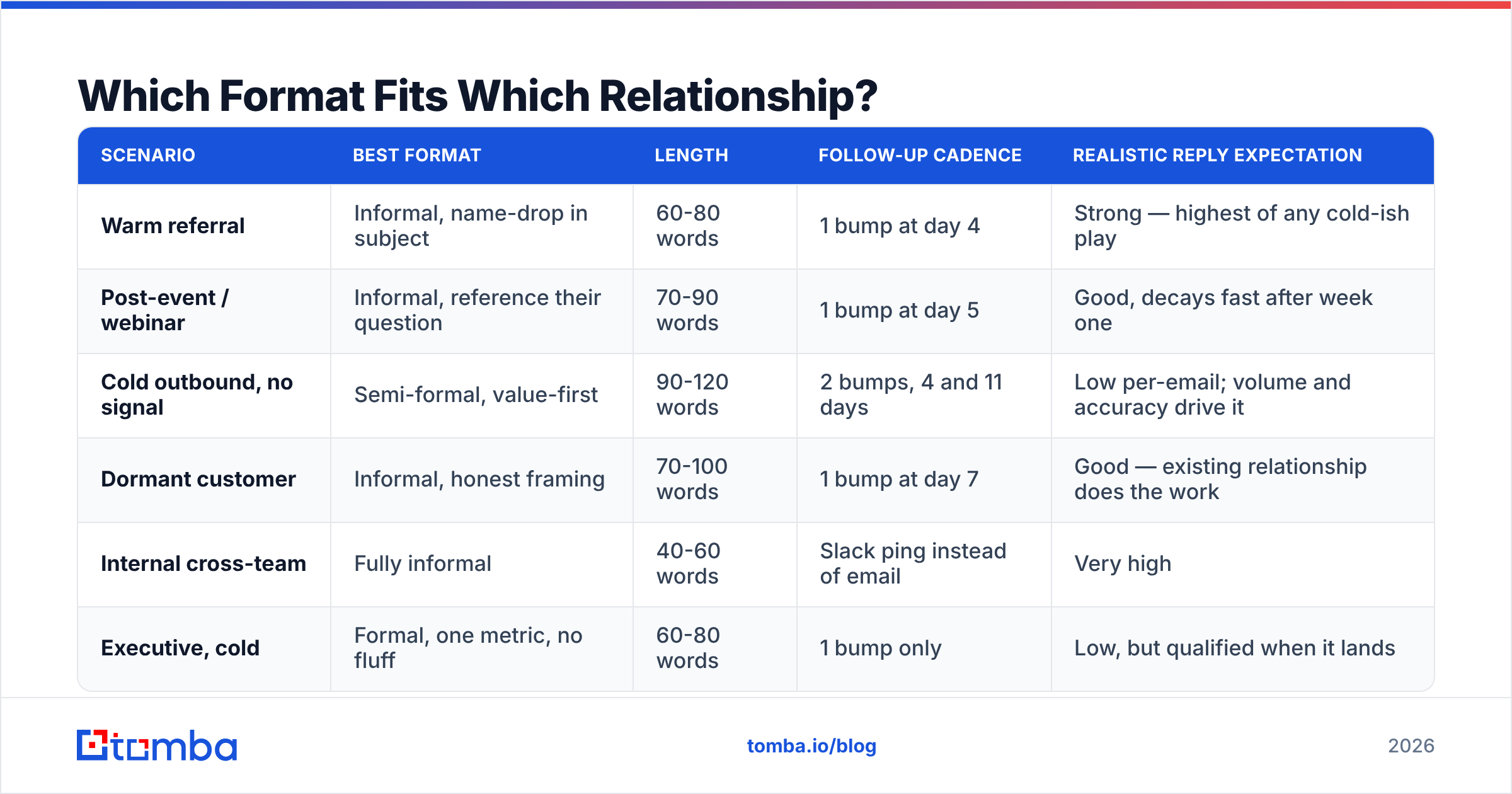
| Scenario | Best format | Length | Follow-up cadence | Realistic reply expectation |
|---|---|---|---|---|
| Warm referral | Informal, name-drop in subject | 60-80 words | 1 bump at day 4 | Strong — highest of any cold-ish play |
| Post-event / webinar | Informal, reference their question | 70-90 words | 1 bump at day 5 | Good, decays fast after week one |
| Cold outbound, no signal | Semi-formal, value-first | 90-120 words | 2 bumps, 4 and 11 days | Low per-email; volume and accuracy drive it |
| Dormant customer | Informal, honest framing | 70-100 words | 1 bump at day 7 | Good — existing relationship does the work |
| Internal cross-team | Fully informal | 40-60 words | Slack ping instead of email | Very high |
| Executive, cold | Formal, one metric, no fluff | 60-80 words | 1 bump only | Low, but qualified when it lands |
The row worth staring at is "cold outbound, no signal." That is the only line where tone barely moves the needle. When nobody knows you, deliverability and data quality decide the outcome before your first sentence is read.

Does Informal Tone Excuse Sloppy Data?#
No, and this is where most casual outreach quietly dies.
A conversational email sent to first.last@company.com when the company actually uses flast@company.com does not get a reply. It gets a bounce, and enough bounces drag down your sender reputation until even your good addresses start landing in spam. Tone is a multiplier on delivery, not a substitute for it.
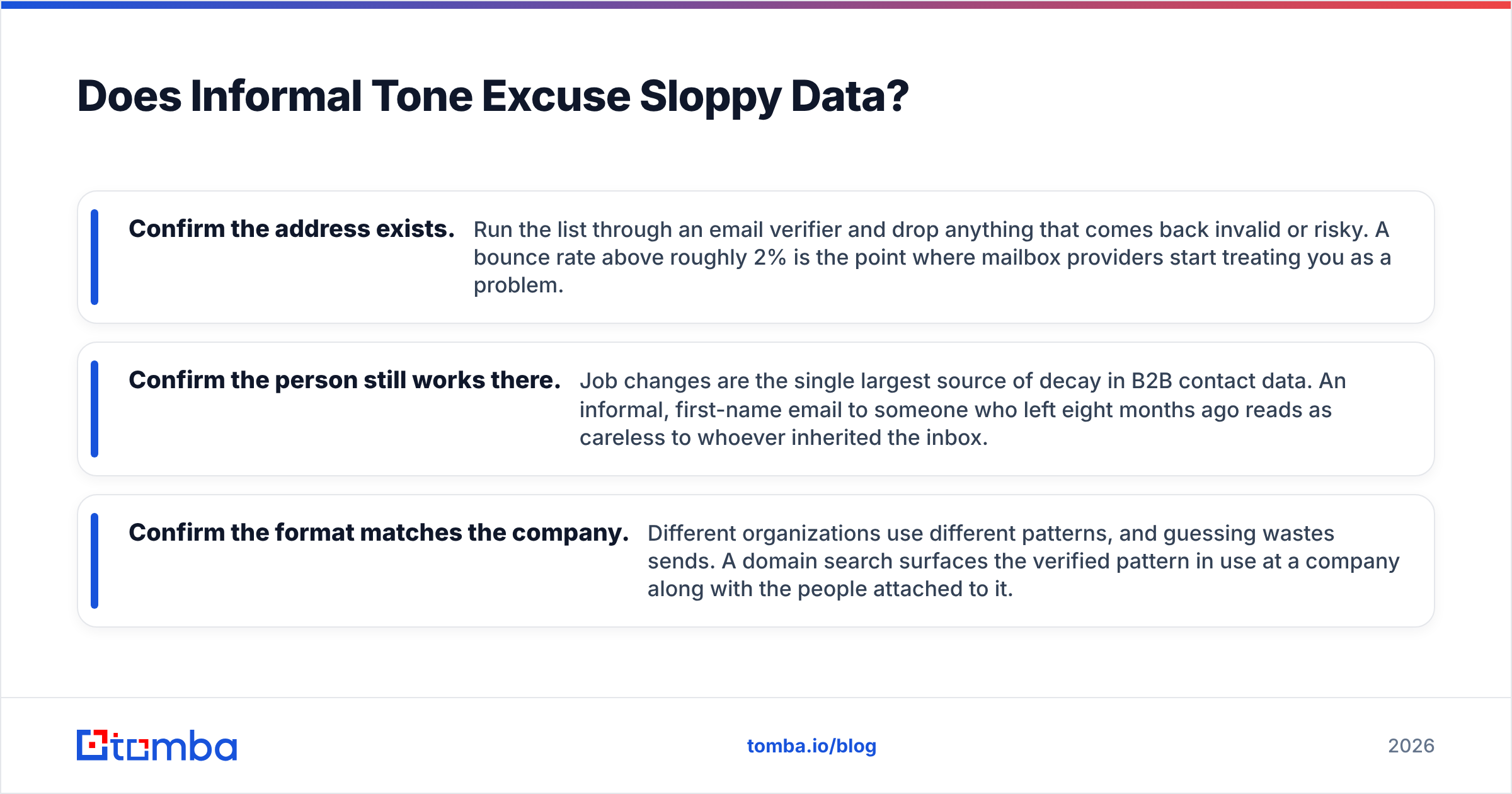
Three checks before any informal send:
- Confirm the address exists. Run the list through an email verifier and drop anything that comes back invalid or risky. A bounce rate above roughly 2% is the point where mailbox providers start treating you as a problem.
- Confirm the person still works there. Job changes are the single largest source of decay in B2B contact data. An informal, first-name email to someone who left eight months ago reads as careless to whoever inherited the inbox.
- Confirm the format matches the company. Different organizations use different patterns, and guessing wastes sends. A domain search surfaces the verified pattern in use at a company along with the people attached to it.
There is also a reputational argument. Informal outreach implies familiarity. Getting the name, the company, or the role wrong while writing as though you are old friends is worse than a formal email with the same error, because the mismatch is louder. Casual tone raises the accuracy bar rather than lowering it.
If you are building the list from scratch, an email finder that returns a confidence score and the public sources behind each address lets you sort your send list by reliability and send the high-confidence half first. That is a much better use of an informal template than blasting everything at once and hoping.
What Mistakes Kill Informal Meeting Requests?#
Fake familiarity. "Hey buddy!" to someone you have never met is not warmth, it is a costume. Informal means unstuffy, not overfamiliar.
Hidden length. "Quick question" followed by 300 words. The subject line is a promise. Break it and the next one goes unopened.
The vague ask. "Let me know if you'd like to connect" puts the work on them. They will not do it.
Attachments. A PDF in a first informal email signals that the fifteen minutes is really a sales presentation. Link to things instead, if you must.
Over-personalization theater. Mentioning their dog's name from Instagram is not research, it is surveillance. Reference professional context only.
No exit. Without a permission-to-decline line, non-responders stay non-responders forever and you never learn anything from the silence.
Sending at volume from one mailbox. Informal templates are cheap to produce, which tempts people into sending hundreds a day. That is how a healthy domain becomes a blocked one. Keep per-mailbox volume conservative and watch bounce and complaint rates weekly.
How Do You Test and Improve These Over Time?#
Treat each template as a hypothesis with three variables: subject line, length of the ask, and the exit line. Change one at a time, over at least 150 sends per variant, or you are reading noise.
Track four numbers: open rate as a rough proxy for subject and deliverability, reply rate as the real signal, meeting-booked rate, and bounce rate as your data-quality alarm. A template with a strong reply rate but a weak booking rate usually has an ask that is too large or too vague. A template with a good booking rate but a low reply rate is probably fine and just needs more volume from a clean list.
Keep a small library of what wins by scenario rather than one universal template. If you want a starting set to fork, the cold email templates library is a reasonable baseline to adapt rather than copy verbatim — copied-verbatim templates get recognized, and recognition is the fastest route to the archive folder.
Finally, revisit your winners every quarter. Language that felt refreshingly casual in 2024 is now the default in half the inboxes you are writing to. Informality is a relative advantage, and it erodes as everyone adopts it. What does not erode is being specific, being short, and being right about who you are emailing.
Start with the part tone can't fix. A warm, well-written informal meeting request is worthless if it lands on a dead address. Tomba Email Finder returns verified professional addresses by name, company, or domain with a confidence score and source attribution, so your templates go to people who actually exist at companies they actually work for. The free tier includes 25 searches a month, Starter runs $49/mo, and Growth is $99/mo — see full Tomba pricing to match a plan to your send volume.
Related guides#
Ready to find emails that actually work?
Join 150,000+ professionals who stopped guessing and started sending. Free credits on signup — no credit card required.
Get the Tomba newsletter
Practical outbound tactics and product updates — once every two weeks.
About the author