Inside Sales in 2026: How It Works, Roles, and Real Costs
Inside sales moved from cost-saving experiment to the default B2B motion. Here is how the model actually works in 2026: team structure, real per-rep costs, the metrics that matter, and where it quietly breaks.
TL;DR
- Inside sales means selling remotely — phone, email, video, chat — instead of traveling to the buyer. It is now the default B2B motion, not the cheap alternative.
- A fully loaded inside sales rep costs roughly $95K–$150K/year in the US once you add base, commission, tools, and management overhead. A field rep costs 2–3x that.
- The model only pays off above a certain activity volume, and activity volume dies the moment your contact data goes stale. Bad emails and wrong numbers are the single biggest silent tax on inside teams.
- Specialized roles (SDR → AE → CSM) beat full-cycle generalists above ~$15K ACV. Below that, generalists usually win on cost.
- The 2026 stack is thinner than the 2021 stack: CRM, a sequencer, a dialer, one enrichment/verification layer, and a conversation-intelligence tool. Everything else is optional.
What is inside sales?#
Inside sales is any sales motion where the rep never physically meets the buyer. Deals get worked over phone, email, video calls, LinkedIn, and increasingly through product-led touchpoints — all from a desk, a home office, or wherever the rep happens to be that week.
The term dates back to the 1980s, when it described the junior people who handled small accounts by phone while "real" salespeople flew out to close enterprise business. That hierarchy is dead. Today inside teams close six- and seven-figure contracts routinely, and the field reps who remain are typically doing strategic account expansion, not first-touch prospecting.
Three things killed the old distinction:
- Buyers stopped wanting visits. Most B2B buying committees now prefer to complete research and evaluation without a rep in the room, and only pull one in for specific, narrow questions.
- Video became normal. A 30-minute Zoom with screen share does most of what a flight and a conference room used to do, at roughly 1/200th of the cost.
- Data and automation got good enough. A single rep can now research, reach, and sequence 200+ accounts a month — volumes that were physically impossible when prospecting meant a phone book and a list broker.
The practical definition that matters for planning: inside sales is a high-frequency, low-cost-per-touch motion. Everything about how you staff it, comp it, and tool it follows from that one economic fact.
Is inside sales better than outside sales?#
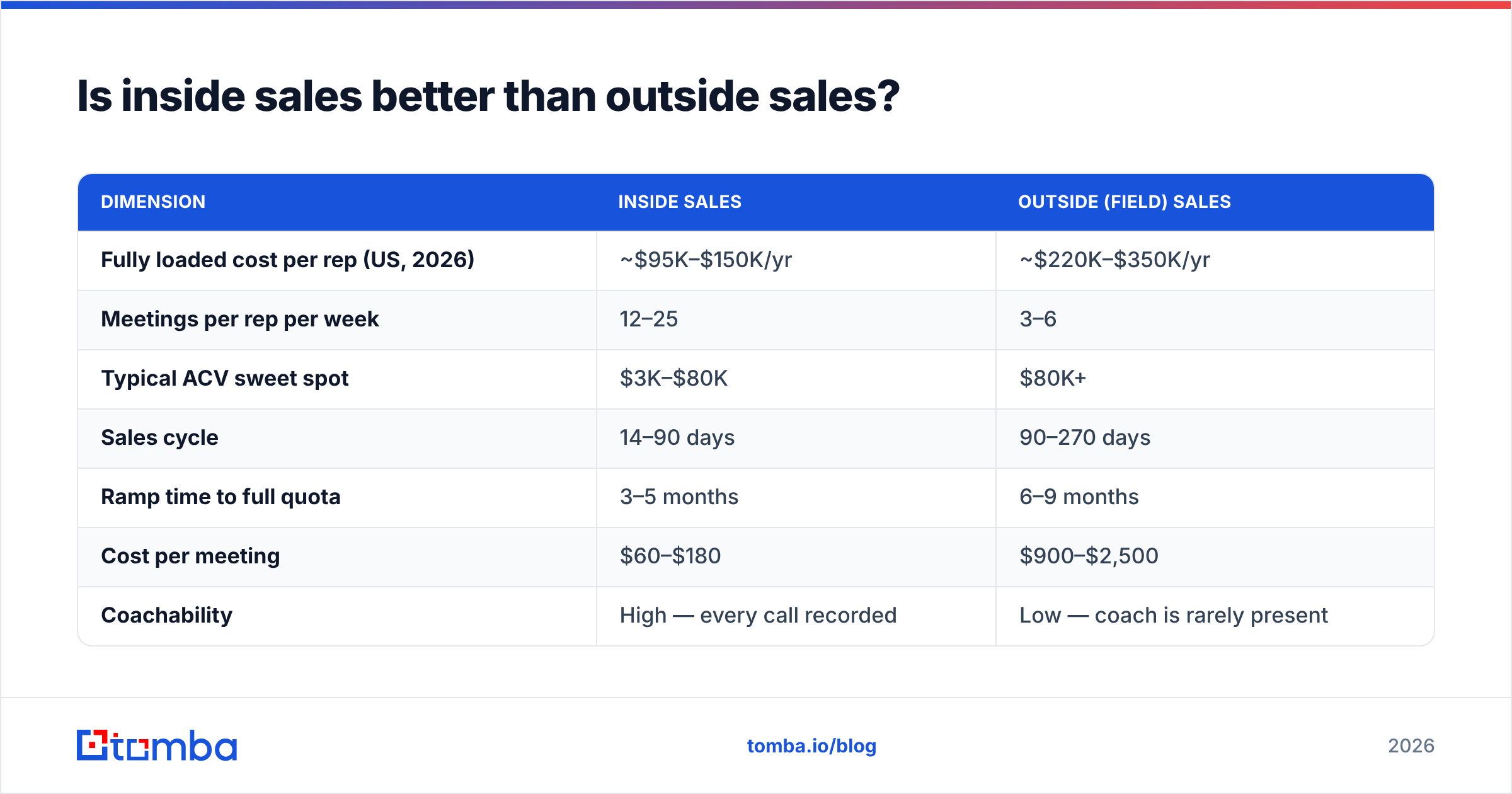
Neither is "better." They optimize for different deal shapes. The honest comparison:
| Dimension | Inside sales | Outside (field) sales |
|---|---|---|
| Fully loaded cost per rep (US, 2026) | ~$95K–$150K/yr | ~$220K–$350K/yr |
| Meetings per rep per week | 12–25 | 3–6 |
| Typical ACV sweet spot | $3K–$80K | $80K+ |
| Sales cycle | 14–90 days | 90–270 days |
| Ramp time to full quota | 3–5 months | 6–9 months |
| Cost per meeting | $60–$180 | $900–$2,500 |
| Coachability | High — every call recorded | Low — coach is rarely present |
| Best for | Volume, repeatable ICP, SMB/mid-market | Complex committees, strategic accounts, regulated buyers |
The decision rule most RevOps leaders use: if your average contract value divided by your fully loaded cost of sale leaves less than 3x margin, you cannot afford field. That knocks out almost everything under $80K ACV.
The nuance people miss is hybrid. The most effective 2026 structures run inside sales end-to-end and deploy a small field team as a "closing squad" that parachutes into the top 5% of deals by value. You get inside economics on 95% of pipeline and field-level intimacy where it changes the outcome.
What roles make up an inside sales team?#
A functioning inside sales org splits the job into pieces that require different skills, not different seniority levels. Here's the standard breakdown:
- SDR / BDR (Sales Development Rep) — Owns top of funnel. Researches accounts, builds lists, runs cold email and cold call sequences, books qualified meetings. Measured on meetings held, not meetings booked. Typical load: 300–600 active contacts in sequence.
- AE (Account Executive) — Takes the meeting, runs discovery, builds the business case, negotiates, closes. Measured on closed-won revenue and pipeline coverage. Typical load: 25–45 open opportunities.
- Sales Engineer / Solutions Consultant — Joins technical evaluations, handles security reviews and integration questions. Shared across 4–8 AEs. Often the difference between a 35% and a 55% win rate in technical categories.
- RevOps / Sales Ops — Owns the CRM data model, routing rules, forecasting, and the tool stack. One RevOps person per 15–20 quota-carrying reps is the common ratio.
- Sales Manager — Coaches on recorded calls, runs pipeline reviews, manages the number. Span of control: 6–8 reps maximum before coaching quality collapses.
- CSM / Account Manager — Owns renewal and expansion post-close. In most 2026 orgs this sits outside the sales team but shares the same CRM and handoff SLA.
Below roughly $15K ACV, collapsing SDR and AE into a full-cycle rep usually outperforms specialization — the handoff overhead costs more than the focus gains. Above it, specialization wins clearly, because prospecting and closing reward opposite temperaments.
What does an inside sales day actually look like?#
Stripped of the motivational-poster version, a productive inside sales day is blocked, not blended:
- Two call blocks, 90 minutes each, at the times your ICP actually answers. For most B2B buyers that's 8:00–9:30 and 16:00–17:30 local.
- One research/list block, 45–60 minutes, building tomorrow's targets rather than improvising them at dial time.
- One admin block, 30 minutes, for CRM hygiene — which is where most forecasting accuracy is won or lost.
- Everything else is meetings. If a rep has more than two hours of internal meetings a day, you have a management problem, not a productivity problem.
The single biggest destroyer of this rhythm is bad data. A rep who dials 60 numbers and reaches 40 disconnected lines hasn't made 60 calls — they've made 20 calls and wasted 90 minutes. The same is true of email: a 12% bounce rate doesn't just cost you 12% of your sends, it drags sender reputation down far enough to suppress the other 88%.
This is the part of inside sales that spreadsheets never capture. Data quality isn't a procurement line item — it's a throughput multiplier on every hour of rep time you're already paying for.
What does an inside sales team cost to run?#
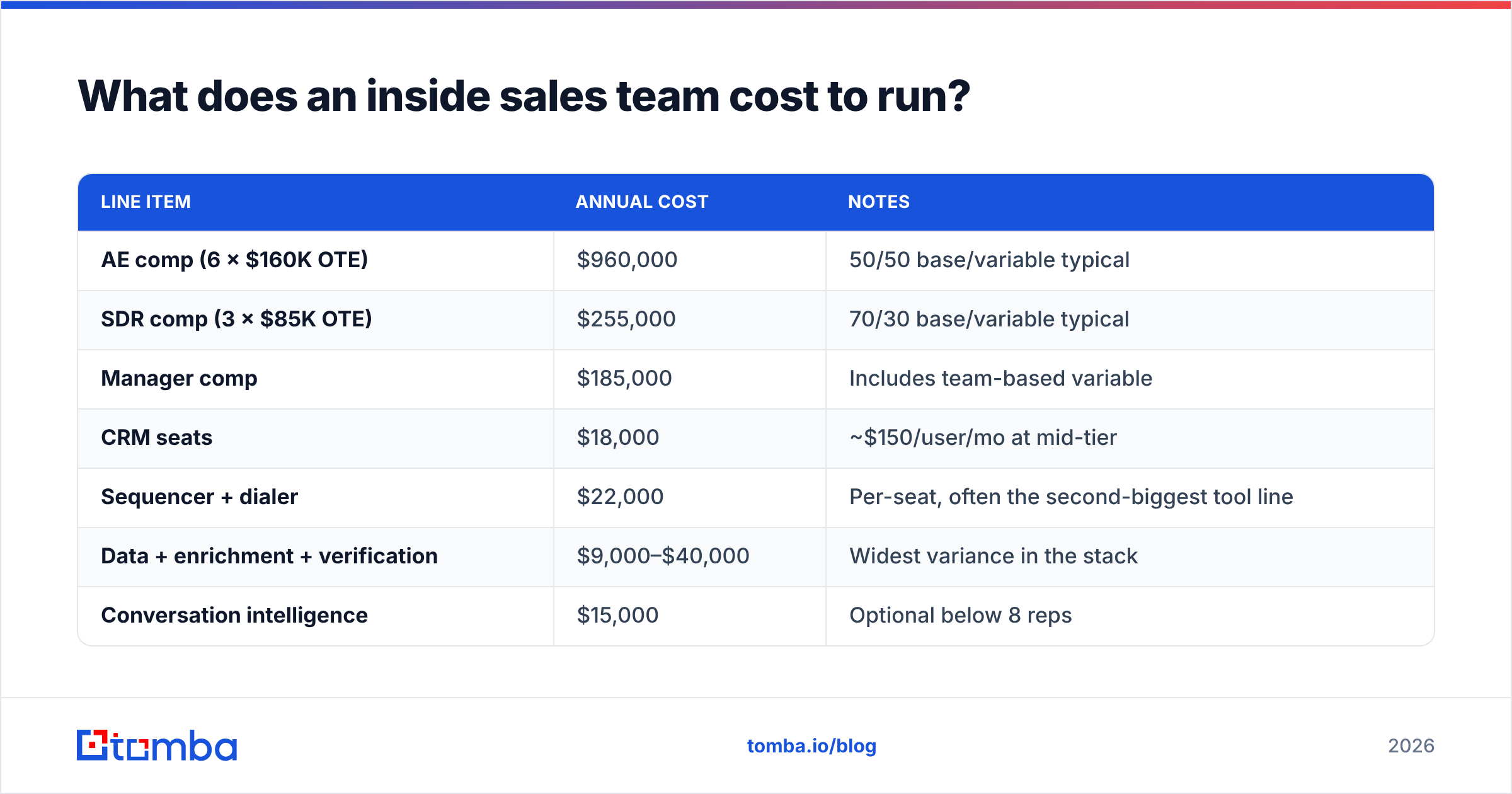
Here's a realistic fully loaded model for a 10-person US inside team (6 AEs, 3 SDRs, 1 manager) in 2026:
| Line item | Annual cost | Notes |
|---|---|---|
| AE comp (6 × $160K OTE) | $960,000 | 50/50 base/variable typical |
| SDR comp (3 × $85K OTE) | $255,000 | 70/30 base/variable typical |
| Manager comp | $185,000 | Includes team-based variable |
| CRM seats | $18,000 | ~$150/user/mo at mid-tier |
| Sequencer + dialer | $22,000 | Per-seat, often the second-biggest tool line |
| Data + enrichment + verification | $9,000–$40,000 | Widest variance in the stack |
| Conversation intelligence | $15,000 | Optional below 8 reps |
| Payroll tax, benefits, equipment | ~$390,000 | ~27% loading on comp |
| Total | ~$1.85M–$1.88M | ~$188K per head all-in |
At that cost base, the team needs roughly $5.5M–$7.5M in annual bookings to hit a healthy 3–4x return on sales spend. Work backward: that's about $1.1M per AE, which at a $25K ACV means 44 closed deals per rep per year, which at a 22% win rate means 200 qualified opportunities. Every assumption in that chain is testable — and the one that breaks first is almost always top-of-funnel contact quality.
Note where the variance lives. Comp is fixed and predictable. The data line is where teams either spend $9K and get a 6% bounce rate, or spend $40K and get a 6% bounce rate, or spend $9K on the wrong vendor and get a 30% bounce rate that quietly costs them $400K in lost pipeline. Which brings us to the expensive surprise.

Which metrics actually predict inside sales performance?#
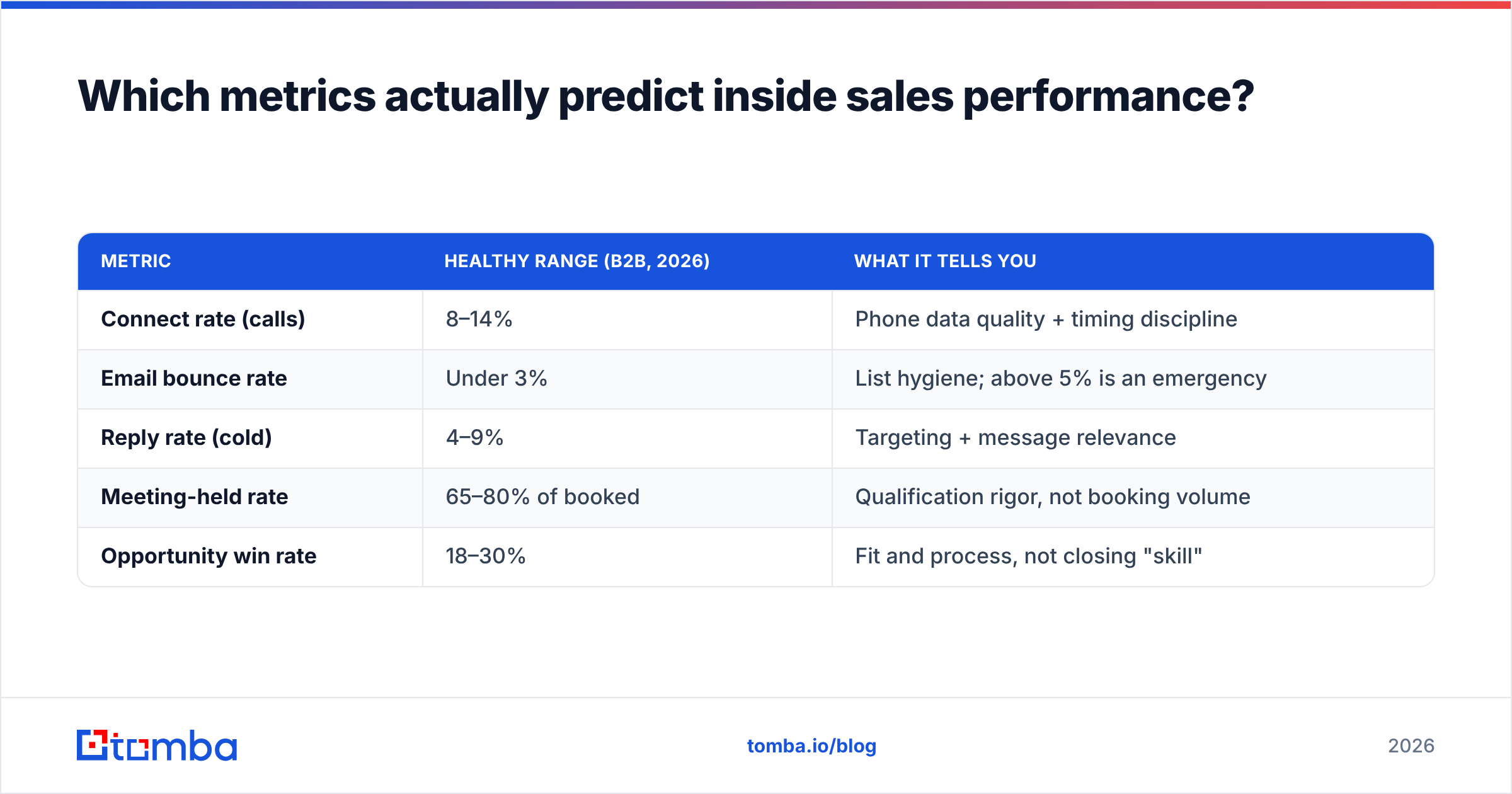
Most inside teams track 30 metrics and manage to none. These five carry almost all the predictive weight:
| Metric | Healthy range (B2B, 2026) | What it tells you |
|---|---|---|
| Connect rate (calls) | 8–14% | Phone data quality + timing discipline |
| Email bounce rate | Under 3% | List hygiene; above 5% is an emergency |
| Reply rate (cold) | 4–9% | Targeting + message relevance |
| Meeting-held rate | 65–80% of booked | Qualification rigor, not booking volume |
| Opportunity win rate | 18–30% | Fit and process, not closing "skill" |
Two of the five are pure data-quality metrics. That's not a coincidence — it's the ratio of how much inside sales performance is determined before anyone opens their mouth.
If your response rate is under 2%, the instinct is to rewrite the email. Nine times out of ten the copy is fine and the list is wrong: wrong seniority, wrong company stage, or addresses that were accurate eighteen months ago and aren't now. B2B contact data decays at roughly 25–30% per year through job changes alone, per Gartner and similar analyst tracking. A list you built in January is meaningfully different by December.
What does the 2026 inside sales stack look like?#
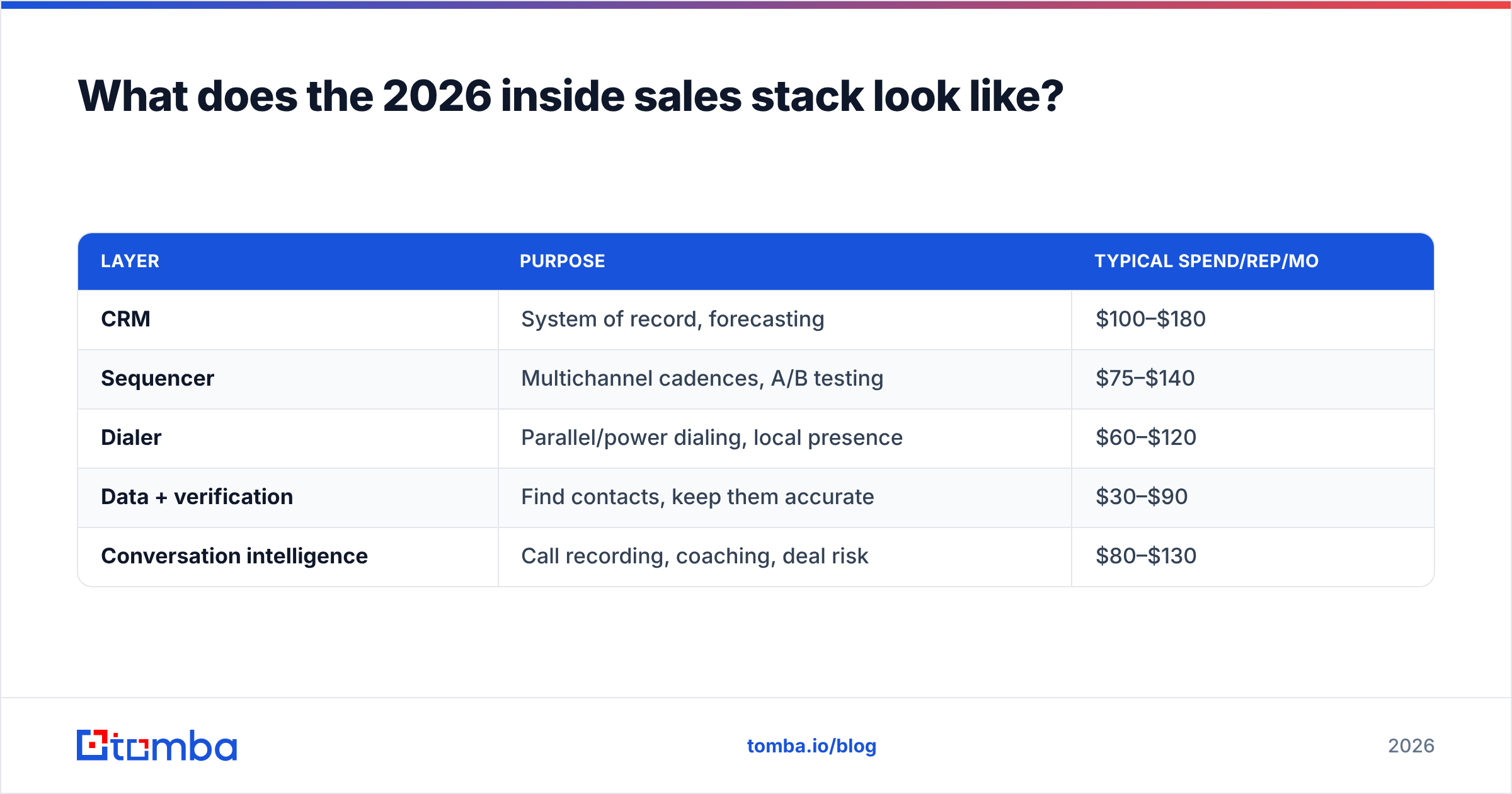
The stack consolidated hard after the 2023–2024 budget compression. The surviving shape:
| Layer | Purpose | Typical spend/rep/mo |
|---|---|---|
| CRM | System of record, forecasting | $100–$180 |
| Sequencer | Multichannel cadences, A/B testing | $75–$140 |
| Dialer | Parallel/power dialing, local presence | $60–$120 |
| Data + verification | Find contacts, keep them accurate | $30–$90 |
| Conversation intelligence | Call recording, coaching, deal risk | $80–$130 |
Everything else — gifting platforms, scheduling widgets, AI note-takers, intent feeds — is a nice-to-have you should be able to remove without anyone noticing for a week. Run that test annually.
On the data layer specifically, the distinction that matters is finding versus verifying. Plenty of vendors will hand you an address. Fewer will tell you honestly whether it's deliverable today. The practical setup is a email finder for discovery, a email verifier run immediately before every sequence launch, and a phone finder for the dial motion — with catch-all domains handled explicitly rather than guessed at. Teams that verify at send time rather than at import time see materially lower bounce rates, because the gap between those two moments is where decay happens.
For teams evaluating providers, G2's sales intelligence category is a reasonable starting filter, and vendors like BookYourData have built solid reputations in the prebuilt-list segment for teams that want coverage without building lists themselves. Match the vendor to the motion: list-buyers and API-first builders have genuinely different needs.
Where do inside sales teams usually break?#
Four failure patterns account for most of it:
- Hiring ahead of process. Adding reps to an unrepeatable motion multiplies confusion, not revenue. Get one rep to quota twice before hiring the third.
- Comping on activity instead of outcomes. Pay for dials and you'll get dials — to disconnected numbers, at 4pm on a Friday.
- Treating data as a one-time purchase. The list you bought is a depreciating asset. Budget for refresh the way you budget for seats.
- Skipping the handoff SLA. SDR-to-AE handoffs without a written definition of "qualified" produce arguments in every pipeline review and no learning at all.
The good news is that all four are structural, which means they're fixable by decision rather than by heroics. HubSpot's sales research and Salesforce's State of Sales both show the same thing year after year: the highest-performing teams aren't the ones with the best individual closers, they're the ones with the least variance between reps. Variance comes from process gaps, and process gaps are a management artifact.
Is inside sales right for your company?#
Run this check:
- Is your ACV under $80K? → Inside, almost certainly.
- Can a buyer evaluate your product without touching it physically? → Inside works.
- Do you need 200+ qualified conversations a quarter to hit plan? → Inside is the only affordable way.
- Is your buying committee 5+ people across 3+ functions? → Inside, with a field or exec closing assist on the top deals.
- Are you selling into regulated industries with in-person procurement norms? → Hybrid, leaning field.
For nearly every SaaS, services, and B2B tech company reading this, the answer is inside sales with a light field overlay. The question isn't whether to run the model — it's whether you're running it with data clean enough for the economics to work.
Where to start#
Fix the input before you optimize the output. Before you rewrite a single subject line or buy another dialer seat, pull a sample of 500 contacts from your current list and check the bounce rate. If it's above 5%, that's your bottleneck — not your messaging, not your reps, not your comp plan.
The Tomba Email Finder gives you verified professional addresses by domain, name, or company, with a free tier at 25 searches a month if you just want to sanity-check your existing list quality. Paid plans start at $49/mo, and every result runs through verification before it reaches you — which means your reps spend their call blocks talking to people instead of listening to disconnect tones. Check the full Tomba pricing to see which tier matches your team's volume.
Related guides#
// get started
Find, verify and enrich your first contacts today
Start on the free plan with 25 searches a month, then scale when your team is ready.
Free plan · No credit card required · GDPR & CCPA
// about the author