Inside Sales Development in 2026: The Complete Playbook
Inside sales development is where most B2B pipeline actually gets built — and where most teams quietly waste half their budget. Here's what the role does, what it costs, and how to staff it.
TL;DR
- Inside sales development is the specialized function that finds, researches, and qualifies prospects so closers only talk to buyers who fit — it is not "junior sales."
- A fully loaded SDR in North America costs roughly $85k–$120k/year, and most teams need 8–14 months before that seat is cash-flow positive.
- The single biggest lever on SDR output is not scripts or cadence tools — it's contact data quality. Bad emails kill 20–40% of a rep's activity before a single word is read.
- Benchmark to beat in 2026: 12–18 qualified meetings per SDR per month, 25–35% meeting-to-opportunity conversion, cost per meeting under $400.
- Build the list layer first (verified emails, direct dials, enrichment), then hire. Reversing that order is how teams burn a year of runway.
What Is Inside Sales Development, Exactly?#
Inside sales development is the practice of generating and qualifying pipeline remotely — by email, phone, LinkedIn, and video — and handing only sales-ready opportunities to account executives. The people doing it are sales development representatives (SDRs) or business development representatives (BDRs). They do not carry a closing quota. They carry a meetings-held or opportunity-created quota.
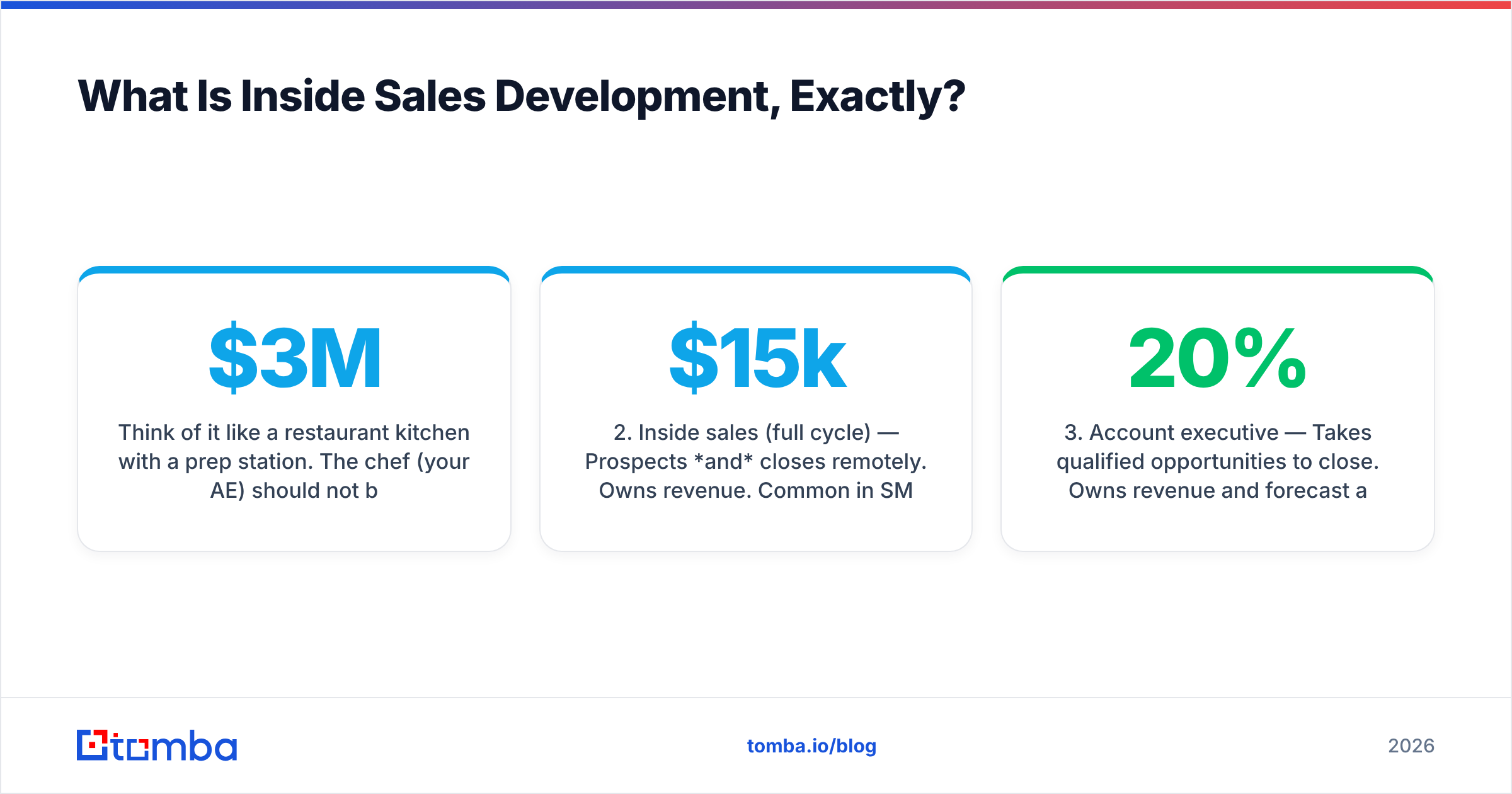
Think of it like a restaurant kitchen with a prep station. The chef (your AE) should not be peeling potatoes when a table is waiting. The prep cook's entire job is to make sure the right ingredients, cleaned and portioned, are ready when the chef reaches for them. Inside sales development is that prep station: research, list-building, verification, first-touch, qualification. Technically, it's the separation of prospecting labor from closing labor, formalized by Aaron Ross at Salesforce and now standard in almost every B2B org above $3M ARR.
The "inside" part matters. Field sales development means driving to offices and working events. Inside sales development happens from a desk, at volume, with instrumentation on every step. That difference changes the economics completely — one inside rep can touch 400–600 accounts a month; a field rep touches 30.
Here's what separates the function from its neighbors:
- Inside sales development — Outbound and inbound qualification. Owns meetings booked. No revenue quota. Measured on activity quality and conversion to opportunity.
- Inside sales (full cycle) — Prospects and closes remotely. Owns revenue. Common in SMB and PLG motions where deal sizes are under $15k.
- Account executive — Takes qualified opportunities to close. Owns revenue and forecast accuracy. Should spend under 20% of time prospecting.
- Account management / CS — Owns retention and expansion on existing logos. Different motion entirely.
- Demand generation — Marketing-side. Creates the inbound flow that SDRs qualify. Measured on MQLs and pipeline sourced.
If your "SDRs" are also closing deals, you don't have inside sales development. You have full-cycle inside sales, and you should measure it that way — otherwise your cost-per-meeting math will lie to you.

Is Inside Sales Development Still Worth It in 2026?#
Short answer: yes, but the bar moved. The lazy version of this role — 300 generic emails a day from a purchased list — stopped working around 2023 and is now actively harmful. Google and Yahoo's bulk sender requirements, tighter spam filtering, and buyer fatigue mean volume without precision produces domain damage, not meetings.
What still works is a narrower, better-informed version of the same function. The teams hitting quota in 2026 share three traits:
- Smaller target lists. 150–400 named accounts per rep, not 5,000.
- Verified contact data. Bounce rates under 2%, not 8%.
- Multi-channel sequences. Email plus phone plus LinkedIn, with the phone doing more work than it did five years ago.
The economics still hold up when you run it this way. Gartner's research on B2B buying has consistently shown buyers spend only a small fraction of the buying cycle with any single vendor's sales rep — which is precisely the argument for a dedicated function whose entire job is earning that sliver of attention early.
What does an SDR actually cost?#
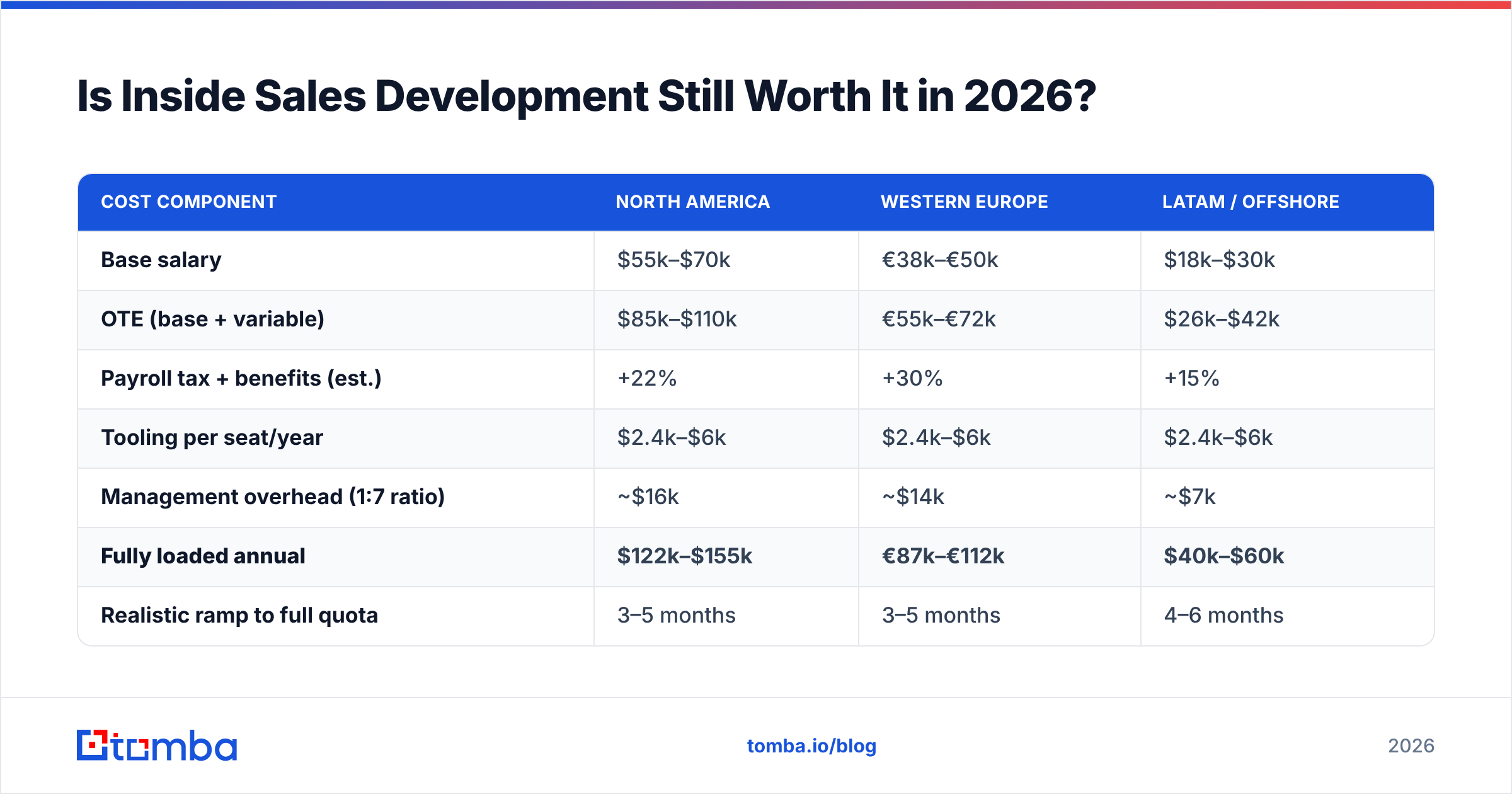
| Cost component | North America | Western Europe | LATAM / Offshore |
|---|---|---|---|
| Base salary | $55k–$70k | €38k–€50k | $18k–$30k |
| OTE (base + variable) | $85k–$110k | €55k–€72k | $26k–$42k |
| Payroll tax + benefits (est.) | +22% | +30% | +15% |
| Tooling per seat/year | $2.4k–$6k | $2.4k–$6k | $2.4k–$6k |
| Management overhead (1:7 ratio) | ~$16k | ~$14k | ~$7k |
| Fully loaded annual | $122k–$155k | €87k–€112k | $40k–$60k |
| Realistic ramp to full quota | 3–5 months | 3–5 months | 4–6 months |
Run your own numbers, but the shape is consistent: an SDR seat in a high-cost market needs to produce roughly 12–15 qualified meetings a month at a 30% opportunity conversion rate to justify itself against a $30k+ average contract value. Below that ACV, the math gets thin fast and you should be looking at full-cycle inside sales or a product-led motion instead.
How Does Inside Sales Development Compare to the Alternatives?#
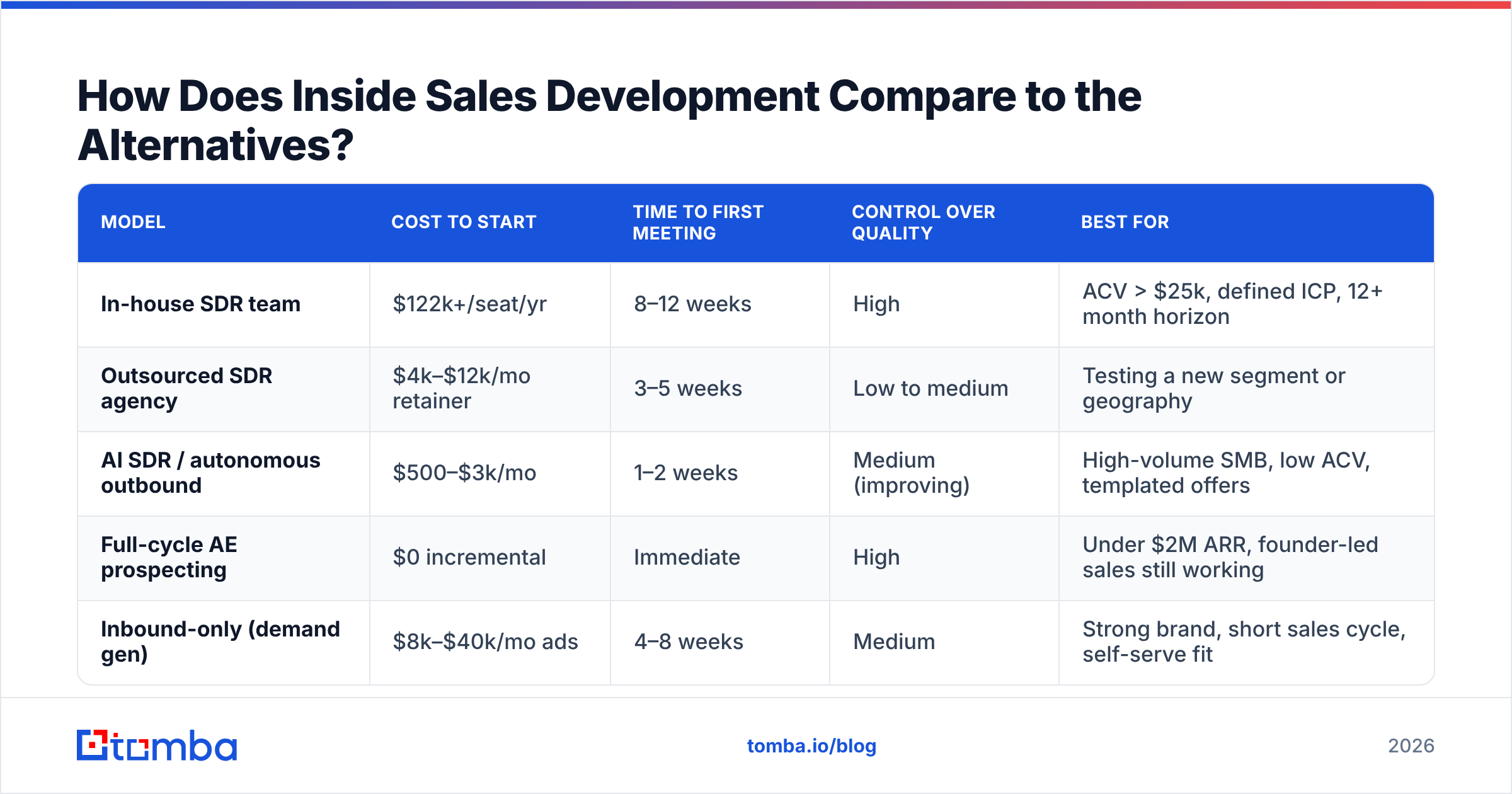
Most teams considering an SDR function are really choosing between four models. They are not interchangeable.
| Model | Cost to start | Time to first meeting | Control over quality | Best for |
|---|---|---|---|---|
| In-house SDR team | $122k+/seat/yr | 8–12 weeks | High | ACV > $25k, defined ICP, 12+ month horizon |
| Outsourced SDR agency | $4k–$12k/mo retainer | 3–5 weeks | Low to medium | Testing a new segment or geography |
| AI SDR / autonomous outbound | $500–$3k/mo | 1–2 weeks | Medium (improving) | High-volume SMB, low ACV, templated offers |
| Full-cycle AE prospecting | $0 incremental | Immediate | High | Under $2M ARR, founder-led sales still working |
| Inbound-only (demand gen) | $8k–$40k/mo ads | 4–8 weeks | Medium | Strong brand, short sales cycle, self-serve fit |
The honest read: outsourced agencies are good for learning and bad for scaling. They'll tell you whether a segment responds. They will not build institutional knowledge you keep. AI SDR tools have gotten legitimately good at research and first-draft personalization, but in 2026 they still underperform humans on the qualification call — which is where meeting quality is actually determined.
And the model nobody sells you: hybrid. One senior SDR plus strong data tooling plus AI drafting often beats three junior SDRs with a purchased list. That's not a slogan, it's a consequence of where the failure actually happens.
Why Do Most Inside Sales Development Teams Underperform?#
Because the inputs are broken, not the people. When an SDR team misses quota, leadership almost always reaches for the script, the cadence, or the rep. In practice, here's where the output actually leaks:
1. Contact data decay. B2B contact data degrades roughly 2–3% per month through job changes, restructures, and domain migrations. A list built in January is meaningfully wrong by June. If you're not re-verifying continuously, a quarter of your rep's day is spent emailing people who left.
2. Bounce-driven deliverability collapse. This is the quiet killer. A 6% hard-bounce rate signals to mailbox providers that you're working from a stale or purchased list. Inbox placement drops, replies fall, and the rep compensates by sending more — which accelerates the damage. Running contacts through an email verifier before the first send is table stakes, and catch-all domains need their own handling via a catch-all verifier rather than a blanket guess. If you want the underlying mechanics, email deliverability is worth understanding before you scale send volume.
3. No phone motion. Email-only SDR teams cap out. Direct dials moved from "nice to have" to "the differentiator" as inboxes got noisier. Teams pairing verified email with a phone finder consistently report higher connect-to-meeting rates than email-only peers.
4. Misaligned qualification criteria. If your SDRs book meetings your AEs disqualify, you don't have a prospecting problem — you have a definitions problem. Fix the handoff SLA before you fix the sequence.
5. Ramp treated as onboarding. Three weeks of product training is not ramp. Ramp is 90 days of supervised reps with call reviews, and teams that skip it see 40%+ first-year attrition.

What Does a Good Inside Sales Development Tech Stack Look Like?#
Four layers, in dependency order. Buy them in this order too — a sequencer on top of bad data just automates failure.
Layer 1 — Data and enrichment. This is where you find and verify contacts. Tools here include Tomba, Apollo, BookYourData, Cognism, and ZoomInfo. They differ mostly on coverage depth versus cost and on how aggressively they verify. Tomba's pricing runs Free (25 searches/mo), Starter $49/mo, Growth $99/mo, and Pro $249/mo — usefully cheap for teams that want a verification-first layer rather than a full database subscription. BookYourData takes a different approach with pay-as-you-go verified lists, which works well when you need a clean list for a specific campaign without a monthly commitment. Both are reasonable starting points depending on whether you want ongoing lookup or one-time list purchase.
Layer 2 — Sequencing and engagement. Outreach, Salesloft, Instantly, Smartlead. This is where cadences live. Commoditized; pick on price and CRM fit.
Layer 3 — CRM and pipeline. HubSpot, Salesforce, Pipedrive. Non-negotiable as the source of truth for what counts as an opportunity.
Layer 4 — Coaching and intelligence. Gong, Chorus, or your sequencer's native analytics. Only worth buying once you have enough call volume to find patterns — usually past 5 SDRs.
A practical build: domain search to map who works at a target account, verification to clean the list, bulk processing via a bulk email finder for whole segments, then push into your sequencer through the HubSpot integration or API. If your team lives in spreadsheets, a Google Sheets add-on removes a whole category of copy-paste error.
For vetting vendors beyond vendor marketing, G2's sales intelligence category is the least-biased volume source of practitioner reviews, and HubSpot's sales research publishes benchmark data that's actually sourced rather than invented.
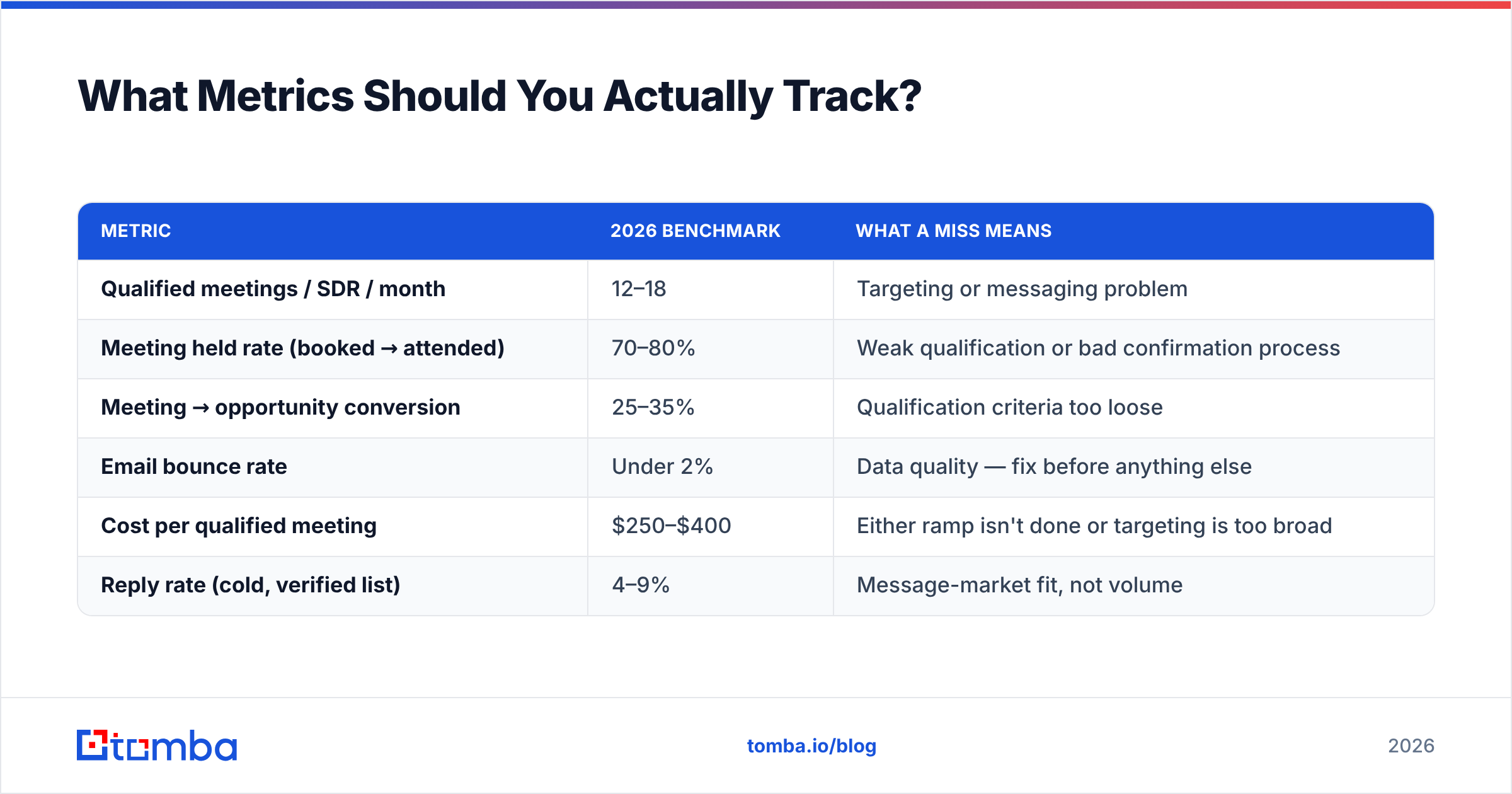
What Metrics Should You Actually Track?#
Track five. Ignore the rest until these are healthy.
| Metric | 2026 benchmark | What a miss means |
|---|---|---|
| Qualified meetings / SDR / month | 12–18 | Targeting or messaging problem |
| Meeting held rate (booked → attended) | 70–80% | Weak qualification or bad confirmation process |
| Meeting → opportunity conversion | 25–35% | Qualification criteria too loose |
| Email bounce rate | Under 2% | Data quality — fix before anything else |
| Cost per qualified meeting | $250–$400 | Either ramp isn't done or targeting is too broad |
| Reply rate (cold, verified list) | 4–9% | Message-market fit, not volume |
One caution on activity metrics. Dials and emails sent are leading indicators, not goals. The moment you make "200 activities a day" the target, reps optimize for activity and quality collapses. Measure activity to diagnose, measure meetings to manage.
Also track response rate segmented by list source. If your self-built verified lists convert at 7% and your purchased lists convert at 1.5%, you just found your budget reallocation for next quarter.
How Do You Build an Inside Sales Development Function From Zero?#
A 90-day sequence that works for most teams under 50 people:
Days 1–30: Define and instrument. Write the ICP down to firmographic and technographic filters. Define what "qualified" means in one sentence your AEs will sign off on. Set up the CRM stages. Build your first 200-account target list manually — yes, manually. You are learning what good looks like.
Days 31–60: Prove the motion yourself. A founder or AE runs the sequence on those 200 accounts. Verify every email first. Track everything. You are looking for a reply rate above 4% and at least 5 meetings. If you can't do it, an SDR won't either — the problem is the offer, not the execution.
Days 61–90: Hire and document. Only now do you hire. Hire two, not one — a single SDR has no benchmark and no peer to learn from, and if they underperform you can't tell whether it's the rep or the motion. Document every play you proved in days 31–60 into a playbook.
The most common failure is hiring on day 1 and asking a 24-year-old to figure out your positioning. That's not a job, it's a coin flip.
Where Does AI Fit in Inside Sales Development Now?#
Honestly assessed: AI is excellent at three parts of the job and mediocre at the rest.
Where it genuinely works — account research summarization, first-draft email personalization, call transcription and coaching signals, and list enrichment at scale. A rep using AI for research spends 20 minutes on what used to take two hours.
Where it still disappoints — qualification judgment, objection handling live, and knowing when not to send. Fully autonomous AI SDRs produce volume, and volume against an unverified list is exactly the deliverability problem described above, just faster.
The practical stance for 2026: use AI to compress research and drafting, keep humans on qualification and phone, and keep your data layer verified regardless. AI amplifies whatever list you point it at — which is an argument for the list being good, not an argument against AI.
Common Questions#
Should SDRs report to sales or marketing? Sales, in most cases. Marketing ownership works when the motion is primarily inbound qualification. Outbound SDRs under marketing tend to get measured on MQLs rather than opportunities, which drifts quality downward.
What's a realistic SDR-to-AE ratio? Between 1:1 and 2:1 SDR-to-AE for enterprise, closer to 1:2 for SMB. If your AEs can't work the meetings your SDRs book, you've over-hired one side.
How long before an SDR hire pays back? 8–14 months typically, factoring 3–5 month ramp plus sales cycle length. Budget for it or don't start.
Is cold email dead? No, but unverified cold email is. The gap between a 2% bounce list and an 8% bounce list is the difference between a channel and a liability.
Start With the Data Layer#
The pattern across every underperforming SDR team is the same: good people working from lists that were wrong before they started. Fix the input and the rest of the function gets easier — better connect rates, better deliverability, less wasted rep time, and metrics that actually tell you something.
Start there. Use the Tomba Email Finder to build verified contact lists from your target account domains, verify before you send, and enrich with direct dials so your reps have more than one way in. The free tier gives you 25 searches a month to test it against your own ICP before spending anything — and Tomba pricing starts at $49/mo when you're ready to scale it across a team.
Related guides#
Ready to find emails that actually work?
Join 150,000+ professionals who stopped guessing and started sending. Free credits on signup — no credit card required.
Get the Tomba newsletter
Practical outbound tactics and product updates — once every two weeks.
About the author