Inside Sales Examples: 9 Real Workflows That Close Deals
Inside sales is not just "phone sales." Here are nine concrete inside sales examples, from SMB self-serve upgrades to mid-market multithreading, with the metrics, scripts, and tooling each one actually needs.
TL;DR
- Inside sales means selling remotely — phone, email, video, chat — instead of traveling to the buyer. It is now the default motion for most B2B software, services, and mid-market deals.
- The nine examples below are real, repeatable plays: SDR-to-AE handoff, self-serve upgrade calls, inbound speed-to-lead, renewal expansion, event follow-up, partner-sourced outreach, win-back, multithreaded mid-market, and PLG assist.
- Every inside sales example lives or dies on three inputs: a defined trigger, verified contact data, and a fixed follow-up cadence. Miss one and the play collapses.
- Cost per touch is roughly 6-10x lower than field sales, but only if your contact data is accurate — bad emails and dead phone numbers destroy the math faster than bad scripts do.
- Three common "examples" waste time: untargeted 5,000-contact blasts, demo-first inbound routing with no qualification, and manual list building that eats 11+ hours per rep per week.
What is inside sales, and how is it different from outside sales?#
Inside sales is selling from a fixed location using remote channels. The rep never gets on a plane. Everything happens through calls, email sequences, video meetings, LinkedIn, and increasingly chat and product-embedded messaging.
Outside sales — field sales — puts a rep in the room. It still wins for eight-figure enterprise contracts, heavy manufacturing, and regional industries where relationships are geographic. But for nearly everything else, the cost structure stopped making sense years ago. Gartner's sales research has tracked buyers shifting toward rep-free and remote-rep interactions for most of the buying journey, and vendors followed.
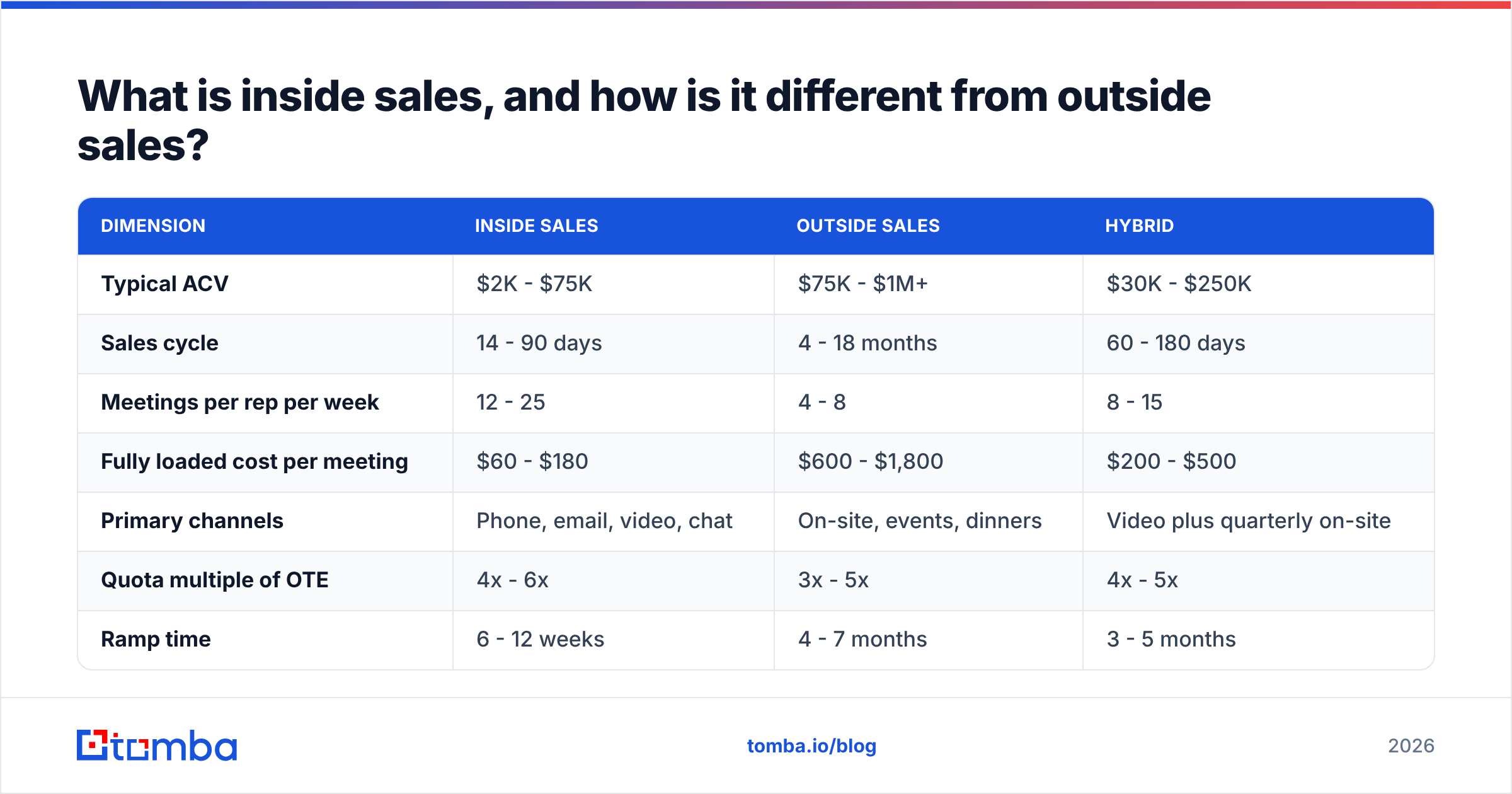
Here is the practical difference:
| Dimension | Inside sales | Outside sales | Hybrid |
|---|---|---|---|
| Typical ACV | $2K - $75K | $75K - $1M+ | $30K - $250K |
| Sales cycle | 14 - 90 days | 4 - 18 months | 60 - 180 days |
| Meetings per rep per week | 12 - 25 | 4 - 8 | 8 - 15 |
| Fully loaded cost per meeting | $60 - $180 | $600 - $1,800 | $200 - $500 |
| Primary channels | Phone, email, video, chat | On-site, events, dinners | Video plus quarterly on-site |
| Quota multiple of OTE | 4x - 6x | 3x - 5x | 4x - 5x |
| Ramp time | 6 - 12 weeks | 4 - 7 months | 3 - 5 months |
The numbers above are directional ranges from published B2B benchmarks, not laws of physics. Your ACV band and cycle length are what decide the motion — not preference.

What roles make up a real inside sales team?#
Most teams that say "we do inside sales" actually run four distinct jobs. Blurring them is the single most common reason a team's numbers look mediocre.
- SDR / BDR (outbound) — Owns cold pipeline. Success metric is qualified meetings held, not meetings booked. Typical target: 12-20 held meetings per month.
- MDR / inbound rep — Works marketing-sourced leads only. Success metric is speed-to-lead and qualification accuracy. Target response time under 5 minutes during business hours.
- AE (account executive) — Runs discovery through close on video. Success metric is win rate and cycle time, not activity. Typical mid-market AE carries 8-15 active opportunities.
- AM / CSM with a quota — Owns renewal and expansion. Success metric is net revenue retention. This is inside sales too, and it is usually the cheapest pipeline in the building.
- Sales engineer (shared) — Joins calls for technical validation. Not a quota carrier, but the fastest lever on mid-market win rates.
- Ops / enablement — Owns the CRM, the data hygiene, and the sequences. One ops person per 8-12 reps is the standard ratio.
If one person is doing jobs 1, 2, and 3 simultaneously, you do not have an inside sales team. You have a generalist, and generalists average roughly half the meeting volume of a dedicated SDR.
What are the best inside sales examples by motion?#
These are the nine plays worth copying. Each one lists the trigger, the sequence, and the number that tells you it is working.
1. The SDR-to-AE outbound handoff#
Trigger: Account matches ICP firmographics plus a hiring signal or tech-stack signal.
The SDR runs a 14-day, 11-touch sequence: day 1 email plus LinkedIn view, day 2 call plus voicemail, day 4 email reply-to-thread, day 6 call, day 8 LinkedIn connection with context, day 10 short video, day 12 call, day 14 breakup email. Meeting booked, the AE gets a 5-line brief in the CRM: trigger, pain hypothesis, who else is on the account, next step, and source.
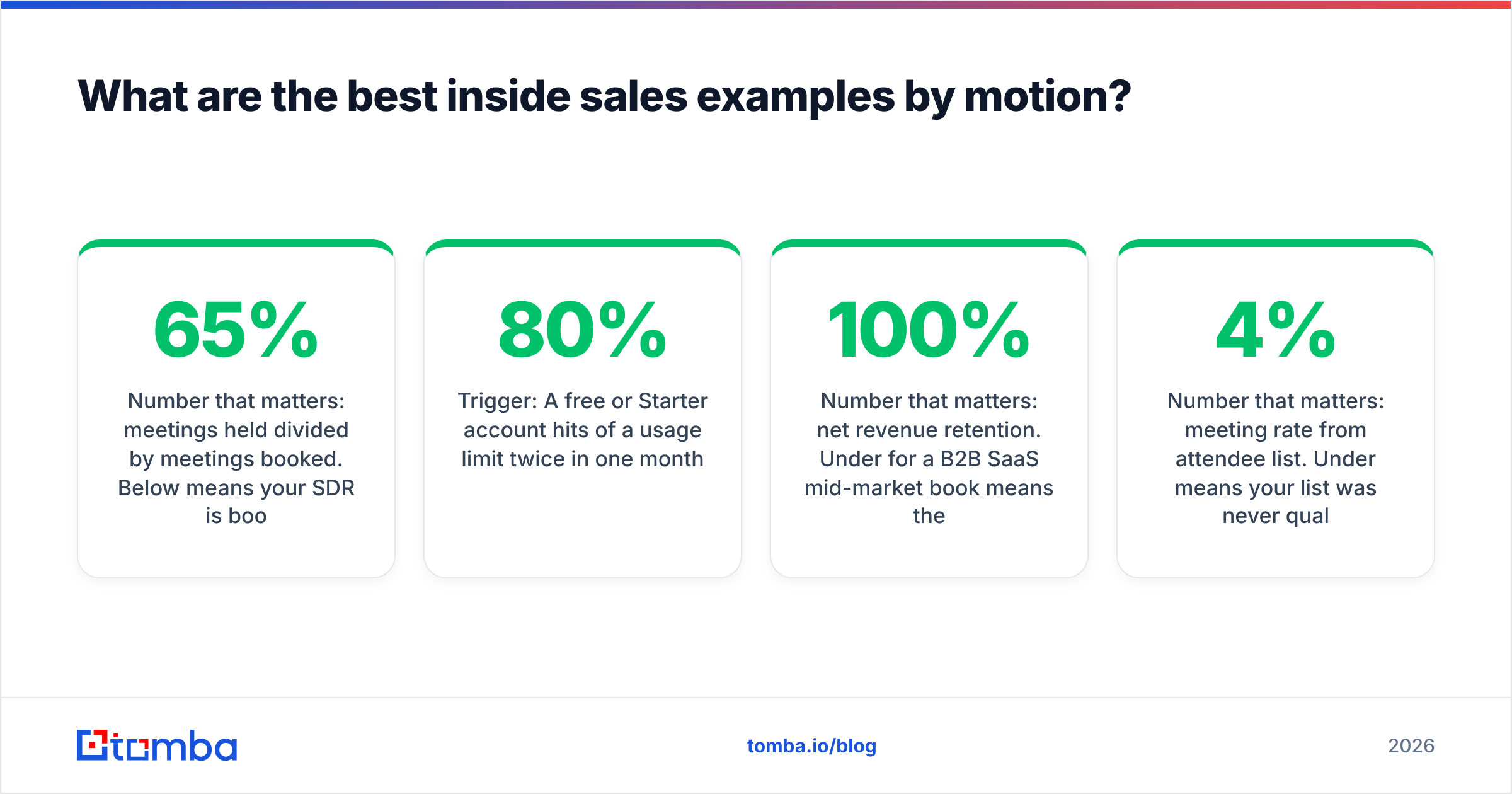
Number that matters: meetings held divided by meetings booked. Below 65% means your SDR is booking anyone with a pulse.
2. The self-serve upgrade call#
Trigger: A free or Starter account hits 80% of a usage limit twice in one month.
A rep calls within 24 hours. No pitch — the opener is "You hit your search cap twice this month, what are you trying to get done?" Roughly a third of these conversations become plan upgrades because the buyer already has the problem.
Number that matters: upgrade rate from usage-triggered calls versus untriggered calls. Expect 3-5x.
3. Speed-to-lead on inbound demo requests#
Trigger: Form fill on a high-intent page (pricing, demo, comparison).
Route to the first available rep by round robin with a 5-minute SLA. Call first, email second. The half-life of an inbound B2B lead is brutally short — HubSpot's sales research has published the same finding repeatedly: contact within five minutes and qualification rates jump by an order of magnitude versus thirty.
Number that matters: median response time. Not average — average hides the 4-hour tail.
4. Renewal-plus-expansion call 90 days out#
Trigger: Contract end date minus 90 days.
An AM runs a structured usage review: what got adopted, what did not, what changed in the account's headcount or stack. Expansion offers land in the same call. This is the cheapest revenue in inside sales and the play most teams run casually instead of systematically.
Number that matters: net revenue retention. Under 100% for a B2B SaaS mid-market book means the play is broken.
5. Event and webinar follow-up within 48 hours#
Trigger: Attended, registered-but-no-show, or stopped by the booth.
Three different messages for three different states. No-shows get the recording plus one question. Attendees get a reference to something specific that was said. Booth conversations get a call, not an email.
Number that matters: meeting rate from attendee list. Under 4% means your list was never qualified in the first place.
6. Partner-sourced warm intro sequence#
Trigger: A partner's customer list overlaps your ICP.
The rep asks the partner rep for a three-way email, then takes over. Warm intros convert at multiples of cold outbound, which is why this play belongs in every inside sales team's week even though it does not scale linearly.
Number that matters: partner-sourced pipeline as a share of total. Healthy is 15-25%.
7. Closed-lost win-back at 6 months#
Trigger: Deal lost 180 days ago on price, timing, or a competitor.
New trigger required — a funding round, a new VP, a competitor's price change. Open with what changed, not with "just checking in." Roughly one in ten reopens.
Number that matters: reopen rate and cycle time on reopened deals, which usually run 30-40% shorter.
8. Multithreaded mid-market pursuit#
Trigger: An opportunity over $40K with fewer than three contacts engaged.
The rep adds the economic buyer, a technical validator, and one end user. Single-threaded deals lose to "no decision" constantly. Salesforce's sales guidance and most enterprise methodologies converge on the same rule: three or more engaged contacts is the threshold where win rates step up.
Number that matters: average contacts engaged per open opportunity.
9. Product-led assist#
Trigger: A team invites three or more users, or an admin opens the billing page without converting.
A rep sends one message offering a 15-minute setup session. It is not a sales call. The conversion happens after the setup works.
Number that matters: assisted conversion rate versus pure self-serve.
Which inside sales examples fit your ACV?#
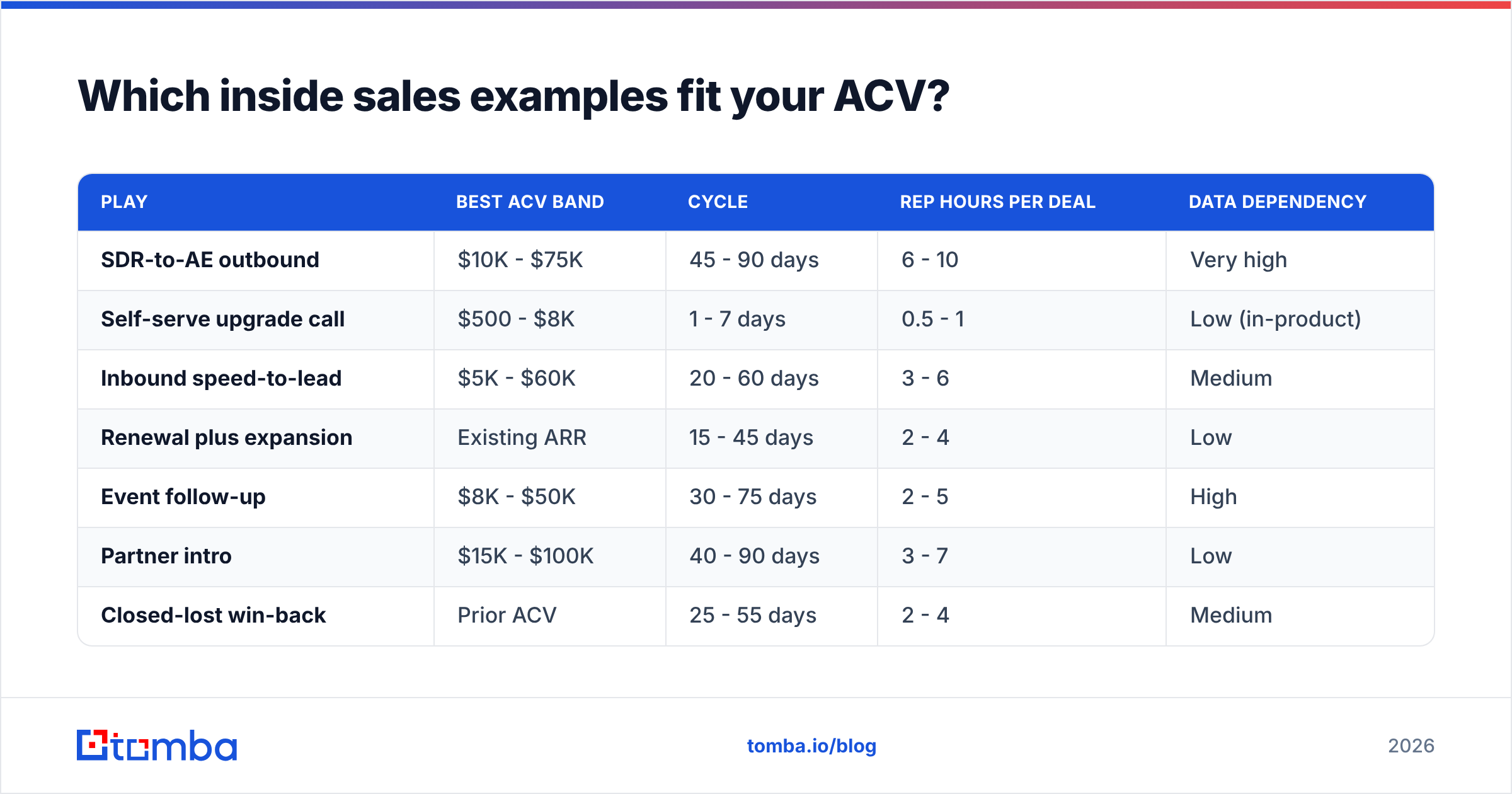
Not every play deserves your reps' hours. Match the motion to deal size and cycle:
| Play | Best ACV band | Cycle | Rep hours per deal | Data dependency |
|---|---|---|---|---|
| SDR-to-AE outbound | $10K - $75K | 45 - 90 days | 6 - 10 | Very high |
| Self-serve upgrade call | $500 - $8K | 1 - 7 days | 0.5 - 1 | Low (in-product) |
| Inbound speed-to-lead | $5K - $60K | 20 - 60 days | 3 - 6 | Medium |
| Renewal plus expansion | Existing ARR | 15 - 45 days | 2 - 4 | Low |
| Event follow-up | $8K - $50K | 30 - 75 days | 2 - 5 | High |
| Partner intro | $15K - $100K | 40 - 90 days | 3 - 7 | Low |
| Closed-lost win-back | Prior ACV | 25 - 55 days | 2 - 4 | Medium |
| Multithreaded mid-market | $40K - $250K | 60 - 150 days | 12 - 25 | Very high |
| Product-led assist | $1K - $15K | 3 - 14 days | 1 - 2 | Low (in-product) |
Read the last column carefully. The four plays marked high or very high all fail the same way: the rep cannot reach the right person. That is a data problem, not a talent problem.
What tooling does each inside sales example actually need?#
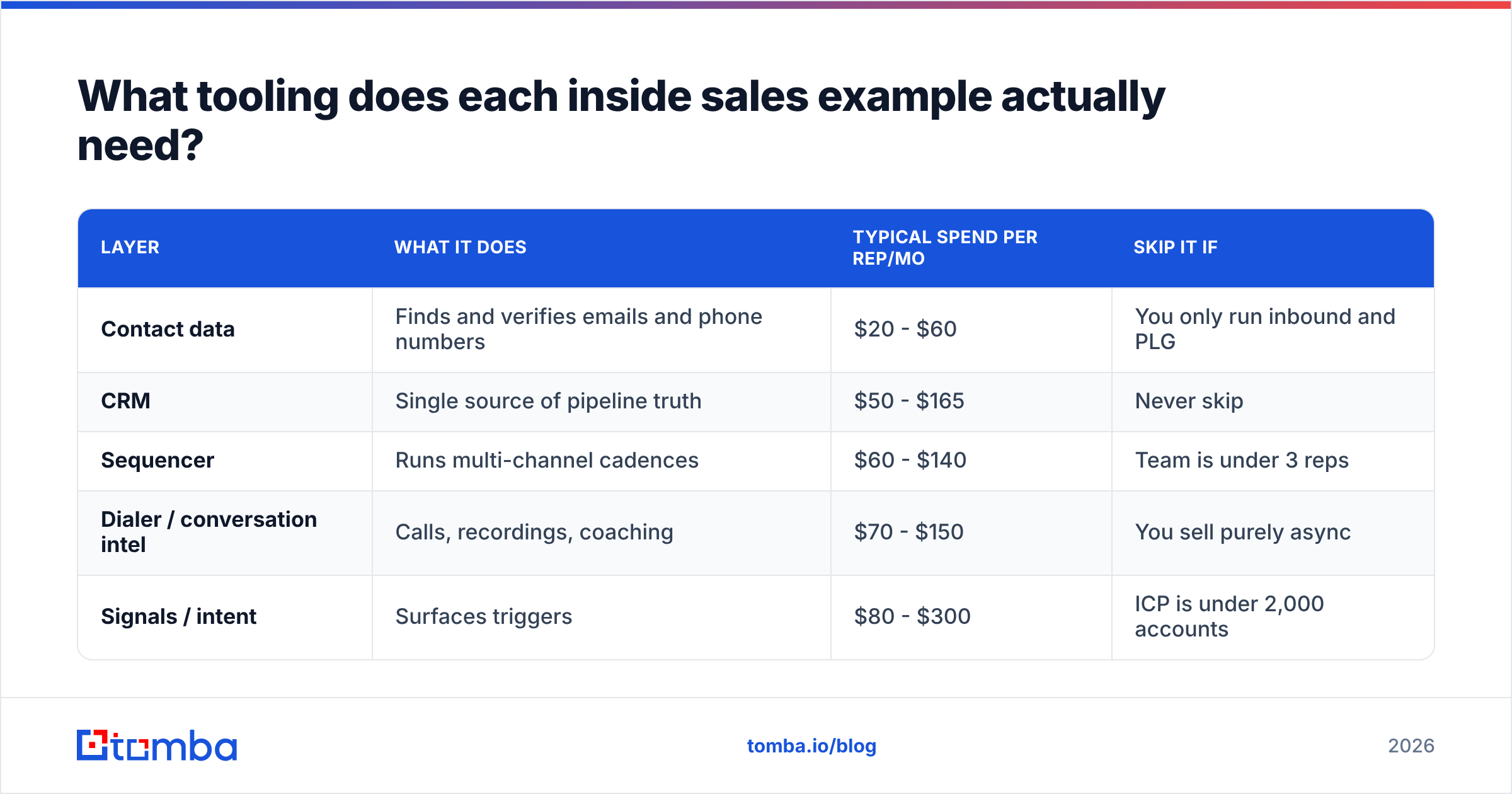
A working inside sales stack has five layers, and teams routinely overbuy the last two while underbuying the first.
| Layer | What it does | Typical spend per rep/mo | Skip it if |
|---|---|---|---|
| Contact data | Finds and verifies emails and phone numbers | $20 - $60 | You only run inbound and PLG |
| CRM | Single source of pipeline truth | $50 - $165 | Never skip |
| Sequencer | Runs multi-channel cadences | $60 - $140 | Team is under 3 reps |
| Dialer / conversation intel | Calls, recordings, coaching | $70 - $150 | You sell purely async |
| Signals / intent | Surfaces triggers | $80 - $300 | ICP is under 2,000 accounts |
The contact-data layer is the one to get right first. If 22% of your outbound emails bounce, your sender reputation degrades, your sequencer's deliverability collapses, and every downstream tool in the stack is working on a broken list. Run your list through an email verifier before it enters a sequence, and use domain search to map who else sits inside a target account when you need to multithread. For phone-heavy motions, a phone finder beats buying a second full data platform.
Which "inside sales examples" are quietly wasting your time?#
Three plays get copied constantly and rarely pay for themselves.
The 5,000-contact blast. A rep uploads a scraped list, writes one email, and sends it to everyone. Reply rates land near 0.3%, bounces spike, and the domain takes weeks to recover. A 300-contact list with verified addresses and one researched line per prospect beats it on absolute meetings, not just percentages.
Demo-first inbound routing. Every form fill goes straight to a calendar link with no qualification. Your AEs' calendars fill with students, competitors, and tire-kickers, and held-meeting rates drop below 50%. Add two qualifying questions to the form and one qualifying call.
Manual list building. Reps spend 8-12 hours a week copying names off LinkedIn and guessing email patterns. That is roughly a quarter of the selling week spent on work that an email finder and a bulk email finder do in minutes. Note that this is also why response rate benchmarks look so bad across the industry — most lists were never clean to begin with.
How do you measure whether an inside sales example is working?#
Track four numbers per play, weekly, and kill anything that misses two quarters running:
- Meetings held per rep per week. Held, not booked. SDRs: 3-5. AEs on inbound: 8-12.
- Contact rate. Connects divided by dials, or replies divided by delivered emails. Under 3% on email means targeting or data, not copy.
- Opportunity-to-close win rate. Segment by source. Partner and win-back plays should outperform cold outbound by 1.5-2x.
- Cost per closed dollar. Fully loaded rep cost plus tooling, divided by closed ARR from that play. This is the number that decides which of the nine examples survives your next budget cycle.
One caveat on benchmarks: peer-reviewed category data from G2 and similar sources is useful for sanity checks, but your own trailing-90-day numbers beat any industry average. Measure your team against itself.
Where should you start?#
Pick two plays, not nine. If you sell under $15K ACV, start with speed-to-lead and self-serve upgrade calls — both are cheap, fast, and use data you already own. If you sell $40K+, start with multithreaded mid-market and SDR-to-AE outbound, and budget for the data layer before the intent layer.
Then fix the input that every outbound-flavored inside sales example depends on: reaching a real person at a real address. Tomba's Email Finder returns verified professional emails by name and domain, with a free tier at 25 searches a month and paid plans starting at $49/mo — enough to test a play across a few hundred accounts before you commit budget to a full data platform. Check Tomba pricing to see which tier matches your list volume, and run your first 300-contact play this week instead of next quarter.
Related guides#
// get started
Find, verify and enrich your first contacts today
Start on the free plan with 25 searches a month, then scale when your team is ready.
Free plan · No credit card required · GDPR & CCPA
// about the author