Inside Sales Lead Generation: The Complete 2026 Playbook
Inside sales teams live or die by contact data quality and cadence discipline. Here is the 2026 playbook: channel mix, touch sequences, real benchmarks, and the stack that holds it together.
TL;DR
- Inside sales lead generation is pipeline built entirely from a desk — phone, email, LinkedIn, and web — by reps who own sourcing, qualification, and the first meeting.
- The bottleneck is almost never effort. It is data: bad emails and dead phone numbers silently eat 30-50% of a rep's working hours.
- A working 2026 cadence is 12-16 touches over 18-21 business days across three channels. Single-channel sequences underperform by a wide margin.
- Measure meetings per 100 verified contacts, not emails sent. Activity metrics reward waste.
- Budget roughly $150-$400 per rep per month for the full stack: data, sequencing, dialer, and enrichment.
What is inside sales lead generation?#
Inside sales lead generation is the process of sourcing, contacting, and qualifying prospects remotely — no field visits, no trade-show badge scanning as the primary motion. The rep sits at a desk, works a list, and hands a qualified meeting to an account executive (or closes it themselves in a full-cycle setup).
The model is not new, but the economics changed. A field rep costs $180k-$250k fully loaded and covers maybe 40 accounts. An inside rep costs a third of that and can work 400. Gartner's sales research has tracked buyers steadily shifting toward rep-free and remote-first buying journeys, which removed the last real argument for putting everyone on a plane.
What separates inside sales lead generation from generic "outbound" is ownership. In a pure outbound org, marketing supplies the list. In inside sales, the rep is usually responsible for building it — deciding which 200 accounts matter this quarter, finding the right five people inside each one, and getting a reply.
That shifts the failure mode. The rep's biggest risk isn't a weak pitch. It's spending Tuesday morning dialing numbers that ring nowhere and emailing addresses that bounce.
How does inside sales compare to outside sales and outsourced SDRs?#
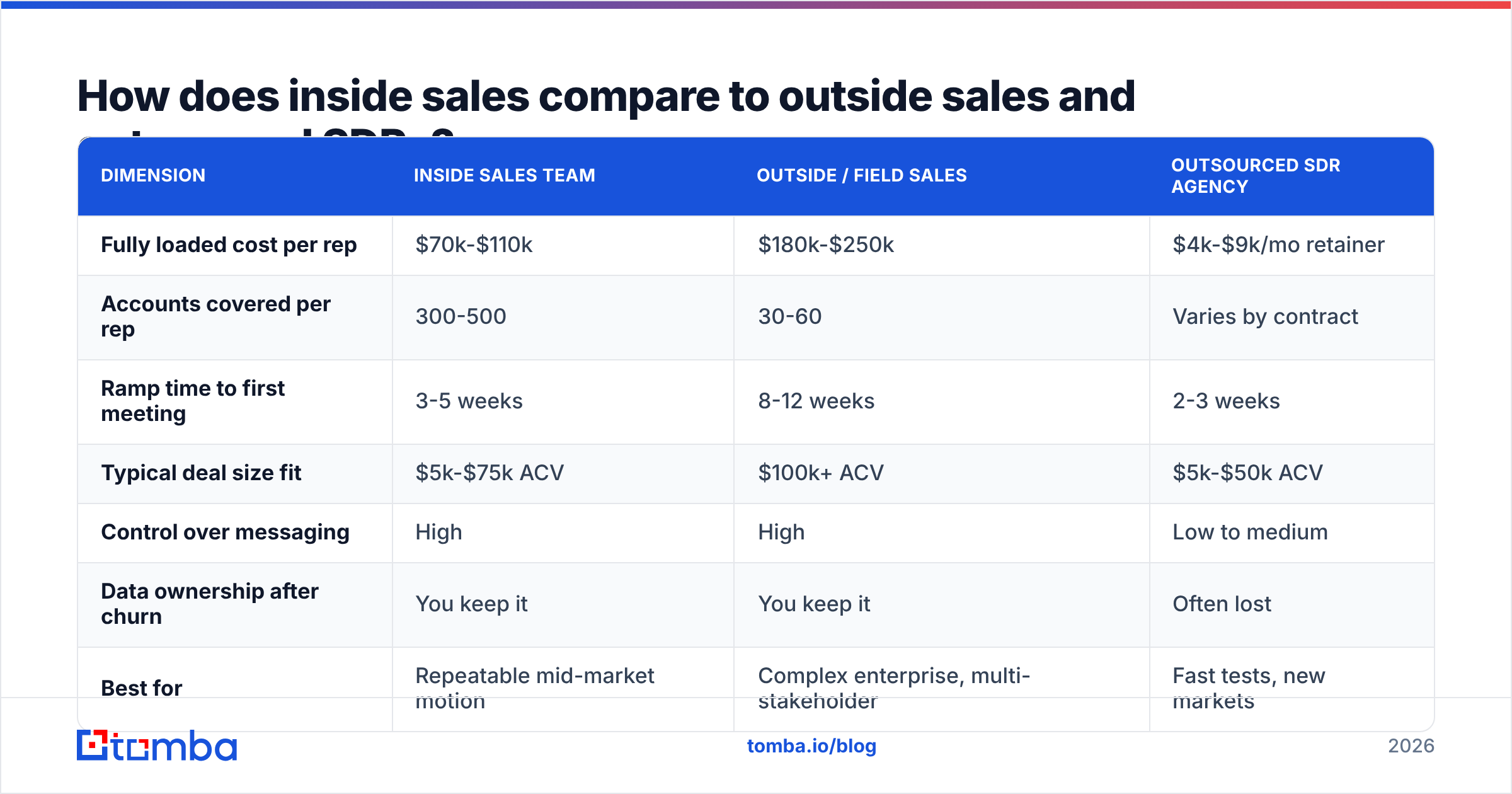
Three delivery models dominate B2B pipeline generation. They are not interchangeable, and the wrong choice shows up as cost-per-meeting six months later.
| Dimension | Inside sales team | Outside / field sales | Outsourced SDR agency |
|---|---|---|---|
| Fully loaded cost per rep | $70k-$110k | $180k-$250k | $4k-$9k/mo retainer |
| Accounts covered per rep | 300-500 | 30-60 | Varies by contract |
| Ramp time to first meeting | 3-5 weeks | 8-12 weeks | 2-3 weeks |
| Typical deal size fit | $5k-$75k ACV | $100k+ ACV | $5k-$50k ACV |
| Control over messaging | High | High | Low to medium |
| Data ownership after churn | You keep it | You keep it | Often lost |
| Best for | Repeatable mid-market motion | Complex enterprise, multi-stakeholder | Fast tests, new markets |
The honest read: outsourced SDRs are a good way to test a new segment without hiring, and a bad way to build a durable motion. You rent the pipeline and lose the learning. Inside sales is slower to stand up and compounds.
Field sales still wins when a single deal is worth more than a rep's annual salary and the buying committee has eight people. That is a narrower band than most sales leaders assume.
What does the inside sales lead generation funnel actually look like?#
Strip away the diagrams and there are six stages. Each one has a conversion rate you can measure and a specific failure mode.
- Account selection — Define the ICP tightly enough that you can name disqualifiers, not just qualifiers. "Series B SaaS, 50-300 employees, US, uses HubSpot" is workable. "Growing tech companies" is not. Expect to disqualify 60-70% of a raw market list.
- Contact discovery — Find 3-5 humans per account: the economic buyer, the likely champion, and a user-level influencer. Single-threaded accounts die when your one contact changes jobs, which happens to roughly one in five B2B contacts each year.
- Data verification — Validate every email and phone before it enters a sequence. This is the stage most teams skip, and it is the stage that determines whether the other five work.
- Multi-channel cadence — 12-16 touches across email, phone, and LinkedIn over about three weeks. Sequenced, not random.
- Qualification call — 15-20 minutes, structured around problem confirmation and budget/authority reality, not a demo.
- Handoff or close — A written handoff note to the AE with the pain, the timeline, and the exact words the prospect used. Meetings that get handed off without context no-show at roughly twice the rate.
The compounding point: a 10% improvement at each of six stages is not a 10% improvement overall. It is close to a 77% improvement in meetings booked from the same list.
Which channels produce pipeline in 2026?#
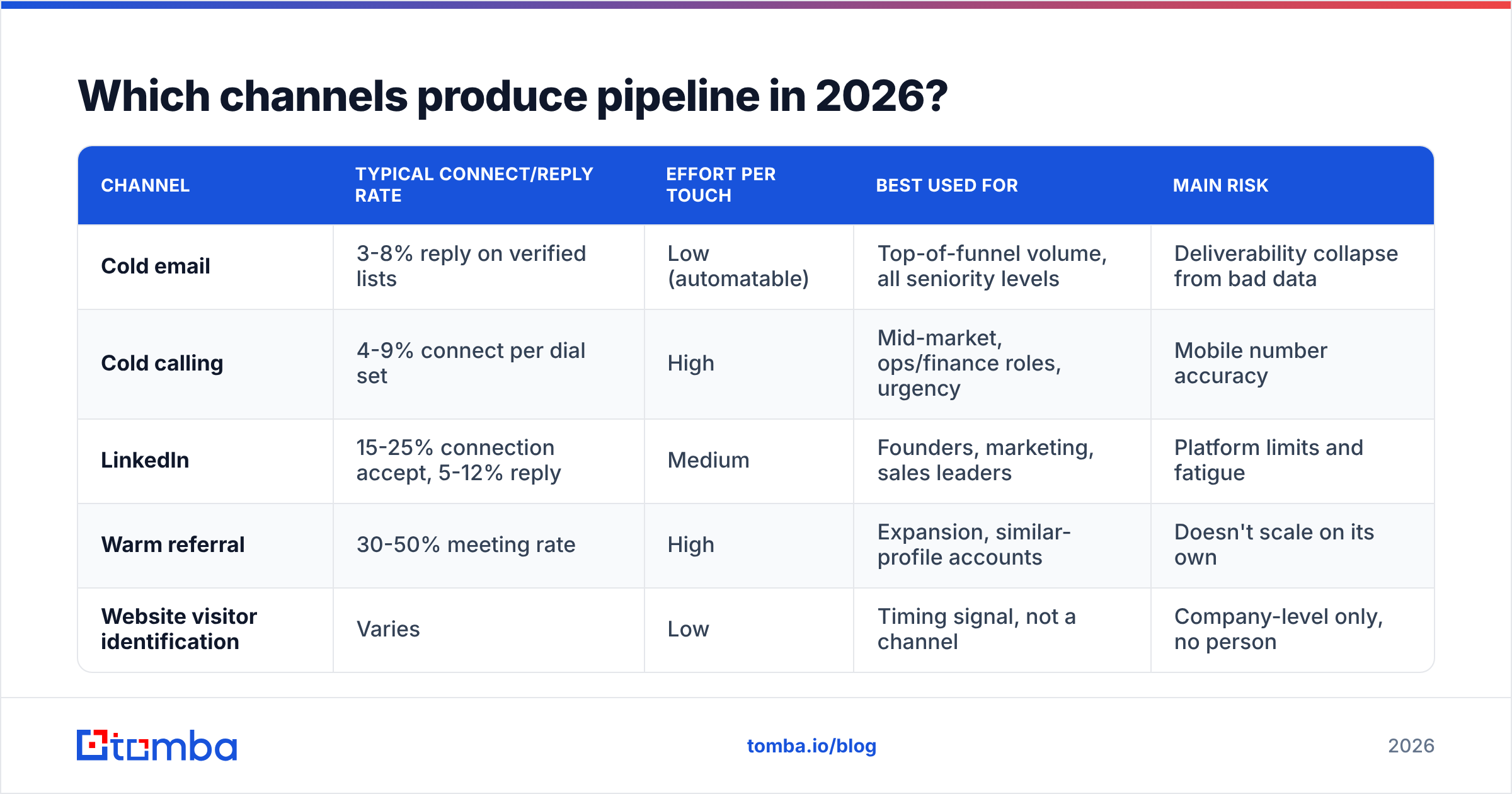
Nobody books meetings from one channel anymore. But the channels are not equal, and the mix matters more than the volume.
| Channel | Typical connect/reply rate | Effort per touch | Best used for | Main risk |
|---|---|---|---|---|
| Cold email | 3-8% reply on verified lists | Low (automatable) | Top-of-funnel volume, all seniority levels | Deliverability collapse from bad data |
| Cold calling | 4-9% connect per dial set | High | Mid-market, ops/finance roles, urgency | Mobile number accuracy |
| 15-25% connection accept, 5-12% reply | Medium | Founders, marketing, sales leaders | Platform limits and fatigue | |
| Warm referral | 30-50% meeting rate | High | Expansion, similar-profile accounts | Doesn't scale on its own |
| Website visitor identification | Varies | Low | Timing signal, not a channel | Company-level only, no person |
Read the table as a sequencing instruction rather than a ranking. Email creates awareness cheaply. The call converts that awareness. LinkedIn makes the caller a recognizable name instead of an unknown number. Teams that run all three against the same contact in the same week consistently outperform teams that run them in isolation — HubSpot's sales research has shown the same pattern across successive years of survey data.
One caveat on website visitor identification: it tells you a company looked at your pricing page. It does not tell you who. That is a trigger to go find the right person, not a lead.
How do you build the data layer without poisoning your domain?#
This is the part that separates a team hitting quota from a team wondering why nothing lands.
Every invalid email address in your sequence is a bounce. Bounces above roughly 2-3% start degrading your sender reputation. Once reputation drops, your valid emails start landing in spam — meaning bad data doesn't just waste the bad rows, it quietly kills the good ones too. A list that is 85% accurate is not 15% worse than a clean list. It can be functionally worthless.
A workable data layer has four jobs:
- Discovery. Find addresses from a name and company domain. An email finder that works from first name, last name, and domain covers most of what a rep needs day to day; a domain search covers the "who works here" question when you don't have names yet.
- Verification. Run every address through an email verifier before it enters a sequence — SMTP check, syntax, disposable domain detection, and role-address flagging. Re-verify anything older than 90 days.
- Phone coverage. Direct dials and mobiles beat switchboards by an order of magnitude. A phone finder paired with a validator keeps dial lists from filling up with disconnected lines.
- Enrichment. Job title, seniority, company headcount, and tech stack drive segmentation. Without them, personalization is guesswork.
Costs are modest relative to rep time. Tomba's free tier covers 25 searches a month for testing; Starter is $49/mo, Growth $99/mo, and Pro $249/mo — full Tomba pricing is public. Compare that to a $6,000/month rep spending eight hours a week on bad records and the math answers itself.
For teams working lists rather than one-offs, a bulk email finder run before each campaign is the single highest-leverage thirty minutes in the week.
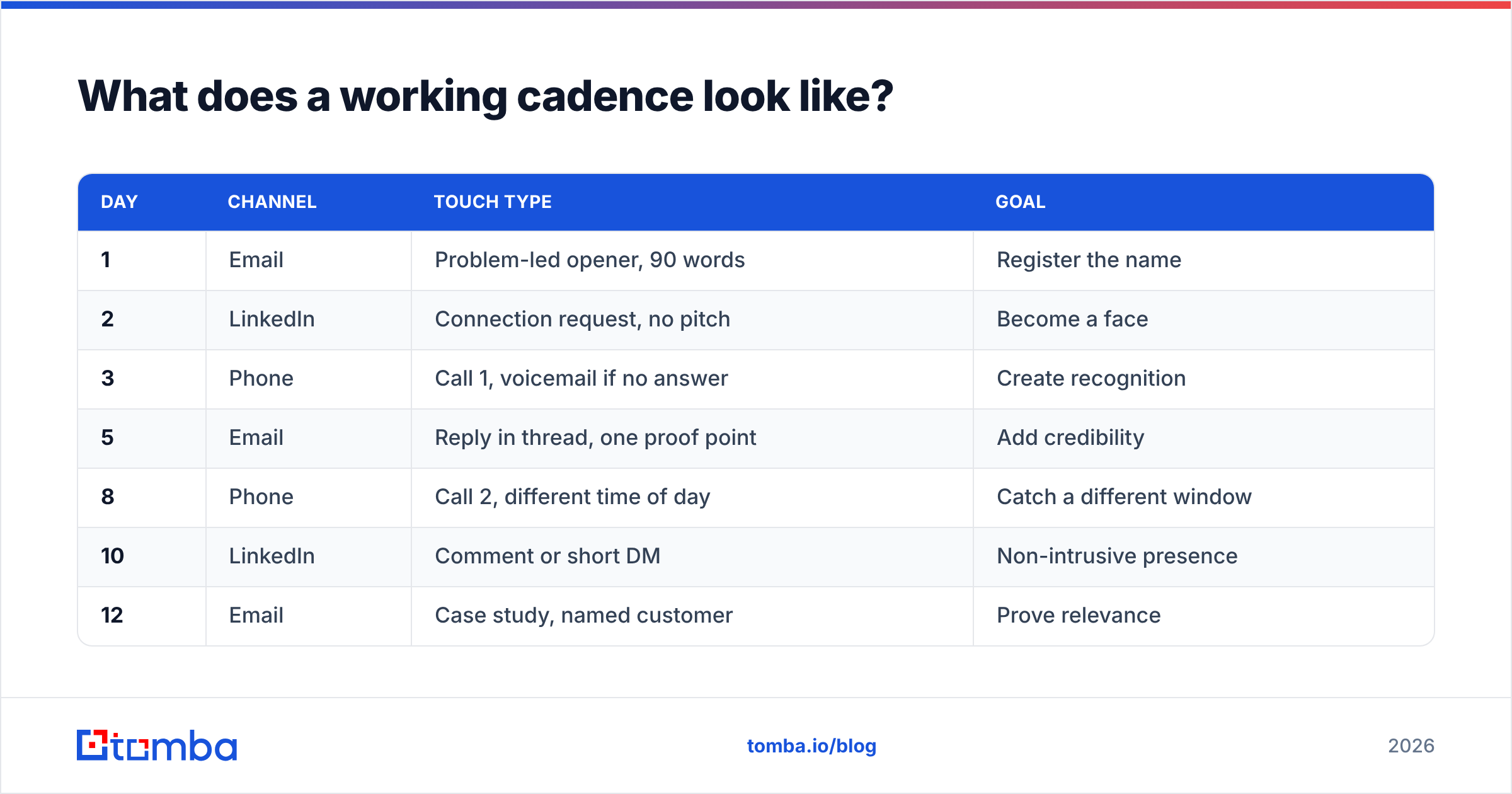
What does a working cadence look like?#
Here is a cadence that holds up across most mid-market B2B motions. Adjust the length, not the structure.
| Day | Channel | Touch type | Goal |
|---|---|---|---|
| 1 | Problem-led opener, 90 words | Register the name | |
| 2 | Connection request, no pitch | Become a face | |
| 3 | Phone | Call 1, voicemail if no answer | Create recognition |
| 5 | Reply in thread, one proof point | Add credibility | |
| 8 | Phone | Call 2, different time of day | Catch a different window |
| 10 | Comment or short DM | Non-intrusive presence | |
| 12 | Case study, named customer | Prove relevance | |
| 15 | Phone | Call 3 | Last serious attempt |
| 18 | Short breakup note | Trigger loss aversion | |
| 21 | — | Move to nurture, revisit in 90 days | Preserve the account |
Two rules that matter more than the schedule itself. First, vary the time of day on calls — a prospect who never answers at 10am may answer at 4:45pm. Second, never restart a cold sequence on a contact who has already seen ten touches; move them to a quarterly nurture instead. Repetition without new information reads as noise.

How many contacts does one rep actually need?#
Run the arithmetic before you set a quota, because most quotas are set by hope.
Assume a rep books 12 qualified meetings per month. Working backward with realistic 2026 rates on verified data:
- Meeting-to-qualified rate: 70% → needs ~17 booked meetings
- Positive reply-to-meeting rate: 45% → needs ~38 positive replies
- Reply rate on a verified, well-targeted list: 6% → needs ~630 contacts reached
- Data waste on an unverified list: 25-35% → would need 850-970 raw records instead
That difference — 630 verified versus 950 raw — is roughly 40 hours of rep time per month. It is also the entire argument for spending $99 a month on data infrastructure.
A rep working 400 accounts with four contacts each has 1,600 records. At 630 contacts touched per month, that territory supports about two and a half months of full cadence before you need fresh accounts or a second pass. Plan account refresh accordingly rather than discovering the gap in week nine.
What should you measure, and what should you ignore?#
Activity metrics are easy to collect and easy to game. Outcome metrics are harder and honest.
Track these:
- Meetings per 100 verified contacts — the single best measure of list quality plus messaging quality combined.
- Bounce rate per campaign — a leading indicator of deliverability trouble, two weeks before replies drop.
- Connect rate per dial — measures phone data quality, not rep effort.
- Positive response rate by segment — tells you which ICP slice to double down on.
- Meeting-held rate — separates real interest from polite scheduling.
Deprioritize these: raw emails sent, total dials, sequence enrollment count, LinkedIn connections made. Every one of them can be inflated without producing a dollar. A rep who sends 2,000 emails to a stale list looks busier than one who sends 600 to a verified one and books four times the meetings.
Most modern sales engagement platforms report all of this natively; if yours doesn't, the G2 sales engagement category is a reasonable place to compare reporting depth before switching.
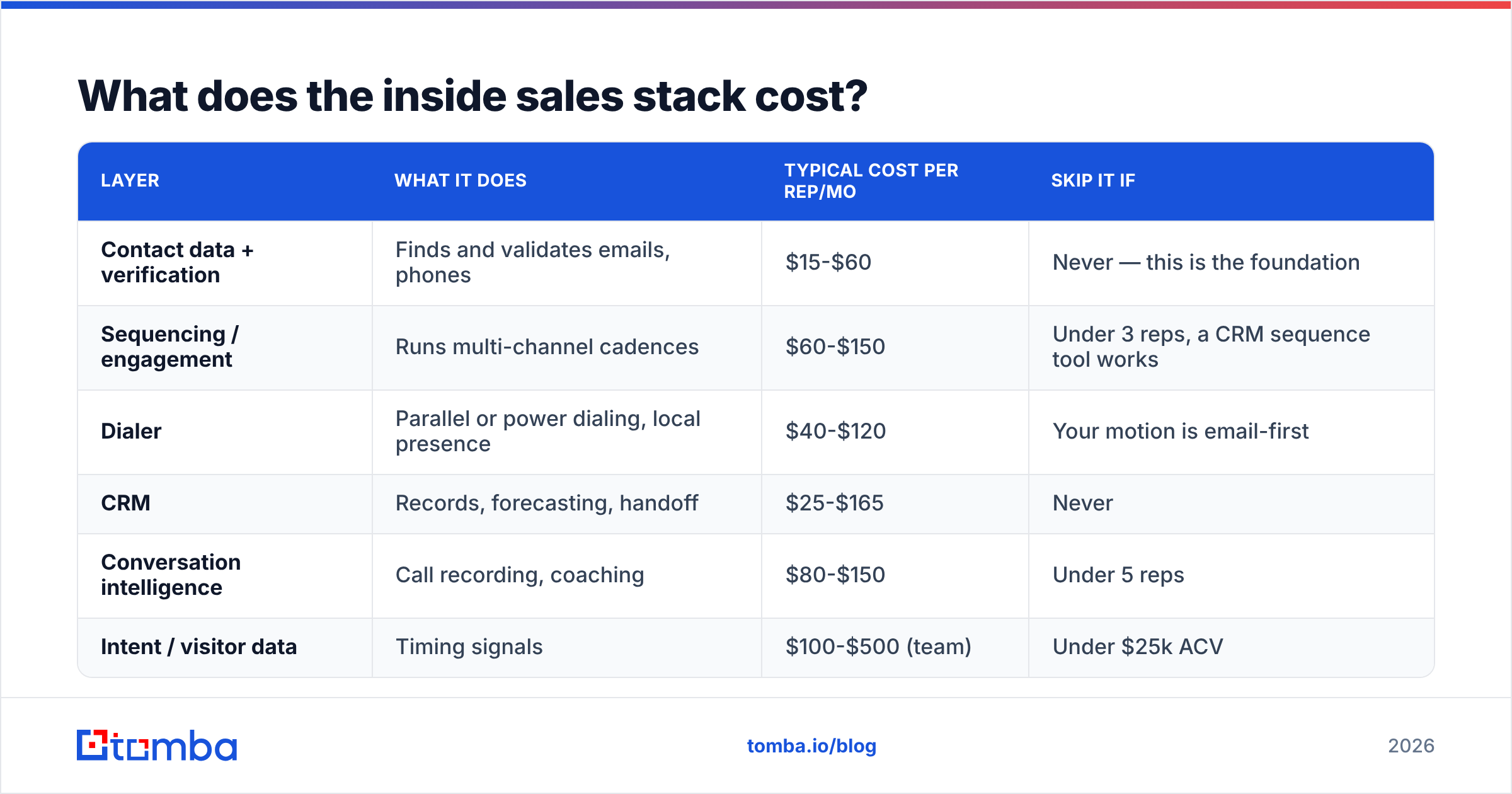
What does the inside sales stack cost?#
You need four layers. Everything else is optional until you have 10+ reps.
| Layer | What it does | Typical cost per rep/mo | Skip it if |
|---|---|---|---|
| Contact data + verification | Finds and validates emails, phones | $15-$60 | Never — this is the foundation |
| Sequencing / engagement | Runs multi-channel cadences | $60-$150 | Under 3 reps, a CRM sequence tool works |
| Dialer | Parallel or power dialing, local presence | $40-$120 | Your motion is email-first |
| CRM | Records, forecasting, handoff | $25-$165 | Never |
| Conversation intelligence | Call recording, coaching | $80-$150 | Under 5 reps |
| Intent / visitor data | Timing signals | $100-$500 (team) | Under $25k ACV |
Total for a lean, effective setup: roughly $150-$400 per rep per month. Against a fully loaded rep cost of $6,000-$9,000 per month, tooling is 3-5% of the investment and determines whether the other 95% produces anything. Underfunding the data layer to save $50 is the most common and most expensive mistake in the category. Salesforce's sales operations guidance makes the same point from the CRM side: garbage records propagate downstream into forecasting and never get cleaned up later.
What are the mistakes that kill inside sales teams?#
- Buying a list and skipping verification. Static lists decay at roughly 2-2.5% per month. A twelve-month-old list is about a quarter wrong.
- Single-threading accounts. One contact, one sequence, one point of failure.
- Optimizing subject lines before fixing data. A 2% lift on a subject line is meaningless when 30% of the sends bounce.
- Treating a demo request as qualification. Interest is not budget. Ask the uncomfortable question on the first call.
- Rotating reps through territories every quarter. Account knowledge is the compounding asset. Destroying it resets the flywheel.
- Measuring dials instead of connects. Reps will optimize for whatever you count.
None of these are strategy problems. They are operational hygiene, which is exactly why they persist — nobody gets promoted for cleaning a list.
Where should you start this week?#
Pick one territory. Rebuild it properly: 200 accounts that genuinely match your ICP, four verified contacts each, every email validated, every phone number checked. Run the 21-day cadence above against it with no changes to the messaging you already use. Measure meetings per 100 contacts before and after.
In most teams, that exercise alone moves the number more than any messaging rewrite, any new sequencing tool, or any additional headcount. The pipeline was never missing. The contact data was.
When you're ready to rebuild that territory, start with the Tomba Email Finder — search by domain, name, or company, verify in the same workflow, and export straight into your sequencer. The free tier covers 25 searches a month, which is enough to test accuracy on your own accounts before you spend anything. Run your current list through it and see how much of it was real.
Related guides#
Ready to find emails that actually work?
Join 150,000+ professionals who stopped guessing and started sending. Free credits on signup — no credit card required.
Get the Tomba newsletter
Practical outbound tactics and product updates — once every two weeks.
About the author