Inside Sales Model: How It Works and When to Use It
Inside sales now closes most B2B deals, but the model only works when your territory math, tooling, and data quality line up. Here's how to build it without burning pipeline.
TL;DR
- The inside sales model means reps sell remotely — phone, email, video, LinkedIn — instead of traveling to buyers. It now covers the majority of B2B selling motions, including deals well above $50K ACV.
- Inside reps cost roughly 40-60% less per head than field reps once travel, car allowance, and regional overhead are stripped out, and they run 3-5x the daily touch volume.
- The model breaks when contact data is stale. A remote rep with a bad email list has no hallway conversations to fall back on — data quality is the single biggest variable in inside-sales productivity.
- Inside sales is not the same as SDR work. SDRs prospect; inside AEs own the full cycle remotely. Conflating the two is the most common structural mistake.
- Choose field sales when the deal requires on-site technical validation, procurement theater, or a buying committee that will not take a video call. Choose inside sales for everything else.
What Is the Inside Sales Model?#
Inside sales is a structure where reps close deals without leaving the office — or their home desk. Every touch happens through a screen or a phone: discovery calls on Zoom, proposals over email, negotiation in a shared doc, signature through an e-sign tool.
Think of it like the shift from house calls to telehealth. A doctor who drives to your living room sees maybe six patients a day. A doctor on video sees thirty. The care model changes, the volume math changes completely, and a handful of cases still genuinely require someone in the room.
That is the whole argument. An outside rep with a three-state territory spends 40-50% of their week in transit or in airports. An inside rep spends that time in conversations. The trade is depth of presence for volume of contact, and for most software, services, and mid-market B2B products, volume wins.
Three things are commonly confused with inside sales and are not the same thing:
- SDR/BDR teams — These are prospecting specialists who book meetings and hand off. They sit inside the inside sales org but do not own quota against closed revenue.
- Telemarketing — High-volume, low-consideration, script-driven, usually B2C. Inside sales runs consultative cycles that can stretch 60-120 days.
- Remote work — A field rep working from home between flights is still a field rep. The model is defined by how the deal is worked, not where the laptop sits.
How Does Inside Sales Compare to Field Sales?#
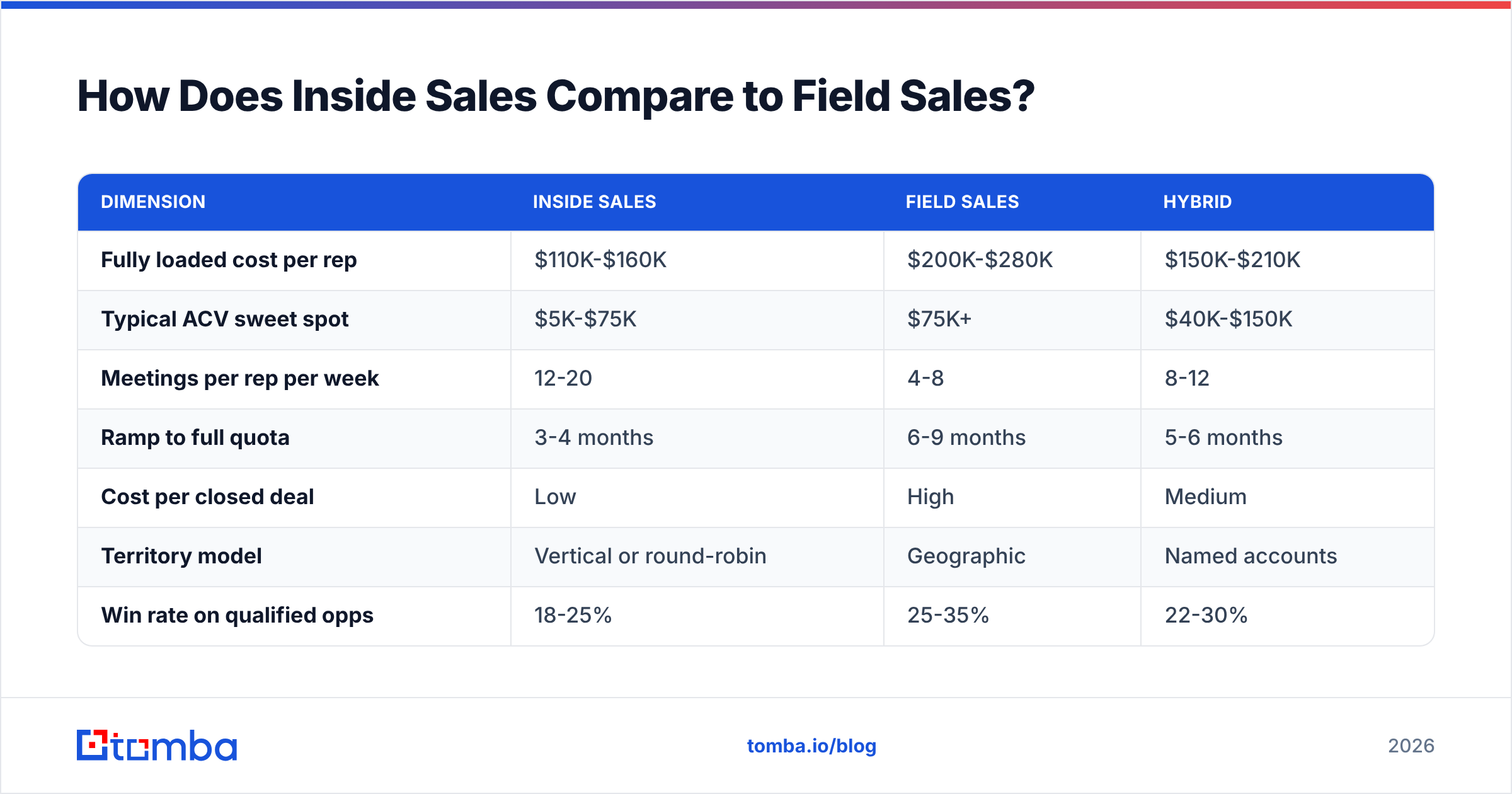
The honest answer is that the two models have different unit economics, and the deciding factor is usually deal size divided by touch cost — not preference.
| Dimension | Inside Sales | Field Sales | Hybrid |
|---|---|---|---|
| Fully loaded cost per rep | $110K-$160K | $200K-$280K | $150K-$210K |
| Typical ACV sweet spot | $5K-$75K | $75K+ | $40K-$150K |
| Meetings per rep per week | 12-20 | 4-8 | 8-12 |
| Ramp to full quota | 3-4 months | 6-9 months | 5-6 months |
| Cost per closed deal | Low | High | Medium |
| Territory model | Vertical or round-robin | Geographic | Named accounts |
| Win rate on qualified opps | 18-25% | 25-35% | 22-30% |
| Best for | Volume + repeatable product | Complex, political, technical | Land inside, expand on-site |
Field sales still wins on win rate per opportunity — being in the room matters when six stakeholders are arguing about a security review. But inside sales wins on opportunities created per dollar, and in most pipelines that gap is larger than the win-rate gap.
The hybrid column is where most mid-market companies actually land in 2026: inside reps run the full cycle, and a small field or solutions team flies in only for deals above a revenue threshold or at the technical-validation stage. Gartner's sales research has tracked this consolidation for years — buyers increasingly prefer a rep-free or rep-light digital path until late in the cycle, which removes much of the historical justification for a travel-heavy team.

What Roles Make Up an Inside Sales Team?#
A functioning inside sales org has four distinct jobs. Collapsing them into two roles is what causes the "our reps spend all day building lists" complaint.
- SDR / BDR — Owns top-of-funnel. Sources accounts, finds contacts, runs sequences, books qualified meetings. Measured on meetings held, not emails sent.
- Inside AE — Owns the cycle from discovery to close. Runs demos, builds business cases, negotiates. Measured on closed-won revenue and cycle length.
- Sales engineer / solutions consultant — Handles technical depth on demos and security questionnaires. Often shared 1:4 or 1:6 across AEs.
- RevOps / sales ops — Owns the data layer, routing rules, CRM hygiene, and reporting. Undervalued and usually hired two quarters too late.
- Account manager / CSM — Owns expansion and renewal once the deal lands. Separate quota, separate comp plan.
The ratio that works for most teams: 2 SDRs per AE in an outbound-heavy motion, 1 SDR per AE if inbound covers half the pipeline. Anything above 3:1 and your AEs will drown in unqualified meetings. Anything below 1:2 and your AEs will start prospecting, which is the most expensive possible use of a closer's hour.
For the operational layer under all of this, a working understanding of revenue operations matters more than another headcount. RevOps is what keeps routing, enrichment, and attribution from turning into a spreadsheet swamp.
Why Does Contact Data Decide Whether the Model Works?#
Because a remote rep has exactly one way in, and if the email bounces or the number is dead, there is no backup plan.
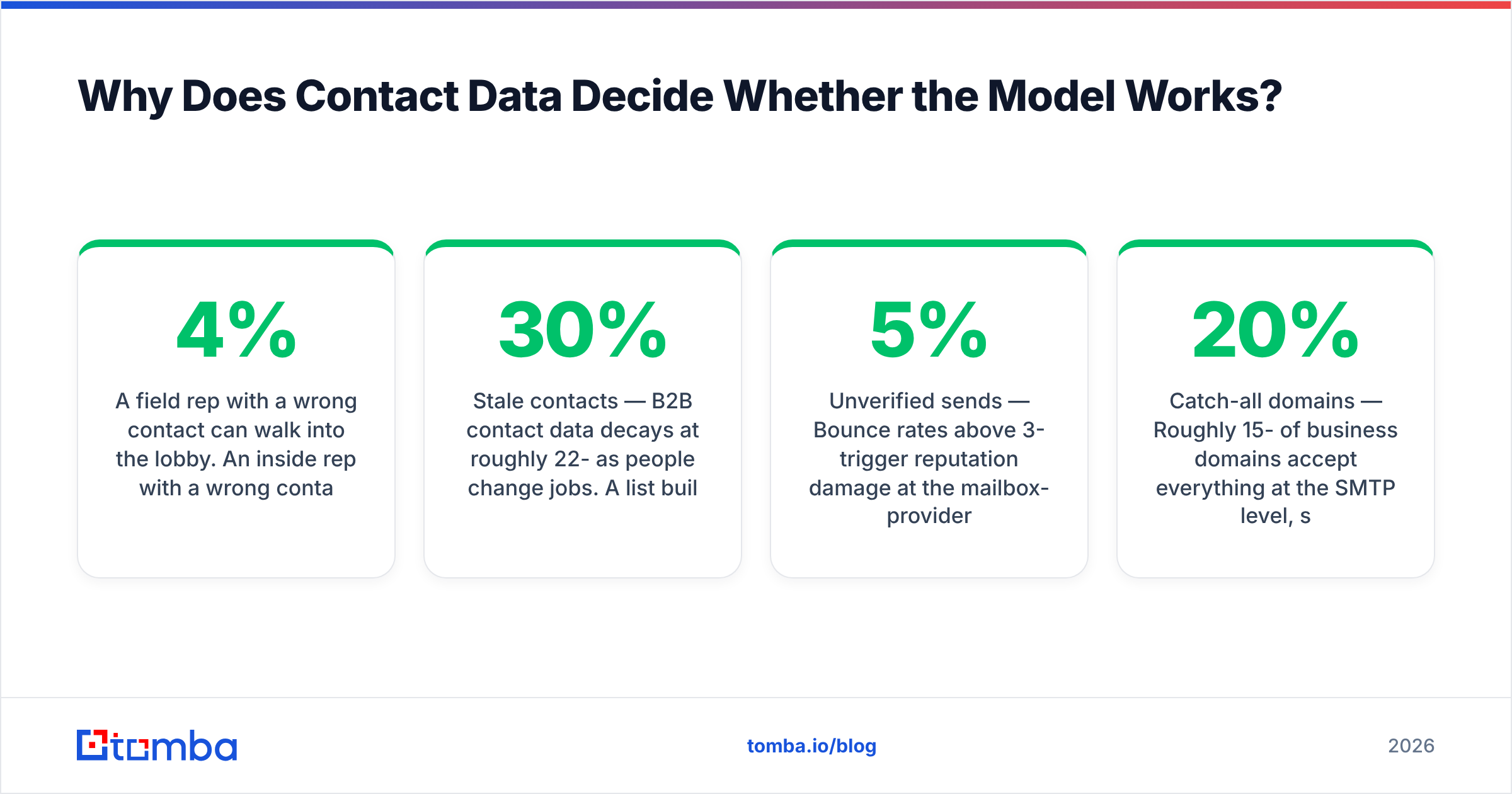
A field rep with a wrong contact can walk into the lobby. An inside rep with a wrong contact has a bounce notification and a burned sending domain. This is the asymmetry nobody puts in the business case, and it is why inside sales teams that skip data hygiene post 2-4% reply rates while identical teams on clean lists post 8-14%.
The failure chain is predictable:
- Stale contacts — B2B contact data decays at roughly 22-30% per year as people change jobs. A list built 18 months ago is half wrong.
- Unverified sends — Bounce rates above 3-5% trigger reputation damage at the mailbox-provider level. Your good emails stop landing too.
- Catch-all domains — Roughly 15-20% of business domains accept everything at the SMTP level, so a naive verifier returns "valid" for addresses that do not exist. You need a catch-all verifier that probes further rather than shrugging.
- No phone fallback — Email-only sequences cap out. Teams that add a call step to the same contact see materially higher connect rates, which means you need B2B phone numbers attached to the same record.
Practically, the workflow that holds up looks like this: build the account list, run domain search to pull every contact at each target company, find the specific decision-maker with an email finder, push everything through an email verifier before it touches a sequencer, then enrich with title, seniority, and phone so the SDR can pick the right channel.
Skip the verify step and you are not running inside sales. You are running a deliverability experiment.
What Does an Inside Sales Process Actually Look Like?#
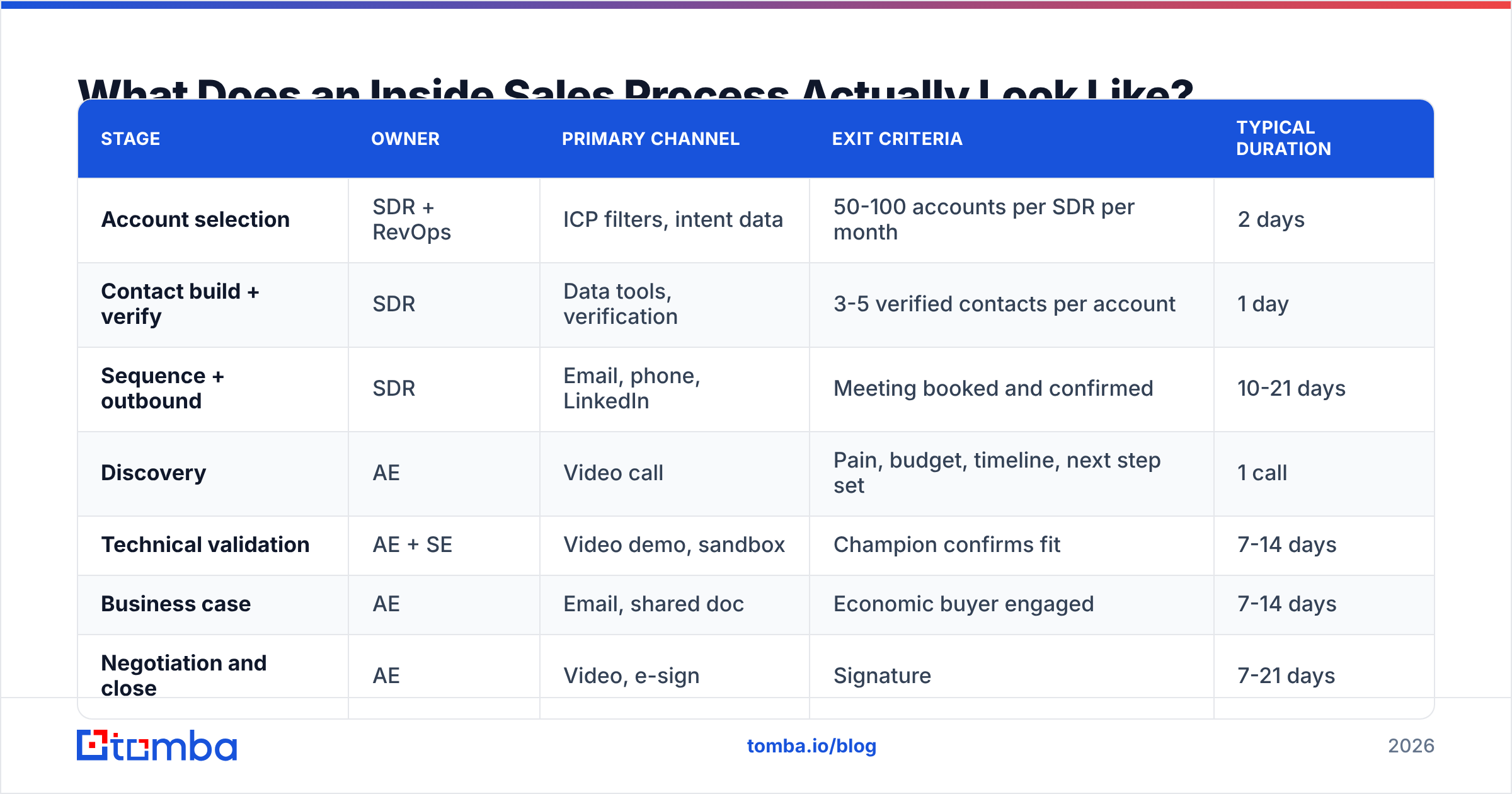
Here is a working sequence for a $20K-$60K ACV product with a 45-70 day cycle. Adjust the day counts, not the order.
| Stage | Owner | Primary channel | Exit criteria | Typical duration |
|---|---|---|---|---|
| Account selection | SDR + RevOps | ICP filters, intent data | 50-100 accounts per SDR per month | 2 days |
| Contact build + verify | SDR | Data tools, verification | 3-5 verified contacts per account | 1 day |
| Sequence + outbound | SDR | Email, phone, LinkedIn | Meeting booked and confirmed | 10-21 days |
| Discovery | AE | Video call | Pain, budget, timeline, next step set | 1 call |
| Technical validation | AE + SE | Video demo, sandbox | Champion confirms fit | 7-14 days |
| Business case | AE | Email, shared doc | Economic buyer engaged | 7-14 days |
| Negotiation and close | AE | Video, e-sign | Signature | 7-21 days |
Two details matter more than the rest.
First, the confirmed-meeting rule. A booked meeting is not a meeting. Teams that require a confirmation reply within 24 hours of the calendar invite cut no-show rates roughly in half. Bake it into the SDR's exit criteria, not their goodwill.
First-touch quality compounds through every later stage — which is why the response rate on your opening sequence is the leading indicator worth watching weekly, ahead of any pipeline metric.
Second, the single-threading trap. Inside reps default to one contact because that contact replied. When that person leaves — and at 25% annual churn, plenty do — the deal dies silently. Require two engaged contacts before an opportunity can move past discovery. HubSpot's sales research has documented multi-threading as one of the most consistent win-rate levers available, and it costs nothing but discipline.

What Metrics Should You Track?#
Track the ratios, not the raw activity. Raw activity numbers get gamed within two weeks of being put on a dashboard.
- Meetings held per SDR per week — Target 8-12. Held, not booked.
- Meeting-to-opportunity conversion — Target 50-65%. Below 40% means your SDRs are booking anyone with a pulse.
- Opportunity-to-close rate — Target 18-25% for inside sales. Track by source; inbound and outbound behave differently enough that a blended number hides problems.
- Cycle length by segment — Watch the trend, not the absolute. A cycle stretching by 20% quarter over quarter usually means you have drifted upmarket without changing the model.
- Bounce rate — Keep it under 2%. This is a data metric masquerading as a deliverability metric.
- Cost per opportunity — Fully loaded team cost divided by qualified opportunities created. This is the number that proves or kills the inside model in your board deck.
One metric to actively distrust: emails sent. It correlates with nothing except domain reputation risk. If a manager is reporting it weekly, the team will send more garbage.
What Tools Does an Inside Sales Team Need?#
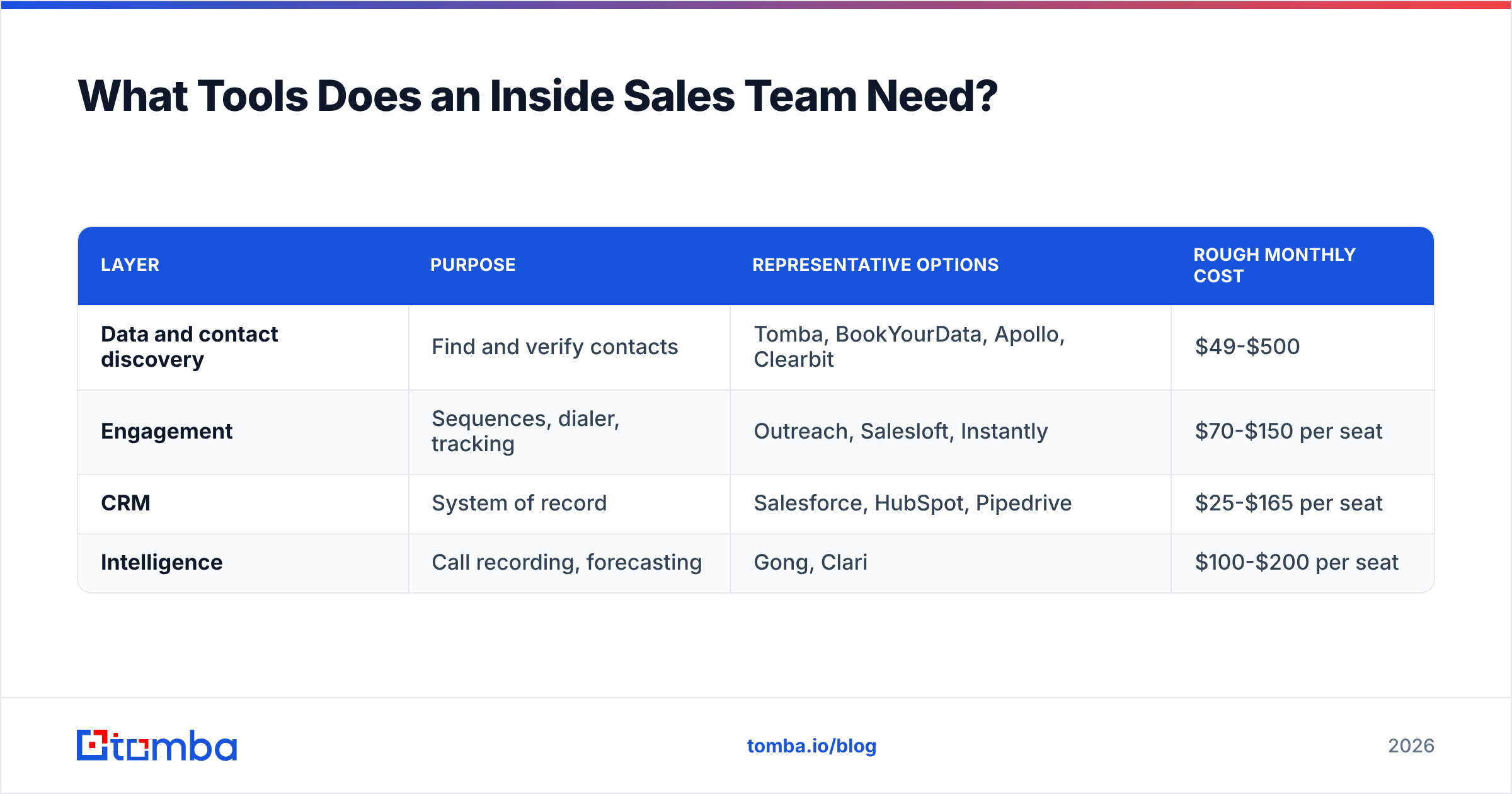
The stack has four layers, and most teams overbuy on layer three while underbuying on layer one.
| Layer | Purpose | Representative options | Rough monthly cost |
|---|---|---|---|
| Data and contact discovery | Find and verify contacts | Tomba, BookYourData, Apollo, Clearbit | $49-$500 |
| Engagement | Sequences, dialer, tracking | Outreach, Salesloft, Instantly | $70-$150 per seat |
| CRM | System of record | Salesforce, HubSpot, Pipedrive | $25-$165 per seat |
| Intelligence | Call recording, forecasting | Gong, Clari | $100-$200 per seat |
On layer one, the pricing spread is worth understanding before you commit. Tomba pricing starts with a free tier at 25 searches per month, then Starter at $49/mo, Growth at $99/mo, and Pro at $249/mo, with enterprise pricing negotiated. BookYourData takes a different approach with prepaid credit packs and no subscription, which suits teams that buy lists in bursts rather than continuously — a genuinely reasonable fit if your prospecting is campaign-driven rather than always-on. Apollo bundles data with sequencing, which is convenient but means your data quality and your sending tool are locked to the same vendor.
The practical test for layer one: run 100 contacts from your actual ICP through two providers, send both lists through the same verifier, and compare the valid-address rate and the bounce rate after a real send. Vendor-published accuracy numbers — including anyone's — are measured on their own benchmark sets. Yours is the only one that matters. G2's category reviews are useful for narrowing the shortlist to three, but not for picking the winner.
For teams running this at volume, API access matters more than the UI. Piping enrichment through the Tomba API into your CRM on lead creation means reps never see an unverified record, which removes the hygiene problem at the source instead of policing it downstream.
When Should You Not Use Inside Sales?#
Four situations where the field model still earns its cost:
- On-site technical validation is mandatory. Manufacturing equipment, physical security systems, anything requiring a site survey. You cannot Zoom a factory floor walkthrough that matters.
- The buying committee will not take video calls. Some sectors — parts of government, healthcare systems, heavy industry — still run on in-person relationship norms. Fighting this costs more than accommodating it.
- ACV above roughly $150K with a 9+ month cycle. At that size the cost of a few flights is rounding error against the win-rate gain from in-person executive access.
- Your product requires physical demonstration. Hardware, lab equipment, anything where the "aha" is tactile.
Everything else — SaaS, agencies, professional services, most mid-market products — runs better inside. And even in the four cases above, the prospecting half of the motion should be inside. There is no version of 2026 where a field rep should be building their own contact lists.
How Do You Actually Build the Team?#
Sequence the hires like this and you will avoid the two most common blowups — hiring closers before you have pipeline, and hiring SDRs before you have a repeatable message.
- Prove the motion yourself first. A founder or first sales hire runs 50 full cycles. You are looking for a repeatable discovery script and a consistent objection set, not revenue.
- Hire one AE, not three. One AE who hits quota proves the model. Three AEs who miss it prove nothing except that you spent the money.
- Add SDRs once the AE is capacity-constrained. If your AE is not turning down meetings, you do not need an SDR. You need better messaging.
- Hire RevOps at roughly five reps. Before that, the sales leader can carry it. After that, the data decay outruns manual cleanup and the reporting stops being trustworthy.
- Add a sales engineer when demos start failing on technical depth. Track the reason-lost field; when "technical fit" crosses 15%, you have your answer.
Compensation should sit at a 50/50 to 60/40 base-to-variable split for inside AEs, with SDRs closer to 70/30. Higher variable than that on an inside team produces sandbagging and short-term behavior, because inside cycles are short enough that reps can see the end of the quarter clearly from the middle of it.
Getting the Data Layer Right#
Everything above depends on one assumption: that when your rep hits send, a real person receives it.
That assumption is wrong more often than most teams measure. Between annual contact decay, catch-all domains that fake a positive verification result, and title changes that are never reflected in the CRM, a list that looked clean at build time is meaningfully degraded within two quarters.
Start with the Tomba Email Finder to build verified contact lists from your target accounts, and run everything through verification before it reaches your sequencer. The free tier covers 25 searches a month, which is enough to test the accuracy of your current list against a second source before you commit budget. If it turns out your existing data is fine, you have lost nothing. If it turns out 30% of your list is dead, you have just found the cheapest available fix to your reply rate.
Related guides#
// get started
Find, verify and enrich your first contacts today
Start on the free plan with 25 searches a month, then scale when your team is ready.
Free plan · No credit card required · GDPR & CCPA
Get the Tomba newsletter
Product and data updates
// about the author