Inside Sales Strategies That Actually Close Deals in 2026
Inside sales teams hit quota on process, not charisma. Here are the strategies, benchmarks, and tooling decisions that separate a 6% reply rate from a 0.8% one.
TL;DR
- Inside sales performance is a data problem before it is a talent problem. Teams with a bounce rate under 2% typically see 3-5x the reply rate of teams sitting at 12% bounces, with identical scripts.
- The highest-leverage strategies are unglamorous: tight ICP definition, multi-channel cadences of 9-14 touches, disciplined list hygiene, and one clear next step per message.
- Specialization beats generalization above ~5 reps. Split prospecting from closing once your AEs spend more than 30% of their week on list building.
- Activity metrics (dials, sends) are leading indicators only when paired with quality gates. Track connect rate, reply rate, and meetings-held — not meetings-booked.
- Budget your stack around three jobs: find accurate contacts, sequence touches, and record what happened. Everything else is optional until it isn't.
What is inside sales, and how is it different in 2026?#
Inside sales is selling conducted remotely — phone, email, video, LinkedIn, chat — instead of in-person field visits. That definition has been stable for two decades. What changed is the ratio: most B2B organizations now run inside-sales motions by default, and field sales is the exception reserved for enterprise expansion.
Three things are materially different from even three years ago:
- Buyer inboxes are filtered harder. Google and Yahoo's bulk-sender requirements pushed authentication and complaint-rate thresholds into the mainstream. Sloppy senders no longer just underperform — they stop being delivered.
- Signal beats volume. The old play of sending 3,000 emails a week to a scraped list now produces worse absolute results than 400 well-researched sends, because the deliverability penalty compounds.
- AI collapsed the cost of drafting, not the cost of relevance. Everyone can produce a plausible paragraph. Almost nobody can produce a correct, current, specific reason to reach out. That gap is where quota lives.
The strategic implication: your inside sales strategy is now mostly a series of decisions about data quality, targeting discipline, and cadence design. Copywriting matters, but it is the fourth variable, not the first.
Which inside sales strategies actually move the number?#
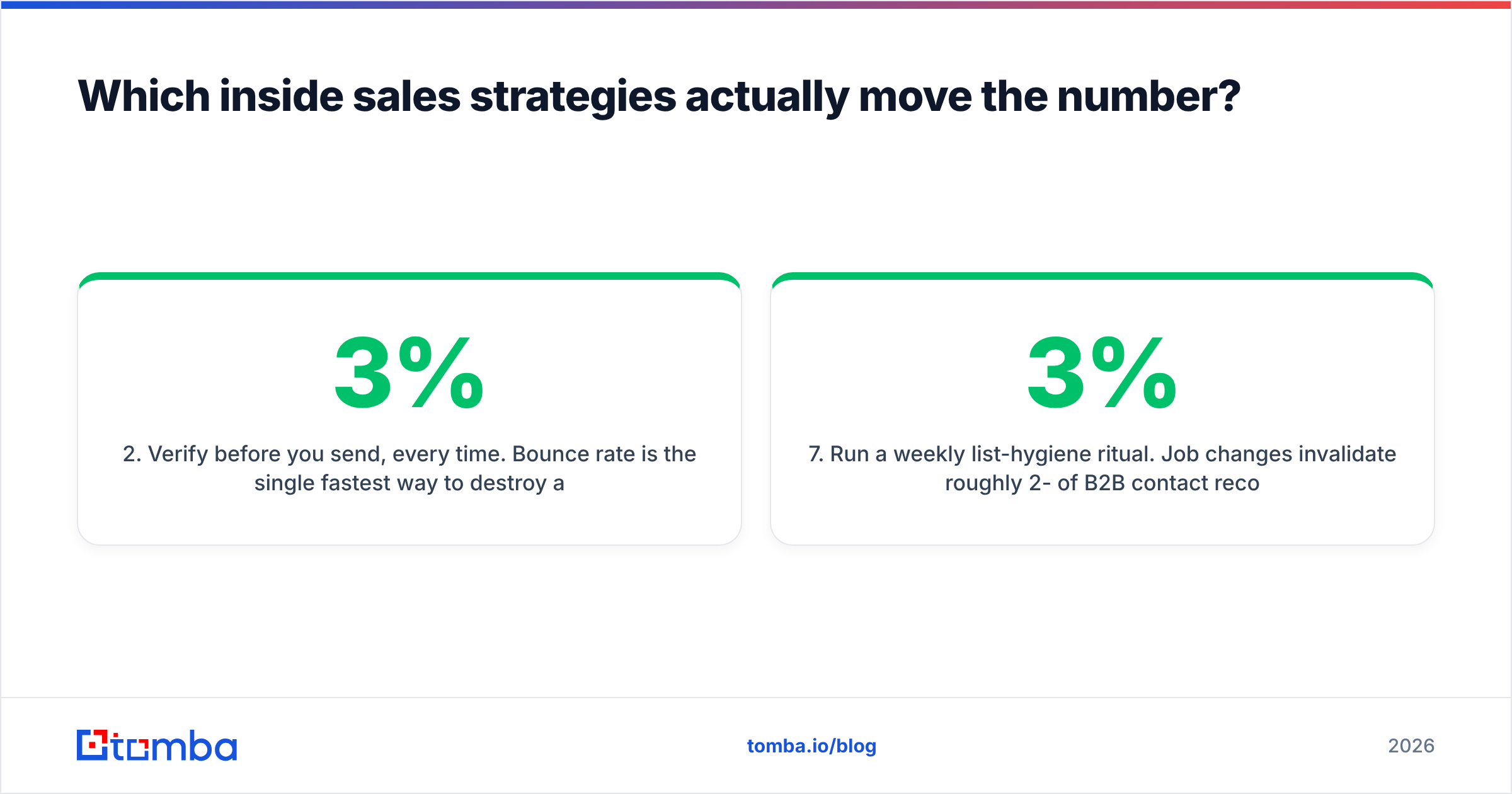
Here are the seven that survive contact with a real pipeline review. They are ordered by leverage — fix the top ones first.
- Narrow the ICP until it hurts. Most teams define ICP as "B2B SaaS, 50-500 employees, US." That is a market, not an ICP. A usable ICP names the trigger ("hired a first RevOps person in the last 90 days"), the buying role, and the disqualifier. Narrowing from 40,000 accounts to 1,200 routinely doubles reply rate because the message can finally be specific.
- Verify before you send, every time. Bounce rate is the single fastest way to destroy a sending domain. Run every list through an email verifier and treat anything above a 3% projected bounce as a blocked release.
- Design cadences, not blasts. A working cadence is 9-14 touches over 18-24 business days across at least three channels. One channel is a monologue; three is a campaign.
- Specialize roles past five reps. SDRs prospect, AEs close, and someone owns list building. Full-cycle reps are efficient at small scale and quietly disastrous at medium scale, because prospecting is the first thing that gets dropped when a deal heats up.
- Make the CTA smaller than you want it to be. "Worth a 15-minute call next Tuesday?" converts worse than "Is inbound routing something your team owns, or does that sit with marketing?" Interest-based CTAs outperform meeting-based CTAs in the first two touches of nearly every cadence I've audited.
- Instrument meetings-held, not meetings-booked. Booked meetings are gameable. Held meetings are not. The gap between the two numbers is your qualification quality score.
- Run a weekly list-hygiene ritual. Job changes invalidate roughly 2-3% of B2B contact records per month. Without a recurring re-verification pass, a six-month-old list is roughly 15-20% decayed before you send a single message.
How should an inside sales cadence be structured?#
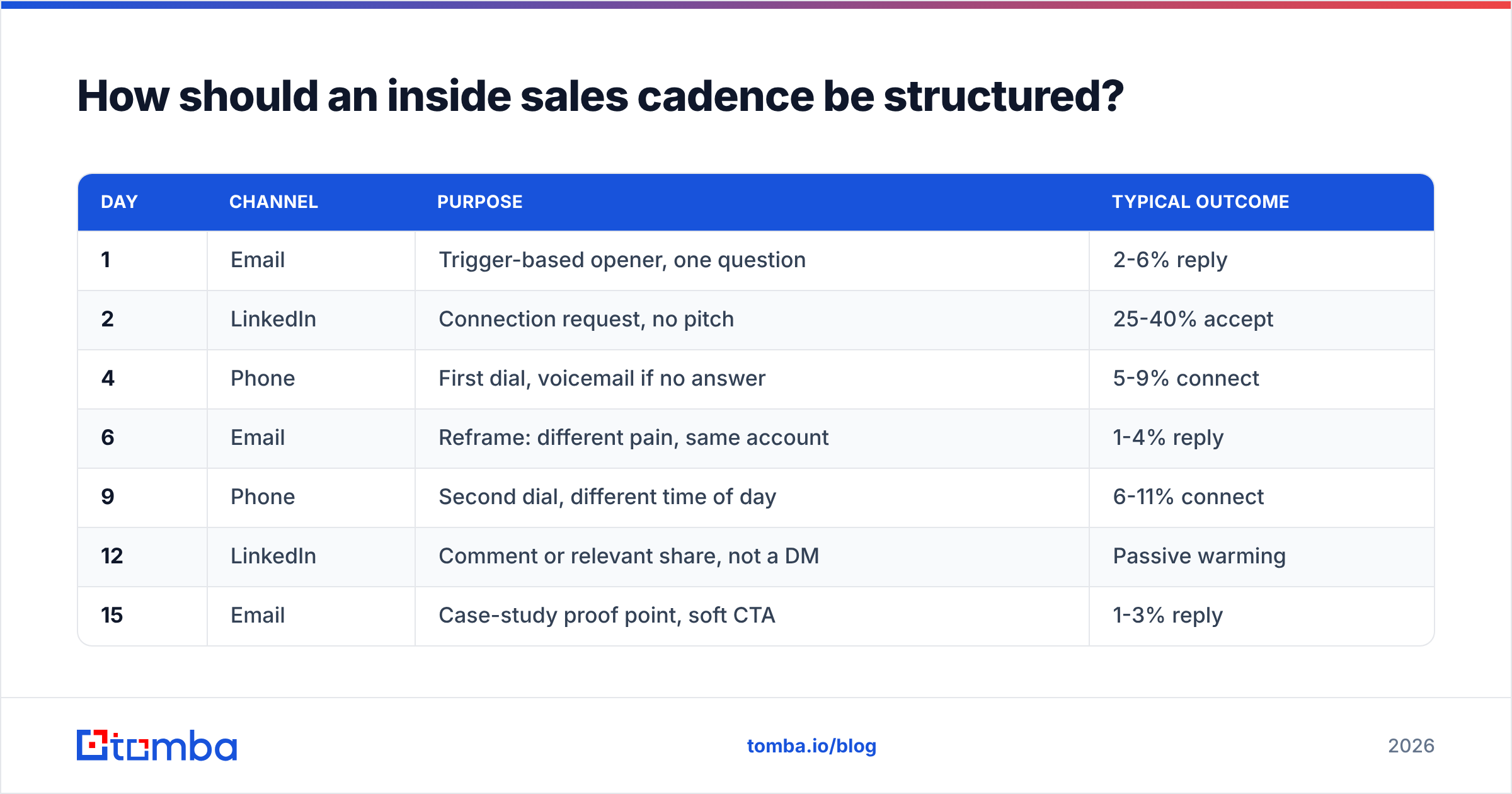
The cadence is where strategy becomes operations. Below is a structure that holds up across most mid-market motions. Adjust touch counts by deal size, not by preference.
| Day | Channel | Purpose | Typical outcome |
|---|---|---|---|
| 1 | Trigger-based opener, one question | 2-6% reply | |
| 2 | Connection request, no pitch | 25-40% accept | |
| 4 | Phone | First dial, voicemail if no answer | 5-9% connect |
| 6 | Reframe: different pain, same account | 1-4% reply | |
| 9 | Phone | Second dial, different time of day | 6-11% connect |
| 12 | Comment or relevant share, not a DM | Passive warming | |
| 15 | Case-study proof point, soft CTA | 1-3% reply | |
| 19 | Breakup, explicit permission to close file | 3-7% reply |
Two notes on reading this table. First, the breakup email frequently outperforms touch three — not because it is clever, but because it is the only message that asks a question the prospect can answer in one word. Second, the LinkedIn touches carry almost no direct conversion and are still worth running; they raise the response rate of the emails that follow them by making you a recognized name rather than an unknown sender.
For a deeper treatment of channel mixing, the LinkedIn outreach definition covers where social touches fit relative to email.
Is inside sales better than field sales for your deal size?#
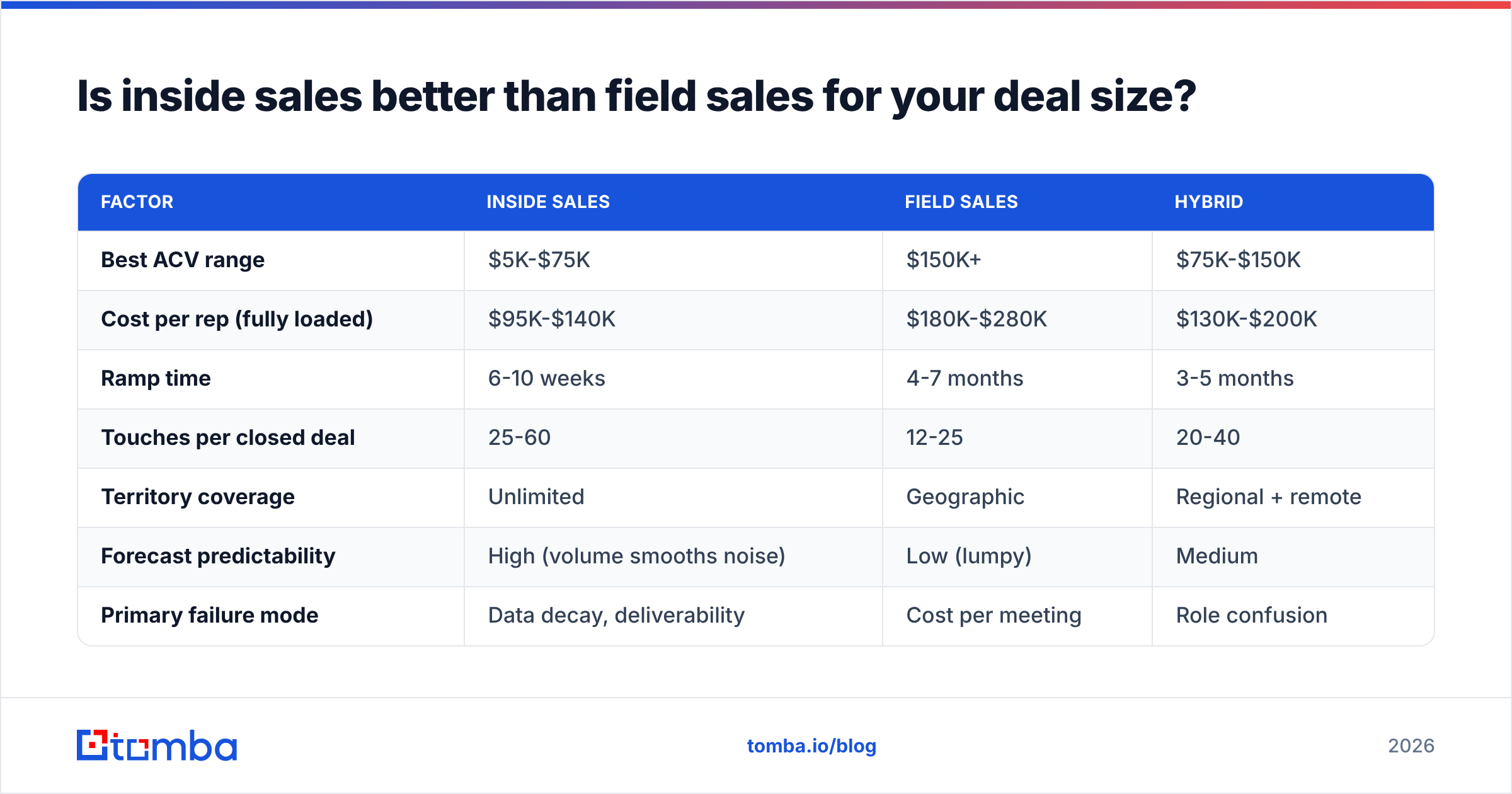
It depends almost entirely on average contract value and buying-committee size. Here is the honest comparison.
| Factor | Inside sales | Field sales | Hybrid |
|---|---|---|---|
| Best ACV range | $5K-$75K | $150K+ | $75K-$150K |
| Cost per rep (fully loaded) | $95K-$140K | $180K-$280K | $130K-$200K |
| Ramp time | 6-10 weeks | 4-7 months | 3-5 months |
| Touches per closed deal | 25-60 | 12-25 | 20-40 |
| Territory coverage | Unlimited | Geographic | Regional + remote |
| Forecast predictability | High (volume smooths noise) | Low (lumpy) | Medium |
| Primary failure mode | Data decay, deliverability | Cost per meeting | Role confusion |
The hybrid column is where most teams land and where most teams get sloppy. Hybrid only works when you define, in writing, which deals earn an on-site visit. Without that rule, your most expensive reps spend their travel budget on deals that would have closed over Zoom.
Industry research from Gartner has consistently found that B2B buyers spend a minority of their buying journey with any sales rep at all, which argues for coverage breadth over touch depth in most mid-market segments.
How do you build a prospect list that does not poison your domain?#
This is the part of inside sales strategy that nobody wants to own and everybody should.
Start with accounts, not contacts. Build the account list from a trigger — funding, hiring, tech-stack change, leadership move — then find the humans inside it. Contact-first lists produce disconnected outreach because you have no reason for the timing.
Find contacts against the account, not the persona. Once you have the domain, a domain search returns the actual people and email patterns at that company, which is far more reliable than guessing firstname.lastname@ and hoping. Tomba's email finder resolves name plus domain into a verified address with a confidence score attached.
Verify, then segment by confidence. Do not treat a 97%-confidence address and a catch-all guess the same way. Send the high-confidence tier from your primary domain and route risky addresses to a secondary sending domain — or drop them entirely. A catch-all verifier is the difference between "we can't tell" and "we know."
Re-verify on a schedule. Monthly for active sequences, quarterly for the reserve list. This is boring and it is the highest-ROI hour in your week.
Track source quality. Tag every contact with where it came from. Within two quarters you will know which sources produce meetings and which produce bounces, and you can stop paying for the latter.

What does a realistic inside sales tech stack cost?#
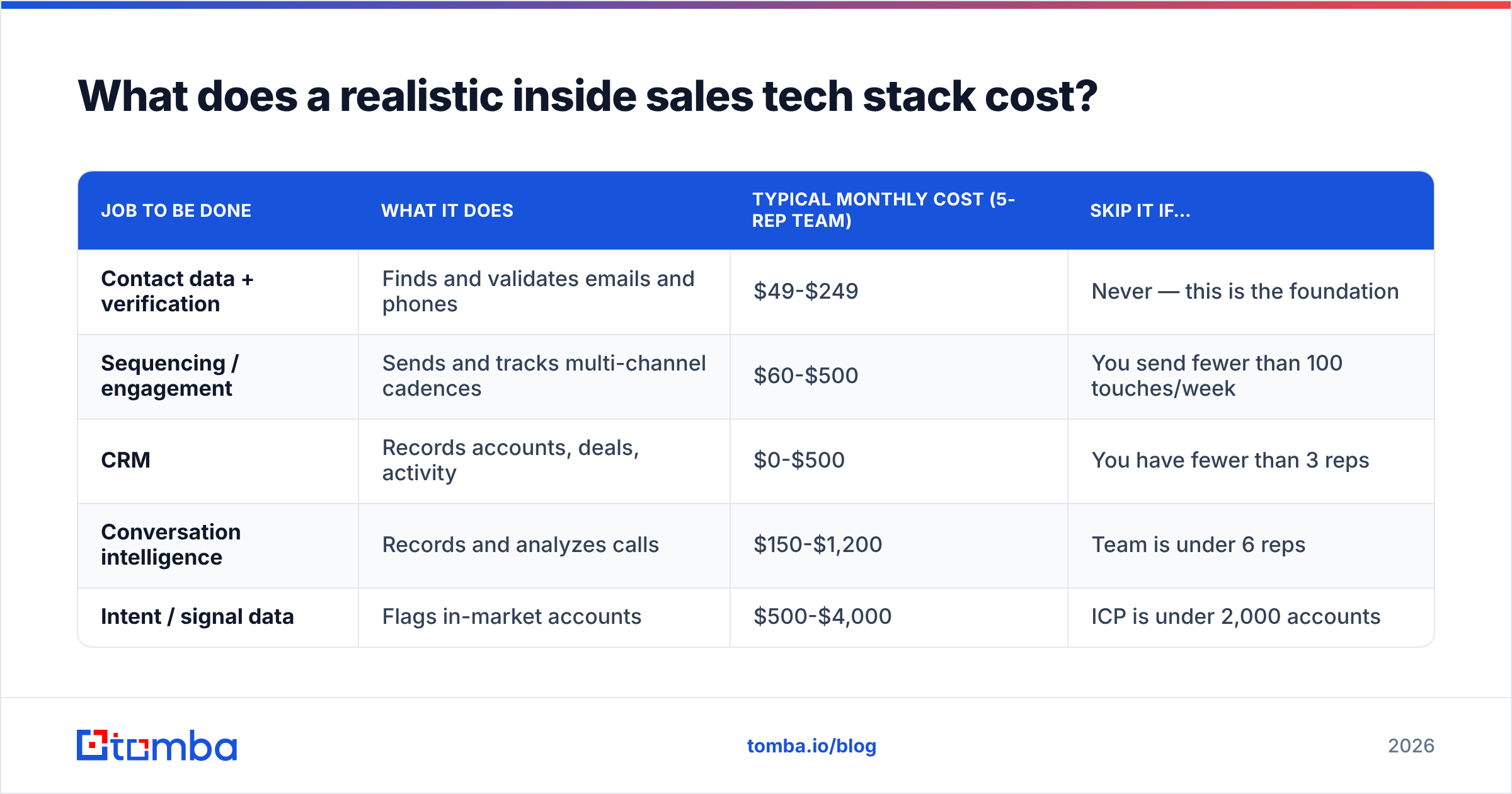
You need three jobs covered. Anything beyond them is a preference, not a requirement.
| Job to be done | What it does | Typical monthly cost (5-rep team) | Skip it if… |
|---|---|---|---|
| Contact data + verification | Finds and validates emails and phones | $49-$249 | Never — this is the foundation |
| Sequencing / engagement | Sends and tracks multi-channel cadences | $60-$500 | You send fewer than 100 touches/week |
| CRM | Records accounts, deals, activity | $0-$500 | You have fewer than 3 reps |
| Conversation intelligence | Records and analyzes calls | $150-$1,200 | Team is under 6 reps |
| Intent / signal data | Flags in-market accounts | $500-$4,000 | ICP is under 2,000 accounts |
On the data layer specifically, pricing spreads widely. Tomba runs a free tier at 25 searches per month, Starter at $49/mo, Growth at $99/mo, and Pro at $249/mo — full details on the Tomba pricing page. Broader database platforms like Apollo bundle sequencing with data at a higher entry point, and specialists like BookYourData sell verified lists outright, which suits teams that want a one-time purchase rather than a subscription and a workflow. Each model is defensible; the mistake is paying for a bundled suite when you only needed accurate addresses, or buying raw records when you needed a repeatable enrichment workflow.
If you want a neutral read on how the platforms stack up, G2's sales intelligence category carries enough reviews per vendor to be directionally useful.
How do you measure inside sales performance without gaming it?#
Pick one metric per stage and resist adding more.
- Top of funnel — contact accuracy rate. Percentage of sent emails that reach a real inbox. Target: 97%+. If this slips, nothing downstream is interpretable.
- Activity — connect rate, not dial count. Dials measure effort; connect rate measures whether you're calling real numbers at reasonable times. Target: 6-10% for cold mid-market.
- Engagement — reply rate by segment. Aggregate reply rate hides everything. Segment by ICP tier and you will find that one tier carries the whole number.
- Qualification — meetings held ÷ meetings booked. Target: above 75%. Below that, your SDRs are booking anyone with a pulse.
- Conversion — win rate by lead source. This is what tells you where to spend next quarter's budget.
One discipline that pays for itself: review a random sample of five lost opportunities every month and ask whether the account was ever a real fit. In most teams, 30-40% of losses are targeting failures dressed up as sales-execution failures. That is a strategy fix, not a coaching fix.
What are the most common inside sales mistakes?#
Sending before verifying. The cost is not the bounce; it's the three weeks of degraded deliverability afterward that silently suppresses your good sends.
Optimizing subject lines before fixing the list. Subject-line testing has a real but small effect ceiling. List quality has a large one. Order your experiments accordingly.
Confusing personalization with research. Mentioning a prospect's podcast appearance is personalization. Knowing they just lost their only data engineer is research. Only one of those changes the reply rate.
Running every account through the same cadence. Tier-1 accounts deserve manual research and 20+ touches. Tier-3 accounts deserve an automated 6-touch sequence. Treating them identically wastes effort on one end and burns pipeline on the other.
Letting the CRM rot. If reps do not trust the data in the CRM, they keep a private spreadsheet, and your forecast becomes fiction. Enforce field hygiene at the stage-gate level, not with reminders.
Hiring your way out of a process problem. Adding reps to a motion with a 0.8% reply rate produces a larger 0.8%. Fix the rate first.
How do you roll this out without stalling the quarter?#
Run it as a four-week sequence, not a rebuild.
- Week 1 — audit. Pull bounce rate, reply rate by segment, and meetings-held ratio. Verify your current active list and record the decay percentage. You now have a baseline.
- Week 2 — narrow. Rewrite the ICP with a trigger and a disqualifier. Re-cut the account list against it. Expect to cut 50-70% of accounts; that is the point.
- Week 3 — rebuild the cadence. Nine to fourteen touches, three channels, one question per message. Write it once, centrally, and have every rep run the same version for 30 days before anyone customizes.
- Week 4 — instrument. One metric per stage in a shared dashboard. Kill every other report for a quarter.
Then leave it alone for 30 days. The single most common cause of failed inside sales strategy is changing four variables at once and losing the ability to attribute the result.
Where should you start?#
Start with the layer everything else depends on: whether the addresses you're sending to actually exist and actually belong to the person you think they do. Every cadence improvement, every subject-line test, and every coaching session compounds on top of accurate data — or gets cancelled out by inaccurate data.
The Tomba Email Finder resolves a name and a company domain into a verified, confidence-scored business email, with domain search, catch-all verification, and bulk processing alongside it. The free tier covers 25 searches a month, which is enough to validate whether your current list is as clean as you think it is before you commit a budget. Run your next 100 prospects through it, compare the bounce rate against your last campaign, and let the delta decide what you do next.
Related guides#
// get started
Find, verify and enrich your first contacts today
Start on the free plan with 25 searches a month, then scale when your team is ready.
Free plan · No credit card required · GDPR & CCPA
// about the author