Inside Sales Success in 2026: The Metrics That Actually Move Revenue
Most inside sales teams track activity and call it strategy. Here's the metric stack, tooling, and process that separates teams hitting quota from teams burning dials on bad data.
TL;DR
- Inside sales success is not a dial-count problem. Teams that hit quota consistently win on list quality, connect rate, and cycle discipline — not raw activity.
- The six metrics that actually predict attainment: connect rate, meaningful conversation rate, meeting-held rate, opportunity conversion, sales cycle length, and rep ramp time.
- Bad contact data quietly eats 20-30% of an inside sales rep's week. Fixing the data layer is usually cheaper than hiring another rep.
- A working inside sales stack in 2026 costs roughly $180-$400 per rep per month across CRM, sequencer, dialer, and data. Most teams overspend on the sequencer and underspend on data.
- Ramp time is the most ignored lever. Teams with documented call frameworks and clean territory data ramp reps in 45-60 days instead of 90-120.
What Is Inside Sales, and What Does "Success" Actually Mean?#
Inside sales is selling remotely — phone, email, video, chat — instead of traveling to the buyer. That's the textbook definition, and it's almost useless for running a team, because it describes the location, not the model.
The useful definition: inside sales is a high-volume, high-repeatability revenue motion where the rep's leverage comes from touching many accounts efficiently rather than from deep in-person relationship building. Everything that makes inside sales work or fail flows from that one constraint.
Which means "inside sales success" has a specific shape. It is not "we made a lot of calls." It is:
- Enough qualified conversations per rep per week — usually 8-15 meaningful conversations, depending on ACV.
- A conversion rate that holds at volume — if your close rate collapses when you double activity, you have a targeting problem, not a scale problem.
- A cycle short enough to forecast — inside sales cycles that stretch past 90 days usually mean the motion is really field sales in disguise.
- Ramp time under 60 days — because inside sales teams churn, and slow ramp compounds into permanent under-capacity.
- Cost per meeting held that beats your blended CAC target — the whole point of inside sales is efficiency.
If you can't state your current number for all five, you're managing activity, not outcomes.
Which Inside Sales Metrics Actually Predict Quota Attainment?#
Here's the honest ranking. Not every metric is worth a dashboard tile, and some of the most-tracked ones are the least predictive.
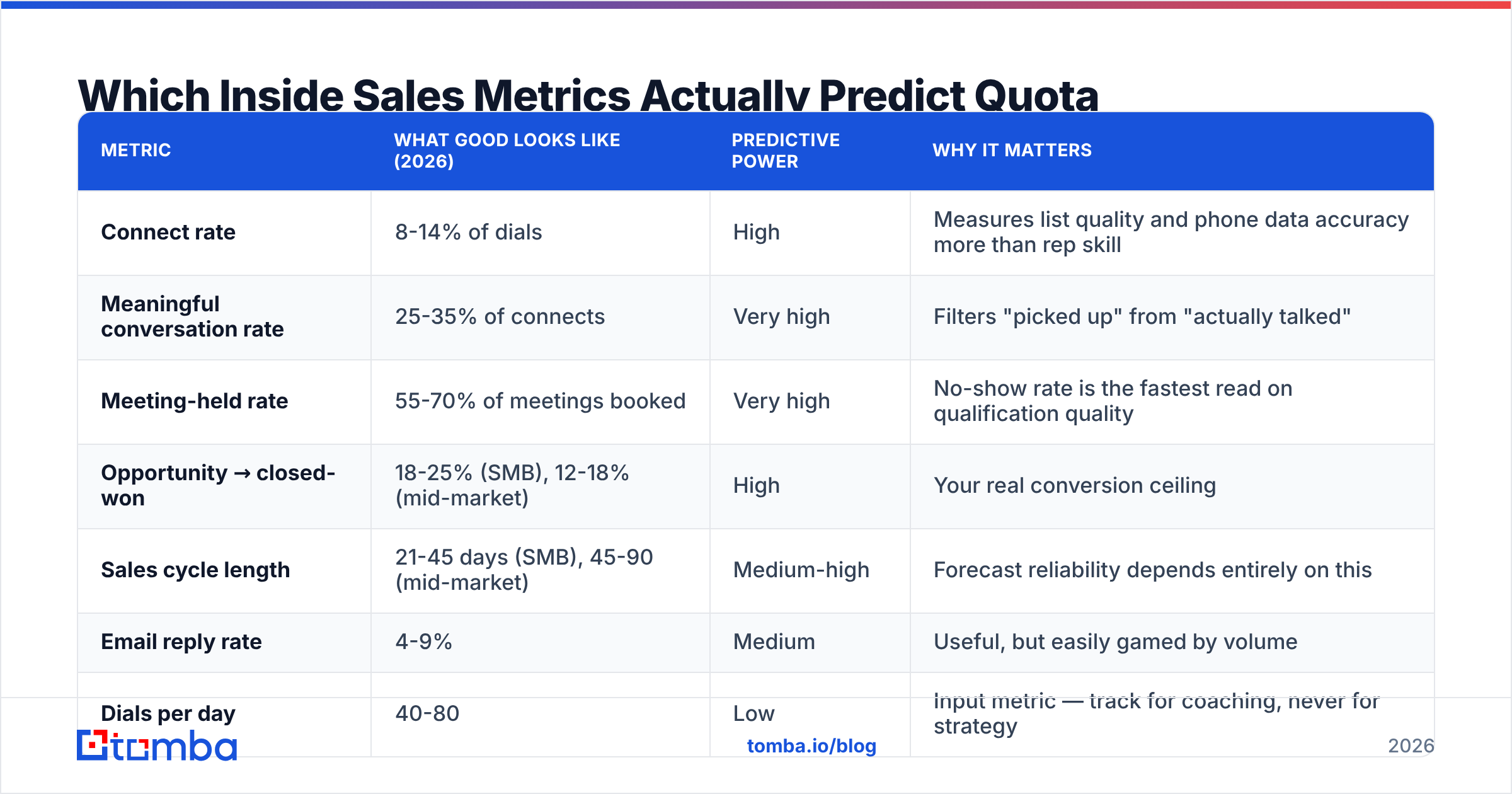
| Metric | What good looks like (2026) | Predictive power | Why it matters |
|---|---|---|---|
| Connect rate | 8-14% of dials | High | Measures list quality and phone data accuracy more than rep skill |
| Meaningful conversation rate | 25-35% of connects | Very high | Filters "picked up" from "actually talked" |
| Meeting-held rate | 55-70% of meetings booked | Very high | No-show rate is the fastest read on qualification quality |
| Opportunity → closed-won | 18-25% (SMB), 12-18% (mid-market) | High | Your real conversion ceiling |
| Sales cycle length | 21-45 days (SMB), 45-90 (mid-market) | Medium-high | Forecast reliability depends entirely on this |
| Email reply rate | 4-9% | Medium | Useful, but easily gamed by volume |
| Dials per day | 40-80 | Low | Input metric — track for coaching, never for strategy |
| Emails sent per day | 60-150 | Low | Correlates with burnout more than revenue |
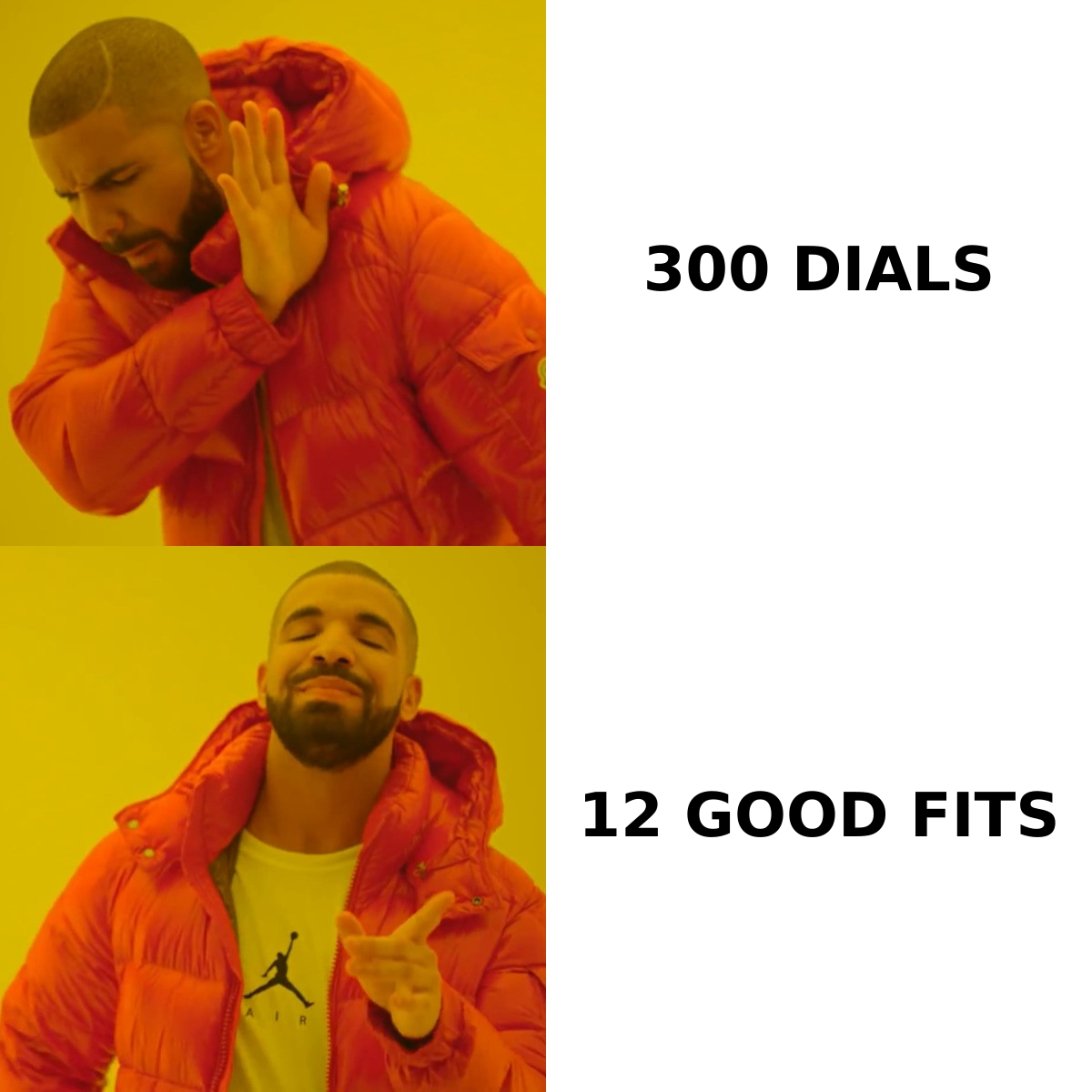
The pattern: quality-of-touch metrics predict revenue, volume metrics predict effort. Most inside sales dashboards are built backwards — big tiles for dials and emails, a footnote for meeting-held rate.
Two numbers deserve special attention.
Connect rate is a data metric disguised as a rep metric. If your team's connect rate is 4%, coaching the openers won't fix it. Either the direct dials are wrong, the personas are wrong, or both. Pull 50 random records from last week's dial list and check them manually. Most teams doing this for the first time find 25-40% of phone numbers are stale, switchboard-only, or belong to someone who left the company 18 months ago.
Meeting-held rate is the qualification lie detector. A rep booking 12 meetings and holding 5 isn't a booking machine; they're a no-show machine. Held rate below 50% almost always means reps are booking on politeness rather than intent.
Why Does Bad Contact Data Break Inside Sales Before Anything Else Does?#
Because it compounds silently at every stage.
Think of it like a restaurant with a bad supplier. The chef is excellent, the kitchen is well-run, the menu is smart — and every plate still goes out slightly wrong, because the ingredients were wrong before anyone touched them. No amount of kitchen coaching fixes a supplier problem.
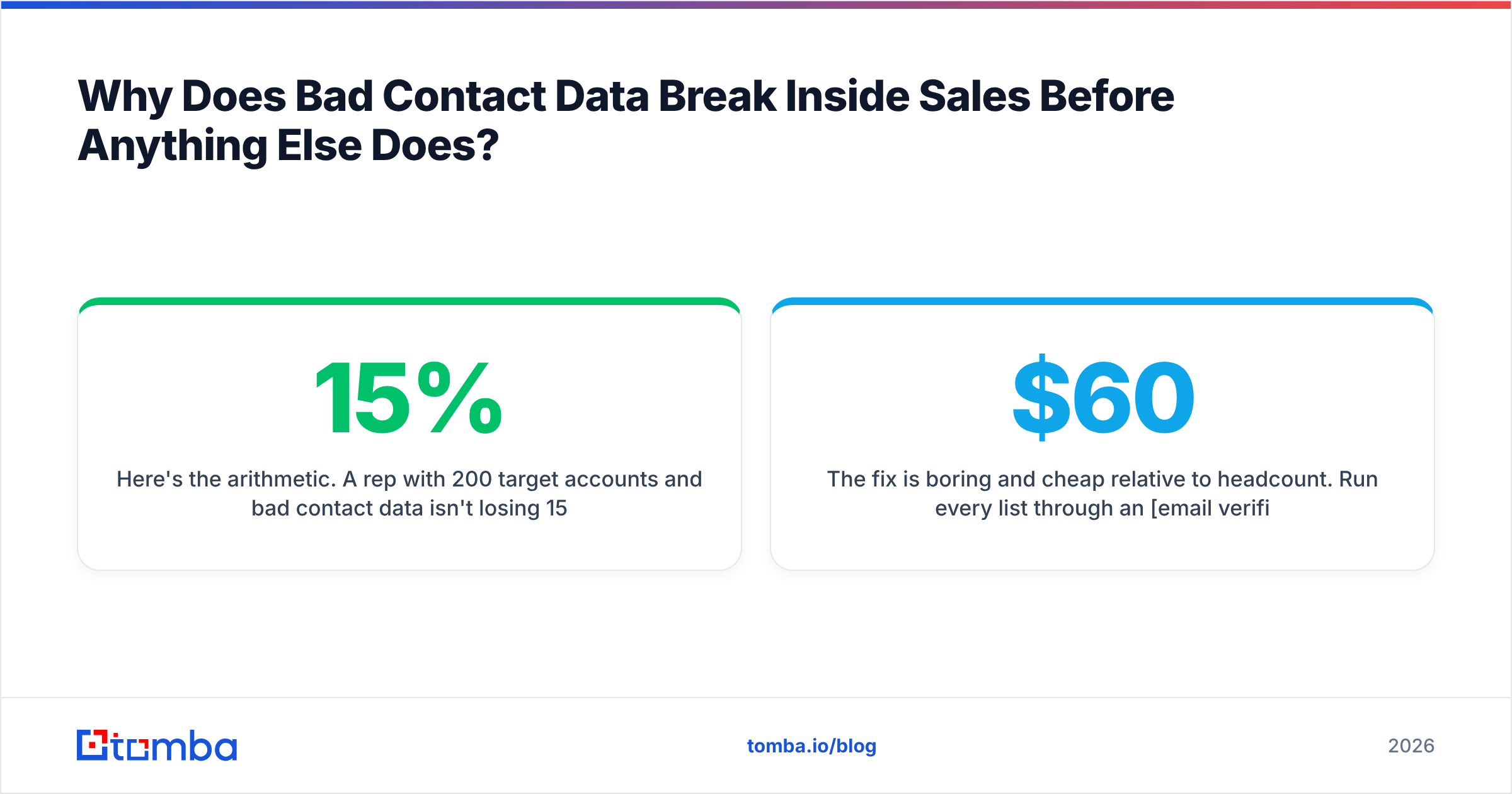
Here's the arithmetic. A rep with 200 target accounts and 15% bad contact data isn't losing 15% of output. They lose:
- Time dialing dead numbers (roughly 6-9 minutes per bad record including research and retry)
- Bounces that degrade email deliverability for the whole domain
- Pipeline accuracy, because "contacted" in the CRM doesn't mean contacted
- Forecast integrity, because coverage ratios assume the list is real
Google and Yahoo's bulk sender requirements — now fully enforced across major mailbox providers — put a hard spam-complaint ceiling on senders, and bounce-heavy lists are the fastest route to tripping it. One rep's dirty list can suppress an entire team's inbox placement.
The fix is boring and cheap relative to headcount. Run every list through an email verifier before it enters a sequence, and use a phone validator on dial lists before they hit the dialer. A rep costs $60-110k fully loaded. Verification costs cents per record. The ROI math isn't close.

Screenshot placeholder: CRM contact record showing a "last verified" timestamp field alongside bounce history — the single most useful field most inside sales teams don't have.
How Do You Build the Inside Sales Tech Stack Without Overspending?#
Four layers. Most teams get the proportions wrong.
- CRM (the system of record) — HubSpot, Salesforce, or Pipedrive. $50-150/user/mo. Non-negotiable, and you should resist the urge to replace it every 18 months.
- Sequencer / engagement — Outreach, Salesloft, Instantly, Reply.io. $60-165/user/mo. This is where teams overspend. A $165/seat sequencer running on a bad list performs worse than a $40 one running on a clean list.
- Dialer / conversation intelligence — Aircall, Orum, Gong. $40-120/user/mo. Worth it once you have 4+ reps and need call review at scale.
- Data and enrichment — this is the layer teams underfund. $49-249/mo at the team level, not per seat, for most providers.
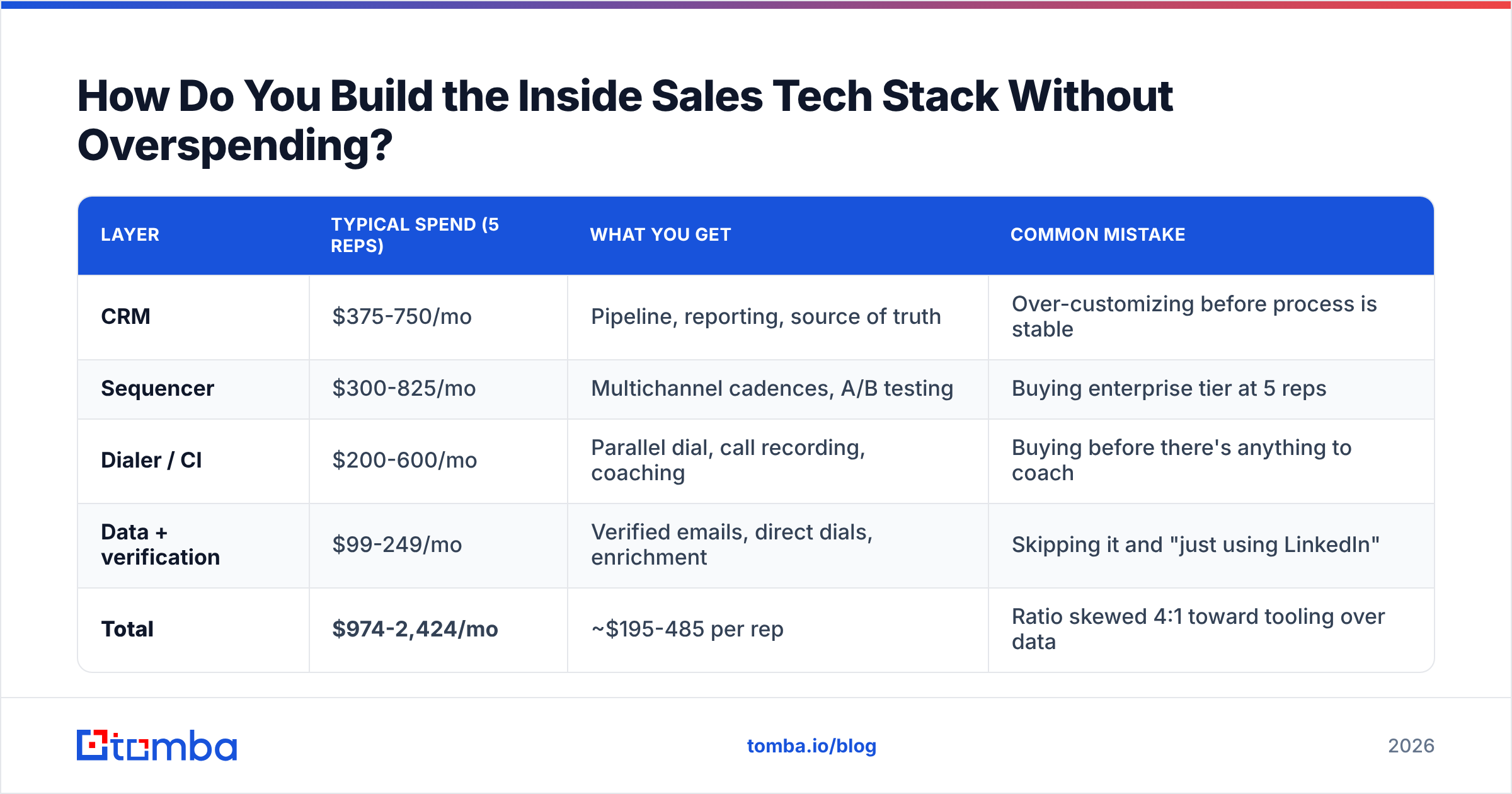
A rough budget for a 5-rep inside sales team:
| Layer | Typical spend (5 reps) | What you get | Common mistake |
|---|---|---|---|
| CRM | $375-750/mo | Pipeline, reporting, source of truth | Over-customizing before process is stable |
| Sequencer | $300-825/mo | Multichannel cadences, A/B testing | Buying enterprise tier at 5 reps |
| Dialer / CI | $200-600/mo | Parallel dial, call recording, coaching | Buying before there's anything to coach |
| Data + verification | $99-249/mo | Verified emails, direct dials, enrichment | Skipping it and "just using LinkedIn" |
| Total | $974-2,424/mo | ~$195-485 per rep | Ratio skewed 4:1 toward tooling over data |
Note the last line of that table. The data layer is typically 8-12% of stack spend while being responsible for the input quality of everything else. That ratio is where most inside sales budgets go wrong.
Which Data Providers Fit an Inside Sales Motion?#
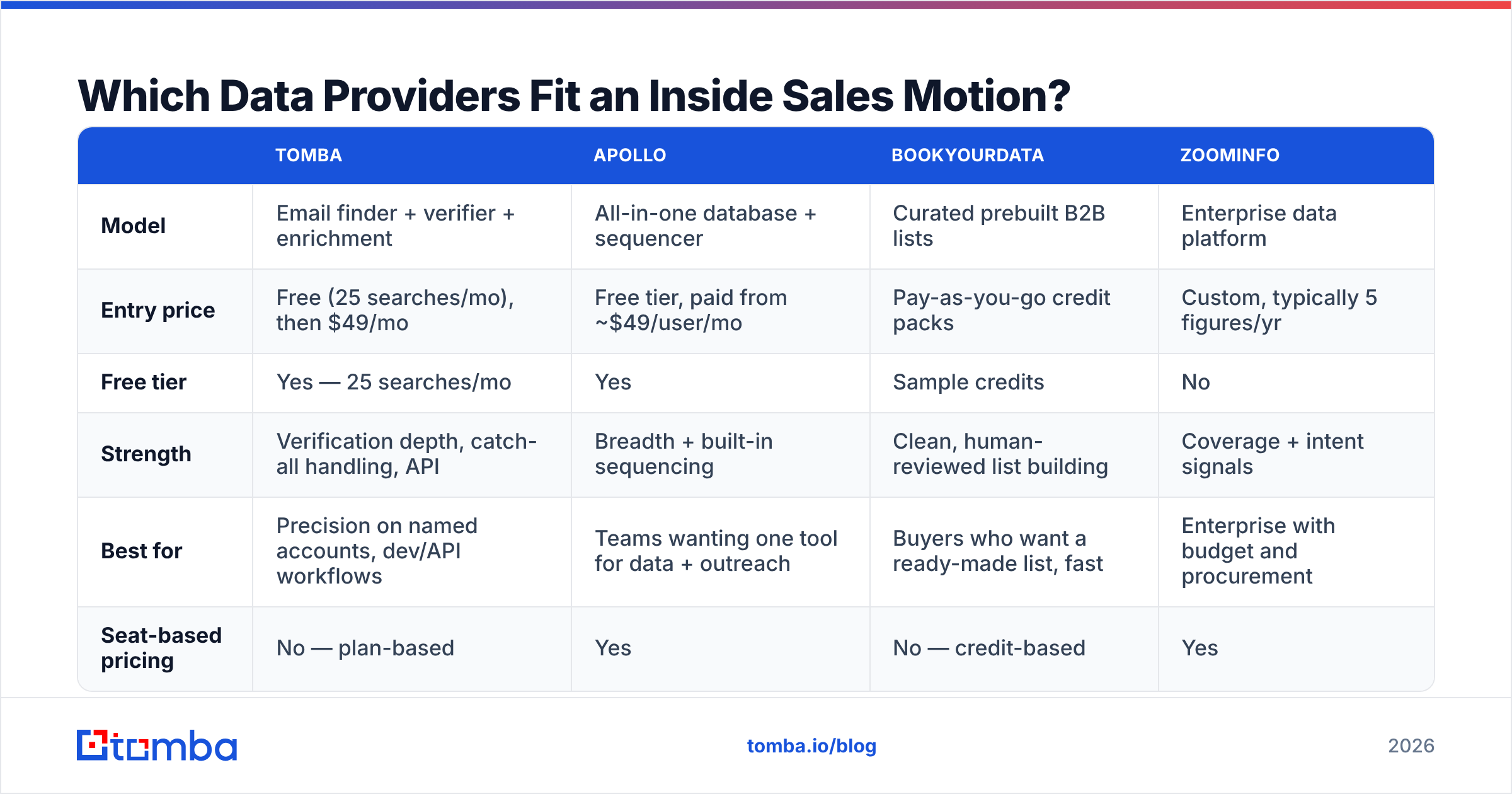
Depends on whether you need breadth (a database to browse) or precision (verified contacts for accounts you already chose). Inside sales teams running named-account territories usually need precision. Teams doing wide-net SMB outbound usually need breadth.
| Tomba | Apollo | BookYourData | ZoomInfo | |
|---|---|---|---|---|
| Model | Email finder + verifier + enrichment | All-in-one database + sequencer | Curated prebuilt B2B lists | Enterprise data platform |
| Entry price | Free (25 searches/mo), then $49/mo | Free tier, paid from ~$49/user/mo | Pay-as-you-go credit packs | Custom, typically 5 figures/yr |
| Free tier | Yes — 25 searches/mo | Yes | Sample credits | No |
| Strength | Verification depth, catch-all handling, API | Breadth + built-in sequencing | Clean, human-reviewed list building | Coverage + intent signals |
| Best for | Precision on named accounts, dev/API workflows | Teams wanting one tool for data + outreach | Buyers who want a ready-made list, fast | Enterprise with budget and procurement |
| Seat-based pricing | No — plan-based | Yes | No — credit-based | Yes |

A practical read on this: Apollo and ZoomInfo are database-first — you go there to discover accounts. Tomba and BookYourData are precision-first — you already know the account and you need a correct, deliverable contact. BookYourData does this through curated, human-reviewed lists you buy outright; Tomba does it through live lookup via domain search and verification, which suits teams whose target list changes weekly.
Most mature inside sales teams end up running two providers, not one: a discovery source for territory building and a verification source as the gate before anything enters a sequence. That's not redundancy — it's the same reason a restaurant has both a supplier and a prep cook.
Third-party review data on G2 is worth reading before you commit, specifically the "ease of setup" and "data accuracy" sub-scores rather than the overall star rating.
How Do You Cut Inside Sales Ramp Time From 90 Days to 60?#
Ramp time is the highest-leverage, least-discussed inside sales metric. A team of 8 with 40% annual turnover loses roughly 1,000 selling days a year to ramp. Cutting ramp by a third recovers a third of that.
Four things move it, in order of impact:
- Give new reps a pre-verified territory on day one. Not a raw export. A verified, deduped, enriched list. A rep who spends week two researching contacts is a rep who ramps in week twelve. Tools like bulk email finder workflows let a manager prep a full territory in an afternoon.
- Document the first 90 seconds, not the whole pitch. Most new-rep failure happens in the opener. Give them three tested openers per persona and let the rest develop naturally.
- Review five calls a week, not fifty. Specific, narrow coaching on one skill beats broad feedback. Pick a skill, coach it for two weeks, measure it, move on.
- Set a meetings-held target, not a meetings-booked target, from week one. This trains qualification instinct early instead of letting reps learn booking-for-the-sake-of-booking habits you have to un-teach in month four.
- Pair every new rep with a CRM hygiene standard. Define what a "contacted" record means, what fields are mandatory, and audit weekly for the first month. Data discipline learned in week one sticks; retrofitted in month six, it never does.
- Shadow-then-do within the first ten days. Listening for three weeks before dialing feels safe and is actively harmful — the confidence curve starts when the rep talks to a stranger, not when they hear one.

Is Inside Sales Still Worth It Compared to Product-Led or Field Sales?#
Yes, for a specific band of deal sizes — and the band has widened, not narrowed.
The 2026 reality: buyers do more self-education than ever, which killed the "explain the product" inside sales rep. It did not kill the "help me decide between three options and navigate my internal approval" rep. HubSpot's sales research has consistently found that buyers still want human contact at the evaluation and negotiation stages, even when they self-serve the discovery stage.
Where inside sales wins:
- ACV between roughly $5k and $60k. Below that, self-serve is cheaper. Above it, the deal usually needs field-sales-style multithreading.
- Products with a real configuration or integration decision. Anything where the buyer needs to be talked out of the wrong plan.
- Markets with clear firmographic targeting. Inside sales scales on repeatability, and repeatability requires a definable ICP.
Where it struggles:
- Sub-$2k ACV — the cost per meeting held rarely clears CAC payback.
- Genuinely enterprise deals with 8+ stakeholders and procurement cycles.
- Undifferentiated products in saturated categories — no amount of process fixes "we're the fourth-best option and 20% more expensive."
Worth noting: the "inside vs. field" framing is mostly obsolete. Most field sellers now run 70%+ of their process remotely. The real distinction in 2026 is transactional velocity motion vs. complex consultative motion, and inside sales is the operating system for the former. Salesforce's State of Sales research tracks this shift across thousands of sales orgs and is worth reading annually.
What Does a Weekly Inside Sales Operating Rhythm Look Like?#
Keep it to one page. Teams that run a tight rhythm outperform teams with better reps and no rhythm.
- Monday (30 min): Pipeline review. Only deals with a next step and a date. Everything else gets a decision — advance, disqualify, or nurture. No third option.
- Tuesday: Territory hygiene block. One hour, whole team, verifying and enriching next week's list. Treat it like knife-sharpening, not admin.
- Wednesday (45 min): Call review. Two calls, whole team, one coaching focus. Rotate whose calls get reviewed.
- Thursday: Highest-volume dial block of the week. Protect it — no meetings, no internal reviews.
- Friday (20 min): Metrics readout. Connect rate, conversations, meetings held, opps created. Four numbers. Trend line, not snapshot.
The Tuesday block is the one most teams skip and the one that quietly determines the other four days. A rep working a verified list on Thursday is a rep having conversations. A rep working a raw export is a rep doing research with a headset on.
How Do You Know Your Inside Sales Process Is Actually Improving?#
Track the ratio between input and output, not the absolute numbers.
Absolute dials went up 20% and meetings went up 20%? You didn't improve — you just worked more. Dials flat and meetings up 20%? That's a real process gain, and it will survive the next headcount freeze.
The three ratios worth putting on a wall:
- Dials per meeting held — should trend down. If it's flat while activity rises, your targeting is the bottleneck.
- Meetings held per opportunity created — should trend down. If it rises, qualification is loosening.
- Days from first touch to closed-won — should trend down or hold. Rising cycle time with rising volume means you're adding poor-fit deals to the top.
Measure these monthly, not weekly. Weekly noise in a small team will make you chase ghosts.
Where to Start This Week#
Pick the cheapest high-leverage fix first: audit your contact data before you change anything else about your process.
Pull last month's dial and email lists, run them through verification, and measure the bad-record percentage. If it's above 10%, that number — not your call script, not your sequencer, not your rep count — is the thing capping your inside sales success. Fixing it costs less than a week of one rep's salary and improves every downstream metric on this page simultaneously.
Start with the Tomba Email Finder to build verified contact lists for your named accounts, then gate every sequence behind verification so bad records never reach your sender domain. The free tier gives you 25 searches a month to test the workflow on a real territory before you commit, and Tomba pricing starts at $49/mo when you're ready to run it across the team.
Related guides#
// get started
Find, verify and enrich your first contacts today
Start on the free plan with 25 searches a month, then scale when your team is ready.
Free plan · No credit card required · GDPR & CCPA
// about the author