Inside Sales Techniques: 12 Plays That Close Deals in 2026
Most inside sales advice is recycled from 2015. Here are the techniques that still book meetings in 2026, the benchmarks to judge them against, and the data work that decides your results before you ever dial.
TL;DR
- Inside sales is no longer "phone sales." It is a multi-channel motion where email, phone, and LinkedIn are sequenced deliberately, and the sequencing matters more than the script.
- The single biggest lever is not your opener. It is list quality: a 20% bounce rate destroys sender reputation and caps every downstream technique you try.
- Techniques that still work in 2026: trigger-based prospecting, permission openers, multithreading 3+ contacts per account, mutual next-step locks, and disciplined call blocks.
- Techniques that quietly stopped working: generic "just checking in" follow-ups, 12-step all-email cadences, and volume-only dialing against unverified mobile numbers.
- Judge every technique on connect rate, reply rate, and meeting-held rate — not on activity counts. Activity is an input, never a result.
What actually counts as inside sales in 2026?#
Inside sales means selling remotely: no travel, no on-site meetings, deals closed over phone, email, video, and social. That definition has not changed in a decade. What changed is that "inside" stopped being the cheap alternative to field sales and became the default motion for most B2B companies, including ones selling six-figure contracts.
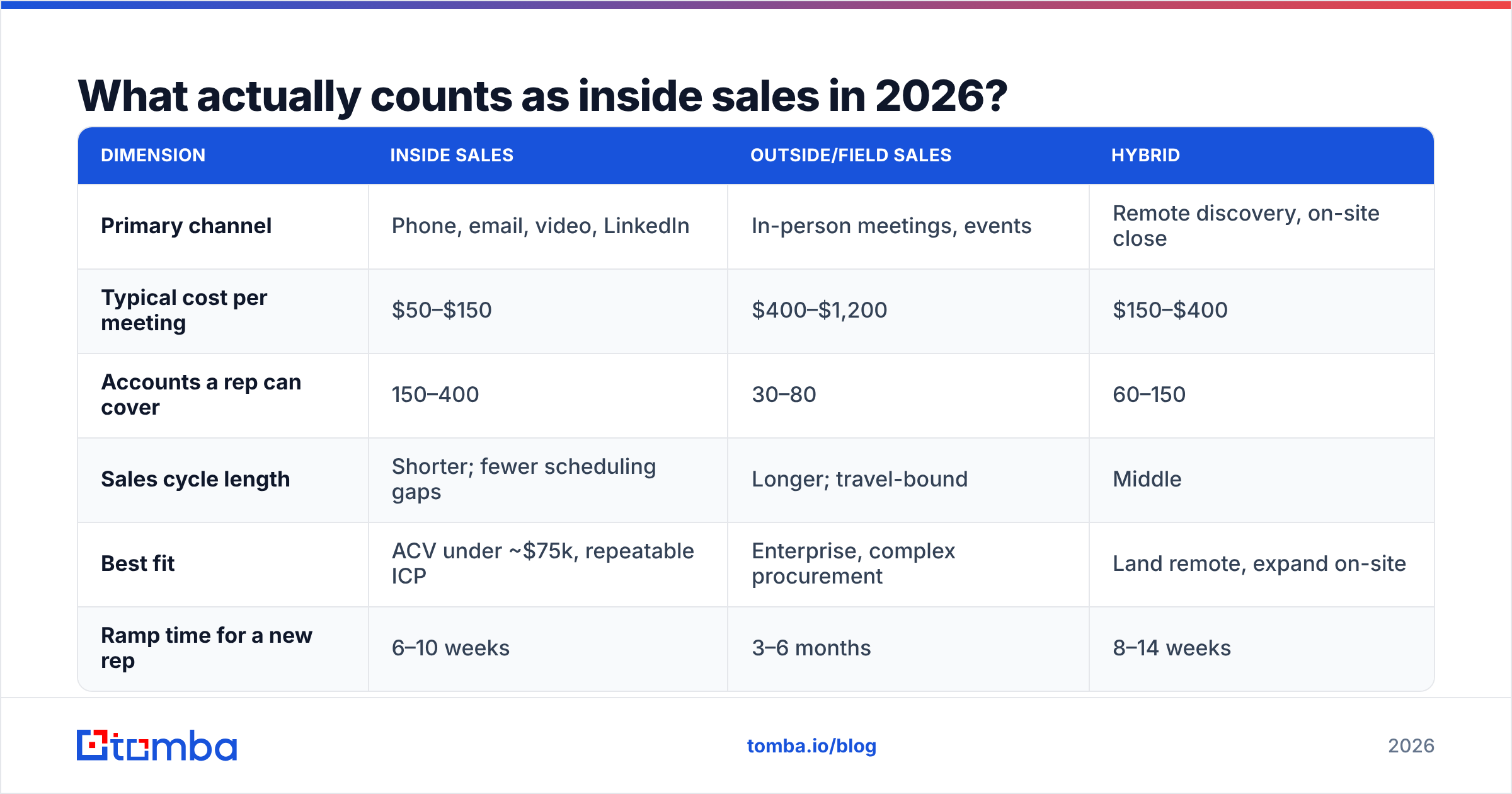
The practical difference between models is cost and coverage, not sophistication:
| Dimension | Inside sales | Outside/field sales | Hybrid |
|---|---|---|---|
| Primary channel | Phone, email, video, LinkedIn | In-person meetings, events | Remote discovery, on-site close |
| Typical cost per meeting | $50–$150 | $400–$1,200 | $150–$400 |
| Accounts a rep can cover | 150–400 | 30–80 | 60–150 |
| Sales cycle length | Shorter; fewer scheduling gaps | Longer; travel-bound | Middle |
| Best fit | ACV under ~$75k, repeatable ICP | Enterprise, complex procurement | Land remote, expand on-site |
| Ramp time for a new rep | 6–10 weeks | 3–6 months | 8–14 weeks |
If your average contract value sits under roughly $75k and your ideal customer profile is repeatable, inside sales wins on unit economics every time. Research summarized in HubSpot's sales statistics has shown for years that buyers are comfortable closing remotely; the resistance now comes from sales leaders, not customers.
What does a modern inside sales process look like end to end?#
Think of it like a commercial kitchen. The plating gets the attention, but the prep station decides whether service runs smoothly. Most inside sales teams obsess over plating (scripts, objection handling) and neglect prep (data, segmentation, routing).
A clean process has six stages:
- Segment before you source. Break your total addressable market into 3–5 segments with distinct pain and distinct language. A rep working one segment per week outperforms a rep working a blended list, because their pattern recognition compounds.
- Source contacts, then verify them. Pull decision-makers plus two adjacent roles per account. Verify every address and number before it enters a sequence. This step is non-negotiable and it is where most teams cut corners.
- Research in three minutes, not thirty. One company trigger, one role-specific pain, one personal detail. Cap it at three minutes per account or your rep becomes a researcher who occasionally sells.
- Sequence across channels. Email, phone, and LinkedIn on alternating days, 12–18 business days, 8–11 touches. One channel alone underperforms a blended cadence by a wide margin.
- Qualify hard and early. Use a simple framework (MEDDIC, BANT, whatever your team actually completes) and disqualify fast. A rep protecting a weak pipeline is a rep missing quota in 90 days.
- Lock the next step before the call ends. No call ends without a calendar invite accepted on-screen. "I'll follow up next week" is how 40% of your pipeline evaporates.
Which inside sales techniques still work?#
Here are the plays that survive contact with real prospects in 2026.
1. Trigger-based prospecting beats persona-based prospecting#
Persona targeting tells you who to contact. Triggers tell you when. The when matters more. Useful triggers: new funding, a new VP in the buying role, a job posting that implies your pain, a competitor logo appearing on their site, a tech-stack change, an M&A announcement.
Reps working triggered accounts routinely see 2–3x the reply rate of reps working the same accounts cold. The reason is boring: relevance. A CFO who just closed a Series B is actively shopping for tooling. The same CFO eight months later is not.
2. The permission opener outperforms the pattern interrupt#
The old "Did I catch you at a bad time?" opener is now so common that it signals a sales call in under two seconds. What still works is a short, honest, permission-based opener:
"Hi Sarah, this is Marc from Tomba. This is a cold call — do you want to hang up, or can I take thirty seconds to tell you why I called?"
Naming the call for what it is buys you attention because it is unexpected honesty, not a trick. Expect roughly 60–70% of people who pick up to give you the thirty seconds. Then earn the next ninety.
3. Make the first email about them, not about you#
The highest-performing cold email structure is unchanged and still ignored: one-line relevance hook, one-line problem statement, one-line proof, one-line low-friction ask. Under 90 words. No attachments, no images, no calendar link in the first touch.
If your email needs scrolling on a phone, it is not a cold email. It is a brochure.
4. Multithread every account from day one#
Single-threaded deals die when your champion changes jobs, which in current B2B markets happens on roughly a 20-month cycle. Work three contacts per account minimum: the economic buyer, the user-level champion, and one adjacent stakeholder (often IT, finance, or ops).
The cleanest way to do this is to run a domain search on the account, pull the full org map, and sequence all three contacts with different angles rather than the same template pasted three times.
5. Use the phone for the follow-up, not the first touch#
Counterintuitive but consistent across teams: a cold call after a prospect has opened two of your emails converts far better than a cold call into total silence. Email builds ambient familiarity. The call cashes it in. Reps who call day one and email day two have it backwards.
6. Talk less than you think you should#
Recorded-call analysis across sales-engagement vendors puts the winning talk-to-listen ratio for discovery calls somewhere near 43:57 in the rep's favor of listening. Most underperforming reps run 70:30. If you do one thing to your call technique this quarter, cut your own talk time by a third and replace it with follow-up questions.
7. Lock the next step on-screen#
End every call with a shared calendar. "Let's put fifteen minutes on the calendar for Thursday — I'm pulling it up now." Meetings booked live during a call show up at roughly double the rate of meetings promised over email afterwards.
Why does list quality decide the outcome before you dial?#
Because every technique above is multiplied by your data accuracy, and multiplication by a bad number produces a bad number.
Run the math. A rep sending 400 emails a month at a 4% reply rate books roughly 16 conversations. Now introduce a 22% bounce rate. You lose 88 sends outright, your domain reputation drops, and your inbox placement falls from ~90% to ~60%. Effective reach drops to about 187 emails. Same rep, same script, same effort, and now you book 7 conversations instead of 16. Nothing about the technique changed. The data changed.
This is why the unglamorous steps matter more than the clever ones:
- Verify before sequencing. An email verifier pass on the full list before import costs minutes and protects months of sender reputation work.
- Handle catch-all domains separately. Roughly 15–20% of B2B domains accept everything at the SMTP level. Treat them as a distinct segment with a lower-volume, higher-personalization approach rather than pretending they are verified.
- Validate mobile numbers. Dialing dead numbers is the single largest hidden time cost in inside sales. A phone validator pass typically removes 10–18% of a purchased list before a rep wastes an hour on it.
- Refresh quarterly. B2B contact data decays at roughly 2.1% per month. A list you bought last year is about 25% wrong today, regardless of who sold it to you.
Where you source matters too. Aggregator databases, verified-contact providers like BookYourData, and API-first finders each have different strengths; the common requirement is that whatever comes in gets verified before it reaches a sequence.
What cadence structure gets replies without burning your domain?#
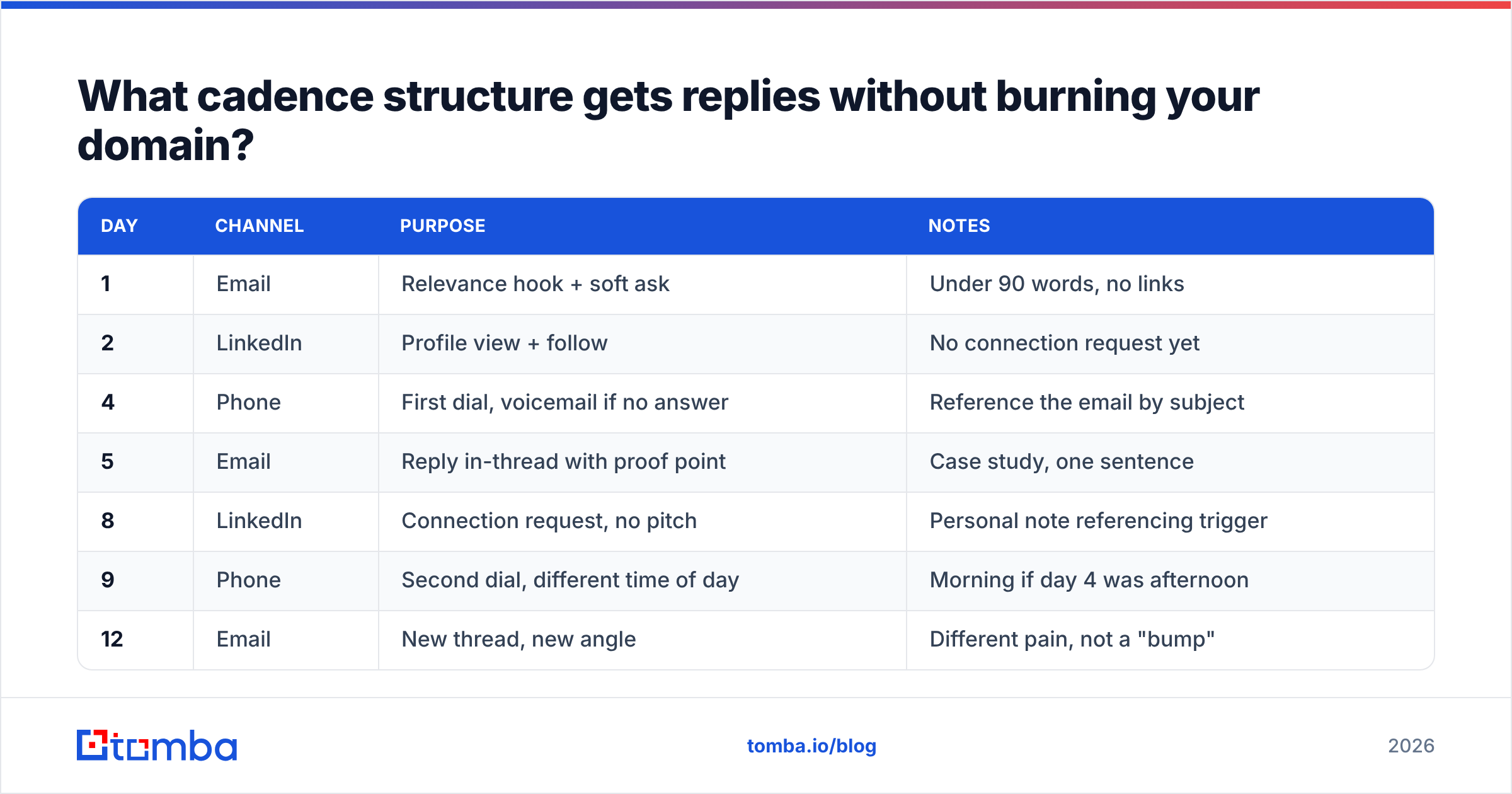
Here is a 14-day multi-channel cadence that holds up across most B2B segments. Adjust volume, not structure.
| Day | Channel | Purpose | Notes |
|---|---|---|---|
| 1 | Relevance hook + soft ask | Under 90 words, no links | |
| 2 | Profile view + follow | No connection request yet | |
| 4 | Phone | First dial, voicemail if no answer | Reference the email by subject |
| 5 | Reply in-thread with proof point | Case study, one sentence | |
| 8 | Connection request, no pitch | Personal note referencing trigger | |
| 9 | Phone | Second dial, different time of day | Morning if day 4 was afternoon |
| 12 | New thread, new angle | Different pain, not a "bump" | |
| 14 | Breakup, permission to close file | Highest single-touch reply rate |
Two rules that matter more than the table itself. First, never send more than two emails from the same thread; a third in-thread "just following up" reads as automation and is the most-ignored message in B2B. Second, vary your dial times. Reps who always call at 2pm only ever reach people whose calendars are free at 2pm.
Which metrics prove an inside sales technique is working?#
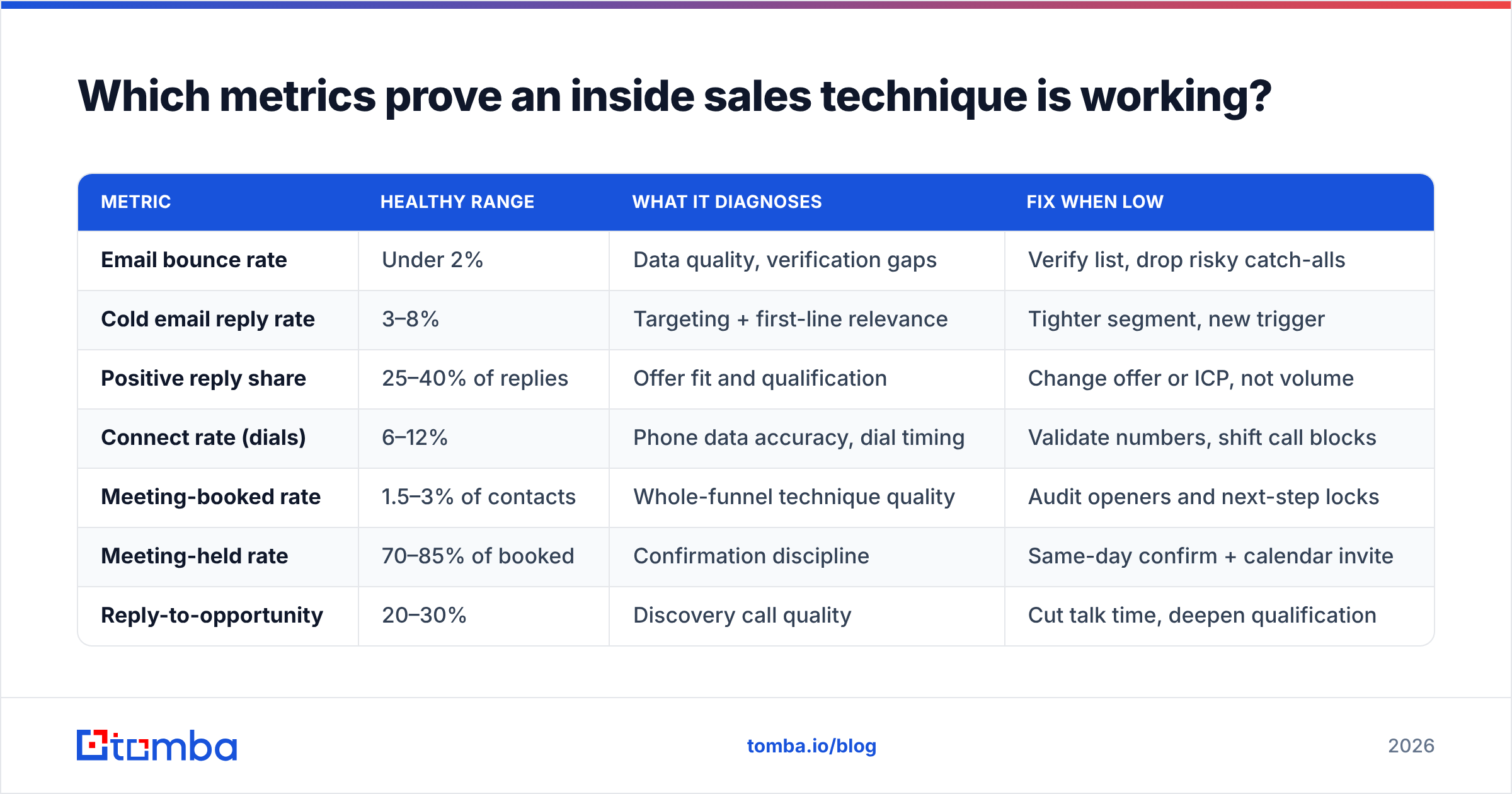
Activity metrics tell you whether a rep is busy. Conversion metrics tell you whether a technique works. Track the second set.
| Metric | Healthy range | What it diagnoses | Fix when low |
|---|---|---|---|
| Email bounce rate | Under 2% | Data quality, verification gaps | Verify list, drop risky catch-alls |
| Cold email reply rate | 3–8% | Targeting + first-line relevance | Tighter segment, new trigger |
| Positive reply share | 25–40% of replies | Offer fit and qualification | Change offer or ICP, not volume |
| Connect rate (dials) | 6–12% | Phone data accuracy, dial timing | Validate numbers, shift call blocks |
| Meeting-booked rate | 1.5–3% of contacts | Whole-funnel technique quality | Audit openers and next-step locks |
| Meeting-held rate | 70–85% of booked | Confirmation discipline | Same-day confirm + calendar invite |
| Reply-to-opportunity | 20–30% | Discovery call quality | Cut talk time, deepen qualification |
If your bounce rate is above 2%, stop optimizing anything else. Fix the data first. Every other number in the table is downstream of it.
What does an inside sales stack actually need?#
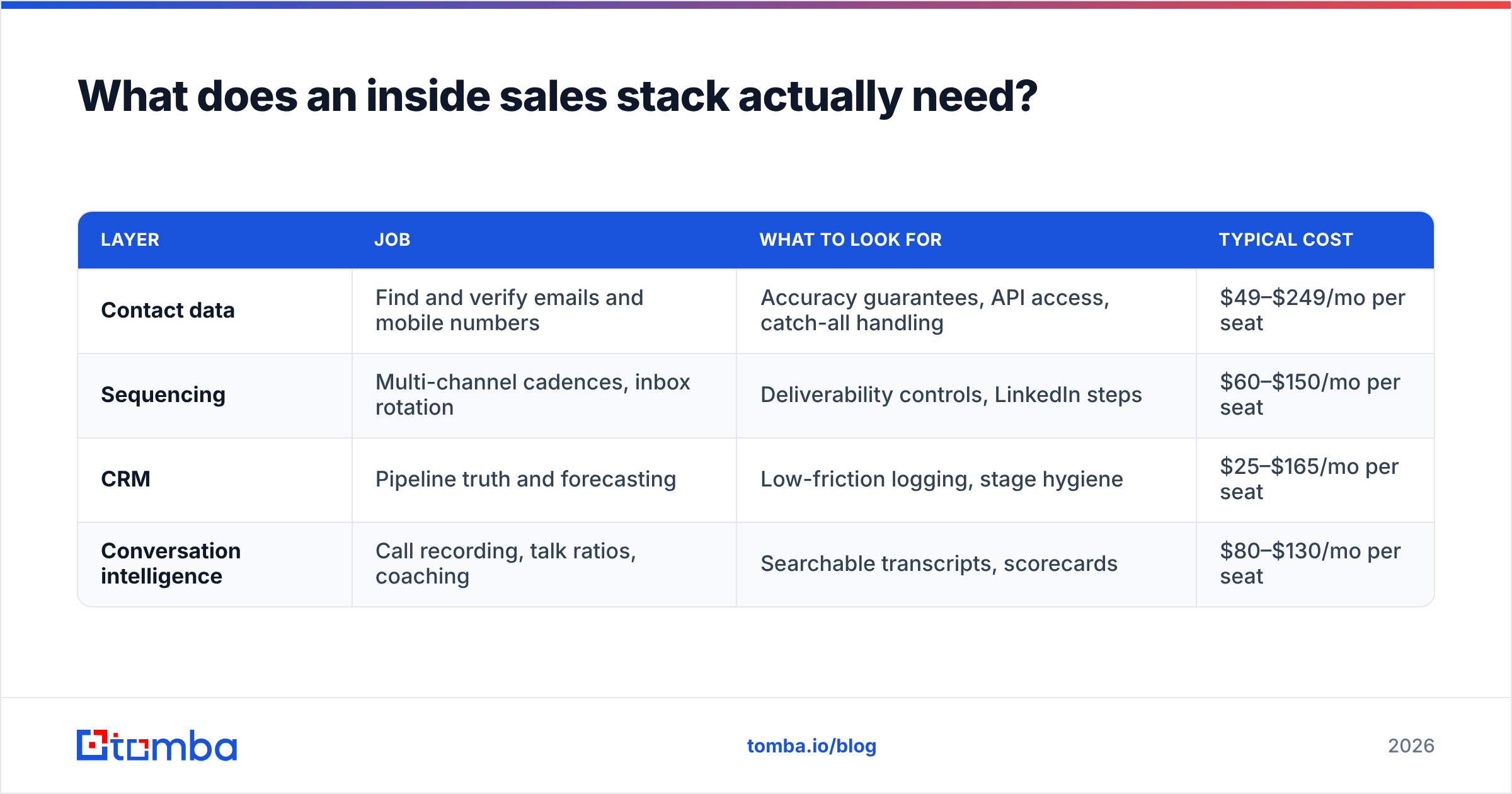
Four layers, and nothing else until those four are working.
| Layer | Job | What to look for | Typical cost |
|---|---|---|---|
| Contact data | Find and verify emails and mobile numbers | Accuracy guarantees, API access, catch-all handling | $49–$249/mo per seat |
| Sequencing | Multi-channel cadences, inbox rotation | Deliverability controls, LinkedIn steps | $60–$150/mo per seat |
| CRM | Pipeline truth and forecasting | Low-friction logging, stage hygiene | $25–$165/mo per seat |
| Conversation intelligence | Call recording, talk ratios, coaching | Searchable transcripts, scorecards | $80–$130/mo per seat |
Compare options in the sales engagement category on G2 before committing, and be honest about seat counts. A four-person team does not need enterprise conversation intelligence; it needs clean data and a manager who listens to calls.
On the data layer specifically, Tomba pricing starts with a free tier of 25 searches per month, then $49/mo for Starter, $99/mo for Growth, and $249/mo for Pro. If your team runs prospecting programmatically, the Tomba API lets you verify and enrich inside your own workflow rather than exporting CSVs by hand. For broader context on how buyer expectations have shifted toward remote-first buying, Salesforce's sales research is worth a read before you redesign your process.
What mistakes quietly kill inside sales teams?#
- Measuring activity instead of conversion. Two hundred dials into a bad list is a worse day than forty dials into a verified one, but only one of them looks good on a dashboard.
- Rewriting the script when the problem is the list. If your reply rate drops and your bounce rate rose in the same month, the script is not the variable that changed.
- Single-threading. One champion, one relationship, one point of failure.
- Treating catch-all domains as verified. They are not. They are unknowns wearing a green checkmark.
- No disqualification discipline. Reps are rewarded for adding pipeline and rarely rewarded for removing it, which is how forecasts rot.
- Skipping call reviews. Thirty minutes a week of recorded-call review moves rep performance more than any tool purchase.
How long before a new technique shows results?#
Give a technique two full cadence cycles — roughly 30 days — before you judge it, and change one variable at a time. Change your opener and your list and your cadence in the same week and you learn nothing. Change the opener alone across 400 contacts and you get an answer you can trust.
The exception is data quality. That one shows up immediately. Clean a list on Monday and your bounce rate on Tuesday tells you whether it worked.
Where should you start this week?#
Start with the layer everything else depends on. Pull your current prospecting list, run it through verification, and look at how much of it was never going to land. Most teams find 15–25% waste on lists they believed were clean, and that percentage is a direct tax on every technique in this article.
Tomba's Email Finder finds verified professional addresses by name, domain, or company, with a free tier of 25 searches a month so you can test accuracy against your own accounts before paying anything. Pair it with the bulk email finder for list cleanup and the phone finder for dial-ready mobile numbers, and your reps spend their day selling instead of bouncing.
Related guides#
// get started
Find, verify and enrich your first contacts today
Start on the free plan with 25 searches a month, then scale when your team is ready.
Free plan · No credit card required · GDPR & CCPA
Get the Tomba newsletter
Product and data updates
// about the author