Inside Sales to Outside Sales: How to Make the Switch in 2026
Moving from inside sales to outside sales is not a promotion — it is a different job with a different cycle, comp plan, and calendar. Here is the honest breakdown of what changes, what transfers, and how to run your first 90 days in the field.
TL;DR
- Inside sales and outside sales are not seniority levels. They are different operating models with different cycle lengths, deal sizes, comp structures, and daily rhythms.
- The move from inside sales to outside sales typically means fewer touches, bigger deals, longer cycles, and a base/variable split that shifts more risk onto you.
- Your call volume skills do not transfer cleanly. Your discovery, multithreading, and account research skills do.
- Territory quality decides your first year more than talent does. Ask about named accounts, existing pipeline, and travel budget before you accept.
- The field reps who ramp fastest treat pre-meeting research and accurate contact data as a daily discipline, not a one-time setup task.
What is the actual difference between inside sales and outside sales?#
Inside sales means you sell remotely — phone, email, video, chat — from a fixed location. Outside sales (field sales) means you sell in person, travelling to prospect offices, trade shows, industry events, and customer sites.
That is the textbook definition, and it stopped being fully accurate around 2020. Today most "outside" reps run half their meetings on video and travel for the moments that actually need a body in the room: executive alignment, multi-stakeholder workshops, contract negotiation, and post-sale expansion. Meanwhile plenty of inside reps close six-figure deals without ever boarding a plane.
So the more useful distinction in 2026 is not where you sit. It is what the deal demands:
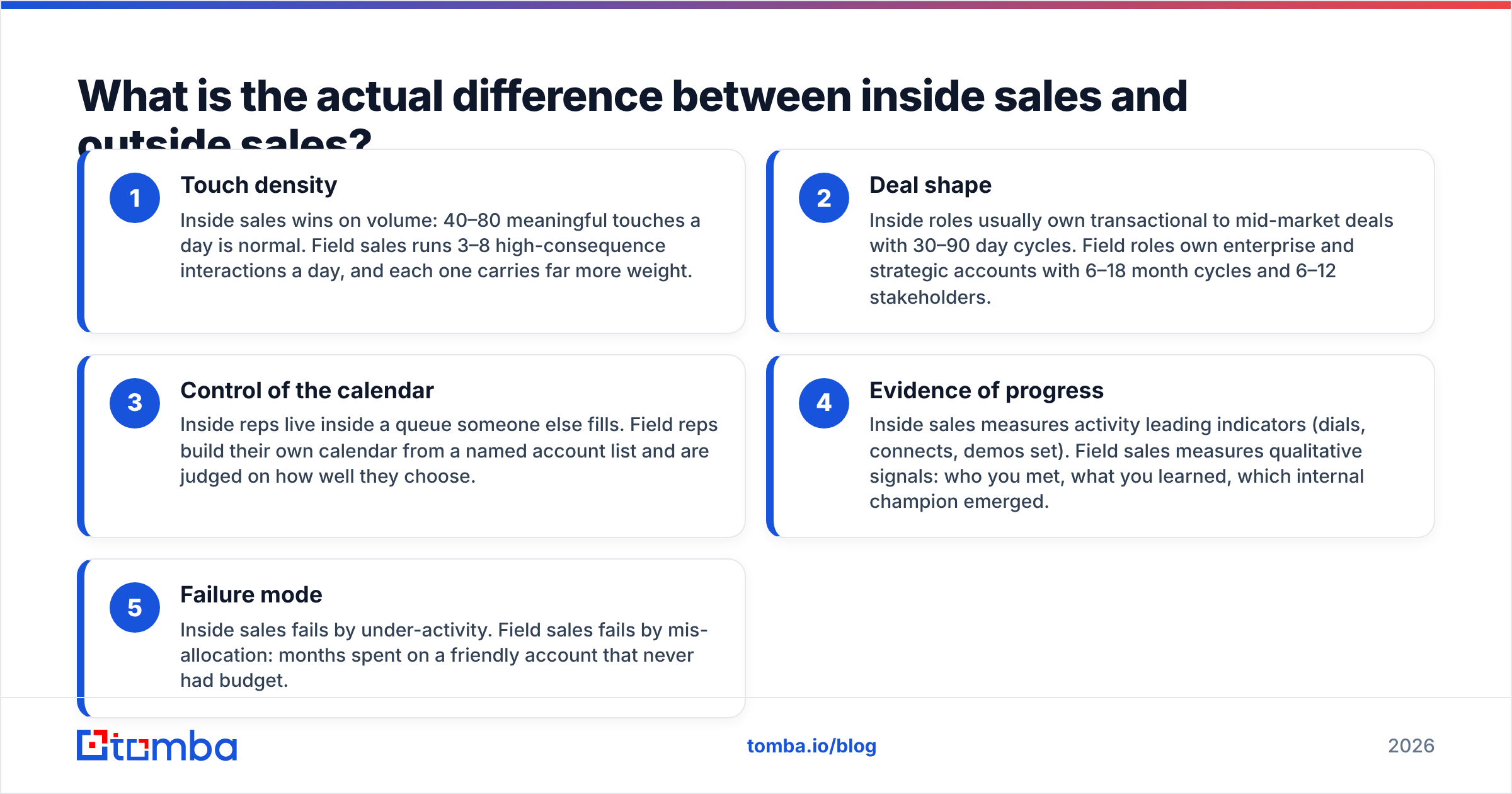
- Touch density — Inside sales wins on volume: 40–80 meaningful touches a day is normal. Field sales runs 3–8 high-consequence interactions a day, and each one carries far more weight.
- Deal shape — Inside roles usually own transactional to mid-market deals with 30–90 day cycles. Field roles own enterprise and strategic accounts with 6–18 month cycles and 6–12 stakeholders.
- Control of the calendar — Inside reps live inside a queue someone else fills. Field reps build their own calendar from a named account list and are judged on how well they choose.
- Evidence of progress — Inside sales measures activity leading indicators (dials, connects, demos set). Field sales measures qualitative signals: who you met, what you learned, which internal champion emerged.
- Failure mode — Inside sales fails by under-activity. Field sales fails by mis-allocation: months spent on a friendly account that never had budget.
If you only remember one thing: inside sales rewards throughput, outside sales rewards judgment.
Why are reps moving from inside sales to outside sales?#
Three reasons, in order of how often they actually drive the decision.
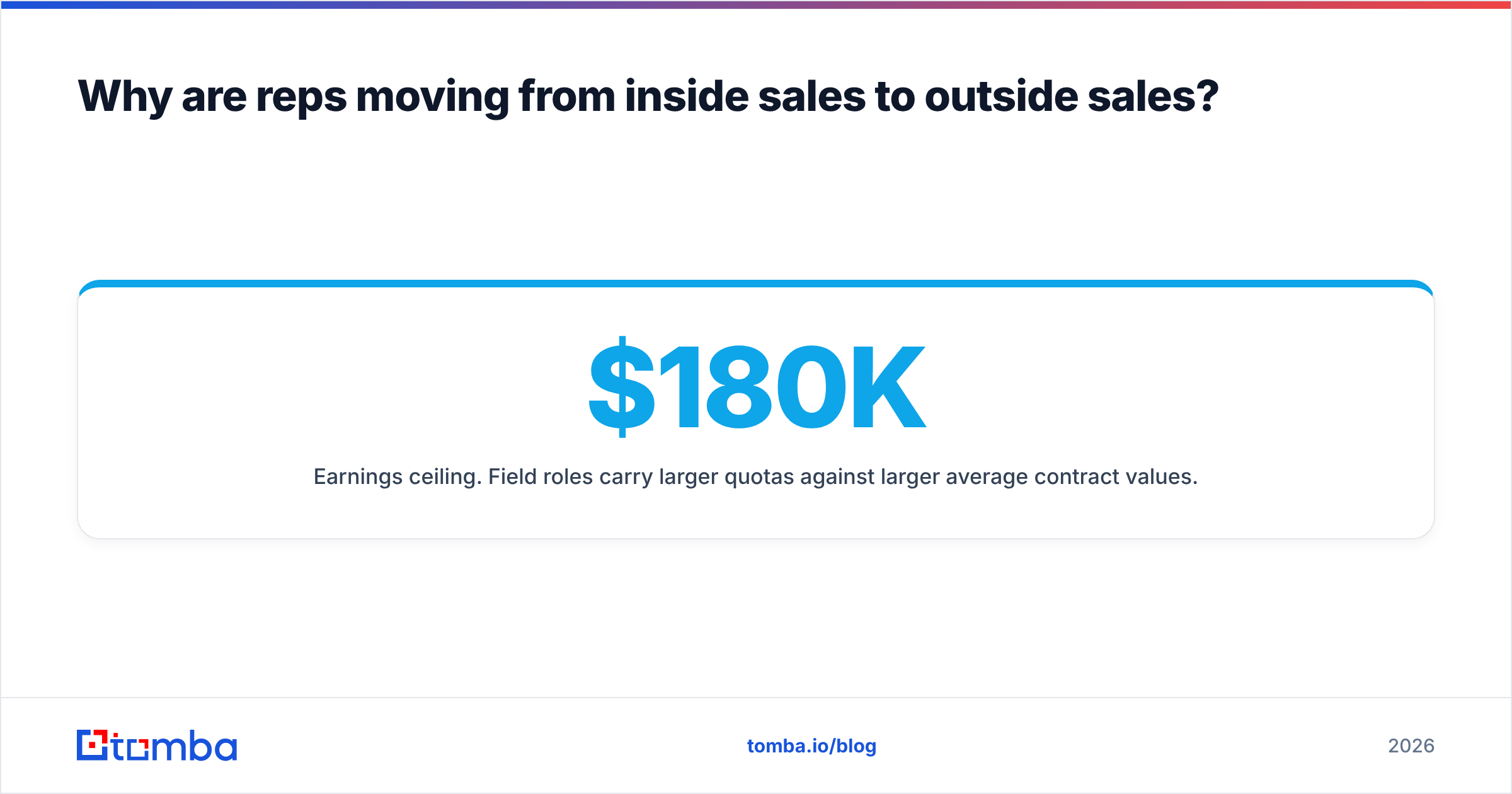
Earnings ceiling. Field roles carry larger quotas against larger average contract values. A $180K quota at a 10% commission rate pays differently than a $1.2M quota at 8%, even accounting for lower win counts. Salesforce's State of Sales research has consistently shown enterprise-focused sellers reporting higher OTE alongside longer ramp times.
Ceiling on the work itself. After two or three years of running the same 25-minute demo, many reps want deal complexity — procurement, security review, executive sponsorship, competitive displacement. Those live in the field motion.
Career path optics. Enterprise AE is still the conventional stepping stone to strategic accounts, sales management, and eventually revenue leadership. It is not the only path, but it is the well-worn one.
There is a fourth reason that people admit less often: burnout on activity metrics. That one deserves a warning. Field sales removes the dial counter, but it replaces it with something harder — a number that arrives quarterly whether or not you had a good week. If you struggle with self-direction, the field will expose that faster than any dashboard.

What actually changes when you move from inside sales to outside sales?#
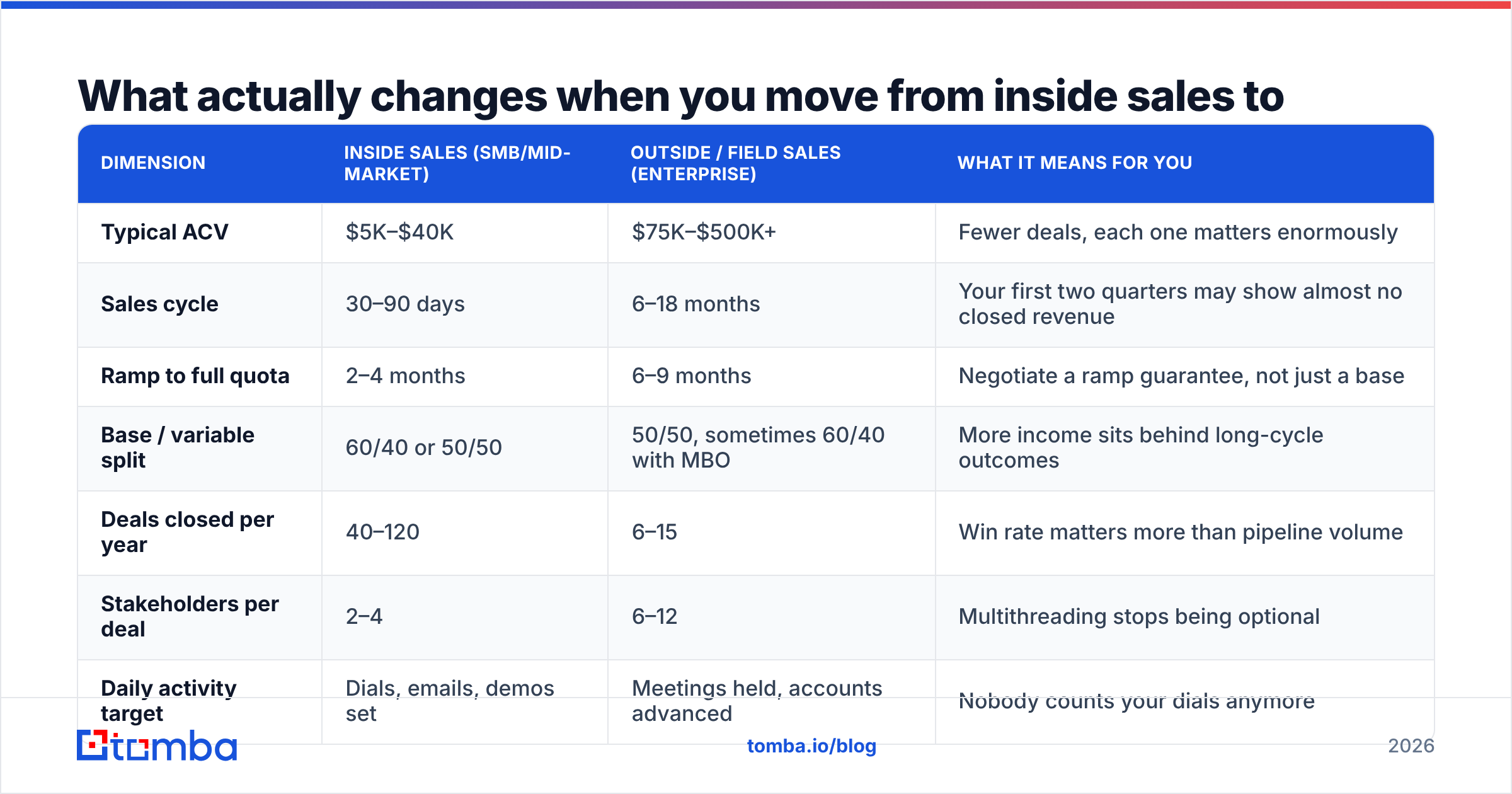
Here is the side-by-side that most hiring managers will not put in writing.
| Dimension | Inside Sales (SMB/Mid-Market) | Outside / Field Sales (Enterprise) | What it means for you |
|---|---|---|---|
| Typical ACV | $5K–$40K | $75K–$500K+ | Fewer deals, each one matters enormously |
| Sales cycle | 30–90 days | 6–18 months | Your first two quarters may show almost no closed revenue |
| Ramp to full quota | 2–4 months | 6–9 months | Negotiate a ramp guarantee, not just a base |
| Base / variable split | 60/40 or 50/50 | 50/50, sometimes 60/40 with MBO | More income sits behind long-cycle outcomes |
| Deals closed per year | 40–120 | 6–15 | Win rate matters more than pipeline volume |
| Stakeholders per deal | 2–4 | 6–12 | Multithreading stops being optional |
| Daily activity target | Dials, emails, demos set | Meetings held, accounts advanced | Nobody counts your dials anymore |
| Travel | Near zero | 25–50% of working days | Budget real time for logistics and recovery |
| Tooling dependence | Dialer, sequencer, CRM | CRM, account research, contact data, mutual action plans | Data quality becomes your bottleneck |
The row people underestimate is ramp to full quota. Gartner's B2B buying research has long documented that buying groups now include six to ten decision-makers who spend most of the cycle away from vendors entirely. In practice that means your first field deal will sit in "verbal yes, waiting on procurement" for longer than your entire previous sales cycle.
Which inside sales skills transfer — and which ones don't?#
Transfers cleanly:
- Discovery discipline. If you can run a structured pain-and-impact conversation in 25 minutes, you can run one in 60. The framework scales up better than it scales down.
- Objection handling under time pressure. Inside reps get interrupted, rushed, and challenged constantly. Field meetings are politer but the muscle is the same.
- CRM hygiene. Reps who already log notes, next steps, and stakeholder maps in the CRM are dramatically easier to coach and forecast in an enterprise motion.
- Research habits. Knowing how to find the right person at the right company — not just any person — is the single most portable skill you own.
Does not transfer:
- Speed-to-lead reflexes. Responding in 90 seconds wins inbound MQLs. It does nothing for a CFO who is nine months from a renewal window.
- Script dependence. Field conversations branch. A memorized flow reads as canned within two minutes across a boardroom table.
- Volume-as-safety. In inside sales, more activity fixes a bad week. In the field, more activity on the wrong accounts destroys a quarter and you will not find out for a month.
- Single-threaded closing. Your champion changes jobs. In a 12-month cycle, research summarized by HubSpot and echoed across industry benchmarks suggests this happens often enough that single-threaded enterprise deals are effectively a coin flip.
How do you build a field territory from scratch?#
You will be handed a list. It will be stale. Assume between 20% and 35% of the contact records are wrong — people change jobs, companies get acquired, domains change after rebrands.
Work in this order:
1. Segment before you prospect. Split the territory into three tiers: 20 strategic accounts you will work all year, 60 mid-tier accounts you will touch quarterly, and everything else. Write down why each strategic account made the list. If you cannot write a reason, it is tier two.
2. Map the buying group, not the buyer. For each strategic account, name the economic buyer, the technical evaluator, the end user champion, and the likely blocker. Four names minimum per account, with titles.
3. Rebuild the contact data. This is where most territory plans die. A name without a reachable email and a mobile number is a wish. Use a domain search to pull the current org chart for each target company, then confirm each address through an email verifier before it enters a sequence. Pair that with a phone finder for the direct dials you will need to schedule on-site visits.
4. Plan travel around clusters, not around individual meetings. One confirmed meeting does not justify a flight. Three confirmed meetings in a 40-mile radius does. Build your outreach around geographic clusters so your accepted meetings compound.
5. Set a research floor. Thirty minutes of pre-meeting research per field meeting, minimum: recent funding, leadership changes, earnings language, tech stack, open roles. Field buyers grant you one hour; showing up uninformed is how you get 40 minutes of it back.
6. Instrument everything. Log every stakeholder, every objection, every next step. Your Q4 forecast is only as good as your Q1 note-taking.

What does the compensation math actually look like?#
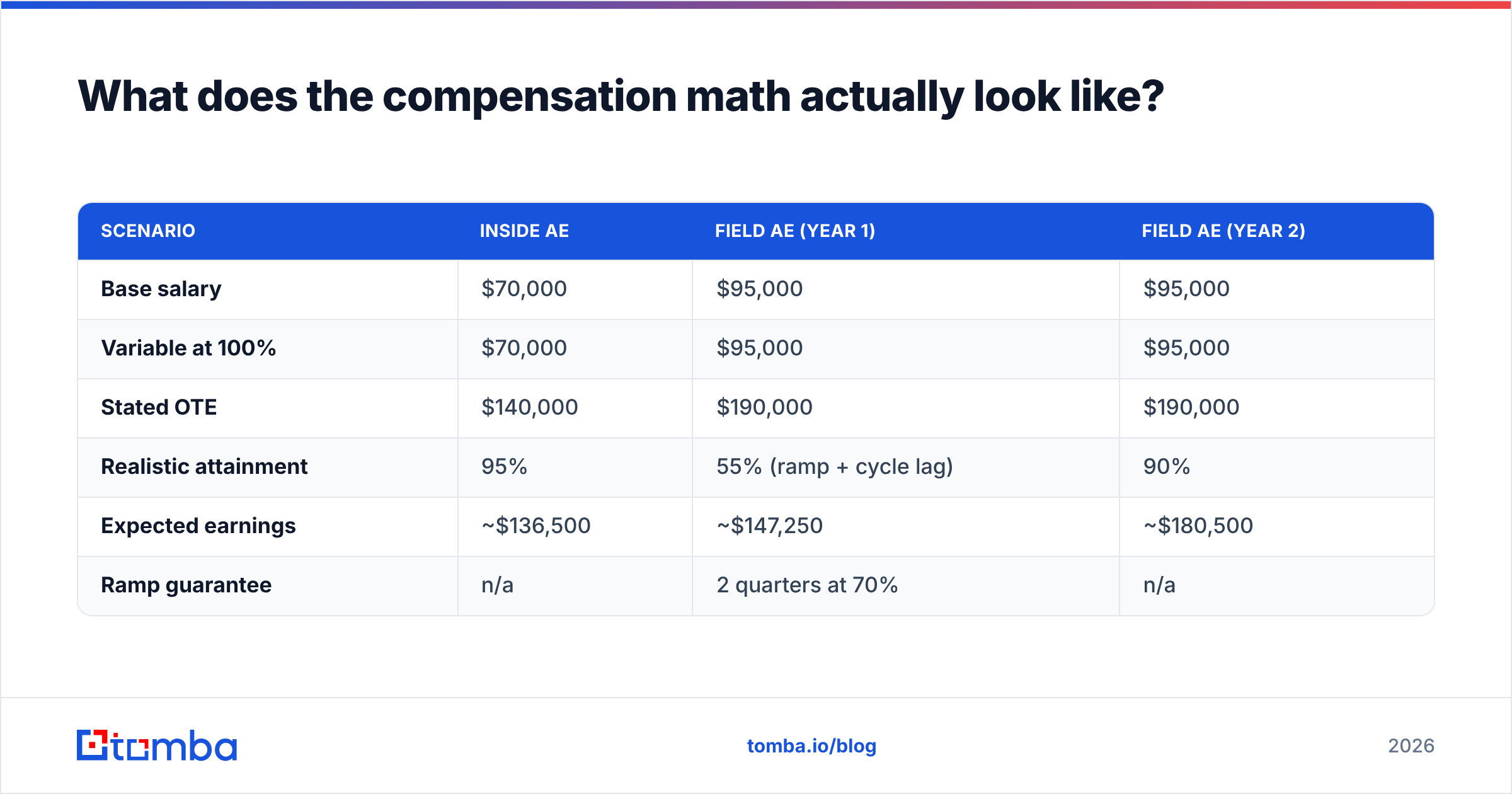
Do not compare OTE to OTE. Compare expected earnings in year one, which is a different number.
| Scenario | Inside AE | Field AE (Year 1) | Field AE (Year 2) |
|---|---|---|---|
| Base salary | $70,000 | $95,000 | $95,000 |
| Variable at 100% | $70,000 | $95,000 | $95,000 |
| Stated OTE | $140,000 | $190,000 | $190,000 |
| Realistic attainment | 95% | 55% (ramp + cycle lag) | 90% |
| Expected earnings | ~$136,500 | ~$147,250 | ~$180,500 |
| Ramp guarantee | n/a | 2 quarters at 70% | n/a |
The field role wins — in year two. Year one is roughly a wash once you account for ramp and cycle lag, and it is a loss if the ramp guarantee is short or absent. That is the negotiation. Ask for four quarters of ramp protection, not two, and get the territory account list in writing before you sign.
Also price the unbilled costs: travel days that eat evenings, expense reimbursement cycles, and the meetings you fly to that get cancelled the morning of.
Is a hybrid model better than a full switch?#
Often, yes — and it is the fastest-growing shape of the role. Most enterprise teams reviewed on sites like G2 now describe a blended motion: remote discovery and technical evaluation, in-person executive alignment and negotiation.
A hybrid transition looks like this:
- Keep your inside sales efficiency for the top of the funnel. Sequences, video prospecting, and data enrichment still fill the calendar cheaper than travel does.
- Reserve in-person time for three moments only: first executive meeting, security or procurement escalation, and the pre-signature alignment session.
- Measure travel ROI explicitly. Cost per on-site meeting versus influenced pipeline. If a trip cannot show a path to $100K of influenced pipeline, run it on video.
If your company offers a "field-enabled" or "hybrid enterprise" seat, take it before a pure field seat. You get the deal complexity without betting an entire year on a territory you have not tested.
How do you run your first 90 days in the field?#
Days 1–30: Learn and map. Shadow three field meetings with a senior rep. Build your tiering. Rebuild contact data for your top 20 accounts. Do not open deals yet — you will open the wrong ones.
Days 31–60: Book and test. Target 15 first meetings, at least 6 in person. Test two messaging angles per vertical. Record which titles reply and which ignore you. Your goal is not pipeline yet; it is a validated message.
Days 61–90: Compound. Convert first meetings into multithreaded opportunities. Every deal needs a second stakeholder before it enters your forecast. Build mutual action plans with dates. Get your manager into at least two accounts so your pipeline is credible at review time.
By day 90 a healthy field rep has 3–5 qualified opportunities, not closed revenue. If your leadership expects closed revenue in quarter one on an 8-month cycle, that is a forecasting problem you should surface early — in writing.
What tooling do you actually need for outside sales?#
Less than the vendor pitches suggest. Four things:
- A CRM you keep honest. Stakeholder records, next steps, close-date discipline.
- Accurate contact data. For the buying group, not just the champion.
- A research routine. News, hiring signals, earnings language, tech stack.
- A mutual action plan template. Shared with the buyer, updated weekly.
The one that breaks most often is contact data, because enterprise org charts churn constantly. Bulk-refresh your top accounts quarterly using a bulk email finder rather than patching records one at a time after a bounce. A bounced email to a VP you spent three weeks researching is an expensive way to learn that they left in March.
Ready to rebuild your territory with data that actually lands?#
Moving from inside sales to outside sales means fewer shots on goal, so every contact record has to be right the first time. Start with the Tomba Email Finder — search by domain, name, or company to rebuild your named-account buying groups with verified addresses, then confirm them before they ever hit a sequence. The free tier gives you 25 searches a month to test your top accounts; paid plans start at $49/mo, with Growth at $99/mo for reps working full enterprise territories. Check the full Tomba pricing and map your first 20 accounts this week.
Related guides#
// get started
Find, verify and enrich your first contacts today
Start on the free plan with 25 searches a month, then scale when your team is ready.
Free plan · No credit card required · GDPR & CCPA
// about the author