Inside Sales Training in 2026: A Complete Practical Guide
Most inside sales training is a week of slides followed by silence. Here is the ramp schedule, coaching cadence, scorecards, and tooling that turn new reps into quota-carriers in 90 days instead of nine months.
TL;DR
- Inside sales training fails when it is treated as an event. The programs that work are a 90-day ramp plus a permanent weekly coaching cadence.
- Onboarding week should be mostly reps talking, not managers presenting. Target a 30/70 split between content delivery and live practice.
- Train on data hygiene before you train on objection handling. A rep dialing a bad list learns the wrong lessons about their own pitch.
- Measure ramp with leading indicators (conversations per day, discovery-to-demo rate, talk ratio), not just closed revenue — revenue lags too far behind to correct anything.
- Buy the curriculum, build the playbook. Generic frameworks are cheap and fine; your ICP, objections, and email sequences are not something an outside vendor can write for you.
What is inside sales training, exactly?#
Inside sales training is the structured process of getting a remote-selling rep — someone who closes over phone, email, video, and LinkedIn rather than in person — from hire date to consistent quota attainment.
It covers four things, in this order:
- Product and market fluency — what you sell, who buys it, what breaks without it, and how a buyer in that seat measures their own success.
- Process mechanics — CRM hygiene, sequence structure, call logging, handoff rules, what "qualified" means on your team specifically.
- Conversation skill — discovery questioning, objection handling, multi-threading, negotiating without discounting reflexively.
- Self-management — territory planning, pipeline math, and the discipline of prospecting on a day when nothing is working.
Most companies spend 80% of onboarding on item 1 and then wonder why reps can run a product demo but cannot book one. The distribution should be closer to even, with items 3 and 4 continuing long after "onboarding" formally ends.
The distinction from field sales matters. Inside reps get shorter cycles, higher volume, and far more measurable activity — which means training can be tightened with real data instead of anecdotes. It also means a bad habit gets repeated 60 times a day instead of four times a week, so catching it early compounds.
Why does most inside sales training fail?#
Because it is front-loaded, passive, and disconnected from the rep's actual pipeline.
The classic failure pattern looks like this. Week one is a firehose of slide decks and recorded demos. Week two the rep shadows a senior seller. Week three they get a list and a quota. Week four onward, nobody watches a single one of their calls unless a deal blows up. By day 90 the rep has either figured it out alone or quietly decided that "the leads are bad."
Four specific breakdowns account for most of it:
- No spaced repetition. Information delivered once in week one is mostly gone by week four. Skills need re-exposure at day 14, day 30, and day 60.
- Certification theater. A multiple-choice quiz proves a rep can recognize your value prop. It proves nothing about whether they can deliver it while a prospect is interrupting them.
- Practice with no stakes. Roleplay only works if it is recorded, scored against a rubric, and repeated until the rep passes. Casual roleplay is conversation.
- Dirty data masking skill gaps. If 30% of the rep's list bounces or reaches the wrong person, their connect rate is meaningless — and so is any coaching built on it.
That last one is underrated. Gartner's sales research has consistently found that seller productivity problems are as often data and process problems as they are capability problems. Before you coach a rep on their opener, verify that the people they are opening to actually exist.
What should a 30-60-90 inside sales ramp look like?#
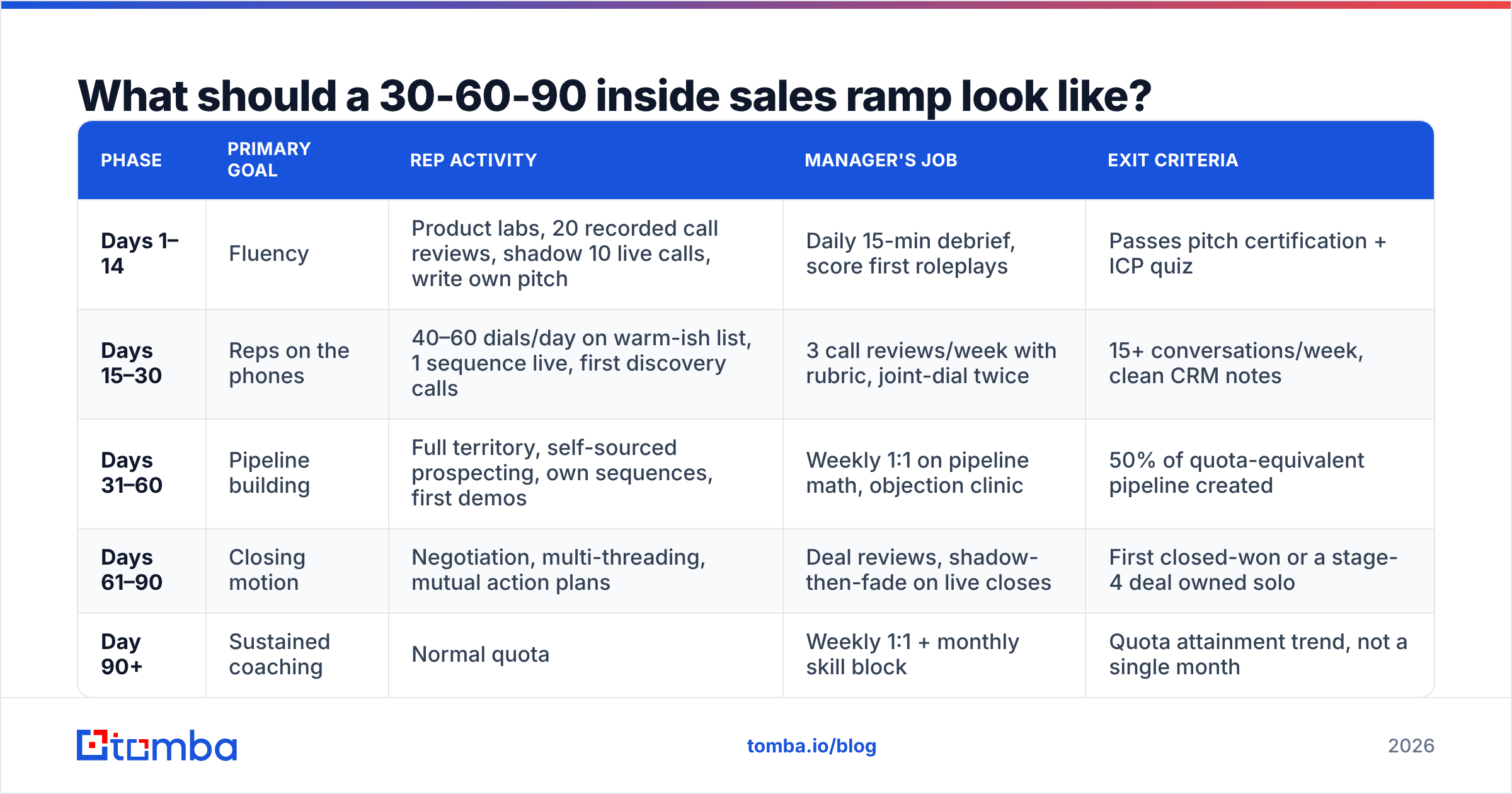
Here is a structure that works for a typical SMB/mid-market SaaS motion with a 30-60 day sales cycle. Compress the timeline for transactional products, extend it for enterprise.
| Phase | Primary goal | Rep activity | Manager's job | Exit criteria |
|---|---|---|---|---|
| Days 1–14 | Fluency | Product labs, 20 recorded call reviews, shadow 10 live calls, write own pitch | Daily 15-min debrief, score first roleplays | Passes pitch certification + ICP quiz |
| Days 15–30 | Reps on the phones | 40–60 dials/day on warm-ish list, 1 sequence live, first discovery calls | 3 call reviews/week with rubric, joint-dial twice | 15+ conversations/week, clean CRM notes |
| Days 31–60 | Pipeline building | Full territory, self-sourced prospecting, own sequences, first demos | Weekly 1:1 on pipeline math, objection clinic | 50% of quota-equivalent pipeline created |
| Days 61–90 | Closing motion | Negotiation, multi-threading, mutual action plans | Deal reviews, shadow-then-fade on live closes | First closed-won or a stage-4 deal owned solo |
| Day 90+ | Sustained coaching | Normal quota | Weekly 1:1 + monthly skill block | Quota attainment trend, not a single month |
Two notes on this table. First, the exit criteria are non-negotiable gates, not suggestions — a rep who cannot pass pitch certification on day 14 does not get a territory on day 15, they get three more days of practice. Second, the manager column is the part that gets cut when the quarter gets busy, and it is the part that actually produces the outcome.
Which skills actually move the number?#
Not all training topics have equal ROI. Ranked by observed impact on ramped rep performance:
- Discovery questioning. The single highest-leverage skill. A rep who can run a 20-minute discovery that surfaces a quantified problem will out-close a rep with a better demo, every time. Train it with recorded roleplays scored on question count, open/closed ratio, and whether they got a number out of the buyer.
- Prospecting volume discipline. Not a "skill" in the classic sense, but the most reliable predictor of ramp speed. Train the block-scheduling habit in week two, before bad habits set in.
- Objection handling by category, not by script. There are usually six to eight real objections in any market. Have reps write and defend a response to each, then pressure-test them live. Scripts break under improvisation; categories do not.
- Email and message writing. Inside reps write more than they talk. Teach structure — one idea, one ask, under 90 words — and review real sent messages weekly, not sample copy. Your cold email templates are a starting point, not the destination.
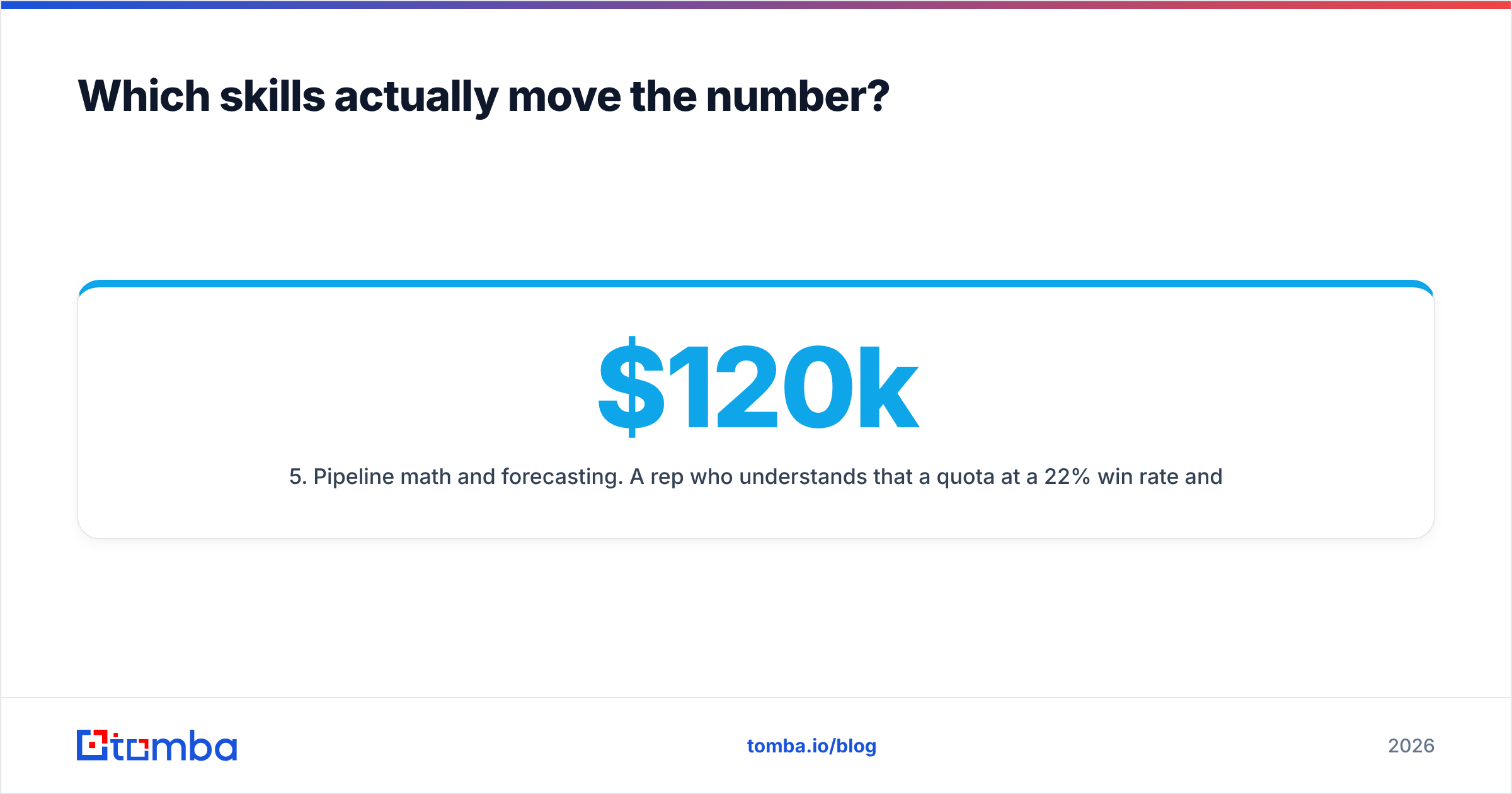
- Pipeline math and forecasting. A rep who understands that a $120k quota at a 22% win rate and a $15k ACV means 36 qualified opportunities per year will prospect without being nagged.
- CRM discipline. Boring, and the thing every enablement leader wishes they had enforced harder in month one. Untracked activity cannot be coached.
Notice what is not on the list: product certification beyond basic fluency, and "closing techniques." Both matter, both are over-taught relative to their effect on the win rate.
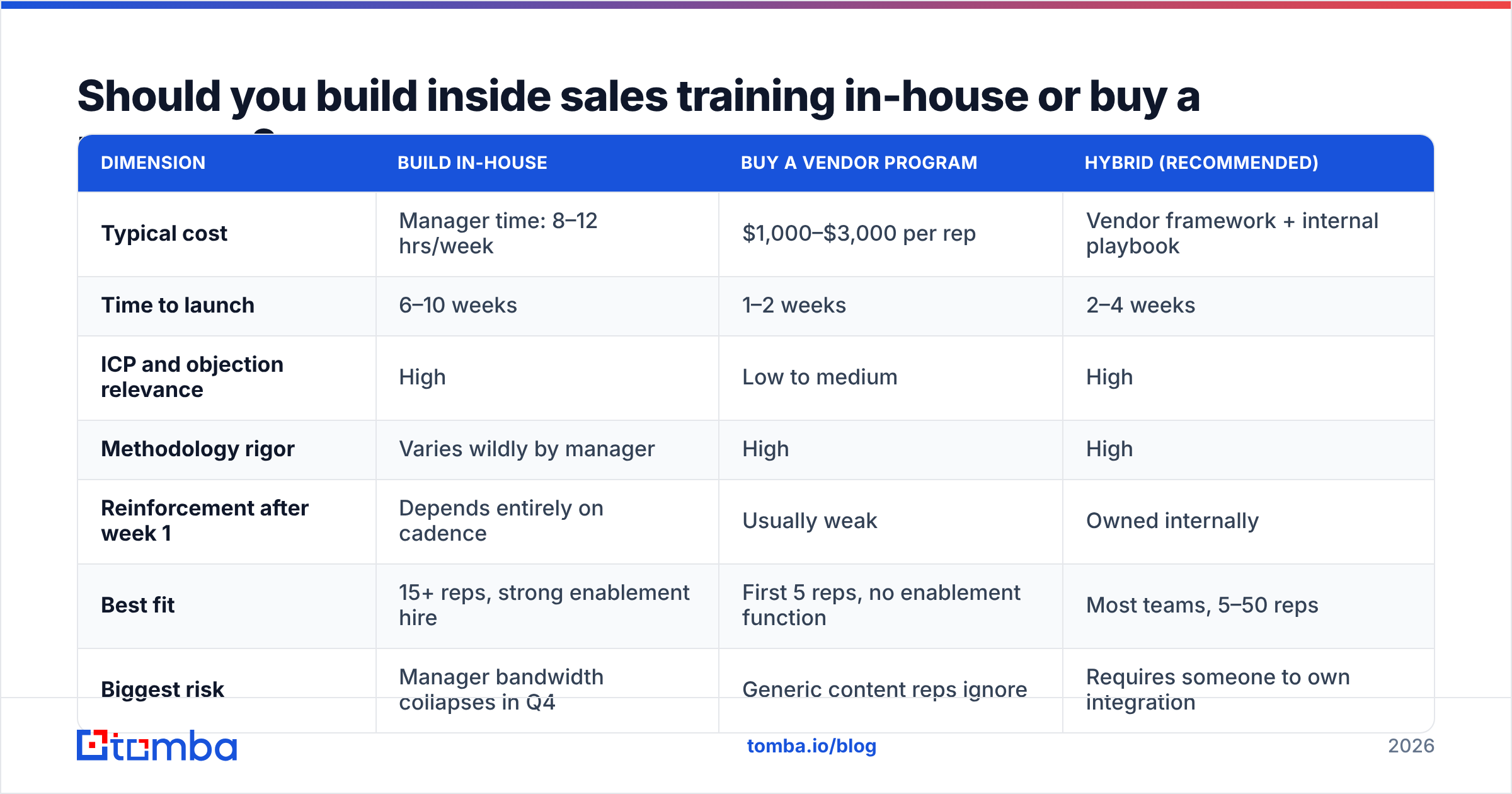
Should you build inside sales training in-house or buy a program?#
The honest answer for most teams under 50 reps: buy the framework, build everything that is specific to you.
| Dimension | Build in-house | Buy a vendor program | Hybrid (recommended) |
|---|---|---|---|
| Typical cost | Manager time: 8–12 hrs/week | $1,000–$3,000 per rep | Vendor framework + internal playbook |
| Time to launch | 6–10 weeks | 1–2 weeks | 2–4 weeks |
| ICP and objection relevance | High | Low to medium | High |
| Methodology rigor | Varies wildly by manager | High | High |
| Reinforcement after week 1 | Depends entirely on cadence | Usually weak | Owned internally |
| Best fit | 15+ reps, strong enablement hire | First 5 reps, no enablement function | Most teams, 5–50 reps |
| Biggest risk | Manager bandwidth collapses in Q4 | Generic content reps ignore | Requires someone to own integration |
Vendor methodologies — MEDDIC, SPIN, Challenger, Sandler and their descendants — are commodities at this point. They are well-documented, and resources like HubSpot's sales blog cover the mechanics for free. What no vendor can supply is your buyer's actual language, your competitor's actual counter-pitch, and the seven objections your reps actually hear. That is the part you build, and it is the part that determines whether training transfers to revenue.
If you are choosing a vendor, check practitioner reviews on G2 rather than case studies on the vendor's own site. The signal you want is reinforcement quality, not curriculum breadth.
How do you coach after onboarding ends?#
You install a cadence and you protect it like a customer meeting.
A workable weekly rhythm for a manager with six to eight inside reps:
- Monday, 30 min, team: pipeline review by number, not by story. Who needs how many new opportunities this week.
- Midweek, 30 min, 1:1 per rep: one recorded call, one rubric, one behavior to change. Not a status update — a status update is a Slack message.
- Thursday, 45 min, team: skill block. One topic, live roleplay, everyone participates. Rotate topics on a 10-week cycle so each returns quarterly.
- Monthly, 60 min, per rep: territory and account plan review. Where is next quarter's pipeline coming from.
Two rules make this work. First, coach one thing at a time. A call review that produces five pieces of feedback produces zero behavior change. Second, close the loop — next week's session starts by checking whether last week's single change actually happened.
Call recording is non-negotiable here. Whether you use a dedicated conversation intelligence tool or the recording built into your dialer, coaching from memory is coaching from fiction. If you are evaluating platforms, a Gong alternative comparison is a reasonable place to start scoping budget.
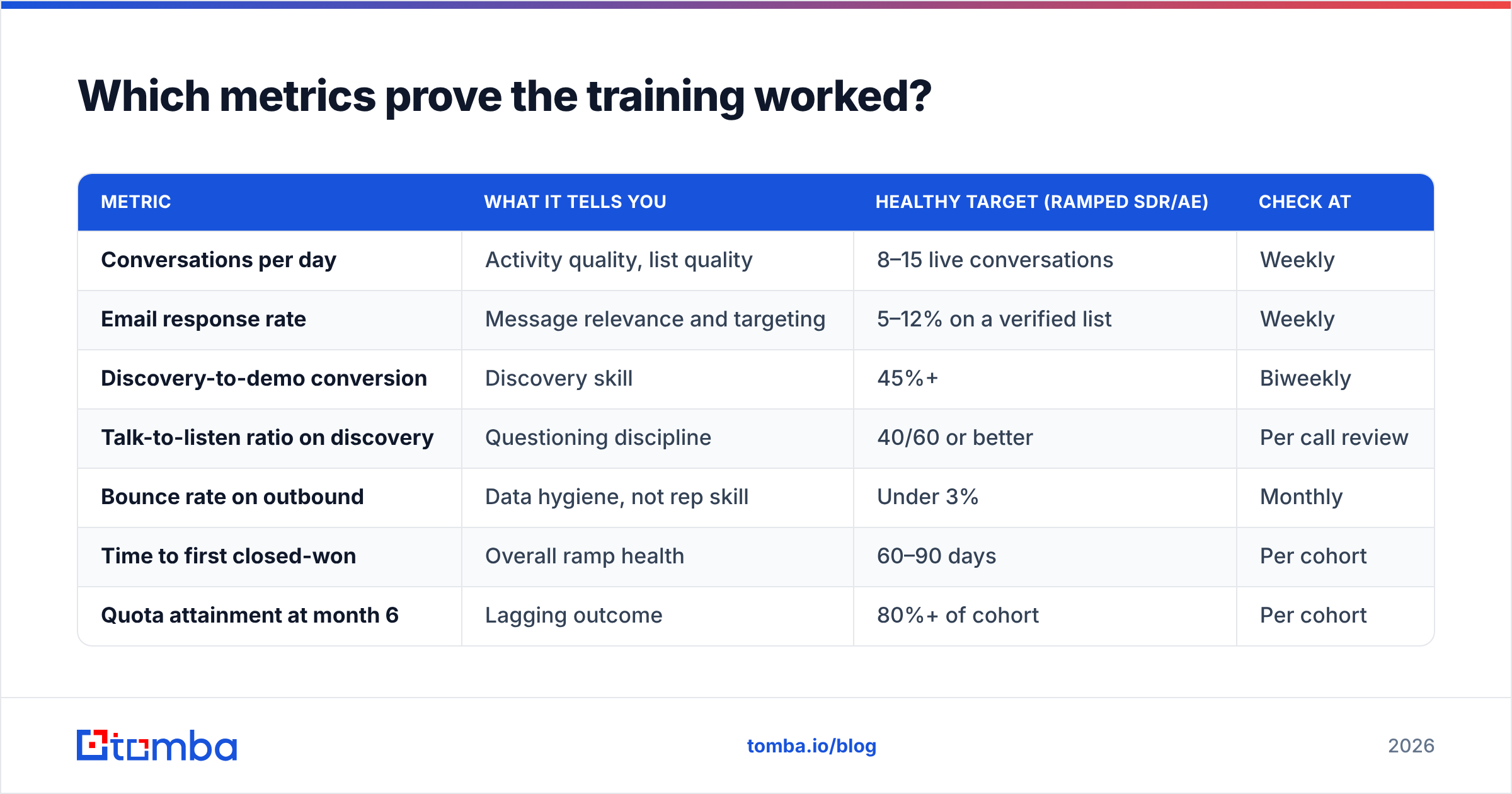
Which metrics prove the training worked?#
Split them into leading and lagging, and hold managers to the leading set.
| Metric | What it tells you | Healthy target (ramped SDR/AE) | Check at |
|---|---|---|---|
| Conversations per day | Activity quality, list quality | 8–15 live conversations | Weekly |
| Email response rate | Message relevance and targeting | 5–12% on a verified list | Weekly |
| Discovery-to-demo conversion | Discovery skill | 45%+ | Biweekly |
| Talk-to-listen ratio on discovery | Questioning discipline | 40/60 or better | Per call review |
| Bounce rate on outbound | Data hygiene, not rep skill | Under 3% | Monthly |
| Time to first closed-won | Overall ramp health | 60–90 days | Per cohort |
| Quota attainment at month 6 | Lagging outcome | 80%+ of cohort | Per cohort |
The bounce rate row is the one teams skip and the one that quietly poisons everything else. If a rep's list is 15% invalid, their connect rate, response rate, and confidence all drop for reasons that have nothing to do with training. Run outbound lists through an email verifier before a new rep ever touches them, and treat the result as a training input rather than an ops chore.
How should you train reps on AI-assisted prospecting in 2026?#
Teach judgment, not prompts.
The tooling has gotten genuinely good — research summarization, first-draft personalization, call transcription and scoring, automatic CRM enrichment. What has not changed is that a buyer can tell within one sentence whether a human thought about them. The training goal is a rep who uses AI to compress the 20 minutes of research into two, then spends the saved 18 minutes on more accounts — not a rep who ships 400 machine-written emails a day and burns the domain.
Three concrete modules worth adding to your curriculum:
- Research-to-relevance. Give reps an account, 90 seconds, and any tool they like. Score the output on whether the resulting opening line could only have been written for that company.
- Verification reflex. Any AI-surfaced contact detail gets verified before it enters a sequence. Make this a habit in week two, and pair it with a walkthrough of how contact data sources work so reps understand why a guessed address is not the same as a confirmed one.
- Deliverability basics. Reps should know what SPF, DKIM, and a spam complaint are well enough to not destroy their own sending domain. Salesforce and other platform vendors publish reasonable primers — see the Salesforce blog for the operations-side view — but a 45-minute internal session is usually enough.
What tooling does an inside sales training program need?#
Less than most teams buy. The minimum viable stack:
- A CRM with enforced required fields, so activity data is trustworthy
- Call recording with timestamped comments for coaching
- A sequencing tool with visible per-step reply data
- A contact data source with verification built in
- A shared scorecard document — a spreadsheet is fine
Everything past that is optimization. Where teams over-invest is enablement content platforms; where they under-invest is data quality, which is the cheapest fix with the largest effect on a ramping rep's morale.
Where should you start this week?#
Pick one thing. If you have no ramp plan, write the 30-60-90 table above and fill in your own exit criteria. If you have a ramp plan but no coaching cadence, put the midweek 1:1 on the calendar as a recurring event and never move it. If you have both and reps are still missing ramp, pull 20 of their outbound calls and check the connect rate against the list quality before you blame the pitch.
And fix the list first. New reps need early wins more than they need advanced technique, and nothing kills an early win faster than three bounced emails and a disconnected number.
Tomba's Email Finder gives your ramping reps verified, source-cited business email addresses so their first 500 outbound touches land on real people — which makes every call review after that a conversation about skill instead of about bad data. The free tier includes 25 searches a month to test it against your own target accounts, and paid plans start at $49/mo; see Tomba pricing for the full breakdown.
Related guides#
// get started
Find, verify and enrich your first contacts today
Start on the free plan with 25 searches a month, then scale when your team is ready.
Free plan · No credit card required · GDPR & CCPA
// about the author