Inside Sales vs Direct Sales: Which Model Wins in 2026?
Inside sales closes cheaper. Direct sales closes bigger. Here's the honest breakdown of cost per rep, cycle length, win rates, and deal size — plus how to pick the right model for your ACV.
TL;DR
- Inside sales is remote selling — phone, email, video, chat. Direct sales means a rep owns the relationship end to end, usually in person, often at the customer's site.
- The deciding variable is annual contract value (ACV). Below roughly $15K ACV, field travel eats the margin. Above ~$75K ACV, a remote-only motion usually leaves win rate on the table.
- Inside sales reps cost roughly 40–60% less fully loaded and touch 5–10x more accounts per week. Direct reps close larger deals with higher win rates but carry a fraction of the pipeline volume.
- Almost nobody runs a pure model anymore. The dominant 2026 pattern is inside sales sources, direct sales closes — one pipeline, two handoff stages.
- Both models die on the same thing: bad contact data. Wrong email, wrong mobile, wrong title — the motion doesn't matter.
What is inside sales, exactly?#
Inside sales is selling without getting on a plane. The rep works from a desk (home, office, or a shared floor) and runs the entire cycle through phone, email, video calls, LinkedIn, and increasingly async video and shared deal rooms.
The name is a leftover from the 1980s, when "inside" literally meant the people who stayed in the building and took orders while the "outside" team drove around. That framing is dead. Modern inside sales reps run discovery, demo, multi-threaded stakeholder mapping, security review, and negotiation — they just never shake a hand. Inside sales is now the default motion for most SaaS, and it's the structure behind the SDR/AE split that dominates B2B org charts.
What defines it operationally:
- Volume of touches. A productive inside AE works 25–60 open opportunities and touches hundreds of contacts per month.
- Cycle compression. No travel logistics means meetings get booked in days, not weeks.
- Measurability. Every call is recorded, every email tracked, every stage timestamped in the CRM. You can actually run experiments.
- Lower cost to serve. No flights, no hotels, no regional offices, no per-diem.
What is direct sales (and why the name confuses people)?#
Direct sales means the vendor sells to the buyer with no intermediary — no channel partner, no reseller, no distributor, no marketplace taking a cut. In B2B practice, "direct sales" almost always implies a named rep who owns a territory or account list and meets buyers face to face: onsite discovery, executive lunches, conference booths, factory walkthroughs.
Here's where people get tangled. "Direct sales" has two meanings floating around:
- The channel definition — you sell directly rather than through partners. Under this definition, inside sales is direct sales.
- The field definition — the everyday usage in B2B orgs, where "direct" is shorthand for a field/outside rep who shows up in person.
This post uses the second definition, because that's the comparison people actually mean when they type "inside sales vs direct sales" into Google. If your real question is direct vs channel, that's a partner-strategy question, not a rep-deployment question.
Field/direct selling still dominates in manufacturing, medical devices, industrial equipment, construction materials, enterprise infrastructure, and anything with a procurement committee larger than seven people. Gartner's sales research has tracked the shift toward hybrid buying for years — buyers want digital self-serve for evaluation and a human for the high-stakes moments.
How do inside sales and direct sales actually differ?#
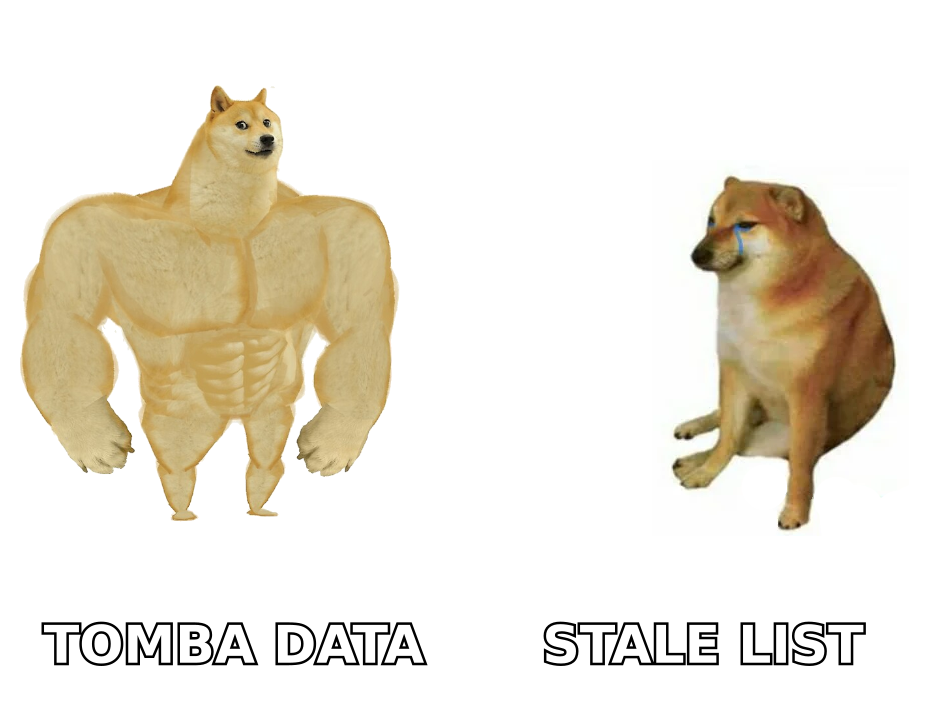
Side by side on the attributes that change your comp plan and your budget:
| Attribute | Inside sales | Direct (field) sales |
|---|---|---|
| Primary channel | Phone, email, video, chat | In-person meetings, events, onsite visits |
| Typical ACV sweet spot | $3K – $75K | $50K – $1M+ |
| Fully loaded cost per rep/yr | ~$95K – $160K | ~$180K – $300K+ |
| Accounts per rep | 150 – 600 | 20 – 80 named accounts |
| Meetings per week | 10 – 25 | 4 – 10 |
| Average sales cycle | 14 – 90 days | 90 – 270 days |
| Win rate (qualified opps) | 15% – 25% | 25% – 40% |
| Ramp time to full quota | 3 – 5 months | 6 – 12 months |
| Quota multiple (quota ÷ OTE) | 4x – 6x | 3x – 5x |
| Travel & expense | Near zero | 8% – 15% of rep cost |
| Data dependency | Extreme — no data, no dials | High — but relationships buffer gaps |
Read the table as ranges, not gospel. Your vertical moves every row. But the shape holds: inside sales optimizes for throughput and cost efficiency, direct sales optimizes for deal size and win rate.
The trap is comparing them on a single metric. A VP who sees "field reps win 35% vs inside at 20%" and shifts headcount to field is comparing win rates on completely different opportunity volumes. Twenty percent of 300 opportunities beats 35% of 45 opportunities, every time, on a $20K ACV product.
Which model costs less per closed deal?#
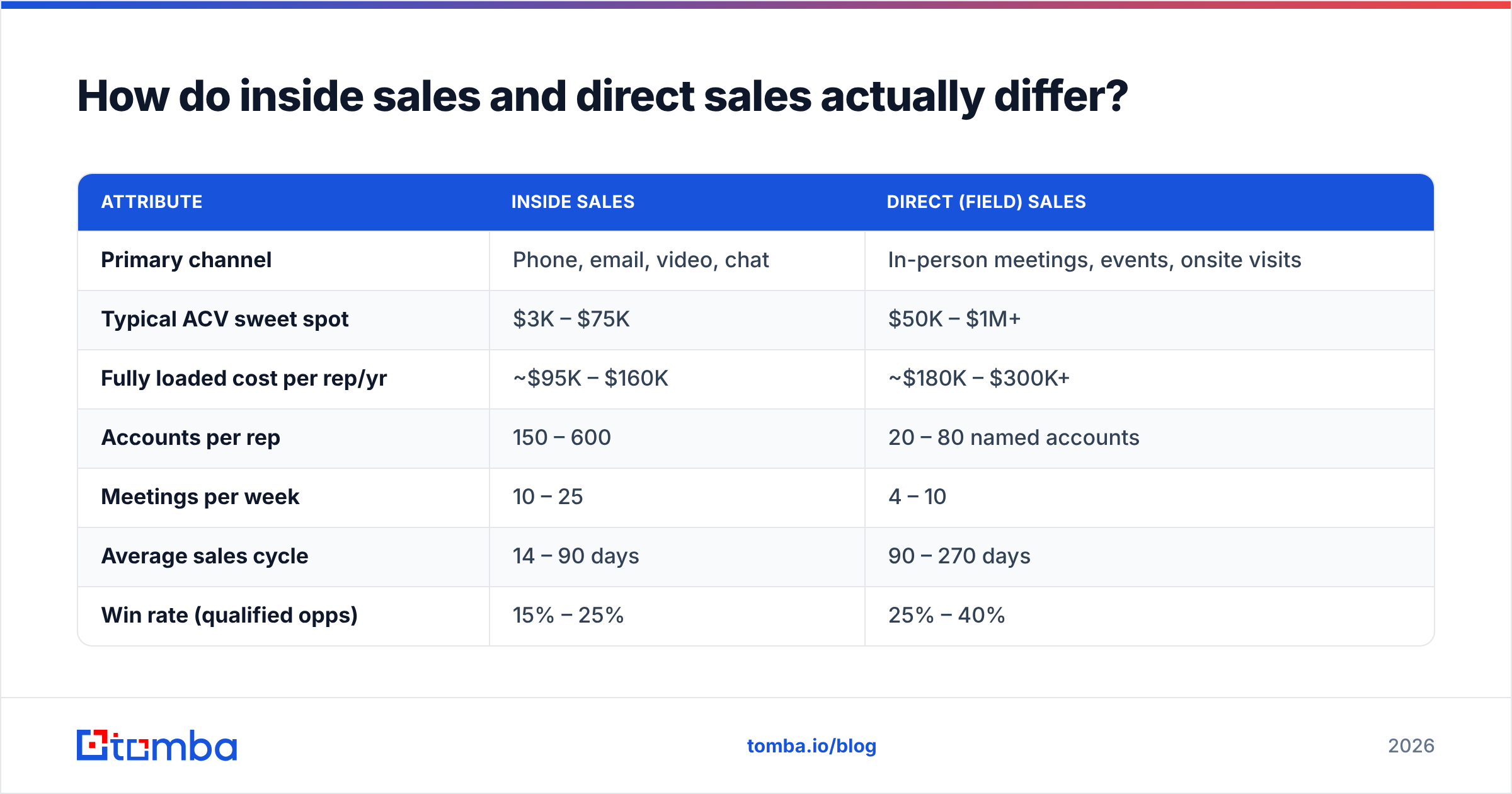
Inside sales — usually by a factor of two to three at mid-market ACV. But cost per deal is the wrong number in isolation. The number that matters is cost per dollar of closed ARR.
Run the math on a $25K ACV product:
| Metric | Inside AE | Field AE |
|---|---|---|
| Fully loaded cost | $130,000 | $225,000 |
| Qualified opps per year | 180 | 55 |
| Win rate | 20% | 33% |
| Deals closed | 36 | 18 |
| Closed ARR (at $25K / $45K ACV) | $900,000 | $810,000 |
| Cost per closed deal | $3,611 | $12,500 |
| Cost per $1 of ARR | $0.14 | $0.28 |
At this ACV, the inside rep wins outright — same ARR, half the cost. Now rerun it with a $150K ACV enterprise product where the field rep closes 12 deals at $150K ($1.8M) and the inside rep closes 14 at $60K because they can't get into the executive room ($840K). The field rep wins by a mile, even at $225K loaded cost.
That's the whole decision in one paragraph: the crossover point is your ACV. Everything else is implementation detail.
Which model wins bigger deals — and why?#
Direct sales wins bigger deals for three reasons that have nothing to do with rep quality.
- Access. A CFO who won't take a Zoom will take a dinner. Physical presence buys you access to people who screen calls.
- Multi-threading by accident. Walk into a building and you meet the ops lead, the plant manager, and the person who actually files the ticket. Remote, you have to engineer every one of those introductions.
- Perceived commitment. Somebody flying to Cincinnati signals a different level of investment than a calendar link. On a seven-figure contract with a five-year switching cost, that signal matters to risk-averse committees.
Inside sales counters with speed and coverage. You can run a 12-touch sequence across four personas at 400 accounts with two reps. No field team on earth does that.
What inside sales genuinely struggles with: highly technical products needing physical demonstration, regulated industries with in-person compliance norms, and markets where the buyer's entire purchasing culture runs on relationships built over a decade. Don't fight that. Staff for it.
Is a hybrid model the real answer in 2026?#
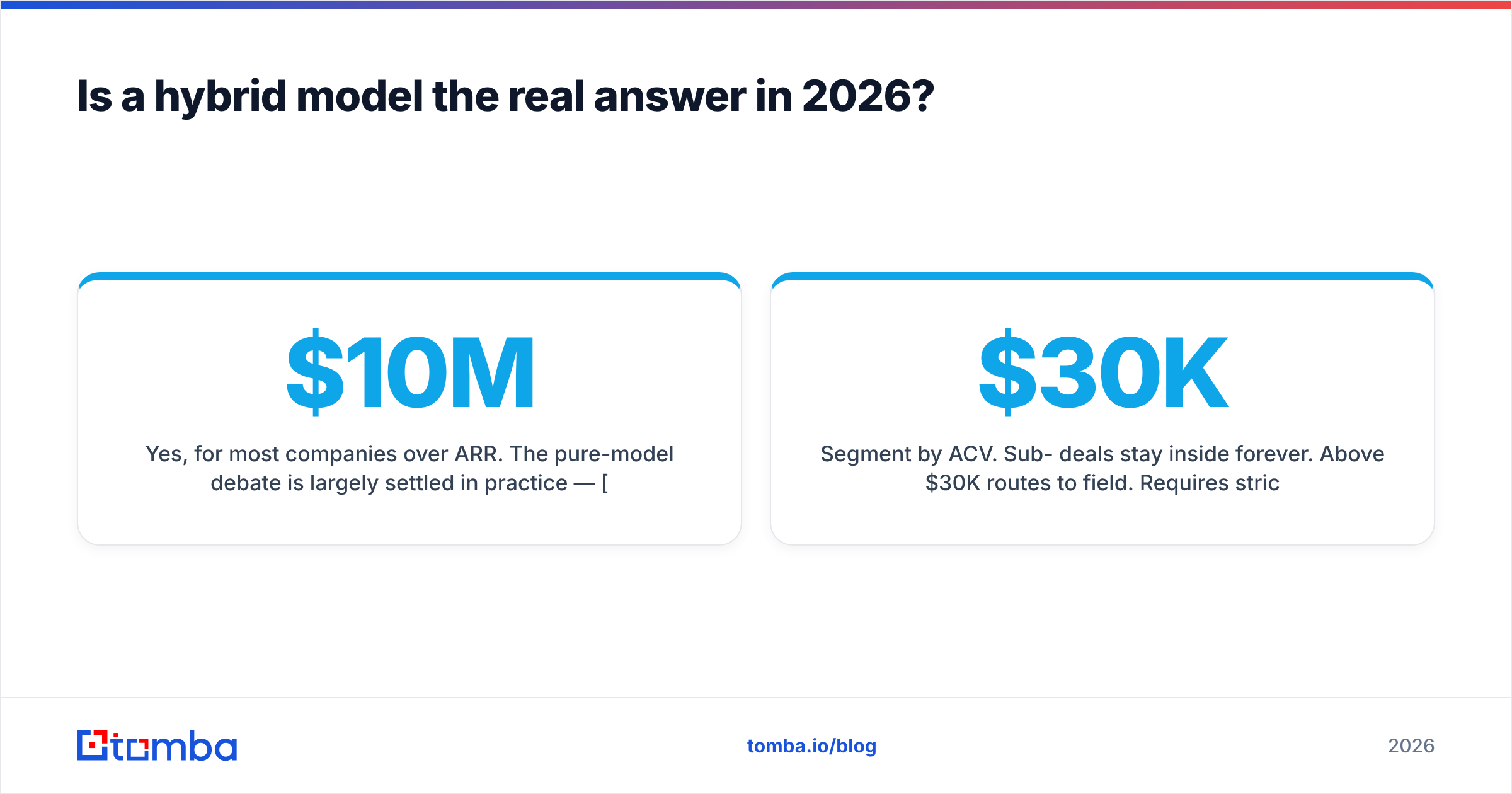
Yes, for most companies over $10M ARR. The pure-model debate is largely settled in practice — Salesforce's State of Sales research has documented the steady collapse of the inside/outside wall, with reps routinely running the same deal across both modes.
The three hybrid patterns that actually work:
- Source inside, close direct. SDRs and inside AEs generate and qualify; field AEs take the deal at proposal stage. Cleanest handoff, easiest to comp, most common in enterprise SaaS.
- Segment by ACV. Sub-$30K deals stay inside forever. Above $30K routes to field. Requires strict deal-desk enforcement or reps will game the routing.
- Inside-first with field escalation. Everything starts remote. The rep pulls in a field resource only for specific moments — executive briefing, site survey, contract negotiation. Cheapest hybrid, hardest to schedule.
- Field-led with inside support. The field AE owns the account; an inside partner handles scheduling, follow-up, renewals, and expansion within the base. Effectively doubles field rep capacity.
Whichever you pick, write the handoff rule down. Ninety percent of hybrid failures are a handoff stage nobody defined, so deals sit in limbo while two reps each assume the other owns next steps. Make it a required CRM stage with an exit criterion, and track time-in-stage.
How do you decide which model fits your business?#
Work through these five in order. Stop at the first one that gives you a clear answer.
- Check your ACV against the break-even. Divide fully loaded field rep cost by expected win rate and opportunity count. If a field rep needs to close more deals than your market realistically supplies, the answer is inside sales. No debate needed.
- Look at where your buyers already are. If your last 20 closed-won deals had zero in-person meetings, your market has told you what it wants. If 18 of 20 started at a trade show, that's also an answer.
- Count the buying committee. One to three stakeholders is comfortably an inside sales motion. Seven or more, with procurement, legal, and a security review, and you want someone who can build coalitions in a room.
- Measure your current cycle length. Cycles over 120 days usually mean complex, consensus-driven buying that rewards a field presence. Cycles under 45 days mean speed is your edge — don't slow it down with travel calendars.
- Audit your data quality before you audit anything else. If your contact database is 30% stale, both models underperform and you'll misattribute the failure to the wrong variable. Fix the inputs first, then run the comparison.
That last one gets skipped constantly. Teams rebuild their entire go-to-market org because pipeline is down, when the actual cause is that their list decayed — B2B contact data typically degrades 22–30% per year as people change jobs. HubSpot's sales research has consistently flagged prospecting and data quality as the top reported bottleneck, well ahead of methodology.
What tooling does each model actually need?#
The stacks diverge more than people expect.
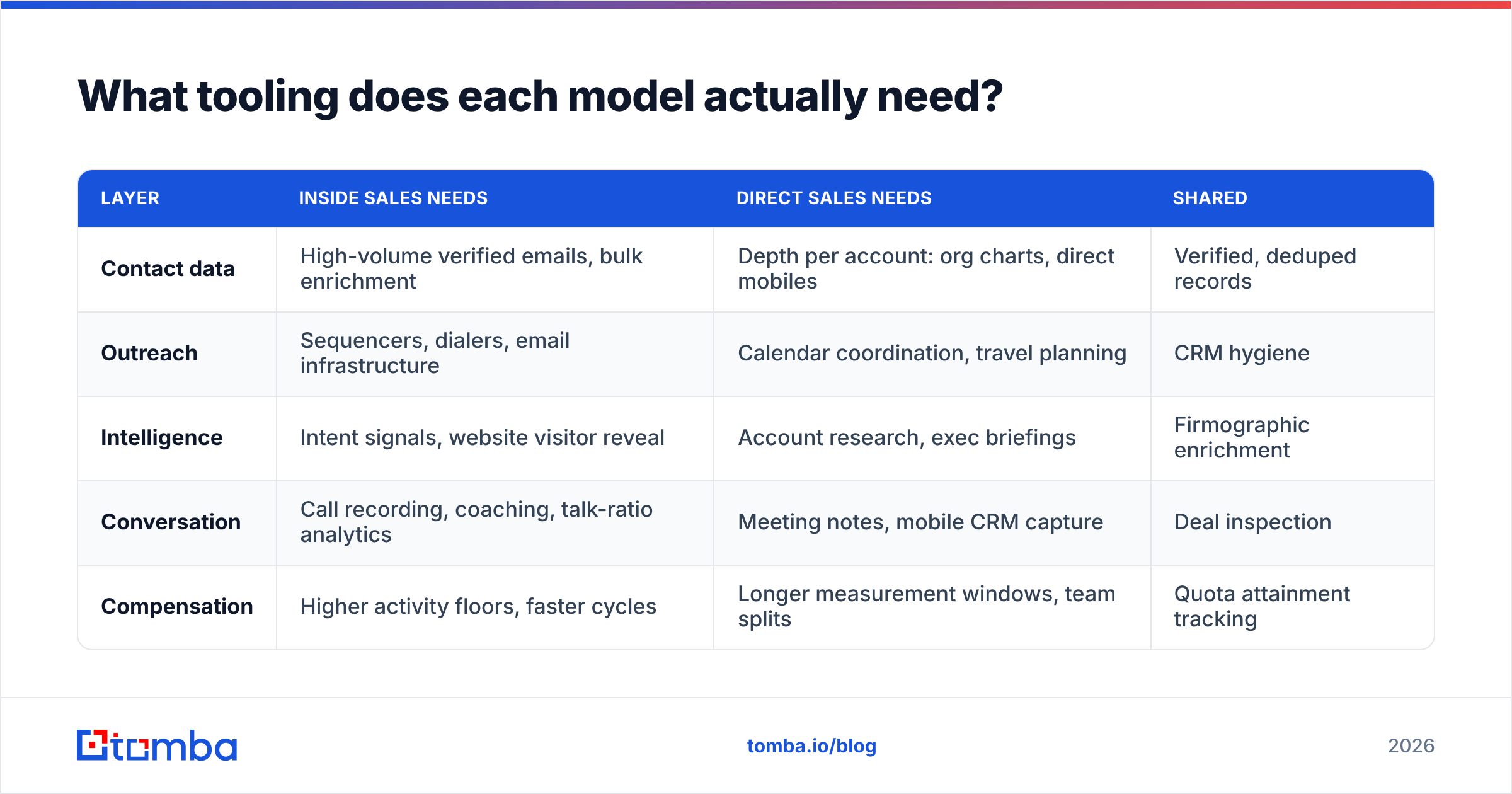
| Layer | Inside sales needs | Direct sales needs | Shared |
|---|---|---|---|
| Contact data | High-volume verified emails, bulk enrichment | Depth per account: org charts, direct mobiles | Verified, deduped records |
| Outreach | Sequencers, dialers, email infrastructure | Calendar coordination, travel planning | CRM hygiene |
| Intelligence | Intent signals, website visitor reveal | Account research, exec briefings | Firmographic enrichment |
| Conversation | Call recording, coaching, talk-ratio analytics | Meeting notes, mobile CRM capture | Deal inspection |
| Compensation | Higher activity floors, faster cycles | Longer measurement windows, team splits | Quota attainment tracking |
Practical notes for each side:
For inside sales, throughput is everything — you need thousands of accurate addresses, not dozens. Run every list through an email verifier before it hits a sequencer, because a 6% bounce rate will wreck your domain reputation and take your whole team's deliverability with it. Use a bulk email finder to build territory lists in batches rather than one-off lookups.
For direct sales, depth beats breadth. A field rep working 40 named accounts doesn't need 10,000 contacts — they need the right nine people at each of those 40 companies, with a mobile number that connects. A phone finder plus proper contact enrichment matters more than list volume here.
For hybrid teams, the shared layer is where things break. If your inside team enriches records one way and your field team another, you'll have duplicate accounts, conflicting owners, and two reps emailing the same VP in the same week. Standardize on one enrichment source and one dedupe rule, enforced at the CRM level.
What should you do next?#
Pick your model off ACV and buying-committee size, then write down the handoff rule before you hire anyone. The org design question is usually simpler than the debate makes it sound — what's genuinely hard is keeping the data underneath it accurate enough that either model performs.
Start there. Whether your reps are dialing 60 accounts a day from a desk or driving to three onsite meetings a week, they're working off the same underlying list, and a wrong address or a disconnected mobile costs you the same either way.
Build that list with the Tomba Email Finder — find verified professional addresses by domain, name, or company, with confidence scoring so your reps know which contacts to trust before they spend a touch on them. The free tier gives you 25 searches a month to test accuracy against your own known-good accounts; paid plans start at $49/mo. Check Tomba pricing to match a tier to your team size, then run a sample of 100 contacts through it and compare against whatever you're using now. The delta in bounce rate will tell you more than another quarter of debating org charts.
Related guides#
// get started
Find, verify and enrich your first contacts today
Start on the free plan with 25 searches a month, then scale when your team is ready.
Free plan · No credit card required · GDPR & CCPA
// about the author