Inside Sales vs Outside Sales: Which Model Wins in 2026?
Inside sales closes faster and costs less per touch. Outside sales wins bigger deals. Here is the cost, quota, and cycle-length data to decide which model your team should run in 2026.
TL;DR
- Inside sales sells remotely — phone, email, video, chat. Outside sales (field sales) sells in person — on-site visits, conferences, dinners, plant tours.
- Inside reps cost roughly 40–60% less per head once travel, per diem, and vehicle costs are stripped out, and they run 3–5x more conversations per week.
- Outside sales still wins where deal size, committee complexity, or physical product demos justify the cost — typically $75K+ ACV with multi-stakeholder buying groups.
- Most B2B teams in 2026 run a hybrid: inside SDRs create pipeline, field AEs fly only to late-stage, high-value opportunities.
- The deciding variable is not preference — it is cost per closed dollar. Calculate it before restructuring anything.
The debate over inside sales vs outside sales has been miscast for a decade. It is not a philosophical question about whether human presence matters. It is an arithmetic question about how much revenue each dollar of selling cost returns, and the answer changes with your average contract value, buying-committee size, and how physical your product is.
This post gives you the operating definitions, the real cost comparison, the quota and cycle-length differences, and a decision framework you can apply this quarter.
What is inside sales?#
Inside sales is selling conducted remotely from a fixed location — an office, a home desk, a hub. The rep never meets the buyer in person. Everything happens over phone, email, video call, LinkedIn, and increasingly in-product chat.
The model became dominant because the economics are brutal in its favor:
- No travel overhead. A field rep burns 20–40% of the work week in transit. An inside rep converts that time into conversations.
- Higher activity volume. Inside reps commonly run 40–60 dials or 8–15 video meetings per week versus 4–8 in-person meetings for field reps.
- Instrumented by default. Every call is recorded, every email tracked, every stage timestamped. Coaching is a playback away.
- Faster ramp. New inside reps typically hit full productivity in 3–4 months versus 6–9 months for field reps who must build territory relationships.
- Cheaper to scale. Adding a seat means a laptop, a headset, a CRM license, and data credits — not a car allowance and an airline budget.
- Geographically unbounded. One rep in Lisbon can cover EMEA; territory maps stop being a constraint.
The trade-off is depth. You are trying to build trust through a 27-inch monitor, and for a $400K platform decision with seven stakeholders, that is a genuine handicap.
What is outside sales?#
Outside sales — field sales — puts the rep physically in front of the buyer. On-site discovery, factory walkthroughs, conference booth conversations, steak dinners with the procurement lead, executive briefings at your headquarters.
It persists for structural reasons, not nostalgia:
- High-consideration purchases. When the contract is a seven-figure, multi-year commitment, buyers want to look someone in the eye.
- Complex or physical products. Industrial equipment, medical devices, and construction materials are hard to sell from a slide deck.
- Multi-threaded committees. Getting nine stakeholders in one room for two hours is worth more than nine separate 30-minute Zooms.
- Relationship-driven verticals. Government, healthcare systems, manufacturing, and enterprise financial services still reward face time heavily.
- Competitive displacement. Unseating an incumbent usually requires showing up where the incumbent will not.
Field sales is not dying. It is being rationed. Companies that used to fly reps to first meetings now fly them to the fourth.
Inside sales vs outside sales: how do the numbers actually compare?#
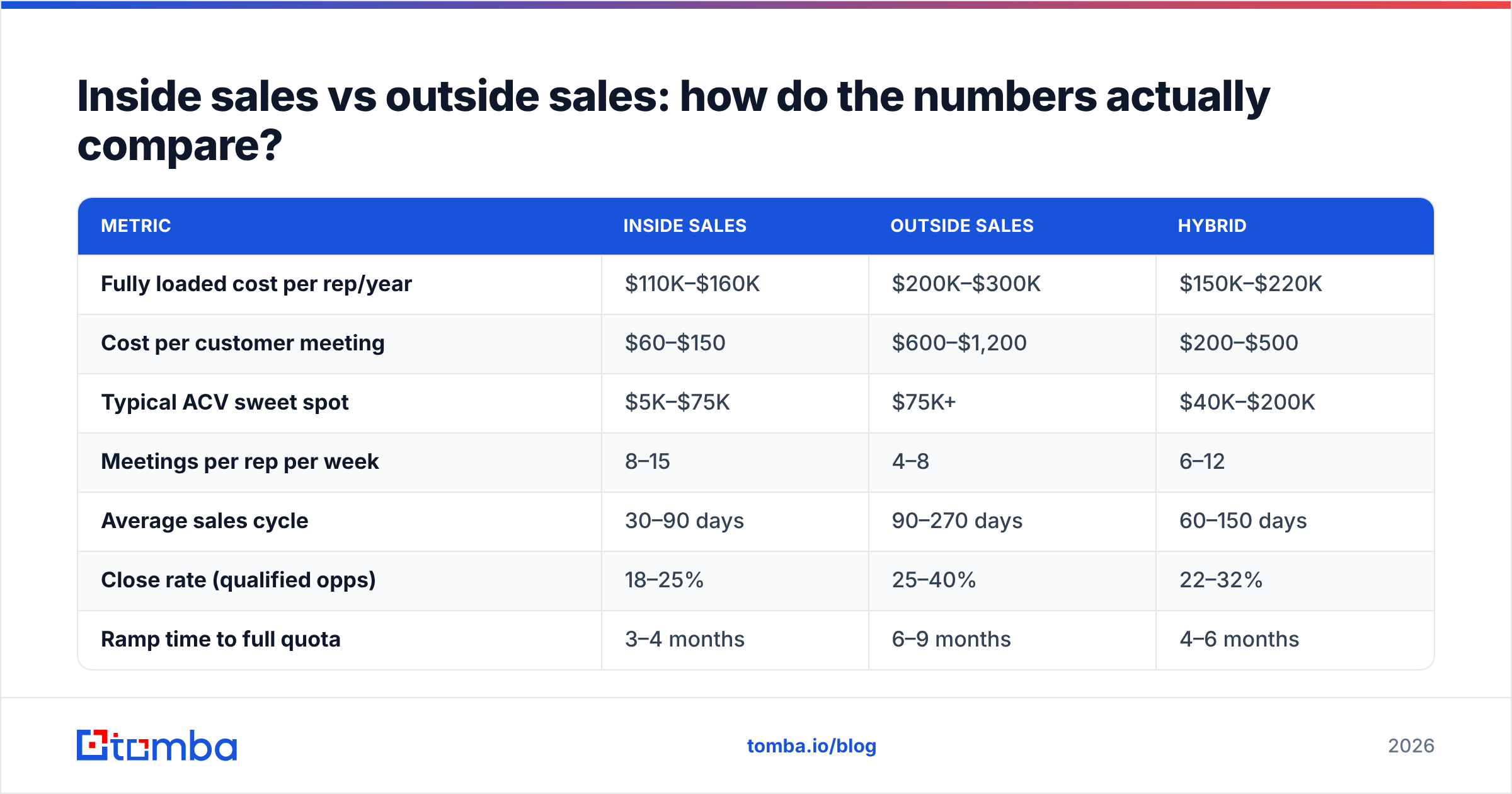
Here is the head-to-head on the metrics that determine which model earns its keep. Figures reflect typical B2B SaaS and technology-services benchmarks; your sector will shift them, and you should re-derive them from your own CRM before acting.
| Metric | Inside sales | Outside sales | Hybrid |
|---|---|---|---|
| Fully loaded cost per rep/year | $110K–$160K | $200K–$300K | $150K–$220K |
| Cost per customer meeting | $60–$150 | $600–$1,200 | $200–$500 |
| Typical ACV sweet spot | $5K–$75K | $75K+ | $40K–$200K |
| Meetings per rep per week | 8–15 | 4–8 | 6–12 |
| Average sales cycle | 30–90 days | 90–270 days | 60–150 days |
| Close rate (qualified opps) | 18–25% | 25–40% | 22–32% |
| Ramp time to full quota | 3–4 months | 6–9 months | 4–6 months |
| Quota-to-OTE ratio | 4–5x | 5–7x | 4.5–6x |
| Coaching visibility | High (recorded) | Low (ride-alongs) | Medium |
| Scalability of headcount | Fast | Slow | Medium |
Read that table as a cost-per-closed-dollar exercise rather than a scoreboard. An outside rep costing $260K who closes $1.6M at a 35% rate is cheaper per dollar than an inside rep costing $140K who closes $600K at 20%. Flip the ACV to $12K and the math inverts violently — field economics collapse because you cannot amortize a $900 meeting across a $12K contract.
Research from Gartner on B2B buying behavior has consistently shown buyers now spend the majority of their purchase journey in independent research rather than with any seller, which compresses the amount of face time that actually changes an outcome. That compression is what moved the breakeven line upward on field sales.
Which model fits your deal size and buying committee?#
Use these four gates in order. If a gate fails, stop and read the recommendation.
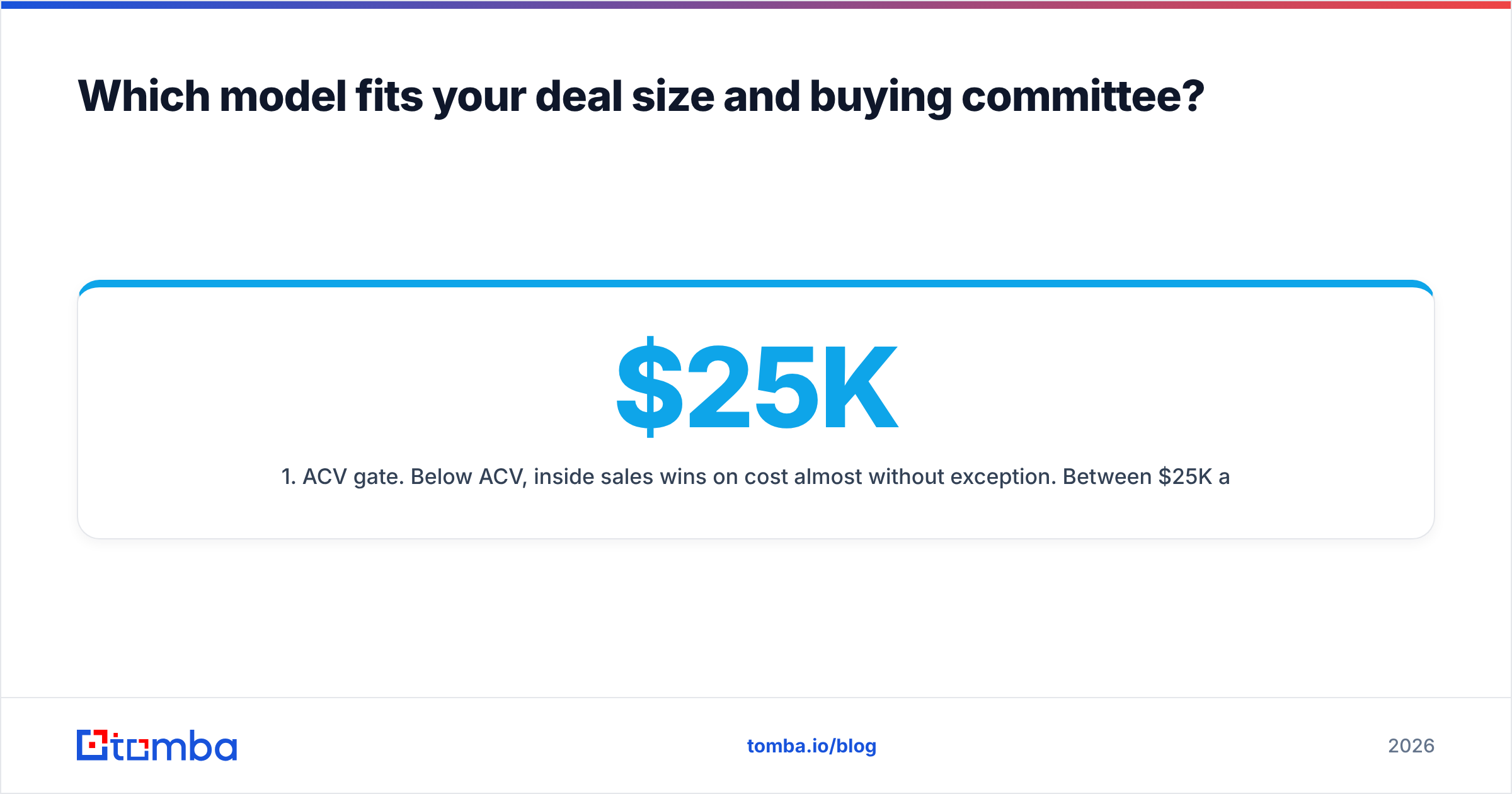
- ACV gate. Below $25K ACV, inside sales wins on cost almost without exception. Between $25K and $75K, run inside with selective field escalation. Above $75K, model both.
- Committee gate. One to three stakeholders is comfortably remote territory. Six or more decision-influencers in regulated or capital-intensive categories tilts toward field.
- Product-tangibility gate. If the buyer needs to touch, walk through, or watch the thing operate, you need a body on site. Software almost never triggers this. Hardware, logistics, and industrial services frequently do.
- Geography gate. Dense metro clusters make field sales viable; a rep can do three meetings in a day. Spread your ICP across six time zones and travel efficiency collapses — inside sales recovers the advantage instantly.
- Incumbent gate. Displacing an entrenched vendor with a multi-year relationship usually requires in-person differentiation at the decision stage, even when everything else in your motion is remote.
Most teams that run this exercise honestly land on hybrid. The question stops being "which model" and becomes "at which stage do we spend travel dollars."
What does a hybrid sales model look like in practice?#
The standard 2026 architecture separates pipeline creation from pipeline conversion:
Stage 1 — Remote prospecting. SDRs work entirely inside. They research accounts, build lists, source verified contact data, and run multi-channel sequences. Nobody travels to generate a first meeting anymore; the cost per meeting makes it indefensible.
Stage 2 — Remote discovery and demo. AEs run discovery and technical demos over video. Recording these calls feeds coaching and gives RevOps the qualification data it needs.
Stage 3 — Selective field escalation. Once an opportunity crosses a defined threshold — deal size, committee count, competitive pressure, or stall duration — the AE or a field specialist gets on a plane. Travel becomes a deliberately allocated resource with an approval gate, not a default behavior.
Stage 4 — Remote expansion. Renewals, upsells, and cross-sells go back inside. The relationship already exists; the cost of maintaining it in person is rarely justified.
This structure depends entirely on the quality of the data feeding Stage 1. A field rep can recover from a bad list by walking into a building. An inside rep cannot — a bounced email or a dead direct dial is simply a wasted slot in the day. That is why teams moving from field to inside usually discover their contact data is far worse than they assumed the moment they try to scale outbound volume.
How do you staff and compensate each model?#
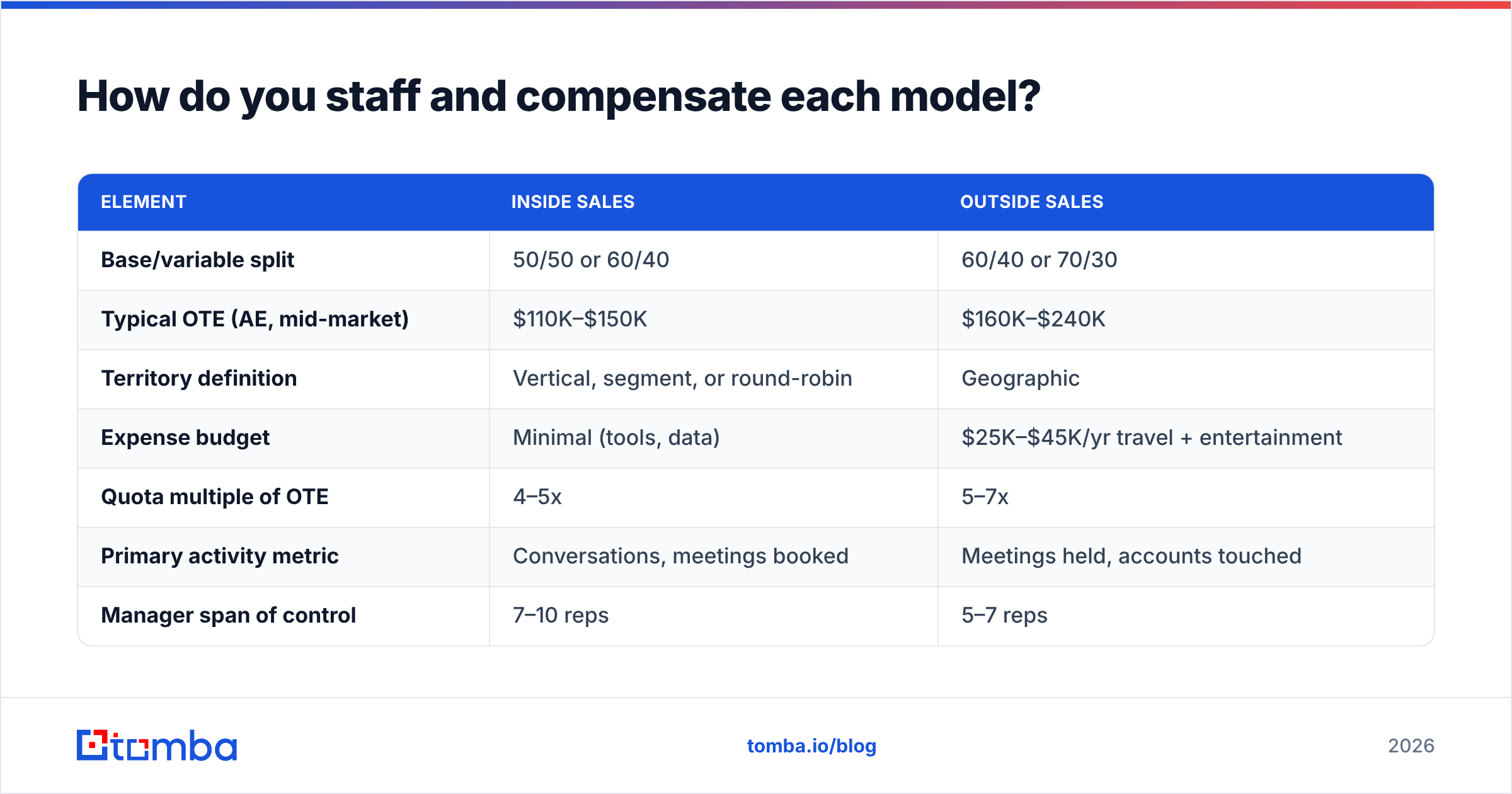
Compensation structures diverge more than most leaders expect.
| Element | Inside sales | Outside sales |
|---|---|---|
| Base/variable split | 50/50 or 60/40 | 60/40 or 70/30 |
| Typical OTE (AE, mid-market) | $110K–$150K | $160K–$240K |
| Territory definition | Vertical, segment, or round-robin | Geographic |
| Expense budget | Minimal (tools, data) | $25K–$45K/yr travel + entertainment |
| Quota multiple of OTE | 4–5x | 5–7x |
| Primary activity metric | Conversations, meetings booked | Meetings held, accounts touched |
| Manager span of control | 7–10 reps | 5–7 reps |
Two structural notes. First, field reps carry higher quota multiples because their cost base is higher — if you set a field rep's quota at an inside multiple, you are running the territory at a loss. Second, manager span is narrower in field because coaching requires ride-alongs rather than call reviews, which is a genuine hidden cost when you model a field org.
For deeper definitions on the surrounding metrics, the win rate and response rate entries in the B2B glossary give you the formulas most comp plans get subtly wrong.
Does inside sales actually convert worse than field sales?#
Not per opportunity — per stage. This distinction matters.
Inside sales typically shows a lower close rate on qualified opportunities (18–25% vs 25–40%), but that comparison is contaminated. Inside teams generate far more opportunities, including marginal ones a field rep would never have driven two hours to pursue. Normalize for opportunity quality and the gap narrows dramatically.
Where field genuinely outperforms is in late-stage momentum. Deals that stall at the proposal or legal stage un-stall faster when someone shows up. Several enterprise sales organizations track "stalled-deal rescue rate" separately for this reason, and it is one of the few metrics where in-person visits produce an unambiguous lift.
Where inside genuinely outperforms is in speed to first meeting and coverage. An inside team can touch 10x the accounts in a quarter. When your TAM is large and fragmented, coverage beats depth.
The practical implication: measure both models on pipeline generated per dollar and revenue closed per dollar separately. Teams that only measure the second one systematically over-invest in field, because field looks efficient when you ignore how much cheap inside-sourced pipeline it was handed.
What infrastructure does each model require?#
Field sales runs on relationships and calendars. Inside sales runs on data. That is the single largest operational difference, and it is where inside-sales transitions fail.
An inside team needs, at minimum:
- Accurate contact data. Verified work emails and direct dials. A 30% bounce rate does not just waste sends — it damages sender reputation and eventually your whole domain's deliverability.
- List-building at the account level. You need every relevant contact at a target company, not one name scraped from a conference badge. A domain search that returns the full contact map of an account is the inside-sales equivalent of a field rep's building directory.
- Verification before send. Every address checked before it enters a sequence. An email verifier belongs upstream of the sequencer, not after the bounces arrive.
- Enrichment into the CRM. Titles, seniority, company size, and technographics so reps prioritize instead of dialing alphabetically.
- Conversation intelligence. Recording and transcription so managers coach from evidence.
Vendors publish honest comparisons of this tooling layer — G2's sales intelligence category is a reasonable starting point for evaluating options against verified user reviews rather than vendor claims. For CRM-side process design, HubSpot's sales resources cover the pipeline-stage mechanics in depth.
Field sales needs far less of this, which is precisely why field orgs transitioning to inside underestimate the budget. They move the headcount and forget to move the data spend. Six months later, quota attainment has dropped and nobody can explain why — the reps are fine, the list is not.
Which model should you run in 2026?#
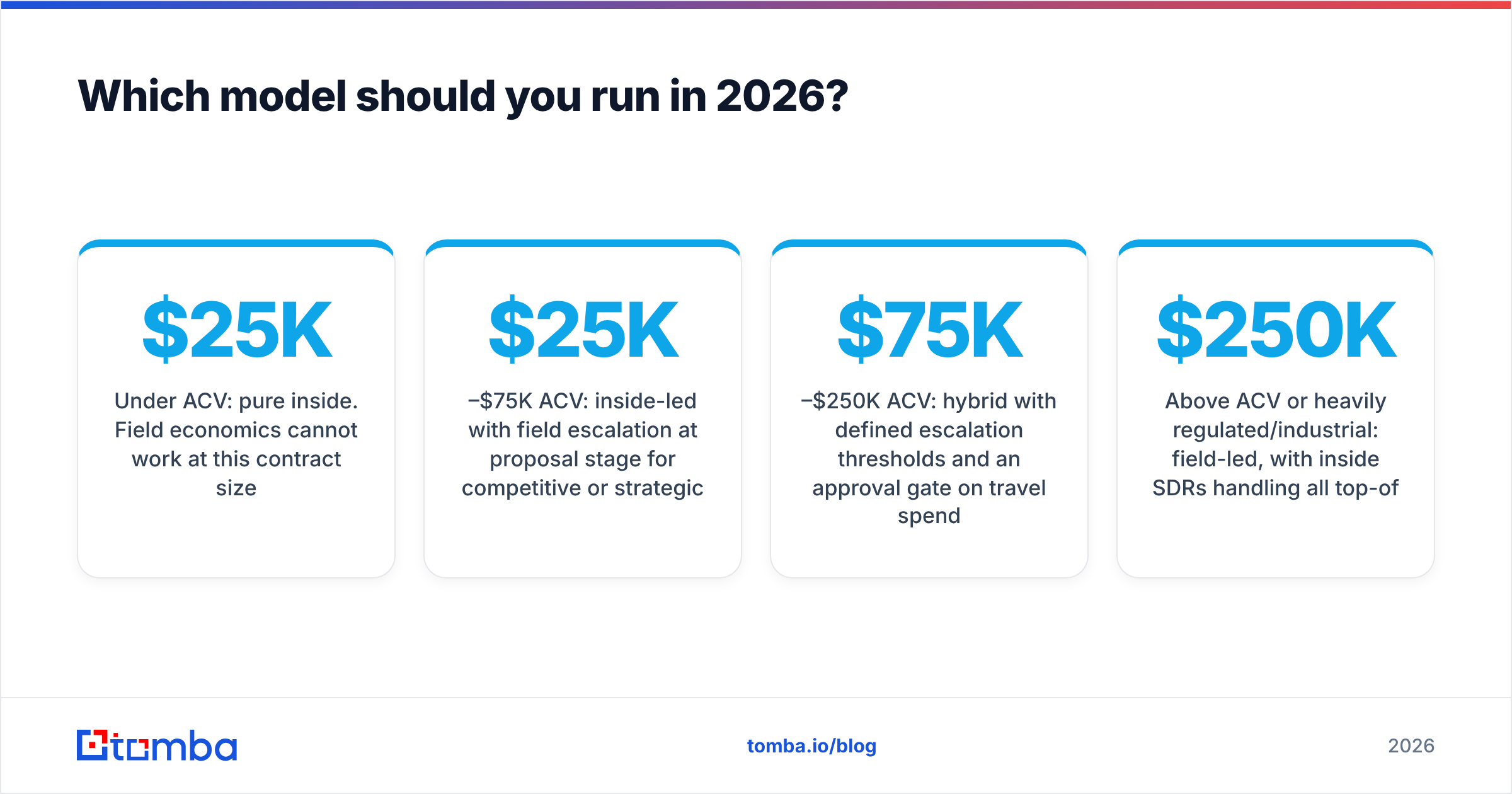
Run inside as the default and treat field travel as a funded exception.
Concretely:
- Under $25K ACV: pure inside. Field economics cannot work at this contract size.
- $25K–$75K ACV: inside-led with field escalation at proposal stage for competitive or strategic accounts.
- $75K–$250K ACV: hybrid with defined escalation thresholds and an approval gate on travel spend.
- Above $250K ACV or heavily regulated/industrial: field-led, with inside SDRs handling all top-of-funnel so field reps never prospect cold.
Whatever mix you choose, the top of the funnel stays remote. No serious organization sends field reps to source first meetings in 2026 — the cost per meeting is 8–10x the inside equivalent for the same outcome. That means your inside infrastructure has to be correct regardless of which model you claim to run.
Start with the data layer, because it is the cheapest thing to fix and the most expensive thing to get wrong. Tomba's Email Finder gives your inside team verified professional email addresses by name, domain, or company, with a free tier of 25 searches a month to test accuracy against your own ICP before committing. Paid plans start at $49/mo (Starter), $99/mo (Growth), and $249/mo (Pro) — see Tomba pricing for credit allocations. Run 50 known-good contacts through it, measure the hit rate, and let the number decide whether your current provider is worth renewing.
Related guides#
// get started
Find, verify and enrich your first contacts today
Start on the free plan with 25 searches a month, then scale when your team is ready.
Free plan · No credit card required · GDPR & CCPA
// about the author