Insight Selling: The 2026 Playbook for B2B Sales Teams
Solution selling stopped working the moment buyers could research you without talking to you. Insight selling is what replaced it — here's how it actually works, with scripts, research workflows, and the data sources that make it possible.
TL;DR
- Insight selling means leading with a point of view the buyer did not already have, instead of asking discovery questions they have answered four times this quarter.
- It works because 70%+ of the buying process now happens before a rep is involved — by the time you show up, "let me understand your challenges" is redundant.
- The hard part is not the framework. It's sourcing enough accurate company and contact data to say something specific at scale.
- Insight selling beats solution selling on complex, multi-stakeholder deals. It underperforms on transactional, price-driven purchases.
- A realistic stack: a trigger source (hiring, funding, tech stack), a data layer to find the right person, and a writing process that ties the trigger to a business consequence.
What Is Insight Selling?#
Insight selling is a sales approach where you open with a perspective the buyer cannot get from your website, your competitor's website, or a G2 review page. You teach them something about their own business, then connect that teaching to a decision they need to make.
Think of it like a doctor versus a waiter. A waiter asks what you want and brings it. A doctor looks at your chart, tells you something you didn't know about your own body, and then recommends a course of action. Solution selling made reps into very good waiters. Insight selling asks them to be doctors.
Technically, the approach traces back to research published by CEB (now part of Gartner) in The Challenger Sale, and to parallel work from the RAIN Group on what separates top performers from average ones. Both studies landed on the same uncomfortable finding: the reps who won the most complex deals were not the ones who built the best rapport. They were the ones who reframed how the buyer understood their problem.
The core mechanic has three parts:
- A trigger — something observable and recent about the account. A funding round, a new VP of Engineering, a shift from Segment to RudderStack, three open SDR roles posted in the last 14 days.
- An implication — the consequence of that trigger that the buyer has probably not modeled yet. "You hired three SDRs; your current data provider charges per seat, so your data cost just went up 60% before a single new meeting is booked."
- A resolution path — what other companies in that exact position did, and what it cost them to do it.
Miss any one of the three and you're back to spam. A trigger alone is stalking ("I saw you raised a Series B, congrats!"). An implication alone is a lecture. A resolution alone is a pitch.
Why Did Solution Selling Stop Working?#
Solution selling assumed the seller held information the buyer wanted. In 1995, that was true. A rep genuinely knew more about ERP implementations than the manufacturing director they were calling.
That asymmetry is gone. Buyers self-educate through vendor docs, Reddit threads, peer Slack groups, analyst reports, and free trials. Gartner's B2B buying research has consistently found that buyers spend the majority of their journey in independent research — a small minority of total buying time is spent with any one vendor's sales team.
So when a rep opens with "Tell me about your current process," the buyer hears: you did not do your homework, and now you want me to do it for you.
Three specific failure modes of solution selling in 2026:
- Discovery fatigue. A buyer evaluating six vendors answers the same eight questions six times. The seventh rep who asks them is memorable only in a bad way.
- Consensus buying. The average enterprise purchase now involves a buying group of roughly 6–10 people. Solution selling optimizes for one champion. Insight selling optimizes for arming that champion with an argument they can repeat in a room you'll never enter.
- Feature parity. In most categories, three vendors do 90% of the same things. Differentiation has moved from the product to the quality of the thinking around it.

Insight Selling vs Solution Selling vs Consultative Selling: What's the Difference?#
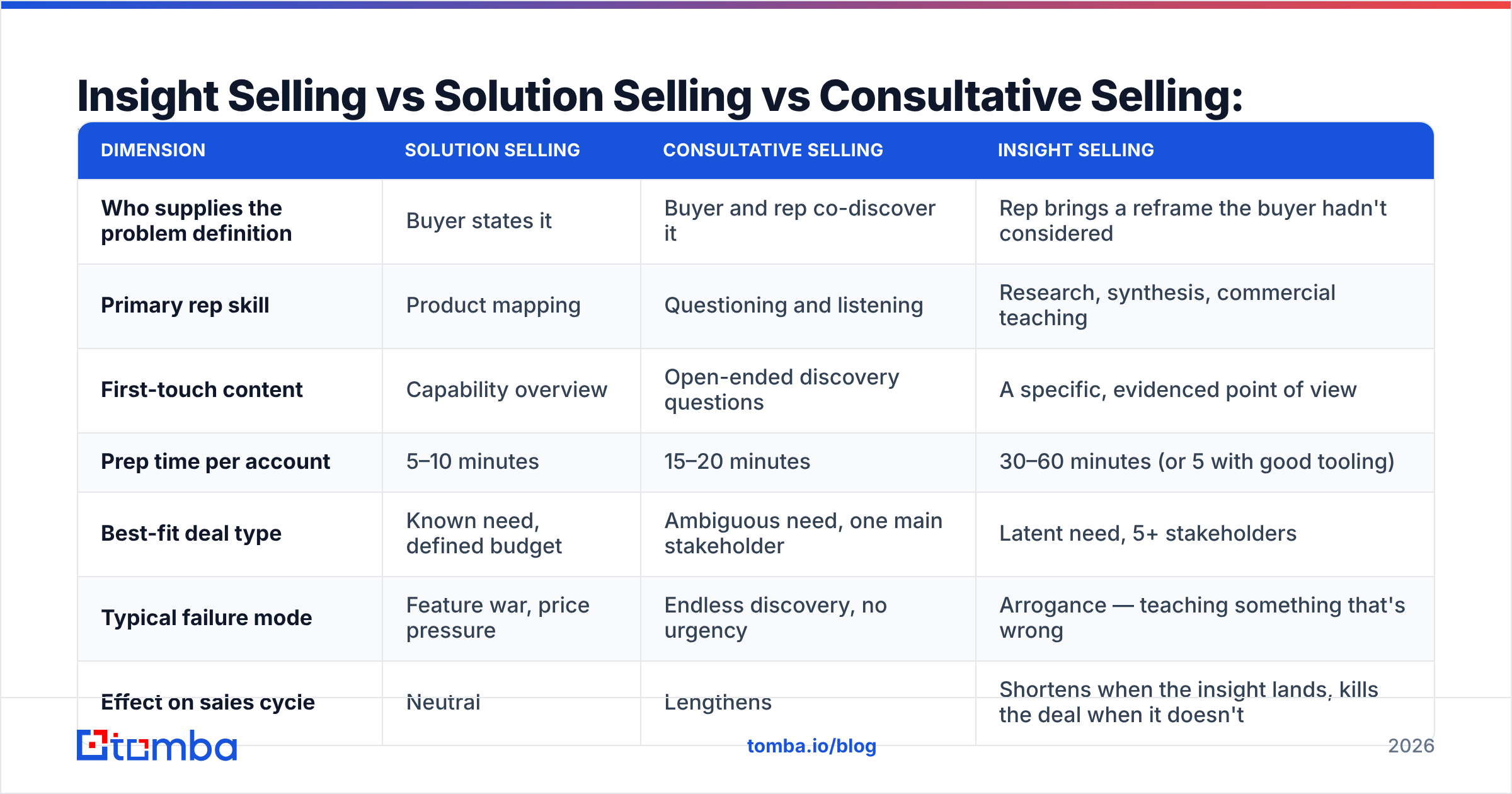
These three get used interchangeably in job descriptions, which is why nobody can tell them apart. They are meaningfully different in where the information originates.
| Dimension | Solution Selling | Consultative Selling | Insight Selling |
|---|---|---|---|
| Who supplies the problem definition | Buyer states it | Buyer and rep co-discover it | Rep brings a reframe the buyer hadn't considered |
| Primary rep skill | Product mapping | Questioning and listening | Research, synthesis, commercial teaching |
| First-touch content | Capability overview | Open-ended discovery questions | A specific, evidenced point of view |
| Prep time per account | 5–10 minutes | 15–20 minutes | 30–60 minutes (or 5 with good tooling) |
| Best-fit deal type | Known need, defined budget | Ambiguous need, one main stakeholder | Latent need, 5+ stakeholders |
| Typical failure mode | Feature war, price pressure | Endless discovery, no urgency | Arrogance — teaching something that's wrong |
| Effect on sales cycle | Neutral | Lengthens | Shortens when the insight lands, kills the deal when it doesn't |
Note the last row. Insight selling is higher variance. A wrong insight delivered confidently is worse than a boring discovery call, because it tells the buyer you don't understand their business while claiming that you do. That risk is entirely a data-quality problem, which we'll get to.
What Does an Insight-Led Outreach Sequence Actually Look Like?#
Here is a real structure you can copy. Assume you sell a data/enrichment platform and your trigger is "company posted 3+ SDR roles in the last 30 days."
Touch 1 — the reframe (email)
Subject: your 3 new SDR reqs
Saw the three SDR openings on the careers page. Most teams that scale SDR headcount this fast hit the same wall around month two: the data budget scales linearly with seats, but meetings don't, because new reps burn through credits learning what a good-fit account looks like.
Two ways teams handle it — pooled credits across the team instead of per-seat, or gating new reps to verified-only lookups for their first 30 days.
Worth 12 minutes to walk through what the second one looked like at [comparable company]? Either way, the pooled-credit thing is worth checking with whoever owns your current contract.
Notice: the email is useful if they never reply. That's the test. If deleting your product from the email makes it worthless, it isn't insight selling.
Touch 2 — the proof (3 days later)
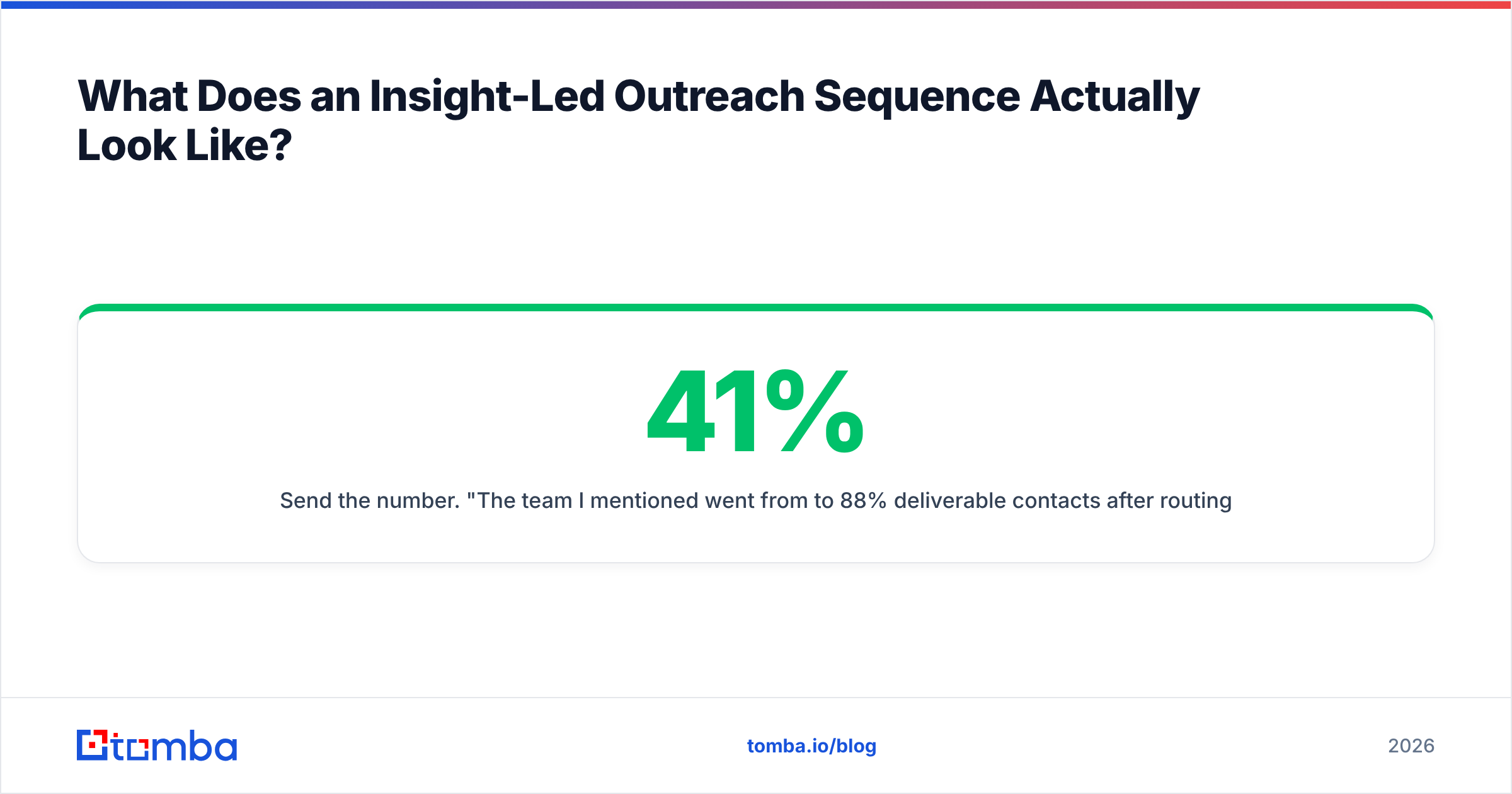
Send the number. "The team I mentioned went from 41% to 88% deliverable contacts after routing everything through verification first. Their bounce rate fell below 2%, which is what kept the new reps' domains alive through ramp." Concrete, attributable, falsifiable.
Touch 3 — the stakeholder widen (7 days later)
Go to the RevOps or marketing ops person, not another AE-adjacent title. Reference the first email explicitly. Buying groups are wide; insight selling only pays off when the insight circulates.
Touch 4 — the graceful exit
Closing the loop on this. If the credit-per-seat math isn't a problem for you, it isn't a problem — happy to be wrong. Sending over the one-page breakdown anyway in case it's useful for the Q1 renewal conversation.
Exits that leave something behind get more replies than exits that guilt. If you want a starting point for the copy itself, our library of cold email templates has structures you can bend into this shape, and the subject line tester will tell you whether "your 3 new SDR reqs" beats whatever you were going to write.
Where Do You Actually Find Insights at Scale?#
This is where most insight-selling initiatives die. The framework is easy to teach in a Tuesday enablement session and impossible to sustain on Wednesday, because a rep with 40 accounts cannot hand-research each one for an hour.
The fix is to industrialize the trigger layer. Five sources that reliably produce insights, ranked by signal-to-noise:
- Job postings. The highest-density signal in B2B. Roles reveal budget, roadmap, tooling (JD requirements list the stack), and org gaps. Three postings for the same function means a re-org or a scale event.
- Tech stack changes. A company adding, dropping, or migrating tools has an active project with an owner and a deadline. A website tech stack checker turns this into a repeatable step instead of a hunch.
- Funding and leadership changes. Low uniqueness — every vendor sees the same TechCrunch post — so these only work when paired with a second-order implication nobody else is drawing.
- Public commitments. Earnings calls, investor decks, conference talks. An executive who said "we're going upmarket in FY26" on a podcast has publicly committed to a set of problems.
- Product and pricing changes. A new tier, a new region, a deprecated feature. Each one implies a GTM motion that needs support.
Once you have the trigger, you still need the human. That's the unglamorous half: knowing that the VP of RevOps at a 300-person company is the right reframe target, then actually reaching her. This is where an email finder and a reliable email verifier stop being commodity tools and start being the difference between an insight that lands in an inbox and one that bounces.

How Do You Measure Whether Insight Selling Is Working?#
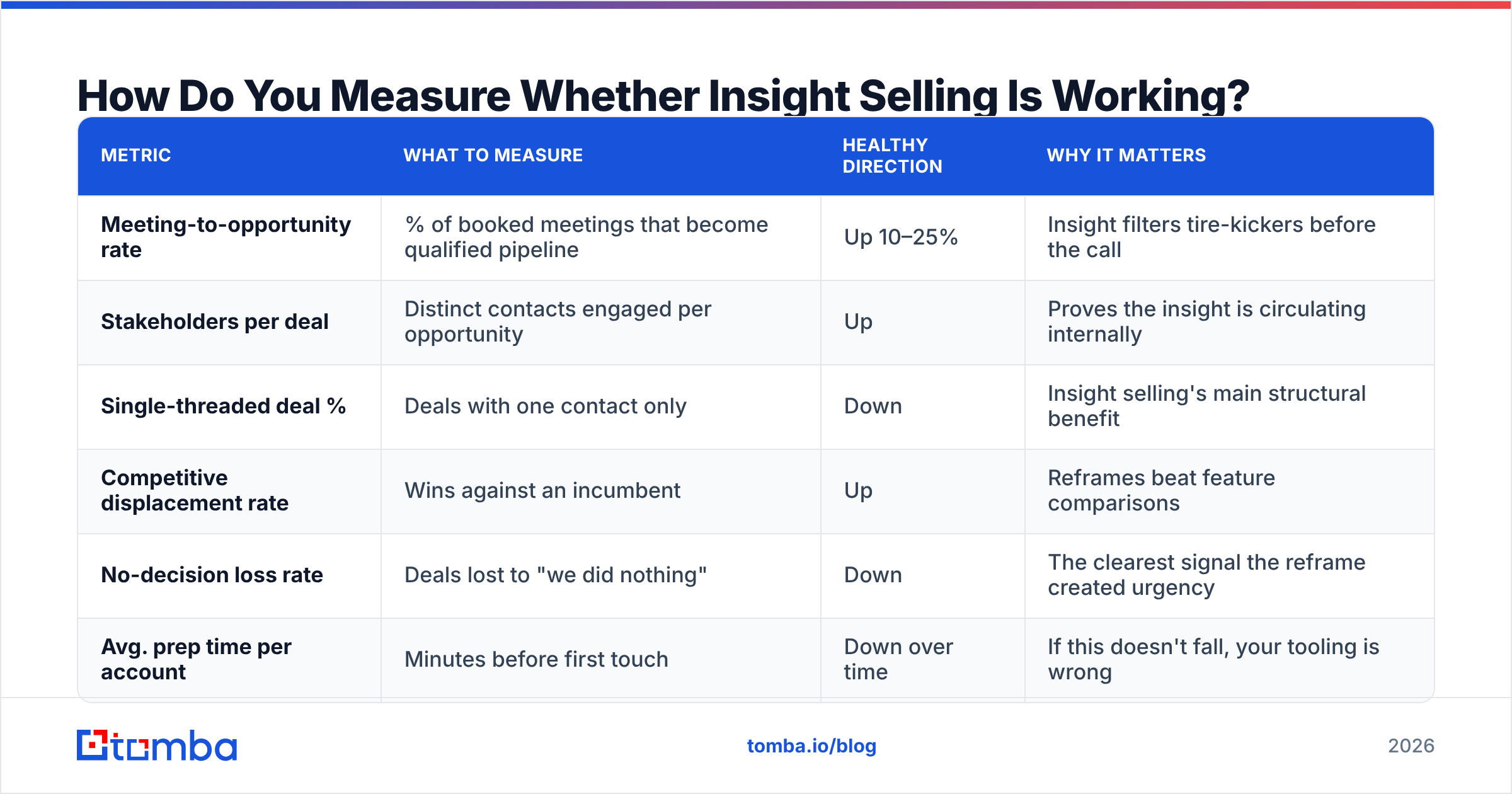
Reply rate is the wrong first metric. Insight selling often lowers raw reply volume while raising the quality of what replies. Track these instead:
| Metric | What to measure | Healthy direction | Why it matters |
|---|---|---|---|
| Meeting-to-opportunity rate | % of booked meetings that become qualified pipeline | Up 10–25% | Insight filters tire-kickers before the call |
| Stakeholders per deal | Distinct contacts engaged per opportunity | Up | Proves the insight is circulating internally |
| Single-threaded deal % | Deals with one contact only | Down | Insight selling's main structural benefit |
| Competitive displacement rate | Wins against an incumbent | Up | Reframes beat feature comparisons |
| No-decision loss rate | Deals lost to "we did nothing" | Down | The clearest signal the reframe created urgency |
| Avg. prep time per account | Minutes before first touch | Down over time | If this doesn't fall, your tooling is wrong |
The last row is the operational canary. Month one, prep should be slow — reps are learning to think this way. If prep time is still 45 minutes per account in month four, the program will quietly revert to templates the moment quota pressure hits.
What Are the Common Ways Insight Selling Fails?#
You confuse "insight" with "statistic you googled." Quoting a McKinsey number about digital transformation is not an insight. It's not about their company, and the buyer has seen it in four other emails this month.
Your data is wrong, so your confidence reads as incompetence. Telling a prospect they're hiring three SDRs when the reqs were filled in March destroys credibility in a single sentence. Insight selling raises the cost of bad data because you're explicitly claiming to know something. Verify before you assert — check company patterns with a domain search and confirm deliverability before the send, not after.
You teach without a commercial hook. A genuinely interesting observation that leads nowhere near your product generates polite replies and zero pipeline. The insight must be one your solution is uniquely positioned to resolve.
You skip the buying group. One person who finds your insight compelling but can't repeat it accurately in a room of nine is a dead deal with good vibes.
You use it on the wrong deals. If someone has a signed budget, a defined spec, and a 30-day timeline, do not reframe their problem. Sell them the thing. Insight selling is for latent need, not active need.
Which Tools Support an Insight-Led Motion?#
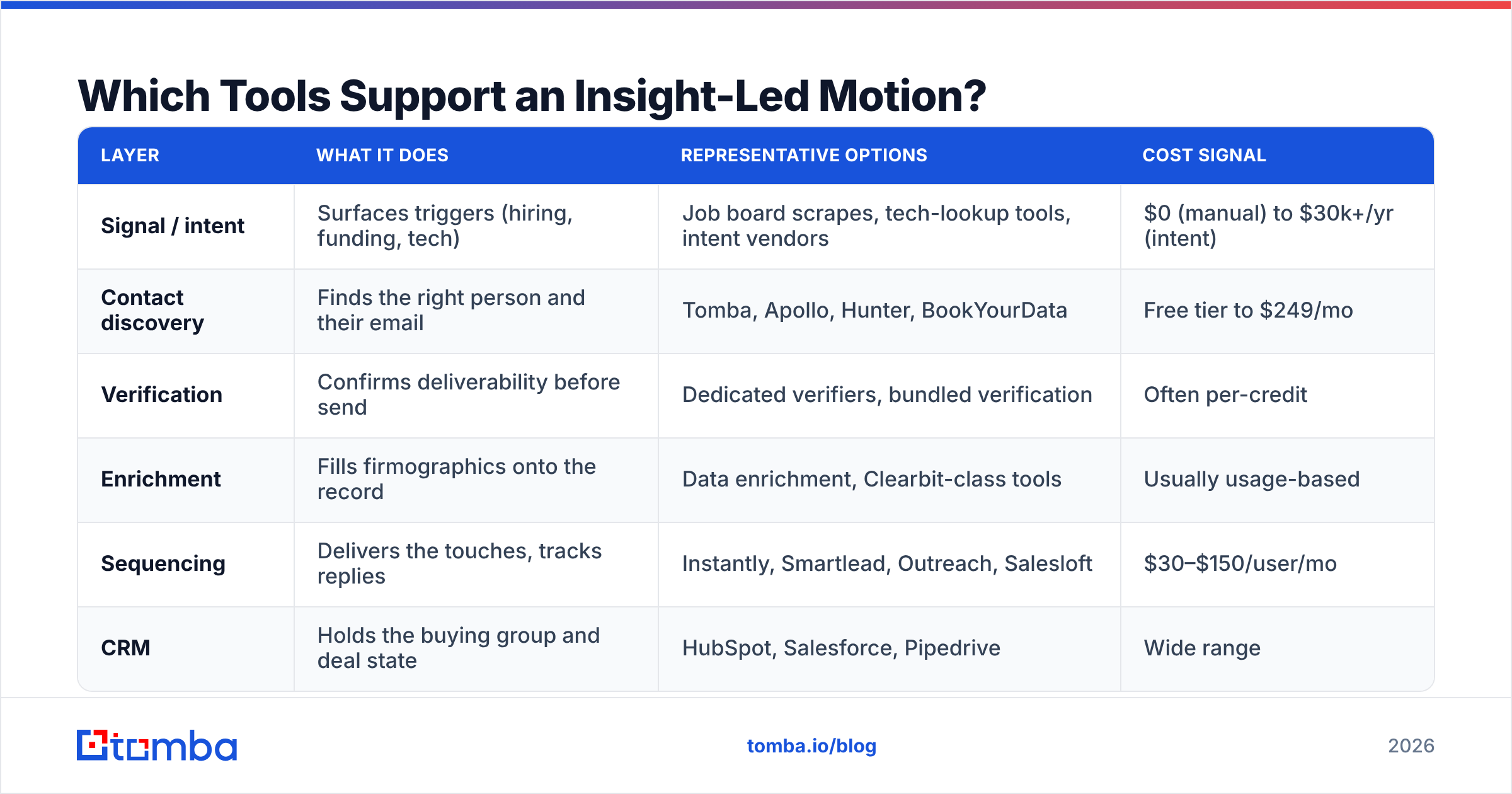
There's no single "insight selling platform." What you need is a chain: signal → account → person → verified contact → sequenced message. Different vendors own different links.
| Layer | What it does | Representative options | Cost signal |
|---|---|---|---|
| Signal / intent | Surfaces triggers (hiring, funding, tech) | Job board scrapes, tech-lookup tools, intent vendors | $0 (manual) to $30k+/yr (intent) |
| Contact discovery | Finds the right person and their email | Tomba, Apollo, Hunter, BookYourData | Free tier to $249/mo |
| Verification | Confirms deliverability before send | Dedicated verifiers, bundled verification | Often per-credit |
| Enrichment | Fills firmographics onto the record | Data enrichment, Clearbit-class tools | Usually usage-based |
| Sequencing | Delivers the touches, tracks replies | Instantly, Smartlead, Outreach, Salesloft | $30–$150/user/mo |
| CRM | Holds the buying group and deal state | HubSpot, Salesforce, Pipedrive | Wide range |
A note on cost discipline: insight selling sends fewer emails to better-researched accounts. That changes the economics of your data spend. If you're sending 200 highly-researched emails a month instead of 8,000 sprayed ones, you don't need an enterprise seat — you need accuracy. Tomba's pricing starts at a free tier with 25 searches/month, with Starter at $49/mo and Growth at $99/mo; BookYourData's prepaid-credit model suits teams who want to buy list volume outright without a subscription. Both are reasonable, and which is better depends entirely on whether your motion is depth-first or volume-first.
For teams already living in a spreadsheet, the Google Sheets add-on and the Tomba API let you attach the contact-discovery step directly to whatever trigger list your ops person is already maintaining, which is usually the fastest path from "we should do insight selling" to "we are doing insight selling."
How Do You Roll This Out Without the Team Reverting in Six Weeks?#
Insight selling fails as a mandate and succeeds as a constraint. Some practical rollout rules:
- Start with one segment, not the whole territory. Pick the 50 accounts where you have the strongest point of view. Prove the meeting-to-opportunity lift there.
- Build a trigger library, not a script library. Give reps 8–10 reusable implications ("if they're hiring X, then Y breaks"), not 8–10 email templates. Templates get copy-pasted; implications get thought about.
- Make prep time a tracked, funded activity. If a rep's activity metric is 80 emails/day, insight selling is structurally impossible. Change the metric or don't run the program.
- Review the insight, not the email. In pipeline reviews, ask "what did you tell them that they didn't know?" before asking about next steps.
- Kill it fast on transactional segments. Not every deal deserves an hour of thinking. Segment ruthlessly.
One more thing worth saying plainly: insight selling is a real advantage that erodes as adoption spreads. When every rep in your category is reframing, reframing stops being differentiating and the advantage moves back to execution — response speed, data accuracy, follow-through. Build the muscle now, but don't mistake it for a permanent moat. Watching your response rate by segment over time will tell you when that erosion starts.
Where Should You Start This Week?#
Pick 25 accounts. For each one, spend ten minutes finding a single observable trigger and writing one sentence about what it implies for their business. Then find the one person for whom that implication is a job-performance problem, not a curiosity. Send 25 emails. Compare the meeting-to-opportunity rate against your last 250 sprayed sends.
That test costs you an afternoon and settles the argument internally better than any deck.
The step most teams stumble on is the last mile — you've identified the account and the role, and now you need an address that actually resolves. Tomba's Email Finder handles that part: search by domain, name, or company, with verification built into the same workflow so your carefully-researched insight doesn't die at the SMTP layer. The free tier gives you 25 searches a month, which is enough to run the 25-account test above without a credit card. If it works, Starter at $49/mo covers a full rep's monthly volume under this motion — because the whole point of insight selling is that you need fewer, better contacts, not more of them.
Related guides#
// get started
Find, verify and enrich your first contacts today
Start on the free plan with 25 searches a month, then scale when your team is ready.
Free plan · No credit card required · GDPR & CCPA
// about the author