Inspiration for Sales Team: 12 Tactics That Actually Work
Pizza parties don't fix a flat quarter. Here are 12 tested ways to rebuild inspiration for your sales team — from pipeline hygiene to recognition systems that survive a bad month.
TL;DR
- Inspiration for a sales team is an output, not an input. Reps get inspired when the job feels winnable — clean data, realistic quota, visible progress — not when someone reads them a quote.
- The single biggest demotivator in most B2B teams isn't comp. It's wasted effort: bad contact data, bounced sends, and dead pipeline that was never qualified.
- Recognition works when it is specific, frequent, and tied to behavior a rep controls. "Top closer" awards only motivate the one person who was going to win anyway.
- Build a motivation stack: activity you control → leading indicators → ritual recognition → comp. Fix it bottom-up when the number slips.
- Tooling matters more than managers admit. A rep who spends 11 hours a week hunting for contact details is not going to be inspired by a Monday huddle.
Why does sales team inspiration keep collapsing?#
Because most teams treat inspiration as a communication problem when it is almost always a systems problem.
Think of it like a gym membership. Nobody quits the gym because the motivational poster in the lobby wasn't good enough. They quit because the machines are broken, the commute is 40 minutes, and after six weeks nothing in the mirror changed. Sales is the same. Reps don't disengage because leadership stopped believing in them. They disengage because effort stopped producing visible results.
That gap between effort and result has a name in most CRMs: it's the 30-40% of dials and emails that never reach a human. Gartner's research on seller burnout consistently points at administrative drag and unclear expectations, not compensation, as the top drivers of turnover intent. When you interview reps who are checked out, you hear the same three sentences:
- "I don't know if what I'm doing is working." — no leading indicators, only lagging quota.
- "Half my list is garbage." — data quality problem disguised as an effort problem.
- "It doesn't matter what I do, the number is the number." — quota set without rep input, no partial credit for progress.
None of those are fixed by a speech.
What actually creates inspiration for a sales team?#
Four layers, stacked bottom to top. When morale drops, diagnose from the bottom.
- Winnable inputs. The rep controls calls, emails, meetings booked, and research depth. If the inputs themselves are broken — bad emails, no phone numbers, no context — nothing above this layer matters.
- Visible leading indicators. Meetings set, opportunities created, multi-threaded accounts. These move weekly, so reps get feedback fast enough to correct course.
- Ritual recognition. Small, frequent, specific. Weekly, not quarterly. Behavior-based, not outcome-based.
- Compensation and career path. Real, but slow. Comp fixes motivation on a 12-month cycle; the other three fix it on a 7-day cycle.
Most sales leaders jump straight to layer 4 — spiffs, accelerators, a new comp plan — because it feels decisive. It's also the most expensive lever with the longest lag. HubSpot's sales research repeatedly shows reps citing "too much time on non-selling activity" ahead of pay as a frustration. Start at layer 1.
Which motivation tactics hold up, and which are theater?#
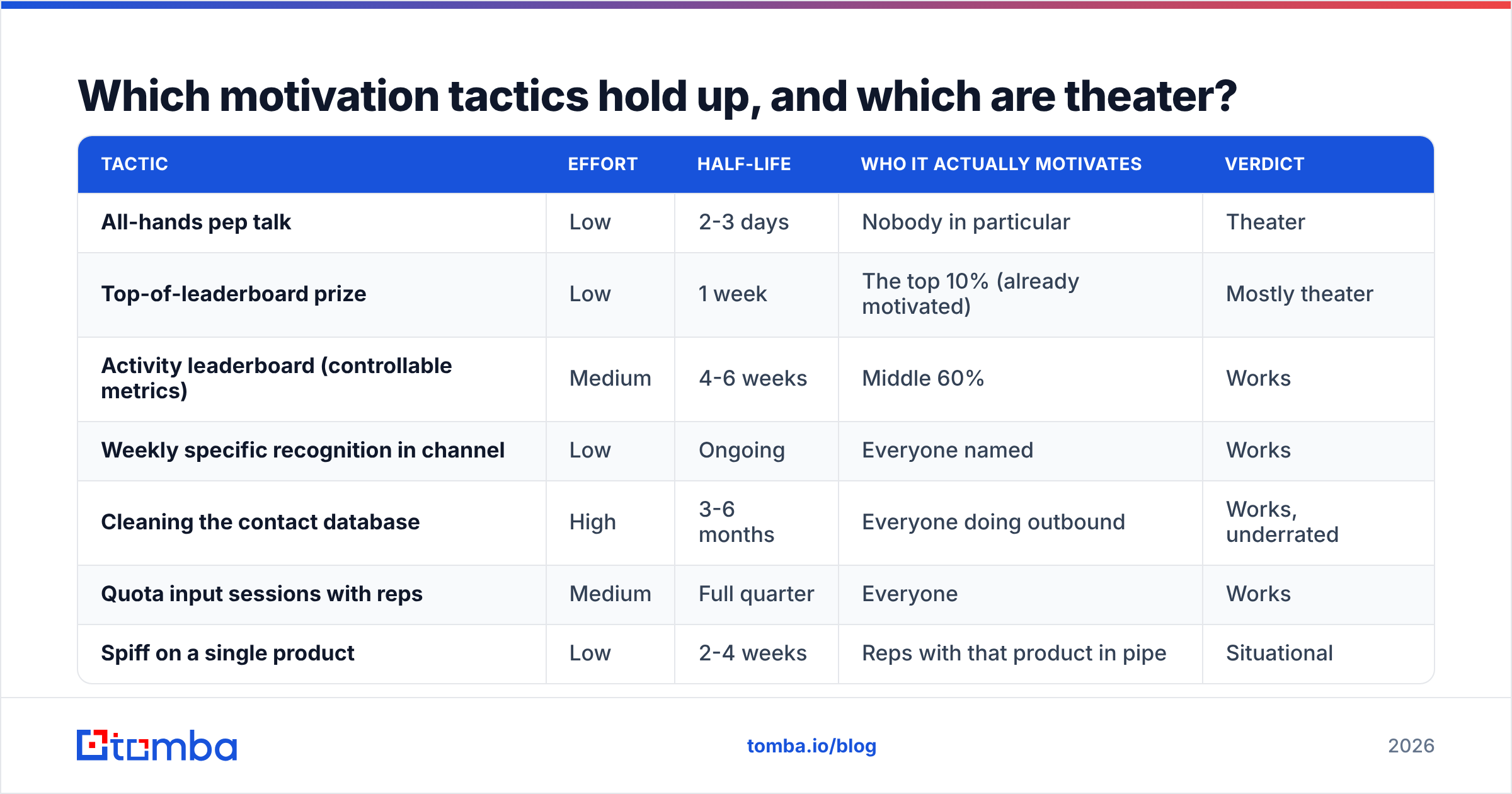
Here's an honest sort. "Effort" is manager hours to implement. "Half-life" is roughly how long the effect lasts before it decays.
| Tactic | Effort | Half-life | Who it actually motivates | Verdict |
|---|---|---|---|---|
| All-hands pep talk | Low | 2-3 days | Nobody in particular | Theater |
| Top-of-leaderboard prize | Low | 1 week | The top 10% (already motivated) | Mostly theater |
| Activity leaderboard (controllable metrics) | Medium | 4-6 weeks | Middle 60% | Works |
| Weekly specific recognition in channel | Low | Ongoing | Everyone named | Works |
| Cleaning the contact database | High | 3-6 months | Everyone doing outbound | Works, underrated |
| Quota input sessions with reps | Medium | Full quarter | Everyone | Works |
| Spiff on a single product | Low | 2-4 weeks | Reps with that product in pipe | Situational |
| Mandatory fun (happy hour, offsite) | Medium | 3 days | Extroverts | Theater |
| Deal-review coaching (1:1, weekly) | High | Ongoing | Middle and bottom | Works, best ROI |
| Public quota-miss callouts | Low | Negative | Nobody | Actively harmful |
The pattern: anything that narrows the gap between what a rep does today and what they learn today survives. Anything that only celebrates the already-winning decays inside a week.
How do you make recognition land instead of bounce?#
Specific, fast, and about behavior the rep chose.
Compare these two messages in a team Slack channel:
"Huge shoutout to Dana for crushing it this month!"
"Dana found the VP of Ops wasn't the buyer at Northwind, re-researched, and got the CFO on a call in 48 hours. That save is why the deal is in commit."
The first one is noise — it tells the other nine reps nothing they can copy. The second one is a free training session that also happens to be praise. It names a decision, not a result, so every other rep on the team learns a repeatable move.
Three rules that make this work in practice:
- Recognize within 72 hours. Praise decays faster than feedback.
- Name one behavior, not a general vibe. "Multi-threaded three contacts before the demo" beats "great hustle."
- Rotate who gets named. If the same two names appear every week, the other eight stop reading the channel.
Does data quality really affect morale that much?#
Yes — more than almost any soft lever, and it's the least discussed.
Run the math on a rep doing 60 outbound emails a day. At a 25% bounce rate, 15 of those sends never land. Over a month, that's roughly 300 dead sends — a full week of work producing literally nothing, plus a sender reputation hit that quietly suppresses the other 45. The rep experiences this as "outbound doesn't work anymore." The actual problem is a list.
You can watch morale track data quality almost linearly. A team working a verified list sees replies, and replies are the fuel. A team working a scraped list from 2023 sees silence, concludes the market is dead, and starts updating their LinkedIn.
Practical fixes, in order of impact:
- Verify before you send. Running a list through an email verifier before a sequence launch removes the bounce tax entirely. It costs minutes.
- Enrich, don't guess. Missing job titles and company context force reps to write generic copy. Contact enrichment fills the gaps so personalization is a 30-second task, not a 10-minute one.
- Find contacts at the account, not just the lead. When a champion goes quiet, a rep with a domain search can find three other people at that company in under a minute instead of writing the deal off.
- Give reps phone options. A phone finder turns a stalled email thread into a conversation.
None of this is glamorous. All of it does more for weekly morale than a quarterly kickoff.
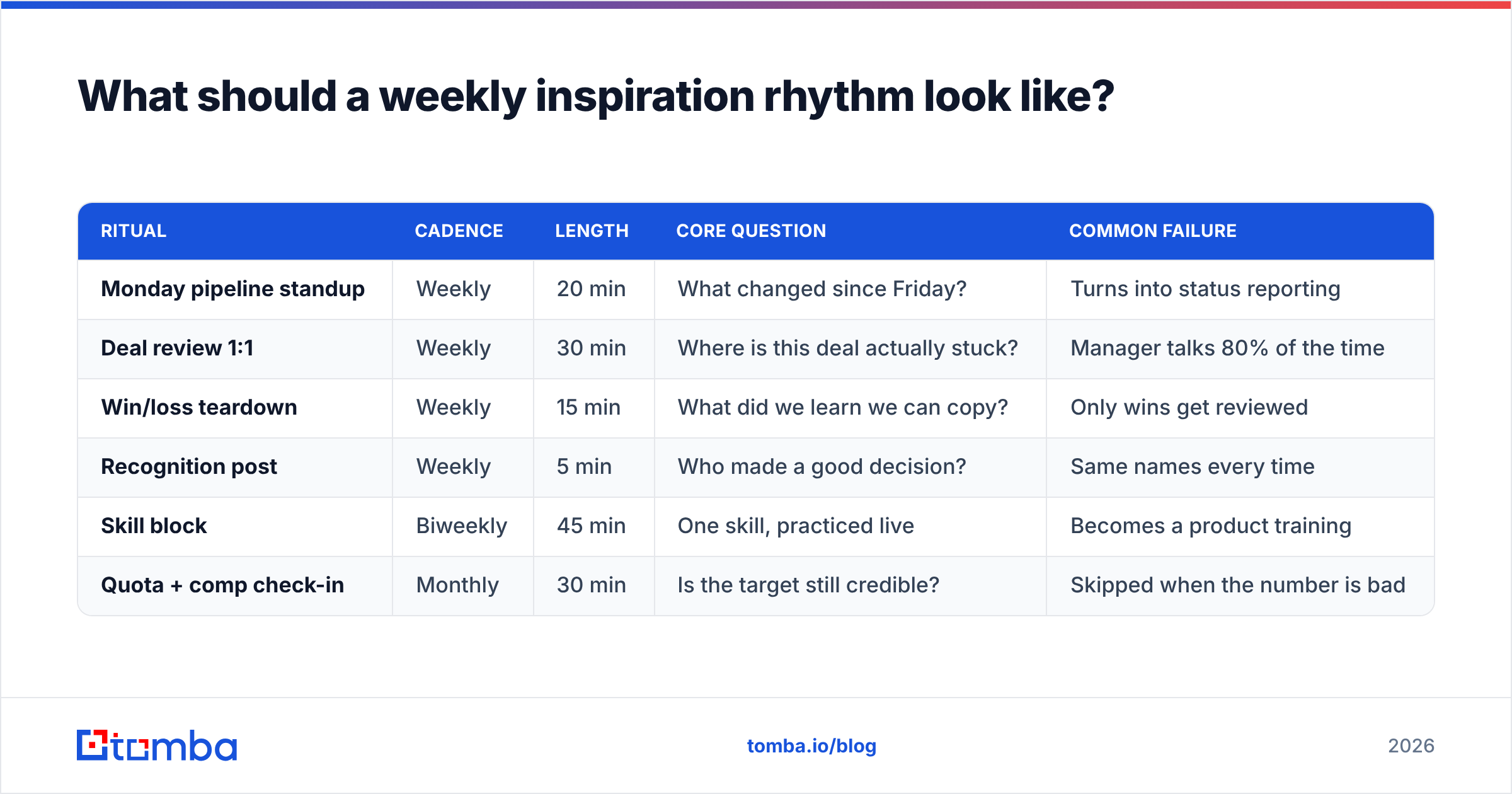
What should a weekly inspiration rhythm look like?#
A cadence beats an event. Here's a structure that holds up across SDR and AE teams of 5-30 people.
| Ritual | Cadence | Length | Core question | Common failure |
|---|---|---|---|---|
| Monday pipeline standup | Weekly | 20 min | What changed since Friday? | Turns into status reporting |
| Deal review 1:1 | Weekly | 30 min | Where is this deal actually stuck? | Manager talks 80% of the time |
| Win/loss teardown | Weekly | 15 min | What did we learn we can copy? | Only wins get reviewed |
| Recognition post | Weekly | 5 min | Who made a good decision? | Same names every time |
| Skill block | Biweekly | 45 min | One skill, practiced live | Becomes a product training |
| Quota + comp check-in | Monthly | 30 min | Is the target still credible? | Skipped when the number is bad |
Two notes on running these. First, the win/loss teardown must include losses or the team learns nothing and the ritual becomes a victory lap. Second, the monthly quota check-in is the one everyone cancels when things go badly — which is precisely when it matters. A rep who believes the target is impossible has already stopped trying; you need to know that in week 3, not week 11.
How do you motivate the middle 60%?#
Stop optimizing for the top.
Leaderboards ranked purely on closed revenue motivate the person in position one and demoralize positions four through ten. The fix isn't to kill leaderboards — it's to rank on things the middle can actually move this week.
Try ranking on:
- Meetings booked from self-sourced accounts — rewards prospecting effort, not territory luck.
- Accounts multi-threaded (3+ contacts engaged) — a controllable behavior that correlates with win rate.
- Response rate improvement week-over-week — rewards trajectory, so a rep in position eight can win.
- Discovery calls with a documented next step — rewards process discipline over volume.
Ranking on trajectory rather than absolute position is the single cheapest change most sales managers can make. It gives eight more people a reason to read the board.
For teams that want to benchmark their tooling choices against peers, vendor-neutral review sites like G2's sales intelligence category are a reasonable starting point — just weight recent reviews heavily, since data providers change coverage fast.
What quietly destroys sales team inspiration?#
Six things, ranked by how often I see them and how rarely they get named:
- Quota set in a spreadsheet with zero rep input. Reps will hit a number they helped build and quietly ignore one handed down.
- Territory reshuffles mid-quarter. Nothing says "your effort doesn't compound" like losing an account you nurtured for five months.
- CRM as surveillance. When the only use of CRM data is catching people, reps log the minimum and the forecast rots. Tie CRM hygiene to something reps get back — better routing, better handoffs.
- Praising outcomes while punishing process. If you celebrate the rep who winged it into a big deal and criticize the rep who ran perfect discovery and lost, you've told everyone process is optional.
- Silent pipeline. A rep with 40 stalled opportunities and no path to unstick them is not lazy, they're stuck. Give them a re-engagement play.
- Tool sprawl. Seven tabs to send one personalized email is a motivation tax paid daily.
That last one is worth a specific fix. Every context switch costs a rep roughly a minute of re-orientation. Pull contact discovery, verification, and enrichment into whatever surface they already live in — a browser extension, a Google Sheets add-on, or straight into the CRM via a HubSpot integration. The goal is that a rep never leaves their workflow to answer "what's this person's email?"
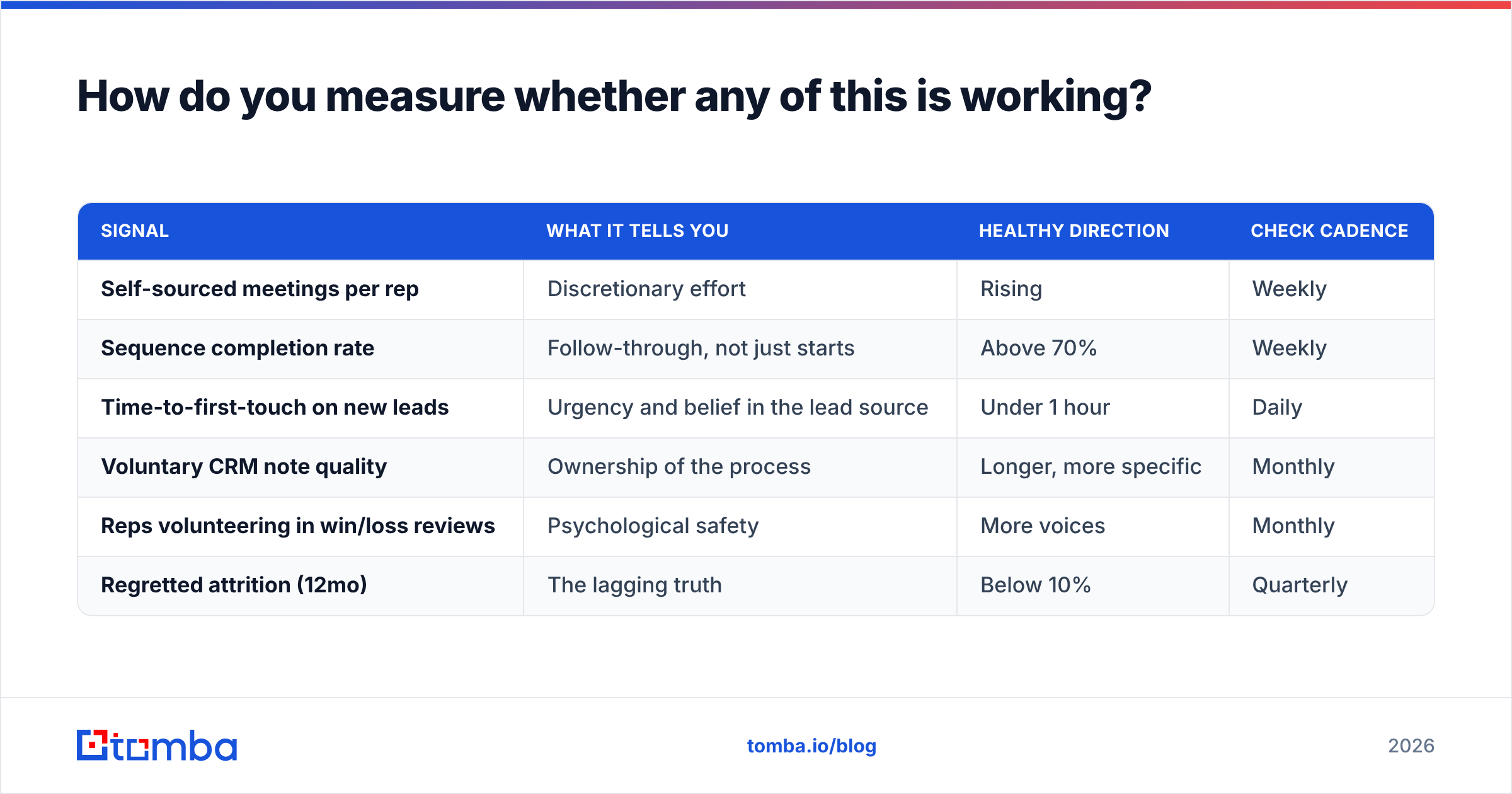
How do you measure whether any of this is working?#
Don't survey for "morale." Measure the behaviors inspiration produces.
| Signal | What it tells you | Healthy direction | Check cadence |
|---|---|---|---|
| Self-sourced meetings per rep | Discretionary effort | Rising | Weekly |
| Sequence completion rate | Follow-through, not just starts | Above 70% | Weekly |
| Time-to-first-touch on new leads | Urgency and belief in the lead source | Under 1 hour | Daily |
| Voluntary CRM note quality | Ownership of the process | Longer, more specific | Monthly |
| Reps volunteering in win/loss reviews | Psychological safety | More voices | Monthly |
| Regretted attrition (12mo) | The lagging truth | Below 10% | Quarterly |
If self-sourced meetings drop while total activity stays flat, reps are going through the motions — they're doing the minimum logged activity without discretionary effort. That's your earliest warning, usually visible four to six weeks before it shows in revenue.
Where should you start this week?#
Pick one layer and fix it properly rather than doing a thin version of all four.
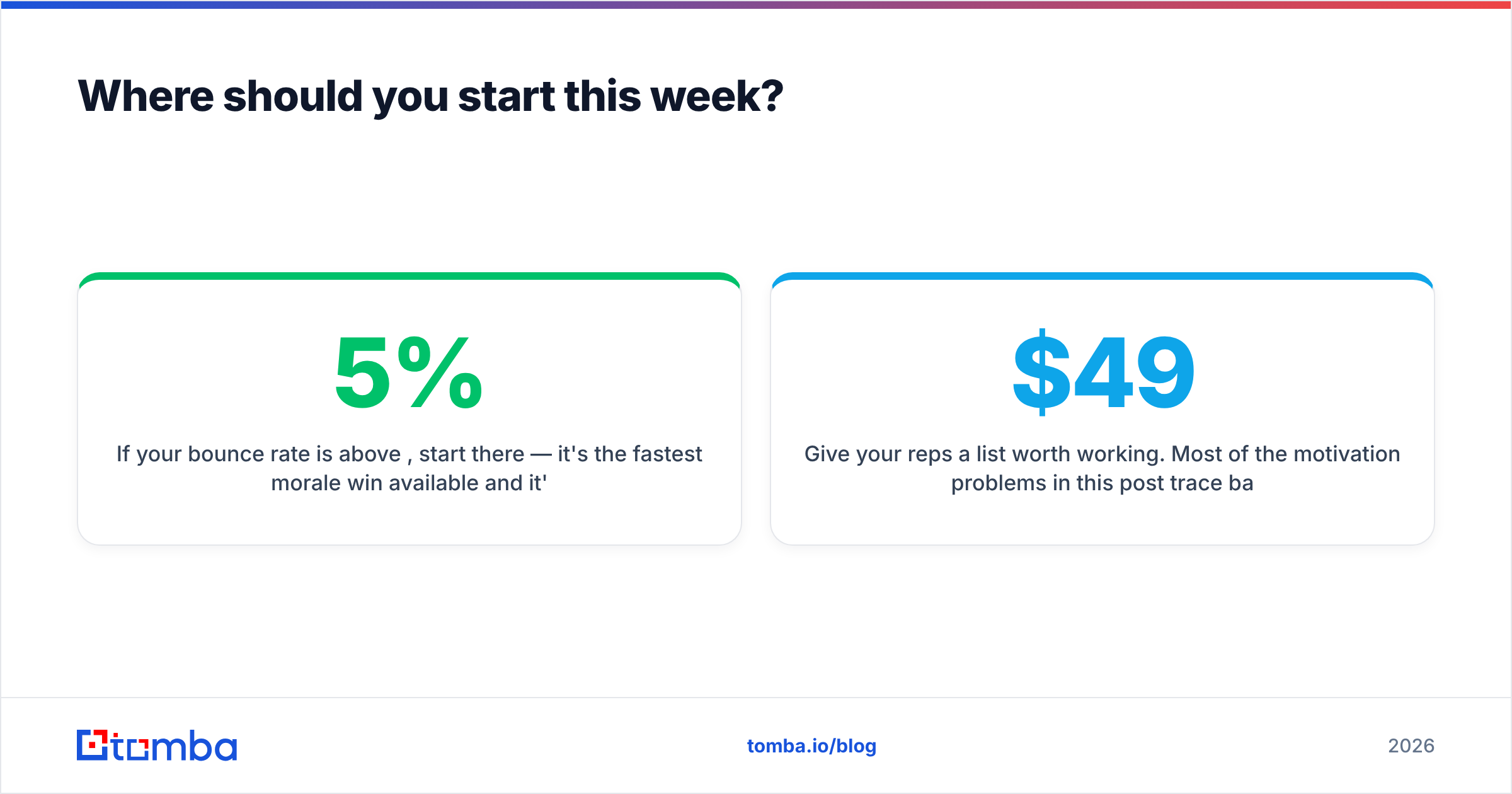
If your bounce rate is above 5%, start there — it's the fastest morale win available and it's mechanical, not emotional. If your data is clean and reps still look flat, go to deal-review 1:1s and check whether the manager is talking more than the rep. If both are healthy, look hard at quota credibility.
And be honest about the diagnosis. A team that is under-resourced on data and over-managed on activity will not be rescued by enthusiasm. Reps are pattern-matchers by trade. They can tell the difference between a leader who fixed the machine and one who bought pizza.
Give your reps a list worth working. Most of the motivation problems in this post trace back to effort that never reached a human. The Tomba Email Finder gives your team verified professional email addresses by name, company, or domain — so sequences land, replies come back, and reps see the feedback loop that actually creates momentum. Start free with 25 searches a month, or check Tomba pricing — Starter is $49/mo, Growth $99/mo, and Pro $249/mo for teams running volume. Fix the inputs, and the inspiration takes care of itself.
Related guides#
// get started
Find, verify and enrich your first contacts today
Start on the free plan with 25 searches a month, then scale when your team is ready.
Free plan · No credit card required · GDPR & CCPA
Get the Tomba newsletter
Product and data updates
// about the author