Instead of Saying Just Checking In: 12 Lines That Work
"Just checking in" tells the buyer you have nothing new to say. Here are 12 replacement follow-up lines, mapped to deal stage, plus the cadence and data hygiene that make them land.
TL;DR
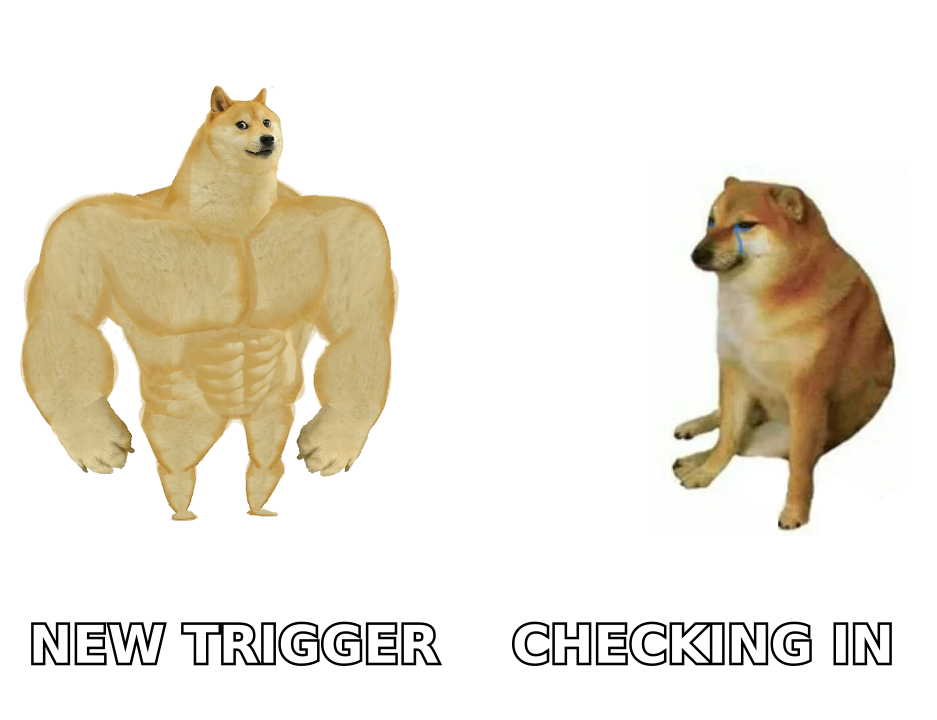
- "Just checking in" fails because it asks the buyer to do the work of remembering why they cared. It carries zero new information.
- Every follow-up needs one of four things: new information, a new angle, a decision-forcing question, or a clean exit.
- The 12 replacement lines below are mapped to deal stage — discovery ghost, post-demo silence, procurement stall, closed-lost revival.
- Cadence matters as much as copy: 4–7 touches over 18–24 days beats 12 touches in a week.
- None of it works if the email never arrives. Verify addresses before you send, or your "better line" bounces into a spam folder.
You already know the feeling. Fourth email in a thread, no reply since the demo, and your fingers type the same six words they always type. The reason you want a script for what to say instead of saying just checking in is that you already suspect the phrase is doing nothing — and you're right. It's not rude, it's not spammy, it's just empty. Empty is worse, because empty gets archived without a flicker of guilt.
This guide gives you the replacements, the logic behind each one, and the cadence to hang them on.
Why does "just checking in" actually fail?#
Three reasons, and none of them are about politeness.
It transfers work to the buyer. "Just checking in" means: please reconstruct the context of our last conversation, re-derive why it mattered, and then reply to me. That's three cognitive tasks in exchange for zero new value. Buyers don't do unpaid labor for vendors.
It signals you have nothing. If you had a case study, a pricing change, a relevant funding announcement, or a competitor teardown, you'd have led with it. Sending a contentless nudge is an admission that nothing has changed on your side. The subtext is "I need something from you," which is the weakest possible opening position.
It doesn't create a decision point. A good follow-up either moves the deal forward or kills it cleanly. "Just checking in" can be ignored at no cost, which means it will be. HubSpot's sales blog has documented for years that follow-ups without a specific ask underperform ones with a single clear next step — the pattern is stable across industries.
There's a fourth, subtler problem: repetition. By the third "just checking in," you've trained the recipient to pattern-match your sender name to "no content." That's a reputation cost inside one inbox, and it's cumulative across your whole list.
What is a follow-up email actually supposed to do?#
Think of a follow-up like a knock on a door you've already been invited through once. You don't knock to ask "are you still in there?" You knock because you brought something.
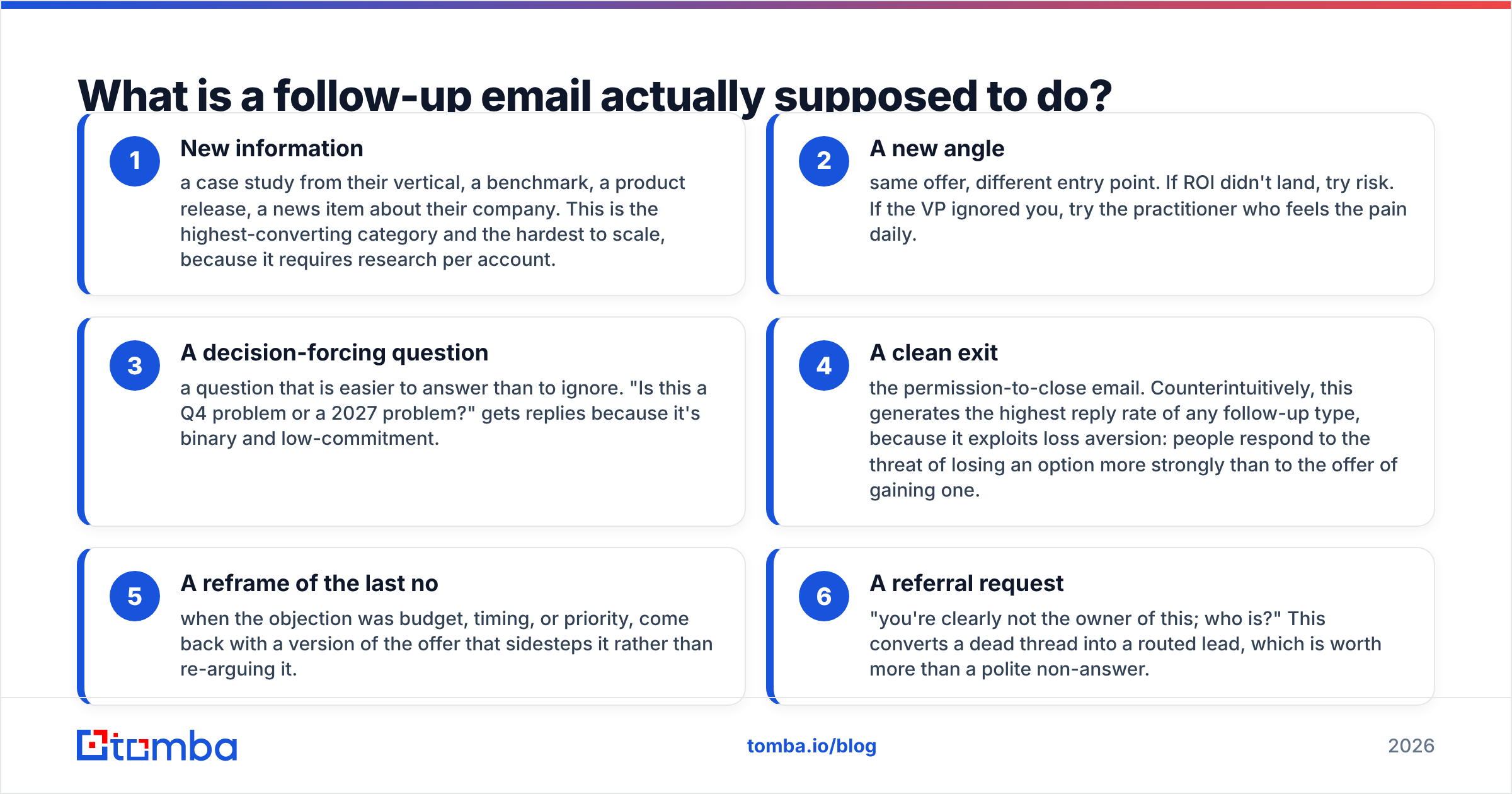
Every follow-up you send should carry exactly one of these payloads:
- New information — a case study from their vertical, a benchmark, a product release, a news item about their company. This is the highest-converting category and the hardest to scale, because it requires research per account.
- A new angle — same offer, different entry point. If ROI didn't land, try risk. If the VP ignored you, try the practitioner who feels the pain daily.
- A decision-forcing question — a question that is easier to answer than to ignore. "Is this a Q4 problem or a 2027 problem?" gets replies because it's binary and low-commitment.
- A clean exit — the permission-to-close email. Counterintuitively, this generates the highest reply rate of any follow-up type, because it exploits loss aversion: people respond to the threat of losing an option more strongly than to the offer of gaining one.
- A reframe of the last no — when the objection was budget, timing, or priority, come back with a version of the offer that sidesteps it rather than re-arguing it.
- A referral request — "you're clearly not the owner of this; who is?" This converts a dead thread into a routed lead, which is worth more than a polite non-answer.
If your draft doesn't contain one of those six, don't send it. Wait until it does. A follow-up that skips a beat and arrives three days later with substance beats one that arrives on schedule with nothing.
What should you say instead of saying just checking in?#
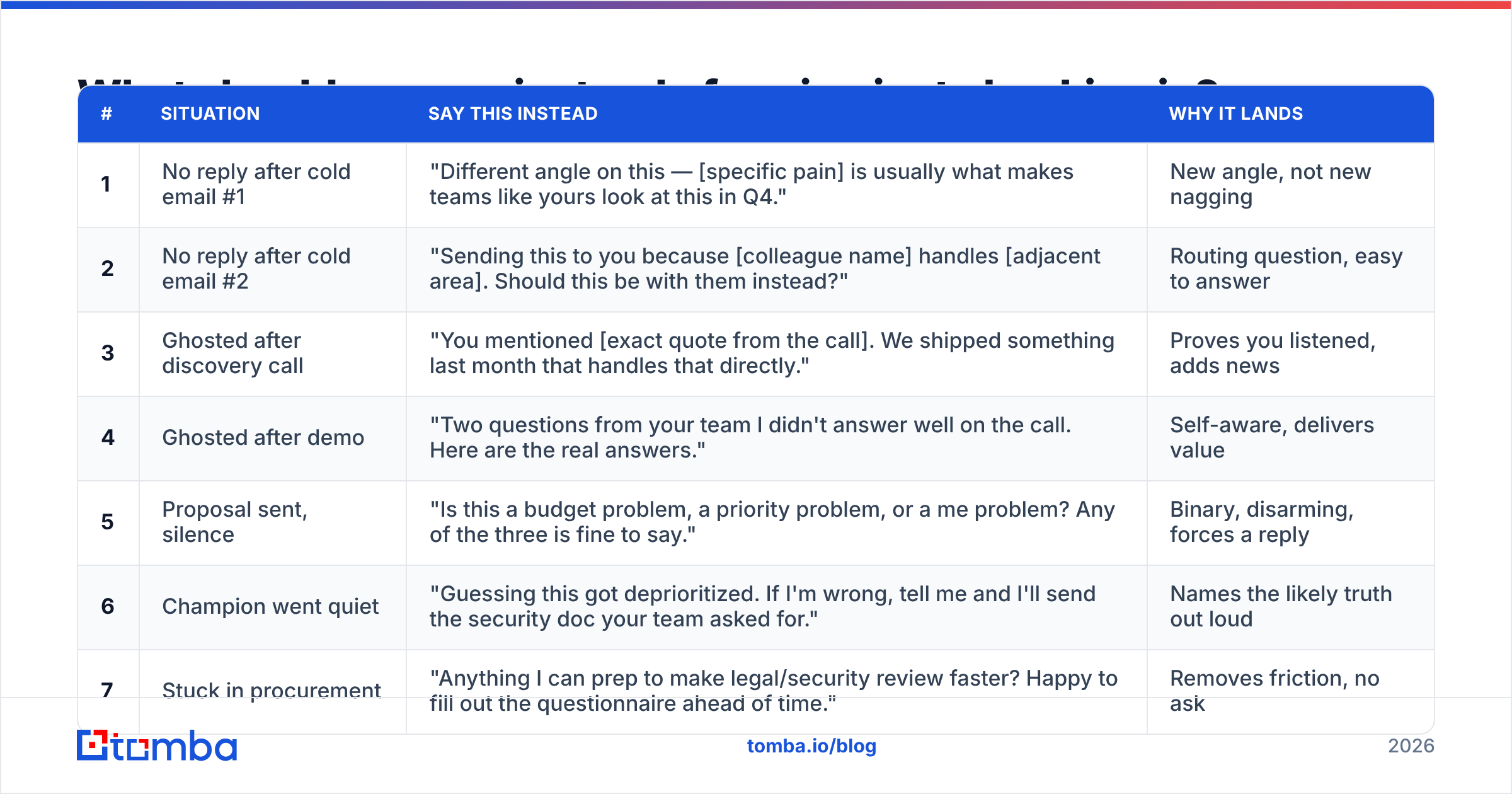
Here are the 12 lines, mapped to the situation where each one actually belongs. Use them as openers, not full emails — each still needs one sentence of context and one clear ask.
| # | Situation | Say this instead | Why it lands |
|---|---|---|---|
| 1 | No reply after cold email #1 | "Different angle on this — [specific pain] is usually what makes teams like yours look at this in Q4." | New angle, not new nagging |
| 2 | No reply after cold email #2 | "Sending this to you because [colleague name] handles [adjacent area]. Should this be with them instead?" | Routing question, easy to answer |
| 3 | Ghosted after discovery call | "You mentioned [exact quote from the call]. We shipped something last month that handles that directly." | Proves you listened, adds news |
| 4 | Ghosted after demo | "Two questions from your team I didn't answer well on the call. Here are the real answers." | Self-aware, delivers value |
| 5 | Proposal sent, silence | "Is this a budget problem, a priority problem, or a me problem? Any of the three is fine to say." | Binary, disarming, forces a reply |
| 6 | Champion went quiet | "Guessing this got deprioritized. If I'm wrong, tell me and I'll send the security doc your team asked for." | Names the likely truth out loud |
| 7 | Stuck in procurement | "Anything I can prep to make legal/security review faster? Happy to fill out the questionnaire ahead of time." | Removes friction, no ask |
| 8 | Timing objection ("not now") | "Putting this down until [specific month]. One thing before I do: [single relevant data point]." | Respects the no, leaves value |
| 9 | Price objection | "Assume the number is fixed. What would the deal need to look like at that number for it to be obvious?" | Reframes instead of discounting |
| 10 | Long-dormant closed-lost | "You went with [competitor] last year. Most teams hit [specific limitation] around month 9 — is that showing up?" | Time-based trigger, specific |
| 11 | Final touch before close-out | "I'll stop here unless you say otherwise. Want me to close the file or check back in [month]?" | Clean exit, loss aversion |
| 12 | Post-close-out revival | "Your team just [hired a X / launched Y / raised Z]. That usually changes the math on this." | Genuine trigger event |
Notice what none of them do: none apologize for following up, none say "circling back," and none ask "did you get my last email?" Apologizing frames your outreach as an imposition. "Did you get my email" is a question you already know the answer to.
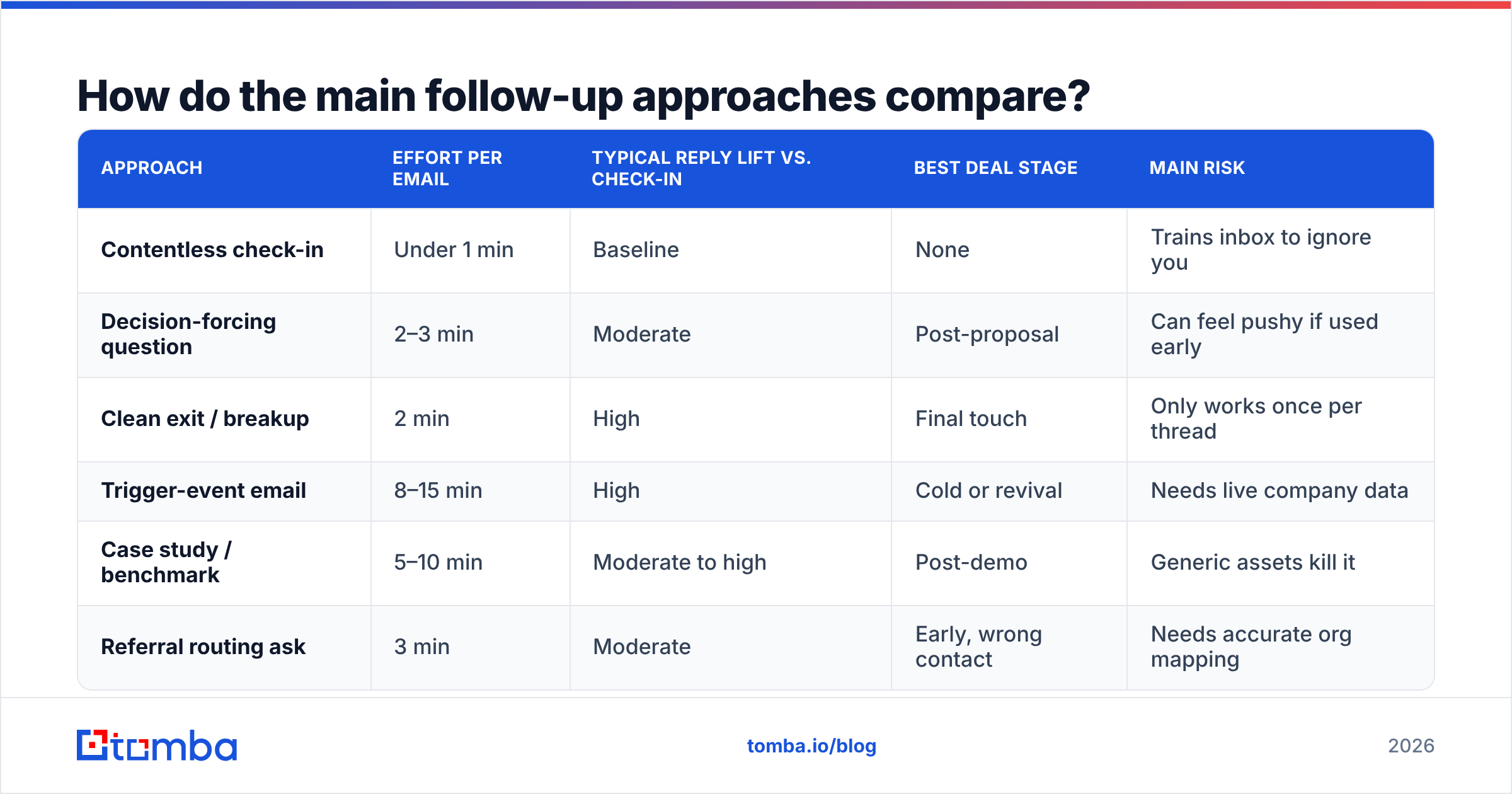
How do the main follow-up approaches compare?#
Not every replacement carries the same cost or the same payoff. If you're deciding where to spend research time, this is the trade-off:
| Approach | Effort per email | Typical reply lift vs. check-in | Best deal stage | Main risk |
|---|---|---|---|---|
| Contentless check-in | Under 1 min | Baseline | None | Trains inbox to ignore you |
| Decision-forcing question | 2–3 min | Moderate | Post-proposal | Can feel pushy if used early |
| Clean exit / breakup | 2 min | High | Final touch | Only works once per thread |
| Trigger-event email | 8–15 min | High | Cold or revival | Needs live company data |
| Case study / benchmark | 5–10 min | Moderate to high | Post-demo | Generic assets kill it |
| Referral routing ask | 3 min | Moderate | Early, wrong contact | Needs accurate org mapping |
The honest read: the clean exit and the trigger-event email are the two highest-leverage plays. The breakup costs almost nothing and converts well. The trigger-event email costs real research time, which is why most teams skip it and default back to the empty nudge.
If you need starting structures rather than single lines, the cold email templates library covers the full sequence shape, and a subject line tester helps you avoid the other silent killer — a follow-up subject line that reads like an automated reminder.
How many follow-ups should you send, and how far apart?#
Cadence is where most teams overcorrect. They fix the copy and then send seven improved emails in nine days, which reads as desperation regardless of content quality.
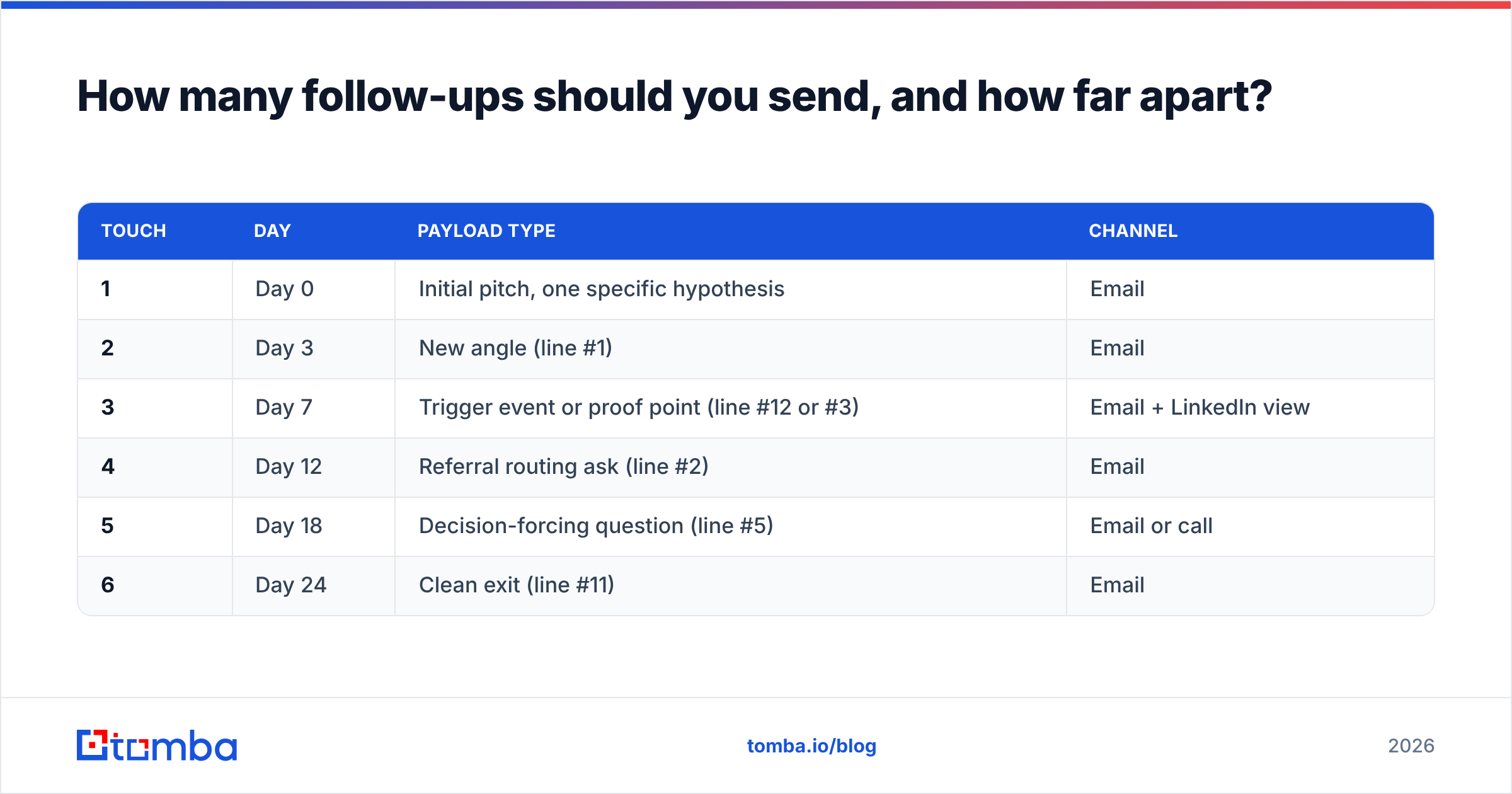
A cadence that holds up across B2B segments:
| Touch | Day | Payload type | Channel |
|---|---|---|---|
| 1 | Day 0 | Initial pitch, one specific hypothesis | |
| 2 | Day 3 | New angle (line #1) | |
| 3 | Day 7 | Trigger event or proof point (line #12 or #3) | Email + LinkedIn view |
| 4 | Day 12 | Referral routing ask (line #2) | |
| 5 | Day 18 | Decision-forcing question (line #5) | Email or call |
| 6 | Day 24 | Clean exit (line #11) |
Six touches, 24 days, every one carrying something. Then stop. Add the account to a 90-day revival list and come back with line #10 or #12 when there's an actual reason to.
Two adjustments worth making. First, if you're selling to engineering or security buyers, stretch the gaps — day 0/5/12/21/35. Those roles batch email and punish frequency. Second, if a prospect opens five times and never replies, treat that as interest without authority and switch to line #2 rather than escalating pressure on the same person.
Reply rate is the metric to watch here, not open rate. Open tracking has been unreliable since Apple Mail Privacy Protection landed, and the whole point of replacing a check-in is to change response rate, which is the only number that survives those changes.
Does better copy matter if your data is wrong?#
No. This is the part most "stop saying just checking in" advice skips.
A follow-up sequence has three failure points, and copy is the third one. The first is whether the address resolves at all. The second is whether the address belongs to the person who can actually decide. Fix those and mediocre copy still gets replies. Leave them broken and line #5 bounces off a catch-all domain that swallows mail silently.
Concretely, before you run any sequence:
- Verify the list. A bounce rate above roughly 3% starts dragging your sender reputation down, and reputation damage is slow to repair. Run the list through an email verifier first.
- Check catch-all domains separately. Catch-all servers accept everything, so a standard verification returns "valid" for addresses that don't exist. A dedicated catch-all verifier distinguishes real mailboxes from black holes.
- Confirm you have the right role, not just a real person. Line #2 — the referral routing ask — exists because most stalled threads are not rejection, they're a contact who has no authority and is too polite to say so.
- Re-verify quarterly. B2B contact data decays at roughly 2–2.5% per month through job changes alone. A list you verified in January is meaningfully wrong by June.
Peer review sites like G2 are a reasonable place to compare verification vendors if you want to benchmark before committing, though be aware that accuracy claims in that category are self-reported far more often than independently audited.
What are the common mistakes people make when replacing the line?#
Replacing one filler phrase with another. "Circling back," "touching base," "bumping this to the top of your inbox," and "wanted to float this again" are the same email with different costumes. If the payload is empty, the wrapper doesn't matter.
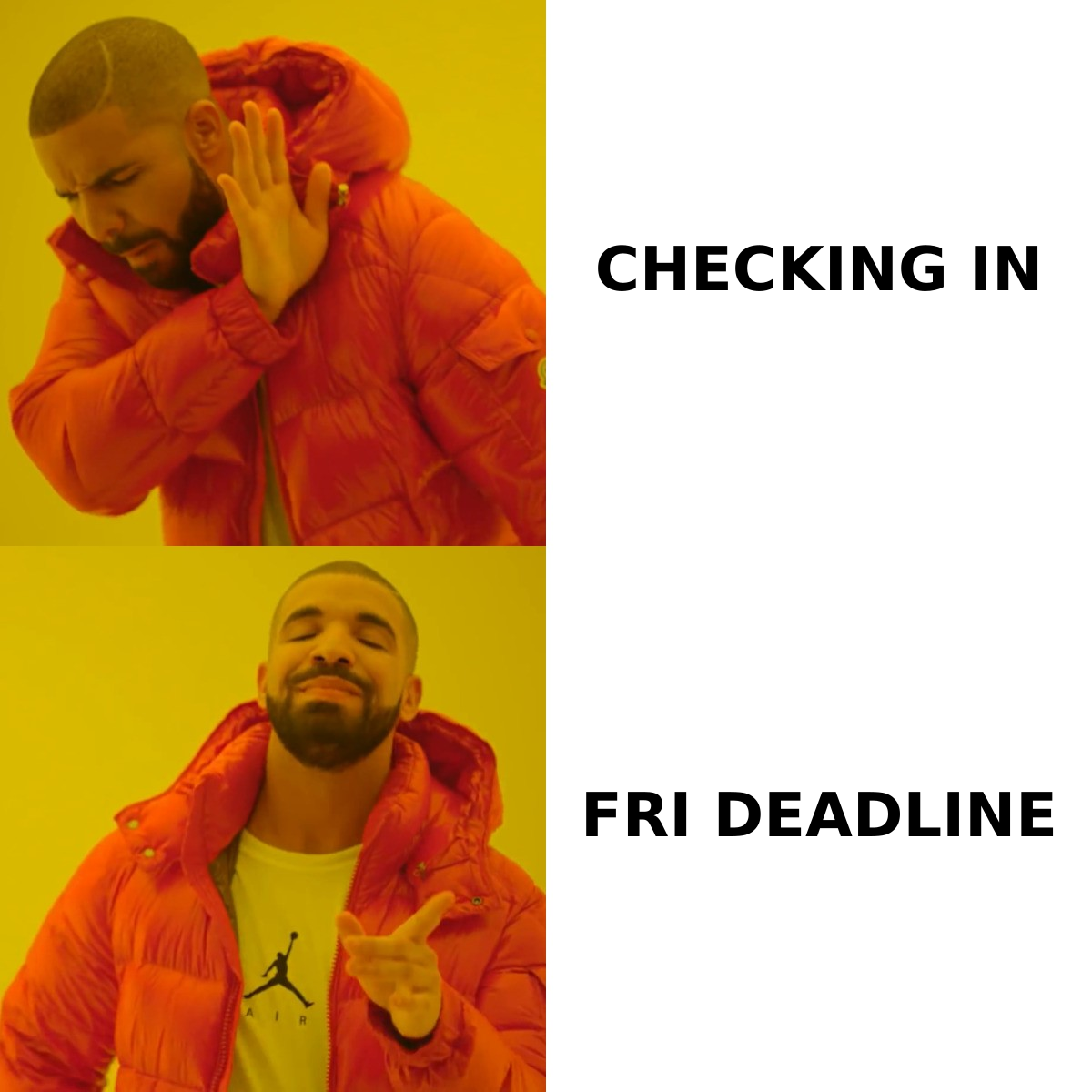
Fake urgency. "Our pricing changes Friday" works exactly once, and only if it's true. Made-up deadlines are the fastest way to convert a warm prospect into a permanent unsubscribe.
Over-personalizing the wrong detail. Mentioning that you saw their marathon photo is not research, it's surveillance. Mention their hiring pattern, their tech stack, their funding, their product launch — things that change what they need to buy.
Sending the breakup email too early. Line #11 is a finisher. Deploy it on touch three and you've closed a deal that was still alive.
Treating silence as rejection. Most non-replies are queue problems, not verdicts. That's why the cadence above spreads across 24 days instead of nine — you're waiting for the week where your email lands on a day they have slack.
Where should you start tomorrow?#
Pick your three oldest stalled threads. Send line #11 — the clean exit — to all three today. You'll get at least one reply, and it will tell you more about the deal than four more check-ins would have.
Then rebuild your sequence around the six-touch cadence, with one payload type assigned per touch. Write the payload first and the wording second. If you can't name the payload, skip the send.
And before any of it ships, make sure the addresses are real and the contacts are the right ones. The Tomba Email Finder resolves verified professional addresses by name and domain so your rewritten follow-ups reach an actual mailbox instead of dying at the gateway. The free tier covers 25 searches a month if you want to test it on a small list; paid plans start at $49/mo on Starter, with full Tomba pricing laid out if you're scaling a full outbound motion. Better lines deserve a better list.
Related guides#
// get started
Find, verify and enrich your first contacts today
Start on the free plan with 25 searches a month, then scale when your team is ready.
Free plan · No credit card required · GDPR & CCPA
// about the author