Insurance Sales Scripts That Actually Close Deals in 2026
Most insurance sales scripts fail because they were written for a buyer who no longer answers the phone. Here are the frameworks, objection handlers, and data workflows that still convert in 2026.
TL;DR
- A script is not a word-for-word recital. It is a decision tree: opener, permission, discovery, objection branch, close. Memorize the branches, not the sentences.
- The single biggest driver of insurance call performance in 2026 is not phrasing — it is list quality. Wrong number, wrong person, wrong life stage kills more calls than a clumsy opener ever will.
- Permission-based openers ("Did I catch you at a bad time?") outperform value-dump openers because they respect the one thing the prospect actually controls: whether to keep listening.
- Objections in insurance cluster into five buckets — price, timing, incumbent agent, trust, and spouse/partner. Five handlers cover roughly 90% of live calls.
- Multi-channel beats phone-only. Pairing a dial with a verified email and a LinkedIn touch lifts connect-to-conversation rates substantially versus dialing alone.
Why do most insurance sales scripts fail before the second sentence?#
Because they solve the wrong problem. Most scripts obsess over the pitch and ignore the setup — who you called, whether that number belongs to them, whether the timing makes any sense for the product.
Think of it like a restaurant. You can have the best menu in the city, but if the host seats someone who came in for coffee at a twelve-course tasting table, the meal fails before the first course. Your script is the menu. Your list is the host.
Three structural failures show up repeatedly in call reviews:
- The script assumes attention it hasn't earned. Opening with "I'm calling about your life insurance needs" presumes the prospect agreed to a conversation. They didn't. They answered a ringing phone.
- It's written for one persona but used on five. A commercial P&C script does not survive contact with a 34-year-old shopping term life. Same product family, entirely different fear.
- It has no branch for "no." A linear script breaks the moment the prospect deviates. A decision-tree script expects deviation and routes it.
The fix is structural, not cosmetic. Rewrite your script as a tree with four named nodes — Open, Permission, Discover, Advance — and write two to three variants for each node depending on how the prospect responds. You stop reading and start navigating.

What does a high-converting insurance cold call script look like in 2026?#
Here is the skeleton. Adapt the language to your voice — the structure is what matters.
1. Open (5 seconds). State your name, your company, and why this specific person.
"Hi Maria, this is Dan with Northbridge. I'm calling because you requested a quote comparison on your homeowners policy about a week ago — is that still on your radar?"
If it's genuinely cold, swap the trigger for something verifiable: a renewal window, a life event, a business milestone.
2. Permission (5 seconds). Ask for the time instead of taking it.
"Did I catch you in the middle of something?"
Counterintuitively, giving the prospect an easy exit lowers their defenses. If they say "kind of," you book a callback — which is a meeting, not a rejection.
3. Discover (90 seconds). Two or three questions, maximum. Not a needs analysis. You are qualifying for fit, not underwriting on the phone.
"Quick question so I don't waste your time — are you currently insured through an agent, or did you buy direct?"
"And is the main thing you're trying to solve premium cost, or coverage gaps?"
4. Advance (20 seconds). Never close the sale on a first call for anything with underwriting. Close the next step.
"Here's what I'd suggest. Give me fifteen minutes Thursday, I'll pull three comparable quotes against your current declarations page, and if nothing beats what you have, I'll tell you that straight and we're done. Does Thursday at 10 or Friday at 2 work better?"
Total runtime: roughly two minutes. That's the point. The call's job is to earn the second call.
What changes for life, health, and commercial lines?#
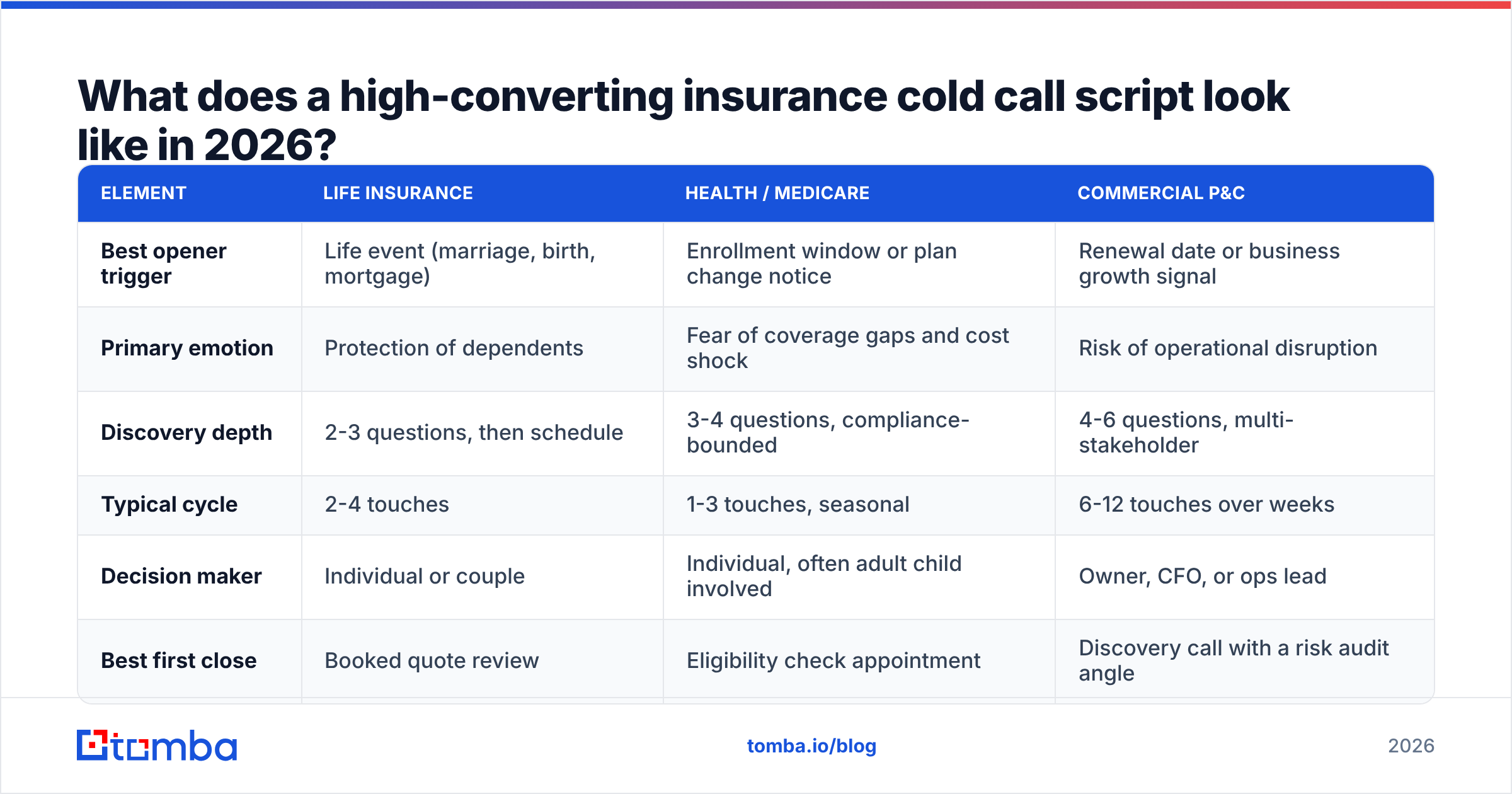
| Element | Life insurance | Health / Medicare | Commercial P&C |
|---|---|---|---|
| Best opener trigger | Life event (marriage, birth, mortgage) | Enrollment window or plan change notice | Renewal date or business growth signal |
| Primary emotion | Protection of dependents | Fear of coverage gaps and cost shock | Risk of operational disruption |
| Discovery depth | 2-3 questions, then schedule | 3-4 questions, compliance-bounded | 4-6 questions, multi-stakeholder |
| Typical cycle | 2-4 touches | 1-3 touches, seasonal | 6-12 touches over weeks |
| Decision maker | Individual or couple | Individual, often adult child involved | Owner, CFO, or ops lead |
| Best first close | Booked quote review | Eligibility check appointment | Discovery call with a risk audit angle |
The mistake agents make is running the life script on commercial prospects. Commercial buyers are procuring, not confessing. They want competence and a clear process; they do not want emotional discovery about their family.
How do you handle the five objections that actually come up?#
Objection handling is where scripts earn their keep, because this is where reps freeze. Learn five patterns and you're covered for most of what a day of dialing throws at you.
"It's too expensive." Don't defend price. Separate price from cost.
"That's fair — compared to what you're paying now, or compared to what you budgeted? Because those lead to different recommendations."
"I already have an agent." Never attack the incumbent. You attack the incumbent, you attack the prospect's judgment.
"Good — most people I talk to who are happy with their agent haven't had a full policy review in three or four years. Rates moved a lot in that window. If I look and yours is still competitive, I'll tell you so."
"Now isn't a good time." Treat as scheduling, not rejection.
"Totally understood. Is it a this-week thing or a this-quarter thing? I'd rather call you when it's useful than keep bothering you."
"Send me some information." The polite brush-off. Convert it to a micro-commitment.
"Happy to. So I send something relevant instead of a generic brochure — are you more concerned about the premium or the coverage limits? I'll send just that piece and follow up Tuesday."
"I need to talk to my spouse." This is real, and it's usually true. Don't fight it — include them.
"Absolutely, that's the right call. Would it be easier if we did the next fifteen minutes with both of you on? That way you're not stuck relaying numbers second-hand."
Notice the shape of every handler: acknowledge, reframe, ask a question. Never acknowledge-then-pitch. The question keeps the prospect talking, and a talking prospect is not a hung-up prospect.
Why does data quality matter more than the script itself?#
Here's the uncomfortable math. If 30% of your list has a wrong number and another 20% has a stale email, half your dialing hours produce nothing regardless of what you say. No phrasing improvement recovers that.
This is the part of the insurance sales process that gets the least attention and produces the most upside. Before a single dial, your list should pass three checks:
- Contact validity. Is the phone number live and attached to the right person? A phone validator flags disconnected lines and line type before you burn a dialer slot on them.
- Email deliverability. Your follow-up is worthless if it bounces. Running the list through an email verifier before the sequence protects your sender reputation and keeps your follow-ups landing in the inbox.
- Role and company fit. For commercial lines especially, you need the actual decision maker, not the general info@ address. Domain search pulls the named contacts at a target business so you're not guessing at gatekeepers.
Agents often treat this as back-office work. It isn't — it's the highest-leverage hour in your week. Fifteen minutes of list hygiene can return several hours of productive talk time.
For outbound follow-up specifically, pair the dial with email. According to HubSpot's sales research, multi-touch, multi-channel sequences consistently outperform single-channel outreach, and buyers increasingly expect to be reachable on their terms rather than yours. A voicemail plus a two-line email the same afternoon roughly doubles your odds of a response compared to the voicemail alone.
How do phone scripts compare to email and LinkedIn for insurance prospecting?#
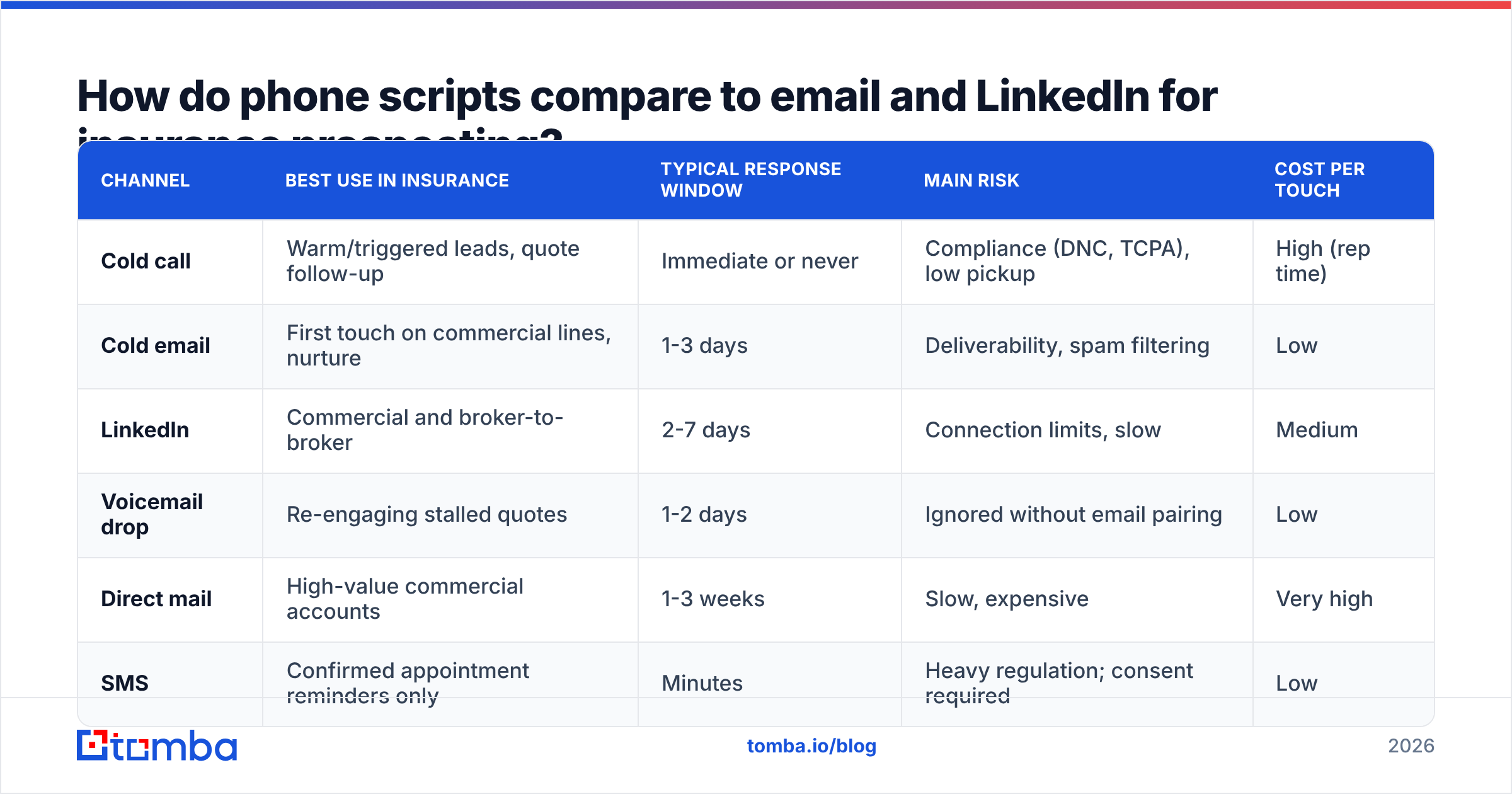
Each channel does a different job. The error is expecting one channel to do all three jobs.
| Channel | Best use in insurance | Typical response window | Main risk | Cost per touch |
|---|---|---|---|---|
| Cold call | Warm/triggered leads, quote follow-up | Immediate or never | Compliance (DNC, TCPA), low pickup | High (rep time) |
| Cold email | First touch on commercial lines, nurture | 1-3 days | Deliverability, spam filtering | Low |
| Commercial and broker-to-broker | 2-7 days | Connection limits, slow | Medium | |
| Voicemail drop | Re-engaging stalled quotes | 1-2 days | Ignored without email pairing | Low |
| Direct mail | High-value commercial accounts | 1-3 weeks | Slow, expensive | Very high |
| SMS | Confirmed appointment reminders only | Minutes | Heavy regulation; consent required | Low |
The practical stack for most agencies: LinkedIn or email opens the door on commercial, phone closes it. For personal lines driven by inbound quote requests, phone first and fast — speed-to-lead dominates everything else, and the advantage decays within minutes, not hours.
Be careful with SMS. In the US, insurance texting sits under TCPA and state rules, and consent requirements are strict. Use it for confirmations with people who have already opted in, and keep prospecting off that channel unless your compliance team has explicitly cleared it.
What should an insurance sales script never do?#
A short list of things that reliably tank calls, drawn from what actually happens on recorded lines:
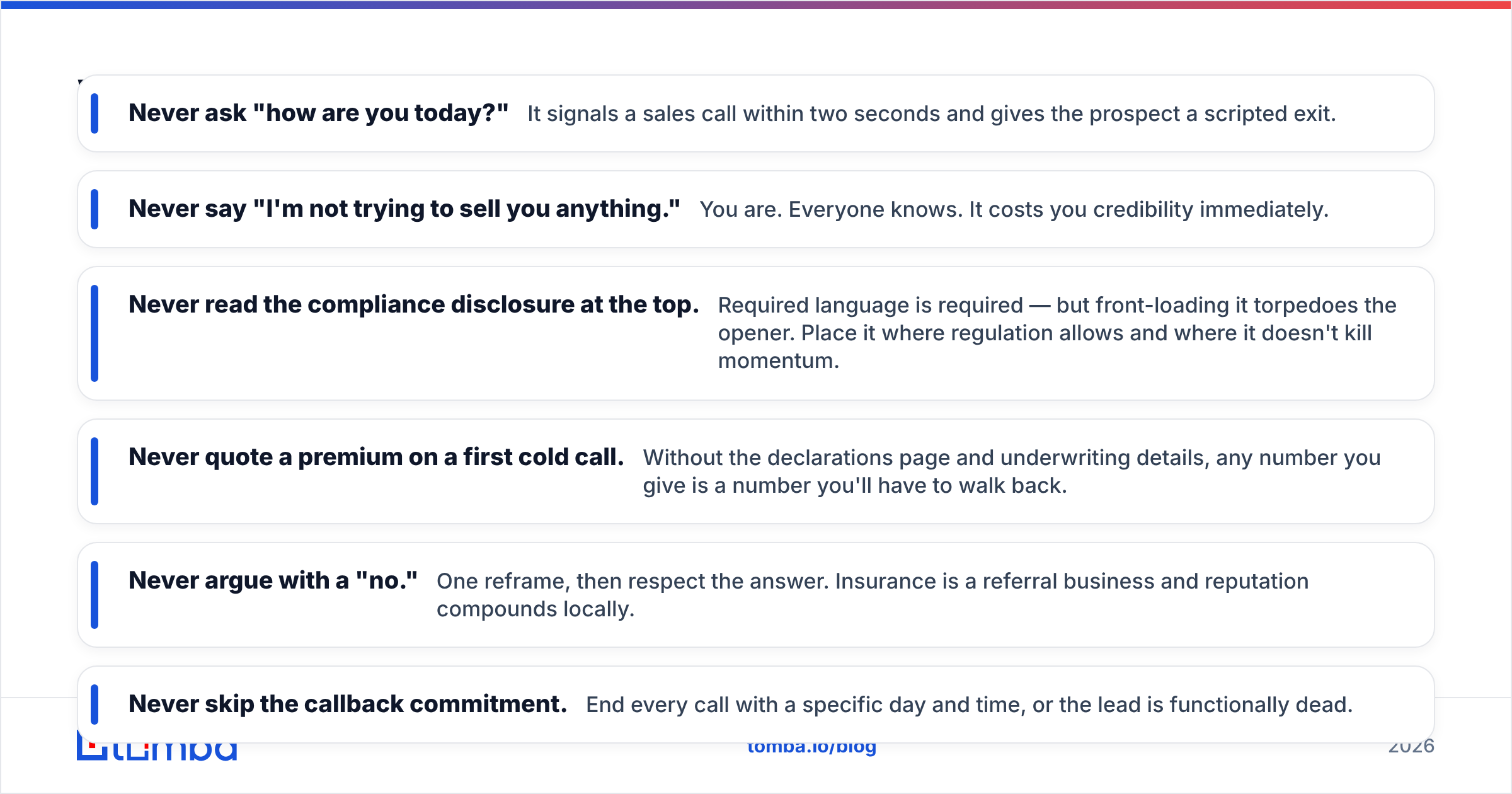
- Never ask "how are you today?" It signals a sales call within two seconds and gives the prospect a scripted exit.
- Never say "I'm not trying to sell you anything." You are. Everyone knows. It costs you credibility immediately.
- Never read the compliance disclosure at the top. Required language is required — but front-loading it torpedoes the opener. Place it where regulation allows and where it doesn't kill momentum.
- Never quote a premium on a first cold call. Without the declarations page and underwriting details, any number you give is a number you'll have to walk back.
- Never argue with a "no." One reframe, then respect the answer. Insurance is a referral business and reputation compounds locally.
- Never skip the callback commitment. End every call with a specific day and time, or the lead is functionally dead.
One more: don't confuse a script with a call. Prospects can hear reading. Practice until the branches are muscle memory, then talk like a person who happens to know where the conversation is going.
How do you build and test a script that keeps improving?#
Treat it like software. Version it, ship it, measure it, revise it.
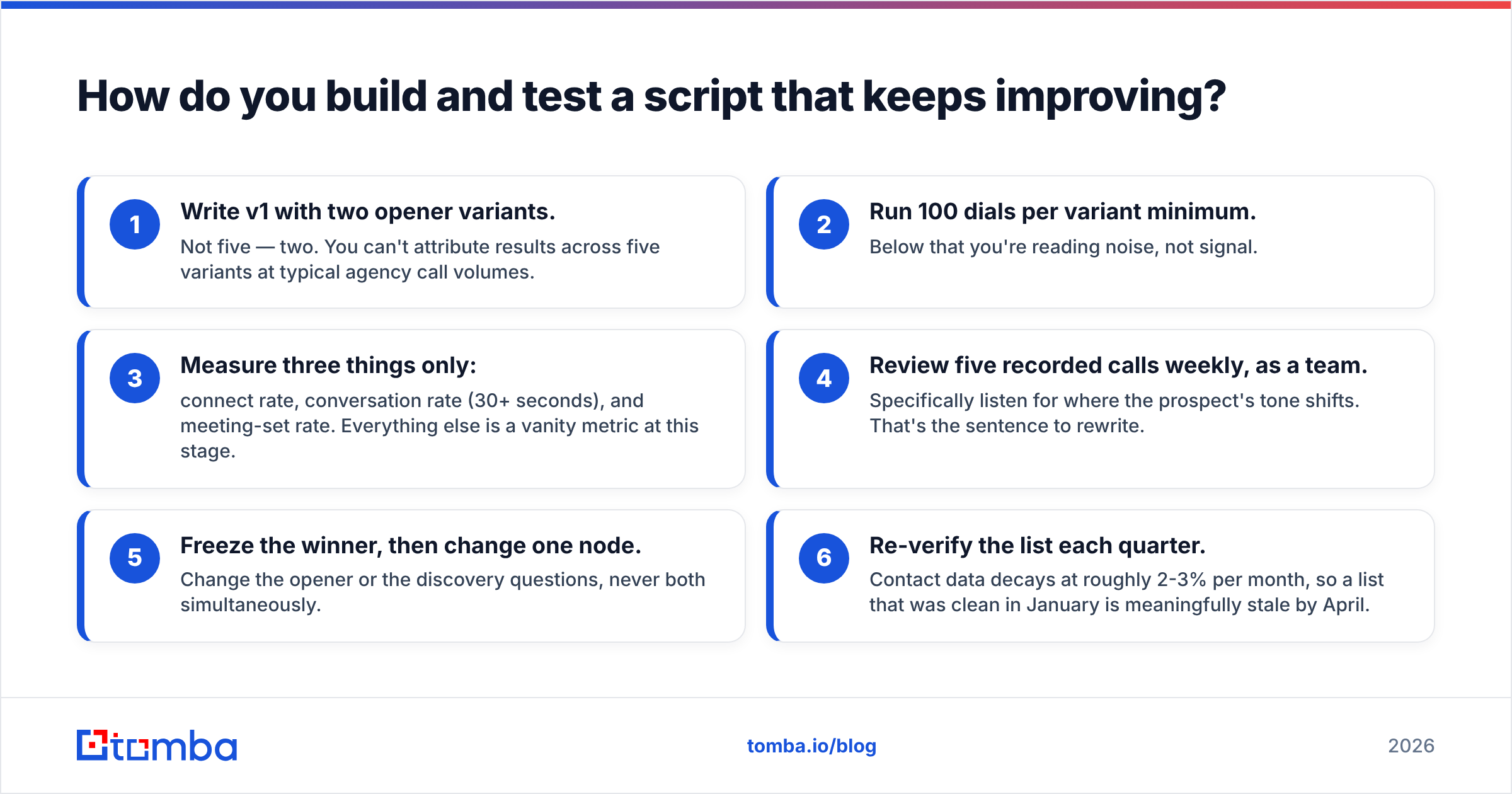
- Write v1 with two opener variants. Not five — two. You can't attribute results across five variants at typical agency call volumes.
- Run 100 dials per variant minimum. Below that you're reading noise, not signal.
- Measure three things only: connect rate, conversation rate (30+ seconds), and meeting-set rate. Everything else is a vanity metric at this stage.
- Review five recorded calls weekly, as a team. Specifically listen for where the prospect's tone shifts. That's the sentence to rewrite.
- Freeze the winner, then change one node. Change the opener or the discovery questions, never both simultaneously.
- Re-verify the list each quarter. Contact data decays at roughly 2-3% per month, so a list that was clean in January is meaningfully stale by April.
Tracking your response rate per variant is what turns script writing from opinion into a process. Most agencies argue about wording in meetings; the ones that grow run the test and let the dial log settle it.
For the research half of the job, plug enrichment into your CRM rather than doing it manually per record. Contact enrichment fills in title, company size, and industry so your commercial script can reference something real in the opener — and a real reference in the first five seconds is worth more than any clever phrasing that follows. Vendors like BookYourData also offer prebuilt B2B lists if you'd rather buy targeting than build it, which can be a reasonable shortcut when you're entering a new vertical cold.
If you want a broader benchmark of how agencies structure their outbound motion, G2's sales software category is a decent starting point for tool comparisons across dialers, sequencers, and data providers.
Where should you start this week?#
Pick the smallest thing that changes outcomes: clean your list, then rewrite your opener. In that order.
Most agents do it backwards. They spend three weeks polishing language and dial the same stale list, then conclude cold calling is dead. It isn't dead — it's just unforgiving of bad inputs. A mediocre script on a verified, well-targeted list beats a brilliant script on a list full of disconnected numbers every single time.
If your commercial pipeline depends on reaching named decision makers at target businesses, the Tomba Email Finder gives you verified contacts by domain, name, or company so your calls and follow-ups land on the right person the first time. The free tier covers 25 searches a month if you want to test it against a handful of accounts before committing, and paid plans start at $49/mo — see Tomba pricing for the full breakdown. Clean the inputs, then run your script. That order is the whole game.
Related guides#
// get started
Find, verify and enrich your first contacts today
Start on the free plan with 25 searches a month, then scale when your team is ready.
Free plan · No credit card required · GDPR & CCPA
// about the author